

50+ Questions to Ask Customers When Selling a Product (And When to Ask Each One)
Every guide on questions to ask customers when selling a product gives you the same recycled list as if buyers haven't heard them a thousand times. "What keeps you up at night?" Really? The questions that actually move deals are the ones that make the buyer think - and they only land when you've earned the right to ask them and done the research to make them specific.
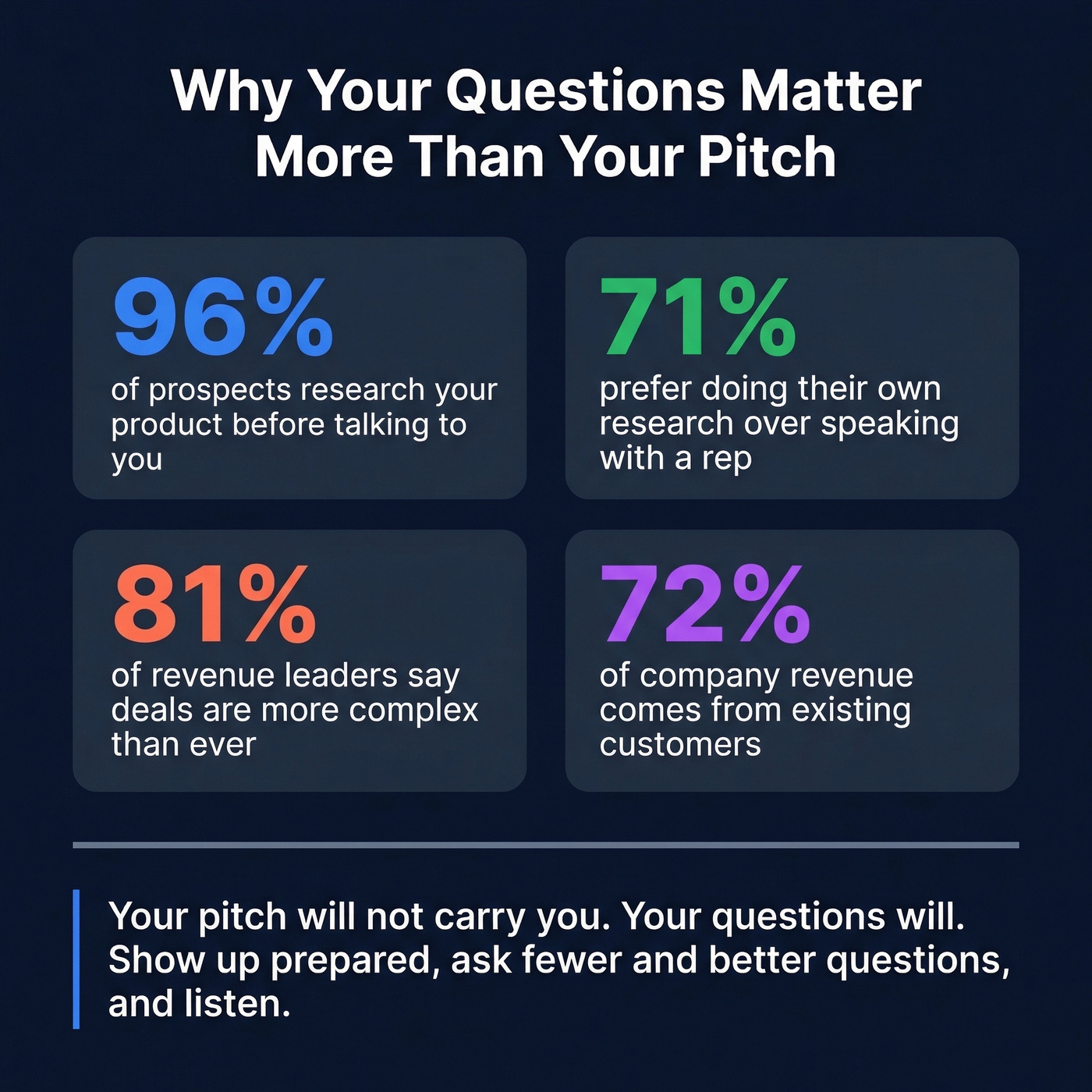
Here's the reality: 96% of prospects research your product before they ever talk to you, 71% prefer doing that research independently over speaking with a rep, and 81% of revenue leaders say deals are more complex than they've ever been. Your pitch isn't going to carry you. Your questions will.
What You Need (Quick Version)
- Learn one framework. SPIN works for most sellers. Add MEDDPICC if you're selling enterprise deals with multiple stakeholders.
- Pick 8-12 questions per call based on what you already know about the buyer. Don't show up with a 30-question script - that's an interrogation, not a conversation.
- Prepare before every call. Research the prospect's company, role, and recent activity so your questions add value beyond what they could find themselves.
The Science Behind Better Sales Questions
Gong Labs analyzed discovery calls and found a pattern that separates top performers from everyone else: average reps frontload their questions early, then shift into pitch mode. Top performers spread questions evenly across the entire conversation.
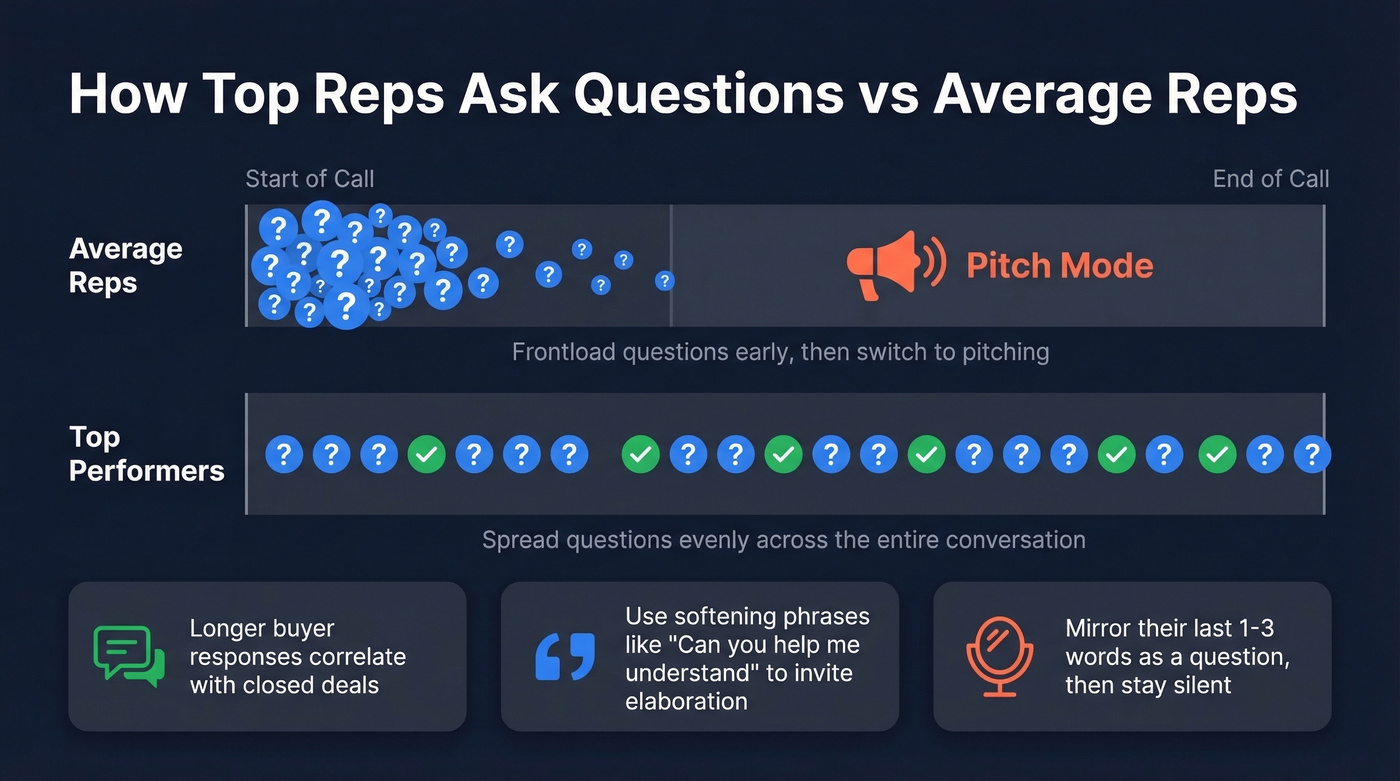
There's also a direct correlation between the length of buyer responses and deal outcomes. Longer, more detailed answers from prospects correlate with closed deals, which is exactly why open-ended sales questions consistently outperform closed-ended ones - they invite the kind of detailed responses that move deals forward. Phrasing matters as much as topic. "What's your biggest challenge?" gets a shorter answer than "Can you help me understand your biggest challenge?" That extra softening phrase invites elaboration.
One technique that's criminally underused: mirroring. Repeat the buyer's last one to three words as a question. They say "we're struggling with rep ramp time," you say "ramp time?" and then shut up. They'll keep talking and go deeper than any scripted follow-up would get them.
The takeaway isn't complicated. Ask fewer, better questions. Spread them out. Phrase them to invite long answers. Then listen.
Types of Sales Questions
Not all questions do the same job. RAIN Group's taxonomy breaks sales questions into three types, and understanding the difference changes how you sequence a conversation.
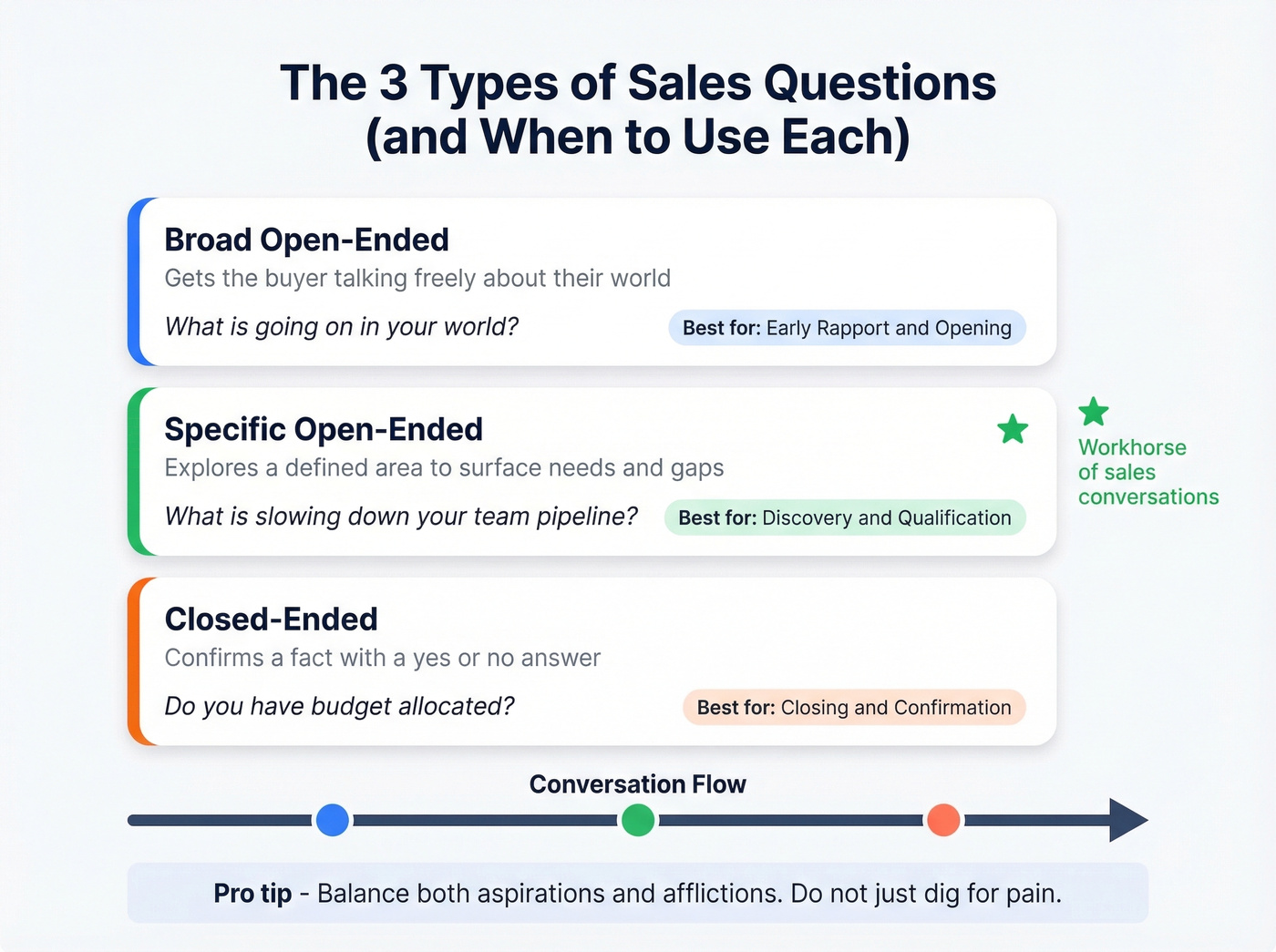
| Type | Definition | Example | When to Use |
|---|---|---|---|
| Broad open-ended | Gets the buyer talking freely | "What's going on in your world?" | Early rapport, opening |
| Specific open-ended | Explores a defined area | "What's slowing down your team's pipeline?" | Discovery, qualification |
| Closed-ended | Confirms a fact (yes/no) | "Do you have budget allocated?" | Closing, confirmation |
Specific open-ended questions are the workhorses of any sales conversation. They can surface an active need, reveal that the buyer doesn't perceive a need yet, or expose a knowledge gap - all of which tell you exactly where to go next.
One thing most question guides miss: don't just dig for pain. RAIN Group emphasizes uncovering both buyer aspirations and afflictions so you can guide the conversation toward a clear "new reality." The best discovery calls balance both.

Your discovery questions are only as good as the prospects you're asking them to. Prospeo gives you 300M+ profiles with 30+ filters - buyer intent, job changes, technographics - so you show up to every call with context that makes your questions land. Research in minutes, not hours.
Stop asking great questions to the wrong people.
50+ Sales Questions by Stage
Bookmark this section or copy these into your CRM's call prep template. You don't need all of them on a single call - pick 8-12 based on what you already know, what stage the deal is in, and what gaps you need to fill.
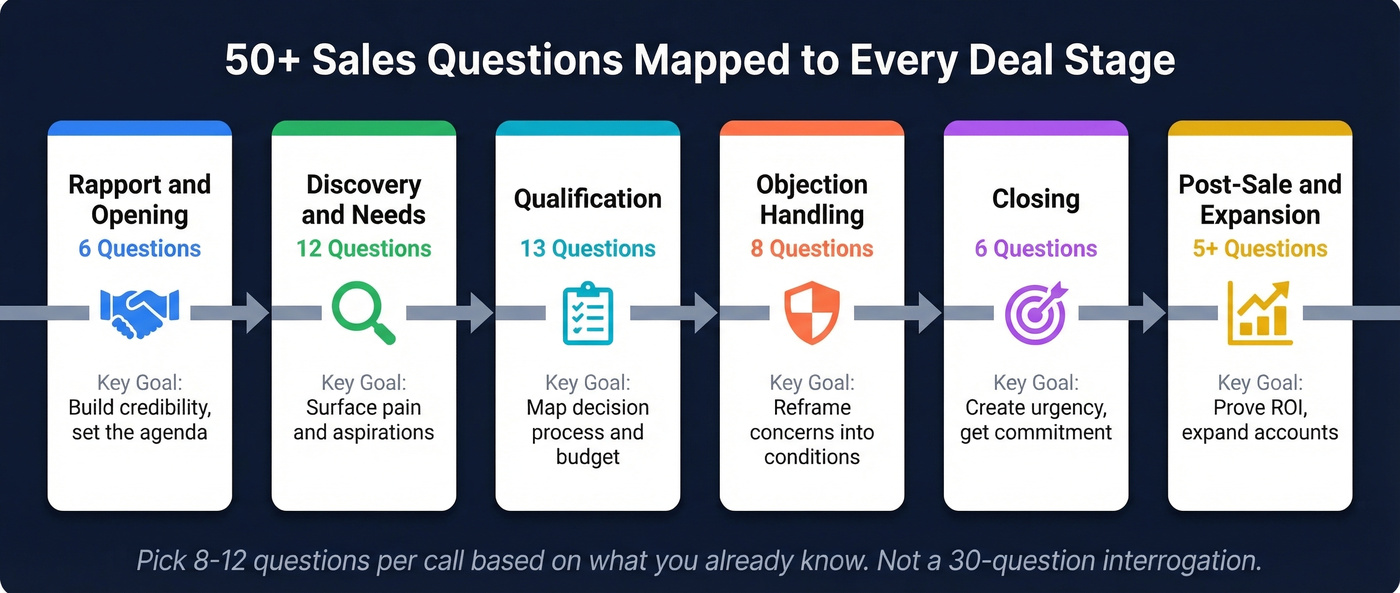
Rapport and Opening
- "What's going on in your world these days?" - Broad and non-threatening. Lets the buyer set the agenda. Only works if you've done your homework first so your follow-ups reference something real.
- "What's changed since we last talked?" - Re-validates discovery on follow-up calls. Priorities shift constantly.
- "I noticed [company] just [specific event]. How's that affecting your team?" - Shows you prepared. Builds instant credibility.
- "What prompted you to take this meeting?" - Cuts straight to intent. Immediately reveals how warm the prospect is.
- "How's your team structured around [relevant function]?" - Maps the org without sounding like you're interrogating.
- "What does a win look like for you this quarter?" - Anchors the conversation to their goals, not your features.
Discovery and Needs
- "Can you help me understand your biggest challenge with [process]?" - The "help me understand" phrasing gets longer, more detailed answers than the blunt version.
- "What tools or processes are you currently using to handle [task]?" - Maps the status quo without judgment.
- "What happens when that process breaks down?" - Surfaces pain they haven't articulated yet.
- "What prevents you from achieving your desired outcomes?" - Classic SPIN problem question. Direct but not accusatory.
- "If you could fix one thing about your current workflow, what would it be?" - Forces prioritization. The answer tells you where to focus your pitch.
- "How does this problem affect other teams or departments?" - Implication question. Expands the perceived scope of the pain.
- "What have you already tried to solve this?" - Reveals what's failed, what they've invested, and what they're skeptical about.
- "Who else on your team feels this pain most acutely?" - Identifies potential champions and multi-threading opportunities.
- "What would solving this mean for your numbers this year?" - Ties the problem to measurable outcomes.
- "Where does this rank on your priority list right now?" - Tells you if you're competing against other internal initiatives, not just other vendors.
- "What does your ideal outcome look like 12 months from now?" - Aspiration question. Gets the buyer thinking about the future state, not just current pain.
- "How are you measuring success for this initiative today?" - Surfaces the metrics they actually care about, which often differ from what you'd assume.
Qualification
- "Who has the final say on this purchase?" - Economic buyer identification. Don't dance around it.
- "Can you outline the steps from today to a signed contract?" - Maps the decision process so you don't get blindsided at step 7.
- "Are there specific legal, security, or compliance checks we should anticipate?" - Paper process question. Deals die in procurement more often than in evaluation.
- "What are the top three must-have features or outcomes?" - Decision criteria. If you can't hit all three, better to know now.
- "Are the decision criteria weighted, or are they all equal?" - Tells you where to focus your demo and proposal.
- "What's your timeline for making a decision?" - Simple but essential. Urgency drives everything.
- "Is there budget allocated for this, or does it need to be created?" - More useful than "what's your budget?" because it reveals process, not just a number.
- "Who else are you evaluating?" - Competition question. Most buyers will tell you if you ask directly.
- "What would make you choose us over the alternatives?" - Flips the evaluation. Now they're selling you on why you'd win.
- "What's the cost of doing nothing for another six months?" - Creates urgency without being pushy.
- "Who else needs to be in the room for the next conversation?" - Identifies stakeholders you haven't met yet. Deals stall when hidden decision-makers surface late.
- "What would disqualify a vendor from consideration?" - Reveals dealbreakers early so you don't waste cycles on a deal you can't win.
- "Has a project like this been attempted before? What happened?" - Uncovers organizational scar tissue that could block your deal.
Objection Handling
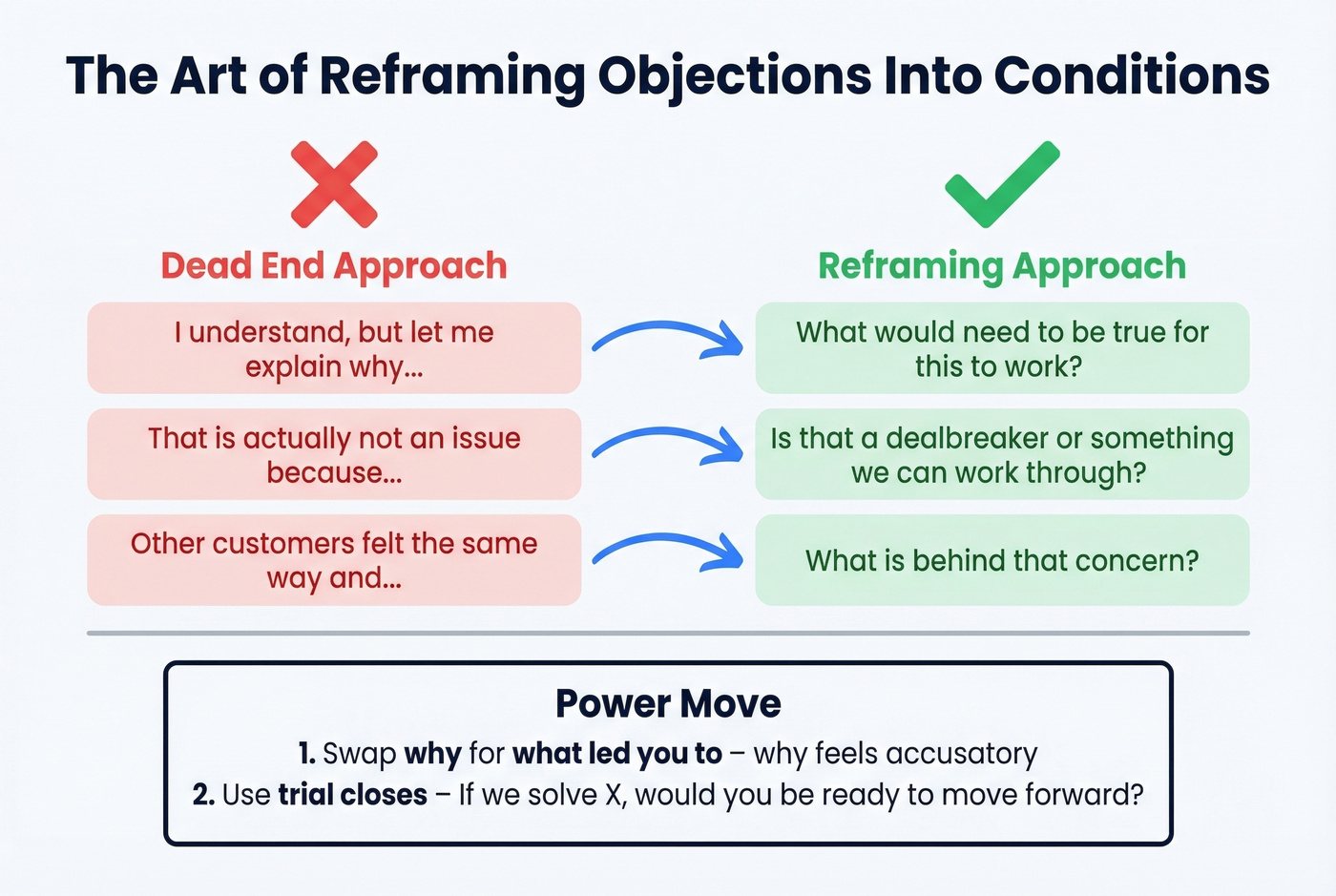
- "What would need to be true for this to work for your team?" - Reframes the objection as a solvable condition instead of a dead end.
- "Is that a dealbreaker, or something we can work through?" - Forces them to categorize the objection. Most aren't actually dealbreakers.
- "What's behind that concern?" - Gets to the root cause. The stated objection is rarely the real one.
- "If we could solve [specific objection], would you be ready to move forward?" - Trial close disguised as an objection handler.
- "Who else on your team might see this differently?" - Useful when one stakeholder is blocking. There's often an internal champion who disagrees.
- "What would your team need to see in a pilot to feel confident?" - Lowers the commitment threshold. Pilots close deals that demos can't.
- "What led you to that vendor?" - Better than "why did you choose that vendor?" because too many "why" questions feel accusatory. Swap "why" for "what led you to" in any objection conversation.
- "What's the risk of moving forward vs. the risk of staying where you are?" - Forces a comparison that usually favors action.
Closing
- "Based on everything we've discussed, does this feel like the right fit?" - Soft trial close. The answer tells you if there's hidden resistance.
- "What happens if you don't solve this in the next 90 days?" - Consequence question. Creates urgency without artificial pressure.
- "Is there anything we haven't covered that would affect your decision?" - Catches last-minute objections before they become ghosting.
- "What's the next step from your side?" - Puts the ball in their court. If they can't articulate a next step, the deal isn't real.
- "Should I send over the proposal, or do we need another conversation first?" - Binary choice that moves things forward either way.
- "If we get the paperwork over today, is your team ready to start by [date]?" - Assumptive close with a specific timeline.
Post-Sale and Expansion
- "What's working well so far, and what could be better?" - Opens the door to feedback without making them feel like they're complaining.
- "How has [product] affected the metrics you mentioned during our first call?" - Ties back to their original goals. Proves ROI in their language.
- "Are there other teams that could benefit from what you're seeing?" - Natural expansion question. 72% of company revenue comes from existing customers - this is where the real money is.
- "Who else in your network is dealing with a similar challenge?" - Referral ask that doesn't feel like a referral ask.
- "What's the next big initiative on your roadmap?" - Positions you for upsell before they start evaluating other vendors.
- "If you were buying this again today, what would you want to be different?" - Retention gold. The answer tells you exactly what to fix before renewal.
- "What's one thing we could do to make you a vocal advocate?" - Turns satisfied customers into referral sources with a direct, specific ask.
Three Frameworks for Sequencing
Memorizing 50 questions is pointless if you don't know when to use each one. Frameworks give you sequencing logic so your questions build on each other instead of bouncing randomly.
SPIN Selling
Developed by Neil Rackham from research across 35,000+ sales calls, SPIN remains the most practical framework for most B2B sellers. The sequence is Situation, Problem, Implication, Need-Payoff.
Situation questions map the current state: "What tools are you using to handle outbound prospecting?" Problem questions surface pain: "What challenges do you face with your current process?" Implication questions expand the pain's scope: "How does that affect your team's ability to hit quarterly targets?" Need-Payoff questions get the buyer to articulate the value of solving the problem: "If you could cut rep ramp time in half, what would that mean for pipeline this quarter?"
Implication questions are the hardest to master but create the most urgency. We've watched reps transform their close rates just by adding one Implication question per call. Most reps jump straight from Problem to pitching - the Implication step is where deals are actually won.
MEDDPICC
MEDDPICC stands for Metrics, Economic Buyer, Decision Criteria, Decision Process, Paper Process, Identify Pain, Champion, and Competition. It's a go-to qualification framework for complex enterprise deals with multiple stakeholders.
Each letter maps to a question category. "What key metrics define success for this initiative?" covers Metrics. "Who holds the ultimate budget authority?" identifies the Economic Buyer. "Can you walk me through the steps from evaluation to signed contract?" maps the Decision Process. "Are there specific compliance or legal reviews we should plan for?" handles Paper Process. The framework shines when you're navigating buying committees of four or more people, because it forces you to map every angle of the decision before you invest heavy resources in a deal.
Skip this for smaller, faster sales cycles. We've seen teams try to run MEDDPICC on SMB deals and it just bogs everything down. Save it for six-figure contracts where the decision process itself is the biggest risk to closing.
RAIN Group's Question Flow
RAIN Group's approach is the simplest framework for newer sellers. Start broad to get the buyer talking, narrow to specific areas, then layer in insight questions where you share a perspective and ask for their reaction.
The progression - "What's going on in your world?" to "What's the biggest bottleneck in your outbound process?" to "We're seeing teams solve that by [approach] - how does that compare to what you've tried?" - feels natural because it mirrors how real conversations work.
If you only learn one framework, make it SPIN. Selling enterprise? Add MEDDPICC. Training newer reps? Start them on RAIN and graduate to SPIN once they're comfortable running discovery without a script.
Questions for Retail and In-Store Selling
B2B gets all the attention, but the majority of transactions still happen in brick-and-mortar stores in 2026. Retail selling has its own rules, and the worst question you can ask is "Can I help you find something?" It invites "just looking" every single time.
| Don't Ask | Ask Instead |
|---|---|
| "Can I help you find something?" | "What brings you in today?" |
| "How are you today?" | "Have you been here before?" |
| "Are you looking to buy today?" | "What's the project?" (hardware) |
| "Do you have a budget in mind?" | "What room gets the makeover?" (furniture) |
| "Is there anything else?" | "How can we connect your world?" (electronics) |
The principle is the same as B2B: ask questions that invite a story, not a one-word deflection. "What's the project?" gets someone talking about their kitchen renovation. "Can I help you?" gets you dismissed.
Seven Mistakes That Kill Deals
1. Asking what you could find in 30 seconds online. "So, what does your company do?" signals zero preparation. The prospect's title, company size, and recent news are all available before the call. Use Prospeo's CRM enrichment to pull 50+ data points per contact before every conversation - there's no excuse for winging it.
2. Interrogation mode. Rapid-fire closed questions make prospects deflect and put up walls. Space your questions. Let them breathe.
3. Pump and pounce. Asking two surface-level questions, then launching into your pitch the moment you hear a keyword. You'll miss critical context and damage trust.
4. Frontloading all questions. Gong's data is clear: cramming questions into the first 10 minutes and then pitching for 20 is what average reps do. Top performers weave questions throughout the entire call.
5. Talking too much. A common discovery benchmark is the 70/30 rule - prospects talk about 70% of the time and reps talk about 30%. Ask the question, then shut up.
6. Asking hard questions before earning rapport. "What's your budget?" in the first two minutes triggers defensiveness. Earn the right to go deeper by building trust first.
7. Overusing "why." "Why did you choose that vendor?" sounds like a cross-examination. Swap it for "What led you to that vendor?" - same information, zero accusation.
Let's be honest: the best question you'll ever ask a customer isn't on any list. It's the specific, researched follow-up that proves you were actually listening. Lists like this one give you the scaffolding. Preparation and genuine curiosity give you the deal. If you want a tighter structure for discovery, use a dedicated set of discovery questions and adapt them to what you already know.
Question #3 says to reference a specific company event before the call. Prospeo's intent data tracks 15,000 topics so you know exactly what your prospect is researching - before you ever dial. Pair that with 98% accurate emails and a 30% mobile pickup rate to actually reach the buyers you've prepared for.
Turn pre-call research from guesswork into a competitive advantage.
FAQ
How many questions should I ask on a discovery call?
Aim for 8-12 strategic questions spread evenly across the conversation. Top performers consistently ask fewer questions but get longer, more detailed answers - which is what actually correlates with closed deals. Quality follow-ups matter more than raw quantity.
What's the difference between open-ended and closed-ended sales questions?
Open-ended questions invite explanation: "What challenges are you facing with outbound?" Closed-ended questions get a yes or no: "Do you have budget approved?" Use open-ended questions for discovery and rapport where you need elaboration; use closed-ended questions for confirmation and closing checkpoints.
How do I prepare so my sales questions actually land?
Research the prospect's company, role, and recent activity before every call. Pull verified contact data and company intel so your first question shows you've done your homework instead of wasting the buyer's time. Even five minutes of prep changes the entire dynamic of the conversation.
Which framework is best for structuring sales questions?
SPIN Selling works best for most B2B sellers, backed by research across 35,000+ calls. Add MEDDPICC for complex enterprise deals with four or more stakeholders. Start newer reps on RAIN Group's broad-to-specific flow, then graduate them to SPIN once they're comfortable running discovery independently.