

Quick Email Verification: Which Tool Actually Delivers?
You send 10,000 cold emails on a Monday morning. By Tuesday, your bounce rate is sitting at 8%, your ESP flags the domain, and your sequences are paused. That's not a hypothetical - it's what happens when "verified" emails aren't actually verified.
The fix isn't sending less. It's running quick email verification that works before you hit send.
Here's what separates good tools from bad ones, where the industry's "99% deliverability" claims fall apart, and which seven tools are worth your money in 2026.
Our Picks (TL;DR)
- Prospeo - Best for teams that want pre-verified data. 98% email accuracy across 143M+ verified emails, a 7-day refresh cycle, and catch-all handling built into a 5-step verification process. Free tier: 75 emails + 100 Chrome extension credits/month.
- Clearout - Best pure bulk verifier for the price. 98.4% accuracy in the LaGrowthMachine benchmark at $4 per 1,000 emails.
- ZeroBounce - Best for integration-heavy stacks. 4.7/5 on G2 with 1,349 reviews, 60+ integrations, and unknown results don't consume credits. Subscriptions from $39/mo on annual billing.
How Email Verification Works
Every validation tool runs some version of the same pipeline, whether it takes 0.01 seconds or 10 seconds per email:
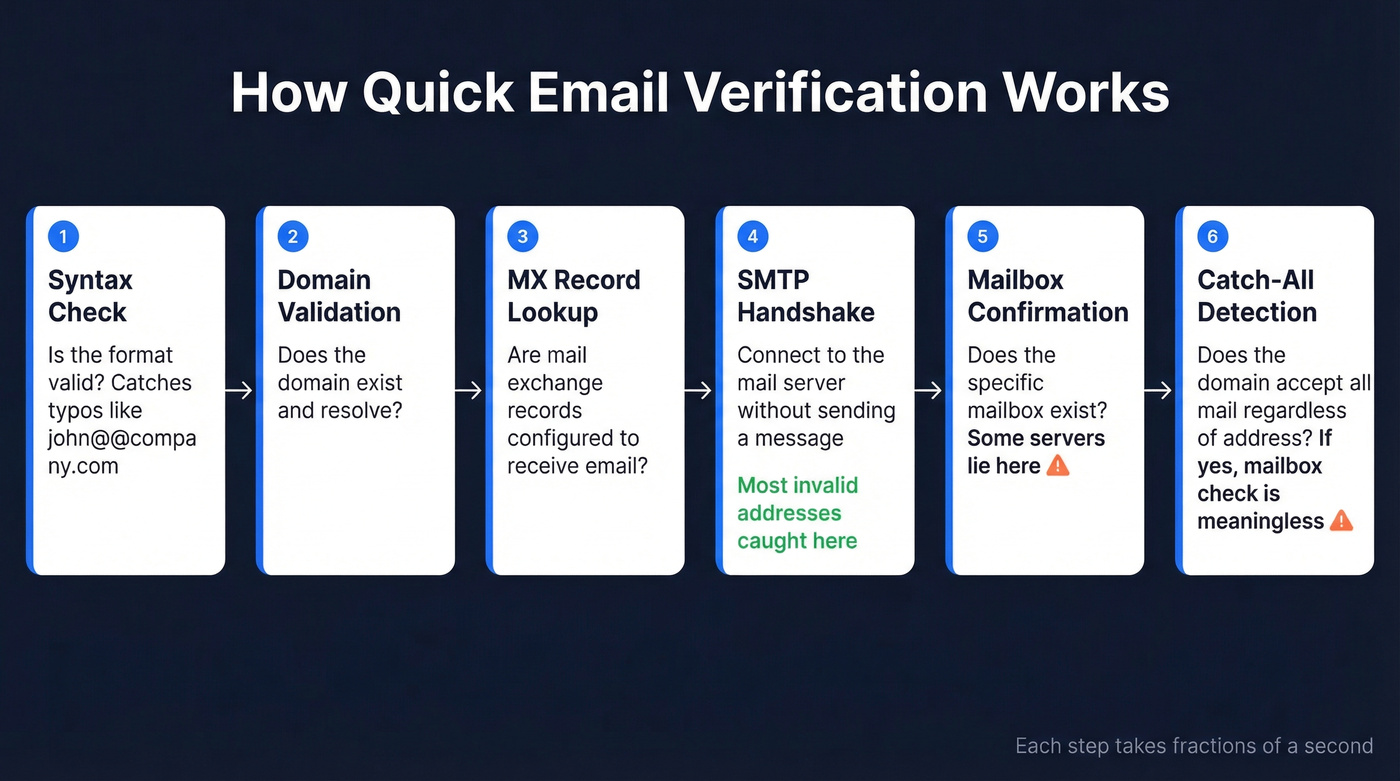
- Syntax check - Does the email follow valid formatting rules? Catches typos like "john@@company.com."
- Domain validation - Does the domain exist and resolve?
- MX record lookup - Does the domain have mail exchange records configured to receive email?
- SMTP handshake - The tool connects to the mail server and initiates a conversation without sending a message. This is where most invalid addresses get caught.
- Mailbox confirmation - The server responds with whether the specific mailbox exists. Some servers lie here.
- Catch-all detection - Does the domain accept all incoming mail regardless of the address? If so, the mailbox-level check is meaningless.
When people say "quick" verification, they usually mean real-time single-email checks - paste an address, get a verdict in under a second. Bulk list cleaning is the same pipeline running at scale, typically processing thousands of emails per minute. The underlying technology is identical; the difference is throughput and pricing model.
Why "99% Accuracy" Is a Lie
Every verification vendor plasters "99% accuracy" on their homepage. The benchmarks tell a different story.
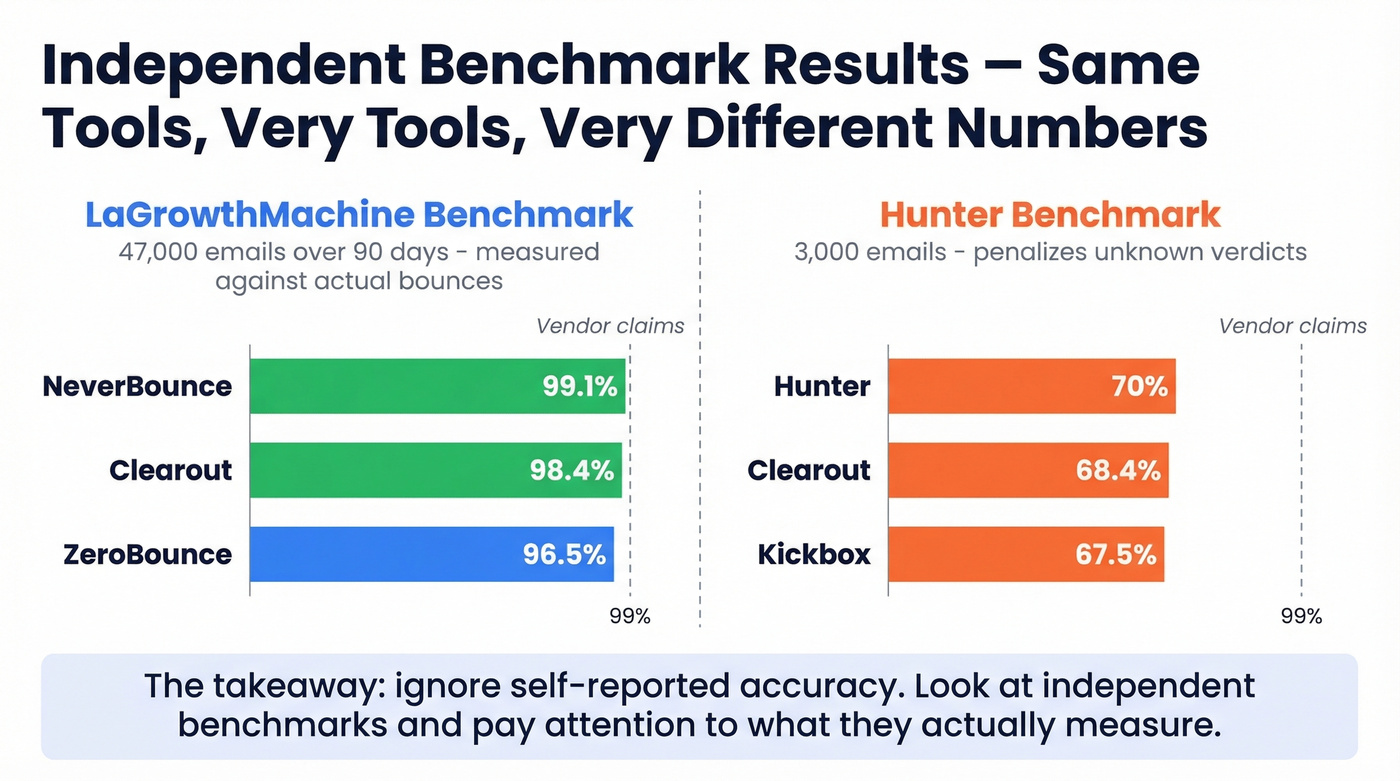
Hunter tested 15 verifiers against 3,000 emails in bulk mode via Clay integrations. The top accuracy score? 70%. Not 99%. Not even 80%. Hunter came in first at 70%, Clearout at 68.37%, and Kickbox at 67.53%. The rest scored lower. Threads on r/Emailmarketing show practitioners getting wildly varying results between verifiers on the same list - which tells you something about how fragile these numbers really are.
A separate LaGrowthMachine benchmark tested 12 tools across 47,000 emails over 90 days and got dramatically different results: NeverBounce hit 99.1%, Clearout 98.4%, ZeroBounce 96.5%.
So which benchmark is right? Both, in a way. The numbers diverge because of how each test handles unknowns and accept-all addresses. Hunter's methodology penalizes tools for returning "unknown" verdicts - which tanks accuracy scores even if the tool correctly identified that it couldn't verify the address. LaGrowthMachine measured against actual bounce data, which rewards tools that make confident calls. The takeaway: ignore any vendor's self-reported accuracy number and look at independent benchmarks instead, paying close attention to what they're actually measuring.

Why verify emails after the fact when you can start with clean data? Prospeo's 5-step verification - with catch-all handling, spam-trap removal, and honeypot filtering - runs before you ever export a single contact. 143M+ emails at 98% accuracy, refreshed every 7 days.
Skip the verification step entirely. Start with data that's already clean.
The Catch-All Problem
Here's the thing: a large share of B2B email addresses sit on catch-all domains. These are servers configured to accept every incoming email regardless of whether the specific mailbox exists. Your verification tool pings the server, the server says "sure, send it over," and you have zero idea if the address is real.
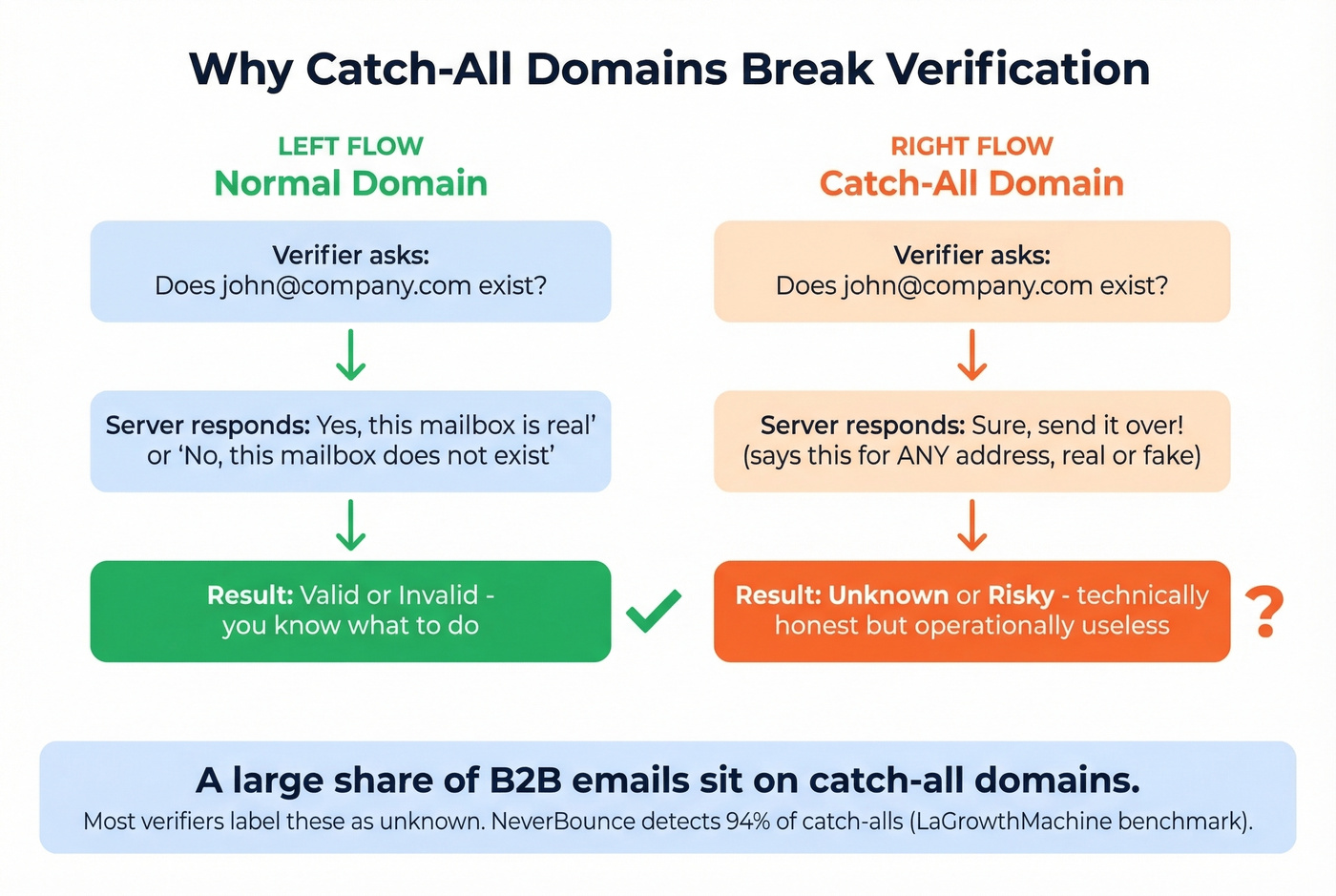
Most verifiers label catch-all addresses as "unknown" or "risky." Technically honest, but operationally useless. You're left deciding whether to send to a huge chunk of your list with no guidance.
The consensus on r/coldemail is that this is the single most frustrating gap in verification tooling - teams want actionable go/no-go decisions, not ambiguous labels. NeverBounce stands out here with 94% catch-all detection accuracy in the LaGrowthMachine benchmark.
7 Best Quick Email Verification Tools
Prospeo
Use this if you're tired of the two-step workflow of buying data from one vendor and then paying a second vendor to verify it.
Prospeo gives you pre-verified contact data: 143M+ verified emails with 98% accuracy, refreshed every 7 days. It uses proprietary email-finding infrastructure and a 5-step verification process with catch-all handling plus spam-trap and honeypot filtering, so you're not exporting "maybe" emails and hoping your verifier catches the damage later. We've seen teams cut their bounce rates from 35%+ down to under 4% just by switching their data source - Snyk's 50-person AE team went from 35-40% bounces to under 5% and added 200+ new opportunities per month.
Pricing runs about $0.01 per email, with a free tier of 75 emails plus 100 Chrome extension credits per month. No contracts, no sales calls required.
Skip this if you only need standalone list verification for data you've already collected elsewhere.
Clearout
Clearout posted 98.4% accuracy in the LaGrowthMachine benchmark across 47,000 emails. At $4 per 1,000 emails, that's one of the best price-to-accuracy ratios you can buy. On G2, it's rated 4.6/5 across 493 reviews.
The Hunter benchmark told a different story: 68.37% accuracy. That gap comes down to methodology - Hunter penalizes unknown verdicts heavily, and Clearout returns more unknowns on tricky domains. In practice, if you're measuring against actual bounces, Clearout performs well. The drag-and-drop CSV upload keeps things simple for teams that just need to clean a list fast.
Use this if you need to verify large lists on a tight budget.
Skip this if you need deep catch-all handling. Clearout covers the basics but doesn't go as deep on accept-all domains as NeverBounce.
ZeroBounce
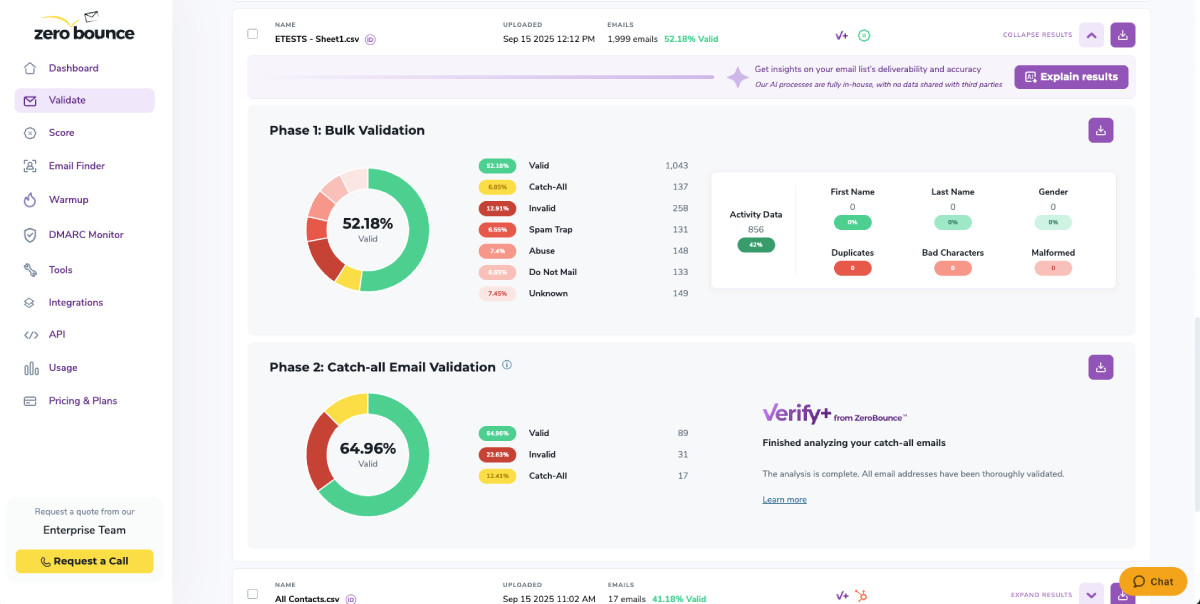
60+ integrations is the headline for ZeroBounce, and it's why teams with complex stacks gravitate toward it. Unknown results don't consume credits - a nice touch when you're verifying messy lists. The 96.5% accuracy in the LaGrowthMachine benchmark is solid, and the G2 review base (4.7/5, 1,349 reviews) gives you real confidence.
Pricing is tiered: 100 free validations per month, pay-as-you-go from $0.00275 to $0.01 per email depending on volume, and subscriptions from $39-$199/mo on annual billing. Capterra reviews include complaints that catch-all scoring costs extra. If catch-alls are a big chunk of your list, that adds up.
Skip this if you're purely cost-sensitive. ZeroBounce isn't the cheapest option, and the catch-all upsell stings at scale.
NeverBounce
Highest accuracy in the LaGrowthMachine benchmark at 99.1%. Catch-all detection hits 94% - one of the strongest published numbers in independent testing. If accuracy is your single most important criterion, NeverBounce earns its premium.
That premium is real, though. At $8 per 1,000 emails, it's double Clearout's price. For high-volume senders cleaning 100K+ emails monthly, the cost difference compounds fast, and the product lacks ZeroBounce's integration breadth.
QuickEmailVerification
The free tier is genuinely generous - 100 credits per day, roughly 3,000 per month. The platform claims 30B+ emails verified for 191,000+ businesses, and it's ISO 27001 certified and GDPR compliant. Two pricing models: pay-as-you-go "Persistent Credits" that never expire ($4 for 500 credits, about $8 per 1,000 at that entry tier) and daily subscription plans where credits reset each day.
G2 is solid but thin at 4.5/5 with 26 reviews. Capterra (4.3/5, 13 reviews) includes complaints about inconsistent results and limited explanations for timeouts. Not cheap relative to Clearout, but the never-expiring credits are a nice touch for teams with irregular verification needs.
MyEmailVerifier
The budget pick. $1.20 per 1,000 emails with 100 free daily credits. MyEmailVerifier claims it verifies 1,000 addresses every minute. The review aggregates on its site are inconsistent, so treat social proof cautiously and spot-check results before running campaign-critical lists through it. For teams verifying massive lists where cost matters more than precision, it's worth a test run on a small sample first.
BriteVerify
Owned by Validity, BriteVerify targets enterprise buyers and doesn't publish pricing - you have to contact sales. Credits expire one year after purchase, which is a dealbreaker if your verification needs are sporadic. Unless your procurement team already has a Validity relationship, there are better options on this list. Skip it.
Pricing at a Glance
Accuracy figures come from independent benchmarks where available; otherwise vendor or platform data.
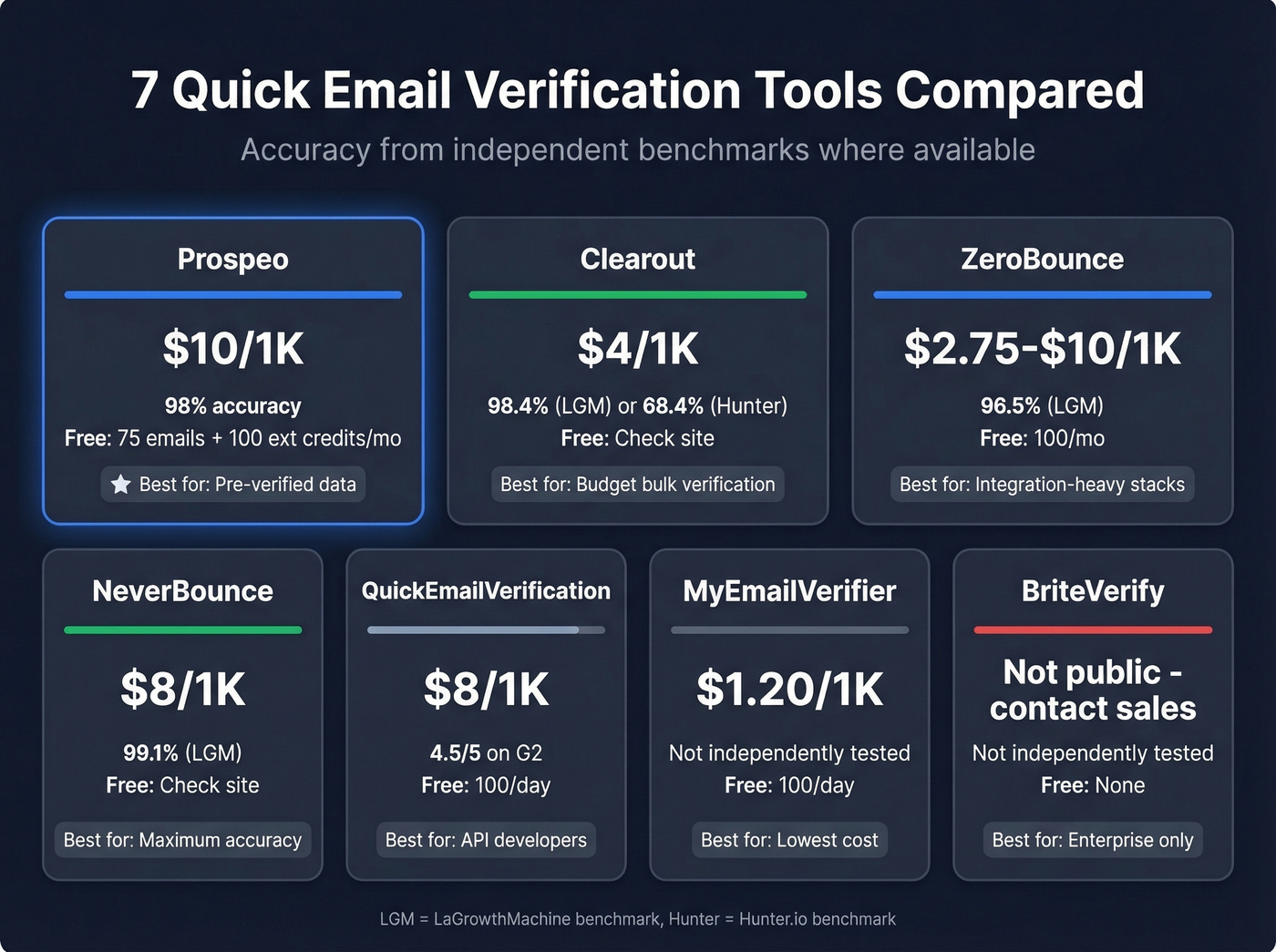
| Tool | Price/1K | Free Tier | Accuracy | Best For |
|---|---|---|---|---|
| Prospeo | ~$10 | 75 emails + 100 ext. credits/mo | 98% (143M+ verified) | Pre-verified data |
| Clearout | $4 | Check site | 98.4% (LGM) / 68.4% (Hunter) | Budget bulk |
| ZeroBounce | $2.75-$10 | 100/mo | 96.5% (LGM) | Integrations |
| NeverBounce | $8 | Check site | 99.1% (LGM) | Max accuracy |
| QEV | ~$8 | 100/day | 4.5/5 (G2) | API developers |
| MyEmailVerifier | $1.20 | 100/day | Not independently tested | Lowest cost |
| BriteVerify | Not public | None | Not independently tested | Enterprise |
Let's be honest: NeverBounce has the best raw accuracy numbers, but most teams don't need 99.1% verification accuracy. They need cleaner source data. If your bounce rate is high, the problem is almost always upstream - not in the verification step. Paying $8/1K to verify emails that were bad from the start is treating the symptom.
When Verification Isn't Enough
If you're verifying 50,000 emails a month, verification isn't your problem - your data source is. People change jobs, companies fold, mailboxes get deactivated. Lists decay fast.
Most data providers refresh records around every 6 weeks. By the time you pull a list and run it through a verifier, some of those emails have already gone stale. You're paying twice: once for the data, once to clean it. We've watched teams burn through thousands of dollars a quarter on this exact cycle before realizing the math doesn't work.
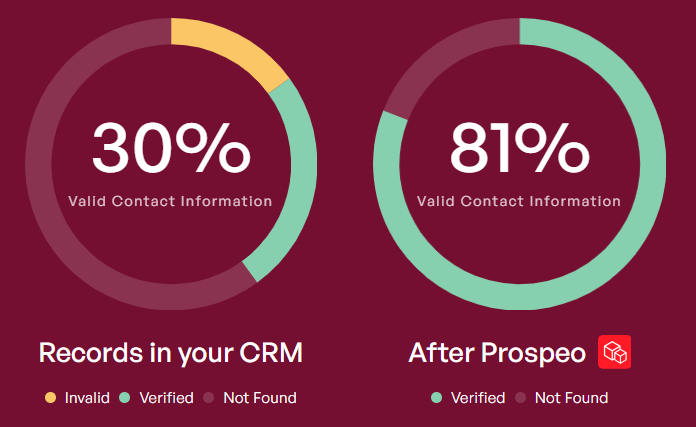
The smarter approach is starting with clean data. A 7-day refresh cycle with verification built into the export pipeline - handling catch-all domains, spam traps, and honeypots before you ever touch the data - eliminates that second bill entirely. For teams running serious outbound volume, that upstream quality difference compounds every single week.
If you're evaluating vendors, it helps to compare broader data enrichment coverage and refresh policies, not just verification accuracy.
Snyk's 50-person sales team dropped their bounce rate from 35-40% to under 5% and added 200+ new opportunities per month - not by switching verifiers, but by switching their data source. At $0.01 per email with no contracts, Prospeo eliminates the verify-after-you-buy workflow entirely.
Teams book 26% more meetings when the data is accurate from the start.
FAQ
What is quick email verification?
Quick email verification is real-time validation of an email address - typically in under a second. The tool checks syntax, domain records, SMTP response, and mailbox existence without sending an actual message. Bulk verification runs the same checks at scale across thousands of addresses per minute.
How often should I re-verify my email list?
Every 3-6 months minimum for low-volume senders. High-volume teams should verify monthly, or use a data source with a weekly refresh cycle so addresses are validated before export.
What's a catch-all domain and why does it matter?
A catch-all domain accepts all incoming emails regardless of whether the specific mailbox exists, making standard SMTP checks unreliable. NeverBounce leads here with 94% catch-all detection accuracy.
What bounce rate should I target?
Keep total bounces below 2% and hard bounces below 1%. Exceed those thresholds and ESPs will throttle or suspend your sending domain. Most teams hitting 4%+ have a data-source problem, not a verification problem.
Is free email verification accurate enough?
Free tiers work for testing a tool's accuracy on a small sample - Prospeo offers 75 free emails/month, ZeroBounce gives 100 validations, and QuickEmailVerification provides 100 daily credits. For production lists, paid plans deliver better speed, higher rate limits, and priority SMTP checks. Don't rely solely on a free tool for a campaign-critical send.