

Recruiting Email Subject Lines That Actually Get Opened
You sent 200 outreach emails to software engineers last week and got 4 opens. The subject line? "Exciting Opportunity at a Fast-Growing Company." That's not a subject line - it's a delete trigger. You have 2.7 seconds before a passive candidate decides to open or skip, and data from 9.5 million emails tells us exactly which recruiting email subject lines earn those seconds.
The Short Answer
Three subject line formulas consistently outperform everything else: a personalized question ("Still happy at [Current Company]?"), a salary/comp data hook ("Software engineers are getting 28% salary increases - here's how"), and a mutual connection reference ("[Name] suggested I reach out"). Put the core message in the first 33 characters - that's the cutoff EmailToolTester measured in the Gmail Android app on a Pixel 7. Optimize for reply rate, not opens. Test with 250+ contacts per variant minimum.
What 9.5M Emails Tell Us
Two datasets give us the clearest picture. Belkins analyzed 5.5 million B2B cold emails and found personalized subject lines hit 46% open rates versus 35% without personalization. Reply rates doubled - 7% versus 3%. Gem's recruiting-specific dataset of 4 million outreach emails confirmed the pattern: personalization tokens like candidate name and company name lift opens by up to 5 percentage points absolute.
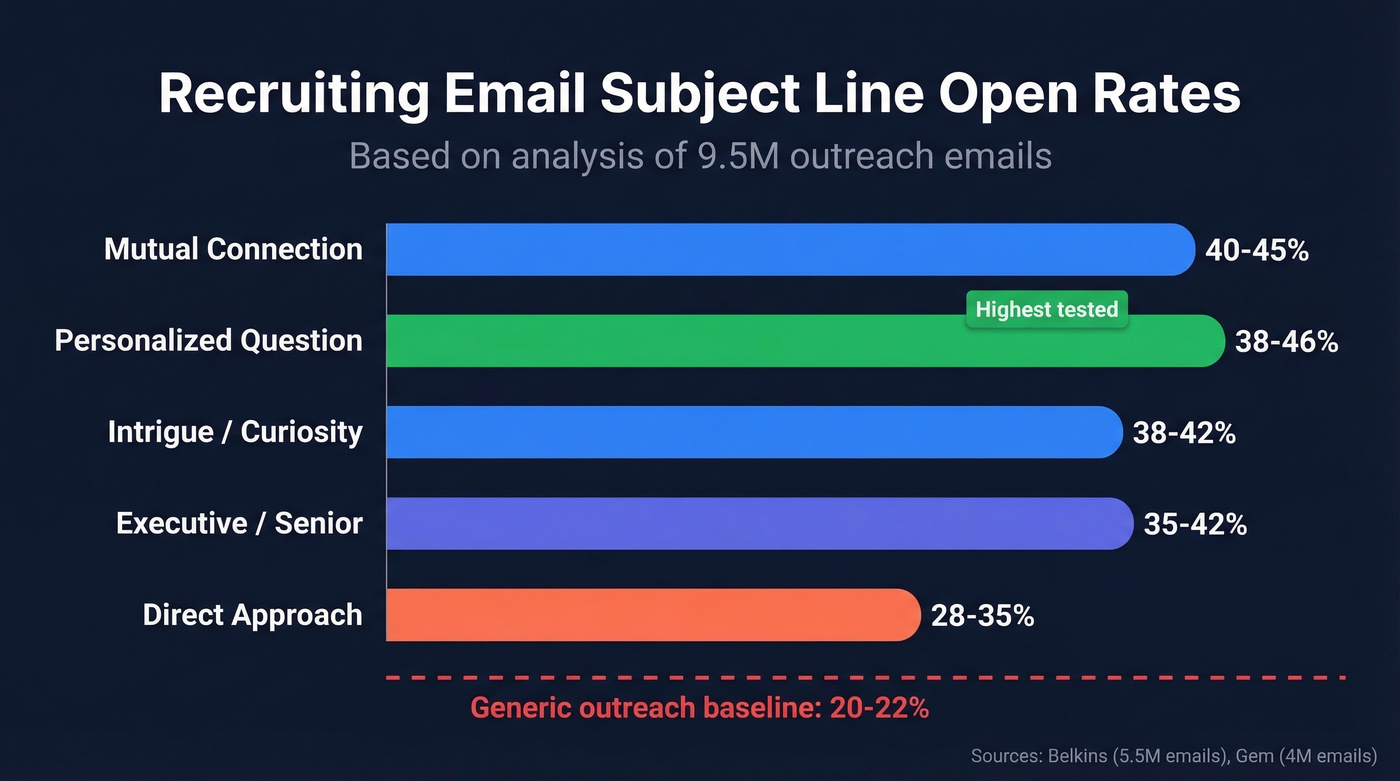
The length sweet spot? Two to four words pulled 46% opens. Opens dropped steadily past seven words. Numbers in subject lines don't help - 27% opens with numbers versus 28% without. ALL CAPS performs marginally better at 30% but isn't worth the spam risk.
| Subject Line Type | Open Rate Range | Best For |
|---|---|---|
| Mutual connection | 40-45% | Warm intros |
| Personalized question | 38-46% | Engineers, ICs |
| Intrigue / curiosity | 38-42% | Passive candidates |
| Executive / senior | 35-42% | C-suite, VPs |
| Direct approach | 28-35% | Active job seekers |
That's an 11-point swing between personalized and generic subject lines. The gap between "basic" outreach (20-22% opens) and strategic subject lines (38-45%) is even wider.
Subject Lines That Work
Personalized Questions
Question-based subject lines hit 46% open rates - the highest of any format tested. Questions demand a mental response before the candidate even clicks.
- "Still happy at [Current Company]?"
- "What would make you leave [Company]?"
- "Can you help me with a [Role] question?"
- "[First Name], open to a quick conversation?"
Mutual Connection
These pull 40-45% opens. They bypass the "who is this person?" barrier immediately.
- "[Name] suggested I reach out"
- "[Name] thought you'd be a fit"
- "Your colleague [Name] mentioned you"
Intrigue and Curiosity
Intrigue lines run 38-42% opens and lean on psychological triggers. Tim Sackett - a recruiter who's tested this stuff obsessively - swears by a few unconventional approaches. "We need to talk" gets extremely high open rates because it triggers concern. Just the candidate's last name as the entire subject line works because it doesn't look like spam. A salary data hook ("Software engineers are getting 28% salary increases by making this change") combines curiosity with self-interest.
- "We need to talk"
- "[Last Name]"
- "This role wasn't posted publicly"
Here's the thing: the consensus on r/recruiting is that most recruiter emails sound identical, and the data backs that up. Forty percent of candidates prefer conversational messages over formal ones, which is another reason to drop the corporate tone entirely.
Niche and Industry-Specific
Persona-specific subject lines follow different rules. Cleared candidates respond to discretion and mission - "TS/SCI role supporting national security - you in?" hits differently than generic tech recruiting lines. Healthcare candidates respond to impact framing ("patients waiting for someone like you"). Finance candidates respond to comp signals.
The principle is the same: match the subject line to what the candidate actually cares about, not what your ATS template defaults to.
Follow-Up Subject Lines
We've seen this pattern repeatedly: 4-stage sequences get 2x more replies than one-off emails. But most recruiters reuse the same subject line or add "Following up" and call it done. Your follow-up subjects should evolve, using a different psychological lever each time - social proof in touch two, loss aversion in touch three, autonomy in touch four.
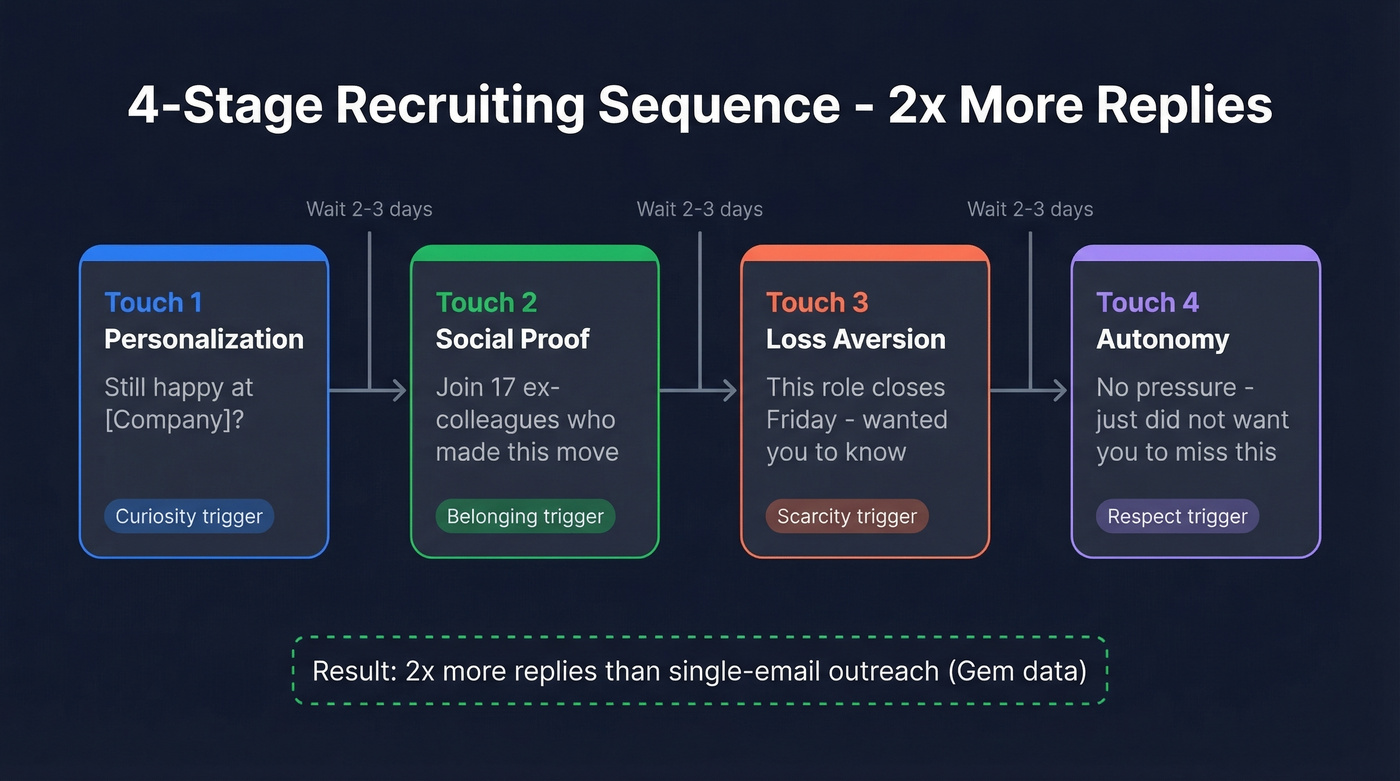
- Touch 2 (social proof): "Join 17 of your ex-colleagues who made this move"
- Touch 3 (loss aversion): "This role closes Friday - wanted you to know"
- Touch 4 (autonomy): "No pressure - just didn't want you to miss this"

A 46% open rate means nothing if 35% of your emails bounce. Bad candidate data poisons your sender domain and kills every future campaign. Prospeo's 5-step email verification - with catch-all handling, spam-trap removal, and honeypot filtering - drops bounce rates to under 4%.
Fix your candidate list before you optimize the subject line.
Character Limits by Device
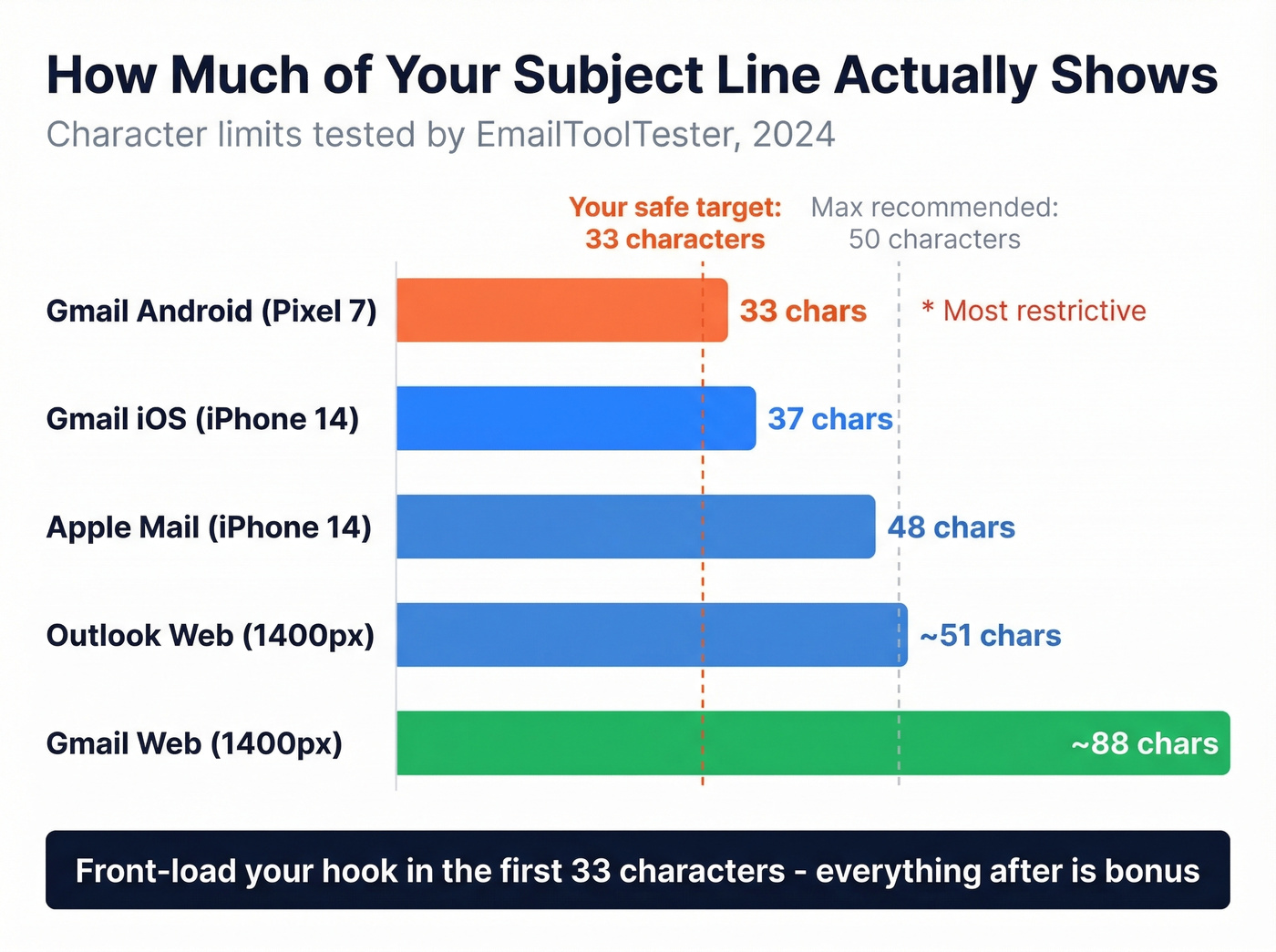
The "how long should my subject line be" debate has a concrete answer. EmailToolTester ran device-by-device truncation tests:
| Device / Client | Subject Limit | Preheader Limit |
|---|---|---|
| Gmail Android (Pixel 7) | 33 chars | 37 chars |
| Gmail iOS (iPhone 14) | 37 chars | 39 chars |
| Apple Mail (iPhone 14) | 48 chars | 99 chars |
| Outlook web (1400px) | ~51 chars | varies |
| Gmail web (1400px) | ~88 chars | varies |
Treat 33 characters as your mobile-safe target. Everything past that is bonus. Don't exceed 50 characters total.
What Kills Your Open Rate
Hype and urgency words drag opens below 36%. Spam filters flag the same patterns - "act now," "guaranteed," "free," ALL CAPS, and excessive punctuation like "!!!" all increase the odds your email never reaches the inbox.
Beyond spam triggers, 60% of candidates don't respond because the opportunity doesn't match their interests. That's not a subject line problem - it's a targeting problem. And 59% say typos or grammar errors leave a negative impression. Proofread.
Skip these entirely:
- Misleading "Re:" or "Fwd:" tricks (candidates notice and it destroys trust)
- Fake sender names (sending as "Google Recruiting" when you're an agency)
- Generic openers like "Hello, friend" or "Dear candidate"
Let's be honest: most recruiters obsess over subject line wording when their real problem is data quality. One bad email batch - full of outdated addresses and spam traps - can poison your sender domain for weeks. Fix the list first, then optimize the copy. We've watched teams run their candidate lists through Prospeo's email verification before campaigns and cut bounce rates from 35% to under 4% overnight. With 98% email accuracy, catch-all handling, and spam-trap removal, it catches the dead addresses that tank your deliverability before they do damage.
How to Test Subject Lines
Don't guess. Use this framework from Instantly's A/B testing methodology:
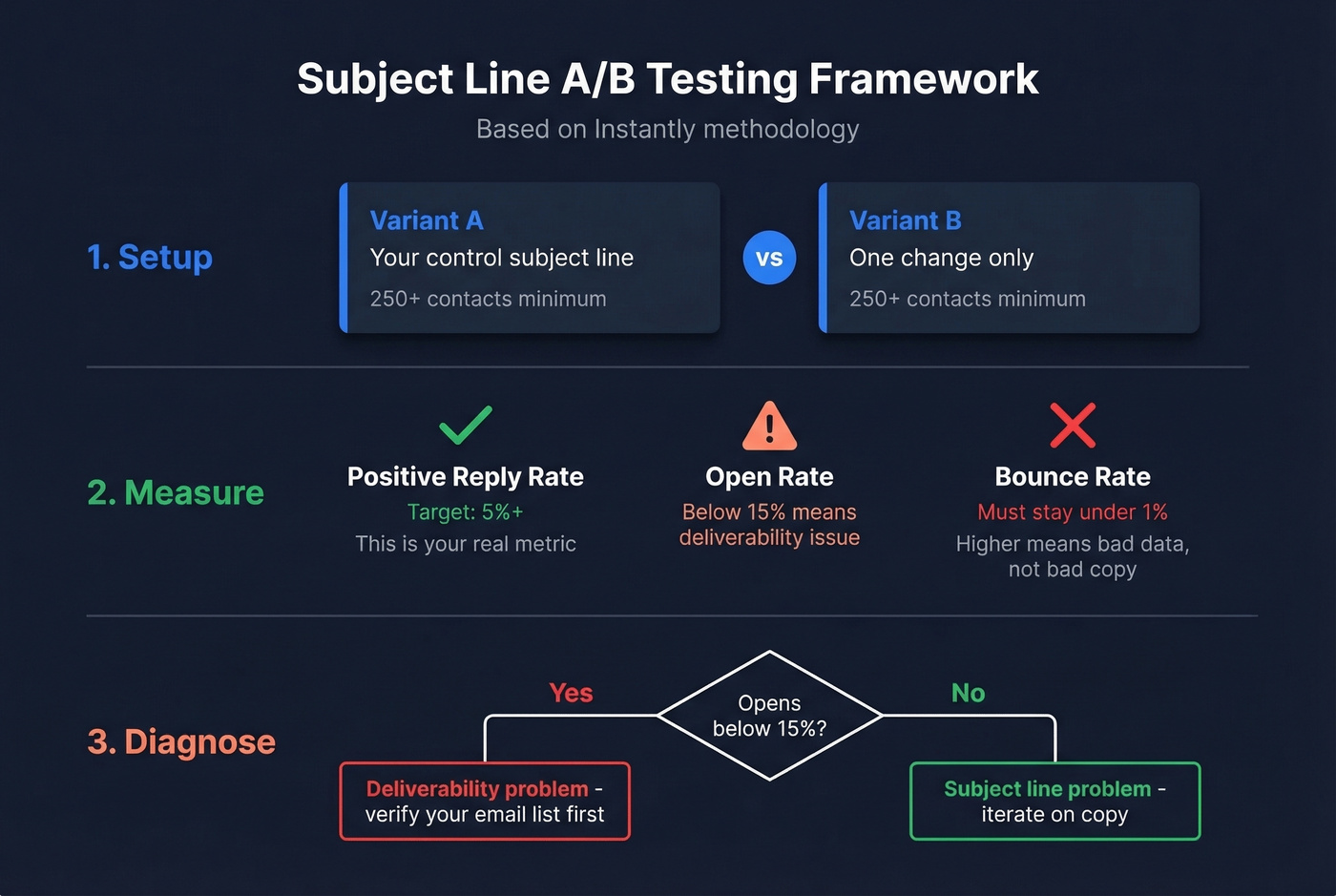
- 250+ contacts per variant minimum (500+ is better)
- One variable at a time - change the subject line, nothing else
- Optimize for positive reply rate, not opens (opens are a vanity metric)
- Target 5%+ positive reply rate - the B2B average sits around 4%
- If opens drop below 15%, it's a deliverability problem, not a subject line problem
- Keep bounce rate at 1% or lower - anything higher signals bad data
Beyond the Subject Line
Subject lines get the open. Everything else gets the reply.
Send on behalf of the hiring manager (SOBO) - only 22% of recruiters do this, but it lifts reply rates by 50%+. Weekend sends pull roughly 66% open rates because there's less inbox competition. Keep your initial message to 101-150 words; Gem's data shows most recruiters write 170-210 words, but shorter messages consistently outperform.

None of this matters if the email bounces. In our experience, teams that verify their candidate lists before every campaign see deliverability improvements within the first week. Your subject line optimization is wasted effort if 10% of your sends are hitting dead addresses.
If you're building a full outreach flow, borrow a proven B2B cold email sequence structure and then tailor it to recruiting.
Running a 4-stage recruiting sequence across 250+ candidates per variant? You need verified emails for every single one. Prospeo delivers 98% email accuracy at $0.01 per email - so you can A/B test subject lines on data that actually reaches inboxes.
Stop testing subject lines against dead email addresses.
FAQ
How long should a recruiting subject line be?
Aim for 33 characters to display fully on the most restrictive major mobile inboxes. Don't exceed 50 characters total. Front-load your hook - the first 33 characters are what most candidates will actually see on Gmail Android.
What's a good open rate for recruiter outreach?
Personalized subject lines commonly land in the 38-46% range. Below 20% means your subject lines need work or you've got a deliverability problem. Check bounce rates first - anything above 1% points to bad contact data, not bad copy.
Should I use the candidate's name in the subject line?
Yes. Personalization lifts open rates by up to 5 percentage points and doubles reply rates from 3% to 7%. Use first name or company name - not both. Cramming tokens wastes your 33-character budget.
How can I verify candidate emails before sending?
Prospeo's email finder verifies addresses in real time at 98% accuracy, including catch-all domain handling and spam-trap removal. The free tier gives you 75 verifications per month - enough to clean a small campaign and protect your sender reputation.