

15 Recruiting Email Templates That Actually Get Replies
The average recruiter juggles 14 open reqs simultaneously - 56% more than three years ago - while working with smaller teams and longer hiring cycles. A sourced candidate is 5x more likely to be hired than an inbound applicant, which means your outbound emails aren't just helpful. They're the most productive activity in your recruiting workflow.
The templates below are built around real benchmarks, structured for the way candidates read email in 2026, and organized by hiring stage so you can grab what you need and move.
What You Need (Quick Version)
- Three templates matter most: cold sourcing, first follow-up, and the breakup email. Nail these before worrying about the other twelve.
- Personalized subject lines get 38-45% open rates vs. 20-22% for generic ones. Lead with something specific to the candidate.
Benchmarks You Should Know
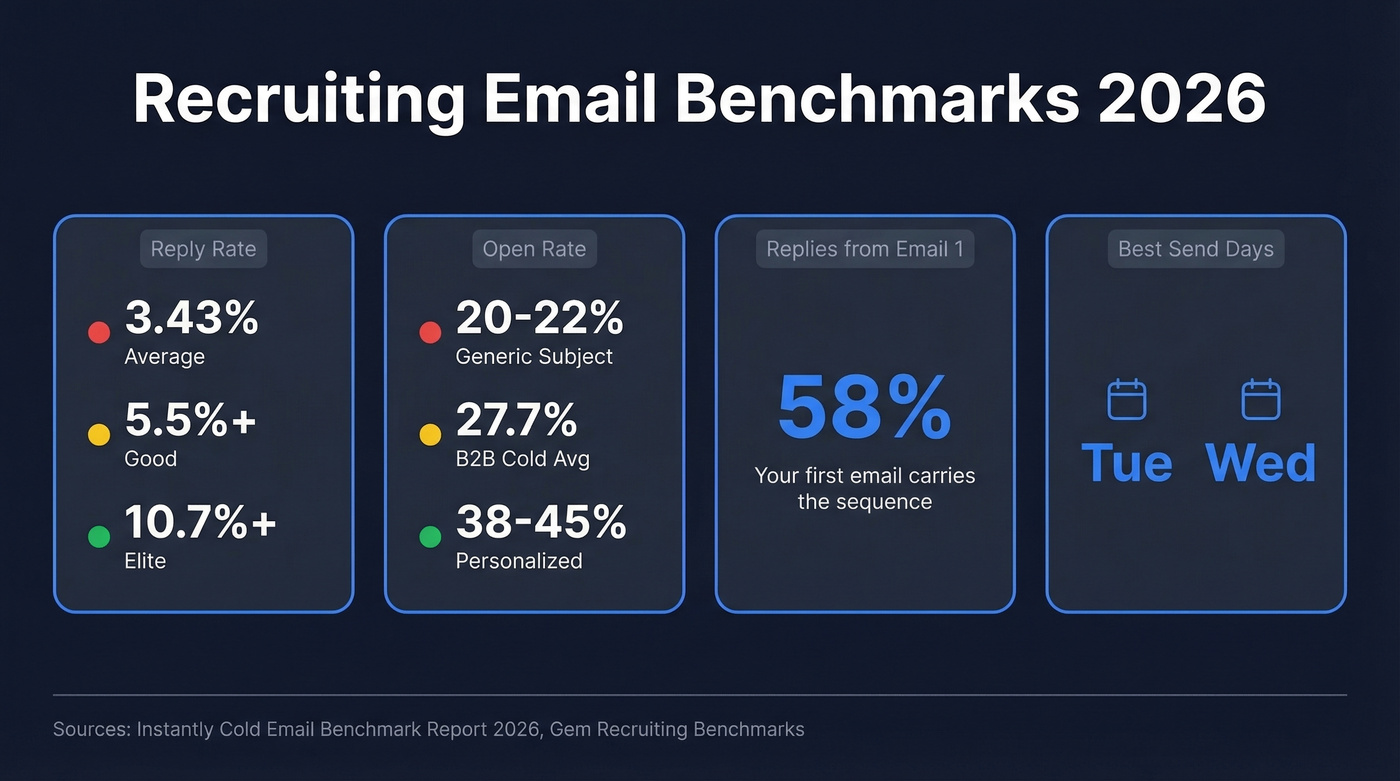
Before writing a single template, know what "good" looks like. These numbers come from cold outreach benchmarks - the closest proxy for recruiting email performance, since most ATS platforms don't publish aggregate reply-rate data.
| Metric | Average | Good | Elite |
|---|---|---|---|
| Reply rate | 3.43% | 5.5%+ | 10.7%+ |
| Open rate | 20-22% (generic) | 27.7% (B2B cold email avg) | 38-45% (personalized) |
| Replies from step 1 | 58% | - | - |
| Best send days | Tue-Wed | - | - |
The 3.43% average reply rate means that for every 100 cold emails, you're getting roughly 3 responses. Top-quartile recruiters hit 5.5%+, and the elite tier - running tight personalization with verified data - clear 10%. The gap between average and elite is largely explained by data quality, subject lines, and sequencing discipline.
The stat that matters most: 58% of all replies come from the first email. Your initial touch carries the sequence.
Subject Lines That Get Opened
69% of recipients report emails as spam based on the subject line alone. That's before they read a single word of your template. And with 61.9% of emails opened on mobile, subject lines should stay short - around 40 characters before they get truncated.
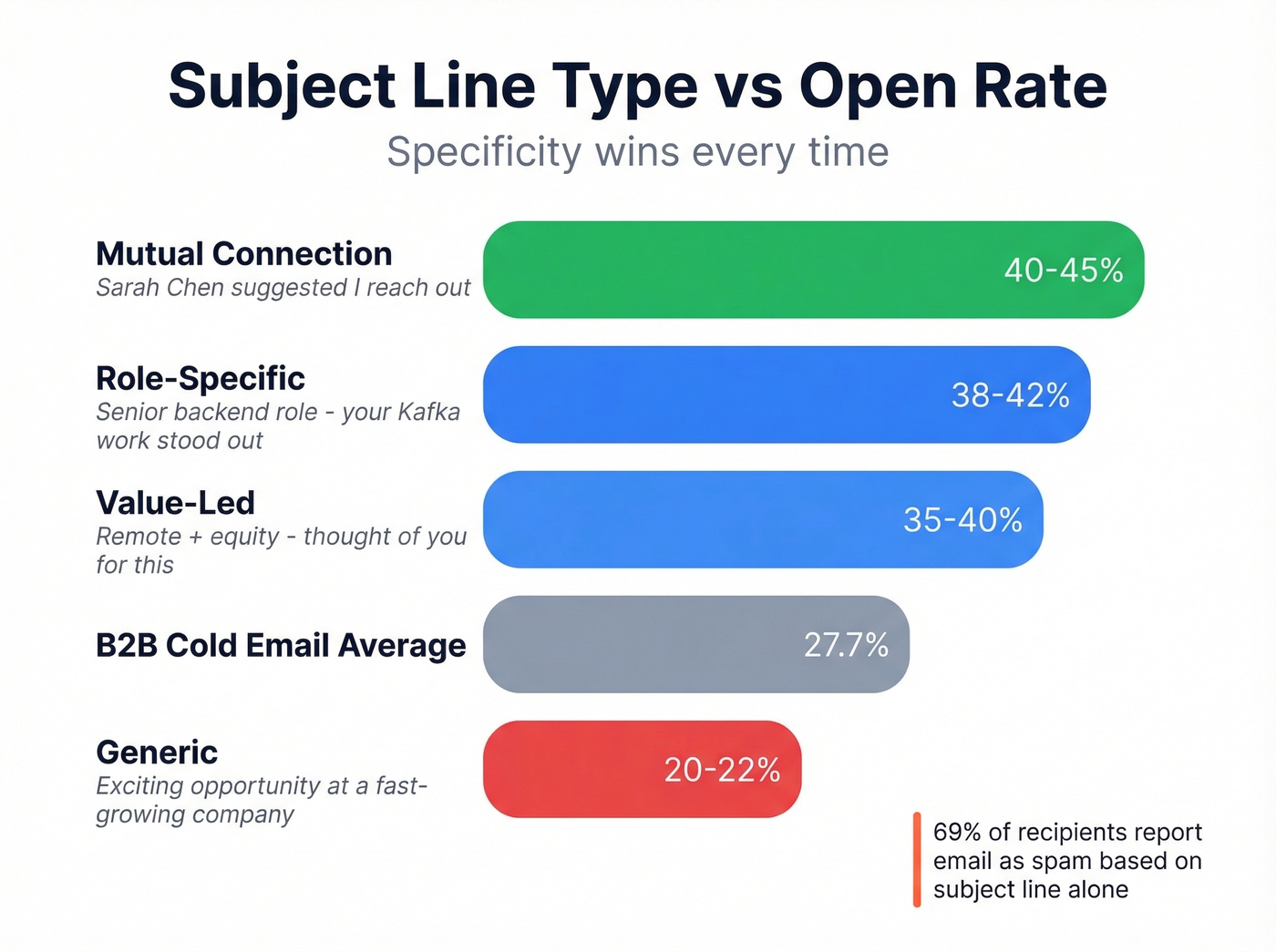
Role-specific (38-42% open rates):
- "Senior backend role - your Kafka work stood out"
- "Staff eng opening, $220K+ - saw your Stripe contributions"
Mutual connection (40-45% open rates):
- "Sarah Chen suggested I reach out"
- "[Name] mentioned you'd be perfect for this"
Value-led (35-40% open rates):
- "Remote + equity - thought of you for this"
- "Your ML background + our Series B timing"
Specificity wins every time. "Exciting opportunity at a fast-growing company" gets 20% opens. "Your Kubernetes work + our infra lead opening" gets 40%+. The extra 30 seconds of research per candidate pays for itself many times over.
We've seen recruiters double their open rates just by switching from generic to role-specific subject lines. It's the single highest-ROI change you can make.
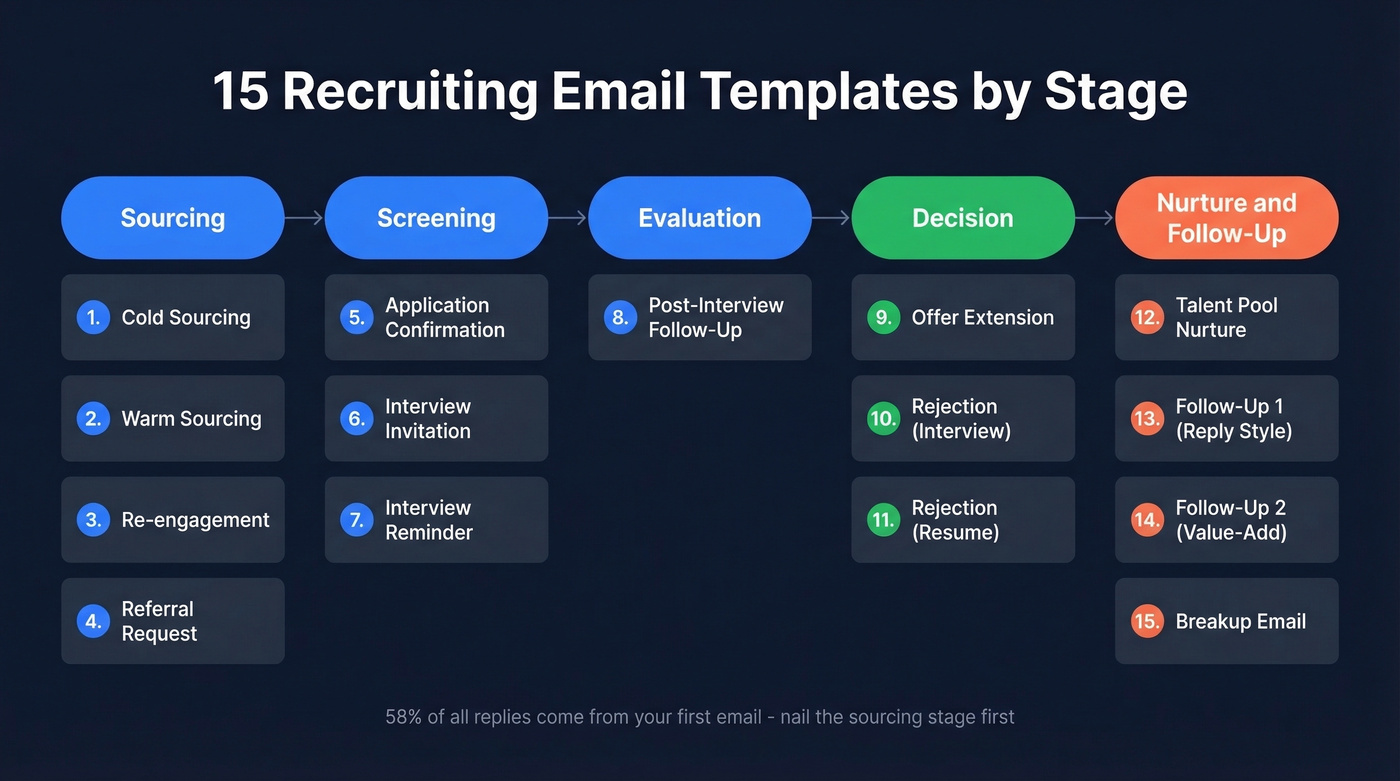
15 Recruiting Email Templates by Stage
Cold Sourcing (Passive Candidate)
When to use: First touch to someone who hasn't applied and doesn't know you.
Hi [First Name],
Your [specific work/project/skill] at [Current Company] caught my attention - especially [one specific detail]. We're building [brief team/mission context] at [Company], and I think your background in [skill] would be a strong fit for our [Role Title] opening.
Would a 15-minute call this week make sense? Happy to share comp details and the team roadmap upfront.
[Your Name]
Lead with what you know about them, not about your company. "I came across your profile" is the fastest way to get ignored. Here's what that looks like in practice:
- ❌ "I came across your profile and thought you'd be a great fit for our exciting opportunity."
- ✅ "Your migration of Acme's monolith to microservices caught my eye - we're tackling the same problem at [Company]."
Warm Sourcing (Mutual Connection)
When to use: You share a connection with the candidate.
Hi [First Name],
[Mutual Connection] mentioned you'd be a great fit for our [Role Title] opening at [Company]. We're looking for someone with [1-2 specific skills], and [they/your background in X] made the introduction feel natural.
Worth a quick conversation? I can share the full scope and comp range.
[Your Name]
Name the connection in the subject line - mutual connection subject lines hit 40-45% open rates, the highest of any category.
Re-engagement (Silver Medalist)
When to use: Someone who interviewed or applied previously but wasn't hired.
Hi [First Name],
We spoke [timeframe] ago about [previous role]. You were a strong candidate, and I've been keeping an eye out for the right fit. We just opened a [New Role] on the [Team] - and your [specific skill/experience] is exactly what we need.
Interested in reconnecting?
[Your Name]
44% of sourced hires in 2024 were rediscovered candidates. Your ATS is a goldmine - mine it before sourcing net-new.
Referral Request (Internal Employees)
Hi [Employee Name],
We're hiring a [Role Title] for [Team/Manager Name]'s team. The ideal person has [1-2 specific skills] and [one trait or experience]. Anyone come to mind?
Even a name and a "they might be interested" is helpful. I'll handle the outreach.
Thanks, [Your Name]
Make the ask specific. "Know anyone good?" gets ignored. A role, a team, and one sentence on the ideal profile gets referrals.
Application Confirmation
Hi [First Name],
Thanks for applying to [Role Title] at [Company]. We've received your application and our team is reviewing it now. You should hear back within [X business days] with next steps.
[Your Name]
Set a timeline. Candidates who know when to expect a response send fewer "just checking in" emails - and they form a better impression of your employer brand.
Interview Invitation
Hi [First Name],
Great news - we'd like to invite you to interview for [Role Title]. Here are the details:
Format: [Phone/Video/On-site/Async video] Duration: [X minutes] With: [Interviewer Name, Title] Availability: [2-3 proposed times or scheduling link]
Let me know which time works, or feel free to suggest an alternative.
[Your Name]
Include all logistics in the first email. Every back-and-forth exchange adds a day to your time-to-hire. If you're using an async video interview tool, include the platform link and a one-sentence explanation of the format - candidates who've never done one will appreciate the heads-up.
Interview Reminder
Hi [First Name],
Quick reminder - your interview for [Role Title] is [Date] at [Time] with [Interviewer Name]. [Link/location details].
Looking forward to it.
[Your Name]
Post-Interview Follow-Up
Hi [First Name],
Thanks for meeting with [Interviewer Name] today. The team was impressed with [one specific thing discussed]. We're wrapping up this round by [date] and will be in touch shortly.
[Your Name]
Offer Extension
Hi [First Name],
I'm excited to share that we'd like to offer you the [Role Title] position at [Company]. Attached is your formal offer letter with comp details, start date, and benefits.
I'm available to walk through everything by phone if that's helpful. We'd love a response by [date] - but take the time you need.
[Your Name]
The current offer acceptance rate sits at 84%. A clean, enthusiastic offer email with zero ambiguity on comp helps you stay on the right side of that number.
Rejection (After Interview)
This is the template most recruiters get wrong. A vague "we decided to go another direction" burns the bridge. A specific, respectful rejection builds your talent pipeline.
Hi [First Name],
Thank you for interviewing for [Role Title]. After careful consideration, we've decided to move forward with another candidate. Your [specific strength] stood out, and this was a close decision.
We'd love to keep you in our talent network for future roles that match your background. Would that be okay?
[Your Name]
Specific feedback plus a talent pool opt-in turns a rejection into a future pipeline asset.
Rejection (Resume Stage)
Hi [First Name],
Thanks for your interest in [Role Title] at [Company]. After reviewing your application, we've decided to move forward with candidates whose experience more closely aligns with this particular role. We'll keep your information on file and reach out if a better fit opens up.
[Your Name]
Candidate Nurture / Talent Pool
Hi [First Name],
Wanted to share a quick update from [Company] - [one piece of news: new funding, product launch, team growth, award]. Thought you'd find it interesting given your background in [area].
No ask here - just staying in touch. When the right role opens up, I'd love to reconnect.
[Your Name]
Follow-Up #1 (Reply-Style)
When to use: 3-4 days after your initial cold outreach, no response.
Hey [First Name],
Bumping this up - wanted to make sure it didn't get buried. The [Role Title] is still open and your [specific skill] is a strong match.
Worth a quick chat?
Write this as a reply to your original email - same thread, no new subject line. Reply-style follow-ups outperform formal ones by roughly 30% because they feel like a natural nudge, not a new pitch.
Follow-Up #2 (Value-Add)
When to use: 3-4 days after Follow-Up #1, still no response.
Hi [First Name],
Saw [relevant article/company news/team update] and thought of you - [one sentence on why it's relevant to them].
The [Role Title] is still open if the timing ever makes sense. Happy to share more details whenever.
[Your Name]
Share something genuinely useful - a relevant article, a team blog post, a conference talk from the hiring manager. It shows you're paying attention, not just pinging.
Breakup Email
When to use: Final touch in your sequence.
Hi [First Name],
I've reached out a few times about [Role Title] and haven't heard back - totally understand if the timing isn't right. I'll stop emailing, but the door's open if things change.
Feel free to reach out anytime: [your email/calendar link].
[Your Name]
Breakup emails often prompt replies because the "I'll stop emailing" framing creates a low-pressure moment where candidates feel safe responding. Keep the door wide open.

The gap between a 3.43% reply rate and 10%+ starts with verified data. Prospeo's 98% email accuracy means your recruiting templates actually reach real inboxes - not bounced addresses that tank your domain reputation.
Stop crafting perfect templates for bad email addresses.
How to Build a Recruiting Sequence
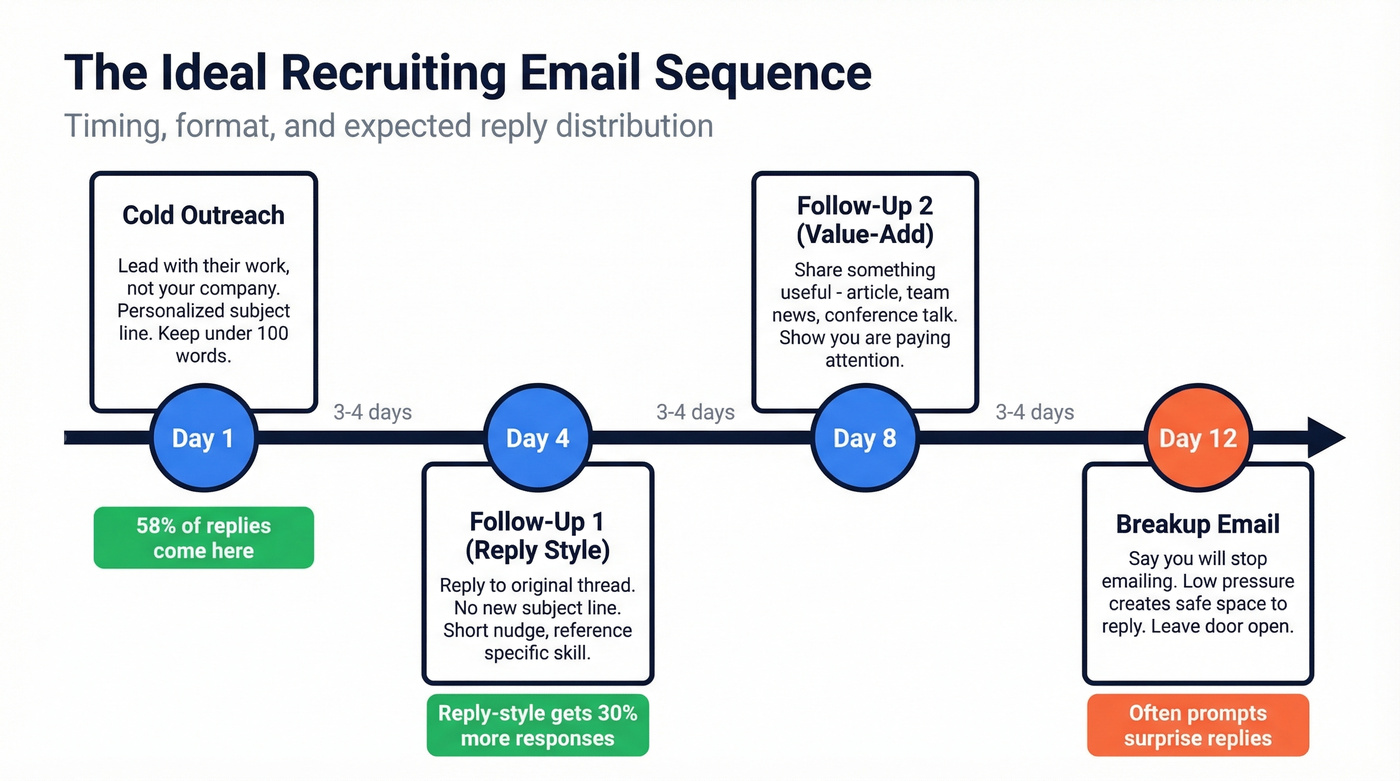
Individual templates are useful. A structured sequence is what actually fills your pipeline. With the average time-to-hire now at 41 days, every day you waste on a poorly timed sequence is a day closer to losing your top candidate.
Day 1: Cold sourcing email - personalized, under 80 words Day 4: Follow-Up #1 - reply-style bump in the same thread Day 8: Follow-Up #2 - value-add with a relevant resource or news Day 12: Breakup email - low-pressure close with an open door
The 4-7 touchpoint range is the sweet spot. Fewer than four and you're leaving replies on the table - remember, 42% of responses come from follow-ups. More than seven and you're burning goodwill with candidates who've already decided they're not interested.
Space your touches 3-4 days apart. Tuesday and Wednesday are peak response days, so time your sends accordingly.
Here's the thing, though: trigger-based timing beats day-of-week scheduling. Sending after a candidate publishes a post, changes roles, or speaks at an event generates far more replies than blasting on a Tuesday because a benchmark report told you to. For senior candidates, go multi-channel before you go multi-email. Start with a thoughtful comment on their recent talk or article, then follow with your cold email - the warm-up makes your inbox outreach feel like a continuation of a conversation rather than a cold pitch out of nowhere.
Personalizing Templates at Scale
Mass campaigns average a 2.1% reply rate. Smaller, targeted sends hit 5.8%. That's nearly 3x the response rate, and the difference comes down to personalization quality.
Personalize these:
- The opening line - reference their specific work, a project, a talk, or a skill
- The role connection - why this person for this role
- The subject line - always candidate-specific
Templatize these:
- Company description (one sentence, same across sends)
- Call-to-action (keep it consistent - "15-minute call this week?")
- Logistics and signature block
Build persona-based variations. A senior engineering leader gets a different tone and pitch than a junior product designer. An engineer cares about the tech stack and autonomy; a sales candidate cares about quota attainment and territory. One template can't serve both.
Effective candidate outreach means creating a library of modular blocks - opening lines, role pitches, and CTAs - that you can mix and match per persona rather than rewriting from scratch every time. A ChatGPT-generated email with zero candidate-specific details is worse than a good template with one genuine sentence about their work. AI can help you draft faster, but the personalization layer - the part that makes a candidate feel seen - still needs a human eye.
I've reviewed thousands of recruiting email templates over the years, and the ones that get replies almost always have one sentence that could only have been written for that specific person. Skip the "I was impressed by your background" filler and write something that proves you actually looked.
Why Your Emails Land in Spam
You can write the perfect template and still get zero replies if your emails never reach the inbox. Here's the deliverability checklist that matters:
- Send from your_name@company.com, never info@ or hr@. Candidates trust real people, not departments.
- Turn off open tracking. An analysis of 44 million emails found that disabling open tracking more than doubled reply rates - 2.36% vs. 1.08%. Tracking pixels trigger spam filters.
- Keep emails under 80 words. Shorter emails tend to get more replies.
- Never email a candidate's work address. It's a privacy risk for them and a deliverability risk for you.
- Set up SPF and DKIM authentication. If your IT team hasn't configured these, your emails are already starting at a disadvantage.
But the foundational problem most recruiters overlook is simpler: you're emailing addresses that don't exist.
Snyk's recruiting team saw their bounce rate drop from 35-40% to under 5% after switching to verified data - that's the difference between a healthy sender domain and one that's slowly getting blacklisted. Before launching any sequence, run your candidate list through a verification tool like Prospeo, which catches invalid addresses, spam traps, and catch-all domains with its 5-step verification process. Upload a CSV or verify one-by-one - the free tier covers 75 verifications per month.
If you’re troubleshooting bounces and list quality, start with email verification benchmarks and fixes.
Sourcing passive candidates means finding their real contact info first. Prospeo gives you verified emails and direct dials from 300M+ professional profiles - so your cold sourcing templates land with the right people, not dead inboxes.
Find any candidate's verified email in one click for $0.01.
Legal Compliance You Can't Skip
Recruiting emails aren't exempt from email regulations. Let's break this down by region.
CAN-SPAM requirements (US): Every message needs a truthful "From" name, a non-deceptive subject line, your company's physical mailing address, a clear opt-out mechanism, and opt-out requests honored within 10 business days. Penalties reach $53,088 per non-compliant email - per email, not per campaign.
GDPR requirements (EU/EEA candidates): This applies to any organization processing EU residents' data, regardless of where you're based. Legitimate interest is the typical legal basis for recruiting outreach, but you need to document it. Candidates must be able to request data deletion. Cumulative GDPR fines have exceeded EUR 5.88 billion across 2,245 enforcement actions and climbing. If you're emailing EU candidates, send a consent renewal email when their data retention period approaches.
Most recruiters don't think about compliance until something goes wrong. Add an unsubscribe link to your sequences, use a real sender address, and keep records of your outreach. It takes five minutes to set up and protects you from five-figure penalties.
For more on safe outreach mechanics, see cold email marketing and email deliverability.
FAQ
How long should a recruiting email be?
Under 80 words for the first touch. Candidates decide whether to engage within 15-20 seconds of opening. Save the detailed job description for the conversation - your template's job is to start a dialogue, not close a hire.
What's a good reply rate for recruiting email templates?
The average cold outreach reply rate is 3.43%. Top-quartile recruiters hit 5.5%+, and elite performers clear 10.7%. If you're consistently below 3%, the problem is usually your subject lines, your data quality, or both.
How many follow-ups should I send?
Four to seven total touchpoints is the sweet spot. 58% of replies come from the first email, but follow-ups capture the remaining 42%. Space them 3-4 days apart and make each one add something new - a resource, a piece of news, or a different angle on the role.