

The Relationship Selling Process That's Actually Measurable
One RevOps lead described his team's relationship selling strategy as "expensive coffee meetings with no pipeline attribution." That stung because it's true for most orgs. The bulk of advice on the relationship selling process boils down to "be nice, build trust, close deals" - about as useful as telling a chef to "make good food." The consensus on r/sales is blunt: "Prospects aren't stupid - they know you want to sell." This approach works, but only when it's built on usefulness, not rapport theater.
Quick Version
- Relationship selling works when it's measurable and value-driven - not fake friendliness.
- Six steps: verified contacts, committee mapping, gap analysis, value-first outreach, disciplined listening, post-sale nurture.
- Track stakeholders engaged, backchannels created, and net revenue retention. Not coffee meetings.
What Is Relationship Selling?
Relationship selling prioritizes long-term connection and mutual value over quick closes. It overlaps with consultative and solution selling but extends further - through the deal and into renewals and expansion. Think of it as consultative selling with a longer time horizon and a deliberate focus on personal connection.
| Methodology | Core Lever | When to Use |
|---|---|---|
| Transactional | Speed, volume | Low-ticket, B2C |
| Consultative | Expertise, advice | High-ticket B2B |
| Relationship | Trust over time | Complex, multi-year |
| Solution | Pain-to-fix mapping | Mid-market B2B |
| Challenger | Tension, reframing | Status-quo accounts |
Why Relationship Selling Is Non-Negotiable Now
Forrester's State of Business Buying, as cited by Traction Complete, puts the average B2B purchase at 13 stakeholders. Gartner's research shows buyers spend only 17% of their total purchase time meeting with vendors. You get a sliver of their attention, split across your competitors.
Meanwhile, 86% of B2B purchases stall at some point, and 41% of buyers already have a preferred vendor before formal evaluation begins. If you're not building relationships across the committee early, you're showing up to a race that's already over.
Here's the thing: if your deal size is small and your sales cycle wraps up in days, you probably don't need a formal relationship-based approach. A solid B2B sales consultative method will do. But the moment you're selling into committees with 6+ stakeholders, investing in trust-building pays for itself many times over.

Relationship selling starts with reaching every stakeholder. Prospeo gives you 98% verified emails and 125M+ direct dials across 300M+ profiles - refreshed every 7 days. Use 30+ filters to map entire buying committees by role, seniority, and department before your competitor even identifies the decision-maker.
Stop building relationships with the wrong people at dead email addresses.
The 6-Step Process for Selling Through Relationships
Step 1 - Build a Verified Contact List
You can't build a relationship with someone you can't reach. We've seen SDRs send 200 emails, watch 70 bounce, and wonder why the pipeline looks empty. Bad data breaks outbound before it begins.
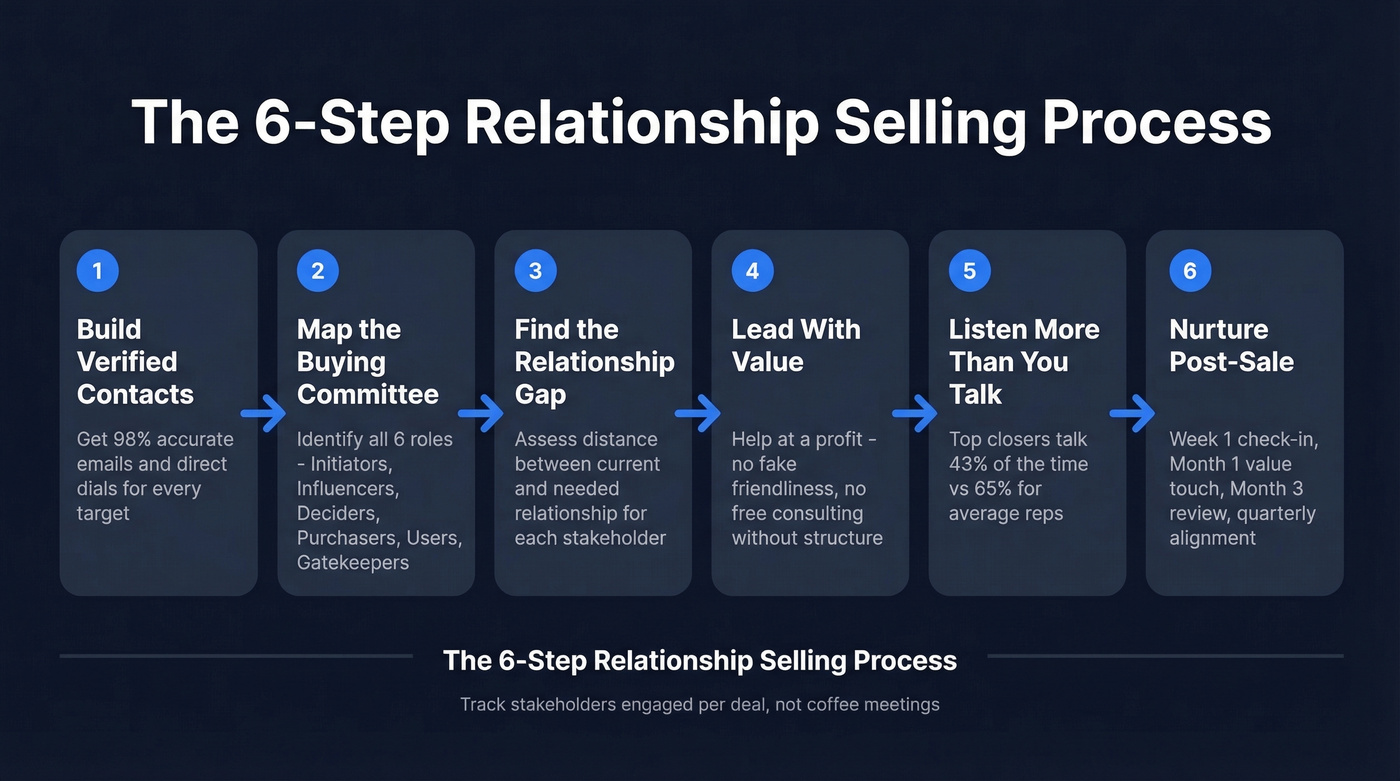
This is where accurate contact data matters most. Prospeo delivers 98% email accuracy across 143M+ verified emails on a 7-day refresh cycle - compared to the 4-6 week cadence you'll find at most legacy providers. Search by 30+ filters, pull verified mobile numbers, and export directly into your CRM or sequencer. When your first touchpoint actually lands, the relationship has a chance to start.
Step 2 - Map the Buying Committee
Your champion loves the product. The demo went great. Then the deal stalls for six weeks because the CFO and IT security director were never mapped. We've watched this happen dozens of times.
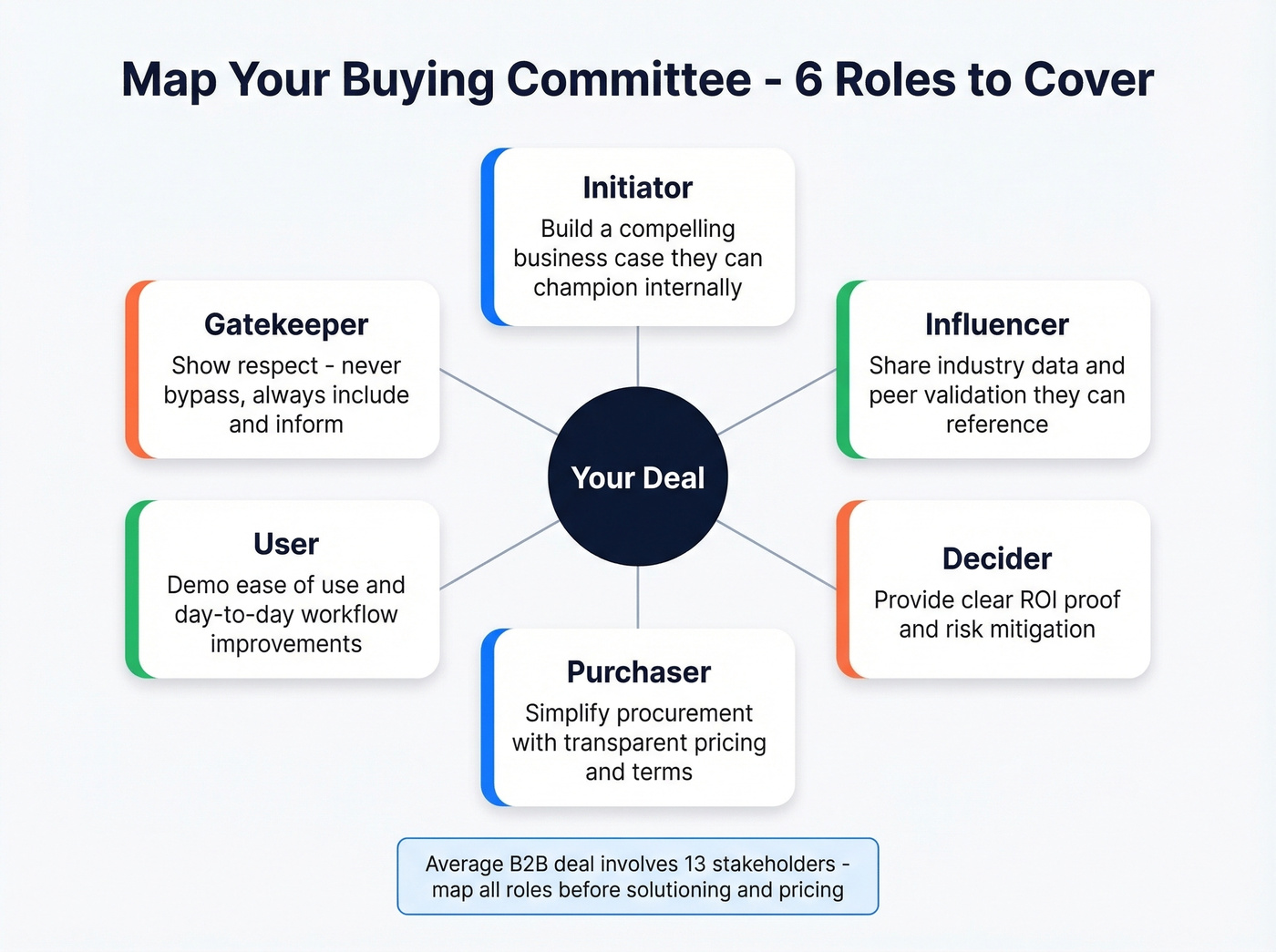
Use the Bonoma/HBR framework: Initiators, Influencers, Deciders, Purchasers, Users, and Gatekeepers. For each role, identify one tactic. Initiators need a compelling business case. Deciders need ROI proof. Gatekeepers need to feel respected rather than bypassed. Aim to have all six roles mapped by the time you're moving into solutioning and pricing - not after.
Step 3 - Find the Relationship Gap
Altify's "relationship gap" is the most useful framework here. For each stakeholder, assess the distance between your current relationship and what's needed to influence the decision.
A champion you've met three times has a small gap. The VP of Finance who's never heard your name has a massive one. Close the widest gaps first - that's where deals die.
Step 4 - Lead With Value, Not Rapport
Reddit practitioners are clear: the "I'm not trying to sell you anything" approach feels manipulative. A Sandler-style "here's what problems we fix, let's see if there's a fit" works better than fake friendliness. As Jim Cathcart put it, relationship selling's purpose is "to help other people at a profit for you."
But watch the free consulting trap. Gate your workshops and audits, tie every piece of help to a sales objective. Generosity without structure creates bloated pipelines and ghosting. If you've given three free strategy sessions and there's no next step on the calendar, you're not relationship selling - you're volunteering.
Step 5 - Listen More Than You Talk
Gong's data is definitive: top closers speak 43% of the time versus 65% for average performers. That 22-point gap is the difference between earning the right to sell and talking yourself out of a deal.
Let's be honest - most reps know this and still talk too much. In any trust-driven sales motion, listening isn't just a nice skill. It's the single highest-return habit you can build.
Step 6 - Nurture Post-Sale
The deal closes. Most reps disappear. A 5% increase in customer retention rates can increase profits by 25%.
Build a concrete cadence: Week 1 check-in, Month 1 value touch, Month 3 business review, quarterly strategic alignment. Relationships compound - treat them like assets, not transactions. Skip this step if you're only selling one-time deals with no expansion potential, but for anything recurring, post-sale nurture is where the real revenue lives.
Measuring Your Results
The r/sales consensus is that calls and emails are "meaningless metrics" for relationship selling. Borrow Varicent's four-pillar framework instead:
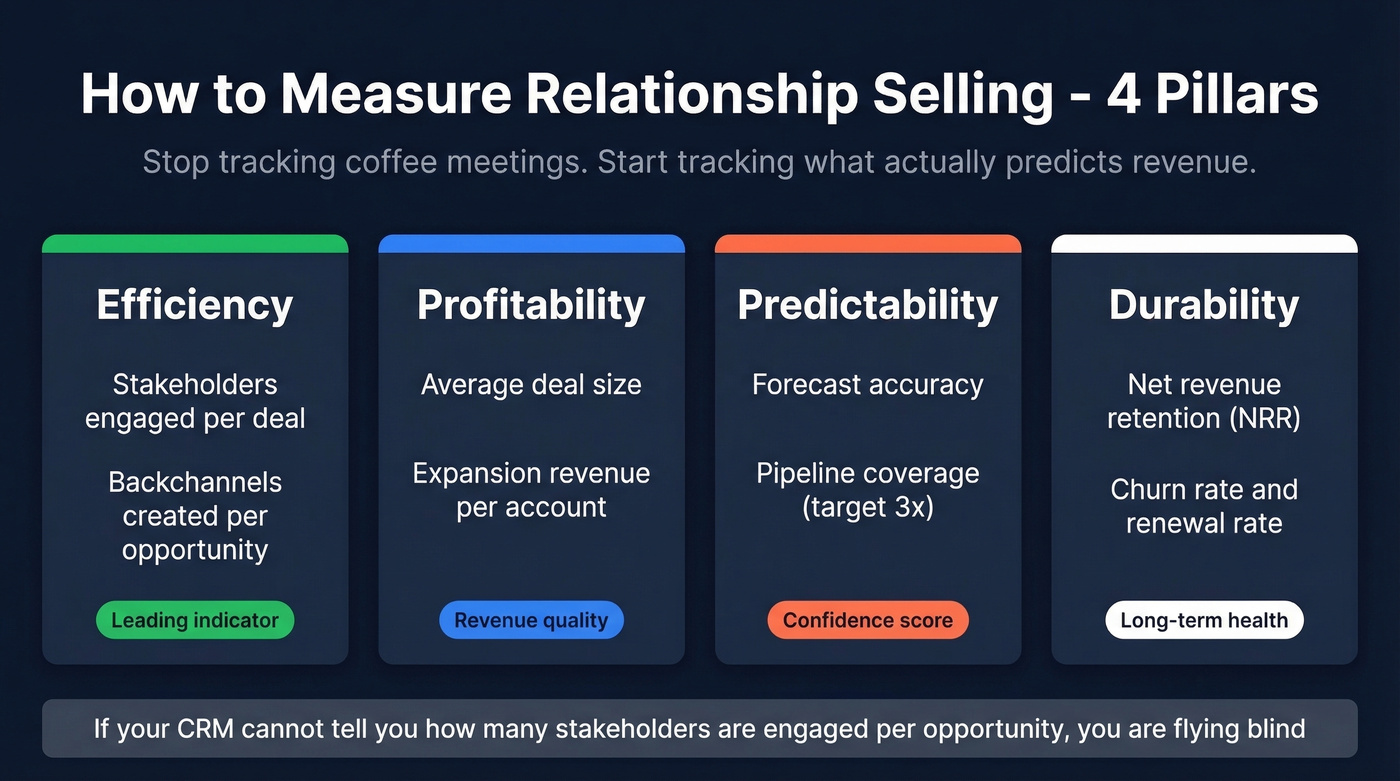
| Pillar | KPIs | Target |
|---|---|---|
| Efficiency | Stakeholders engaged per deal | Increase over time in complex deals |
| Profitability | Deal size, expansion revenue | Improve expansion in retained accounts |
| Predictability | Forecast accuracy, pipeline coverage | 3x coverage |
| Durability | NRR, churn rate, renewal rate | Improve retention and renewal outcomes |
If your CRM can't tell you how many stakeholders are engaged per opportunity and what each one cares about, you're flying blind. In our experience, teams that track stakeholders-per-deal as a leading indicator catch single-threading problems weeks before the deal stalls.
Mistakes That Kill Deals
Do this: Maintain a 40/60 talk-to-listen ratio. Map all six buying committee roles early. Verify contact data before launching sequences.
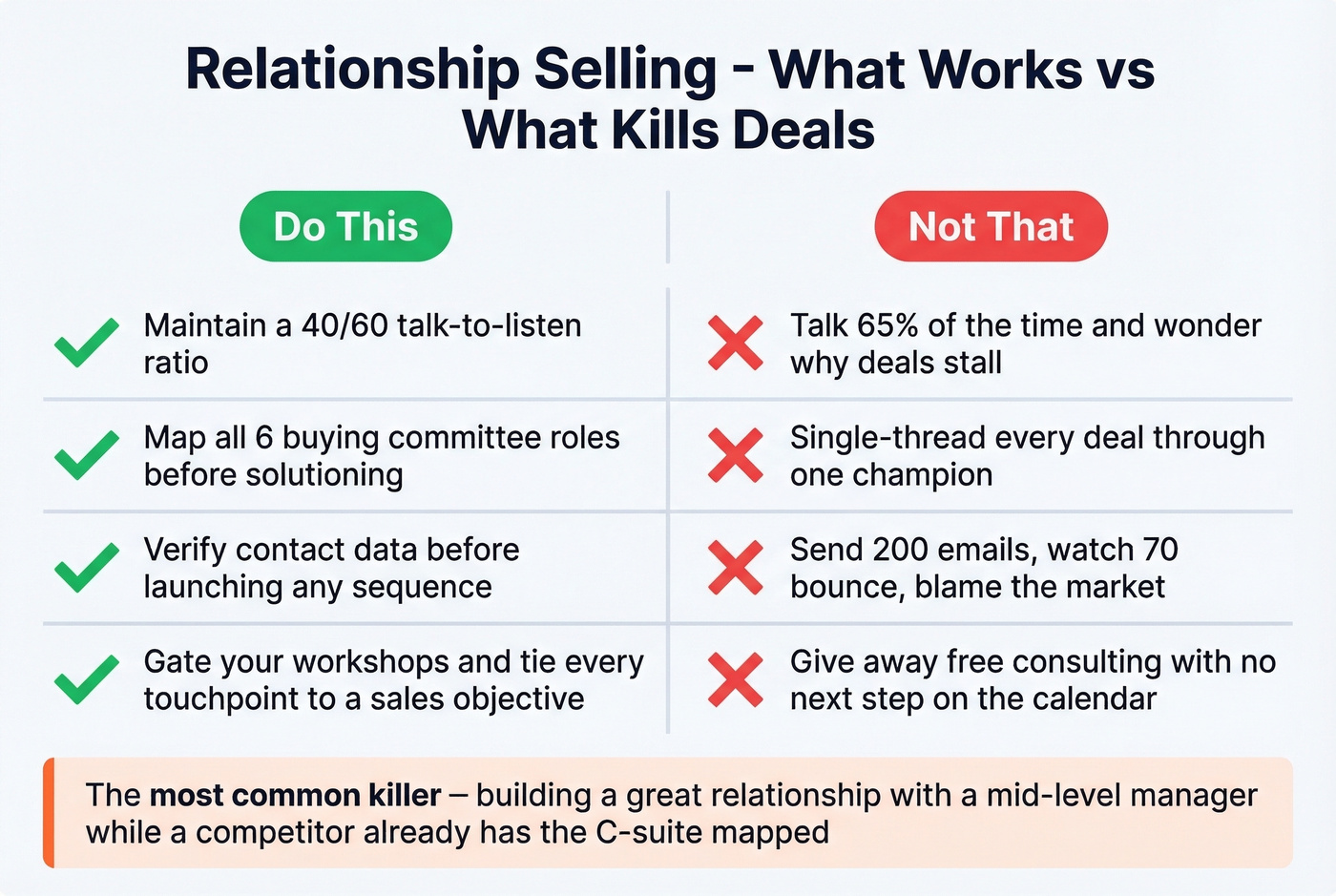
Not that: Talk 65% of the time and wonder why deals stall. Single-thread every opportunity through one champion. Speak to the wrong stakeholders because you never mapped the committee. Give away free consulting with no sales objective attached.
One scenario we see constantly: a rep builds a great relationship with a mid-level manager, runs a flawless demo, then discovers the actual decision-maker is a C-suite exec they've never spoken to. By the time they get the intro, a competitor who mapped the committee on day one already has the inside track. That's not bad selling - it's bad process.
You just mapped 13 stakeholders. Now you need verified contact data for every single one - the CFO, the gatekeeper, the silent influencer. Prospeo's database covers 143M+ verified emails at $0.01 each, with CRM enrichment that returns 50+ data points per contact. Close the relationship gap before the deal stalls.
Reach every member of the buying committee on the first attempt.
FAQ
What's the difference between relationship selling and consultative selling?
Consultative selling builds trust through expertise within a single deal cycle. A relationship-based sales process extends that through post-sale nurture, renewals, and expansion - it's consultative selling with a longer time horizon and deliberate multi-stakeholder engagement.
How long does this process typically take?
Simple B2B deals close in 2-4 weeks. Enterprise deals with 10+ stakeholders run 3-9 months. Mapping the buying committee early - with verified contact data so you're not wasting weeks on bounced outreach - compresses the timeline significantly.
What tools support a relationship selling process?
You need three layers: a CRM for tracking stakeholder touchpoints like HubSpot or Salesforce, a verified contact data platform for accurate emails and direct dials, and a structured system for logging relationship gaps per stakeholder. Intent data adds a fourth layer - tracking active buying signals so you can time outreach to when prospects are actually in-market.