


10 Best Relevance AI Alternatives in 2026
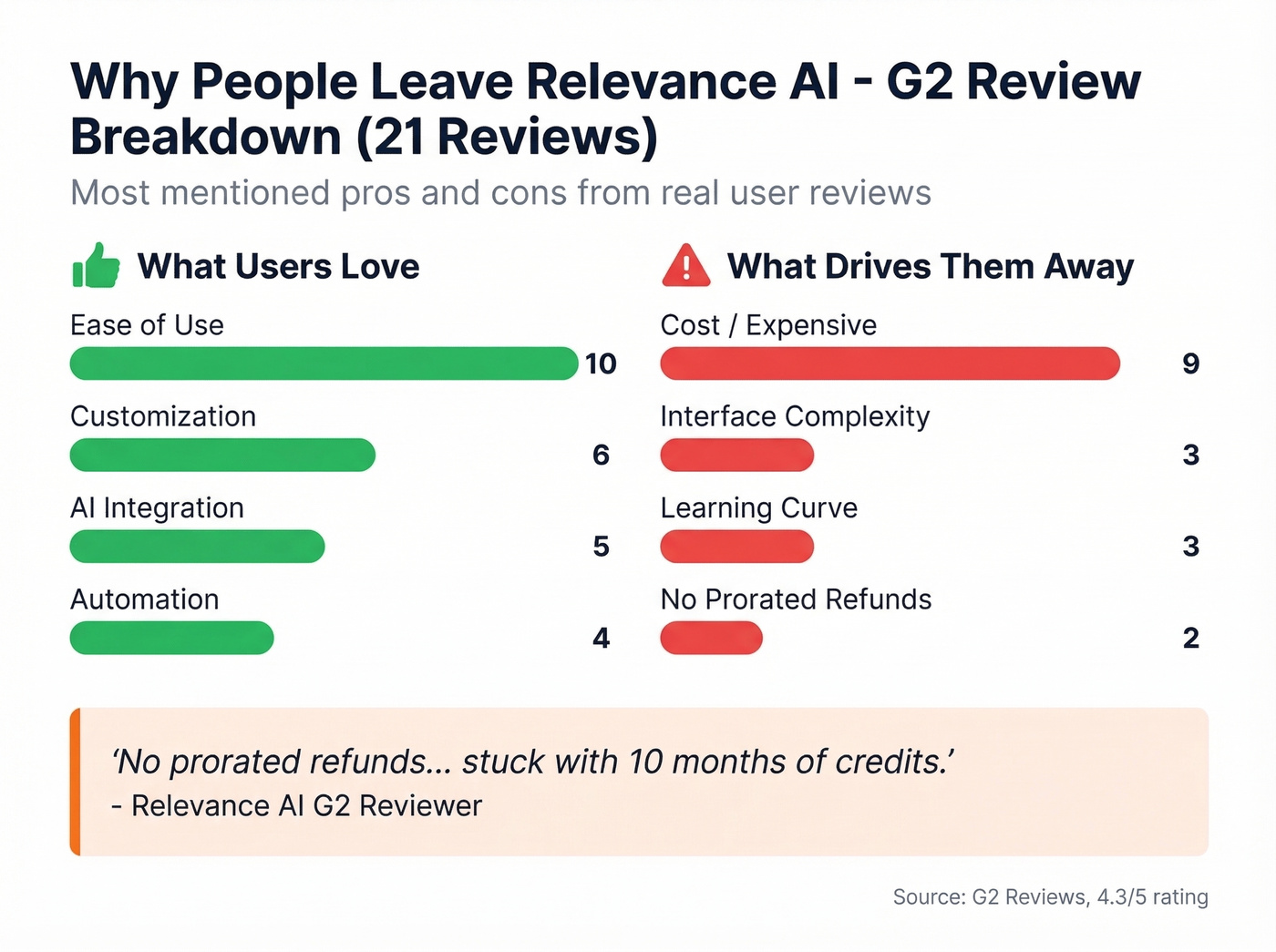
You just opened your Relevance AI invoice and the credit math doesn't add up. You're not alone - on G2's Pros & Cons rollup, Cost (5 mentions) and Expensive (4 mentions) show up again and again across the 21-review set, and one reviewer put it bluntly: "No prorated refunds... stuck with 10 months of credits." Credit-based billing sounds flexible until you're bleeding money on agent runs you can't predict.
Here are 10 alternatives that give you more control over what you pay - and one data layer that makes whichever tool you pick actually work.
Top Picks at a Glance
| Pick | Best For | Starting Price |
|---|---|---|
| n8n | Technical teams wanting self-hosting and predictable billing | EUR 20/mo (pay per execution, not per step) |
| Make.com | Reliability and low cost with growing AI capabilities | Free (1,000 credits/mo) |
| Prospeo | Verified emails + direct dials for any agent workflow | Free (75 emails/mo), ~$0.01/email |
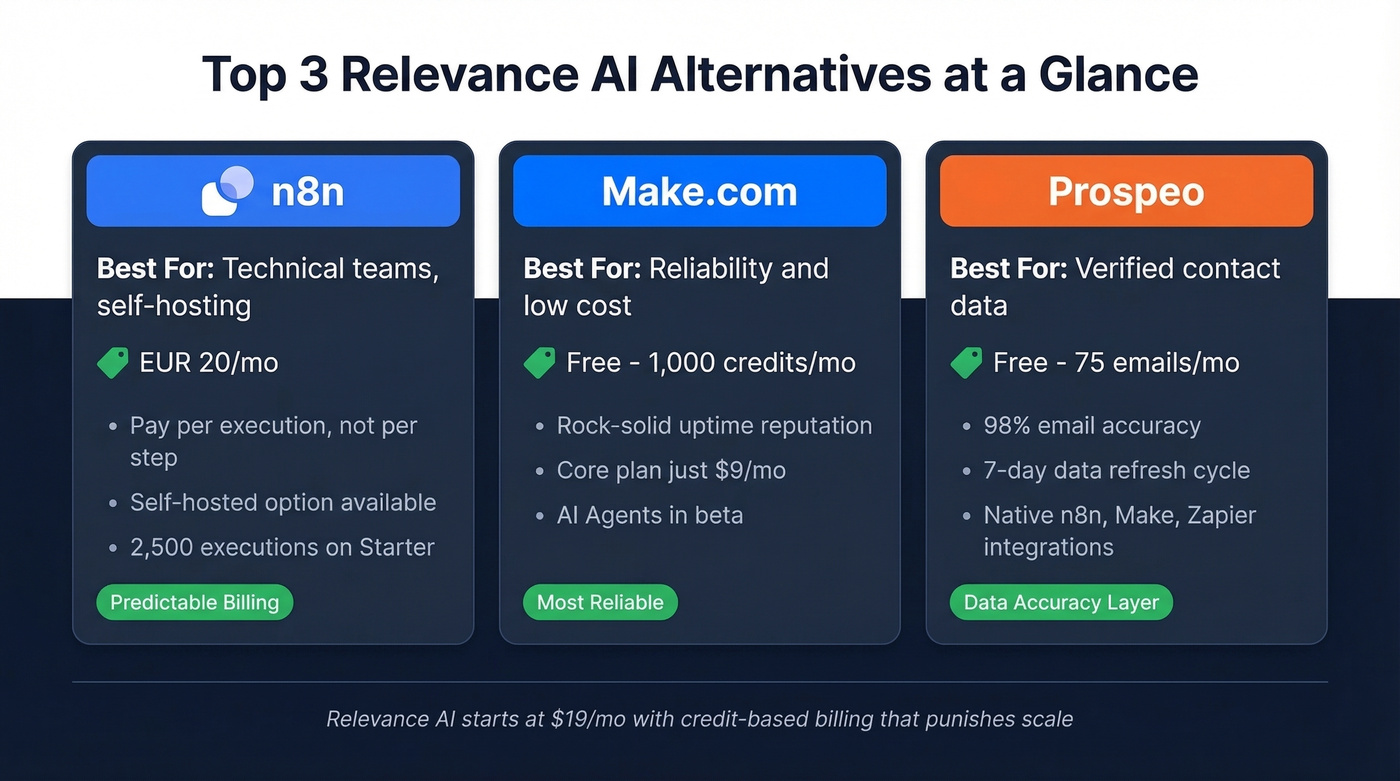
n8n's execution-based billing means you pay for a full workflow run regardless of how many steps it contains - that alone kills the "surprise invoice" problem. Make.com is the workhorse that doesn't break. And Prospeo fills the gap every agent builder ignores: making sure the contact data your agents use is actually accurate.
Why People Switch from Relevance AI
Relevance AI carries a 4.3/5 on G2 from 21 reviews. The praise is real - ease of use gets 10 positive mentions, and customization and AI integration are consistently called out as strengths. But the billing model is where things fall apart. Cost and pricing complaints are the most repeated negatives, and interface complexity shows up too (3 mentions), along with a learning curve.
On pricing: Relevance AI's pricing page presents plans in more than one way depending on which section you're looking at. One credit-based tier set runs Free / $19/mo (Pro) / $199/mo (Team) / $599/mo (Business) with monthly credit caps. Another plan table emphasizes actions plus vendor credits, with Free ($0), Pro ($29/mo or $19/mo annual), Team ($349/mo or $234/mo annual), and Enterprise (custom), plus top-ups for extra actions, credits, and storage. Either way, it's easy to hit usage ceilings once you move from testing to production.
Here's the thing: credit-based billing creates a specific kind of anxiety. You build an agent, it works great in testing, you deploy it - and suddenly you're watching credits drain faster than expected with no clear way to predict monthly spend. The billing model punishes success.

Credit-based billing anxiety doesn't stop at your agent platform - it starts with bad data. Every bounced email is a wasted credit, a hit to your domain, and a lost opportunity. Prospeo delivers 98% email accuracy on a 7-day refresh cycle, so your agents send to real inboxes every time.
Stop burning agent credits on emails that bounce.
Best Relevance AI Alternatives Compared
n8n
n8n is the obvious pick for technical teams who want control over their infrastructure and their invoices. The execution-based billing model is the key differentiator: you pay per full workflow execution , not per step. A 50-step workflow costs the same as a 5-step one.
The Starter plan runs EUR 20/mo (billed annually) with 2,500 workflow executions. Pro bumps to EUR 50/mo with a custom number of executions and 20 concurrent runs. Self-hosted options exist for teams that need data on-prem - the Business (self-hosted) tier is EUR 667/mo and includes 40K workflow executions plus enterprise controls like SSO.
Reddit threads on r/automation consistently praise n8n for privacy, visual flow building, and community support. One practitioner summed it up: the appeal is "longevity, privacy, pricing, and community." The tradeoff? Self-hosting requires setup, and complex multi-agent designs need careful state management. But if your team has even one developer, n8n offers one of the most predictable billing models in this space.
Use this if you want self-hosting, transparent pricing, and a massive connector library. Skip this if your team is entirely non-technical and nobody wants to touch infrastructure.
Make.com
Make.com's biggest selling point is reliability. We've heard the same refrain from multiple practitioners: "It just never broke... solid, cheap." That's not a flashy pitch, but reliability is underrated when you're running production workflows.
The free tier gives you 1,000 credits per month, and each module action in a scenario counts as one credit. Core starts at $9/mo (10,000 credits/mo). Pro is $16/mo. Teams is $29/mo. These are real numbers, not "contact sales" hand-waving.
Make offers AI Agents (beta) plus an AI Toolkit that works with their built-in AI provider or your own LLM key. It isn't as agent-native as Relevance AI, but the AI capabilities are growing fast on top of an already rock-solid automation foundation.
Use this if you want the most reliable, cheapest automation platform with emerging AI agent features. Skip this if you need the most advanced multi-agent orchestration out of the box.
Prospeo
Every agent builder on this list has the same blind spot: they assume the data flowing through your workflows is accurate. It usually isn't.
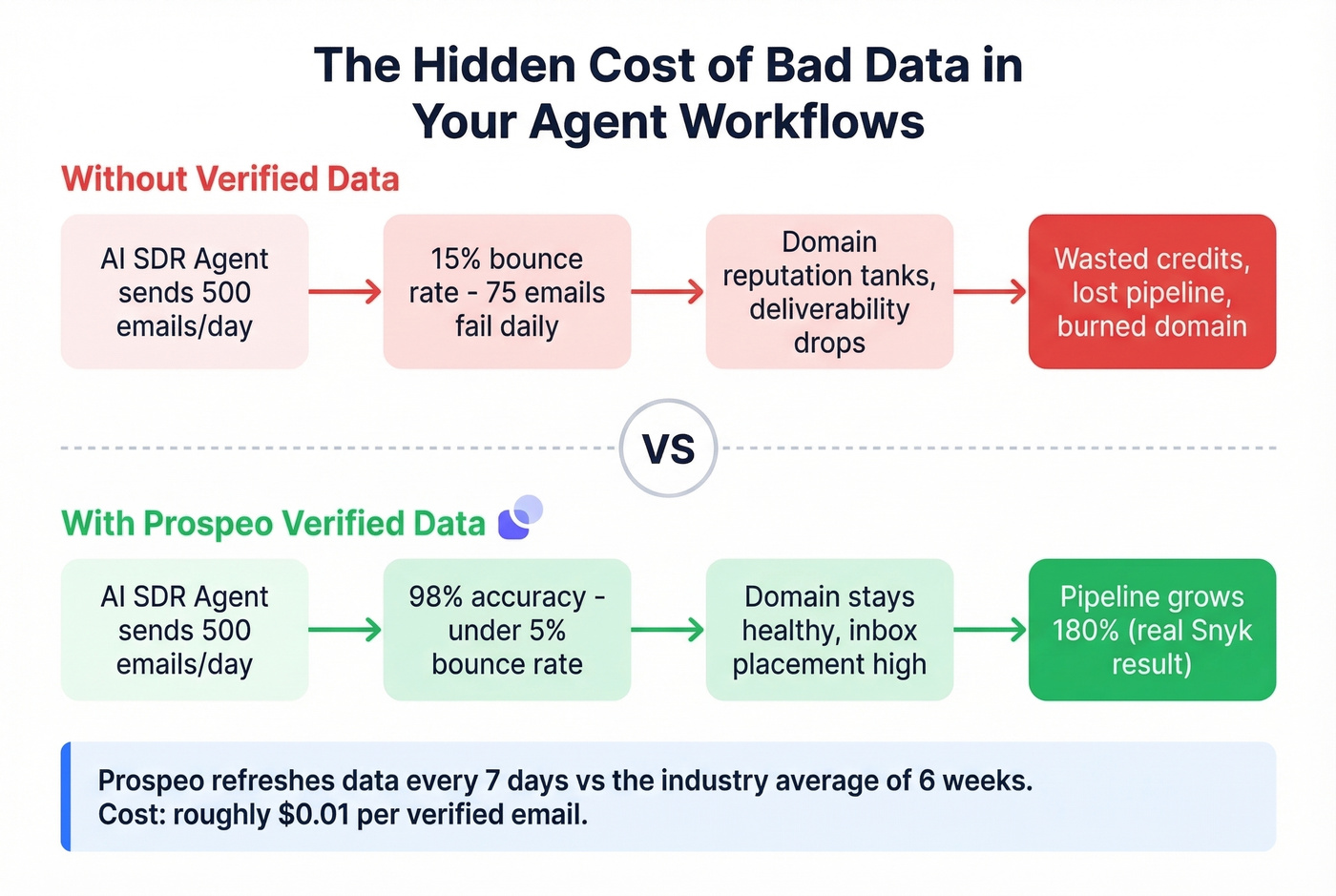
We built Prospeo to solve that specific problem. It provides 300M+ professional profiles, 143M+ verified emails at 98% accuracy, and 125M+ verified mobile numbers - all refreshed on a 7-day cycle where the industry average is six weeks. It integrates natively with n8n, Make, and Zapier, so whatever agent platform you choose, you can pipe verified contacts directly into your workflows.
Here's a scenario that plays out constantly: your AI SDR agent sends 500 emails a day and 15% bounce. That's 75 wasted sends daily, your domain reputation is tanking, and the agent builder can't fix it because the problem isn't the agent - it's the data feeding it. One of our customers, Snyk, had 50 AEs dealing with 35-40% bounce rates before switching. After plugging in Prospeo, bounces dropped under 5% and AE-sourced pipeline jumped 180%.
Pricing is ~$0.01 per email, the free tier starts at 75 verified emails per month, and there are no contracts required. If you're comparing providers, start with these data enrichment services to see what "accurate" really means.
Use this if your agents touch contact data at any point in the workflow. Skip this if your automation doesn't involve outreach or contact enrichment.
Gumloop
Practitioners call Gumloop "Slick & Stable... UI is a pleasure," and that's not something you hear about most automation tools. If you've been frustrated by clunky workflow builders, Gumloop's modern, AI-native interface is a genuine breath of fresh air.
The catch: Gumloop uses credit-based billing. Plans include Free, Solo ($37/mo), Team ($244/mo), and Enterprise (custom). The experience is better, but the billing anxiety doesn't fully disappear.
Use this if you want a polished, AI-native builder and don't mind credit-based pricing. Skip this if you're cost-sensitive at scale.
Lindy AI
One reviewer nailed the Lindy experience: "You can't even slightly look under the hood." That's either a feature or a dealbreaker depending on who you are. For non-technical marketers who want an AI assistant that handles tasks without requiring them to understand what's happening underneath, Lindy delivers.
The Plus plan runs $49.99/mo, and Pro is $59.99/mo. Enterprise pricing is custom. A free tier offers 400 credits/month (up to 40 tasks) with credit top-ups like 1,000 credits for $10.
Skip this if you're even slightly technical - the lack of transparency will frustrate you within a week.
Zapier
Look, Zapier is the incumbent everyone already has. It offers 6,000+ SaaS integrations, and that breadth is the whole reason it's everywhere.
Reddit users consistently flag Zapier as expensive for high-volume tasks, and the task-based billing compounds fast. Standard automation plans start at $29.99/mo (Starter) and go to $73.50/mo (Professional) on annual billing. Zapier's AI agents pricing is separate, with a $50/mo Pro tier. For simple "if this, then that" automations, Zapier is still king. For complex agent orchestration, you're often overpaying.
If your workflows are outbound-heavy, pair Zapier with a dedicated SDR tool so automation doesn't become your sales system.
StackAI
If you're in healthcare, finance, or legal, governance isn't optional - it's the first filter. StackAI is built for teams that need stronger controls than a lightweight automation tool, including enterprise-friendly governance patterns like auditability and role-based access.
The free plan includes 500 runs/month, which is generous enough to test workflows before committing. Paid plans start at $139/mo (Starter). Enterprise tiers go higher with dedicated support and custom configurations.
Skip this if you're a startup that just needs to ship fast - the governance overhead adds friction you don't need yet.
CrewAI
CrewAI is purpose-built for multi-agent orchestration - multiple AI agents collaborating on complex tasks. It's powerful when it works, but Reddit users warn that agents can get stuck in loops if your prompts aren't tight. Free tier available, Pro ~$49.99/mo.
Langflow
Langflow is a free, open-source framework for developers building multi-tool agent architectures. It supports both MCP server and MCP client capabilities, meaning your agents can expose tools via MCP and also consume tools from other MCP servers across the ecosystem. Self-hosted is free; cloud plans available. Langflow's framework guide is worth reading if you're evaluating orchestration layers and tooling connectors.
Flowise
Flowise is another open-source option, focused specifically on RAG pipelines and chatbot workflows. Self-hosted is free. Cloud hosting starts at $35/mo. If your use case is retrieval-augmented generation rather than general agent building, Flowise is purpose-built for that.
Pricing Comparison
| Tool | Starting Price | Free Tier? | Billing Model | Best For |
|---|---|---|---|---|
| Relevance AI | $19/mo (Pro) | Yes (200 actions) | Credits + actions | No-code agents |
| n8n | EUR 20/mo | Self-hosted free | Per execution | Technical, self-hosted |
| Make.com | $9/mo (Core) | Yes (1,000 credits) | Per module action | Reliable, cheap automation |
| Prospeo | ~$0.01/email | Yes (75 emails) | Per verified contact | Verified data for agents |
| Gumloop | $37/mo (Solo) | Yes | Credits | AI-native workflow UI |
| Lindy AI | $49.99/mo (Plus) | Yes | Credits + tasks | Non-technical marketers |
| Zapier | $29.99/mo (Starter) | Yes | Per task | Integration breadth |
| StackAI | $139/mo (Starter) | Yes (500 runs) | Per run | Regulated industries |
| CrewAI | ~$49.99/mo (Pro) | Yes | Per agent run | Multi-agent orchestration |
| Langflow | Free (self-hosted) | Yes | Self-hosted / cloud | Developer agent frameworks |
| Flowise | $35/mo (cloud) | Yes (self-hosted) | Self-hosted / cloud | RAG and chatbot pipelines |
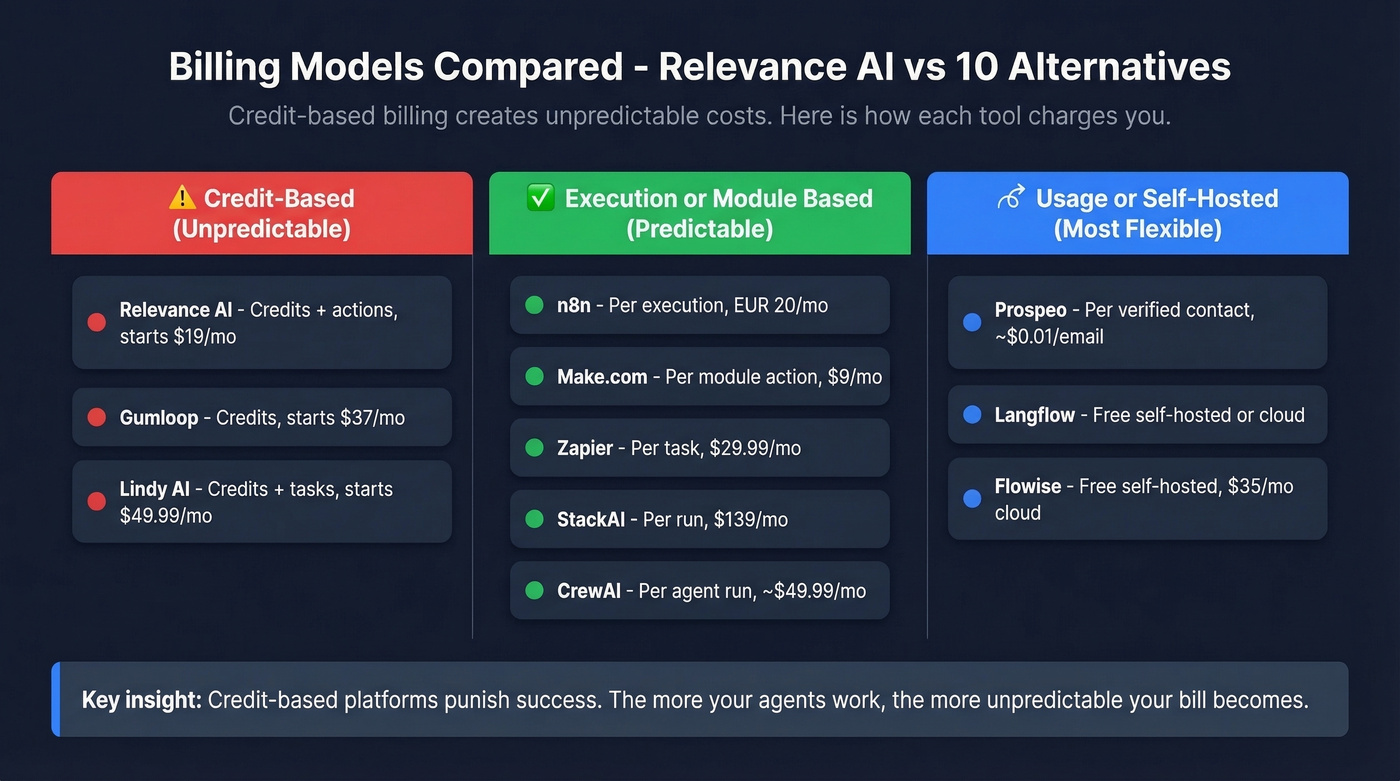
The pattern is clear: credit-based billing (Relevance AI, Gumloop, Lindy) creates unpredictable costs. Execution-based (n8n) and per-module (Make.com) models are easier to forecast.
Our take: Most teams don't need an all-in-one agent platform. A solid automation tool paired with accurate contact data outperforms any single platform trying to do everything. The "all-in-one" pitch is how vendors justify $199/mo tiers. If you're building lists to feed these workflows, use a dedicated sales prospecting database instead of scraping and hoping.
Which Alternative Fits Your Team?
Let's break this down by team type, because the right answer depends entirely on who's building and what they're building.
If your team has developers and wants self-hosting with full control, n8n is the clear winner. If you need reliability and low cost above everything else, Make.com has earned that reputation over years of production use. For a polished, AI-native builder where the UI actually feels modern, Gumloop is the pick - just watch the credit burn. Non-technical marketers who want zero-config automation will be happiest with Lindy AI. And if you're in a regulated industry where governance is non-negotiable, StackAI is built for that from the ground up.
When evaluating agent frameworks, think in layers: orchestration model, tooling and connectors, memory and state management, and evals and guardrails. Not every tool covers every layer, and that's fine - the best stacks are composable. LangChain's agent architecture docs are a solid reference if you want to go deeper on how these layers interact.
You don't need to replace Relevance AI with another all-in-one platform. The smarter move is often simpler: one solid agent builder plus one accurate data source. That combination outperforms tool-hopping every time. If your agents send email, make sure you understand email deliverability and how bounce rates impact sender reputation.
Snyk's 50 AEs went from 35-40% bounce rates to under 5% after switching to Prospeo - and AE-sourced pipeline jumped 180%. Whatever agent platform you pick from this list, pipe in 143M+ verified emails and 125M+ direct dials at $0.01/email with zero contracts.
Fix the data layer every agent builder ignores.
FAQ
Is Relevance AI worth the price?
Relevance AI earns a 4.3/5 on G2 with genuine strengths in ease of use, customization, and AI integration. But cost complaints appear repeatedly in reviews, and credit-based billing makes monthly spend hard to predict. It's worth it if your usage stays within a single tier - the moment you hit usage ceilings, the value equation breaks fast.
What are the cheapest alternatives?
Make.com's free tier gives you 1,000 credits per month at zero cost. n8n is free if you self-host. Langflow and Flowise are both free and open-source. For the best paid value, Make.com's Core plan at $9/mo with 10,000 credits is hard to beat.
Are there open-source options?
Three strong picks: n8n offers self-hosted deployment with a massive community. Langflow supports MCP server and MCP client capabilities for complex agent architectures. Flowise focuses on RAG pipelines and chatbots. More control and lower cost, but more setup on your team.
Which alternative is best for multi-agent workflows?
CrewAI is purpose-built for multi-agent orchestration if you're comfortable with code. LangGraph (from LangChain) is another strong option recommended frequently on Reddit for teams that want granular control over agent state and routing. The caveat for all: multi-agent reliability depends heavily on prompt quality and data accuracy.
How do I get accurate contact data into my AI agents?
Prospeo provides 98% verified emails and 125M+ mobile numbers accessible via API or native integrations with n8n, Make, and Zapier. Search by 30+ filters or connect via API to feed verified contacts directly into your agent workflows. The free tier includes 75 verified emails per month - enough to test the pipeline before committing.