

Responsibilities of a Sales Manager: What the Role Actually Looks Like in 2026
You've got 8 reps, a $2M quarterly target, and a CRM full of contacts that were "verified" six months ago. Half the phone numbers are disconnected. Two reps are coasting. Your forecast is due Friday, and the VP wants to know why pipeline coverage dropped below 3x.
Welcome to Monday morning as a sales manager.
Here's the thesis most job descriptions miss: the responsibilities of a sales manager boil down to three jobs - build the team, build the pipeline, and build the forecast. Everything else is a sub-task.
The quick version:
- Team: Hire, coach, fire. In that order of importance.
- Pipeline: Own coverage ratios, deal velocity, and data quality.
- Forecast: Deliver a number your VP can take to the board without flinching.
- KPIs to track first: pipeline coverage (3-4x), win rate (20-30%), sales cycle length, quota attainment, rep ramp time.
What Is a Sales Manager?
A sales manager leads a team of individual contributors toward a revenue target. The Bureau of Labor Statistics defines the role more broadly - setting goals, analyzing data, projecting profitability, resolving escalations - but it always comes back to this: you're accountable for a number, and you hit it through other people. A senior rep closes deals solo. A manager multiplies output across an entire team.
There are currently 619,500 sales manager jobs in the U.S., with a median annual pay of $138,060. The role is growing at about 5% through 2034, with roughly 49,000 openings per year. The biggest employers are wholesale trade (20%), retail (16%), and professional/scientific/technical services (13%), followed by finance and insurance (11%) and manufacturing (10%).
The industry mix shapes the job dramatically. A B2B SaaS sales manager running outbound sequences and managing 6-month deal cycles lives in a different world than a B2C retail manager optimizing high-volume transactional sales. B2B management is relationship-driven - longer cycles, more stakeholders, heavier CRM dependency. B2C management is velocity-driven - higher lead volume, faster decisions, more emphasis on conversion rate optimization. The duties shift depending on which side of that divide you sit on, and we've seen managers struggle badly when they jump from one to the other without adjusting their playbook.
Certifications like the CPSP and SMEI's Certified Sales Executive exist and can help with career progression, but no hiring manager we've talked to has ever made a decision based on a sales management certification. Results and references still win.
Sales Manager vs. Director vs. VP
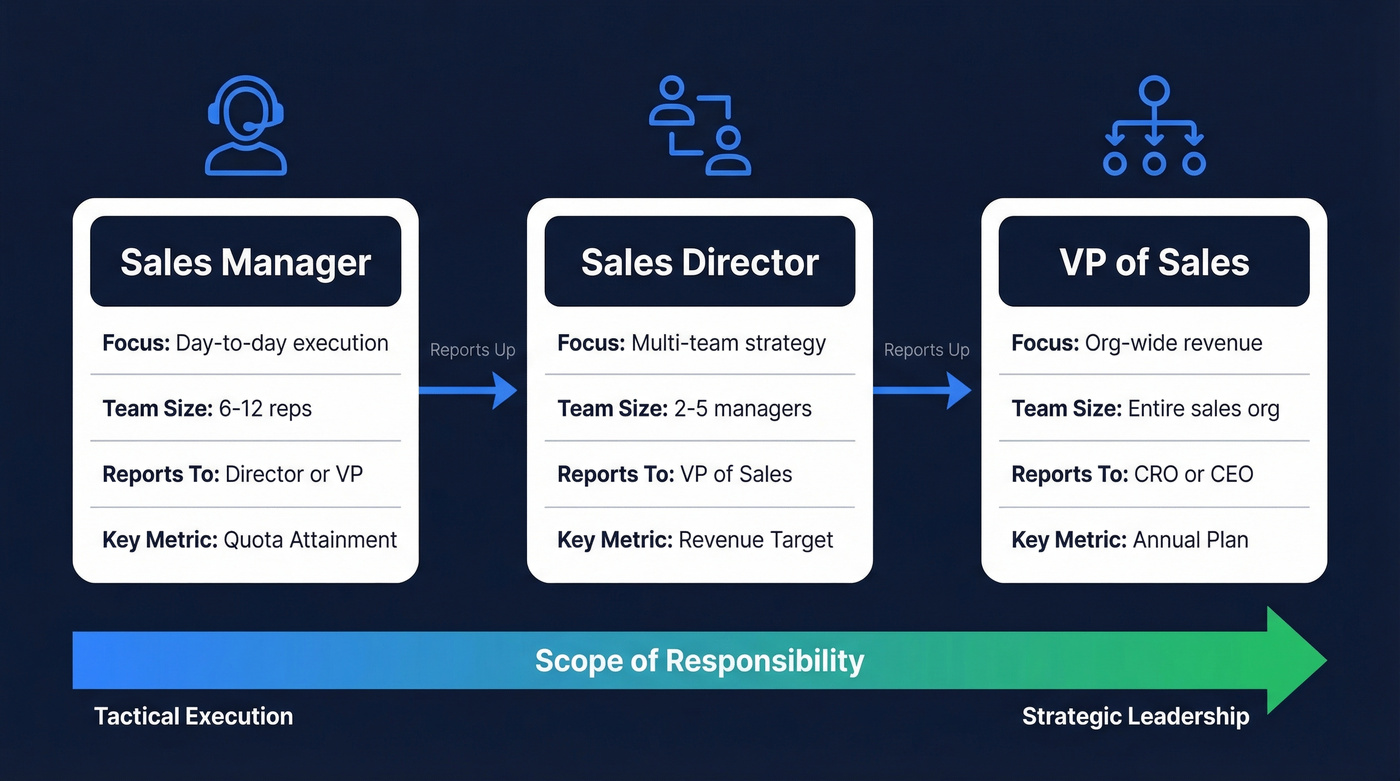
The hierarchy is straightforward once you see it laid out.
| Role | Focus | Typical Team Size | Reports To | Key Metric Owned |
|---|---|---|---|---|
| Sales Manager | Day-to-day execution | 6-12 reps | Director or VP | Quota attainment |
| Sales Director | Multi-team strategy | 2-5 managers | VP of Sales | Revenue target |
| VP of Sales | Org-wide revenue | Entire sales org | CRO or CEO | Annual plan |
Managers manage reps. Directors manage managers. The sales manager's world is coaching calls, pipeline reviews, and 1:1s. A director sets strategy across multiple teams. A VP owns the entire revenue number and aligns sales with marketing, CS, and finance at the executive level.
If you're a first-time manager, your job is execution. Leave the org-wide strategy to the people above you and focus on making your 8-12 reps as effective as possible.
Core Duties and Responsibilities
The SBI Growth framework identifies seven distinct roles a sales manager plays - from recruiter to coach to performance manager. We've distilled these into six operational areas, roughly ordered by how much of your week they should consume.
Strategy & Goal Setting
Before your reps can execute, they need a plan they believe in. That starts with quota methodology - how you distribute a team target across individual reps based on territory, experience, and historical performance.
The pipeline coverage formula is your best friend: maintain 3-4x your quota in active pipeline at all times. If your quarterly target is $500K, you need $1.5-2M in qualified pipeline. Anything below 3x and you're gambling. Territory planning matters too - uneven territories create uneven results, and your best rep will burn out carrying a territory twice the size of everyone else's.
Think in 12-18 month windows. Your weekly job is tactical, but your strategic job is building a team and territory plan that compounds over the next year.
Hiring & Team Building
You should always be in recruiting mode, even without an open req. The moment you lose a rep, you're already behind. Having a warm bench of candidates you've been talking to for months is the difference between a two-week backfill and a two-month one.
Build a hiring scorecard before you interview anyone. Define the 5-6 attributes that actually predict success on your team - coachability, curiosity, resilience, domain familiarity - and score every candidate against them. The biggest mistake new managers make is hiring on experience alone. A rep with 10 years of experience and zero coachability will poison your culture faster than an eager hire who needs training.
Among all the responsibilities of a sales manager, getting the right people in seats is the one that compounds most. One bad hire doesn't just miss quota - they drag down the reps sitting next to them, consume your coaching time, and delay the performance improvement plan conversation you should've started weeks ago.
Coaching & Development
Here's the thing: you got promoted because you were the best closer. Nobody taught you how to coach. And coaching isn't managing - it's the difference between telling a rep "you need to improve your discovery calls" and sitting in on three calls, asking questions about what they noticed, and helping them build a framework they own.
Join calls. Do ride-alongs. Then debrief with questions, not directives. "What did you notice when the prospect brought up budget?" lands better than "You should've asked about budget earlier."
Set a 1:1 cadence and protect it ruthlessly. Weekly 30-minute 1:1s with every rep, focused on development rather than deal updates. Use pipeline reviews for deal updates. Use 1:1s for skill building. The moment you start canceling 1:1s because you're "too busy," you've stopped coaching and started firefighting.
Use this approach if: You have reps who are close to quota but inconsistent - coaching unlocks the last 15-20%.
Skip this approach if: A rep has been below 60% of quota for two consecutive quarters. That's not a coaching problem; that's a hiring problem.
Pipeline & Forecasting
Pipeline management is where most sales managers either earn their keep or get exposed. The math is simple: if your team needs to close 25 deals this quarter and your win rate is 25%, you need 100 opportunities. Working backward, if 50% of demos convert to opportunities, you need 200 demos. If 20% of qualified leads take a demo, you need 1,000 qualified leads at the top.
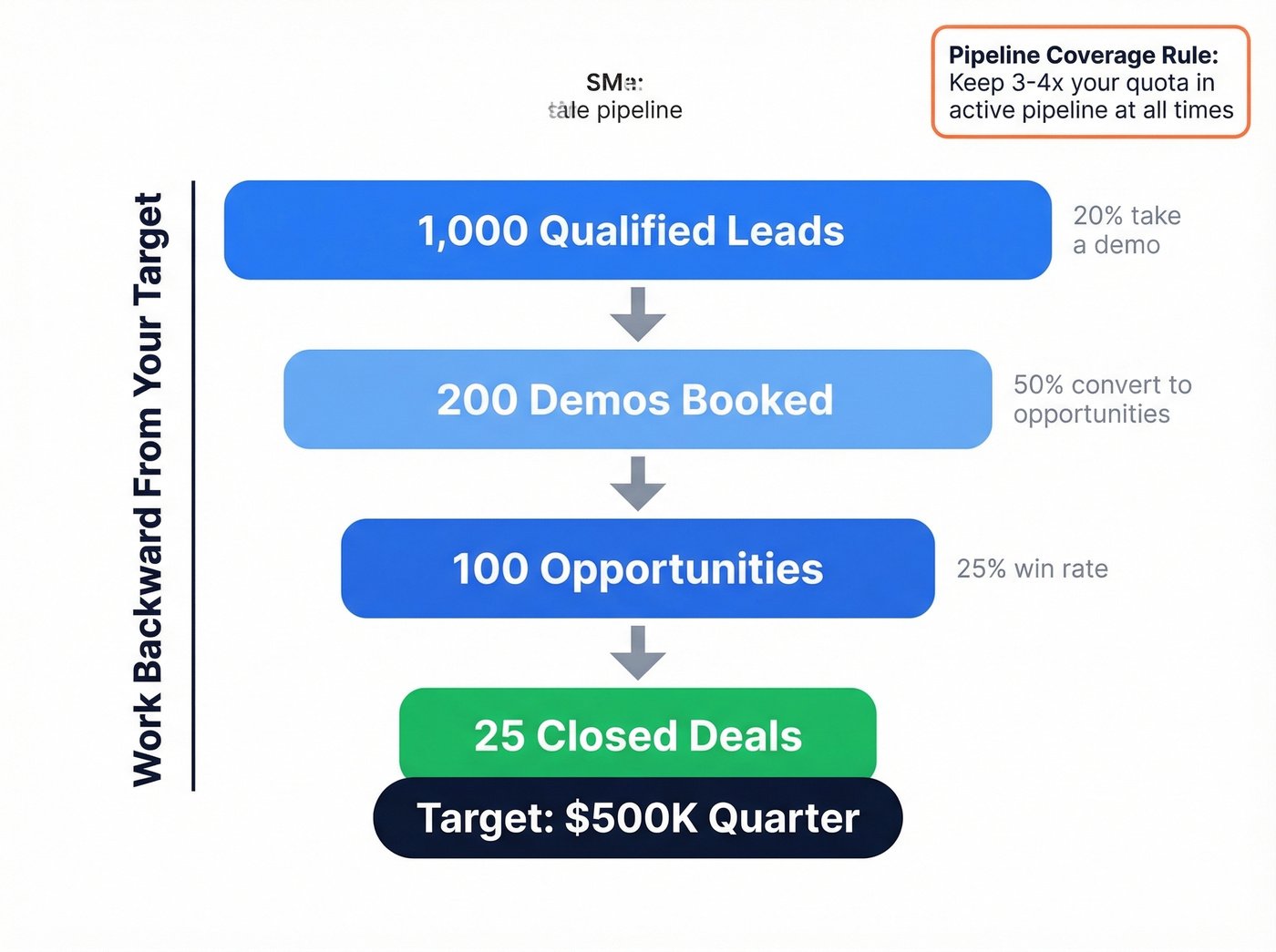
That 1,000 → 200 → 100 → 25 funnel math should be on a whiteboard somewhere your team can see it. It makes activity targets feel logical instead of arbitrary.
Deal slippage should stay below 20%. Above that, your pipeline isn't real - it's aspirational. And speed matters more than most managers realize: responding to a new lead within one minute increases conversion rates by 391%. That's not a typo. One minute.
Forecast accuracy is your deliverable to leadership. If you tell your VP the team will close $480K and you come in at $320K, that's not a miss - that's a credibility problem. Build your forecast from the bottom up, deal by deal, and be honest about what's real versus what's hopeful.
Prospecting & Data Quality
This is the responsibility most sales managers underestimate. Your top rep told you half the phone numbers in the CRM are disconnected - she's right. And that's not a rep problem; it's a management problem.
If your team's email bounce rate is above 5%, you don't have a messaging issue. You have a data issue. Bad data wastes rep time, burns your sending domain, and tanks deliverability for the entire team. We've seen outbound teams lose months of domain reputation because nobody audited the contact list before launching sequences.

Tools like Prospeo solve this at scale - 300M+ professional profiles with 98% email accuracy and 125M+ verified mobile numbers, all refreshed on a 7-day cycle. At roughly $0.01 per email, your reps spend time selling instead of scrubbing contact lists. The consensus on r/sales is pretty clear: bad data is the silent killer of outbound programs, and most managers don't realize it until deliverability is already wrecked.
Reporting & Cross-Functional Work
Reporting is the tax you pay for managing a team. Build a cadence so it doesn't eat your week:
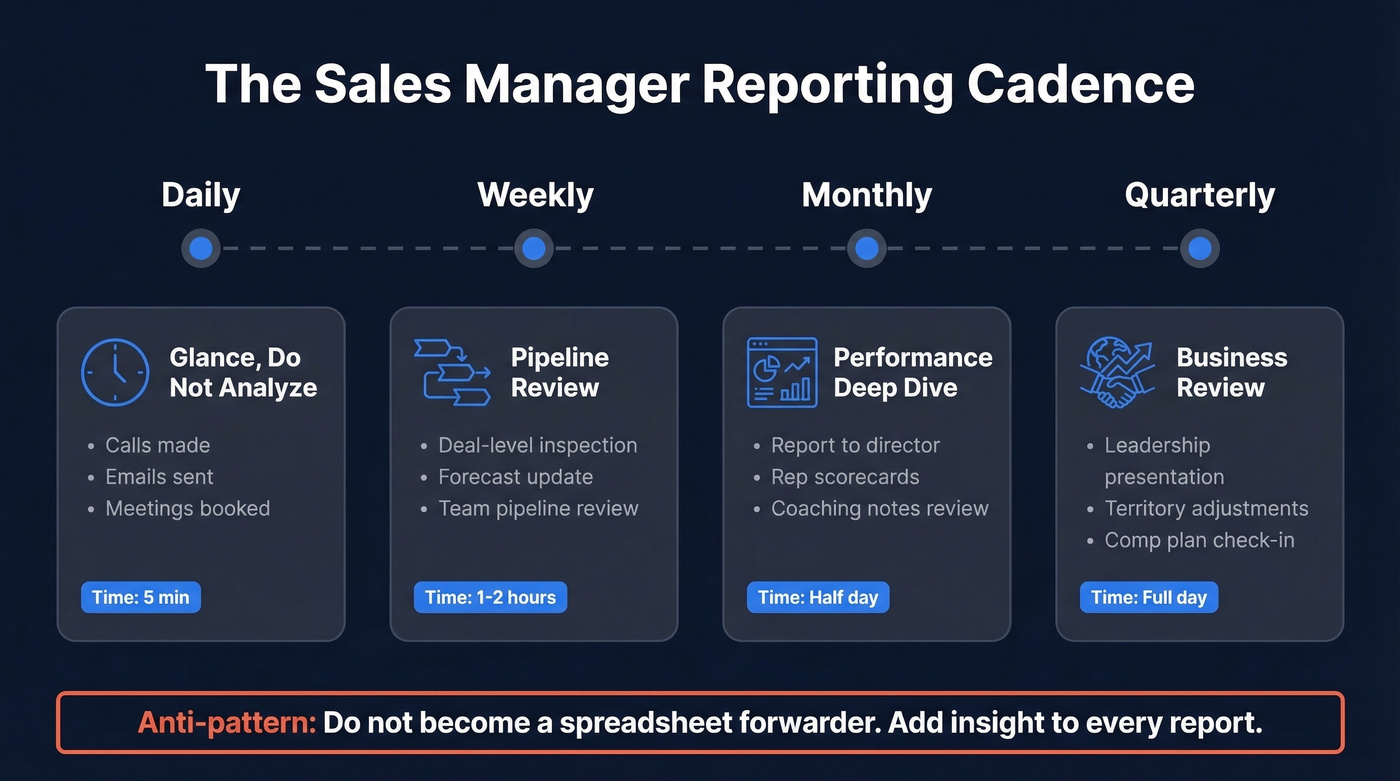
- Daily: Activity dashboards (calls, emails, meetings booked) - glance, don't analyze.
- Weekly: Pipeline review with the team. Deal-level inspection. Forecast update.
- Monthly: Performance report to your director. Rep scorecards. Coaching notes.
- Quarterly: Business review with leadership. Territory adjustments. Comp plan check-in.
You're also the bridge between marketing and revenue - if lead quality drops, flag it with specific data, not vague complaints. Work with finance on forecast accuracy and with CS on expansion revenue and churn signals.
The anti-pattern to avoid: becoming a spreadsheet forwarder. Managers who pull a CRM export and email it to their boss without adding a single insight don't manage - they forward. The best managers use reports to coach, not just to inform.

You just read that pipeline coverage needs to stay at 3-4x. That math falls apart when half your contact data is stale. Prospeo refreshes every record on a 7-day cycle - not the 6-week industry average - so your reps are calling real numbers and emailing real inboxes.
Stop letting bad data sabotage your pipeline coverage ratios.
KPIs Every Sales Manager Tracks
Metrics are raw activity data - calls made, emails sent, demos booked. KPIs are the strategic metrics tied to business outcomes. You track metrics to diagnose. You own KPIs to deliver.
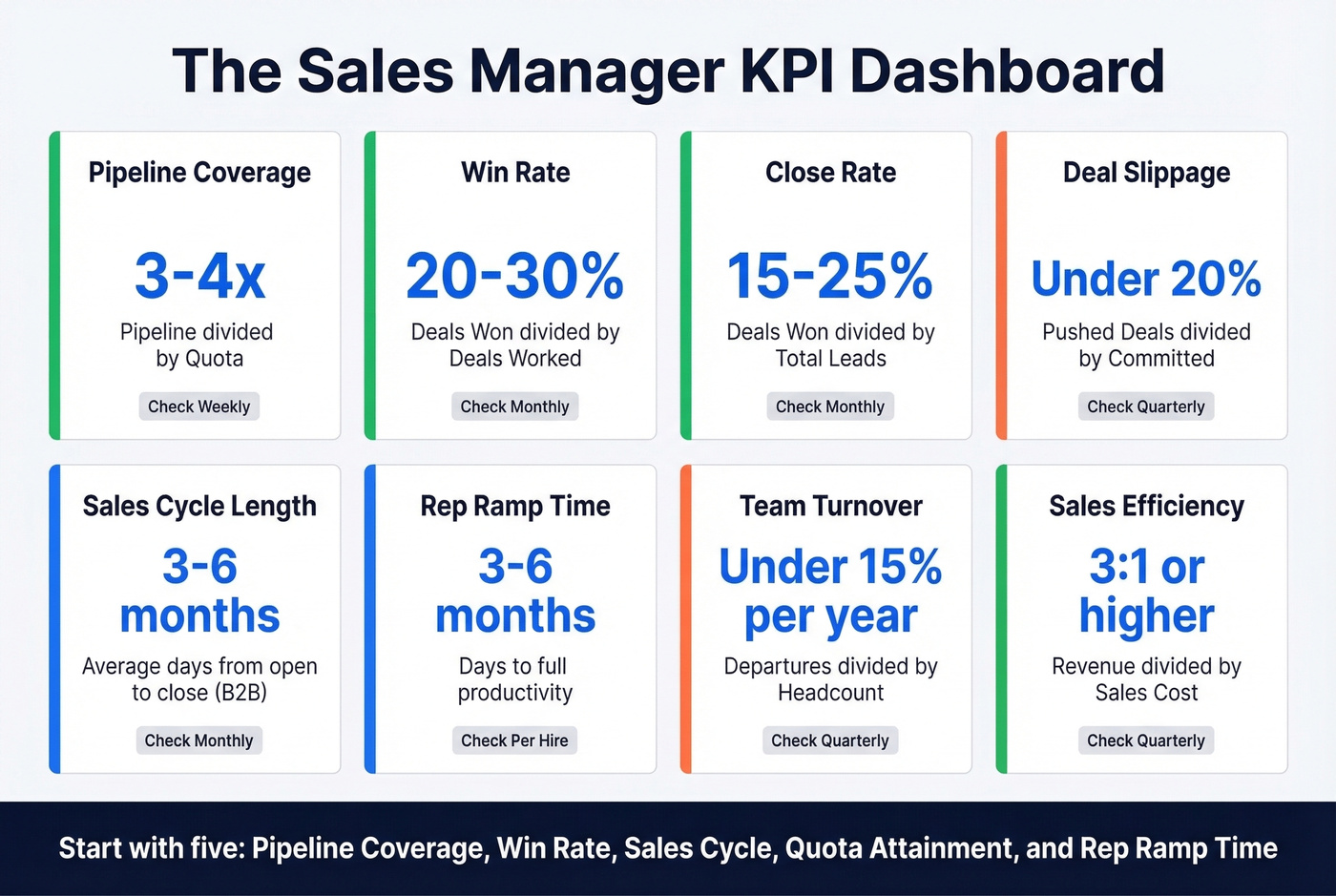
Organizations that manage by data are 6% more profitable, and teams tracking campaign metrics are 2.3x more likely to exceed revenue targets.
| KPI | Formula | Benchmark | Frequency |
|---|---|---|---|
| Pipeline Coverage | Pipeline / Quota | 3-4x | Weekly |
| Win Rate | Deals Won / Deals Worked | 20-30% | Monthly |
| Close Rate | Deals Won / Total Leads | 15-25% | Monthly |
| Deal Slippage | Pushed Deals / Committed | <20% | Quarterly |
| Sales Cycle Length | Avg days, open to close | 3-6 months (B2B) | Monthly |
| Rep Ramp Time | Days to full productivity | 3-6 months | Per hire |
| Team Turnover | Departures / Headcount | <15%/year | Quarterly |
| Sales Efficiency | Revenue / Sales Cost | 3:1+ | Quarterly |
Start with five: pipeline coverage, win rate, sales cycle length, quota attainment, and rep ramp time. Get those right before you add complexity. Every additional KPI you track dilutes focus unless it directly changes behavior.
The Sales Manager Tech Stack in 2026
Most teams have a lot of tools and only a handful are used well. Audit quarterly. Cut anything nobody's actually using.
| Category | Tools | What It Does | Approx. Cost |
|---|---|---|---|
| CRM | Salesforce, HubSpot | System of record | $25-300/user/mo |
| Outreach | Salesloft, Outreach, Smartlead | Sequences & cadences | $75-150/user/mo |
| Conversation Intel | Gong, Chorus | Call recording & coaching | $100-150/user/mo |
| Forecasting | Clari, Aviso | Revenue intelligence | $50-100/user/mo |
| Prospecting/Data | Prospeo, ZoomInfo, Cognism | Contacts & verification | $0.01+/lead |
| Enablement | Highspot, Guru | Content & training | $25-75/user/mo |
Let's be honest: if your average deal size is under $15K, you probably don't need a ZoomInfo-tier platform. A CRM, an outreach tool, and accurate contact data cover 90% of what a sales team actually uses daily. The CRM is non-negotiable. The outreach tool is non-negotiable. Everything else should earn its seat every quarter.
If your conversation intelligence tool costs $100/user/month and only two managers actually review calls, kill it.
Salary & Compensation
The BLS median for sales managers is $138,060/year. That number hides a lot of variance.
Compensation typically splits 70-85% base salary and 15-30% variable pay. A manager earning $115K total might be on a $90K base with $25K in variable tied to team quota attainment. The range runs from about $70K at the low end to $180K+ in high-cost markets.
Regional Sales Manager averages (Salary.com, March 2026):
| Location | Avg. Salary |
|---|---|
| San Jose, CA | $159,490 |
| San Francisco, CA | $157,990 |
| Washington, DC | $139,990 |
| California (statewide) | $139,490 |
| Massachusetts | $137,690 |
The 5% growth outlook through 2034 and 49,000 annual openings mean this isn't a shrinking career path. If anything, the role is getting more complex as tech stacks grow and buyers get harder to reach. Understanding the full scope of sales manager duties today means accepting that you're part coach, part analyst, and part systems architect.
Mistakes That Sink New Managers
You just got promoted from top rep. Here's what'll trip you up.
Selling instead of managing. Every deal you close personally is a rep you didn't develop. Your job is to make 8 people better, not to be the 9th rep.
Hiring on experience alone. A 15-year veteran who can't be coached will underperform a hungry 2-year rep who listens. Build a scorecard. Score against it.
Delaying firings. Everyone knows who the bottom performer is. Your team is watching. Every week you wait, you're telling your A-players that mediocrity is acceptable.
Tracking activity over results. "Make 80 calls a day" is a management crutch. Track outcomes - meetings booked, pipeline created, deals advanced.
Skipping the coaching cadence. Cancel three 1:1s in a row and you've told your team that development doesn't matter. I've watched managers lose their best reps over this exact pattern - the top performer doesn't complain, they just quietly start interviewing.
Ignoring data quality. Your reps are dialing disconnected numbers and emailing invalid addresses. That's not their fault - it's yours. Own the data stack. Audit it monthly.
Tolerating consistent underperformance. There's a difference between a rep in a slump and a rep who's been below 70% of quota for six months. One needs coaching. The other needs a different role.
FAQ
What do sales managers do day to day?
A typical week splits across coaching 1:1s, pipeline reviews, forecast updates, cross-functional meetings, and hiring. Coaching should consume the largest block. The duties that move the needle most are deal inspection and rep development - everything else is supporting infrastructure.
What's the difference between a sales manager and a sales director?
Managers coach individual reps and run pipeline reviews. Directors set strategy across multiple teams and manage the managers. If you're in 1:1s with reps, you're a manager. If you're setting quota methodology across teams, you're a director.
What KPIs should a sales manager track first?
Start with five: pipeline coverage (3-4x), win rate (20-30%), sales cycle length, quota attainment, and rep ramp time. Add deal slippage and turnover once those are dialed in. More than seven KPIs dilutes focus.
How do sales managers keep CRM data accurate?
Set a monthly data audit cadence and own the tooling. Prospeo refreshes 300M+ profiles on a 7-day cycle with 98% email accuracy at ~$0.01 per email - far cheaper than letting reps waste hours on disconnected numbers. ZoomInfo and Cognism are alternatives, though typically at higher cost.
How much does a sales manager earn?
The BLS median is $138,060/year, ranging from $70K to $180K+ depending on region, industry, and experience. Expect a 70-85% base and 15-30% variable split tied to team quota attainment.
A sales manager's hardest job is making 8-12 reps productive. Prospeo gives every rep access to 300M+ profiles with 98% email accuracy and 125M+ verified mobiles - at $0.01 per email. No more wasted dials on disconnected numbers or bounced sequences torching your domain.
Multiply rep output with data that actually connects to real buyers.