

Revenue Management Systems: What They Are, What They Cost, and How to Choose
A revenue manager at an 80-room seasonal resort described their week on Reddit: 8-10 hours tracking booking pace in spreadsheets, manually shopping competitor rates, and producing forecasts that amounted to "educated guessing." That's the Excel ceiling - and it hits harder than most operators admit.
Revenue management systems exist to eliminate that ceiling, but choosing the right one is its own challenge. Global RevPAR is up 19% since 2019, yet booking costs per available room have climbed 25% over the same period. Revenue is growing. Profit isn't keeping up. The right system fixes that gap.
The Quick Decision Tree
Skip the research spiral. Here's where to start:
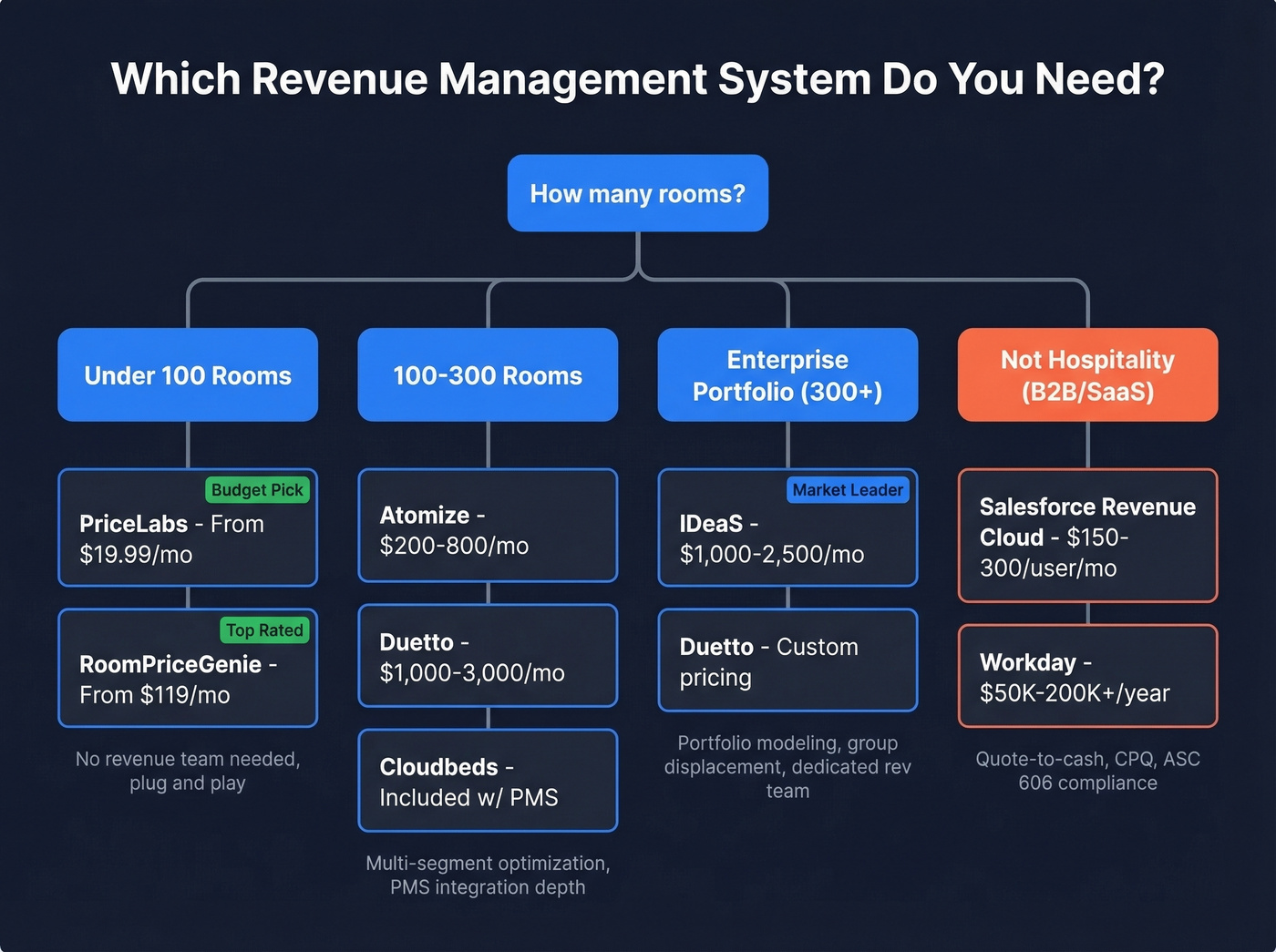
- Under 100 rooms: PriceLabs ($19.99/mo) or RoomPriceGenie ($119/mo). Plug-and-play, no revenue team required.
- 100-300 rooms: Atomize, Cloudbeds, or Duetto. You need multi-segment optimization and PMS integration depth.
- Enterprise hotel portfolio: IDeaS or Duetto. Portfolio-level modeling, group displacement, dedicated revenue team assumed.
- Not in hospitality? Salesforce Revenue Cloud or Workday. Completely different category - quote-to-cash, not room pricing.
What Is an RMS?
The term means different things depending on your industry.
Hotel RMS
A hotel RMS ingests historical booking data, competitor rates, and demand signals - events, weather, flight patterns, local economic indicators - then uses rules-based or analytics-driven algorithms to recommend or automatically set room pricing and stay restrictions. Modern systems pull data via PMS and channel manager integrations, layer in external demand drivers, and output dynamic pricing decisions that update hourly.
The core feature set includes automated pricing rules, rate parity visibility, demand forecasting, and configurable control levels ranging from "show me recommendations" to "update rates automatically." Hotels implementing a modern RMS typically see a 15-20% lift in RevPAR, based on analysis of 4,599 hoteliers across 109 countries.
Enterprise Revenue Management Software
If you're in SaaS, manufacturing, or professional services, skip everything above. Enterprise revenue management software handles the quote-to-cash lifecycle: CPQ, contract lifecycle management, order orchestration, billing, and revenue recognition under ASC 606/IFRS 15. Salesforce Revenue Cloud is a major platform here. Completely separate category. If you're in B2B, jump to the non-hospitality section below.
The Profit Problem
RevPAR is a vanity metric if your booking costs are eating the gains.
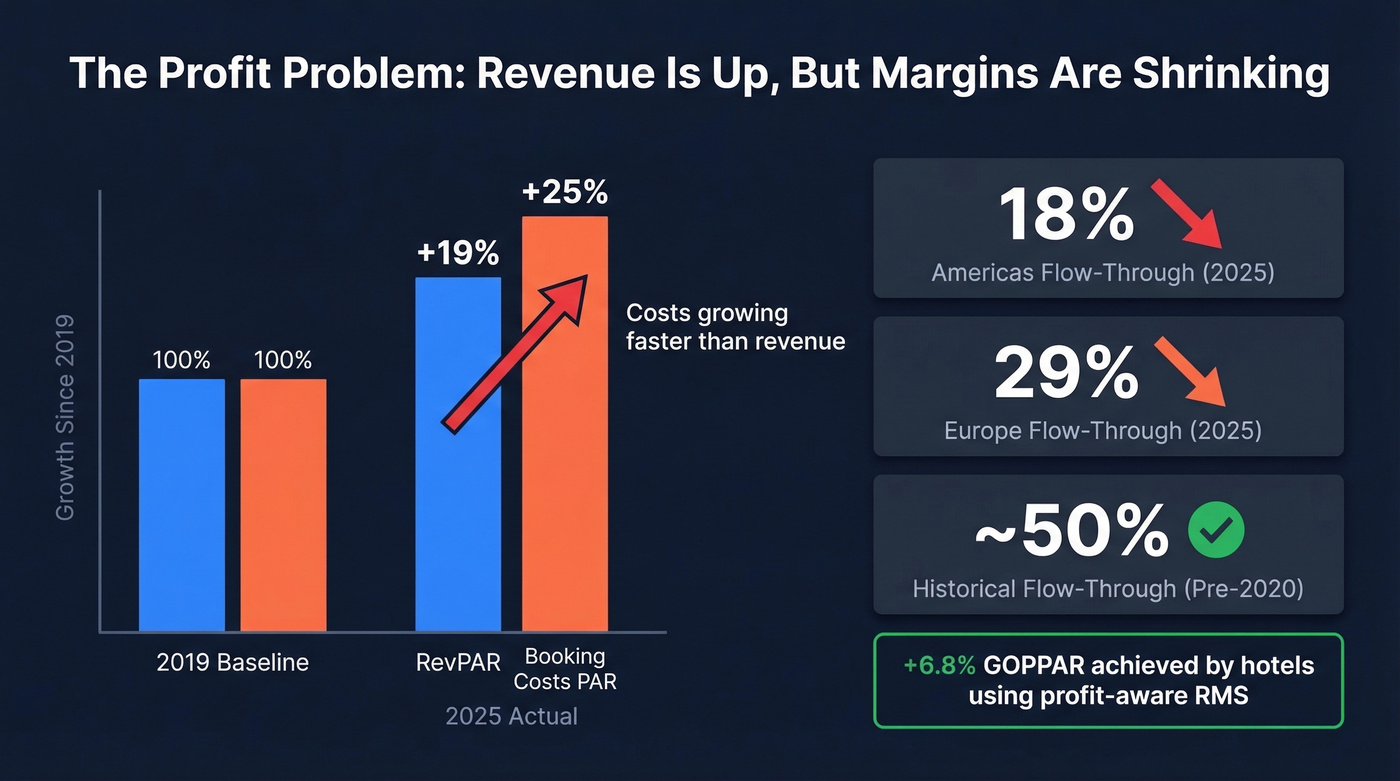
The data tells the story: global RevPAR climbed 19% since 2019, but booking costs PAR surged 25%. Flow-through - the percentage of incremental revenue that drops to profit - has collapsed. The Americas averaged just 18% flow-through in full-year 2025, Europe 29%, compared to roughly 50% in prior years.
Hotels are working harder for less. That's why profit-aware RMS matters. Hotels using Duetto combined with HotStats benchmarking achieved +6.8% GOPPAR in 2025 - a 2.1 percentage point improvement versus comparable properties. The system that optimizes for profit, not just top-line revenue, wins.
Three Types of Hotel RMS
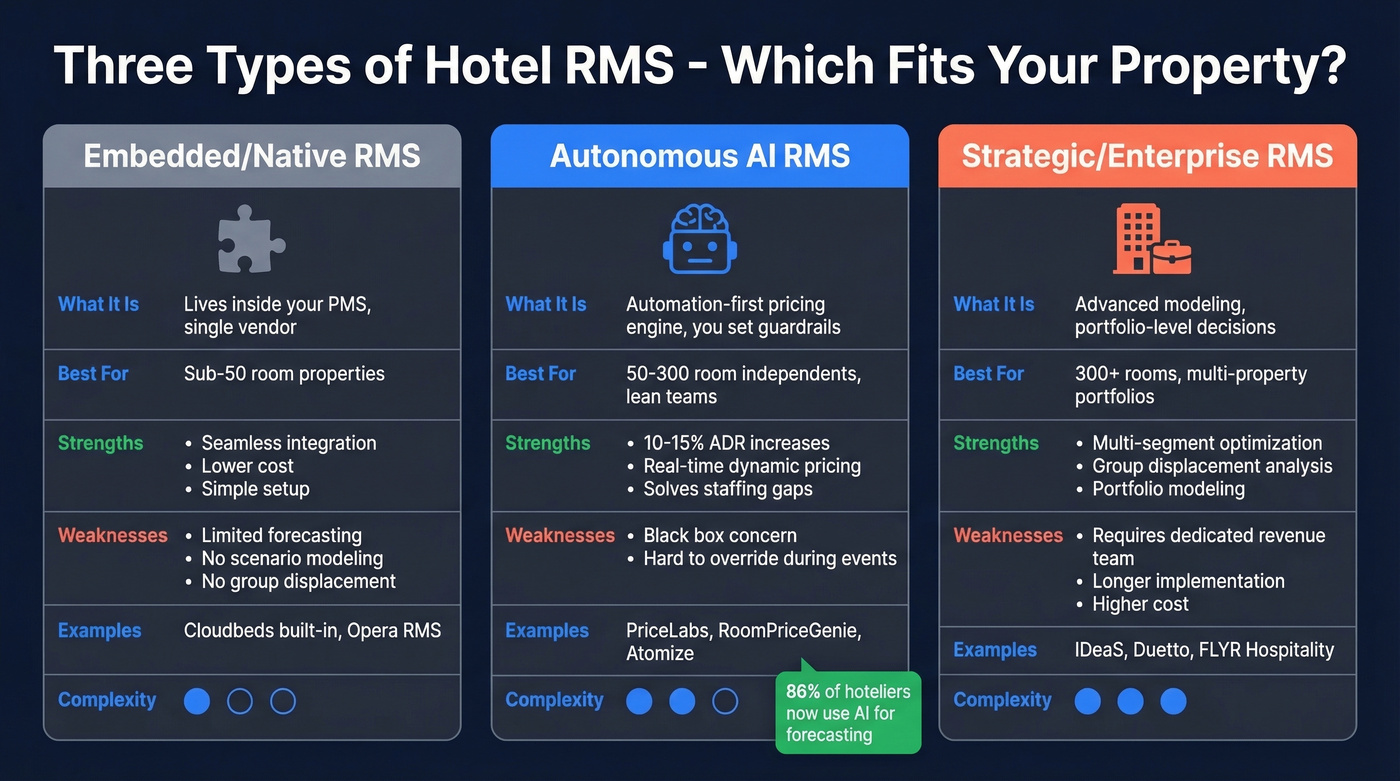
HotelTechReport's framework breaks hotel RMS into three categories, and the distinction matters for your buying decision.
Embedded/Native RMS
These live inside your PMS. Strengths: seamless integration, lower cost, single vendor. The tradeoff is real - limited forecasting depth, minimal scenario modeling, and rarely any group displacement support. For a sub-50-room property that just needs basic dynamic pricing, this can be enough. Anything more complex and you'll hit the ceiling fast.
Autonomous AI RMS
Automation-first pricing engines designed for lean teams. You set guardrails, the system handles the rest. Industry surveys suggest 86.1% of hoteliers now rely on AI for forecasting and demand analytics, with early adopters reporting 10-15% ADR increases from real-time dynamic pricing. And with 79% of hotels unable to fill open positions, automation isn't a luxury - it's a staffing necessity.
The concern practitioners raise on Reddit is the "black box" problem: when you can't explain why the system set a rate, it's hard to trust it during citywide events. Valid worry. But the staffing math increasingly favors automation over manual control.
Strategic/Enterprise RMS
Advanced modeling, multi-segment optimization, group displacement analysis, and portfolio-level decision support. This is what IDeaS and Duetto sell. It requires a dedicated revenue team and longer implementation timelines, but for properties managing complex demand patterns across segments, there's no substitute.
The integrated-vs-standalone debate comes up constantly on r/RevenueManagement. Embedded tools win on simplicity. Standalone tools win on depth. Your team size and complexity should drive the decision.

Selling revenue management systems to hotels? Your pitch only works if it lands in the right inbox. Prospeo gives you 98% verified emails and 125M+ direct dials for hotel GMs, revenue directors, and operations VPs - refreshed every 7 days so you're never pitching stale contacts.
Stop guessing who to sell to. Start reaching revenue decision-makers directly.
Top Tools for Hotels in 2026
Best for Independents (Under 100 Rooms)
RoomPriceGenie ranks #1 out of 74 RMS products with 727 verified hotelier reviews: 4.8 overall, 4.8 ease of use, 4.9 support. Starting at $119/month. This is the plug-and-play choice for independents who want automated pricing without a learning curve. Set it up in days, not weeks.
PriceLabs scores 5.0 on HotelTechReport (43 reviews) and 4.9 on Capterra (244 reviews). Starting at $19.99/month. If you're budget-conscious, PriceLabs gives you granular control at a fraction of RoomPriceGenie's cost.
Cloudbeds bundles revenue optimization into its PMS subscription at no separate fee. If you're already on Cloudbeds, the built-in revenue optimization is good enough for properties that don't need advanced forecasting.
Aiosell runs ~$400/month with a modern UI for independents. Worth a demo if RoomPriceGenie feels too simple and Duetto feels like overkill.
Look - if you're running a sub-100-room independent hotel and someone quotes you $800/month for an RMS, walk away. That's priced for 200+ room properties and you'll be paying for features your team will never touch.
happyhotel and Revolution Plus round out the 2026 shortlist. happyhotel is budget-friendly for small European properties (expect under $200/mo), while Revolution Plus takes a consulting-led approach with bundled advisory fees.
Best for Mid-Market (100-300 Rooms)
Atomize, now part of Mews, delivers autonomous AI pricing at $200-800/month for independents, with bundled pricing for Mews PMS customers. CBRE's research validates that tools like Atomize have successfully penetrated independent hotels of all sizes.
Duetto (GameChanger) excels at multi-segment optimization and group displacement. Estimated $1,000-3,000/month. That +6.8% GOPPAR improvement from the Duetto+HotStats data is hard to argue with - we've seen mid-market properties recoup the subscription cost within the first quarter.
BEONx lands on the 2026 shortlist at an estimated $500-1,500/month and pushes RevPAG (Revenue Per Available Guest) as a more useful metric than RevPAR. Worth evaluating alongside Duetto if you want a second bid. Other shortlisted tools include Blastness and Smartness - niche players worth a look if the above don't fit.
Best for Enterprise Portfolios
IDeaS is the market leader, trusted by 31,000+ properties around the world. Custom pricing - typically $1,000-2,500/month for mid-market, with enterprise portfolios negotiating annual contracts. If you're managing 10+ properties, IDeaS is probably already on your shortlist. Check their best practices guide for a sense of their methodology.
FLYR Hospitality targets enterprise-grade deployments at an estimated $500-2,000/month.
Enterprise Platforms (Non-Hospitality)
Salesforce Revenue Cloud handles CPQ, contract lifecycle management, and billing. Typically $150-300/user/month. If you're already in the Salesforce ecosystem, adding Revenue Cloud is far simpler than integrating a standalone CPQ.
Workday manages contract-to-cash with ASC 606 compliance baked in. Typically $50,000-200,000+/year. Enterprise-only. For B2B companies evaluating revenue growth management software beyond hospitality, these platforms anchor the shortlist.
What Hotel RMS Actually Costs
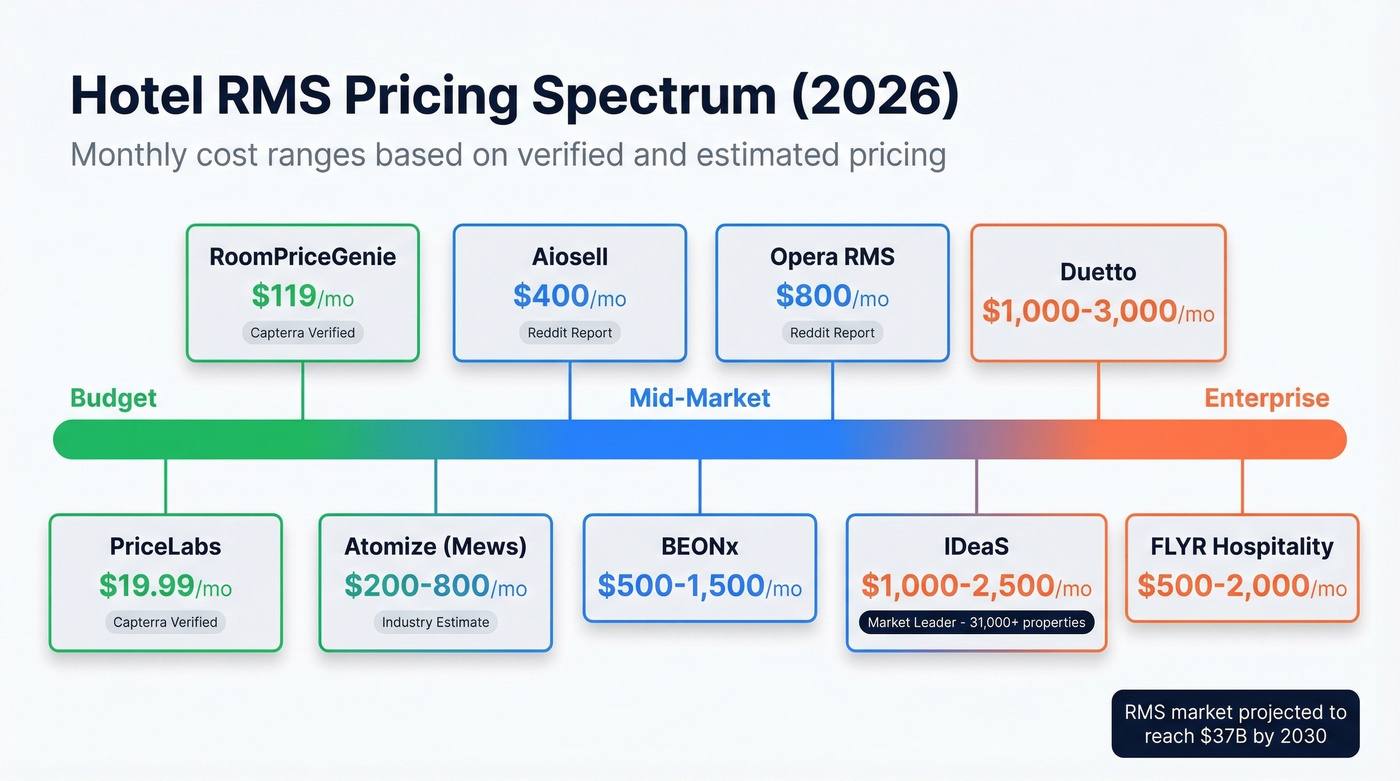
Almost no RMS vendor publishes pricing. We dug up real numbers so you don't have to.
| Tool | Price | Source |
|---|---|---|
| PriceLabs | From $19.99/mo | Capterra verified |
| RoomPriceGenie | From $119/mo | Capterra verified |
| Cloudbeds | Included w/ PMS | Reddit user report |
| Aiosell | ~$400/mo | Reddit user report |
| Atomize (Mews) | ~$200-800/mo | Industry estimate |
| BEONx | ~$500-1,500/mo | Industry estimate |
| Opera RMS | ~$800/mo | Reddit user report |
| Duetto | ~$1,000-3,000/mo | Industry estimate |
| IDeaS | ~$1,000-2,500/mo | Industry estimate |
| FLYR Hospitality | ~$500-2,000/mo | Industry estimate |
The RMS market is projected to reach $37B by 2030, which partly explains why vendors prefer opaque pricing.
Why RMS Implementations Fail
Most implementations fail because of people, not software. Here are the failure modes we see over and over again in our conversations with revenue teams.
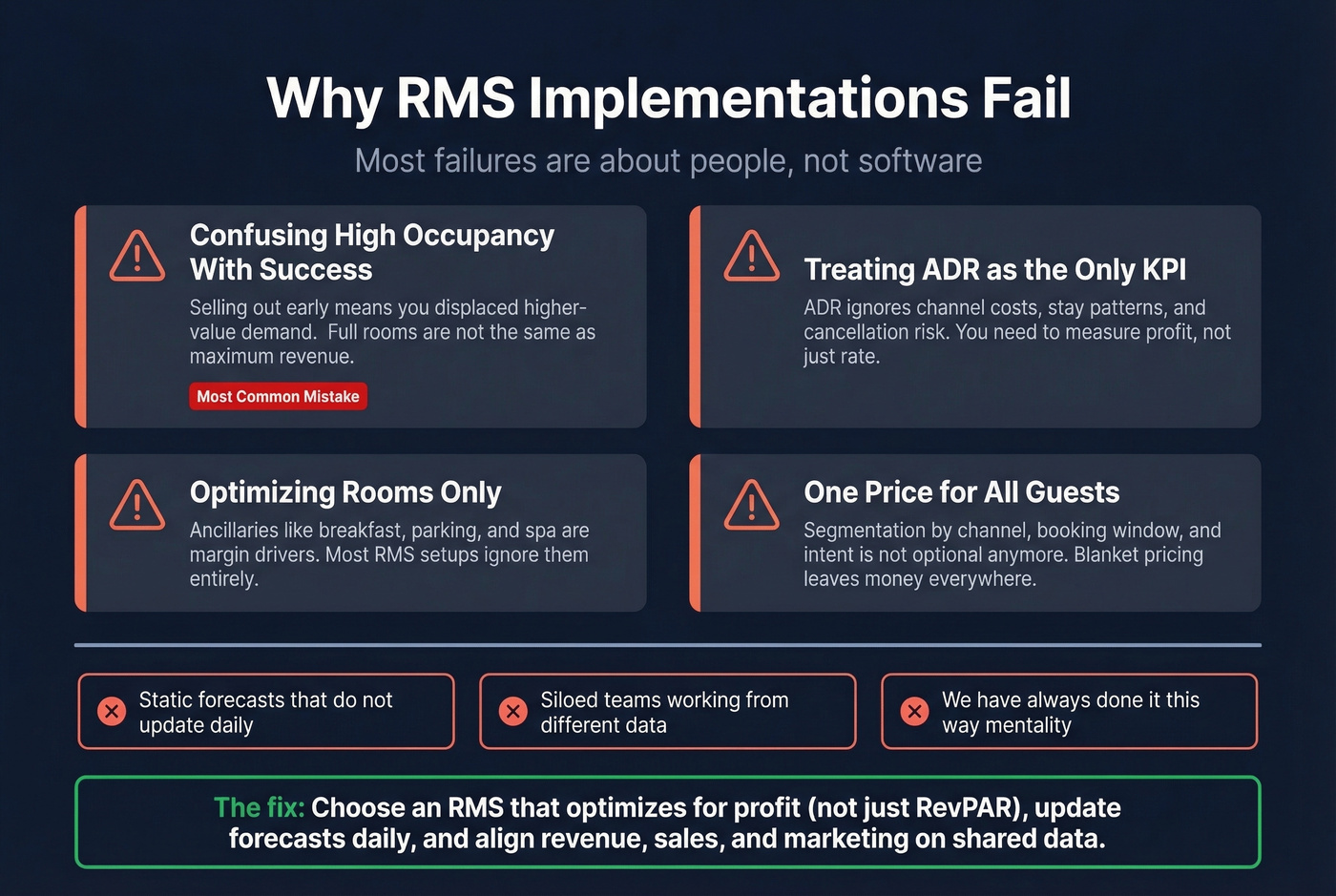
Confusing high occupancy with success. Selling out early means you displaced higher-value demand. Treating ADR as the only KPI. It ignores channel costs, stay patterns, and cancellation risk. Optimizing rooms only. Ancillaries - breakfast, parking, spa - are margin drivers that most RMS setups ignore entirely. One price for all guests. Segmentation by channel, booking window, and intent isn't optional anymore.
The subtler traps are equally damaging. Static forecasts that don't update daily leave money on the table during demand shifts. Siloed teams - revenue, sales, marketing operating from different data - create conflicting strategies. And the single most expensive sentence in hospitality remains "we've always done it this way."
Let's be honest: if your property runs under 150 rooms and you're spending more than 5 hours a week on manual rate adjustments, you don't need a better spreadsheet. A $20/month solution will outperform your gut instinct within 30 days.
Revenue Depends on Who You're Selling To
Revenue management optimizes what you charge. But hotel sales teams doing outbound to corporate accounts and group booking prospects also need verified contact data. If your team is bouncing emails trying to land corporate accounts, Prospeo's 98% email accuracy and free tier let you test without a contract or a sales call. If you're building outbound motions, start with proven sales prospecting techniques and a clean lead generation workflow.
Hotels with 79% of positions unfilled need solutions fast - but they'll never see your demo if your outreach bounces. Prospeo's 300M+ profiles with 30+ filters let you target hotel chains by headcount, tech stack, and funding stage at $0.01 per verified email.
Build your hotel prospect list in minutes, not hours.
FAQ
What's the difference between a hotel RMS and enterprise revenue management software?
Hotel RMS optimizes room pricing using demand signals, competitor rates, and booking pace to maximize RevPAR and profitability. Enterprise platforms like Salesforce Revenue Cloud manage the quote-to-cash lifecycle - CPQ, contracts, billing, and ASC 606 revenue recognition. They share a name but solve completely different problems.
How long does it take to implement a hotel RMS?
Plug-and-play tools like PriceLabs or RoomPriceGenie take days to a few weeks. Mid-market tools requiring PMS integration typically need 2-6 weeks. Enterprise multi-property deployments with IDeaS or Duetto run 2-6 months depending on integration complexity and change management readiness.
Can a small hotel afford an RMS?
PriceLabs starts at $19.99/month and RoomPriceGenie at $119/month. Cloudbeds includes revenue optimization in its PMS subscription at no extra cost. The real cost isn't the software - it's the 8-10 hours per week you're currently spending in Excel making educated guesses about tomorrow's rates.
What's the best RMS for small hotels?
RoomPriceGenie for ease of use, PriceLabs for budget and flexibility. Both integrate with major PMS platforms and channel managers. If you're already on Cloudbeds, use its built-in revenue optimization first - it's free and it might be all you need.
How much does a hotel RMS cost?
Entry-level tools start at $20-120/month. Mid-market platforms run $200-1,500/month depending on property size and feature depth. Enterprise systems like IDeaS and Duetto typically cost $1,000-3,000/month, with portfolio deals negotiated annually. See the pricing table above for tool-by-tool breakdowns.