

The 10 Best Revenue Operations Software Platforms for 2026
A RevOps consultant we know audited a mid-market SaaS company last quarter and found their average lead response time was 23 hours. Not 23 minutes - 23 hours. Reps followed up twice, then moved on. After fixing just those two process leaks - response time and follow-up cadence - the company saw a 34% revenue lift in three months without spending a dollar more on lead gen.
That's the kind of leak revenue operations software is built to fix.
The problem with every "best RevOps tools" list? Feature bullets and no pricing. You're left comparing tools you can't actually budget for. We've done the digging on real pricing, real TCO, and stack recommendations by company size so you don't have to.
Our Picks
| Category | Tool | Why | Starting Price |
|---|---|---|---|
| Best CRM (SMB/mid) | HubSpot | Published pricing, free tier | Free-$2,000/mo |
| Best data enrichment | Prospeo | 98% email accuracy, ~$0.01/lead | Free tier available |
| Best forecasting | Clari | Deep pipeline visibility | ~$820/user/year |
| Best conversation intel | Gong | Coaching + deal insights | ~$1,600/user/year + platform fee |
What Is Revenue Operations Software?
Revenue operations software isn't just your CRM with a new label. G2 defines the RO&I category as platforms that centralize prospect and customer data across systems to provide revenue insights and more accurate forecasts. A CRM stores data. A RevOps platform adds intelligence, automation, and enrichment on top. The need is real - 68% of organizations cite data silos as their top revenue concern, which is exactly what these tools break down.
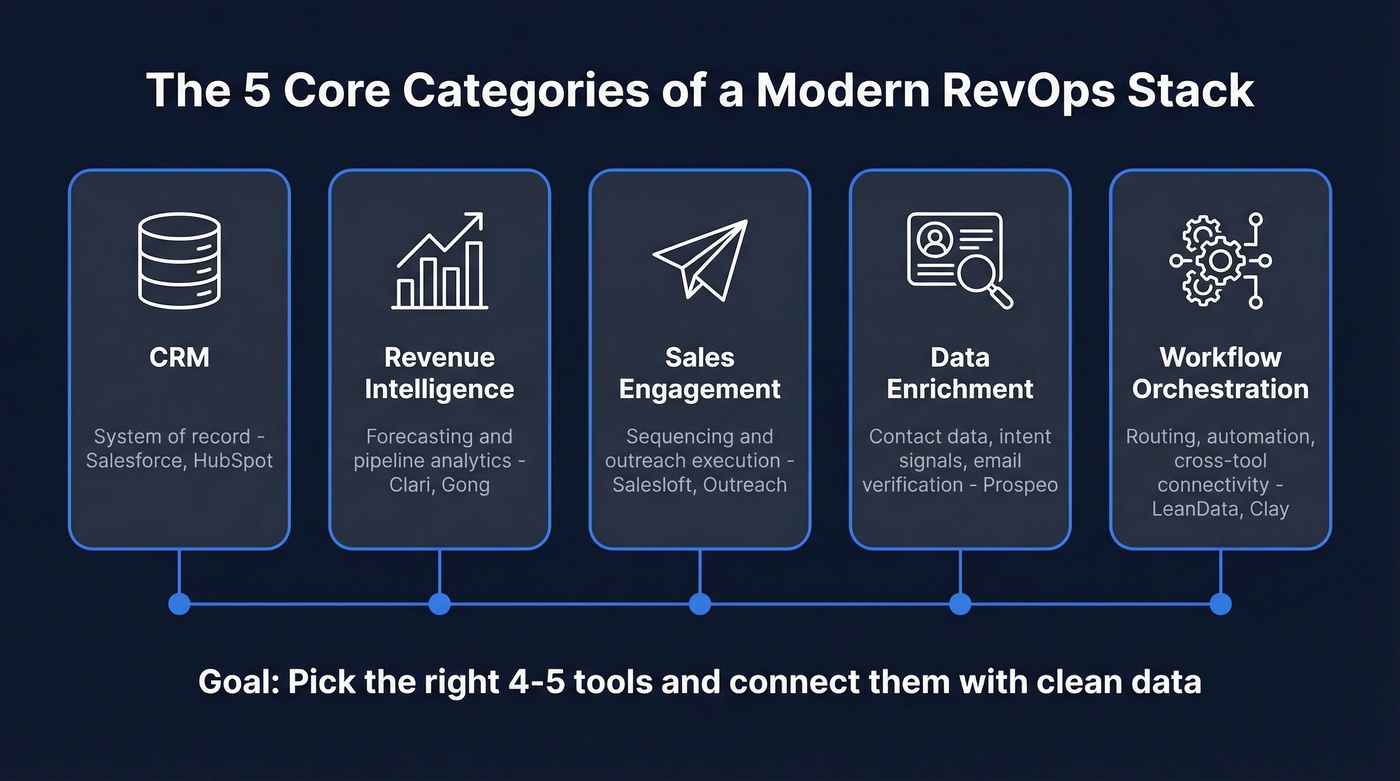
A modern RevOps stack spans five core categories:
- CRM - your system of record (Salesforce, HubSpot)
- Revenue intelligence - forecasting and pipeline analytics (Clari, Gong)
- Sales engagement - sequencing and outreach execution (Salesloft, Outreach)
- Data enrichment & verification - contact data, intent signals, email validation
- Workflow orchestration - routing, automation, and cross-tool connectivity (LeanData, Clay)
RevOps also extends beyond pipeline into billing, renewals, and customer expansion - the full lead-to-cash lifecycle. The average enterprise RevOps team manages 12-18 tools with significant overlap. The goal isn't adding more software. It's picking the right four or five and connecting them with clean data.
The 10 Best RevOps Platforms
HubSpot
Best for: SMB and mid-market teams that want predictable pricing and a CRM they can set up without a consultant.
Pricing: Free for up to 2 users. Starter at $9/seat/month (annual). Professional jumps to $720/seat/month - a surprise for teams that assumed HubSpot stays cheap at scale. Enterprise tops out at $2,000/month. HubSpot is one of the few major vendors that publishes full pricing across all tiers.
Key limitation: Enterprise-grade forecasting isn't HubSpot's strength. If you're already deep in the Salesforce ecosystem, switching rarely makes sense.
The Operations Hub gives you data quality automation, programmable automation, and datasets - enough to run a solid RevOps operation without bolting on three extra tools.
Prospeo
Best for: The data enrichment and verification layer that makes everything else in your RevOps stack actually work. A forecasting tool is only as good as the contacts feeding it, and a sequencer is useless if 35% of your emails bounce.
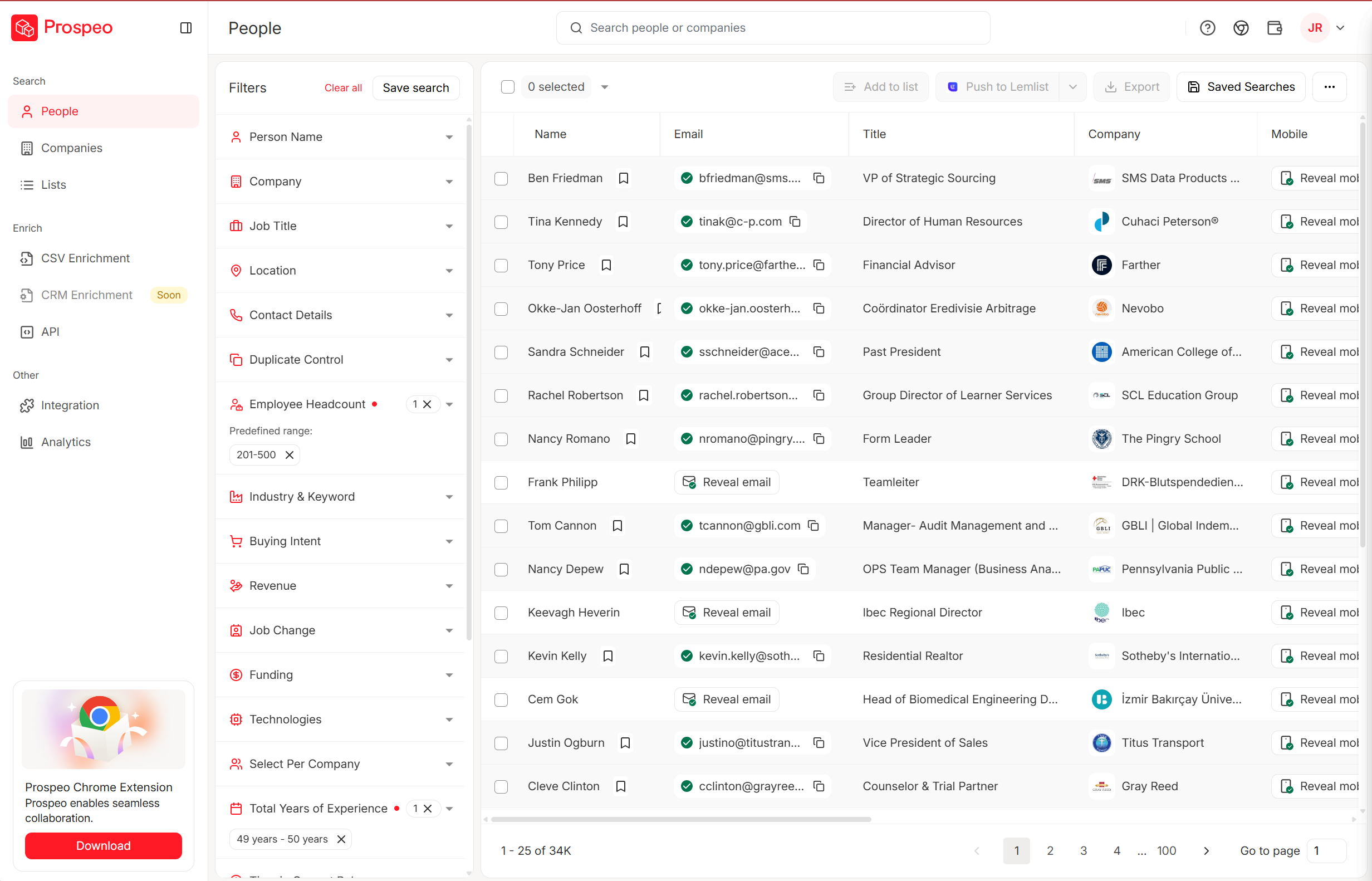
Pricing: Credit-based and transparent - roughly $0.01 per email, with a free tier (75 emails + 100 Chrome extension credits per month). No contracts, no annual commitments. Native integrations with Salesforce, HubSpot, Clay, Zapier, Make, Lemlist, Instantly, Smartlead, and more.
The platform covers 300M+ professional profiles, 143M+ verified emails, and 125M+ verified mobile numbers on a 7-day refresh cycle compared to the 6-week industry average. Email accuracy sits at 98%, the API match rate is 92%, and intent data spans 15,000 topics powered by Bombora for layering buyer signals directly into prospecting workflows.
At Snyk, 50 AEs were prospecting 4-6 hours per week with bounce rates of 35-40%. After switching, bounce rates dropped under 5%, AE-sourced pipeline jumped 180%, and the team generated 200+ new opportunities per month. That's not a marginal improvement - that's a fundamentally different pipeline.
Clari
Best for: Enterprise RevOps teams that need pipeline visibility, deal inspection, and forecast accuracy.
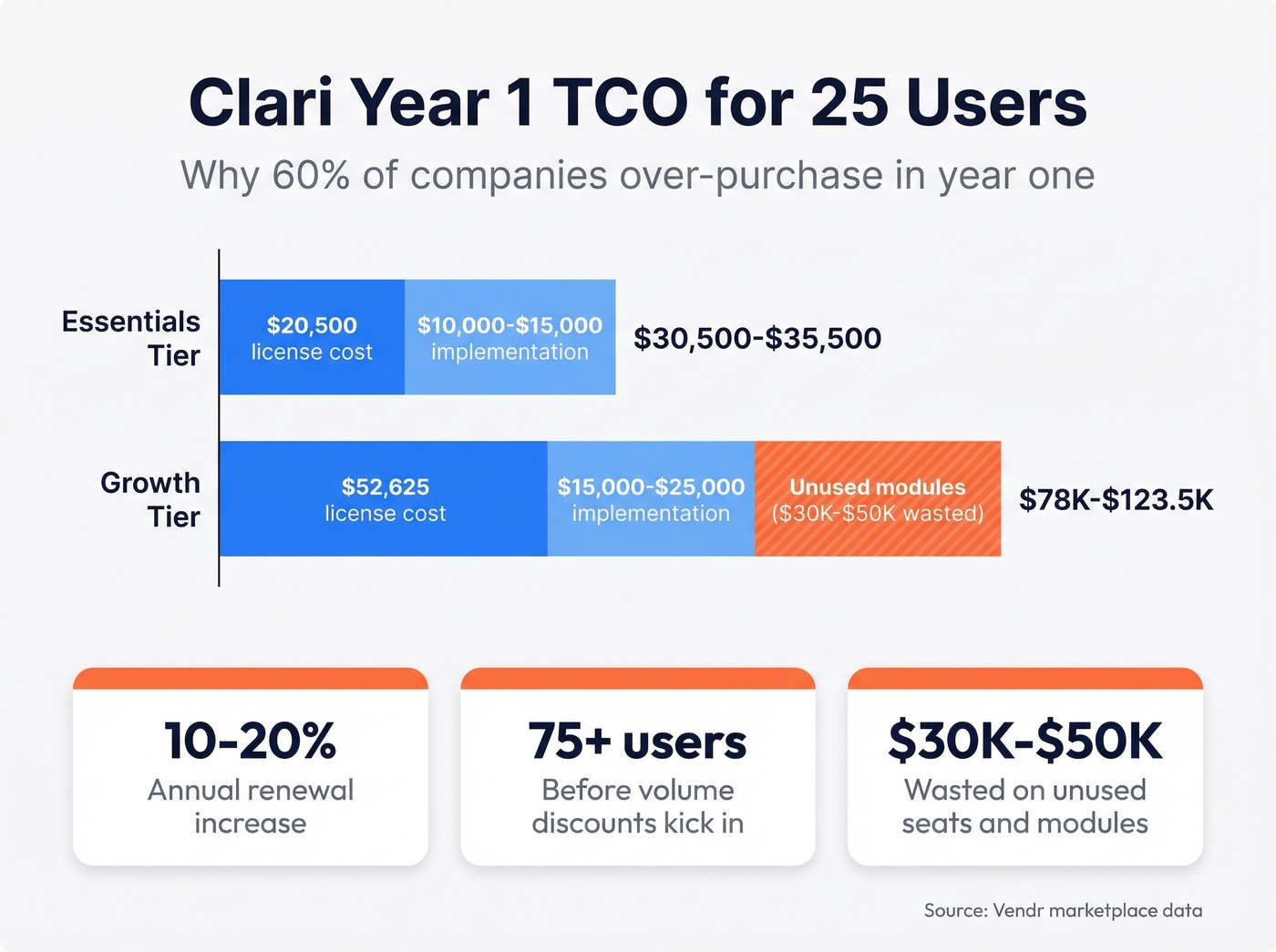
Forget the feature tour - here's what Clari actually costs. Revenue Forecasting Essentials runs ~$820/user/year, and Growth jumps to ~$2,105/user/year. Individual modules break down further: Core runs $100-$120/user/month, and Copilot sits at $60-$100/user/month. A full-stack deployment for 25 users lands between $78K and $123.5K in year one, with implementation adding $10K-$25K in professional services.

Here's the thing: 60% of companies over-purchase Clari in year one, wasting $30K-$50K on seats and modules they don't use. Volume discounts don't kick in meaningfully until 75+ users, and renewal increases run 10-20% annually with pressure to add modules at each cycle.
Key limitation: Clari is an enterprise purchase disguised as a team tool. If your RevOps function isn't mature enough to enforce forecast discipline across the org, you'll pay enterprise prices for a dashboard nobody trusts.
Gong
Gong is the fastest-to-adopt enterprise RevOps tool we've seen. Reps actually use it - which is more than you can say for most platforms in this category.
Best for: Conversation intelligence, deal boards, and coaching workflows for teams of 30+ reps.
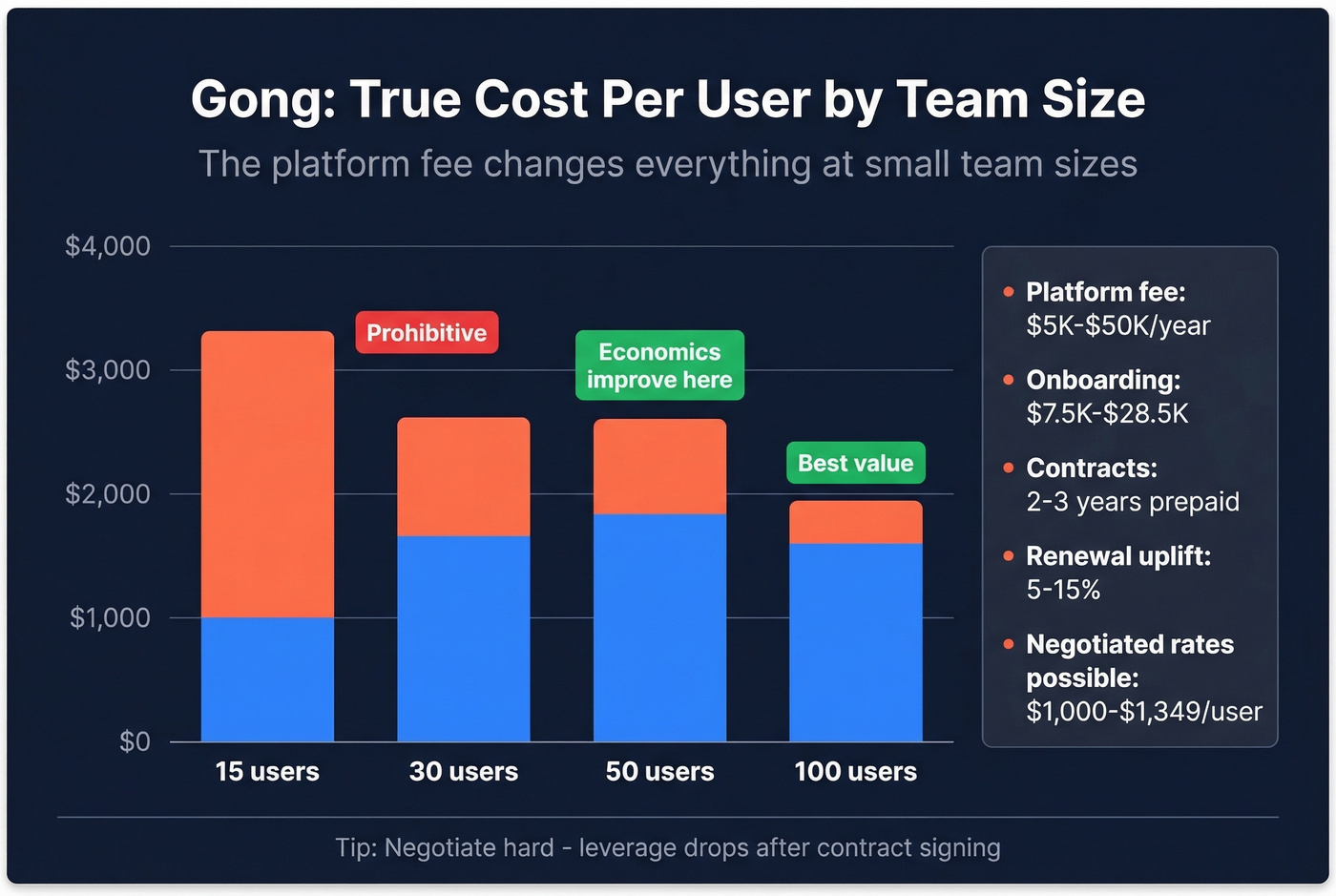
Pricing breaks down into three parts. Platform fee: $5K-$50K/year. Per-user licenses scale by volume:
| Users | Per-User/Year |
|---|---|
| 1-49 | $1,600 |
| 50-99 | $1,520 |
| 100-249 | $1,440 |
| 250+ | $1,360 |

Mandatory onboarding runs $7.5K-$28.5K. A pricing restructure in early 2025 pushed the platform fee to $50K for new customers on the Foundations plan - and that model is still in effect. For a 50-user team, expect $105K-$180K in year one. With leverage, negotiated rates can drop to $1,000-$1,349/user.
Contracts run 2-3 years with annual prepayment, and renewal uplift sits at 5-15%. Add-ons like Gong Forecast ($700/user/year) and Gong Engage ($800/user/year) push costs higher.
Key limitation: The platform fee makes Gong prohibitive for teams under 30 users. At 15 seats, you're paying $3,300+ per user per year - steep for conversation recording. Above 50 seats, the economics improve dramatically.
Salesforce Revenue Cloud
Best for: Organizations already running Salesforce as their CRM. Growth tier starts at $150/user/month, Advanced at $200/user/month, both billed annually. The Premier Success Plan adds 30% to your net license fees.
If you're not already on Salesforce, skip this one. For Salesforce shops running CPQ, billing, and revenue lifecycle management, it consolidates three or four point solutions into one.
Key limitation: Meaningless outside the Salesforce ecosystem.
SalesLoft
Best for: Sales engagement in Salesforce-centric stacks. Cadences, dialer, deal intelligence, and forecasting in one platform. Mid-market contracts typically land at $75-$150/user/month, so expect enterprise-style procurement even for smaller deals.
Key limitation: Near-total overlap with Outreach - pick based on CRM ecosystem and rep preference.
People.ai
Best for: Activity capture and buying committee mapping in complex enterprise sales cycles. It automatically logs rep activities into your CRM and maps stakeholder engagement. Pricing runs ~$50-$100/user/month for enterprise contracts.
Key limitation: Requires CRM discipline and long, multi-threaded sales cycles. If your average deal closes in two calls, you won't see the ROI.
Outreach
Best for: Sales engagement alternative to Salesloft, particularly for Salesforce- or HubSpot-centric stacks. ~$100-$130/user/month, billed annually.
Key limitation: Increasingly overlapping with Salesloft. Choose based on workflow builder preference.
LeanData
Best for: Lead routing and matching for Salesforce. ~$25K-$50K/year for mid-market deployments. If you have complex territory rules, round-robin assignments, or account-based routing needs, LeanData is the standard.
Key limitation: Salesforce-only. Niche but essential for the teams that need it.
Clay
Best for: Workflow orchestration and waterfall enrichment. Free tier available, paid plans from $149-$720/month plus credits. Clay isn't a traditional RevOps platform - it's the glue layer that connects multiple data providers, deduplicates records, and writes clean data into your CRM.
Key limitation: Credit costs can spike on high-volume workflows. Monitor usage closely.

Bad data is the revenue leak no forecasting tool can fix. Prospeo delivers 98% email accuracy, 92% API match rates, and a 7-day refresh cycle - so every tool downstream actually works.
Stop feeding your RevOps stack dirty data. Start with Prospeo free.
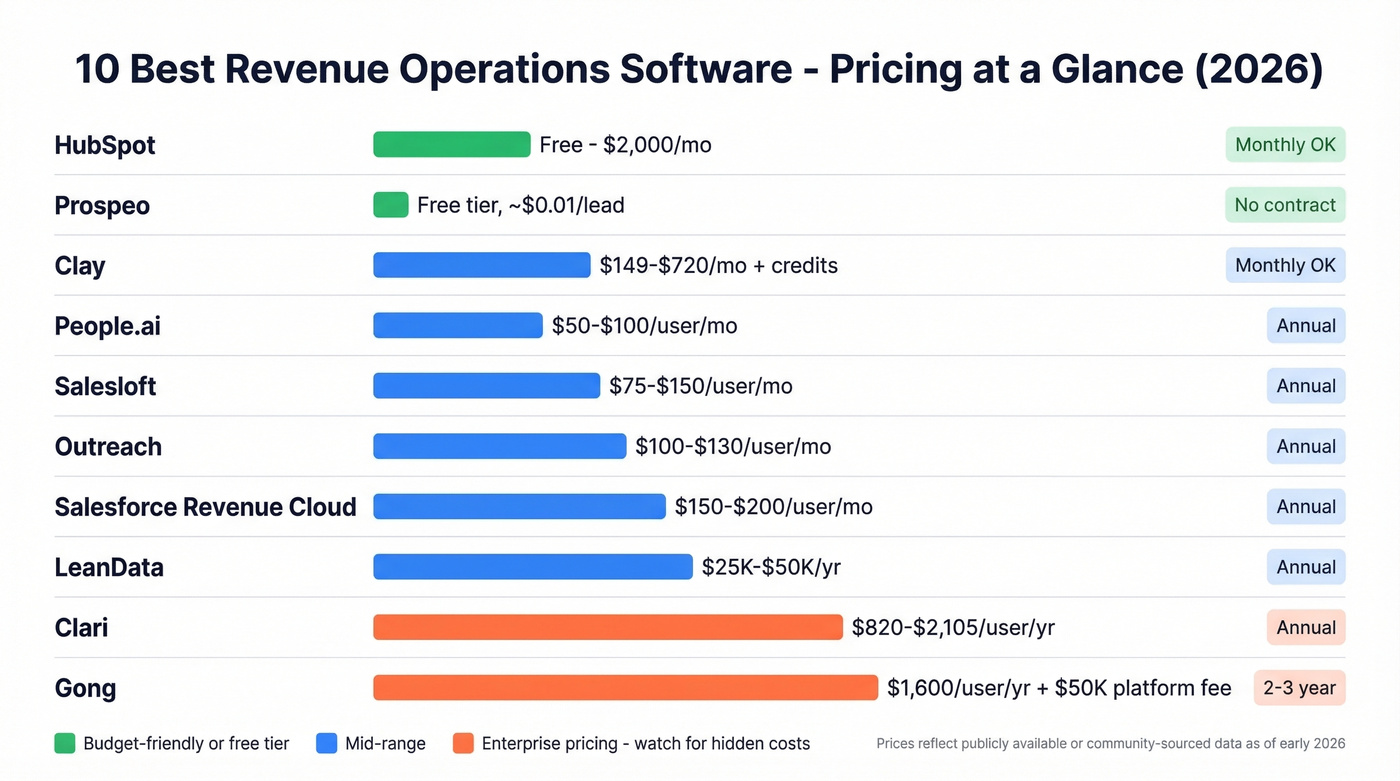
Pricing Comparison
| Tool | Best For | Starting Price | Contract | Hidden Costs |
|---|---|---|---|---|
| HubSpot | SMB/mid CRM | Free-$2,000/mo | Monthly available | Pro tier price jump |
| Prospeo | Data enrichment | ~$0.01/lead, free tier | No contract | None |
| Clari | Forecasting | ~$820/user/yr | Annual | 10-20% renewal uplift |
| Gong | Conversation intel | ~$1,600/user/yr | 2-3 year | $50K platform fee |
| Salesforce RC | Enterprise CRM | $150/user/mo | Annual | 30% Premier plan |
| Salesloft | Sales engagement | ~$75-$150/user/mo | Annual | Custom add-ons |
| People.ai | Activity capture | ~$50-$100/user/mo | Annual | CRM setup overhead |
| Outreach | Sales engagement | ~$100-$130/user/mo | Annual | Seat minimums |
| LeanData | Lead routing | ~$25K-$50K/yr | Annual | Salesforce-only |
| Clay | Orchestration | $149-$720/mo + credits | Monthly available | Credit overages |
Best Stack by Company Size
The average enterprise team runs 12-18 tools with massive overlap. ZoomInfo and Apollo share roughly 70% coverage on US business contacts - so paying for both is lighting money on fire. Let's break down what a lean stack looks like at each stage.
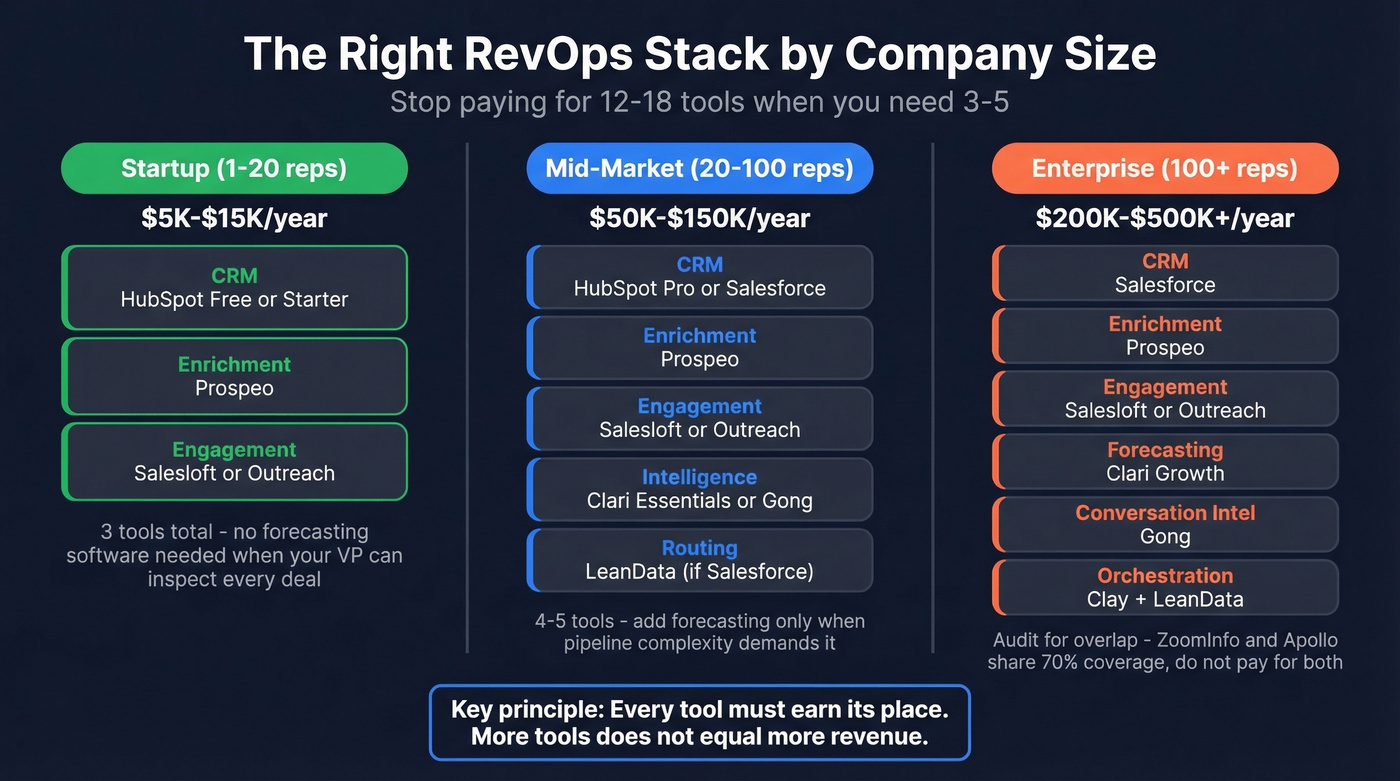
Startup (1-20 reps): ~$5K-$15K/year. HubSpot Free or Starter as your CRM, Prospeo for enrichment and verification, and Salesloft or Outreach for sequencing. Three tools. You don't need forecasting software when your VP of Sales can inspect every deal in a 30-minute pipeline review.
Mid-market (20-100 reps): ~$50K-$120K/year. HubSpot Professional or Salesforce as your CRM, a dedicated enrichment layer for data quality, Gong or Clari Essentials for revenue intelligence, and Salesloft for engagement. Four tools, clean integrations, no overlap. At this stage, choosing the right revenue operations software matters more than adding features - every redundant tool increases maintenance overhead and creates another integration to babysit.
Enterprise (100+ reps): ~$250K-$500K/year. Salesforce as the CRM, Clari Growth for forecasting, Gong for conversation intelligence, your enrichment platform for verified contacts, LeanData for routing, and Clay for waterfall enrichment workflows. Six tools - each doing one thing well.
Look, most teams buy RevOps tools to fix problems that are actually process problems. If your reps aren't following up and your territories are a mess, a $200K forecasting platform just gives you a prettier view of the dysfunction. Fix the process first, then buy the software. And at every stage, bad data is the single fastest way to tank your entire stack's ROI - a $200K forecasting platform is worthless if 30% of the contacts in your pipeline have stale emails.
Snyk's 50 AEs cut bounce rates from 35% to under 5% and grew AE-sourced pipeline 180%. The difference wasn't a new CRM or forecasting tool - it was clean, verified contact data from Prospeo at $0.01 per email.
The best RevOps investment is data your reps can actually reach buyers with.
5 Mistakes That Burn Your Budget
1. Over-purchasing seats. 60% of companies buying Clari over-purchase in year one, wasting $30K-$50K. Start with core forecasting users and expand quarterly based on actual adoption.
2. Ignoring data quality. 31% of admins say poor-quality data costs at least 20% of annual revenue. Enrichment and verification should be the first line item in your budget, not an afterthought. No RevOps platform can compensate for a database full of outdated contacts.
3. Slow speed-to-lead. That 23-hour response time isn't unusual - it's the norm. Best-in-class teams respond in under 5 minutes. No software fixes this if your routing and notification workflows aren't configured properly.
4. Stacking redundant tools. A new AE's annual tool cost can run 15-20% of their OTE across 7-10 tools. When two of those tools do the same thing, you're paying twice for diminishing returns. Audit overlap before adding anything.
5. Locking into multi-year contracts early. Gong's 2-3 year contracts with 5-15% renewal uplift and Clari's 10-20% annual increases compound fast. A $100K year-one deal becomes $130K by year three. Negotiate hard on renewal caps, or choose vendors with monthly flexibility.
FAQ
What are RevOps tools?
RevOps tools are platforms that unify data, automate workflows, and deliver intelligence across the full revenue lifecycle - from lead generation through renewal. They span CRM, revenue intelligence, sales engagement, data enrichment, and workflow orchestration, breaking silos between sales, marketing, and customer success.
How is revenue operations software different from a CRM?
A CRM is your system of record for storing contact and deal data. Revenue operations software layers forecasting, enrichment, automation, and cross-functional analytics on top. Most teams need a CRM as the foundation plus two to four specialized RevOps tools to actually operationalize their revenue process.
What's a reasonable RevOps budget?
Startups should plan $5K-$15K/year, mid-market teams $50K-$120K, and enterprise orgs $250K-$500K. The enrichment layer - verified contact data at scale - is consistently the highest-ROI line item because it makes every other tool more effective.
Should I buy an all-in-one platform or build a stack?
A tight stack of 4-5 specialized tools connected by clean data outperforms bloated all-in-ones almost every time. Consolidate around integrations and data quality, not brand names. The average enterprise runs 12-18 tools with massive overlap - aim for half that.
What is waterfall enrichment?
Waterfall enrichment queries multiple data providers sequentially, deduplicates results, and writes one authoritative record to your CRM. Tools like Clay orchestrate this process, reducing credit waste and improving match rates compared to running overlapping providers in parallel.