

Reverse Email Appending: What It Is & Costs (2026)
You've got a list of email addresses and nothing else attached to them. No names, no mailing addresses, no phone numbers. Reverse email appending fixes that - a vendor matches your emails against their databases and hands back enriched records, usually for as little as $0.02 per successful match.
It's one of the fastest ways to turn a dead list into something you can actually use.
The Quick Version
You submit email addresses. A vendor matches them against consumer-focused databases (and sometimes business datasets), then returns enriched records. Costs run $0.02-$0.12 per match depending on vendor and data depth. Plan for 30-50% match rates on a typical list - vendors claim higher, but that's marketing math on clean datasets.
What Is a Reverse Email Append?
Roughly 23% of an email list degrades every year. People change jobs, switch providers, abandon inboxes. A reverse append fights back by starting with what you have (an email) and filling in what you don't.
You hand a vendor a list of email addresses. They match those addresses against their databases, then return enriched records with names and postal addresses - and sometimes phone numbers and demographic or firmographic data depending on the package. Related services include reverse phone append and reverse postal append, which work the same way but start from different identifiers.
Don't confuse it with forward appending, which works in the opposite direction:
| Direction | You Provide | You Get Back |
|---|---|---|
| Forward append | Name + address | Email address |
| Reverse append | Email address | Name + address (+ optional phone/attributes) |
How the Process Works
- Upload your email list - CSV or secure FTP, depending on the provider. Some accept hashed emails (MD5/SHA256) for privacy-sensitive workflows.
- The vendor matches against their database - they cross-reference your emails against consumer records, public data, and proprietary sources. Turnaround can be under 5-10 minutes on self-serve platforms like Datazapp, while other providers run on a roughly 24-hour standard turnaround.
- You receive an enriched file - matched records come back with appended fields. Unmatched records return as-is.
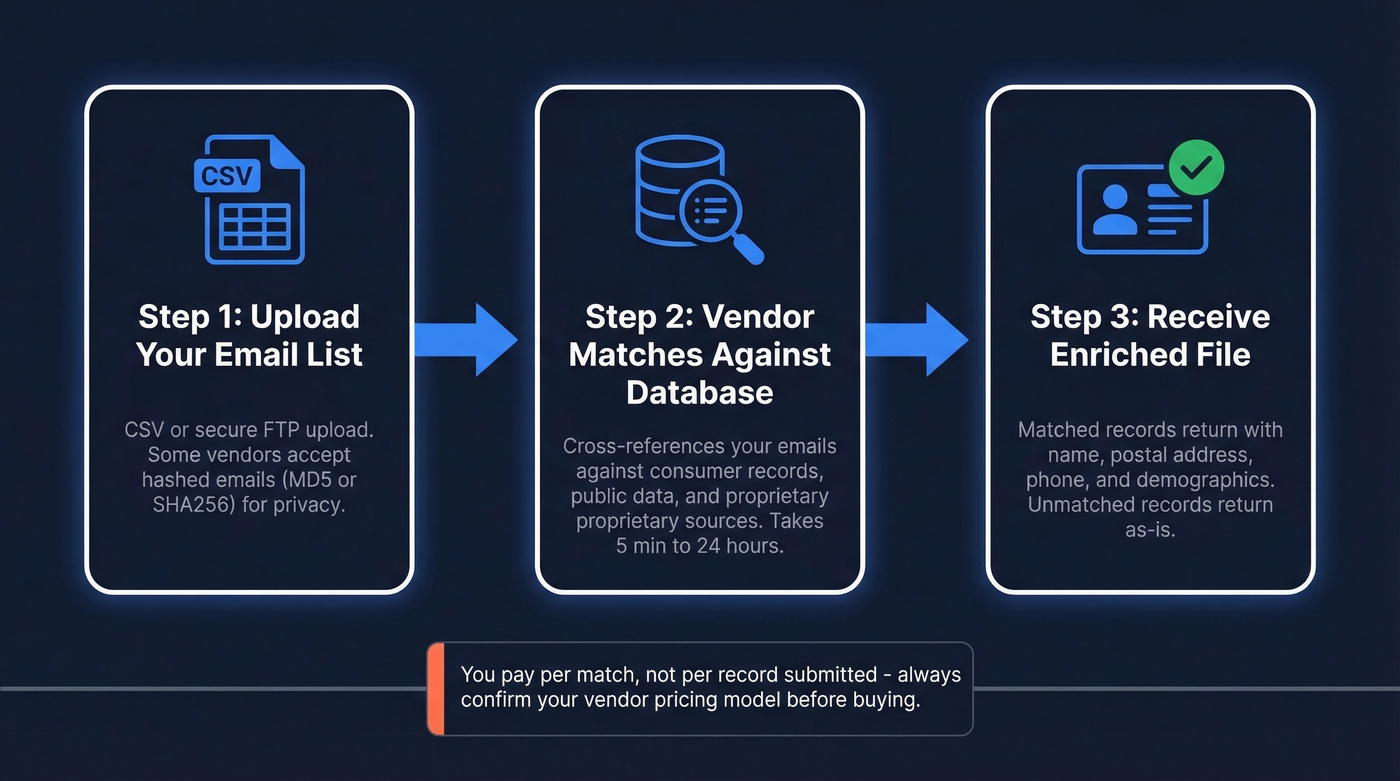
Most vendors charge per match, not per record submitted - you pay only for emails that successfully return data. A few charge per input record regardless. Always confirm which model you're buying.
What Data You Get Back
The fields depend on whether you're working with consumer or B2B data.
Consumer fields: Full name, USPS-standardized postal address, plus optional household demographics like gender, marital status, home value, income ranges, age code, children present, length of residence, owner/renter likelihood, and language. NCOA Source includes 15+ demographic fields per match - a strong pick for direct-mail campaigns needing segmentation depth.
B2B fields: Company name, job title, department, direct phone number, and sometimes firmographic data like industry and company size. If all you need is to find a company from an email address, even a basic reverse append can return the associated organization. But if you need deeper B2B enrichment - job titles, company details, verified direct dials - a dedicated B2B data platform will outperform most batch append services.

Batch append services return names and postal addresses. Prospeo returns 50+ data points per contact - verified work emails, direct dials, job titles, company firmographics, and intent signals - with a 92% match rate and 98% email accuracy. All refreshed every 7 days, not sitting in a static CSV.
Turn email lists into pipeline-ready records for $0.01 per contact.
Costs and Vendor Comparison
People dramatically overestimate append pricing. An old Reddit thread on r/marketing shows users expecting $0.10-$0.50 per person. The actual market is far cheaper.
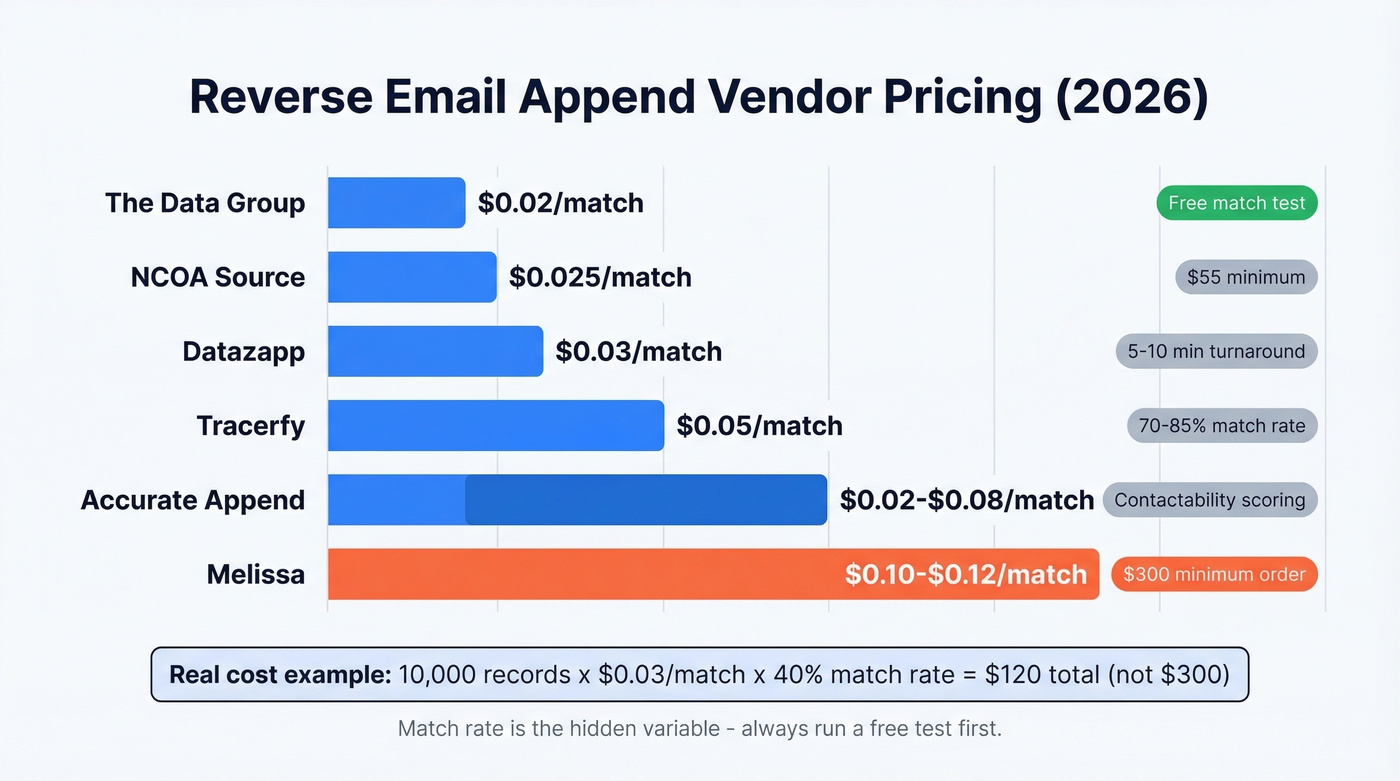
| Vendor | Price/Match | Match Rate | Turnaround | Notable Feature |
|---|---|---|---|---|
| The Data Group | $0.02 | Up to 90% | Varies | Free match test |
| NCOA Source | $0.025 | Not published | Under 1 hour | 15+ demographics, $55 min |
| Datazapp | $0.03 | 25-60% | 5-10 min | Hashed email support |
| Tracerfy | $0.05 | 70-85% | Same day | API ($200 setup) |
| Accurate Append | $0.02-$0.08 | Not published | Same day (90%) | Contactability scoring |
| Melissa | $0.10-$0.0.12 | Not published | ~24 hours | $300 minimum order |
Here's the math that actually matters: don't multiply your list size by the per-match price. You pay only on matches. So 10,000 records at $0.03/match with a 40% match rate costs $120 total, not $300. Match rate is the hidden variable that determines your real cost.
Run the free match test before committing budget. Always.
Mistakes That Kill Results
Starting with dirty data. Typos, duplicates, and malformed addresses tank your match rate before the vendor touches your list. Dedupe and validate first. If you're doing this at scale, use an email deliverability workflow, not a one-off cleanup.
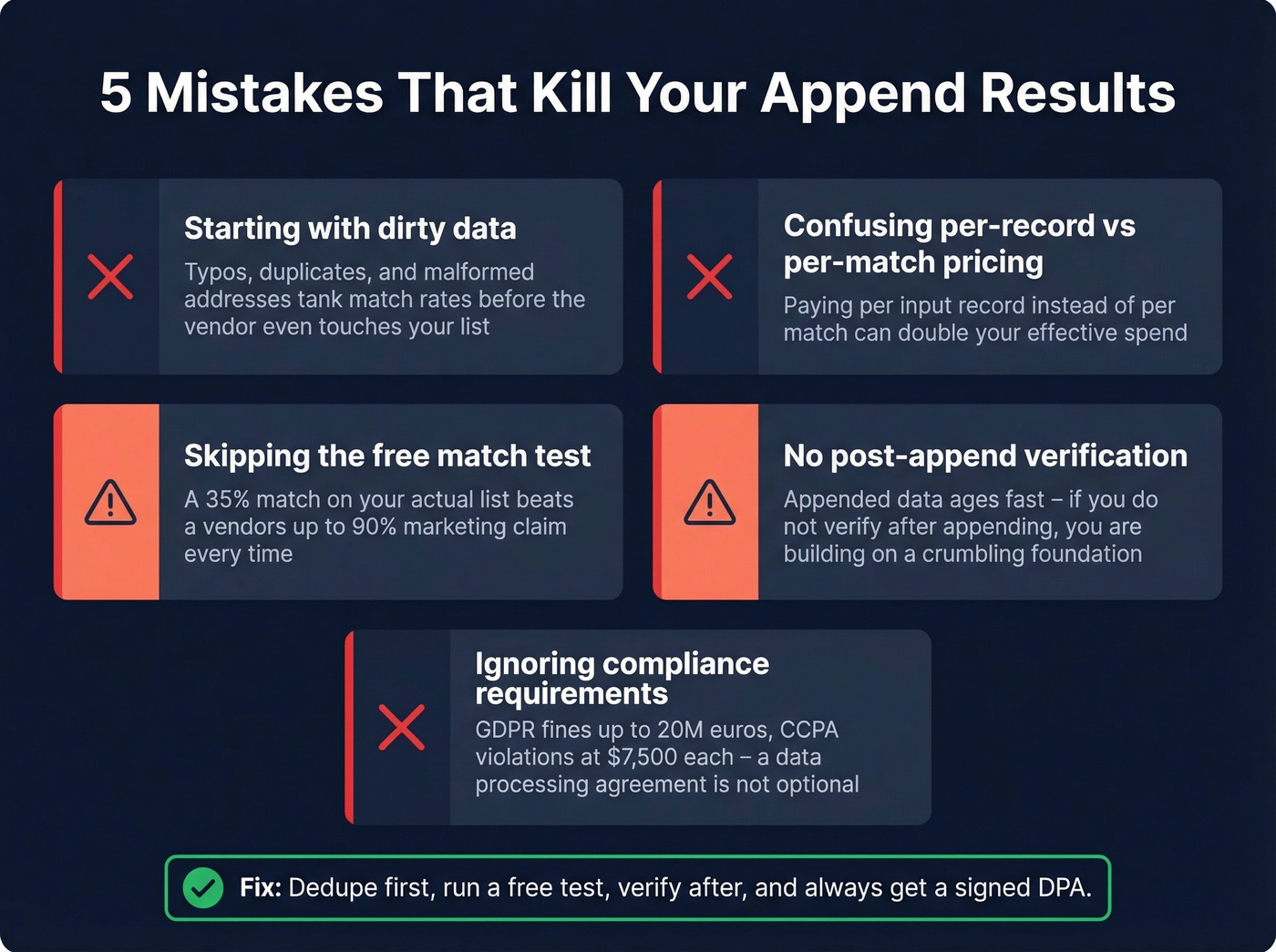
Confusing per-record vs. per-match pricing. People already overestimate costs - paying per input record instead of per match can double your effective spend on top of that.
Skipping the free match test. Most vendors offer one. A 35% match rate on your specific list is worth more than a vendor's "up to 90%" marketing claim. We've seen teams commit thousands of dollars based on headline match rates, only to get back a fraction of what they expected.
No post-append verification. Appended data ages fast. If you don't verify emails and addresses after appending, you're building on a foundation that's already crumbling. (If you need a verifier shortlist, see email verification alternatives.)
Ignoring compliance. Appended data falls under GDPR, CCPA, and state privacy laws. A data processing agreement isn't optional - it's table stakes. If you're unsure where the line is, start with an ethics in sales lens before you buy data.
Compliance You Can't Ignore
Reverse email appending sits in a regulatory gray zone that's getting less gray every year. GDPR fines run up to EUR 20M or 4% of global turnover, and enforcement is real. Under CCPA, intentional violations cost $7,500 each. Those add up fast on a 50,000-record append.
Multiple new state privacy laws have taken effect since 2025, and the trend is accelerating. For append projects, you need a data processing agreement with your vendor, a suppression list workflow that honors opt-outs, and CAN-SPAM-compliant unsubscribe handling on any emails sent to appended contacts. If your vendor can't explain their data sourcing and opt-out compliance in plain language, find a different vendor.
When Real-Time Enrichment Wins Instead
Let's be honest: if you're in B2B, batch reverse email append is the wrong tool.
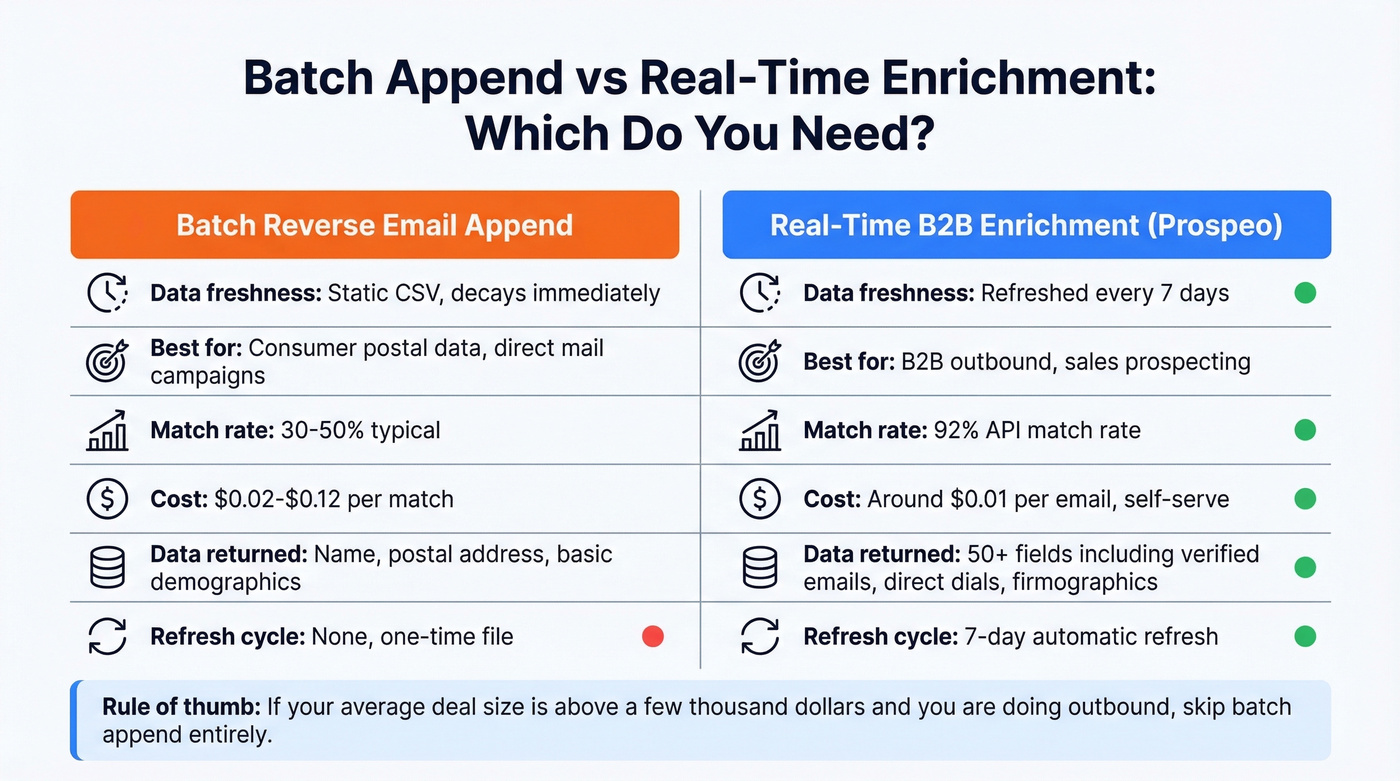
Use batch append when you need postal addresses for direct mail or you're enriching a consumer database with demographics. Batch append services are built for these high-volume, offline-style use cases, and they're good at it.
Use real-time enrichment when you need verified work emails and direct dials for outbound, or your data needs to stay fresh rather than decay in a CSV. The difference in data freshness between a batch file and a real-time platform is night and day - we've tested both extensively and it's not close. If you're evaluating providers, start with a list of data enrichment services and narrow by your use case.
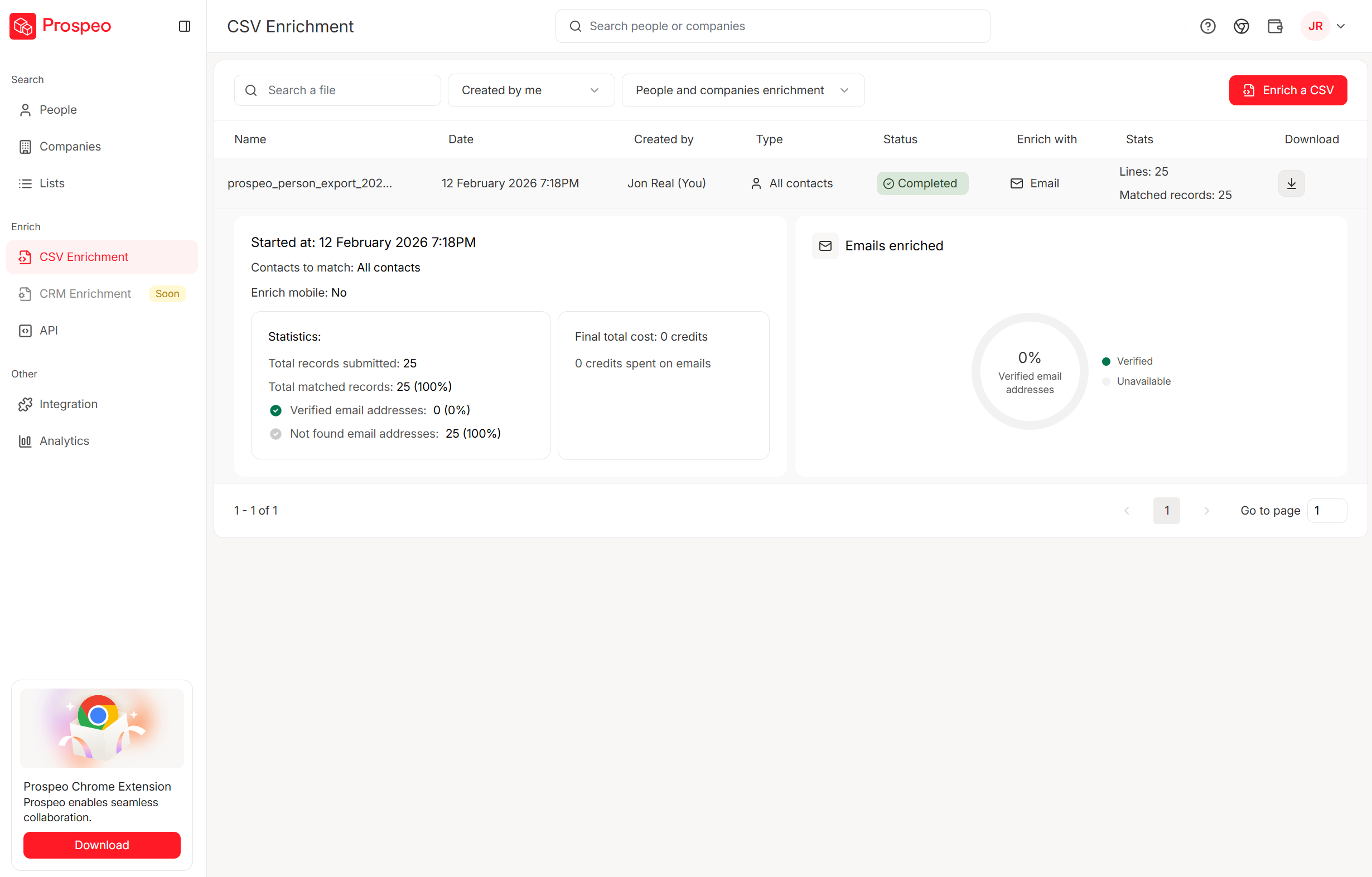
On the HubSpot Community, practitioners report 70-80% hit rates with tools like Apollo and 85%+ with waterfall enrichment platforms like FullEnrich ($29/month). Cognism covers Europe well but runs $15k+/year with annual contracts. Prospeo returns 50+ data points per contact with a 92% API match rate and 98% email accuracy, all refreshed on a 7-day cycle, at roughly $0.01 per email - self-serve from day one with no contracts. (If you're building outbound around this, pair it with modern sales prospecting techniques.)
Skip batch append entirely if your average deal size is above a few thousand dollars and you're doing outbound. A self-serve enrichment tool paired with good outbound process will outperform an enterprise suite your team barely logs into.
Real-time enrichment beats batch appending every time for B2B. Prospeo's enrichment API returns verified emails, direct dials from 125M+ mobile numbers, and firmographic data at a 92% match rate - with a 7-day refresh cycle while batch vendors hand you data that's already decaying.
Skip the batch file. Enrich contacts in real time with data you can trust.
FAQ
What's a realistic match rate for reverse email appending?
Plan for 30-50% on a typical consumer list. Vendors advertise 70-90%, but those numbers reflect best-case scenarios with clean, US-only data. Always run a free match test on your actual file before committing budget - a 35% match at $0.03 costs just $105 per 10,000 records.
Is reverse email appending legal?
Yes in most jurisdictions, but guardrails matter. GDPR requires a lawful basis for processing, typically legitimate interest with a balancing test. CCPA requires honoring opt-out requests and disclosing data sales. Always use a vendor with a signed data processing agreement and clear suppression-list workflows.
How is it different from email verification?
Verification checks whether an email inbox is deliverable - it returns a pass/fail status. Reverse email appending starts with an email and finds the person behind it: name, postal address, and sometimes phone or demographic attributes. They solve different problems and are often used together.
What's a good alternative for B2B enrichment?
Batch append services are built for consumer postal data, not B2B prospecting. For B2B, real-time enrichment platforms like Prospeo offer 98% email accuracy, 125M+ verified mobiles, and a 7-day data refresh cycle - starting free at 75 emails/month. Apollo and Cognism are other options, though Apollo's accuracy sits around 79% and Cognism requires $15k+/year contracts.