

Reverse IP Tracking: What It Actually Means and How to Use It
You're a security analyst tracing suspicious traffic, and the reverse lookup returns ec2-52-23-145-67.compute-1.amazonaws.com. Useless. Or you're a B2B marketer who searched "reverse IP tracking" hoping to see which companies visit your site, and every result is about DNS records. The term means three completely different things depending on who's asking, and most guides only cover one.
What You Need (Quick Version)
- PTR / reverse DNS lookup - You want the hostname behind an IP. Use
dig -xor MxToolbox. Free, instant. - Co-hosted domain discovery - You want all domains sharing an IP. Use HackerTarget (free) or DomainTools (paid, deeper).
- B2B website visitor identification - You want to know which companies visit your site. Use a visitor ID tool like Dealfront, then find verified contacts with Prospeo.
Three Types of IP-to-Identity Lookups
These three use cases share a name but have almost nothing else in common.
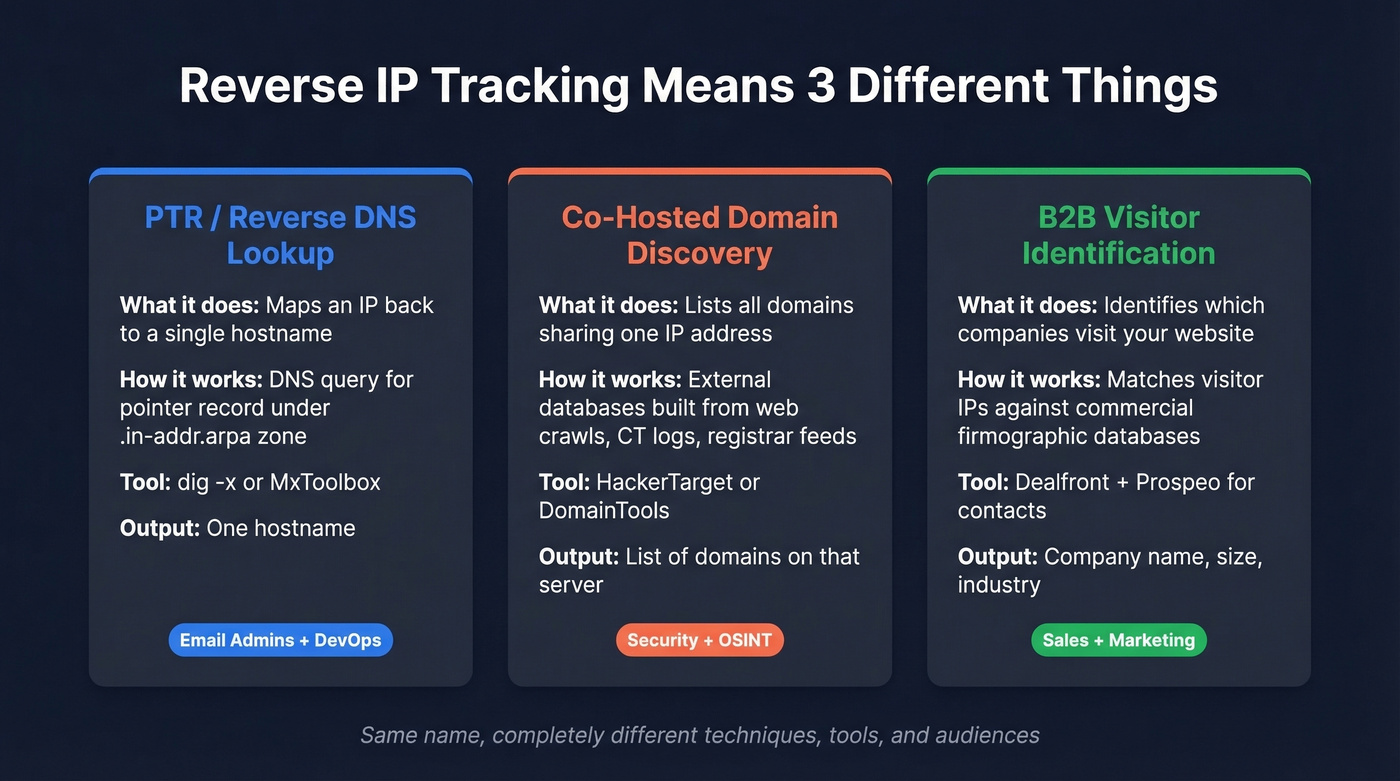
PTR lookups query DNS for a pointer record - the IP block owner sets this, and it returns a single hostname. Mail servers use it constantly. One command, one answer.
Co-hosted domain lookups answer "what other domains live on this IP?" That's not a DNS query at all. A well-known Stack Overflow thread explains that DNS provides no mechanism to list all A records pointing to an IP. You need an external database built from web crawls, certificate transparency logs, and registrar feeds - and every dataset has holes.
B2B visitor identification is the marketing use case. A website visitor IP tracker captures visitor IPs, matches them against commercial databases, and returns company names and firmographics. It identifies organizations, not individuals.
Reverse DNS (PTR) Lookups
A PTR record maps an IP address back to a hostname, stored under the .in-addr.arpa zone for IPv4 or .ip6.arpa for IPv6. The key concept is FCrDNS - Forward-Confirmed reverse DNS - where the reverse lookup returns a hostname and the forward lookup of that hostname returns the same IP. When both directions match, mail servers treat it as a trust signal.
This matters for email deliverability. Many mail systems treat missing or misconfigured reverse DNS as a negative signal, and SpamAssassin penalizes mail when PTR/rDNS isn't set up properly. If you're running outbound email infrastructure, proper rDNS configuration isn't optional.
dig -x 93.184.216.34
That's it. One command, one hostname back.
Co-Hosted Domain Lookups
This is the OSINT use case. You have an IP and want every domain hosted on it - useful for mapping attack surfaces, identifying virtual hosts, or investigating suspicious servers.
HackerTarget's reverse IP tool is a strong free option with clear limits and a transparent methodology. Their dataset draws from the Alexa Top 1M list, Bing indexing, Common Crawl, Certificate Transparency logs, and scans.io. Free tier gives you 20 queries per day with 50 results per request. DomainTools goes deeper for paid users - their wildcard % search lets you broaden from a single host to an entire network segment, which is invaluable for infrastructure mapping.
Use this if you're doing security research, pen testing, or competitive intelligence on shared hosting. The Bing ip: search operator is another quick trick - plug an IP into Bing with the ip: prefix and you'll get indexed domains on that address.
Skip this if you're trying to identify companies visiting your website. Co-hosted domain tools tell you what's on a server, not who's visiting yours.

Reverse IP tracking tells you a company visited your site. Then what? Prospeo turns that company name into verified decision-maker emails (98% accuracy) and direct mobile numbers across 300M+ profiles. No bounced emails. No guessing.
Stop identifying companies and start reaching the people inside them.
Why These Lookups Are Less Reliable Now
A huge share of websites now sit behind CDNs and reverse proxies like Cloudflare, Akamai, and Fastly. When a domain is proxied through Cloudflare, DNS lookups return a Cloudflare IP - not the origin server. Run a reverse IP lookup on that address and you'll get thousands of unrelated domains sharing the same anycast range.
Cloud hosting creates the same problem from a different angle. A thread on r/firewalla captured the frustration perfectly: a user saw ec2-52-23-145-67.compute-1.amazonaws.com in their reverse DNS results. That's AWS infrastructure naming. It tells you the region. It tells you nothing about who's running the service.
Add VPNs and CGNAT - ISPs sharing a single public IP across hundreds of subscribers - and the signal-to-noise ratio for any IP-based identification technique has dropped hard over the past five years. Here's the thing: if more than half your target audience works remotely, reverse IP tracking for B2B is closer to a coin flip than a strategy. You need it as one signal among many, not as your primary intent source.
Finding the Real IP Behind a CDN
When a CDN masks the origin, security researchers use these techniques:
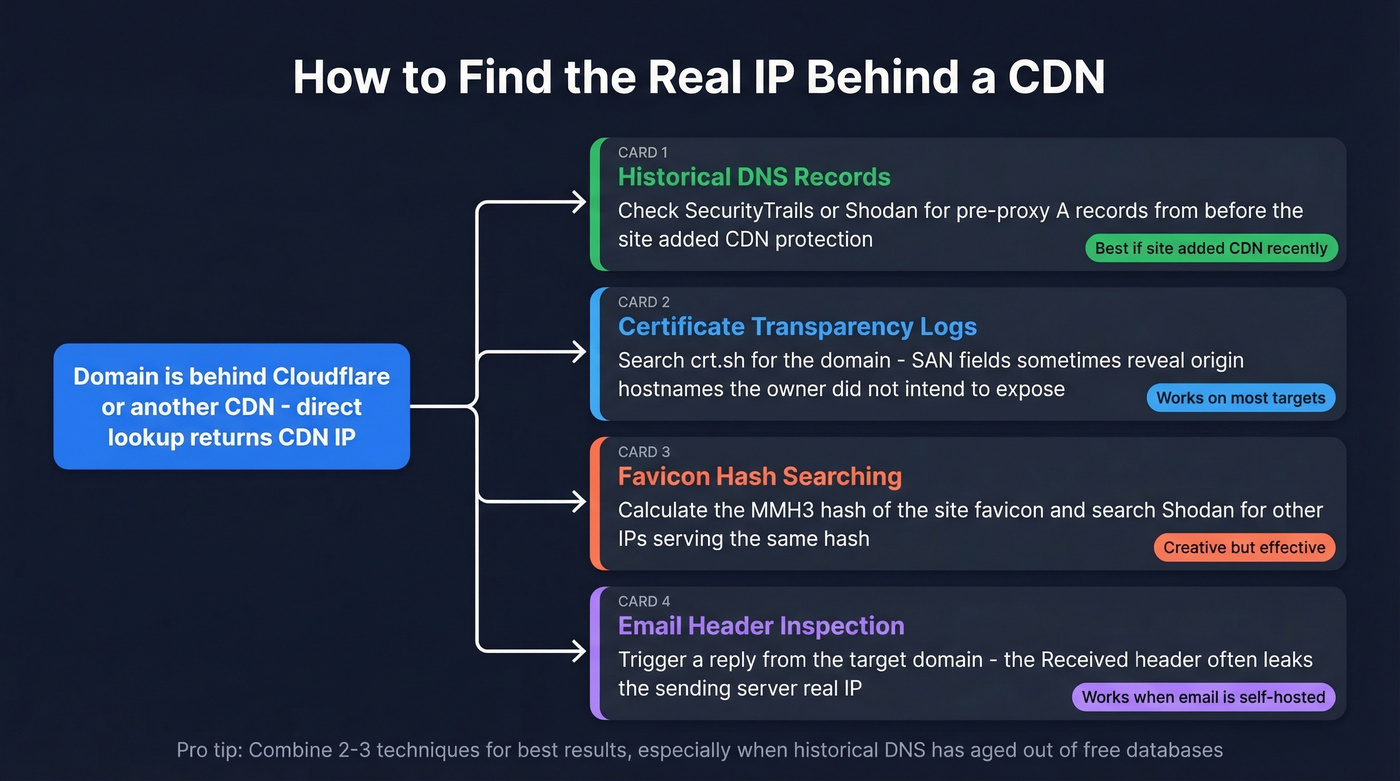
- Historical DNS records - If the site added Cloudflare after launch, pre-proxy A records still exist in SecurityTrails or Shodan indexes.
- Certificate Transparency logs - Search crt.sh for the domain. SAN fields sometimes reveal origin hostnames the owner didn't intend to expose.
- Favicon hash searching - Calculate the MMH3 hash of a site's favicon and search Shodan for other IPs serving the same hash.
- Email header inspection - Trigger a reply from the target domain. The "Received" header often leaks the sending server's real IP.
Passive DNS databases like VirusTotal and Farsight DNSDB round out the toolkit for threat intel work. We've found that combining two or three of these methods gives you the best shot at uncovering an origin IP that a single technique would miss entirely, especially when the target has been behind a CDN for years and historical DNS records have aged out of most free databases.
B2B Visitor Identification via IP
97% of website visitors leave without converting. Google Analytics used to show a "Service Provider" dimension that mapped each visitor IP to an organization name, but GA removed it in early February 2020. That gap created an entire category of B2B visitor identification tools.
The workflow is straightforward: capture visitor IP, reverse lookup against commercial databases, return firmographics like company name, size, industry, and revenue. The tools identify the company, not the individual - which is how vendors frame GDPR compliance.
Let's be honest about match rates, though. They're lower than vendors suggest. In our experience testing these tools across client sites, expect closer to 15% for sites with heavy mobile traffic. Corporate office traffic with static ASNs converts well. Remote workers on residential ISPs? Invisible. This is especially challenging in manufacturing, logistics, and other industries where buyers research solutions from personal devices long before engaging sales.
Dealfront (formerly Leadfeeder) runs roughly $100-500/mo for SMB plans. Lead Forensics targets mid-market at $1,000-3,000+/mo. Both stop at the company name. To actually reach decision-makers, you need verified contact data - search by company in Prospeo, filter by role, and get 98% accurate emails and 125M+ verified direct dials.
Best Free Reverse IP Tools in 2026
| Tool | What It Does | Free Limits | Best For |
|---|---|---|---|
| MxToolbox | PTR lookup | Unlimited | Email admins |
| HackerTarget | Co-hosted domains | 20 queries/day | OSINT research |
| DomainTools | Co-hosted domains | Free for members (up to 2,000 domains/IP) | Investigators |
| ViewDNS.info | Co-hosted domains | Unlimited | Quick checks |
| DNSChecker | PTR lookup | Unlimited | Troubleshooting |
| crt.sh | CT log search | Unlimited | Finding origin IPs |
From Company Name to Contact
Every reverse IP tool stops at the same point: a list of results. For security work, that's enough. For B2B sales, it's the starting line. Once you've identified a visiting company, you still need to find the right person and get a verified way to reach them - and that's where most workflows fall apart.
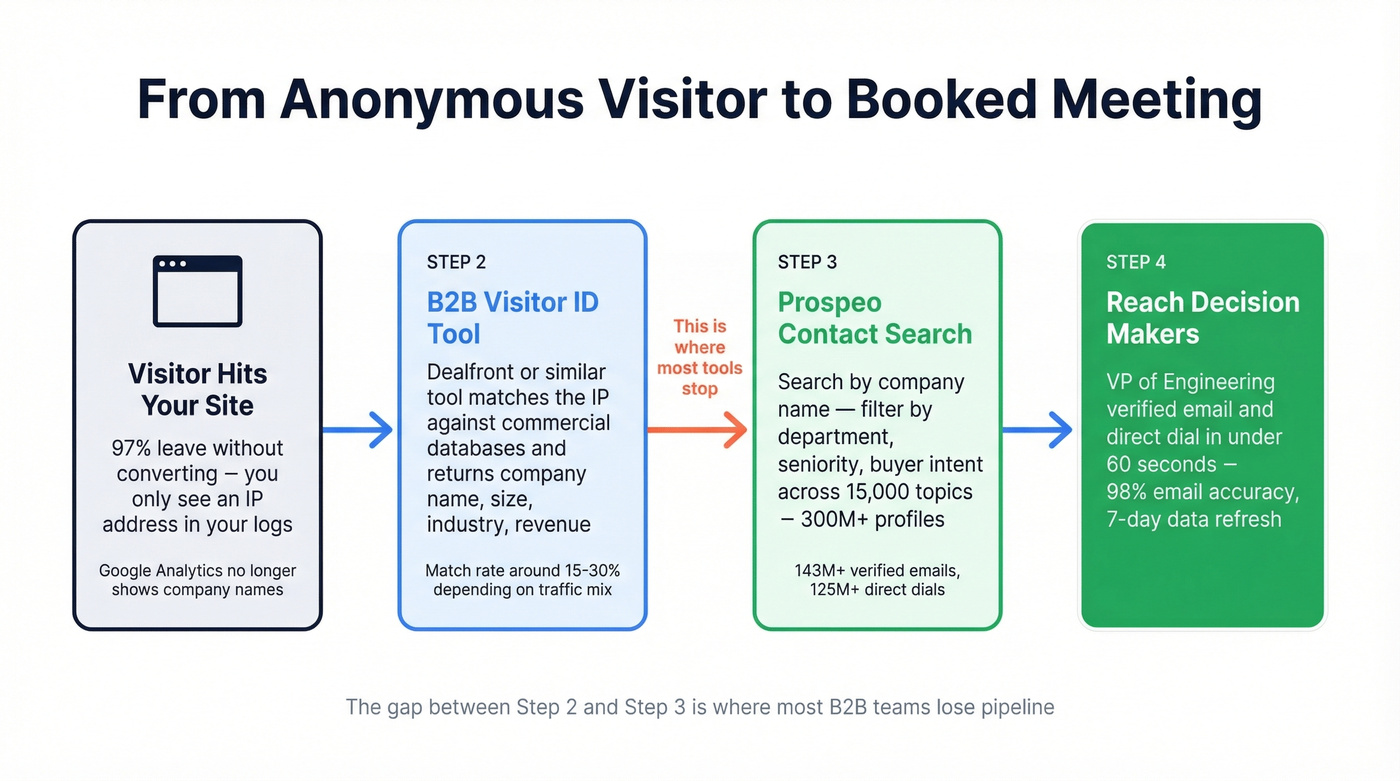
Prospeo's 300M+ profiles with 30+ search filters (buyer intent, department, seniority, technographics) let you go from "Acme Corp visited our pricing page" to "here's the VP of Engineering's verified email and direct dial" in under a minute. Data refreshes every 7 days, and there's a free tier to test the workflow before committing.

Remote work and CDNs have crushed reverse IP match rates to ~15%. Skip the coin flip. Prospeo's 30+ search filters - including buyer intent across 15,000 topics - let you find in-market companies and verified contacts without relying on IP signals at all.
Build pipeline from intent signals, not unreliable IP lookups.
FAQ
Is reverse IP tracking legal?
Reverse DNS and co-hosted domain lookups query public records - legal everywhere. B2B visitor ID tools identify companies, not individuals, and are GDPR-compliant when they avoid processing personal data. Check your jurisdiction's privacy laws before deploying visitor identification at scale.
Does a shared IP address hurt SEO?
No. Google's Matt Cutts confirmed average webmasters running a few sites shouldn't worry about sharing an IP or server. CDNs make IP sharing universal in 2026. A dedicated IP ($2-$25/mo) offers zero SEO benefit - save your money.
Which companies visit my website?
You need a B2B visitor identification tool that resolves IP addresses to company names using commercial databases. Free analytics platforms no longer provide this data. Tools like Dealfront or Lead Forensics handle identification, then a contact database like Prospeo - with 143M+ verified emails and a 7-day data refresh cycle - helps you reach the decision-makers at those companies.
What's the best free reverse IP lookup tool?
For PTR/reverse DNS, MxToolbox or dig -x handles it instantly. For co-hosted domains, HackerTarget gives you 20 free queries per day with a well-sourced dataset. For identifying companies visiting your website, you'll need a paid visitor ID tool - free options don't exist for this use case.