

Every Role of Sales Explained: Titles, Compensation, and Career Paths for 2026
The sales job market grew 31.9% year-over-year - from 54,748 to 72,215 commercial roles between 2024 and 2025. Account Executive demand jumped 41.2%. Sales Manager demand surged 149.3%. Companies aren't just hiring more salespeople; they're hiring more specialized salespeople, and the roles of sales look different than they did even two years ago.
Whether you're an SDR wondering when you'll get promoted, a founder figuring out your first sales hire, or a VP redesigning your org chart, the playbook has shifted. Here's every role that matters - with real compensation data, quota attainment rates most job postings conveniently leave out, and the career timelines nobody talks about honestly.
Sales Roles at a Glance
All compensation data comes from RepVue's 2026 salary guide, which aggregates self-reported data from thousands of sales professionals.
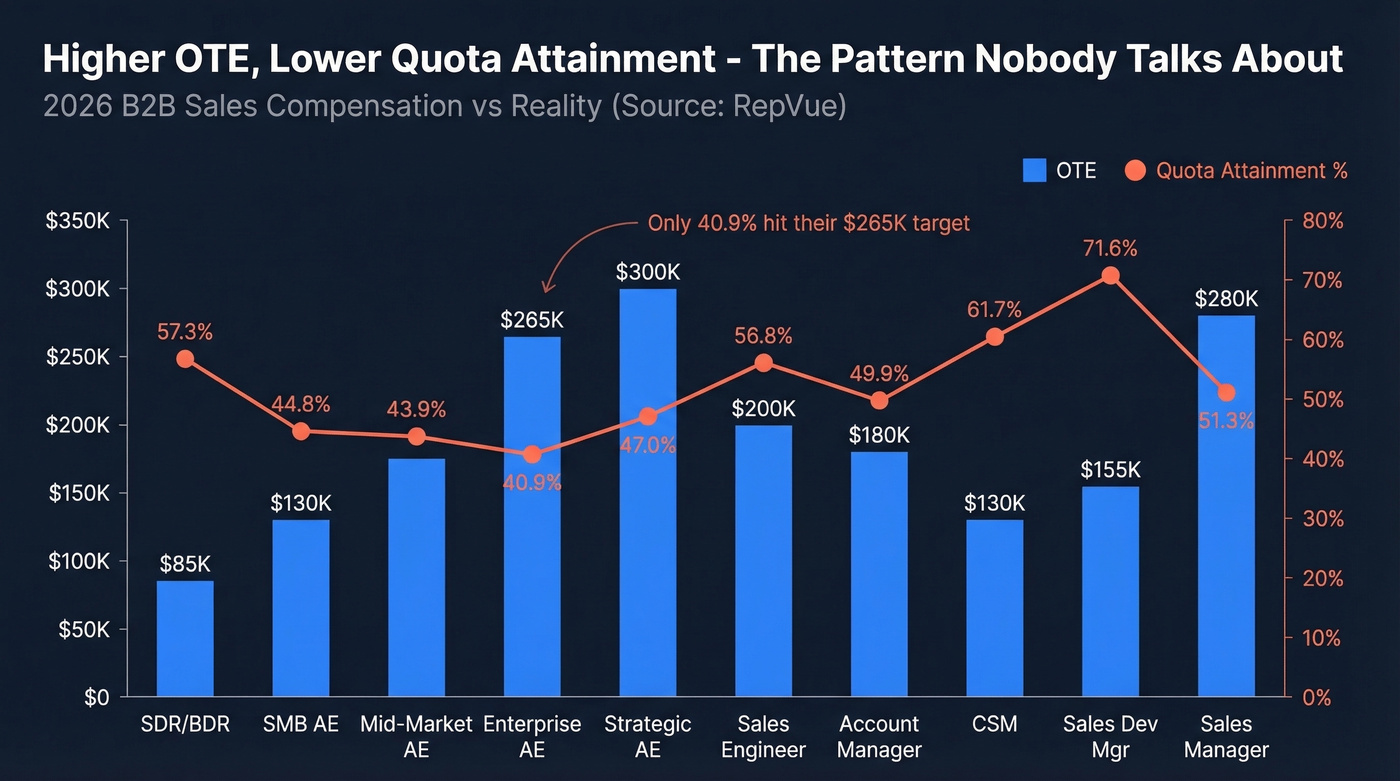
| Role | Level | Base | OTE | Quota % | Core Job |
|---|---|---|---|---|---|
| SDR/BDR | Entry | $60K | $85K | 57.3% | Pipeline generation |
| SMB AE | IC | $70K | $130K | 44.8% | Close new deals |
| Mid-Market AE | IC | $90K | $175K | 43.9% | Close mid-size deals |
| Enterprise AE | Senior IC | $135K | $265K | 40.9% | Close complex deals |
| Strategic AE | Senior IC | $150K | $300K | 47.0% | Land marquee accounts |
| Sales Engineer | IC | $145K | $200K | 56.8% | Technical deal support |
| Account Manager | IC | $100K | $180K | 49.9% | Retain & expand accounts |
| CSM | IC | $100K | $130K | 61.7% | Prevent churn, drive NRR |
| Sales Dev Manager | Leadership | $100K | $155K | 71.6% | Coach SDR team |
| Sales Manager | Leadership | $150K | $280K | 51.3% | Coach & forecast |
The pattern that jumps out: as OTE rises, quota attainment drops. Enterprise AEs have the flashiest comp plans, but fewer than 41% actually hit target. Keep that in mind when evaluating offers.
Entry-Level Sales Positions
SDR / BDR
The SDR role is where most B2B sales careers start - and where the gap between good data and bad data shows up fastest.
SDRs earn a median base of $60K with $85K OTE. Top performers push to $127,955. About 57.3% hit quota, which is actually one of the healthier attainment rates in sales. The Bridge Group benchmarks the average SDR pipeline at $3M/year, with SDRs responsible for 30-45% of new revenue. Operatix's study of 150 SDRs found roughly 15 meetings per month as the standard, with about 20% dropout before the meeting actually happens.
Bad contact data is one of the fastest ways to kill SDR productivity. We've seen this firsthand - reps burning hours on bounced emails and disconnected numbers aren't lazy, they're under-equipped. Prospeo's 98% email accuracy and 125M+ verified mobile numbers help teams spend more time selling and less time researching, and the impact shows up in outcomes like lower bounce rates and faster ramp.

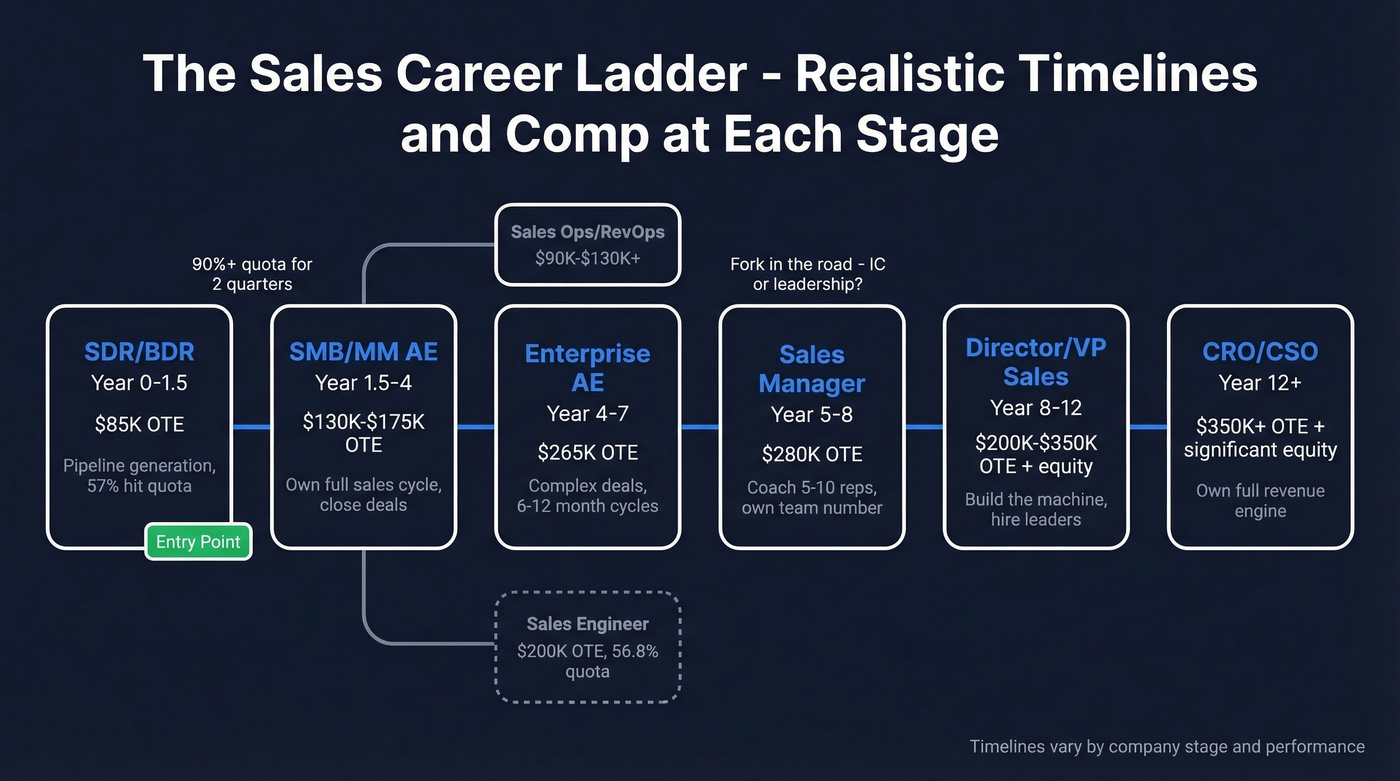
Career path: most SDRs transition to AE within 12-18 months. High performers make it in 10-12. The promotion threshold at most companies is 90%+ quota attainment for two consecutive quarters. Some SDRs also move into demand gen or product marketing, using their buyer-conversation experience as a springboard.
Inside Sales Rep
Inside sales reps handle the full cycle - prospecting through close - but do it remotely and typically on smaller deals. The key distinction from SDRs: inside reps own revenue, not just pipeline. They're common in high-velocity sales models where deal sizes don't justify field visits.
Inbound conversion benchmarks vary wildly by lead quality. Low-intent leads like content downloads and webinar signups convert at roughly 5-10% from lead to meeting. High-intent leads - demo requests, pricing page visits - convert at 75-80%. The role works best when paired with strong marketing. Without qualified inbound, it becomes an SDR role with a fancier title.
Outside Sales Rep
Outside reps work territories in person. They're meeting prospects at offices, conferences, and dinners. The comp structure typically skews toward a higher base and lower variable split compared to inside roles, reflecting longer sales cycles and relationship-heavy selling.
This role is shrinking in some industries and growing in others. Enterprise software, medical devices, and industrial sales still rely heavily on field reps. SaaS companies under $50M ARR rarely need them. Don't default to field sales because it feels "serious" - default to it because your buyers genuinely require face-to-face engagement.
Mid-Level Sales Titles
Account Executive
The AE role is where compensation gets interesting - and where the gap between OTE and reality gets uncomfortable.
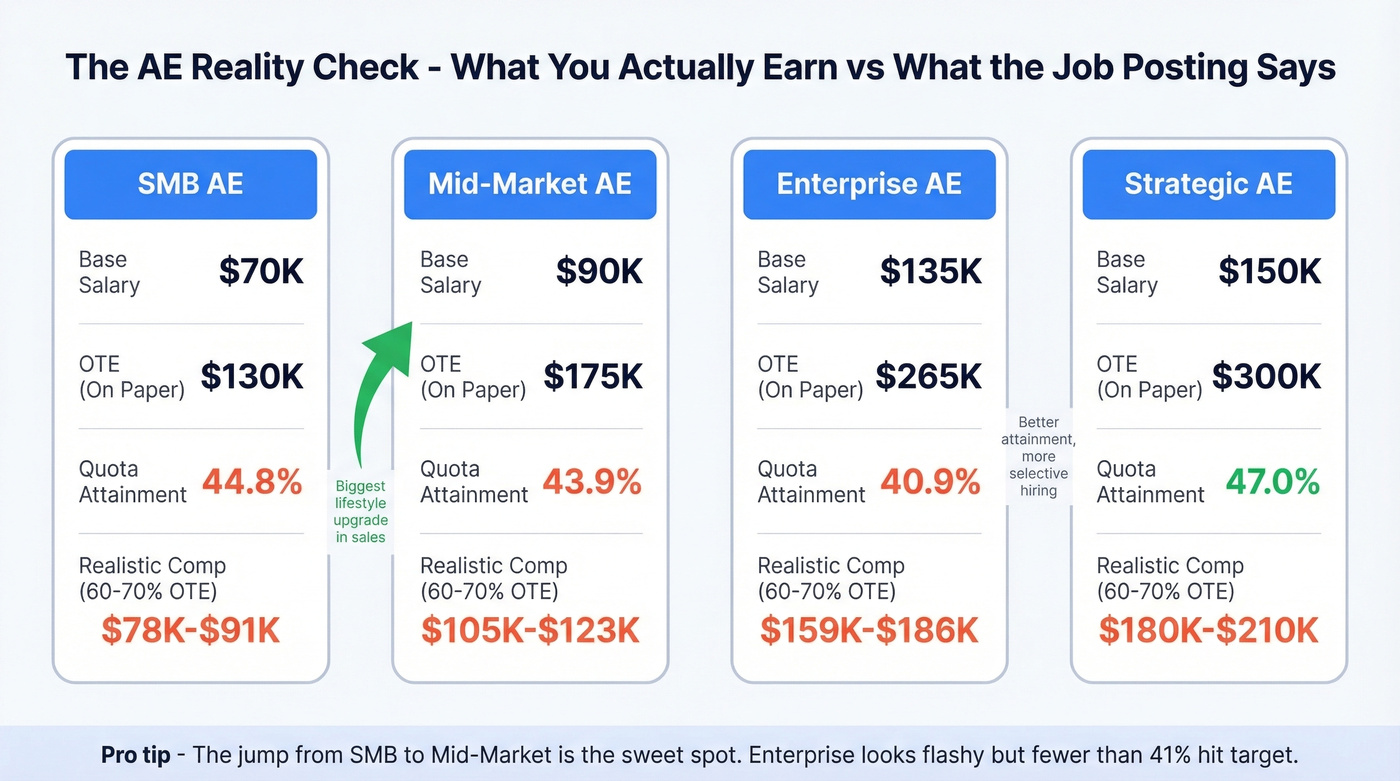
| Segment | Base | OTE | Quota % |
|---|---|---|---|
| SMB | $70K | $130K | 44.8% |
| Mid-Market | $90K | $175K | 43.9% |
| Enterprise | $135K | $265K | 40.9% |
| Strategic | $150K | $300K | 47.0% |
Enterprise AEs have $265K OTE, but only 40.9% hit quota - that's the number nobody puts on the job posting. The consensus on r/sales is that real comp lands closer to 60-70% of OTE for most reps. Strategic AEs actually have better attainment at 47%, likely because companies are more selective about who gets those accounts and more realistic about targets.
Here's the thing: the jump from SMB to mid-market AE is the biggest lifestyle upgrade in sales. You go from $130K OTE to $175K, deal cycles get longer but less chaotic, and you start working with actual buying committees instead of solo decision-makers. Inside AEs typically maintain higher close rates on smaller deals, while field AEs earn their keep on complex enterprise B2B sales engagements where face time moves the needle. The jump from mid-market to enterprise is bigger on paper but harder to execute - you need patience, political savvy, and comfort with 6-12 month cycles.
Account Manager
Account Managers earn $100K base with $180K OTE and hit quota 49.9% of the time. Their job isn't hunting - it's farming. They own the existing customer relationship, focusing on retention, expansion, and upsell.
The primary metric is net revenue retention. A great AM keeps NRR above 110%, meaning the accounts they manage grow even after churn. It's a fundamentally different skill set from closing new business, and companies that force AEs to do both usually do neither well.
Sales Engineer
Skip this section if you're not technical or not selling products over $50K ACV.
Sales Engineers pull $145K base and $200K OTE with 56.8% quota attainment - the highest among non-CS roles. They own technical demos, proof-of-concept builds, and the "can your product actually do this?" conversations that make or break enterprise deals.
This is the most underrated path for technical sellers. SEs don't carry the full weight of quota, but they're essential in deals over $50K where technical validation is a gating factor. The best ones become the reason a prospect picks your product over a competitor's. If you're an engineer who likes people or a salesperson who likes technology, this role pays extremely well with less of the feast-or-famine stress that AEs deal with.
Leadership & Executive Roles
Sales Manager
Sales Managers earn $150K base with $280K OTE and 51.3% quota attainment. They typically own a team of 5-10 reps, and their job is equal parts coaching, forecasting, and firefighting.
The cost of getting this hire wrong is brutal. A bad sales hire can cost up to 30% of a sales leader's annual revenue target. Structured interview processes reduce mis-hire risk by 30%+ - yet most sales teams still rely on gut-feel hiring. SalesGlobe's research on role design warns specifically about the "selling manager" trap - managers who carry their own quota while coaching a team. The conflicting priorities almost always mean one job gets neglected. If you're hiring a sales manager, decide upfront: are they managing or selling? Not both.
Sales Director / VP of Sales
The Director is the execution layer - owns the number, manages managers, and builds the machine. The VP is strategy and board-level - sets the go-to-market, hires the directors, and owns the forecast that the CEO presents to investors.
Most startups hire a VP of Sales too early and Sales Ops too late. A VP makes sense when you're between $5M and $20M ARR and need someone to professionalize what founders built by instinct. Before that, a strong Sales Director or Head of Sales who can build playbooks is the better hire. Expect VP of Sales comp in the $200K-$350K OTE range at growth-stage companies, with significant equity.
CRO / CSO
The Chief Revenue Officer owns the full revenue engine - sales, customer success, and sometimes marketing. It's the role that emerged when companies realized these functions couldn't operate in silos. Typically a $20M+ ARR hire.
The newest variant is the CAIRO - Chief AI Revenue Officer - commanding $200K-$350K and responsible for integrating AI across the entire revenue operation. Whether this title sticks or becomes a footnote depends on how seriously companies invest in AI-driven GTM over the next two years.

SDRs hit quota 57.3% of the time - but only when they're not burning hours on bounced emails. Prospeo delivers 98% email accuracy and 125M+ verified mobiles so reps spend time selling, not researching dead leads.
Ramp your SDRs faster with data that actually connects.
Operational & Specialist Roles
Sales Ops / RevOps
This is the most underrated role in B2B sales. Companies investing in data-driven sales operations see 15% higher quota attainment and 20% faster sales cycles. Yet most startups don't hire for it until they're drowning in broken processes.
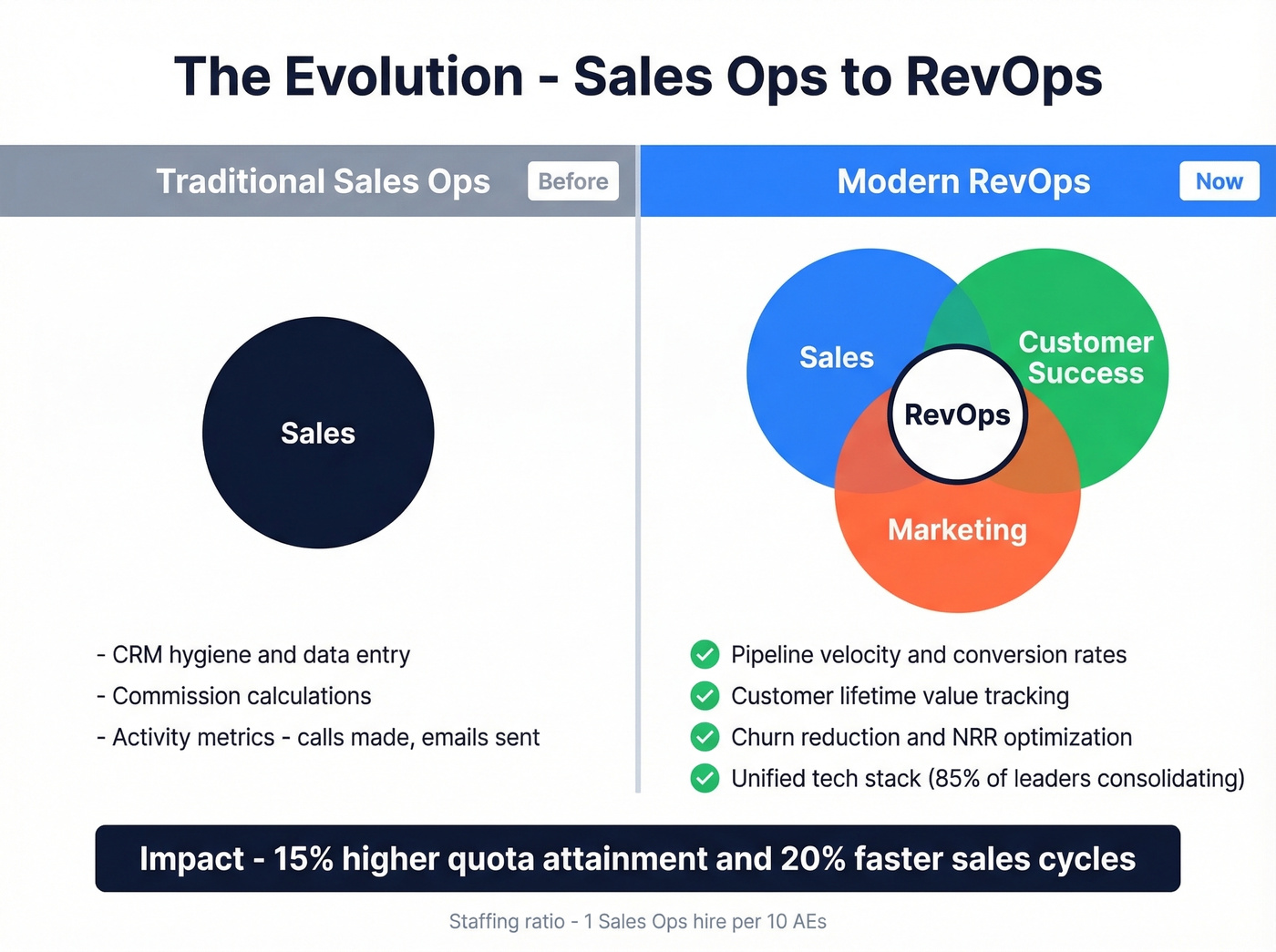
Traditional Sales Ops managed CRM hygiene and commission calculations. Modern RevOps spans sales, marketing, and CS under one operational umbrella, with 85% of sales leaders planning to consolidate their tech stacks over the next two years. The KPI shift is equally dramatic - from activity metrics like calls made and emails sent to outcome metrics like pipeline velocity, customer lifetime value, and churn reduction.

Staffing ratio: plan for roughly 1 Sales Ops hire per 10 AEs. Comp runs $90K-$130K total for mid-level, scaling up significantly for RevOps leaders at growth-stage companies.
Sales Enablement
Sales Enablement owns onboarding, training content, and the tools reps use daily. The hiring trigger is typically $5M-$20M ARR - before that, managers handle enablement informally and usually poorly.
The impact is measurable. GreyScout cut rep ramp time from 8-10 weeks to 4 weeks after investing in better data and enablement tooling. That's getting reps productive in half the time, which compounds across every new hire.
Customer Success Manager
CSMs earn $100K base with $130K OTE and boast the highest quota attainment of any role at 61.7%. They own NRR, churn prevention, and expansion revenue - the metrics that determine whether your SaaS company compounds or stalls.
The career path from SDR to CSM typically takes 15-20 months. It's an underappreciated move for SDRs who enjoy relationship-building more than cold outreach. Senior CSMs at enterprise companies push well past $150K total comp.
How Sales Compensation Works
The formula: OTE = Base Salary + (Quota x Commission Rate). The commission rate spans 5-50% depending on margin, deal size, and how much support the rep gets. A rep selling a high-margin SaaS product with no SE support might earn 15-20% commission. A rep selling low-margin hardware with a full support team might earn 5-8%.
The split matters as much as the total. A 50/50 split is aggressive - common for hunting roles where the company wants reps motivated by commission. A 70/30 split is conservative - typical for account management or roles with long sales cycles. Most AE roles land at 60/40.
Beyond the basics, watch for accelerators that pay higher commission above quota, draws that advance against future commissions, caps on maximum commission (a red flag), and clawbacks that return commission if a customer churns within a window. Let's be honest: if a comp plan has a cap, the company is telling you they don't want you to make too much money. Walk.
Here's how US and French compensation compares:
| Role | US OTE | France Base | France OTE |
|---|---|---|---|
| SDR | $85K | EUR30-45K | EUR40-70K |
| AE | $130-300K | EUR40-90K | EUR60-180K+ |
| Sales Manager | $280K | EUR70-120K | EUR100-200K+ |
The fact that most companies still list "competitive salary" instead of actual OTE ranges tells you everything about how broken sales hiring transparency remains in 2026.
Which Roles to Hire First
You're at $2M ARR, doing half the selling yourself, and wondering who to hire next. Here's the framework, adapted from Sloane Staffing's ARR model and David Sacks' SaaS org chart:
| ARR Stage | Roles to Add | Key Ratios | ARR/Employee |
|---|---|---|---|
| Up to $1M | SDR + AE (founder sells) | - | $20-25K |
| $1M-$5M | More SDRs, Sales Ops, CSM | 1 SDR : 2 AEs | $40-50K |
| $5M-$20M | VP Sales, Enablement, AMs | 1 Ops : 10 AEs | $50-67K |
| $20M+ | CRO, Regional Mgrs, RevOps | 1 Mgr : 5-10 reps | $100K |
If your ACV is under $15K, you don't need an enterprise sales org. You need a tight pod of 2-3 SDRs feeding mid-market AEs, one Sales Ops person keeping the CRM honest, and a CSM preventing churn. That's it.
The most common mistake we see is hiring a VP of Sales at $1.5M ARR when what you actually need is two more AEs and a Sales Ops person to fix your CRM. The VP will spend their first six months doing ops work anyway - and resenting it.
Career Ladder - Timelines and Thresholds
You're an SDR six months in, crushing quota, wondering: how long until AE?
SDR to AE: 12-18 months. High performers make it in 10-12. The threshold at most companies is 90%+ quota attainment for two consecutive quarters. Comp jumps from $85K OTE to $130K+ depending on segment.
SDR to CSM: 15-20 months. A natural move for SDRs who prefer relationship-building. Total comp lands around $80K-$110K, with a more predictable income thanks to higher base-to-variable ratios.
SDR to RevOps: 18-24 months. The analytical path. You'll need to demonstrate CRM proficiency, process thinking, and comfort with data. Comp runs $90K-$130K total, with strong upside as you move into leadership.
Mid-Market AE to Enterprise AE: Typically 2-3 years of consistent performance. The OTE jump from $175K to $265K is significant, but remember - attainment drops from 43.9% to 40.9%. You're trading predictability for upside.
The universal promotion signal: consistent quota attainment plus demonstrated ability to do parts of the next role already. Nobody gets promoted on potential alone.
Enterprise AEs close at 40.9% quota attainment. Every deal matters. Prospeo's 30+ search filters - buyer intent, technographics, headcount growth - help AEs target the right accounts before the first call, not after wasted cycles.
Stop guessing which accounts are in-market. Start knowing.
Emerging AI Sales Roles for 2026
AI isn't replacing sales roles - it's creating new ones. Companies using AI in sales have seen a 50% increase in leads and appointments, and Gartner predicts 75% of B2B purchases will move to digital platforms by 2027. Here are the titles showing up in job postings and recruiter projections right now:
| Role | Pay Range | Core Focus | Key Tech |
|---|---|---|---|
| Revenue Intelligence Architect | $130-210K | Signal analysis | Clari, Gong, People.ai |
| AI Sales Automation Orchestrator | $100-170K | Workflow design | Outreach, Clay, n8n |
| Agentic Sales Manager | $120-190K | AI agent oversight | LangChain, custom agents |
| AI Prospecting Engineer | $95-155K | Outbound automation | Data platforms, APIs |
| Predictive RevOps Manager | $110-180K | Forecasting models | Snowflake, dbt, BI tools |
| CAIRO | $200-350K | Full AI revenue strategy | All of the above |
Look, you don't need 15 different AI titles. You need 4-6 well-defined roles with clear ownership. Most of these "new" positions are existing functions - RevOps, enablement, prospecting - with an AI layer bolted on. The companies getting this right aren't creating new departments; they're upskilling their current Sales Ops and enablement teams to manage AI tools alongside their existing responsibilities.
The AI Prospecting Engineer role is particularly interesting because it sits at the intersection of data quality and automation - the person who builds and maintains the systems that find, verify, and route prospects to reps. Expect this to become a standard hire at companies running high-volume outbound by late 2026.
FAQ
What are the main roles of sales?
Six core roles form the backbone: SDR/BDR for pipeline generation, Account Executive for closing, Account Manager for retention and expansion, Sales Engineer for technical support, Sales Manager for team leadership, and Sales Ops/RevOps for process and technology. Most teams add Customer Success and Enablement as they scale past $5M ARR.
What's the highest-paying sales role?
Strategic AEs top out at $300K OTE, and CROs command $200K-$350K+. But quota attainment drops as OTE rises - only 40.9% of Enterprise AEs hit target. The highest realized earnings often belong to mid-market AEs who consistently exceed quota with accelerators.
How long does it take to go from SDR to AE?
Twelve to eighteen months is standard, with high performers making the jump in 10-12 months. The typical promotion threshold is 90%+ quota attainment for two consecutive quarters. Comp jumps from roughly $85K OTE to $130K+ depending on the AE segment you enter.
What's the difference between Sales Ops and RevOps?
Sales Ops supports the sales team specifically - CRM management, territory planning, commission calculations. RevOps spans sales, marketing, and customer success under one operational umbrella. RevOps is the direction most companies are moving, especially post-Series B when siloed operations create handoff problems.
What tools do SDRs need to hit quota?
Three essentials: a CRM like Salesforce or HubSpot, a sales engagement platform like Outreach or Salesloft, and a verified contact data source. Everything else is nice-to-have until those three are locked in.