

SaaS Sales Methodology: How to Choose, Combine, and Actually Make It Stick
Your VP of Sales comes back from SaaStr with a new religion. Last year it was Challenger. This year it's MEDDPICC. The enablement team scrambles to build training decks, reps sit through a two-day workshop, and six weeks later everyone's back to selling however they were selling before - except now there's a mandatory "Champion" field in Salesforce that nobody fills out honestly.
A common take on r/sales is blunt: most methodologies "pretty much sound the same" and boil down to need, budget, stakeholders, and timeline. That's not wrong. But it misses the point. Your SaaS sales methodology matters less as a label than whether you picked one that fits your deal shape, trained it against real pipeline, and built systems that reinforce it without creating bureaucracy.
The Quick Version
Don't have time for the full breakdown? Here's the cheat sheet:
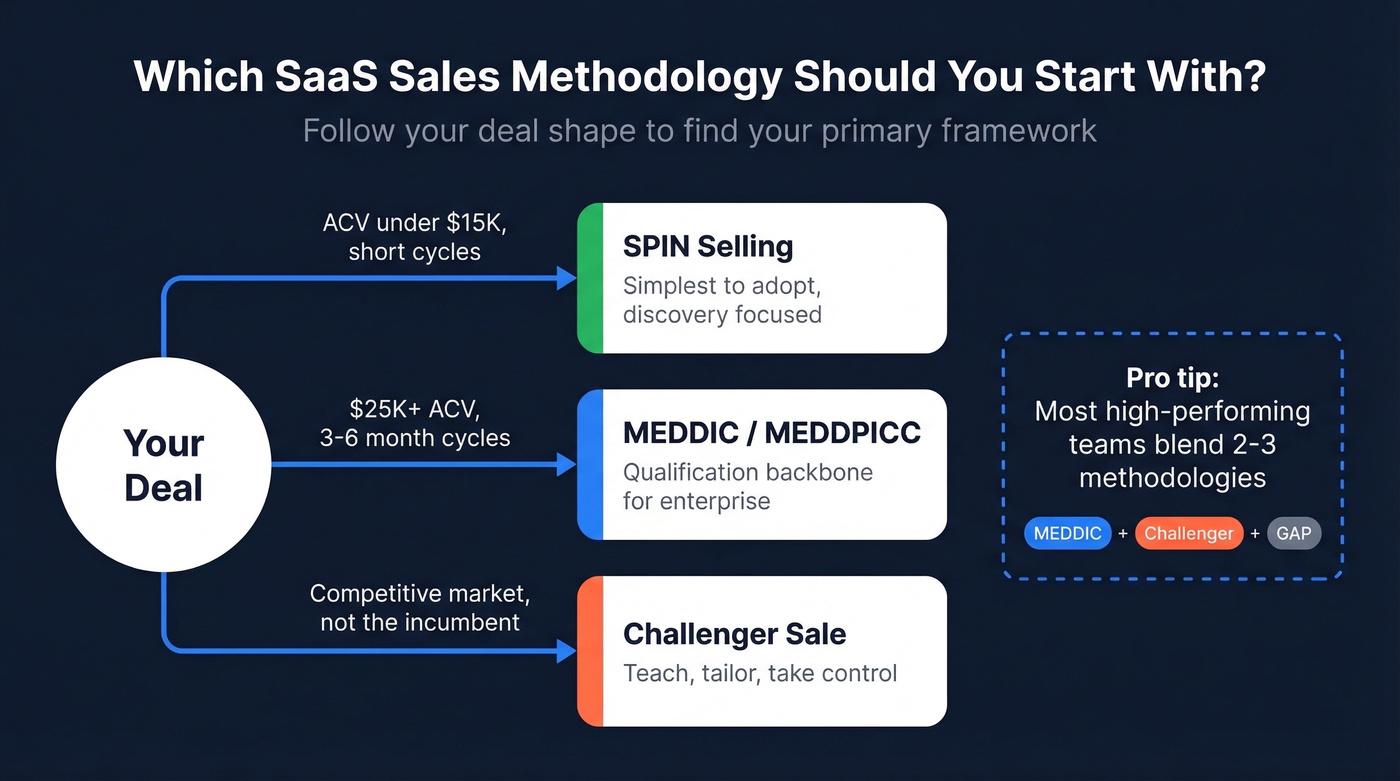
- Selling sub-$15K ACV deals with short cycles? Start with SPIN. Simplest to adopt, hardest to screw up.
- $25K+ ACV enterprise with 3-6 month cycles? Start with MEDDIC. It's the qualification backbone you need.
- Competitive market where you're not the incumbent? Challenger. Teach, tailor, take control.
- Most high-performing SaaS teams blend 2-3 methodologies. MEDDIC for qualification, Challenger or GAP for discovery and messaging, Sandler for deal control. The rest of this guide shows you how to pick your blend and make it stick.
Why Your Framework Choice Matters in 2026
SaaS efficiency pressure isn't a talking point anymore - it's the operating reality. The 2026 Benchmarkit report paints a clear picture: median growth hit 26%, with even top-quartile companies slowing to 50% from 60% in 2023. Median NRR slid to 101%. The cost of acquiring new customers keeps climbing, too - the median New CAC Ratio sits at $2.00 of S&M spend per $1.00 of new customer ARR, up 14% year-over-year.
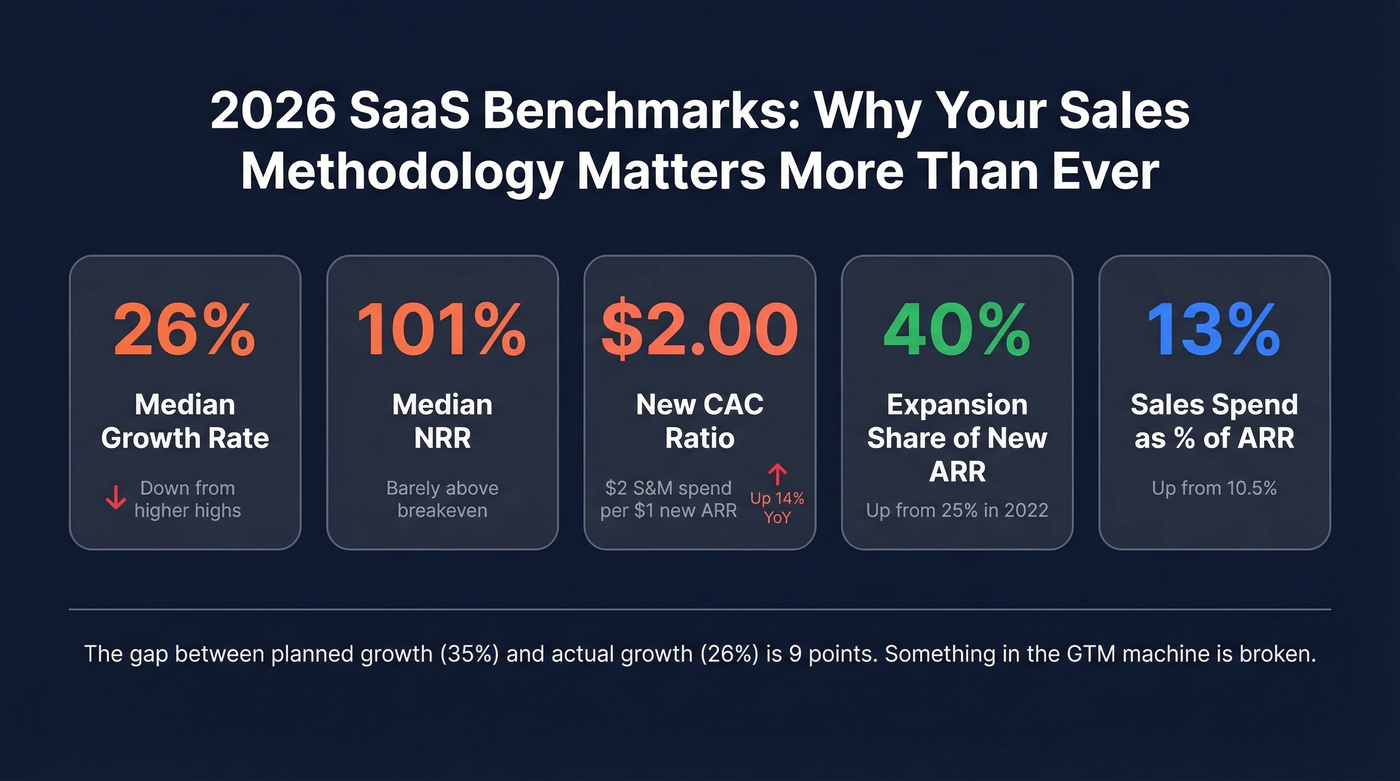
Companies planned for 35% growth after delivering just 26%. That's a 9-point gap between ambition and recent execution. Something in the go-to-market machine isn't working.
Expansion ARR now accounts for 40% of total new ARR, up from 25% in 2022. For companies above $50M ARR, it's over half. Your methodology can't just close new logos - it has to create the conditions for expansion. And SaaS Capital's survey of 1,000+ private B2B SaaS companies shows sales departments now consume 13% of ARR, up from 10.5%. You're spending more on sales than ever. A methodology that improves qualification, shortens cycles, and reduces late-stage slippage is the difference between that 13% being an investment or a waste.

Sales Methodology vs Sales Process
These get conflated constantly, and the confusion kills rollouts before they start.
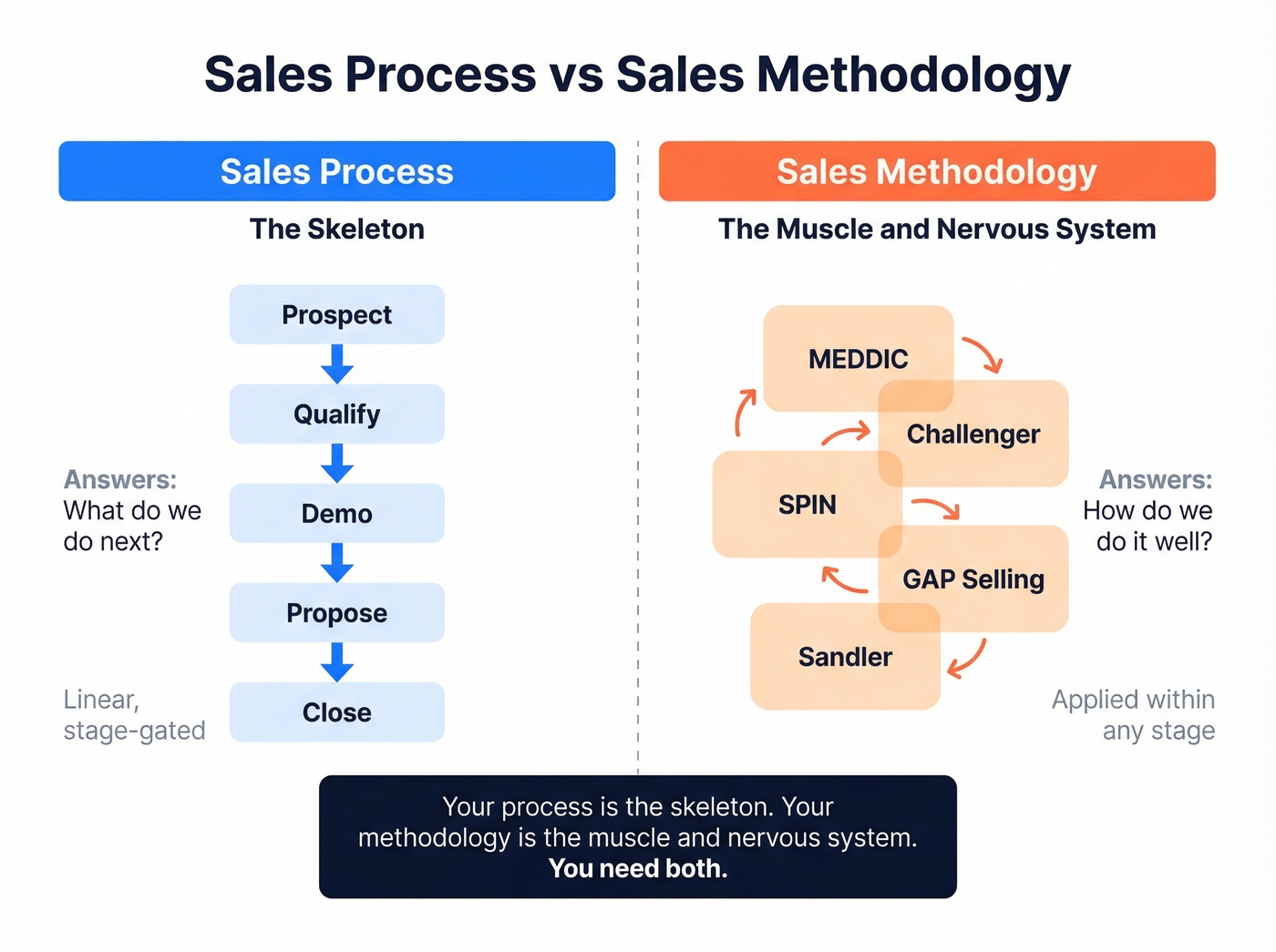
| Sales Process | Sales Methodology | |
|---|---|---|
| What it is | Repeatable stages and steps | Guiding philosophy and tactics |
| Example | Prospect > Qualify > Demo > Propose > Close | MEDDIC, Challenger, SPIN |
| Answers | "What do we do next?" | "How do we do it well?" |
| Scope | Linear, stage-gated | Applied within any stage |
Your process is the skeleton. Your methodology is the muscle and nervous system. Winning by Design takes this further - their model blends marketing, sales, and customer success into a single revenue architecture where the methodology doesn't stop at "closed-won."
The 9 Methodologies That Matter
MEDDIC / MEDDPICC
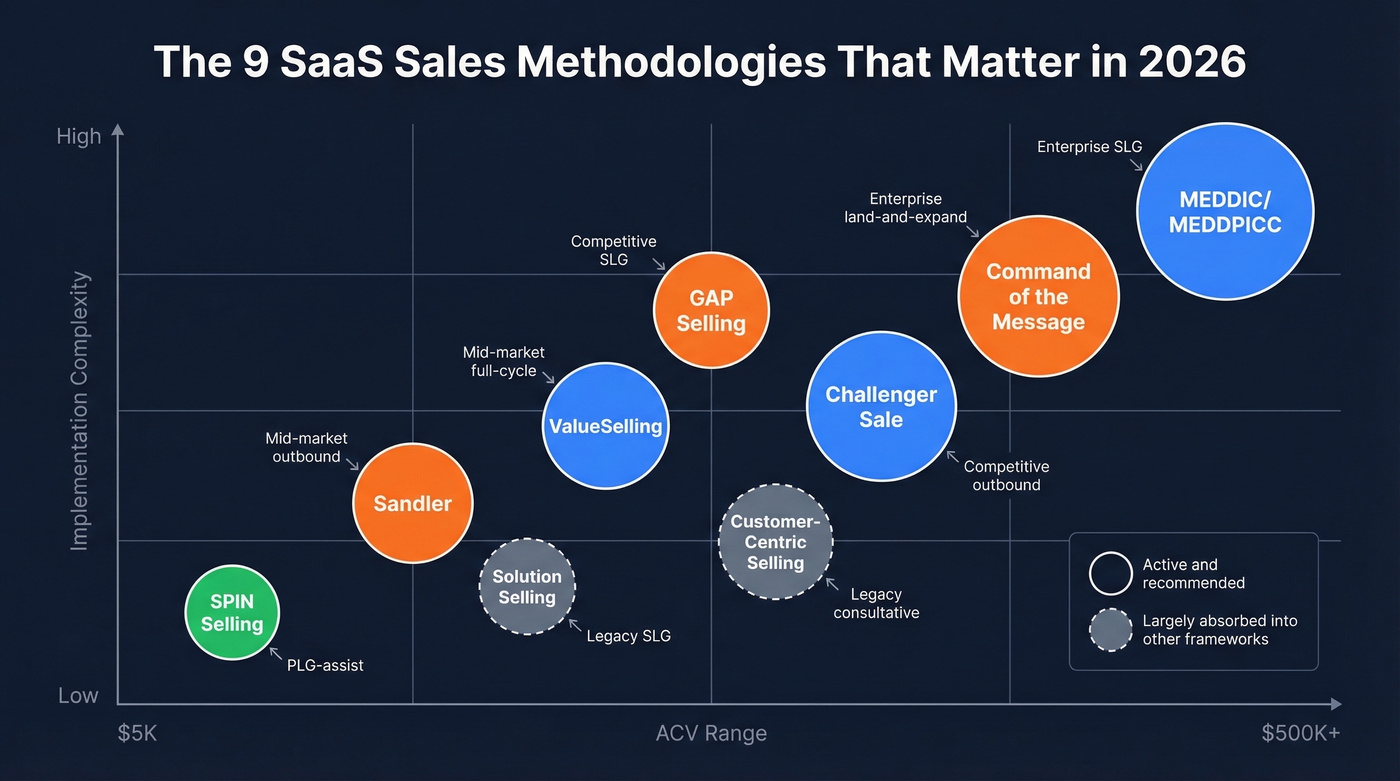
MEDDIC is the enterprise qualification standard for a reason. It forces rigor around Metrics, Economic Buyer, Decision Criteria, Decision Process, Identify Pain, and Champion - with MEDDPICC adding Paper Process and Competition. Built for $25K-$500K+ ACV deals with 3-6+ month cycles.
When it works, managers use MEDDIC to coach reps through stuck deals, not audit checkboxes. When it doesn't work, it becomes what Reddit calls "a CRM exercise, not a sales methodology." The difference between those outcomes is entirely about coaching culture. We've seen teams where a single strong frontline manager turned MEDDIC from shelfware into the operating system for every pipeline review - and teams where a $150K rollout produced nothing but resentment and empty Salesforce fields.
Challenger Sale
Here's the uncomfortable truth about Challenger: it only works if your reps are smarter than your buyers on at least one dimension. The core idea - teach the buyer something they didn't know, tailor the message to their context, and take control of the commercial conversation - is powerful for $15K-$250K ACV deals in competitive markets where you're not the incumbent.
But it breaks down fast when reps lack the domain expertise to actually "teach." If your team can't deliver a genuine insight that reframes how the buyer thinks about their problem, Challenger becomes a performance. Buyers see through performances fast. Organizations that nail Challenger win more competitive deals, but the prerequisite is deep industry knowledge baked into enablement, not just a two-day workshop.
SPIN Selling
If your team has never used a structured selling framework, start here. Neil Rackham's SPIN - Situation, Problem, Implication, Need-Payoff - is the simplest to adopt and a strong foundation for $5K-$50K ACV deals under 3 months, especially PLG-assist and inbound motions.
SPIN's strength is its focus on discovery. It teaches reps to ask better questions in a logical sequence rather than pitch features. It breaks down in complex multi-stakeholder deals where you need to map decision processes and build champion relationships. That's where you layer MEDDIC on top.
Sandler Selling System
Skip this if your reps already qualify ruthlessly and walk away from bad-fit deals without hesitation.
Consider it if your team chases every opportunity to the bitter end, burning cycles on deals that were never real. David Sandler's system centers on the "pain funnel" - a structured questioning technique that uncovers the emotional and business impact of the buyer's problem before discussing solutions. It's effective for $10K-$100K ACV transactional SLG deals with 1-3 month cycles. Sandler operates as a franchise training model, so expect around $1,500-$3,000 per rep. Practitioners consistently rate the pain funnel technique as the single most transferable skill from the program, and the mutual qualification mindset - where the rep qualifies the buyer as much as the buyer qualifies the vendor - is worth the investment alone for teams that chase too many bad-fit deals.
Solution Selling
Mike Bosworth's Solution Selling taught a generation of enterprise reps to diagnose before they prescribe, map solutions to pain, and build business cases. In 2026, it's largely been absorbed into other methodologies - Challenger, GAP, and MEDDIC all borrow from it. Still useful as a foundation for teams completely new to structured selling, but most organizations will get more mileage from one of its descendants.
GAP Selling
Keenan's GAP Selling is the most discovery-intensive methodology on this list. It maps the buyer's current state across five elements - physical environment, problem, impact, root cause, and emotions - and the "gap" between current state and desired future state becomes the motivation to buy.
The philosophy is problem-centric before needs-centric. You don't discuss solutions until you've thoroughly understood the problem. When done well, it shortens cycles and improves forecasting because reps only advance deals where a real gap exists. The caveat, per Keenan's own framing: it "requires a lot of work." Discovery calls take longer. Reps need genuine curiosity and analytical skill. You can't half-implement it.
Command of the Message
Force Management's Command of the Message follows a 9-step arc from Current State through Negative Consequences, Desired State, Positive Outcomes, Required Capabilities, Success Metrics, and on to Proof Points. Built for $25K-$250K+ ACV deals with 2-5 month cycles where messaging inconsistency is costing deals. The training is intensive and expensive - typically $50K-$150K+ for a rollout - but it produces a shared vocabulary that aligns marketing, sales, and customer success around value messaging.
ValueSelling
ValueSelling connects product capabilities directly to measurable outcomes, and it resonates with analytical buyer personas in healthcare, fintech, and other complex verticals. It fits $10K-$150K ACV deals with 1-4 month cycles, especially technical PLG environments. The limitation: it requires reps who can build quantified business cases, not just demo features. For simple, low-ACV purchasing decisions, it's overkill.
Customer-Centric Selling
Customer-Centric Selling aligns the sales process to the buyer's journey rather than the seller's pipeline stages. It shares DNA with most modern consultative approaches and largely overlaps with Solution Selling's evolution. Worth knowing about, but unlikely to be your primary framework - it's too broad to give reps specific, actionable guidance in defined deal shapes.

You're spending 13% of ARR on sales. A methodology that improves qualification only works when reps can actually reach the Economic Buyer. Prospeo gives your team 300M+ profiles with 98% verified emails and 125M+ direct dials - so MEDDIC fields get filled with real conversations, not guesswork.
Stop qualifying deals you can't even connect on.
Choosing Your Blend
No single methodology fits every SaaS company. Here's the practical mapping:
| Methodology | ACV Range | Cycle | GTM Motion | Best For |
|---|---|---|---|---|
| MEDDIC/MEDDPICC | $25K-$500K+ | 3-6+ mo | Enterprise SLG | Qualification rigor |
| Challenger | $15K-$250K | 1-4 mo | Competitive outbound | Displacing incumbents |
| SPIN | $5K-$50K | <3 mo | PLG-assist / inbound | Discovery foundations |
| Sandler | $10K-$100K | 1-3 mo | Transactional SLG | Deal control |
| GAP Selling | $10K-$150K | 1-4 mo | Any | Deep discovery |
| Command of Message | $25K-$250K+ | 2-5 mo | Mid-market/enterprise | Messaging alignment |
| ValueSelling | $10K-$150K | 1-4 mo | Technical PLG | Skeptical buyers |
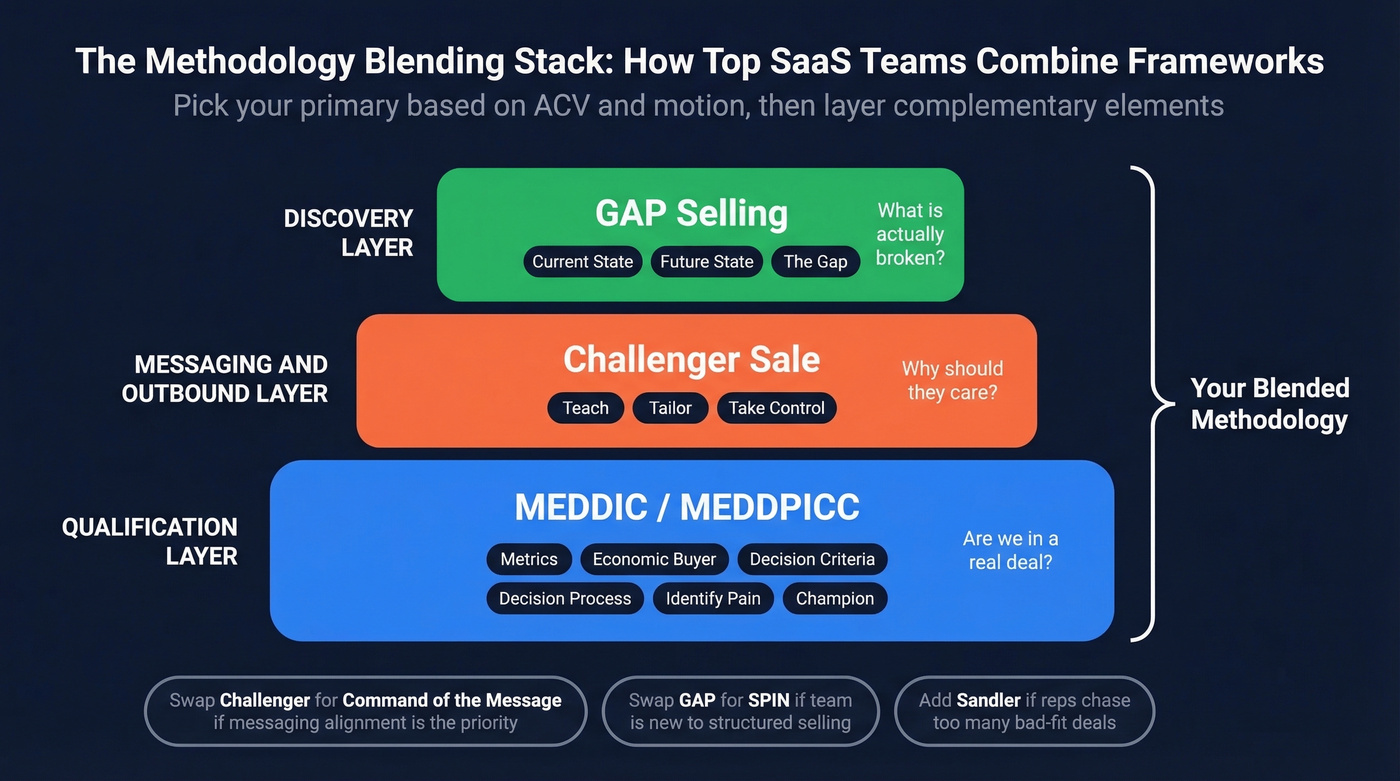
The grid is a starting point, not a prescription. A stack we've seen work repeatedly: MEDDIC for qualification (are we in a real deal?), Challenger for outbound messaging (why should they care?), and GAP for discovery (what's actually broken?). Pick your primary methodology based on ACV and motion, then layer complementary elements from others.
Let's be honest: if you're closing deals under $10K, you probably don't need a formal methodology at all. You need a great product, a fast demo-to-close motion, and reps who ask good questions. SPIN gives you the question framework. Everything else is overhead at that price point.
Adapting for PLG and Hybrid Motions
McKinsey's analysis of 107 public B2B SaaS companies found that the top product-led subset generates 10 percentage points more ARR growth and achieves valuations roughly 50% higher than high-performing sales-led peers. But most PLG adopters don't automatically outperform - the gains are concentrated in companies that build a true hybrid motion. In our experience, these teams typically operate as cross-functional pods of 7-9 people spanning product, sales, and growth.
The bridge between PLG and sales-led is the Product Qualified Account - a signal from product usage that triggers a sales conversation. SPIN works naturally in PLG-assist because the product has already demonstrated value; reps just need to uncover the broader organizational pain. MEDDIC needs adaptation: instead of cold-qualifying economic buyers, you're using product analytics to identify which accounts have enough usage momentum to justify an enterprise conversation.
The teams that get this wrong treat PLG users like traditional outbound leads. The teams that get it right use product signals to skip early discovery and enter conversations with context the buyer already trusts.
Why the Funnel Isn't Enough
Traditional selling frameworks end at "closed-won." In SaaS, that's where most of the value begins.
Jacco van der Kooij's Winning by Design Bowtie model makes the case that 72-93% of customer lifetime value happens post-sale - through onboarding, adoption, renewal, and expansion. With expansion ARR now at 40% of total new ARR and climbing, your methodology needs to extend beyond the funnel. The Bowtie model maps the full journey from awareness through education, selection, onboarding, first impact, renewal, and expansion, with marketing, sales, and customer success all operating within it.
If your methodology stops at the signature, you're optimizing for 7-28% of the customer's lifetime value. That's not a methodology. That's a closing technique.
How to Operationalize Without Bureaucracy
This is where most rollouts die. The methodology is sound, the training was good, and six weeks later it's a ghost. We've watched this happen at companies that spent $100K+ on Force Management engagements. Here's what separates teams that make it stick from teams that don't.
Map methodology fields to coaching, not compliance. A MEDDIC "Champion" field should prompt the manager to ask "How did you test this champion? What happens if they leave?" during pipeline review. Build call scorecards in Gong (around $100-$200/user/month) that score against methodology-specific behaviors - not generic "did the rep ask an open-ended question" criteria. The moment MEDDIC becomes "fill out these 8 fields or you can't move the deal to Stage 3," you've killed deal clarity and replaced it with compliance theater.
Run weekly 30-minute coaching sessions on live deals. Pick two deals per session, walk through the framework together, identify gaps. Adoption happens in the context of real pipeline, not in training decks. I've never seen a methodology stick without this rhythm.
No methodology survives bad data, either. If a big chunk of emails bounce and mobile pickup is low, reps never get to apply any framework in a real conversation - they're too busy chasing dead contacts. Prospeo's 98% email accuracy and 7-day data refresh cycle (versus the 6-week industry average) solve this at the foundation layer. Pair it with Gong for conversation intelligence and your CRM for stage management, and you've got the execution stack that lets methodology actually work. If you want a deeper look at keeping lists clean, start with email deliverability and email bounce rate basics.
Every hour a rep spends chasing a bounced email or leaving voicemail on a disconnected number is an hour they're not running SPIN questions or building a champion map. At 13% of ARR going to sales, that waste adds up fast.
Challenger reps need domain expertise and the right contacts. Prospeo's 30+ search filters - buyer intent, technographics, job changes, funding - let reps build hyper-targeted lists that match their teach-tailor-take-control messaging. At $0.01 per email, scaling outreach costs less than a single lost deal.
Teach the right buyers by finding them first.
FAQ
What's the difference between a sales methodology and a sales process?
A sales process is the repeatable sequence of stages - prospecting, discovery, demo, proposal, close. A methodology is the philosophy and tactics you apply within those stages. MEDDIC tells you how to qualify; your process tells you when. You need both to run a consistent revenue engine.
Can you use more than one sales methodology?
Yes, and most high-performing SaaS teams do. The most common blend: MEDDIC for qualification, Challenger or GAP for discovery, and Sandler for deal control. Assign each methodology to a specific stage or function rather than asking reps to internalize three complete frameworks at once.
Which methodology works best for early-stage SaaS?
SPIN Selling. It's simple, discovery-focused, and doesn't require a 6-week certification or a $100K training engagement. It teaches reps to ask better questions - the single highest-leverage skill when you're still finding product-market fit. Layer MEDDIC once you cross ~$15K ACV and deals involve multiple stakeholders.
How do you make sure reps actually reach the right prospects?
The best methodology fails if contact data is bad. Prospeo's 98% email accuracy and 30% mobile pickup rate keep reps in real conversations instead of chasing bounced emails. Pair verified data with your CRM and conversation intelligence tools so your framework gets applied in live buyer interactions, not wasted on dead leads.