

Sales Bluebird: What It Is, Why It's Controversial, and How to Handle One
A SaaS security AE gets an inbound lead from someone who used the product at their last company. The buyer skips the demo, asks for a quote, and signs in under three weeks - a deal that normally takes six months. Commission lands at roughly $50k. No prospecting, no multi-threading, no champion-building. Just a deal that fell out of the sky.
That's a sales bluebird. Every rep dreams of one. Every sales leader dreads the comp plan argument that follows.
What Is a Bluebird in Sales?
A bluebird is an unexpected, high-value deal that closes with minimal effort from the rep. The term comes from the idea of something happening "out of the blue," and practitioners use it to describe lucrative opportunities that drop into a rep's lap without the usual grind of outbound prospecting, discovery calls, and procurement negotiations. Nutshell's sales slang glossary includes "bluebird" as one of those terms every rep recognizes but few orgs formally define.
Salesforce's sales glossary frames bluebirds as "unpredictable and unsustainable," which is the right way to think about them. They're wonderful when they happen. You can't build a revenue plan around them. Many orgs define a bluebird as a deal where the contract value exceeds the rep's entire quota.
Bluebird vs. Inbound Lead vs. Referral
These three get conflated constantly. They shouldn't be.
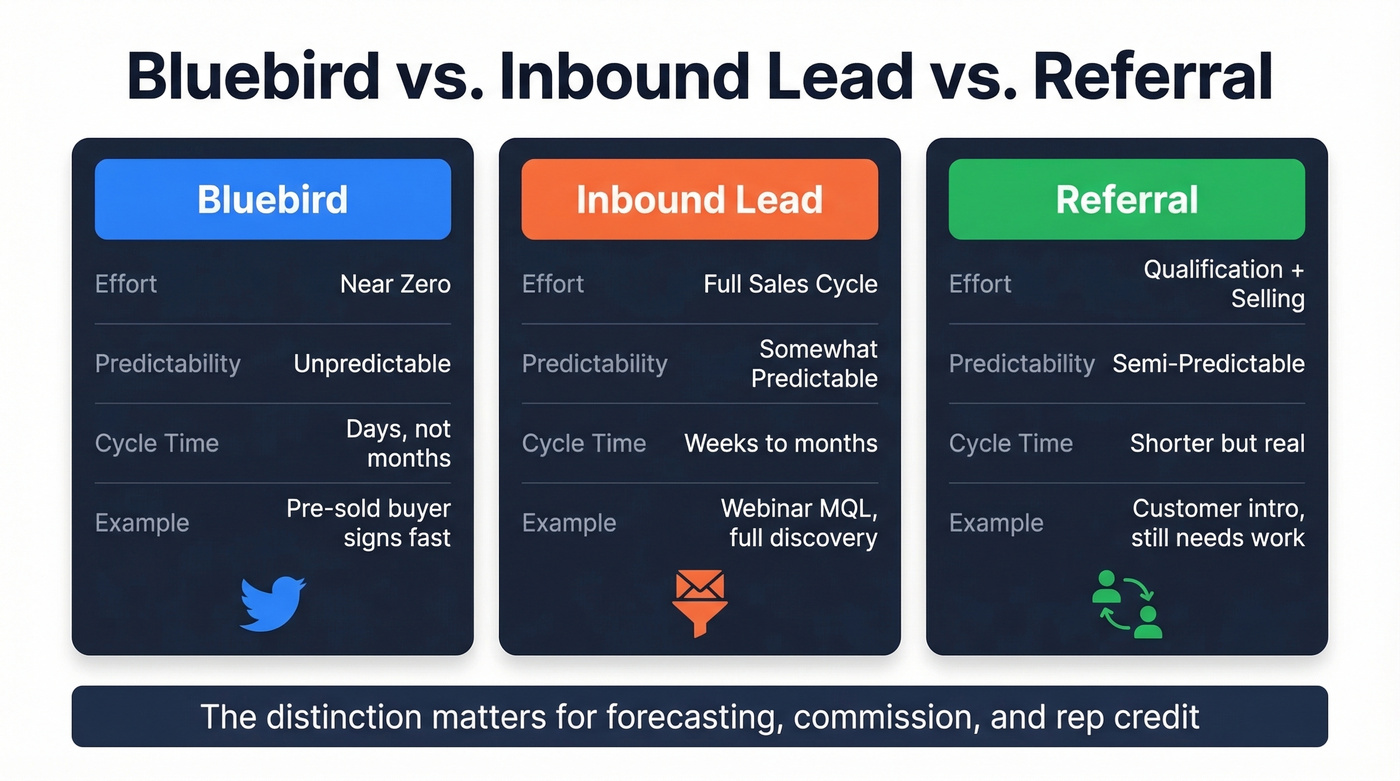
| Type | Effort Required | Predictability | Example |
|---|---|---|---|
| Bluebird | Near zero | Unpredictable | Pre-sold buyer, signs in days |
| Inbound lead | Full sales cycle | Somewhat predictable | Webinar MQL, full discovery and negotiation |
| Referral | Qualification + selling | Semi-predictable | Customer intro, still needs discovery |
A lot of bluebirds arrive through inbound channels - or look inbound in your CRM - because the buyer shows up already convinced. A referral can turn into one if the intro is essentially a pre-sold handoff, but most referrals still require real selling. A standard inbound lead usually needs the full cycle.
The distinction matters because it drives how you forecast, how you pay commission, and how much credit the rep actually deserves.
Real-World Bluebird Examples
The boomerang buyer. A SaaS security rep gets an inbound from someone who deployed the product at a previous company. The buyer already knows the feature set, the pricing ballpark, and the implementation timeline. They skip the demo, ask for a contract, and close in under three weeks versus the typical six-month cycle. Commission: ~$50k.
The whitespace stocking order. An enterprise IT seller has a dormant account that suddenly places a massive stocking order. No outbound sequence triggered it - the customer's budget cycle aligned with an internal mandate. Finance flags the deal size and invokes the bluebird clause. The rep's current-year quota gets increased so aggressively it nearly doubles.
The SDR hot-route. An SDR routes an inbound lead to an AE on a Tuesday. The buyer's already been evaluated internally, has budget approved, and just needs a signature. Deal signed in eight days. Marketing wants attribution credit. The AE wants full commission. The SDR wants their bonus. Nobody's happy except the customer.
Windfall Clauses and Pipeline Panic
Here's the thing: closing a bluebird feels incredible for about 48 hours - until your manager mentions the windfall clause.
A windfall clause (sometimes called a bluebird clause) is a comp plan provision that lets the company adjust your quota or commission rate when a rep closes a deal significantly above normal size. In theory, it protects the company from paying outsized commissions on deals the rep didn't "earn." In practice, it punishes overperformance and can trigger pipeline panic across the team when reps realize their forecasted deals now carry inflated quota targets.
The r/sales conversations around this are brutal. One enterprise seller described a single whitespace stocking order triggering a clause that almost doubled their current-year quota - wrecking the economics on every other deal in their pipeline. Another rep who hit roughly 1000% of quota feared a commission cap would be imposed the following year. A third, sitting on a potential 7-figure ARR deal with a year-one value of $700k, worried they'd only get credit for year-one value while the company captured the multi-year upside.
Let's be honest: capping commissions on a bluebird is the fastest way to lose your best rep. If you can't afford to pay the plan you wrote, you wrote a bad plan.

Bluebirds are great - but you can't build quota around luck. Prospeo gives your reps 300M+ verified profiles with 30+ filters including buyer intent, job changes, and headcount growth, so they generate pipeline that's predictable, not accidental. At $0.01 per email with 98% accuracy, every rep prospects like they just landed a bluebird.
Turn outbound into your most reliable revenue channel.
How to Pay Commission on a Bluebird Deal
There's no single right answer, but four frameworks cover most scenarios:
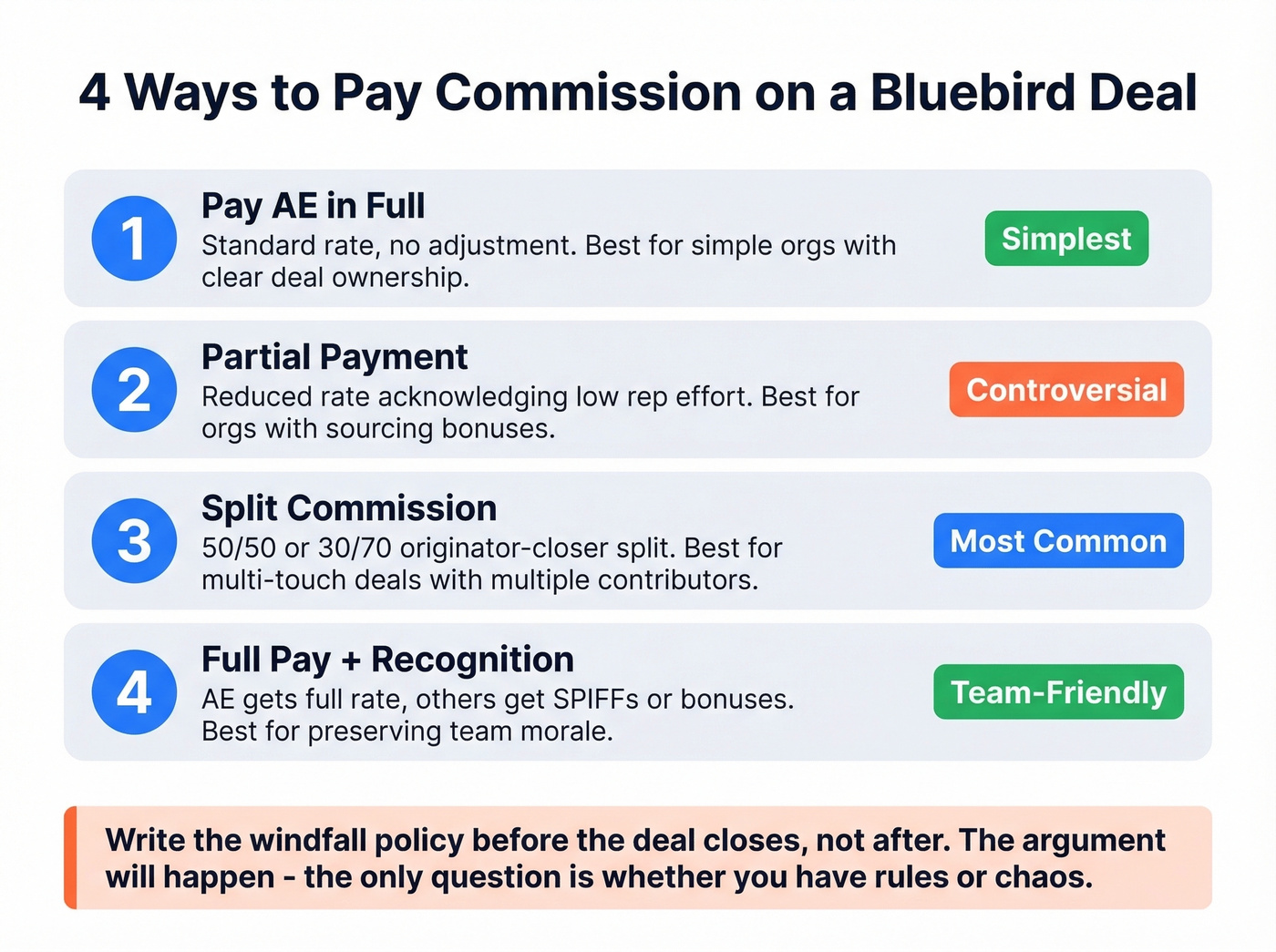
| Approach | How It Works | Best For |
|---|---|---|
| Pay AE in full | Standard rate, no adjustment | Simple orgs, clear ownership |
| Partial payment | Reduced rate acknowledging low effort | Orgs with sourcing bonuses |
| Split commission | 50/50, 30/70, or stage-based splits | Multi-touch deals |
| Full pay + recognition | AE gets full rate; others get SPIFFs | Preserving team morale |
A 50/50 split between originator and closer is the simplest. A 30/70 originator/closer split rewards the person who does the heavy lifting. Stage-based splits assign credit based on which rep owned the deal at each pipeline stage - they're the most precise option and the most administratively painful.
Write the windfall policy before the deal closes, not after. The argument will happen. The only question is whether you have rules or chaos.
Payout Timing
Structuring payouts around invoices rather than signatures protects against deals that evaporate post-close. Two patterns work well:
- 25/75 split: 25% on the next pay period, 75% once the customer pays the first invoice.
- Three-invoice installments: equal payments spread across the first three customer invoices.
For large, unusual deals, invoice-based payouts protect the company without punishing the rep. We've seen teams adopt this approach after getting burned once by a six-figure deal that churned within 90 days.
How to Forecast a Bluebird Opportunity
Don't build your committed forecast around bluebirds. It teaches your org to expect lightning to strike twice.
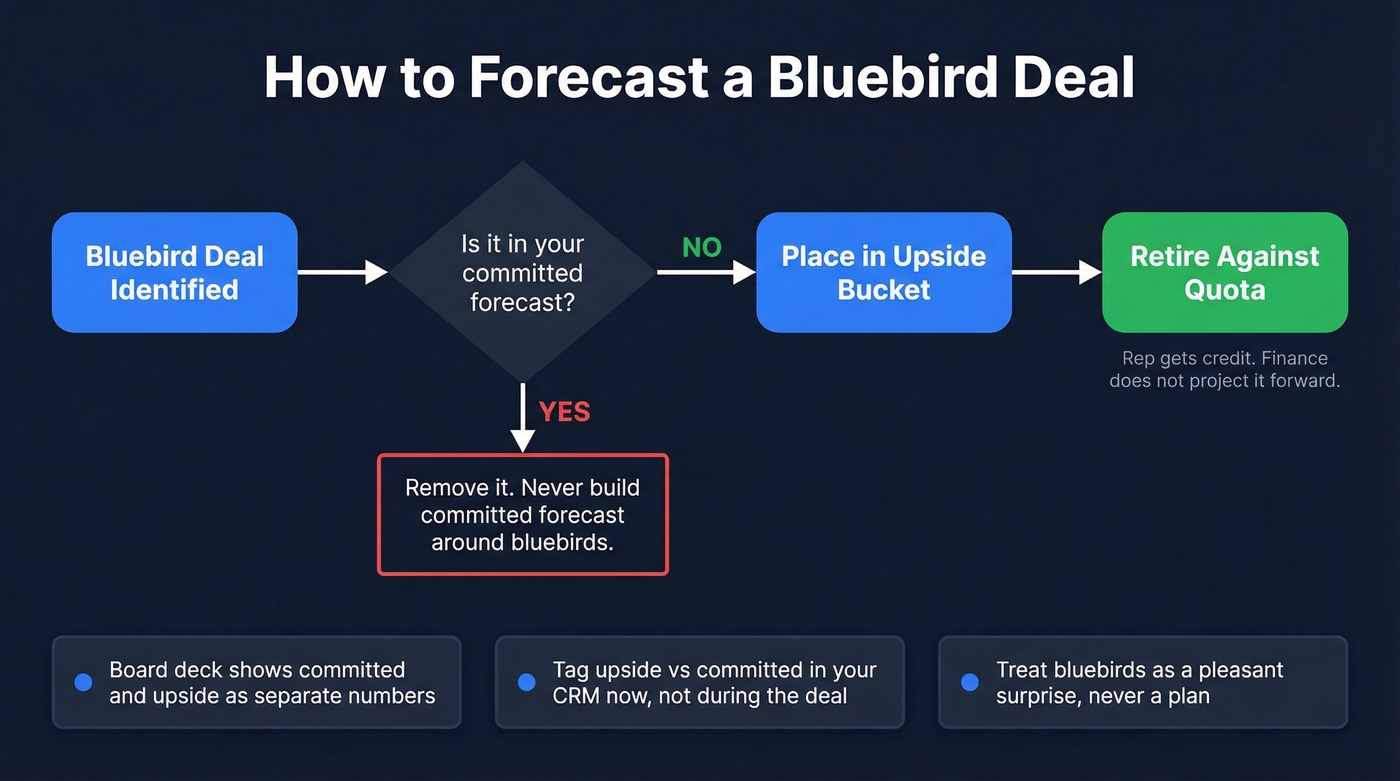
- Exclude entirely from committed forecast. Treat it as a pleasant surprise.
- Place in a separate "upside" bucket. Your board deck shows committed and upside pipeline as distinct numbers. Bluebirds live in upside.
- Retire against quota but don't project forward. The rep gets credit. Finance doesn't build next quarter's plan around a one-time event.
The deal itself may close fast, but your forecasting process shouldn't skip steps. Some leaders use a 9-box model to segment pipeline by probability and deal size, which makes it easier to isolate bluebird-class opportunities from repeatable revenue. If your CRM doesn't have a clean way to tag upside vs. committed, fix that before the next bluebird lands - because you won't have time to fix it during.
Creating Conditions for More Bluebirds
Salesforce is right that strong reputation and exceptional branding increase your chances. But here's the hot take most sales leaders won't say out loud:
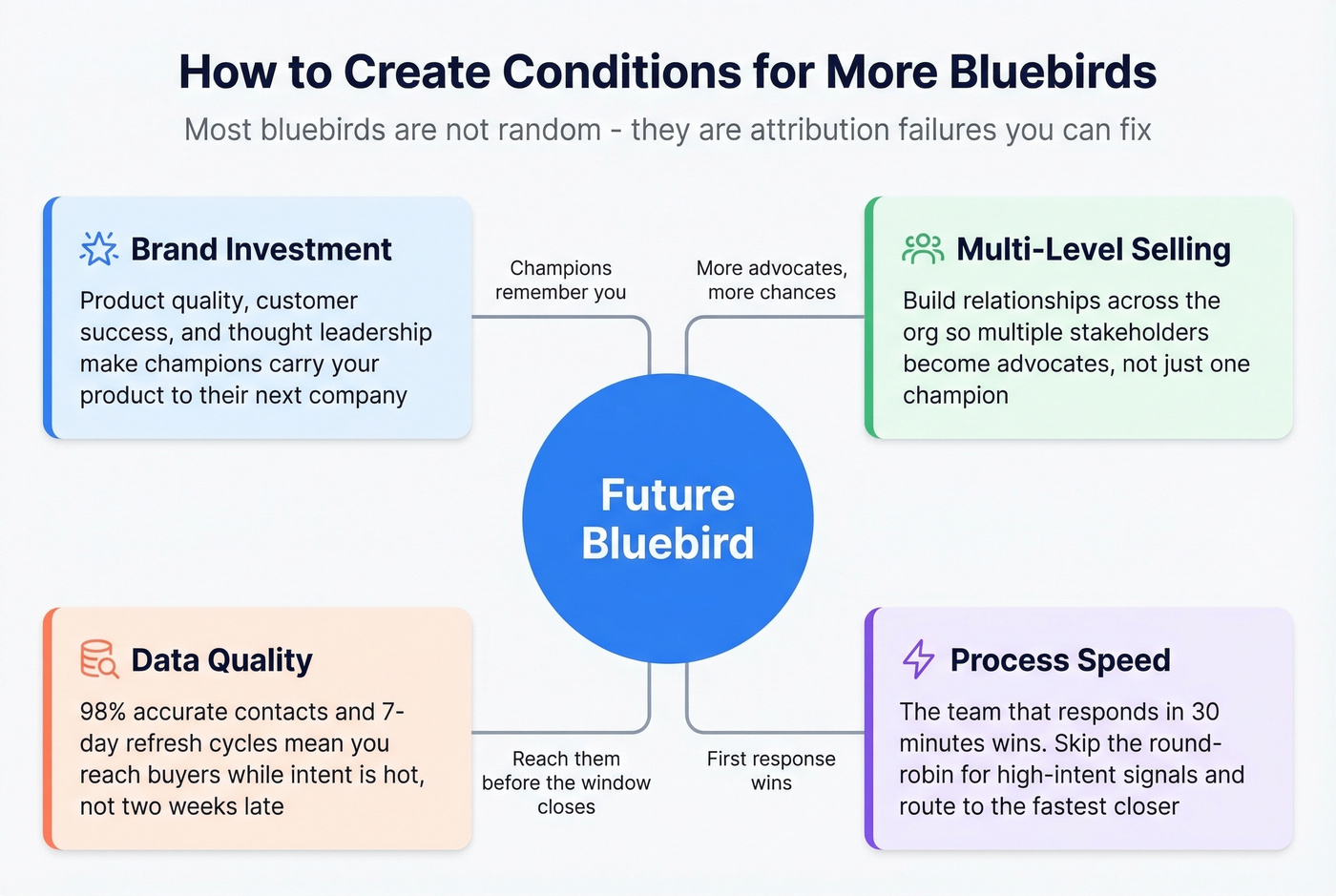
Most bluebirds aren't random - they're attribution failures. A buyer who used your product at a previous company didn't appear out of nowhere. They were influenced by years of product experience, brand exposure, and peer conversations your CRM never tracked. Better CRM hygiene, intent data, and contact verification would reclassify many "bluebirds" as properly attributed inbound deals.
That reframe points to three things you can actually control.
Brand Investment
Every dollar spent on product quality, customer success, and thought leadership increases the probability that a champion carries your product to their next company. You can't manufacture bluebirds, but you can build the conditions for them. In hyper-competitive markets where every deal is contested, these conditions are harder to create - which makes the investment even more important.
Multi-Level Selling
Bluebirds often come from a single champion, but the deals that stick depend on relationships across the org. When multiple stakeholders at a customer account know and trust your product, you increase the odds that at least one of them carries that preference to a new company. This also protects existing revenue: if your only champion leaves and nobody else internally advocates for renewal, you've lost the account and the future bluebird it could have generated elsewhere.
Data Quality and Speed-to-Lead
When a bluebird signal fires - a form fill, a website visit from a target account, a referral email - stale CRM data kills the speed advantage. If your contact records are six weeks old, you're reaching out to people who've already changed roles or signed with someone else. Prospeo's 98% email accuracy and 7-day data refresh cycle means reps reach the buyer while intent is hot, not two weeks later when the window has closed.
Process Speed
The team that responds in 30 minutes wins the bluebird. The team that takes 48 hours loses it.
In our experience, we've seen teams lose deals simply because their inbound routing added an unnecessary 24-hour delay. Build your routing, enrichment, and rep notification stack to minimize every minute between signal and first touch. Skip the round-robin queue for high-intent signals - route them directly to the rep who owns the account or the fastest available closer. Think of it as applying a moneyball approach to your inbound motion: optimizing for speed and data accuracy rather than relying on gut instinct or seniority-based routing.
The real fix for bluebird dependency? A pipeline so full of qualified buyers that windfall deals are a bonus, not a lifeline. Prospeo's intent data tracks 15,000 topics so you reach prospects already researching your solution - the closest thing to engineering a bluebird on demand.
Find buyers who are already in-market before they find you.
Related Sales Jargon Worth Knowing
Bluebirds sit alongside a handful of other colorful terms that describe specific pipeline dynamics:
- Sales pit: a prolonged slump where pipeline dries up and nothing closes - the opposite of a bluebird streak.
- Sales spill: revenue that leaks from one quarter into the next because deals slip past the close date, distorting your forecast.
- SAO: a Sales Accepted Opportunity, the pipeline stage where a qualified lead becomes a real deal the rep commits to working. A bluebird often skips the normal qualification steps entirely, which is exactly what makes it hard to forecast.
- SLED: deals sold into State, Local government, and Education - a vertical where bluebirds are rare because procurement cycles are rigid and budget windows are fixed.
Knowing these terms helps you speak the same language as your revenue team when a bluebird lands and the comp plan debate begins.
FAQ
Is a bluebird the same as an inbound lead?
No. An inbound lead still requires qualification, discovery, and a full sales cycle. A bluebird is an unexpected, high-value opportunity where the buyer arrives pre-sold and the deal closes with minimal effort - often in days rather than months.
Should you include bluebirds in your sales forecast?
No - place them in a separate "upside" bucket. Including bluebirds in your committed forecast inflates expectations and creates sandbagging incentives. Your board needs committed numbers they can trust, and bluebirds aren't predictable enough to commit.
Can you make bluebirds happen more often?
Not directly, but you can increase the odds. Invest in brand reputation so champions carry your product to new companies. Keep contact data fresh so reps act on signals immediately. Build fast inbound routing - the team that responds first wins.
What is a windfall clause in a comp plan?
A windfall clause lets the company adjust quota or commission rates when a rep closes a deal significantly above normal size. QuotaPath advises against reducing rates or capping commissions after the fact - it's a fast track to losing top talent. Write the policy before the deal closes.
How does a bluebird differ from a referral?
A referral introduces a warm lead, but the rep still runs discovery, builds a business case, and navigates procurement. A bluebird skips most of that - the buyer arrives pre-sold and ready to sign. Some referrals become bluebirds, but most still require real selling effort.