

The Discovery Call Guide: Scripts, Questions, and Benchmarks That Actually Work
It's 2pm Tuesday. Four discovery calls booked. First one no-shows. Second - the prospect left that company two months ago. Third goes well but the person has zero budget authority. Fourth is the real deal. That's a 25% hit rate, and two of those misses were entirely preventable with better data.
A discovery call converts when three things align: you're talking to the right person, you ask more than you pitch - top reps maintain a 46:54 talk-to-listen ratio - and you leave with a concrete next step. The fastest deals spend 53% more time on next steps in the first meeting. The rest of this guide gives you the script, the questions, and the benchmarks. Short on time? Jump to the script or the question bank below.
What Is a Discovery Call?
The definition is straightforward: it's a scheduled, needs-focused conversation that happens after a prospect has shown interest but before you demo anything. It sits between the cold outreach that generates interest and the demo that showcases your solution. The entire purpose is qualification - does this prospect have a real problem you can solve, the budget to solve it, and the authority to make it happen?
You'll hear it called different things depending on the team. Some say "qualification call," others call it a mapping call where you're charting the prospect's pain points, stakeholders, and buying process. Regardless of what your org calls it, the meaning stays the same: diagnose before you prescribe.
Don't confuse it with adjacent call types.
| Discovery Call | Cold Call | Demo | |
|---|---|---|---|
| Trigger | Prospect opted in | Rep-initiated | Qualified opportunity |
| Goal | Qualify + uncover needs | Generate interest | Show the solution |
| Duration | 20-60 min | 2-3 min | 30-60 min |
| Talk ratio | ~46% rep / 54% prospect | ~80% rep / 20% prospect | ~65% rep / 35% prospect |
| Tone | Diagnostic | Interruptive | Presentational |
Everything downstream - the demo, the proposal, the negotiation - depends on what you uncover here. If you want a tighter structure for qualification, use a proven set of discovery questions instead of improvising every call.
Why Discovery Matters More in 2026
Most buyers don't need you for basic product information anymore. 96% of consumers research tools before speaking to a sales rep. Buyers spend just 17% of their buying time meeting with any supplier, and 80% of B2B sales interactions happen in digital channels. When you do get a live conversation, it has to count.
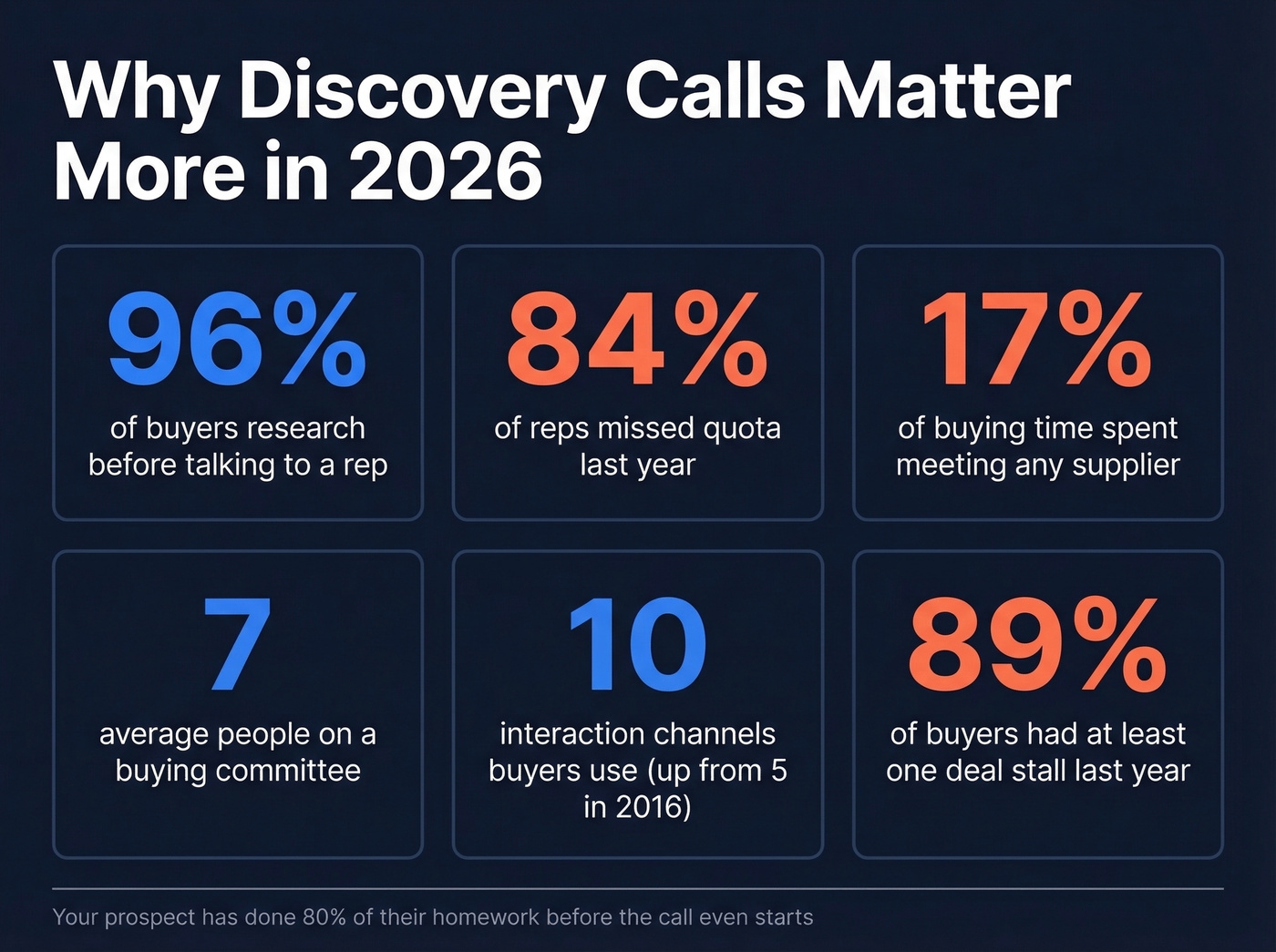
The pressure on reps is brutal. 84% of reps missed quota. Buying committees average 7 people for mid-sized firms, and buyers now use roughly 10 interaction channels on average - up from 5 in 2016. Meanwhile, 89% of buyers report at least one deal stall in the past year, often from budget freezes.
Here's the thing: your prospect has already done around 80% of their homework. They know your features. They've read the G2 reviews. The call isn't about educating them - it's about understanding their specific situation well enough to run a real diagnostic conversation. That shift, from information delivery to diagnosis, is why the old "show up and throw up" approach is dead.
If your average deal is under $10k, you probably don't need a 45-minute qualification conversation. A tight 20-minute call is worth more than a bloated hour of rapport-building that makes everyone feel good but qualifies nothing.
How to Prepare Before the Call
The "gold standard" of 60 minutes of research before every call is a fantasy. Almost no one does it, and the reps who try burn out fast. We call it the 5/20 Prep Rule - and it's the single best time-management hack we've seen for discovery-heavy teams.
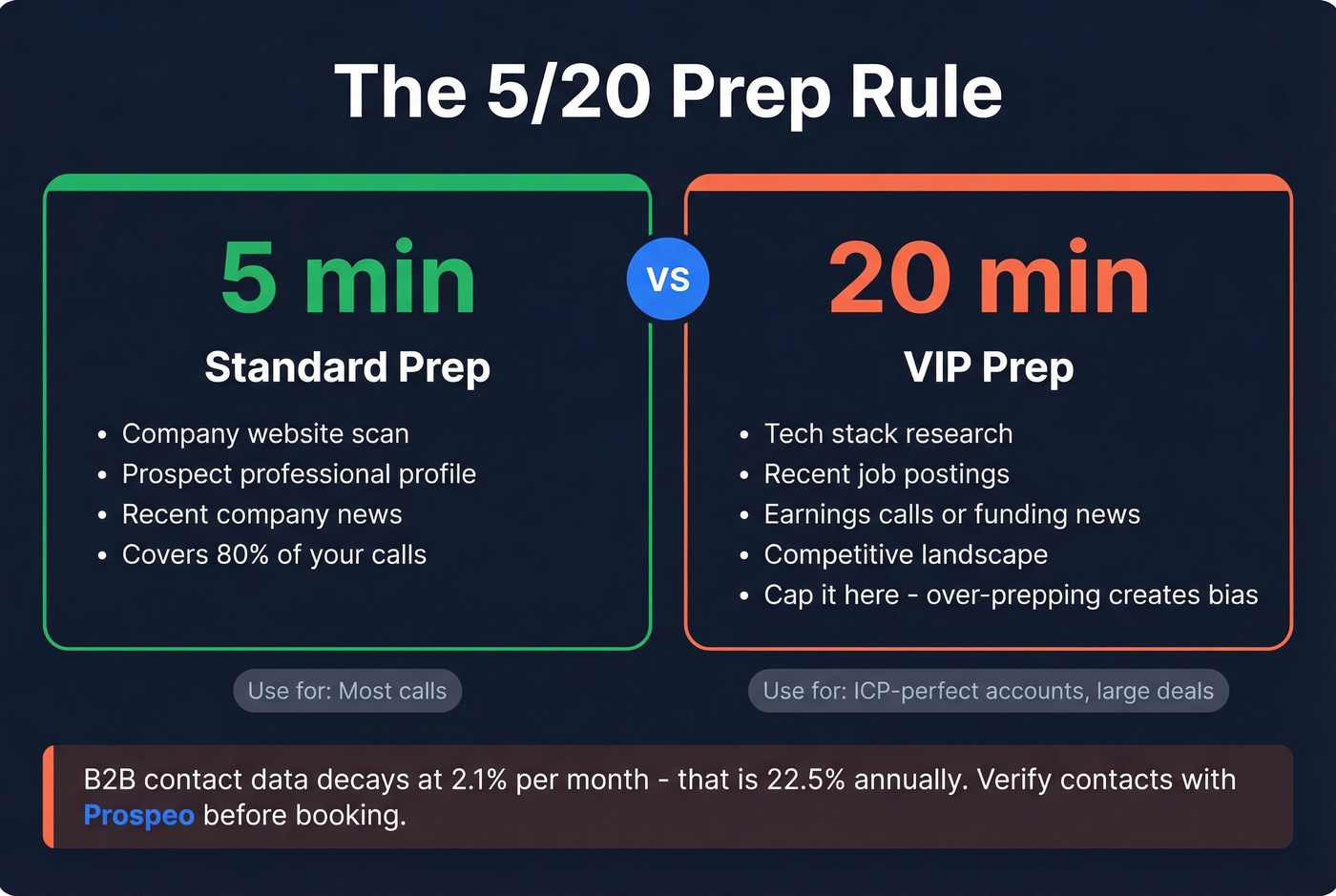
Standard prep (5 minutes): Company website, the prospect's professional profile, any recent news. Enough to not sound clueless. This covers 80% of your calls.
VIP prep (20 minutes): For accounts that match your ICP perfectly or represent significant deal size. Dig into their tech stack, recent job postings, earnings calls, and competitive landscape. Cap it at 20 minutes - over-prepping creates preconceived notions that bias your questions.
86% of buyers expect reps to be well-informed about their business. But "well-informed" doesn't mean "spent an hour on their 10-K." It means you know enough to ask smart questions and not waste their time.
Before you prep your questions, though, make sure you're reaching the right person. B2B contact data decays at roughly 2.1% per month - that's 22.5% annually. If you're booking calls off a list that's six months old, one in five contacts has changed roles or companies. Prospeo's 98% email accuracy and 7-day data refresh cycle mean you're not burning slots on dead contacts. The Chrome extension lets you verify contact details in one click from any professional profile or company website before you even schedule the call. If you're building lists at scale, data enrichment services can help keep records current.
Pre-call checklist:
- Prospect's role and reporting structure confirmed
- Contact info verified (email + direct dial)
- Company size, industry, and recent triggers like funding, hiring, or leadership changes
- 2-3 tailored questions based on their specific situation
- Clear hypothesis about their likely pain point
How Does a Discovery Call Work?
Every great qualification conversation follows a four-stage arc, whether it's 20 minutes or an hour.
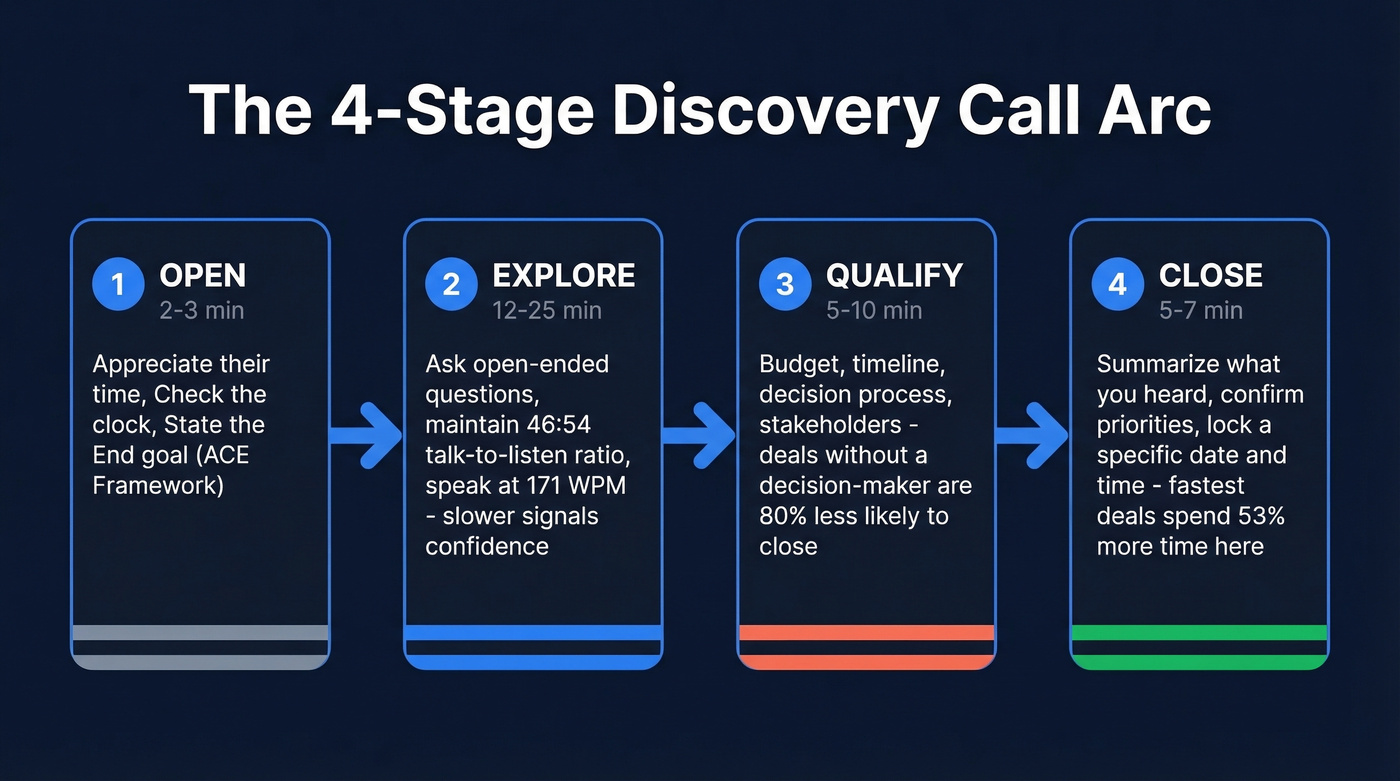
Step 1: Open (2-3 minutes). Use the ACE framework: Appreciate their time, Check the time ("Do we still have 30 minutes?"), and state the End goal ("By the end of this call, I'd love to understand X so we can figure out if there's a fit"). This sets expectations and gives the prospect control.
Step 2: Explore (12-25 minutes). This is the core. Ask open-ended questions, then shut up. Top reps maintain a talk-to-listen ratio of about 46% - meaning the prospect talks more than the rep. Average reps? They're in the high 60s. Top performers also speak at 171 words per minute versus 182 WPM for lower performers. Slower, more deliberate speech signals confidence and gives the prospect space to elaborate.
Step 3: Qualify (5-10 minutes). Now you're confirming fit. Budget, timeline, decision process, stakeholders. Don't interrogate - weave these into the conversation naturally. "Who else would need to weigh in on this?" feels very different from "Are you the decision-maker?" One stat worth knowing: deals without a decision-maker involved are 80% less likely to close. Find that person early. You also close 10% more deals when pricing comes up on the first call, so don't shy away from the money conversation. If you're selling into larger orgs, it helps to understand the technical buyer vs economic buyer dynamic early.
Step 4: Close with next steps (5-7 minutes). This is where most reps fumble. The fastest-closing deals spend 53% more time discussing next steps in the first meeting compared to average deals. Summarize what you heard, confirm the prospect's priorities, and lock a specific date and time for the next conversation. "I'll follow up next week" isn't a next step. "I'll send a calendar invite for Thursday at 2pm with a tailored demo agenda" is. If you want plug-and-play language, keep sales follow-up templates handy.
Discovery Call Scripts That Work
Scripts aren't meant to be read verbatim. They're guardrails. The best reps internalize the structure and improvise within it. If you want a printable version for your team, use a discovery call script PDF.
SMB / Short-Cycle Script (20-30 min)
BANT-aligned, built for deals under $50k. The goal is efficient qualification without feeling rushed.
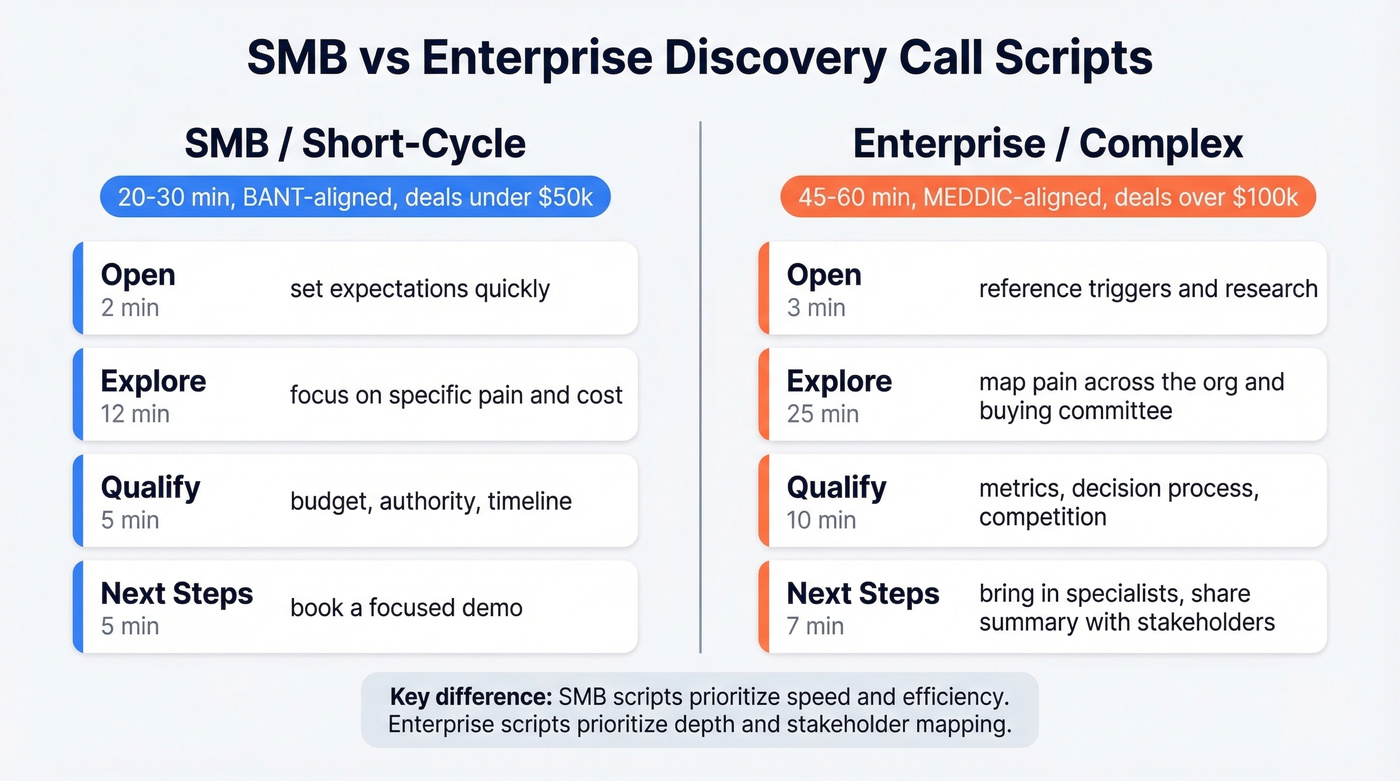
Open (2 min): "Thanks for making time, [Name]. I know you're busy, so let's make this count. I've got us down for 25 minutes - does that still work? Great. My goal is to understand what you're dealing with around [problem area] and figure out if we can actually help. If we can't, I'll tell you that too. Sound fair?"
Explore (12 min): Lead with their world, not yours. "Walk me through how you're currently handling [process]. What's working? What's not?" Follow the thread. When they mention a pain point, go deeper: "How long has that been an issue? What's it costing you?" Top reps ask 39% more questions during discovery, and their calls run 76% longer than average - not because they're rambling, but because they're pulling real answers out of the prospect.
Qualify (5 min): "If we could solve [specific pain], what would that be worth to your team? Is there a budget earmarked for this, or would we need to build a case? Who else would need to sign off?"
Next steps (5 min): "Here's what I'm hearing: [summary]. Does that sound right? I think a focused demo on [specific feature] would make sense. Can we lock in Thursday at 2?"
Enterprise / Complex Script (45-60 min)
MEDDIC-aligned for deals over $100k with multiple stakeholders. Slower pace, deeper questions, and you're mapping the buying committee. If you're implementing MEDDIC across the org, start with MEDDIC sales qualification and then standardize your MEDDIC discovery questions.
Open (3 min): Same ACE structure, but add context: "I've done some homework on [company] - I noticed [specific trigger: new funding round, leadership change, job postings in X area]. I'd love to understand how that's shaping your priorities."
Explore (25 min): Start broad, then narrow. "What's the strategic initiative driving this evaluation?" Map the pain across the organization: "How does this affect your team specifically? What about [adjacent department]?" Identify the economic buyer: "When your team has made purchases like this before, what did the approval process look like?"
Qualify (10 min): "What metrics would you use to measure success? What's the timeline for a decision? Are you evaluating other solutions?"
Next steps (7 min): "I'd like to bring in [SE/specialist] for a technical deep-dive with your team. Can we schedule that for next week? I'll send a brief summary of what we discussed so you can share it with [stakeholder they mentioned]."

Contact data decays 2.1% per month. That means one in five discovery calls booked off stale lists is wasted before it starts. Prospeo's 98% accurate emails and 7-day refresh cycle ensure every slot goes to a real person at the right company.
Fix your discovery call hit rate before you fix your script.
20 Discovery Call Questions
Most question lists are written by marketing teams who haven't run a call in years. The actual skill isn't asking clever questions - it's shutting up long enough to hear the answer. Here are 20 organized by what you're trying to learn, so you can pick the right ones for each conversation.
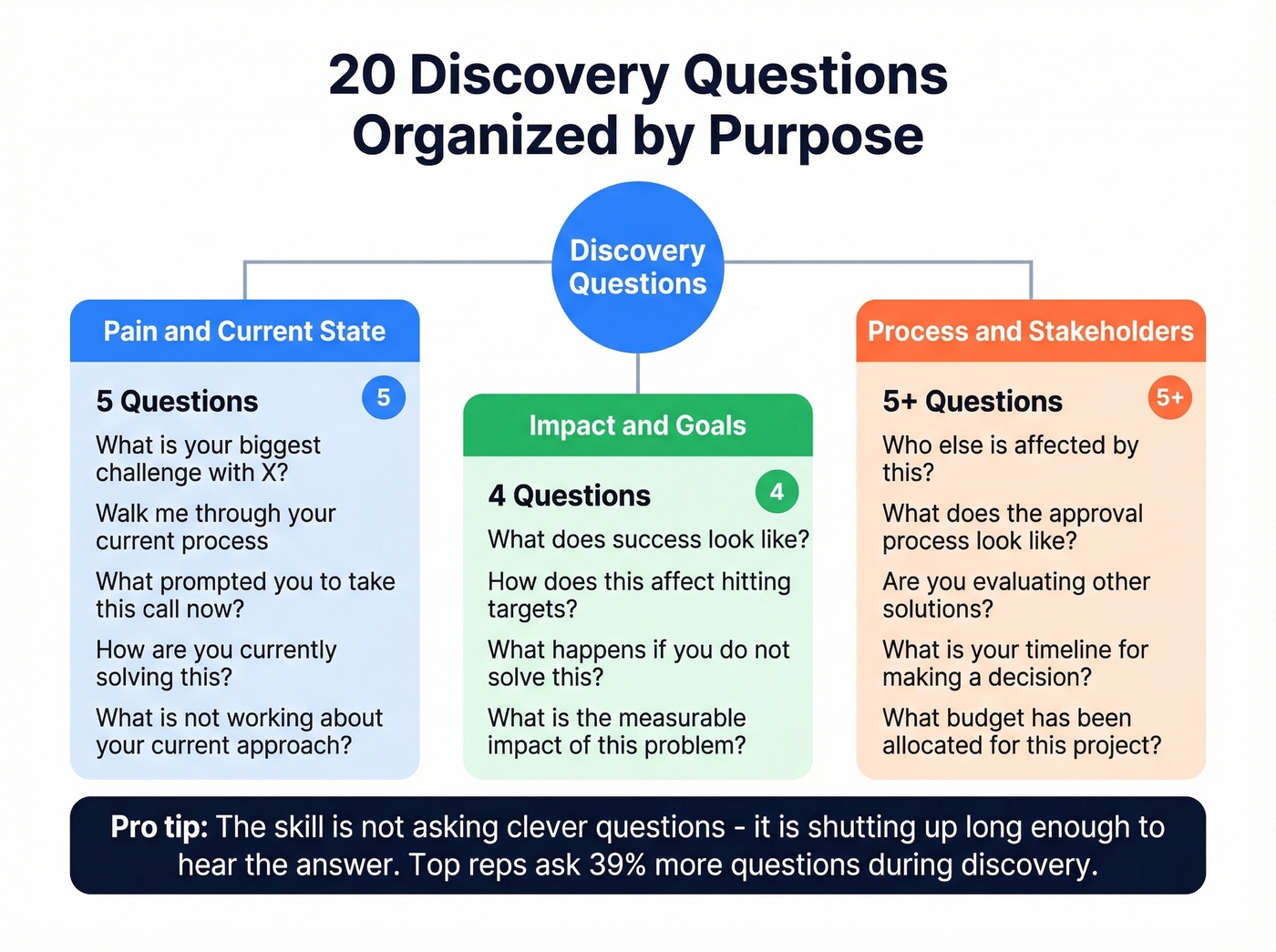
Pain & Current State
- What's been your biggest challenge with [area] over the past 6 months?
- Walk me through your current process for [workflow]. Where does it break down?
- How are you solving this today - and what's not working about that approach?
- What prompted you to take this call now rather than six months ago?
- If you could fix one thing about [process] tomorrow, what would it be?
Impact & Goals
- What would success look like for you in the next [timeframe]?
- How is this problem affecting your team's ability to hit their targets?
- What happens if you don't solve this in the next quarter?
- How does this initiative tie into your company's broader priorities this year?
Process & Stakeholders
- Who else on your team is affected by this?
- When your company has made a purchase like this before, what did the process look like?
- Is there a technical review or security process we'd need to go through?
- Who would need to sign off on a decision like this?
Budget & Timeline
- Is there budget allocated for this, or would we need to build a business case?
- What's your ideal timeline for having a solution in place?
- Have you evaluated other tools for this? What did you like or not like?
- What would make this a "no" for you?
Decision & Next Steps
- What would you need to see in a demo to feel confident moving forward?
- What's the single biggest thing that could derail this project?
- If everything checks out, what does the path from here to a signed agreement look like?
Pick 12-18 that fit the conversation and leave room to follow the prospect's lead. Don't treat this as a checklist you need to complete.
Qualification Frameworks Compared
| Framework | Best For | Deal Size | Cycle Length | Stakeholders |
|---|---|---|---|---|
| BANT | Transactional | <$50k | <60 days | 1-3 |
| MEDDIC | Enterprise | >$100k | 3-9 months | 5+ |
| SPIN | Consultative | Any | Relationship-driven | 2-10+ |
BANT was developed at IBM in the 1950s. It's fast, simple, and works well for transactional sales with short cycles and few stakeholders. For deals over $100k or buying committees with 5+ people, it's not enough on its own.
MEDDIC was created at PTC in the 1990s by Jack Napoli and Richard Dunkel. After implementing it, PTC's revenue grew from roughly $195M to $650M in four years. Today, 73% of SaaS companies selling above $100k ARR use some version of MEDDIC. Full proficiency takes about 3.6 months, but the payoff is real: teams report 18% higher win rates and 24% larger deal sizes.
SPIN comes from Neil Rackham's analysis of 35,000+ sales calls. SPIN practitioners see 57% higher prospect talk time compared to traditional approaches. It's less of a checklist and more of a questioning philosophy - ideal for complex, relationship-driven sales where the prospect needs to articulate their own pain.
Let's be honest: the consensus on r/sales is that every framework reduces to four things - need, budget, stakeholders, timeline. Pick one and commit. The framework matters less than the discipline of actually qualifying instead of just demoing.
Benchmarks and Conversion Rates
Numbers give you a baseline. Without them, you're guessing whether your calls are working.
Conversion Rates by Industry (2026)
| Industry | Conversion Rate |
|---|---|
| Janitorial/cleaning | 27.15% |
| Printing/publishing | 26.82% |
| Tech/software | 9.39% |
| Industrial equipment | 8.37% |
Conversion by Channel & Deal Size
| Segment | Conversion Rate |
|---|---|
| Referral leads | 25.56% |
| SEO-sourced leads | 21.22% |
| Cold calling | 9.38% |
| $500-$10k deals | 25.73% |
| $100k-$500k deals | 16.89% |
| $5M-$10M deals | 9.09% |
Data from Focus Digital's benchmarks. Overall, sales call conversion rates range 13-25% depending on industry, deal size, and lead source. For a broader view across the funnel, compare against the average B2B lead conversion rate.
The talk-to-listen ratio is the single most diagnostic metric. Top reps sit at 46% talk time. Average reps hit 65% or higher. If you're recording your calls - and you should be - check this number first. For managers, these ratios are your best coaching lever: pull call recordings for any rep above 60% talk time and work on their questioning technique.

Your conversion rate is a lagging indicator. The leading indicator is data quality. If your no-show and wrong-person rates are above 20%, the problem isn't your script - it's your data. We've seen teams cut no-show rates in half just by verifying contacts before scheduling. If you're auditing your pipeline end-to-end, track pipeline health alongside call metrics.
Your discovery call is only as good as the person on the other end. Prospeo's 30+ search filters - including buyer intent, job changes, and org charts - help you book calls with decision-makers, not gatekeepers. 125M+ verified mobile numbers mean you can reach them directly.
Reach the decision-maker on the first try, starting at $0.01 per contact.
Common Mistakes to Avoid
Talking too much. The data is unambiguous. Average reps talk 65%+ of the call. Set a timer or use a conversation intelligence tool that tracks your ratio in real time.
Jumping to solutions. The prospect mentions a pain point and you immediately pitch your feature. Resist. Ask two more follow-up questions before you say anything about your product. "How long has that been an issue?" and "What have you tried?" buy you context and credibility.
Assuming they don't know your product. 96% of buyers have already researched tools before talking to a rep. Repeating your homepage pitch wastes their time and yours. Ask what they already know and build from there.
Skipping next steps. "Great call, I'll follow up" is how deals die. Book the next meeting before you hang up. Calendar invite sent during the call, not after. If you need a system for what happens after the meeting, use a sales meeting follow-up email framework.
Over-prepping for every call equally. Spending 45 minutes researching a $5k deal is a poor use of your time. Use the 5/20 Prep Rule: five minutes for standard calls, 20 minutes for high-value accounts. Skip the deep research for anything below your average deal size - the reps who try to gold-standard every call burn out within a quarter.
AI Tools for Call Intelligence
Conversation intelligence is a $25.3B market and growing fast - projected to reach $55.7B by 2035. These tools record, transcribe, and analyze your calls so you can coach reps and spot patterns at scale.
| Tool | Best For | Est. Pricing |
|---|---|---|
| Gong | Team coaching + analytics | ~$100-200+/user/mo (enterprise) |
| Chorus (ZoomInfo) | ZoomInfo customers | ~$15,000+/yr bundled |
| Avoma | Mid-market teams | ~$49-79/user/mo |
| Fireflies.ai | Budget-conscious teams | Free; ~$10-30/user/mo |
| Fathom | Individual reps | Free; ~$19-39/user/mo |
Start with Fathom or Fireflies if you're an individual rep or small team - both have free tiers that are genuinely useful. For 10+ reps needing coaching analytics, talk-ratio tracking, and deal intelligence, Gong is the standard but expect enterprise pricing. If you're a mid-market team that wants 80% of Gong's functionality at half the cost, Avoma is worth evaluating - though in our experience it's still maturing on the analytics side. If you're building a full stack, compare options in our SDR tools roundup.
Benefits of Running Structured Discovery
If you're still wondering whether these calls are worth the calendar space, consider what they protect you from. The benefits compound across your entire pipeline.
Fewer wasted demos. When you qualify properly, you stop demoing for prospects who were never going to buy. Teams that run structured qualification report significantly higher demo-to-close rates.
Shorter sales cycles. Uncovering budget, timeline, and stakeholders upfront means fewer surprise objections later. The deals that stall are almost always the ones where discovery was rushed or skipped entirely.
Better forecasting. When every opportunity in your pipeline has been through a real qualification conversation, your forecast accuracy improves because you're working with real data instead of hope. If forecasting is a recurring pain, use dedicated sales forecasting solutions.
Stronger champion relationships. A good discovery call gives your internal champion the language and business case they need to sell on your behalf when you're not in the room. That's the part most reps underestimate - you're not just qualifying, you're arming someone to fight for your deal in meetings you'll never attend.
FAQ
How long should a discovery call last?
SMB deals: 20-30 minutes. Mid-market: 30-45 minutes. Enterprise: 45-60 minutes. Top reps' calls run 76% longer than average because they ask more questions and give prospects room to talk. Don't rush to fit an arbitrary time box - let the conversation breathe when the prospect is engaged.
What's the difference between a discovery call and a demo?
A discovery call qualifies fit and uncovers needs; a demo shows the solution. Running a demo before discovery means you're presenting features without knowing which ones matter - and 96% of buyers already know the basics from their own research. Discovery first, always.
What's a good conversion rate?
It depends on deal size and channel. Referral leads convert at roughly 25%, cold-sourced leads at about 9%. Tech/software averages 9.39%. The overall range across industries is 13-25%. If you're below your industry benchmark, audit lead quality and qualification rigor before blaming the script.
How many questions should I ask?
Top reps ask 39% more questions than average performers. Aim for 12-18 well-placed questions across pain, impact, stakeholders, budget, and timeline - but prioritize listening over checking boxes. It's a conversation with structure, not an interrogation.
How do I reduce no-shows?
Confirm 24 hours before and send a brief agenda so the prospect knows what to expect. But the biggest lever is data quality - B2B data decays roughly 2.1% per month, so you're booking calls with people who've changed roles or numbers if your list is stale. Verify contacts with a tool like Prospeo before scheduling.