

Sales Buying Signals: The Operational Playbook for Scoring, Responding, and Converting
Your marketing team just handed over 200 "intent leads." Your SDRs called through the list. Five were actually in-market. The other 195? Noise dressed up as signal.
Most guides on sales buying signals give you a list and stop. That's useless. What you need is a system for scoring those signals, responding at the right speed, and having verified contact data so the signal doesn't die in a CRM with no valid way to reach the buyer.
Here's the thing: 83% of B2B buyers define their purchase requirements before speaking with sales, and 61% prefer a completely rep-free buying experience. By the time a prospect does something visible - visits your pricing page, requests a demo, downloads a comparison guide - they've already done most of their evaluation in the dark. The window between "signal fires" and "deal is lost" is shrinking fast. If you're not catching and acting on signals operationally, you're watching pipeline evaporate.
Every sales team knows buying signals exist. The gap is operational - scoring them, building response SLAs, and having the contact data to actually reach the person behind the signal.
What You Need (Quick Version)
- Score 5 high-value signals and tier them. Not 15. Not 25. Five you can actually operationalize with response workflows attached. Add more only after those five convert consistently.
- Set response SLAs by tier. Tier 1 signals like demo requests, pricing page clusters, and multi-stakeholder engagement get a sub-5-minute response. Anything slower and you lose to the first responder.
- Pair intent detection with verified contact data. A hot signal routed to an SDR who has no verified mobile number and a bounced email is a wasted signal.
What Are Sales Buying Signals?
A buying signal is any observable behavior - verbal, non-verbal, or digital - that indicates a prospect is moving toward a purchase decision. Signals are indications of intent, not certainty. You don't know they're ready to buy until you get a signed contract. But you can read the pattern.
The taxonomy breaks into three buckets. Verbal signals happen in conversations: a prospect asks tough implementation questions, introduces you to other stakeholders, or expresses a time-sensitive need. Non-verbal signals show up in body language during demos and meetings - leaning in, nodding, taking notes. Digital signals are the big category for modern sales: pricing page visits, content downloads, intent data surges, product usage patterns, and social engagement.
The operational question isn't "what counts as a signal?" It's "which signals are strong enough to warrant immediate action, and which are just noise?"
Buying Signal Examples Ranked by Strength
Content downloads are the most overrated buying signal in B2B. A single whitepaper download tells you almost nothing about purchase intent - it tells you someone wanted the content. Meanwhile, a director-level contact who visits your pricing page three times in a week and then connects with your CEO on social is practically waving a flag. The strength gap between these two signals is enormous, but most teams treat them the same.
In real-world sales ops, pricing page clusters, Multi-stakeholder engagement, and champion job changes tend to be the most reliable signals. Content downloads barely register. We've ranked these from strongest to weakest so you can prioritize your response workflows:
| Signal | Type | Strength | Recommended Action |
|---|---|---|---|
| Demo/trial request | Digital | High (50 pts) | Route immediately, <5 min |
| Pricing page cluster | Digital | High (40 pts) | Alert AE, personalize |
| RFP/vendor eval | Verbal | High (40 pts) | Exec sponsor + SE assigned |
| Multi-stakeholder engagement | Verbal/Digital | High (35 pts) | Multi-thread the account |
| Competitor comparison research | Digital | High (30 pts) | Battlecard-informed outreach |
| ROI calculator / quote request | Digital | High (30 pts) | Fast follow-up + business case |
| Case study download | Digital | Medium (15 pts) | Nurture with relevant proof |
| Webinar attendance | Digital | Medium (12 pts) | Follow up within 24 hrs |
| Return visits (3+ in 7 days) | Digital | Medium (12 pts) | Alert SDR for warm outreach |
| Social follow/connection | Digital | Medium (10 pts) | Engage within 24 hrs if ICP |
| Job change at target account | Digital | Medium (10 pts) | Warm re-engagement sequence |
| Newsletter signup | Digital | Low (5 pts) | Add to nurture, score over time |
| Single blog visit | Digital | Low (3 pts) | No action - track only |
| Single content download | Digital | Low (3 pts) | No action - track only |
| Ad click | Digital | Low (2 pts) | Retarget, don't outbound |
High-Intent Signals (25-50 Points)
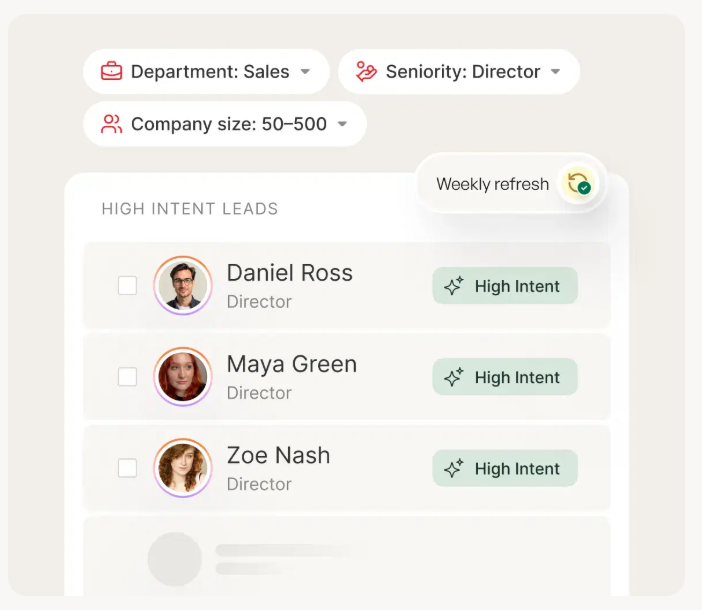
These justify pulling an AE off whatever they're doing. A demo request is obvious, but the real gold is in compound signals: a prospect who visits your pricing page multiple times, downloads a competitor comparison, and then has a second stakeholder visit your integrations page. That cluster pattern is stronger than any single action.
The most inquisitive prospects - the ones asking tough pointed questions about implementation timelines, security certifications, and data residency - are often the closest to buying. They're not kicking tires. They're doing due diligence because someone internally has already said "yes, let's evaluate this."
Medium-Intent Signals (10-15 Points)
These say "interested but not urgent." Social follows are a natural way to start a conversation, but only if you follow up within 24 hours and the person fits your ICP. A social follow from a marketing coordinator at a 10-person company isn't worth the same as one from a VP of Sales at a Series C startup. Context matters more than the signal itself.
Job changes at target accounts deserve special attention. When a champion moves to a new company, that's a warm door opening - but it's time-sensitive. Wait two weeks and they're already evaluating your competitor. The consensus on r/sales is that champion tracking is one of the highest-ROI activities an SDR can do, yet most teams don't have a systematic process for it.
Low-Intent Signals (1-5 Points)
Newsletter signups, single blog visits, individual content downloads, ad clicks. These are tracking signals, not action signals. A single content download earns 3 points. It takes a lot of stacking before it warrants outbound. Skip outreach entirely on these - just let them accumulate in your scoring model.
PLG Signals Your Team Is Missing
Most buying signal frameworks assume inbound or outbound motions. If you're running a product-led growth model, the product itself is your richest signal source - and most teams aren't systematically tracking it.
Conversion Signals
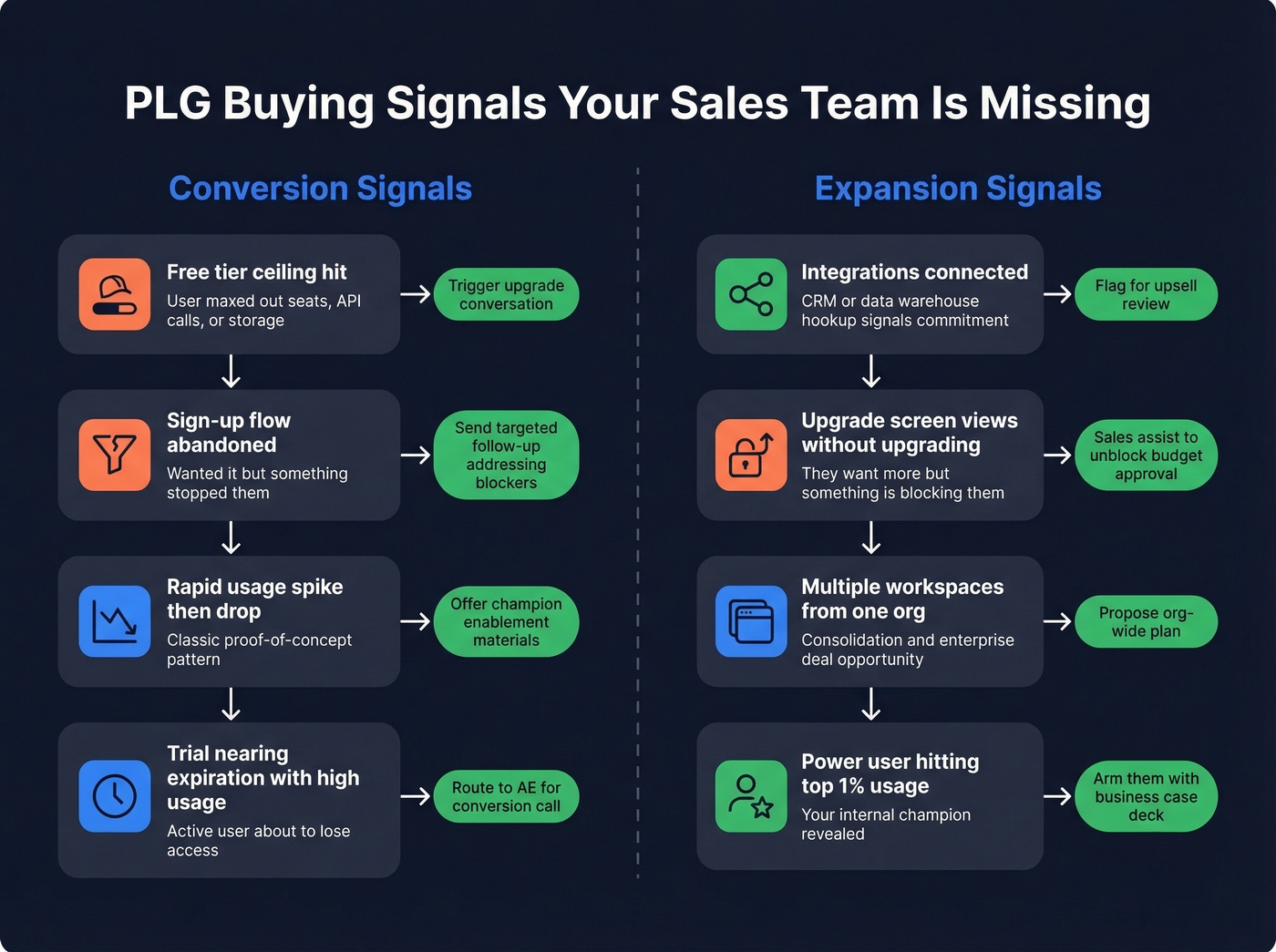
A new trial signup is obvious, but the interesting ones are subtler. A user hitting their free-tier ceiling on seats, API calls, or storage is telling you they've outgrown the free product. Sign-up flow abandonment means they wanted it but something stopped them - price, a missing feature, a compliance question. A rapid usage spike followed by a drop is the classic proof-of-concept pattern: someone ran a test, got results, and now needs internal buy-in. Each of these deserves a specific response, not a generic "how's your trial going?" email.
Expansion Signals
For existing customers, expansion signals are untapped pipeline. Upselling and cross-selling each drive roughly 21% of company revenue on average, yet most teams don't systematically track the signals that predict them.
Watch for integrations connected - CRM or data warehouse hookups signal long-term commitment. Upgrade screen activity without upgrading means they want more but something's blocking them, often budget approval. Multiple workspaces from one org represent a consolidation opportunity. And power-user thresholds where a single user hits top-1% usage reveal your internal champion - arm them with the business case to expand.

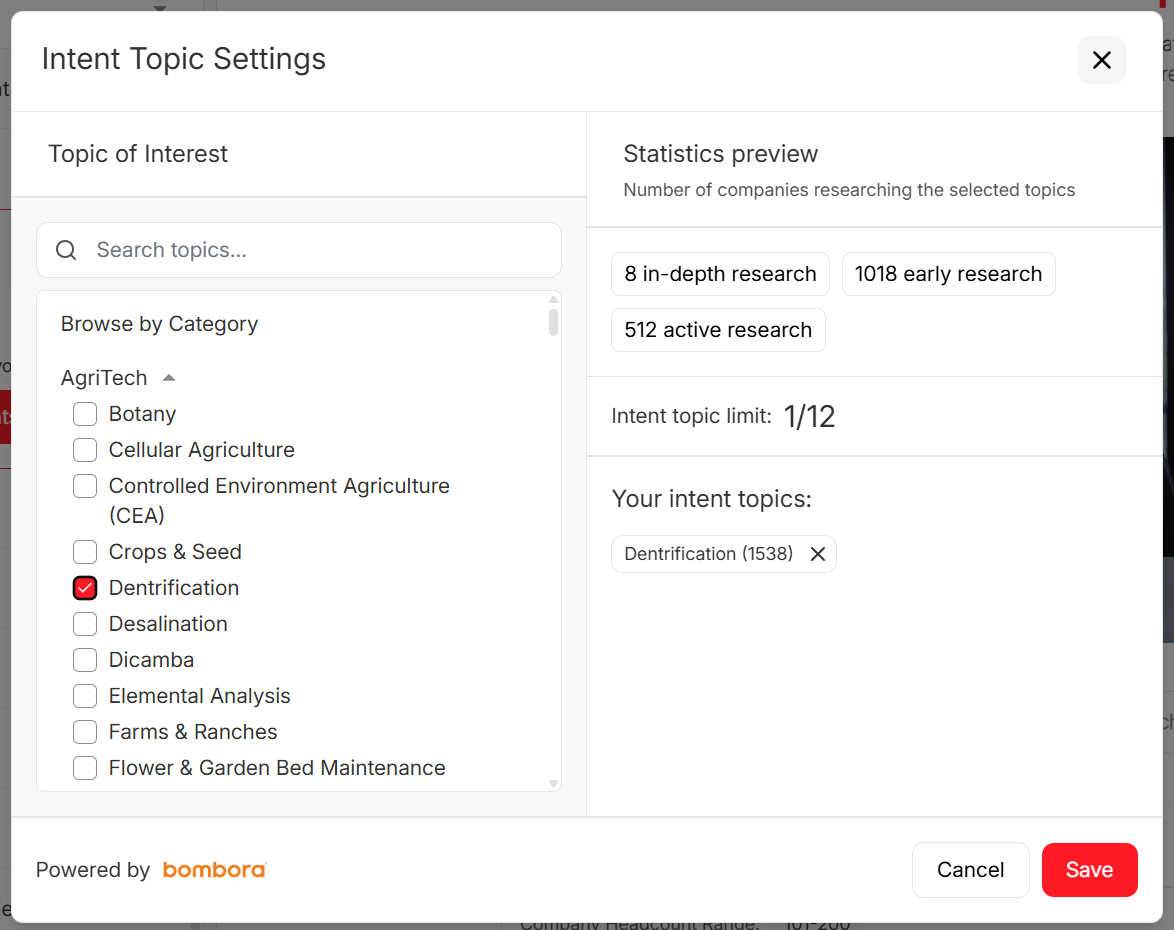
A buying signal without verified contact data is a wasted signal. Prospeo tracks 15,000 intent topics via Bombora and pairs them with 98% accurate emails and 125M+ verified mobile numbers - so your SDRs can actually reach the person behind the signal.
Stop watching hot signals die in your CRM with no way to connect.
How to Score Buying Signals
A signal without a score is just an anecdote. You need a point system simple enough for reps to internalize and structured enough for automation to act on. Point ranges by tier:
- High-intent actions (demo, pricing cluster, RFP, multi-stakeholder): 25-50 points
- Medium-intent actions (case study, webinar, return visits, social, job change): 10-15 points
- Low-intent actions (newsletter, blog, single download, ad click): 1-5 points
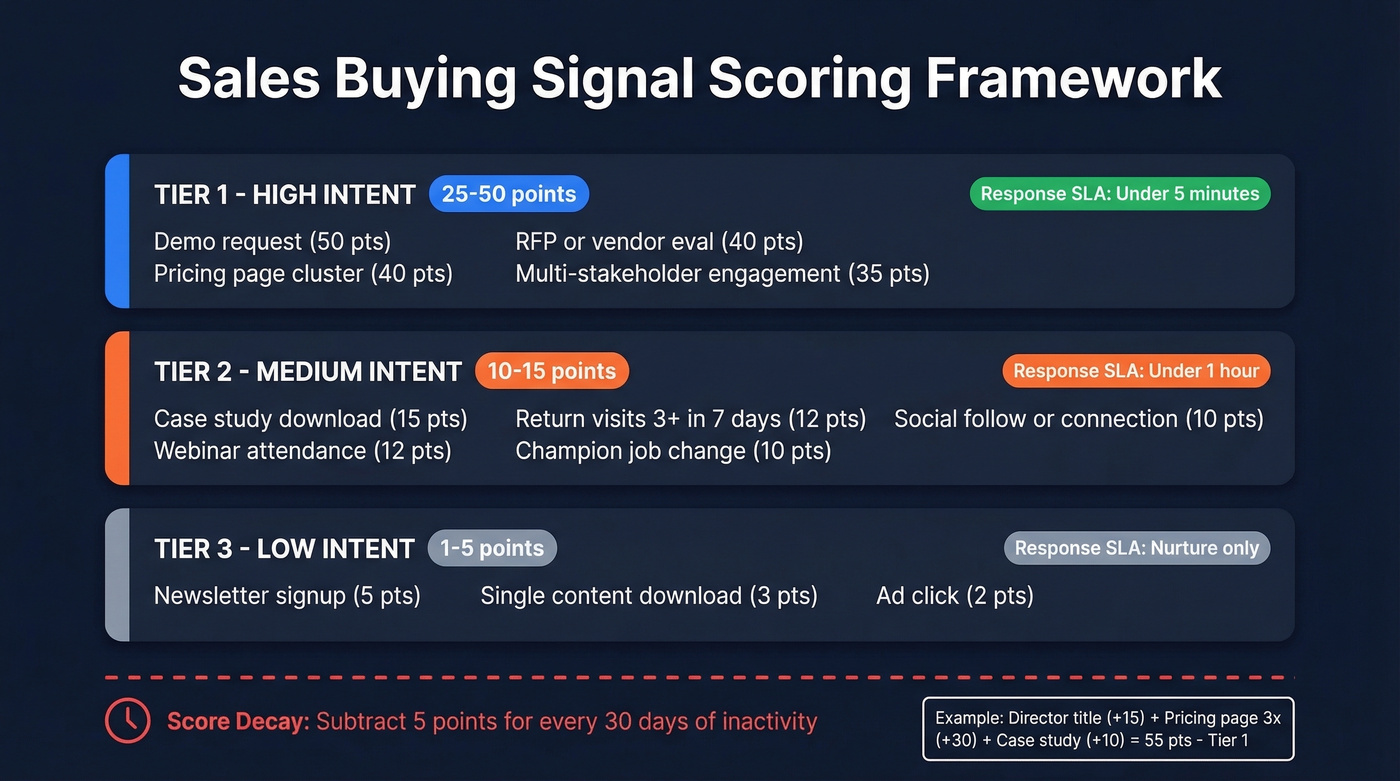
Worked example: A director-level contact (+15 for title fit) visits your pricing page three times in a week (+30 for pricing cluster) and downloads a case study (+10). Total: 55 points. That's a Tier 1 signal - sub-5-minute response, routed directly to the assigned AE.
Score decay is non-negotiable. Subtract 5 points for every 30 days of inactivity. A prospect who surged three months ago and went silent isn't a hot lead - they're a nurture candidate. Without decay, your pipeline fills with stale scores that waste rep time.
Behavior-heavy scoring works best for transactional and mid-market sales where the buying cycle is weeks, not months. For enterprise and ABM motions, weight firmographic and technographic fit more heavily - a perfect-fit account showing even moderate signals is worth more than a poor-fit account showing high activity.
How Fast Should You Respond?
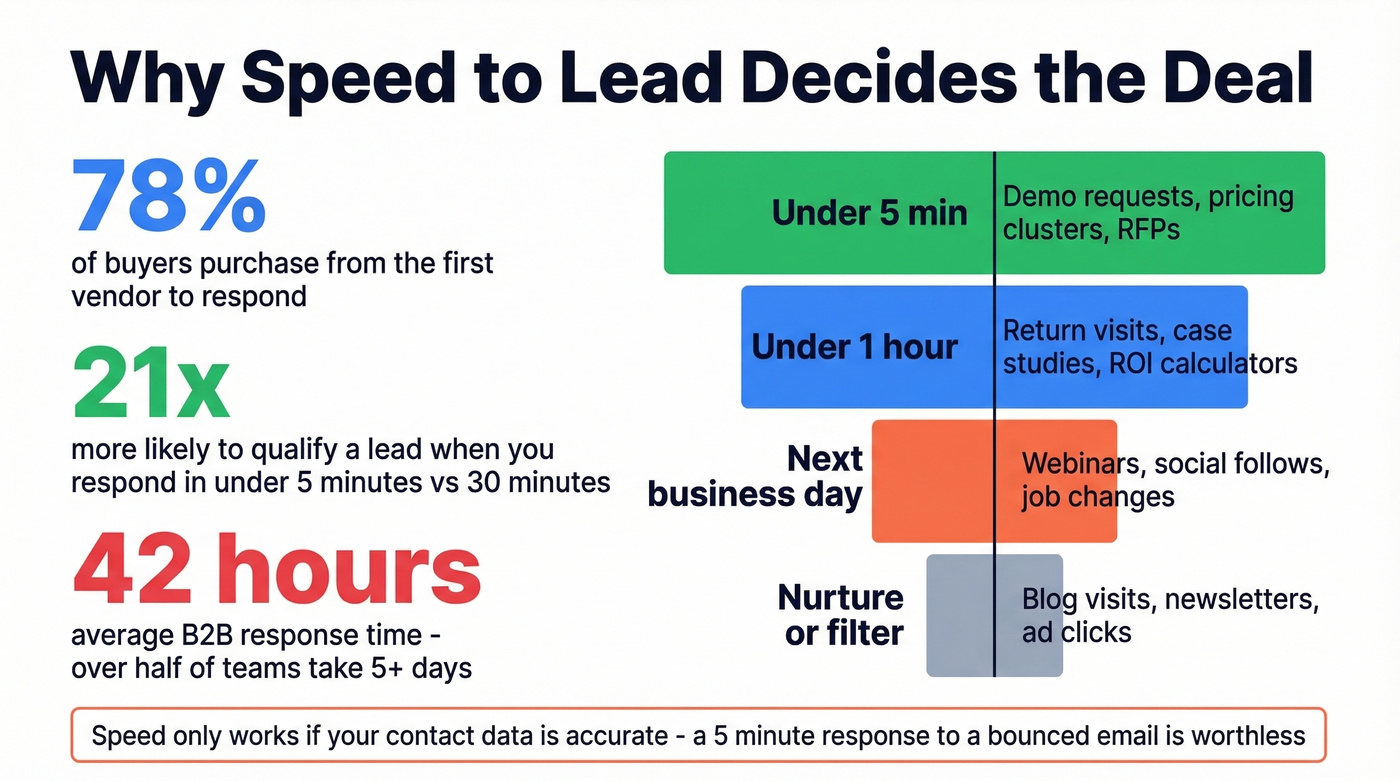
If you're not responding to Tier 1 signals within 5 minutes, you've already lost. 78% of buyers purchase from the first vendor to respond, and responding within 5 minutes makes you 21x more likely to qualify the lead versus waiting 30 minutes. The average B2B response time? 42 hours. Over half of teams take five or more days. That's not a speed problem - it's a structural failure.
| Signal Tier | Response SLA | Examples |
|---|---|---|
| Tier 1 (active buying) | <5 minutes | Demo request, pricing cluster, RFP |
| Tier 2 (evaluating) | <1 hour | Return visits, case study, ROI calc |
| Tier 3 (interested) | Next business day | Webinar, social follow, job change |
| Tier 4 (noise) | Nurture/filter | Single blog visit, newsletter, ad click |
Speed only matters if you're reaching the right person. A 5-minute response to a bounced email is worthless. We've seen teams nail their SLA routing only to discover that 30-40% of the contact data in their CRM is stale. Verified contact data - accurate emails and mobile numbers refreshed weekly, not every 4-6 weeks - is the prerequisite that makes speed-to-lead actually work.
Let's be honest: if your average deal size is under $15K, you probably don't need a $35K+/year intent platform. You need five well-defined signals, a sub-5-minute SLA for Tier 1, and contact data accurate enough that your outreach actually lands. Most teams would see a meaningful jump in signal-to-meeting conversion by fixing data quality alone.
Tools for Detecting Buying Signals
The intent data market is $4.49B in 2026 and projected to hit $20.89B by 2035. That growth is attracting a lot of vendors, and enterprise intent tools are overpriced for most teams. If you're not running a 200-person sales org with a dedicated ABM function, you don't need a $35K/year intent platform. You need signal detection paired with actionable contact data.
| Tool | Signal Type | Best For | Starting Price |
|---|---|---|---|
| Prospeo | Third-party intent + contact data | SMB-mid-market, self-serve | Free tier; ~$0.01/email |
| 6sense | Predictive intent + buying stage | Enterprise ABM | ~$35K/yr |
| Bombora | Third-party topic intent | Data layer for other platforms | ~$12K-$40K/yr |
| ZoomInfo Streaming Intent | First + third-party intent | Mid-market sales teams | ~$7,200/yr (add-on) |
| Demandbase | Intent + ABM orchestration | Enterprise marketing | ~$40K/yr |
| G2 Buyer Intent | Review-site intent | Category-level signals | ~$10K/yr (add-on) |
Prospeo
Prospeo combines Bombora-powered intent data with verified contact data in a single self-serve platform. That matters because the #1 failure mode in signal-based selling is detecting a signal and then having no way to reach the person behind it.
The platform tracks 15,000 intent topics and layers them with 300M+ professional profiles, 143M+ verified emails at 98% accuracy, and 125M+ verified mobile numbers. Data refreshes every 7 days - compared to the 6-week industry average. You can layer intent signals with job title, company size, technographics, funding stage, headcount growth, and 30+ other filters to go from "this account is surging" to "here's the director-level buyer with a verified mobile number." At roughly $0.01 per verified email with no annual contract, it's 90% cheaper than ZoomInfo for the core workflow most teams actually need. Start with the free tier and run a side-by-side test against whatever you're using now.
6sense
6sense is the enterprise heavyweight. It predicts buying stage, scores accounts into awareness/consideration/decision buckets, and orchestrates multi-channel plays. Forrester's Wave for intent data lists 6sense as a leader. The tradeoff: enterprise contracts can reach $300,000+/year, and implementation takes months, not days. For 500+ person sales orgs running full ABM, it's the gold standard. For everyone else, it's overkill.
Bombora
Bombora is a major third-party intent data provider used as a data layer inside other platforms. You typically access Bombora through tools that integrate it, including ZoomInfo and many others. Starting at ~$12K-$40K/year depending on volume, it's a foundational data source for topic-level intent.
ZoomInfo Streaming Intent
Solid mid-market option combining first- and third-party intent signals. Strong if you're already in the ZoomInfo ecosystem. The catch: the intent add-on starts around $7,200/year, but that's on top of your existing ZoomInfo contract - typically $15-40K/year for the core platform. Total cost adds up fast.
Demandbase
Enterprise ABM orchestration with intent baked in. Starting around $40K/year, Demandbase is built for marketing teams running coordinated account-based plays across display, web personalization, and sales alerts. Skip it if you don't have a dedicated ABM function.
G2 Buyer Intent
G2's intent data tells you when prospects are actively researching your category or your competitors on G2's review platform. At ~$10K/year as an add-on, it's a useful supplementary signal - but narrow. It only captures activity on G2 itself, so it misses the broader research journey.
7 Mistakes That Kill Signal-Based Outreach
1. Treating all signals as equal. A pricing page visit and a blog visit aren't the same thing. Use the scoring framework above and route by tier.
2. Relying on a single data source. First-party website data alone misses the 83% of the journey that happens before a prospect ever talks to sales. Layer third-party intent data with your own analytics.
3. Ignoring the topic behind the signal. Knowing an account is "surging" means nothing if you don't know what they're researching. Use topic-level intent data and tailor outreach to the specific pain.
4. Acting too slowly. Intent has a shelf life. A signal that's 48 hours old is already decaying. Automate Tier 1 routing and enforce the SLA table above.
5. Sending generic automated outreach. "We noticed you're researching [category]" feels invasive and lazy. 73% of B2B buyers actively avoid suppliers who send irrelevant outreach, and 69% report inconsistencies between what a vendor's website says and what the sales rep tells them. Reference the specific problem the signal implies, not the signal itself - and make sure your messaging matches what's on your site.
6. Sales and marketing misalignment. Marketing captures the signal, scores it, and routes it. Sales ignores it because they don't trust the scoring. Build the scoring model together and review conversion data monthly. 86% of B2B purchases stall at some point - misalignment between teams is one of the biggest reasons.
7. Not measuring which signals actually convert. You're tracking signals but not tracking which ones turn into meetings, pipeline, and revenue. Tag signal source on every opportunity and run attribution quarterly. Only 24% of teams report exceptional ROI from intent data - the other 76% aren't measuring well enough to optimize.
FAQ
What's the difference between buying signals and intent data?
Buying signals are any behavior indicating purchase interest - verbal questions, pricing page visits, demo requests. Intent data is a specific subset: third-party tracking of anonymous research activity across publisher networks that detects signals invisible on your own properties.
How many signals should a sales team track?
Start with five high-value signals you can score and build response SLAs around. Most teams that track 15+ signals without tiered workflows end up treating everything equally, which defeats the purpose. Add more only after your first five convert consistently.
How should signal scoring differ by deal size?
For transactional deals under $15K, weight digital signals like demo requests and pricing page clusters highest - the cycle is short and individual. For enterprise deals above $100K, multi-stakeholder engagement and RFP activity carry more weight because they reflect organizational commitment, not just individual curiosity.
Is there affordable intent data for small sales teams?
Prospeo offers Bombora-powered intent data across 15,000 topics with a free tier and no annual contract. Enterprise tools like 6sense and Demandbase start at $35K-$40K/year, which is hard to justify for teams under 20 reps.
Champion job changes are high-ROI signals - but only if you act fast with real contact data. Prospeo refreshes 300M+ profiles every 7 days, so you catch job changes weeks before competitors still running on stale data.
Reach moved champions before your competitors even notice they left.