

The Data-Backed Sales Call Playbook: Scripts, Frameworks, and Benchmarks That Actually Work
It's 9:07 on a Monday morning. You've got 50 dials queued up, coffee's still hot, and the first three numbers ring straight to disconnected tones. The fourth goes to a voicemail box that's full. The fifth? Wrong person entirely - left the company six months ago. By 9:30, you've burned 23 minutes and talked to exactly zero prospects.
This isn't bad luck. It's the norm. Reps waste 27.3% of their selling time on bad contact data - roughly 546 hours a year dialing numbers that go nowhere.
The gap between reps who crush quota and reps who miss it isn't talent or charisma. It's preparation, structure, and knowing which rules apply to which type of sales call.
The Short Version
- Fix your data first. 27.3% of rep time evaporates on bad contact info. Verify numbers before you dial. Every minute spent on a dead number is a minute you're not talking to a real buyer.
- Different calls, different rules. Cold calls need a 55/45 talk-to-listen ratio. Discovery calls flip to 43/57. Stop treating every conversation the same way.
- Follow up or lose. The first follow-up alone boosts reply rates 49%. Only 8% of reps follow up more than five times, yet most deals need 5-12 touchpoints. Persistence isn't annoying - it's required.
What Is a Sales Call?
A sales call is any phone or video conversation between a seller and a prospect or customer with a commercial objective. But here's the more useful definition: it's a conversation designed to earn the next step. Not close the deal on the spot. Not dump features for 20 minutes. Earn the next meeting, the next introduction, the next commitment.
Phone still matters in a digital-first world. McKinsey's "rule of thirds" shows that at any stage of the buying process, roughly one-third of buyers prefer in-person interaction, one-third prefer remote, and one-third prefer digital self-serve. Meanwhile, buyers now use approximately 10 interaction channels on average - up from 5 in 2016. The phone isn't the only channel anymore, but it's the one where you get real-time feedback, handle objections live, and build trust fastest. No email sequence replicates that immediacy.
Five Types of Sales Calls
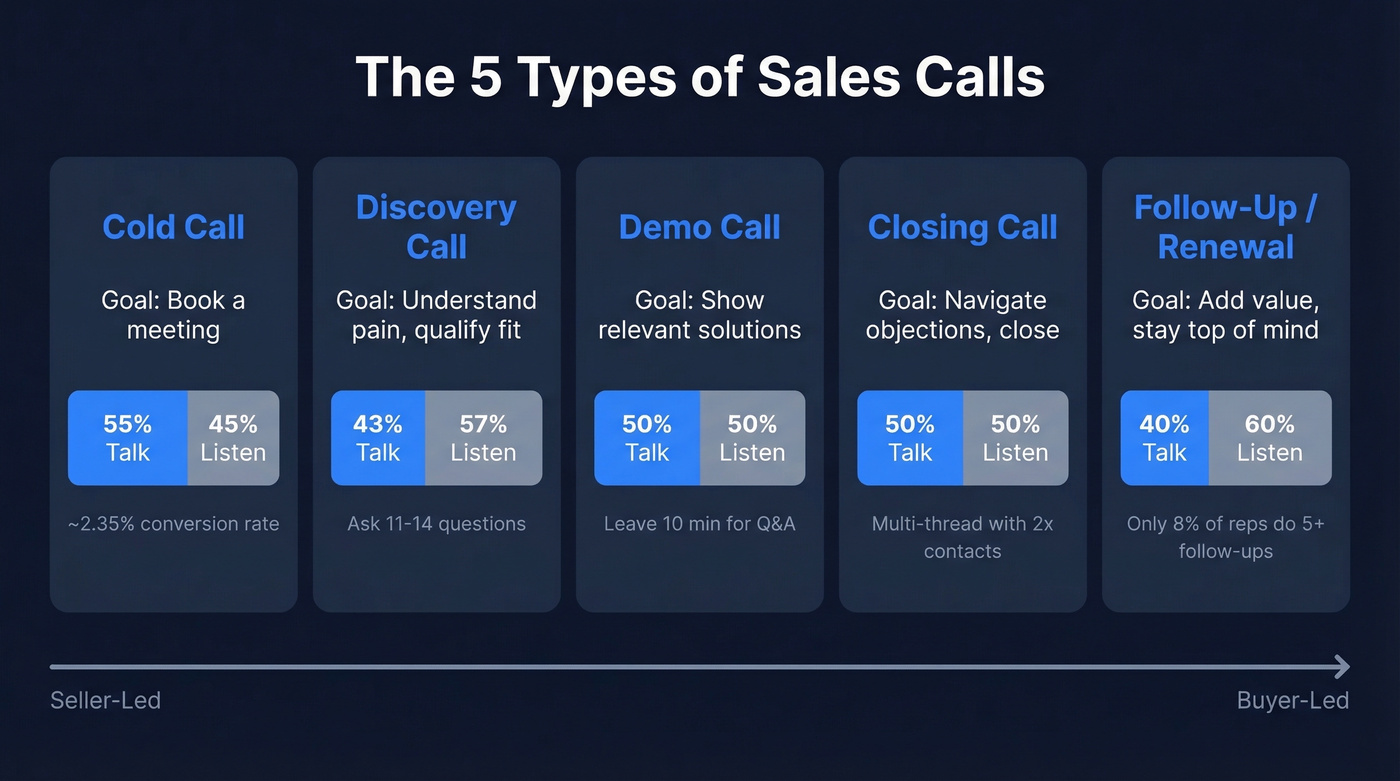
Not all calls are the same. Treating them identically is one of the most common mistakes we see reps make, and each type has a different goal, a different talk-to-listen ratio, and a different definition of success.
Cold Calls
The goal is simple: book a meeting. You're not selling the product - you're selling 15 minutes of their time. Gong's data shows successful cold calls run a 55/45 talk-to-listen ratio, which makes sense. The prospect didn't ask for this conversation, so you need to earn their attention fast.
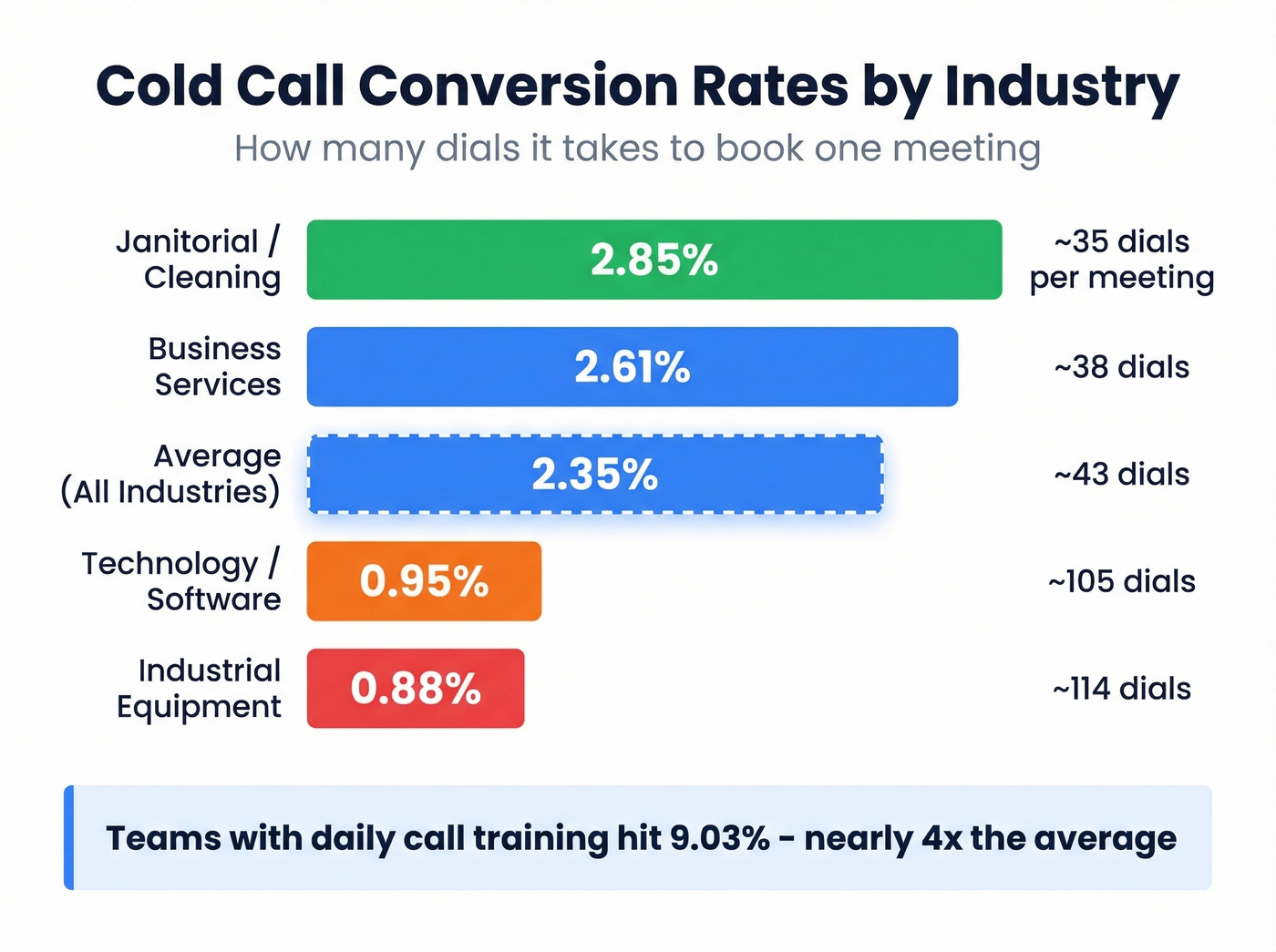
The average cold call conversion rate sits at about 2.35% - roughly one booked meeting per 43 dials. That number varies wildly by industry and deal size:
| Industry | Conversion Rate | Dials Per Meeting |
|---|---|---|
| Janitorial/Cleaning | 2.85% | ~35 |
| Business Services | 2.61% | ~38 |
| Average (all) | 2.35% | ~43 |
| Technology/Software | 0.95% | ~105 |
| Industrial Equipment | 0.88% | ~114 |
Deal size matters too. Expect ~2.64% conversion for deals under $10K, but only ~1.16% for seven-figure contracts. The bigger the deal, the harder the cold open - plan your dial volume accordingly.
Here's the thing: teams that invest in daily call training push their conversion rate to 9.03% - nearly 4x the average. Most sales orgs do weekly or monthly training. The ones winning do it daily, even if it's just a 15-minute morning session reviewing yesterday's best and worst calls. If your team is below 2.35%, the fix probably isn't a new script. It's more reps making consistent dials with better coaching.
Discovery Calls
The goal flips entirely. Now you're listening, not pitching. The optimal ratio inverts to 43% talk / 57% listen. Your job is to understand the prospect's pain, qualify the opportunity, and determine whether there's a real fit. Discovery calls that turn into feature dumps are discovery calls that die.
Demo Calls
Most reps treat demos like product tours. They open the app, start at the top-left corner, and click through every feature while the prospect's eyes glaze over. The best demos spend the first few minutes confirming what you learned in discovery, then show only the features that solve those specific problems. If you're presenting capabilities the prospect didn't ask about, you've already lost the thread. Leave at least 10 minutes for Q&A - that's where real buying signals surface.
Closing Calls
Skip this if you haven't multi-threaded. Gong's data is unambiguous: closed-won deals involve 2x as many buyer contacts as closed-lost deals. If you're single-threaded on a deal, you're gambling that one person can sell internally on your behalf. They usually can't. The talk-to-listen ratio shifts back toward the middle here because you're navigating objections, discussing terms, and confirming next steps.
Follow-Up and Renewal Calls
The most neglected type - and the biggest missed opportunity. 90% of buyers respond within two days of their most recent message, yet only 8% of reps follow up more than five times. Every follow-up touch needs to add value: a relevant case study, a competitive insight, a new data point. Renewal calls work the same way - show up with value, not just an invoice.
Pre-Call Preparation
The highest-ROI improvement to your phone conversations isn't a new opener or a better script. It's what happens before you ever pick up the phone.
The Pre-Call Research Checklist
Before every dial, you should know:
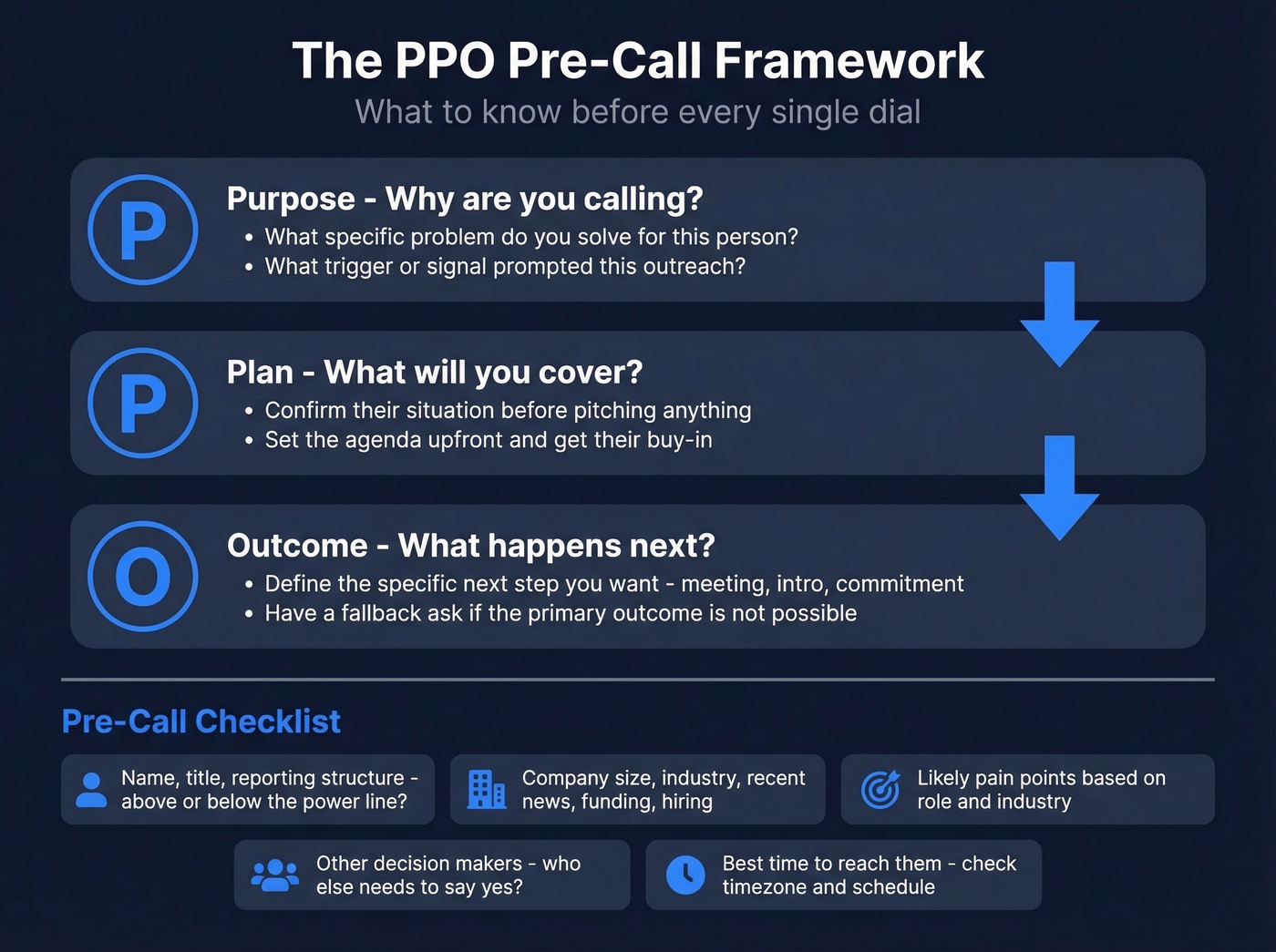
- Prospect's name, title, and reporting structure - are they above or below the power line? VPs and above care about strategic outcomes; managers and directors care about tactical execution.
- Company size, industry, and recent news - funding rounds, leadership changes, hiring surges
- Likely pain points based on their role and industry
- Key decision makers beyond your contact - who else needs to say yes?
- Your PPO - Purpose (why you're calling), Plan (what you'll cover), Outcome (what you want to happen next)
The PPO framework comes from 30 Minutes to President's Club, and it's the best pre-call structure we've found. It prevents the most common derailment: the prospect who says "just show me pricing" two minutes in. When you've set the agenda upfront and gotten their opt-in, you have permission to say, "We'll get there - let me make sure I understand your situation first so the pricing actually makes sense."
The Data Quality Problem
None of that preparation matters if you're calling the wrong number. 42% of salespeople don't have sufficient data before making a call. 80% of dials go to voicemail. Reps spend 15% of their time just leaving voicemail messages.

Best Timing for Outbound
The data on call timing is consistent across multiple studies:
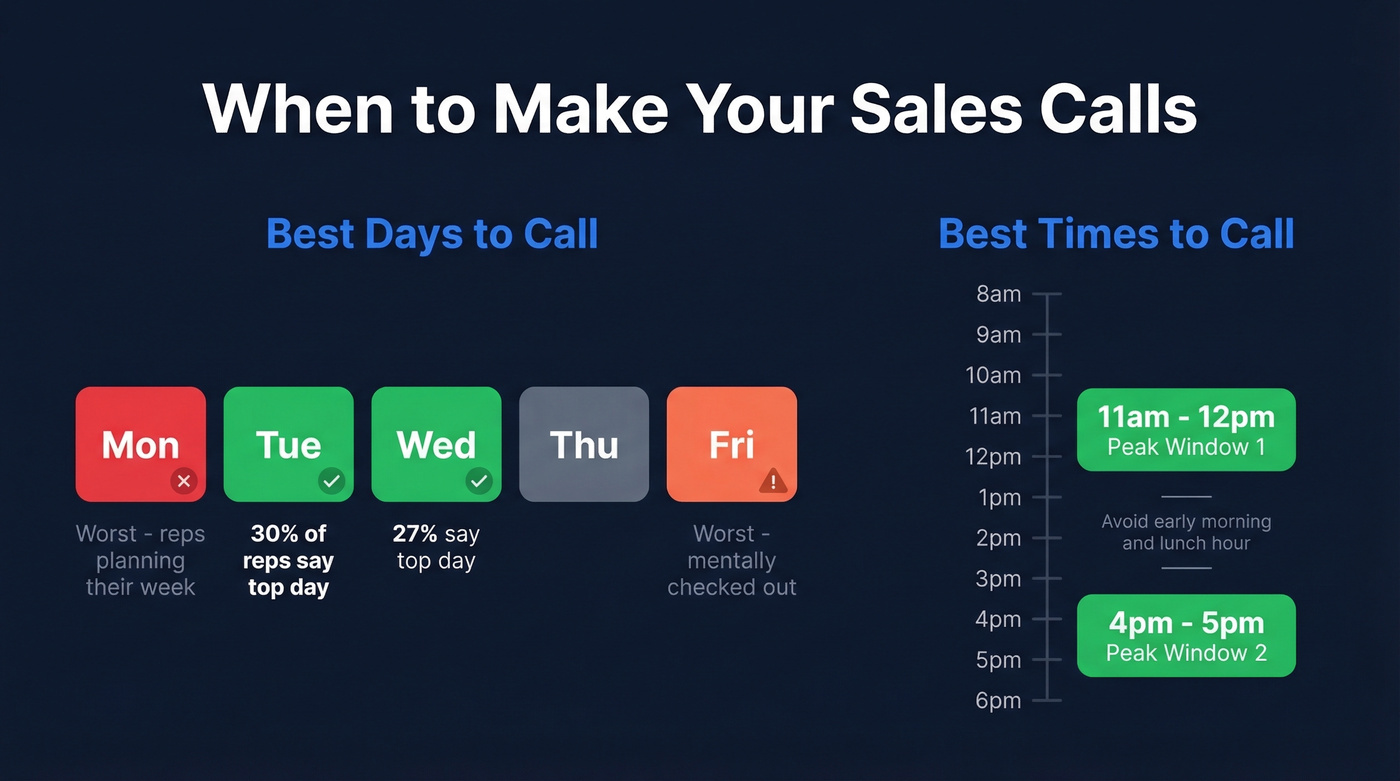
- Best days: Tuesday (30% of reps report it as their top-converting day) and Wednesday (27%)
- Best windows: 11am-12pm and 4-5pm
- Worst time: Monday morning and Friday afternoon - prospects are either planning their week or mentally done with it
Cold Call Scripts and Openers
Scripts aren't about reading a teleprompter. They're about having a structure so your brain can focus on listening instead of scrambling for what to say next. The best cold callers sound unscripted precisely because they've practiced their scripts until the words feel natural.
Openers That Work
Gong analyzed thousands of cold calls and the data on openers is clear.
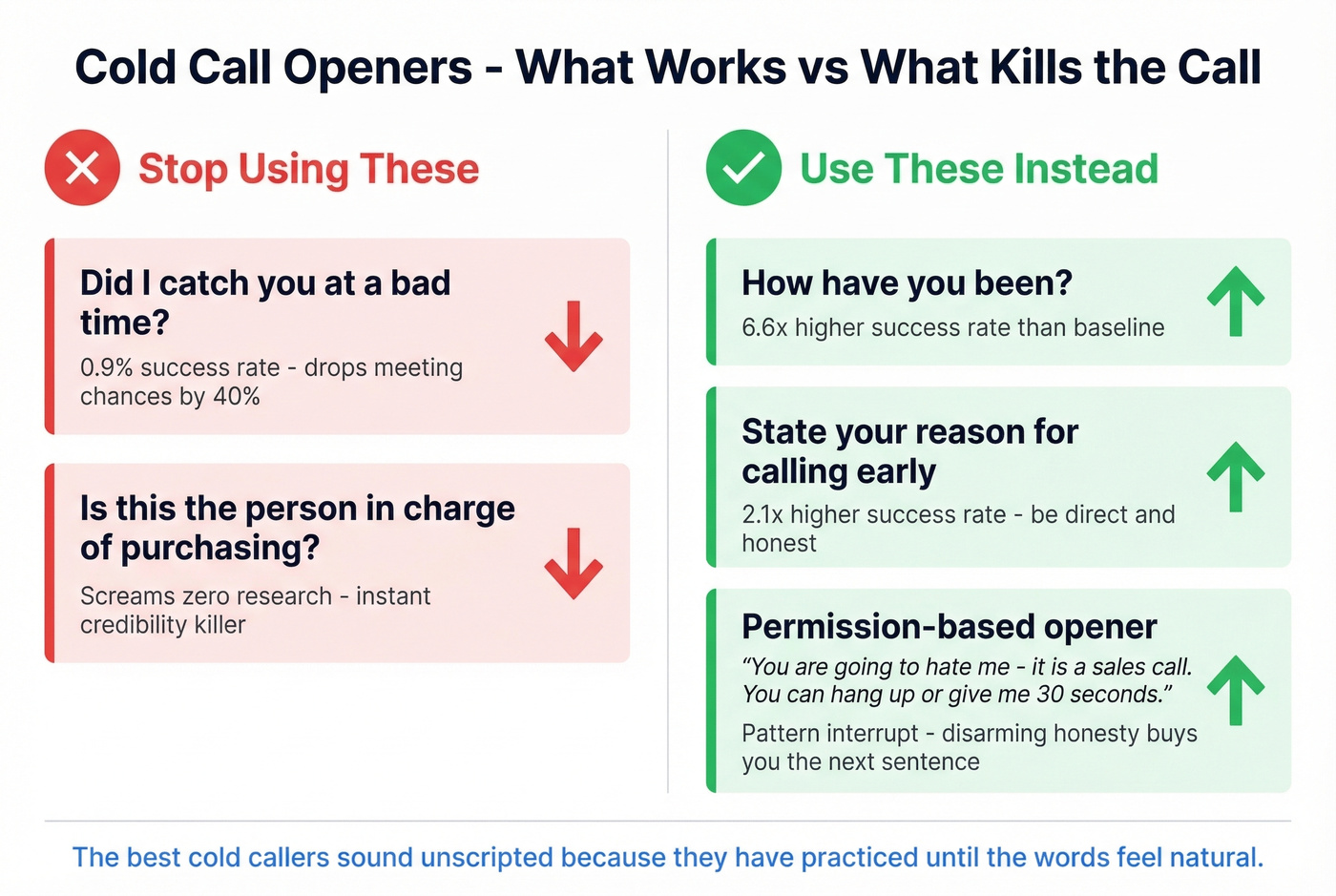
Skip these:
- "Did I catch you at a bad time?" - 0.9% success rate. Drops your meeting-booking chances by 40%. It practically begs the prospect to hang up.
- "Is this the person in charge of purchasing?" - Screams "I didn't do any research." Instant credibility killer.
Use these instead:
- "How've you been?" - 6.6x higher success rate than baseline. It sounds casual, almost like you've spoken before. That ambiguity works in your favor.
- State your reason for calling early. This single move increases success rates 2.1x. Don't bury the lead. "I'm calling because we help [type of company] solve [specific problem]" - direct, honest, and it respects their time.
The permission-based opener is a favorite on r/salestechniques, and in our experience it works well: "You're going to hate me - it's a sales call. You can either hang up or give me 30 seconds." It's disarming because it's honest. The prospect wasn't expecting candor, and that pattern interrupt buys you the next sentence.
The referral name-drop works extremely well when you have a mutual connection: "[Mutual connection] suggested I reach out - they mentioned you're dealing with [problem]. Worth a quick conversation?" A warm intro collapses the trust gap instantly.
Gatekeeper Scripts
Gatekeepers aren't obstacles - they're people doing their job. Treat them that way.
"Hi [Gatekeeper Name], I'm hoping you can help me. I need to speak with [Prospect Name] about [specific topic]. Could you transfer me, or is there a better time to reach them?"
The key phrase is "I'm hoping you can help me." It reframes the interaction from adversarial to collaborative. Don't try to trick gatekeepers. They've heard every trick.
Handling "Not Interested"
The prospect says "not interested" within five seconds. This isn't a real objection - it's a reflex. They haven't heard enough to form an actual opinion.
"That makes sense - you weren't expecting my call. Can I take 10 seconds to tell you the problem we solve, and then you can hang up if it's not relevant?"
Ten seconds is nothing. Most people will agree. And now you've got a window to deliver your one-sentence value prop.
For "I don't have time" - don't push. Instead: "Totally understand. When would be a better time this week? I can call back Thursday at 2pm." Lock in a specific callback. Vague "let's reconnect sometime" never converts.

The article says reps waste 546 hours a year dialing bad numbers. Prospeo's 125M+ verified mobile numbers hit a 30% pickup rate - nearly 3x the industry average. Every number is refreshed on a 7-day cycle, so you're never calling someone who left six months ago.
Stop burning dials. Start booking meetings with numbers that actually connect.
Discovery Call Framework
Discovery is where deals are won or lost. A bad discovery call means you're demoing to the wrong pain, proposing to the wrong stakeholder, and losing to a competitor who asked better questions.
Step 1: Set the PPO Agenda
Open every discovery conversation with Purpose, Plan, and Outcome:
"The purpose of this call is to understand whether [problem area] is something you're actively trying to solve. Here's my plan - I'll ask a few questions about your current setup, share how similar companies have handled this, and then we'll decide together if it makes sense to keep talking. Sound fair?"
That last question is critical. It gets the prospect to opt in. Now you've got an agreement that prevents the "just show me pricing" derailment.
Step 2: Situation, Problem, Impact
Don't ask 15 situational questions. Discovery fatigue is real - the prospect starts giving shorter answers, checking their phone, mentally leaving the conversation. Ask enough situational questions to establish context (two or three), then pivot hard to problems.
The UserGems "Menu of Pain" technique accelerates this. Instead of open-ended "what keeps you up at night?" questions, offer a multiple-choice menu: "When I talk to other VPs of Sales, the top three things I hear are [A], [B], and [C]. Which of those resonates most?"
This works because it demonstrates credibility (you've talked to their peers), it's easier to answer than an open-ended question, and it often prompts the prospect to correct you - which reveals the real pain. Once you've identified the problem, push into impact. "What happens if this doesn't get solved in the next quarter?" That's where urgency lives.
Step 3: Parallel Stories
After the prospect shares a problem, don't immediately pitch your solution. Share a parallel story - a brief anecdote about a similar company that faced the same challenge. "That's exactly what [Company X] was dealing with. They were losing 15 hours a week to [problem]. Here's what they did..." This keeps the conversation collaborative rather than transactional.
Step 4: The 5-Minute Drill
With five minutes left, shift to three direct questions:
- "Is this something you'd want to solve?" - Pressure-tests intent. If the answer is lukewarm, you know where you stand.
- "What's your timeline?" - Separates "nice to have" from "need to fix this quarter."
- "What would the next step look like on your end?" - Gets them to articulate the buying process. Who else needs to be involved? Is there budget? What's the approval chain?
This drill prevents the most common discovery call failure: a great conversation that ends with "let me think about it" and no clear next step.
7 Rules for Selling Over the Phone
Gong's analysis of 1.8 million opportunities reveals clear patterns separating top performers from everyone else. These aren't opinions - they're data.
1. Listen more than you talk. The 43/57 ratio isn't just a target - it's a consistency game. Low performers swing their talk time by 10%, hitting 54% on won deals but ballooning to 64% on lost deals. Top performers stay steady regardless of how the call is going.
2. State your reason for calling early. Calls where the rep stated their reason upfront converted at 2.1x the rate of calls that opened with small talk or vague pleasantries.
3. Use parallel stories. Instead of pitching features, tell a 30-second story about a similar customer. It builds credibility and keeps the prospect engaged in a way that a feature list never will.
4. Handle objections with questions, not arguments. When a prospect pushes back, the instinct is to counter. Resist it. Ask "what's driving that concern?" instead. You'll learn more and the prospect won't feel steamrolled.
5. Multi-thread relentlessly. Closed-won deals have 2x as many buyer contacts as closed-lost. For deals over $50K, multi-threading boosts win rates by 130%. Selling teams on closed-won deals are 67% larger than on lost deals, and bringing in a sales engineer can lift win rates up to 30%. If you're single-threaded, you're gambling.
6. Turn on your camera. Deals are 127% more likely to close when video is used during calls, and win rates jump 94% when the seller's camera is on. In 2026, audio-only calls signal low effort.
7. Keep cold calls under five minutes. 49% of successful cold calls last 2-5 minutes. You're booking a meeting, not running a demo. Get in, deliver value, get the commitment, get out.
After the Call
The conversation ended well. The prospect seemed engaged. Now what?
Send your follow-up within two hours. Not tomorrow. Not "when I get a chance." Two hours. 90% of buyers respond within two days of their most recent message - your follow-up needs to land while the conversation is still fresh.
A template that works:
Subject: [Specific pain point] - next steps
Hi [Name], thanks for the conversation today. To recap: you mentioned [pain point] is costing your team [impact]. We discussed [proposed solution/next step]. I'm confirming our follow-up for [date/time] with [attendees]. In the meantime, here's [relevant resource]. Talk soon.
Keep subject lines under 8 words and 40 characters. Brevity wins in the inbox.
Build a multi-touch cadence. The first follow-up boosts reply rates by 49%. But most deals require 5-12 touchpoints before closing, and only 8% of reps follow up more than five times. That means 92% of reps quit before the deal has a chance to mature. Mix your channels - email, phone, video message, a relevant article share. Each touch should add value. Nobody responds to "just checking in."
If you want plug-and-play messaging, steal a few sales follow-up templates and adapt them to your call notes.
Common Mistakes
Most of these are backed by data. Fix them and you'll outperform most of your peers by default.
| Mistake | Data | Fix |
|---|---|---|
| "Bad time?" opener | 0.9% success rate | State reason early (2.1x) |
| Talking too much | 64% talk time in lost deals | Target 43/57 ratio |
| No agenda | Prospect derails to "show me pricing" | Set PPO at the start |
| No follow-up | 92% quit before 5 touches | Build 5-12 touch cadence |
| Single-threaded | 2x fewer contacts in lost deals | Multi-thread every deal |
| Calling with bad data | 27.3% of time wasted | Verify before dialing |
| Features over problems | Prospect disengages | Lead with pain, not product |
| Audio-only calls | 94% higher win rates with camera on | Turn your camera on |
AI Tools for Sales Calls in 2026
Let's be honest about the AI paradox: sellers who frequently use AI generate 77% more revenue according to Gong's analysis of 7.1 million opportunities. Yet MIT's research found 95% of organizations reported no measurable bottom-line impact from their AI spending. The difference? Top performers use AI for specific, high-leverage tasks - transcription, coaching, and conversation analysis - not as a replacement for human judgment.
Gartner's data backs this up: sellers who effectively partner with AI are 3.7x more likely to meet quota. AI handles the note-taking so you can focus on listening. It flags coaching moments so managers can give targeted feedback. It doesn't make the call for you.
The 2026 tool market breaks into three categories:
| Tool | Category | Starting Price | Best For |
|---|---|---|---|
| Fathom | Conversation Intel | $19/user/mo | Reps on a budget |
| Fireflies.ai | Conversation Intel | $10/user/mo | Transcription + search |
| Gong | Conversation Intel | ~$160-250/user/mo | Enterprise coaching |
| Aircall | AI Dialer | $30/user/mo | Mid-market teams |
| JustCall | AI Dialer | $19/user/mo | SMB-friendly dialer |
If you're building a modern outbound stack, start with a few proven SDR tools and keep your workflow simple.
Our recommendation: Start with Fathom at $19/user/month if you're an individual rep or small team. It handles transcription, summaries, and CRM logging without the enterprise price tag. For a 20+ person sales floor that needs coaching analytics at scale, Gong is the gold standard - but expect $160-250/user/month. Make sure you'll actually use the coaching features, not just the recording.
Autonomous agents are the emerging third category - tools like Warmly ($400-1,000/month) that monitor website visitors and trigger real-time outreach. The technology is promising but the category is still maturing. Skip this unless you're already maxing out your human-driven pipeline.
The biggest AI win for most teams isn't a fancy conversation intelligence platform. It's simply having every call transcribed and searchable. That alone changes how you prep for follow-ups, how managers coach, and how you onboard new reps.
If you're tightening your pipeline math, benchmark your sales conversion rate so you know what “good” looks like.
Your pre-call research checklist is useless without accurate contact data. Prospeo returns 50+ data points per contact at 98% email accuracy and 92% API match rate - names, titles, reporting structures, verified directs - so every dial is a real conversation, not a dead end.
Prep smarter when every contact comes back verified and enriched.
FAQ
What's the best time to make a sales call?
Tuesday and Wednesday convert highest, with Tuesday leading at 30% of reps reporting it as their top day. The best windows are 11am-12pm and 4-5pm. Avoid Monday mornings and Friday afternoons - prospects are either planning their week or mentally done with it.
How many cold calls to book one meeting?
The average conversion rate is 2.35%, meaning roughly 43 dials per booked meeting. In technology/software, expect closer to 105 dials. Teams doing daily call training push conversion to 9.03% - nearly 4x the average - so coaching cadence matters more than script tweaks.
Do I need to record my calls?
Most US states are one-party consent, meaning only you need to know you're recording. California, Illinois, and several others require two-party consent; GDPR requires explicit consent in the EU. Always disclose - it's legally safer and builds trust. Tools like Fathom ($19/mo) make recording and transcription effortless.
How do I get accurate phone numbers for prospects?
Use a verified B2B data platform like Prospeo rather than scraping directories or buying unverified lists. Bad data wastes 27.3% of rep time - over 500 hours a year you'll never get back.