

Best Sales Call Tracking Software in 2026
Five hundred dials. A hundred and eighty connections. Zero attribution on which campaigns sourced the numbers that actually picked up. That was one SDR manager's Tuesday last quarter - and it's a scene we've watched repeat across dozens of teams. The dials get tracked. The outcomes don't. And the 320 that never connected? Nobody can say whether those were bad numbers, bad timing, or bad luck.
There are 214 call tracking tools on Capterra and 114 on G2. The global call tracking software market is projected to hit $2.62B by 2032. Most of those tools solve one narrow problem - inbound attribution - and ignore outbound entirely. Here are the 10 best picks that cover both sides.
Our Picks
| Use Case | Tool | Starting Price |
|---|---|---|
| Pre-call data verification | Prospeo | Free (75 emails/mo) |
| Inbound call attribution | CallRail | $45/mo |
| Agencies & call centers | CallTrackingMetrics | $79/mo |
| Enterprise outbound teams | Salesloft | ~$20K/yr |
| Best value for SMBs | WhatConverts | $30/mo |
Let's be honest: most teams spend $500/mo on call tracking and $0 verifying their contact data. That's backwards. The best tracking platform in the world can't fix a list full of wrong numbers. Prospeo sits at the top because it solves the problem every other tool ignores - making sure the number you're dialing is real, current, and belongs to the right person. CallRail dominates inbound attribution. CallTrackingMetrics gives agencies the most flexibility per dollar. Salesloft is the enterprise outbound standard if you can stomach the pricing. WhatConverts is the cheapest dedicated option that actually works.
Inbound vs. Outbound Tracking
Inbound call tracking is a marketing tool. It answers: which campaign, keyword, or landing page drove this phone call? The core technology is dynamic number insertion (DNI), which swaps phone numbers on your site so each visitor gets a unique trackable number. You're measuring marketing ROI, not coaching reps.
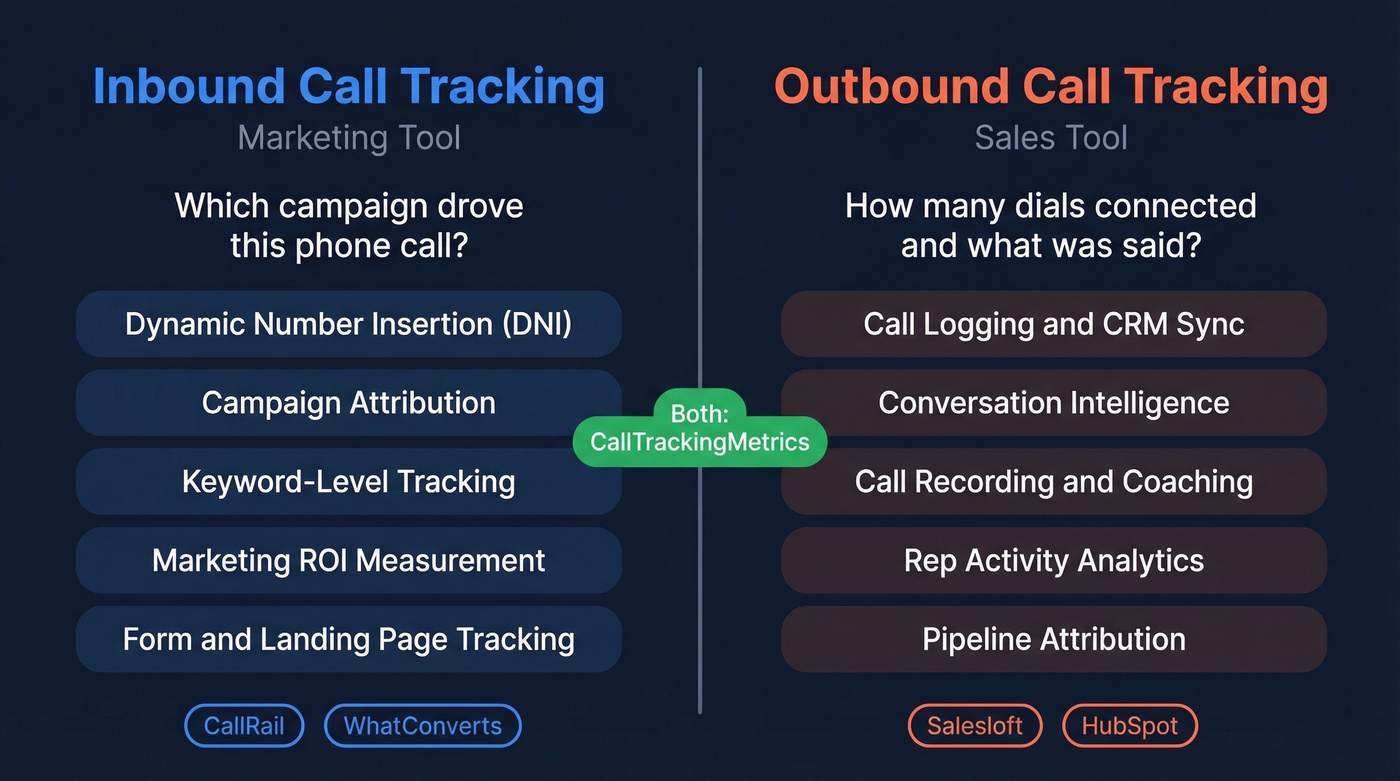
Outbound call tracking is a sales tool. It answers: how many dials did each rep make, how many connected, what was said, and did the CRM get updated? The core capabilities are call logging, CRM sync, conversation intelligence, call recording, and coaching analytics.
Some tools do both. Most don't. CallRail and WhatConverts are inbound-first. Salesloft and HubSpot Sales Hub are outbound-first. CallTrackingMetrics straddles the line better than most. The list below tells you which is which.
10 Best Tools for 2026
Prospeo - Pre-Call Data Layer
Call tracking tools track what happens during and after the call. Prospeo solves what happens before - making sure the number you're dialing is real, current, and belongs to the right person.
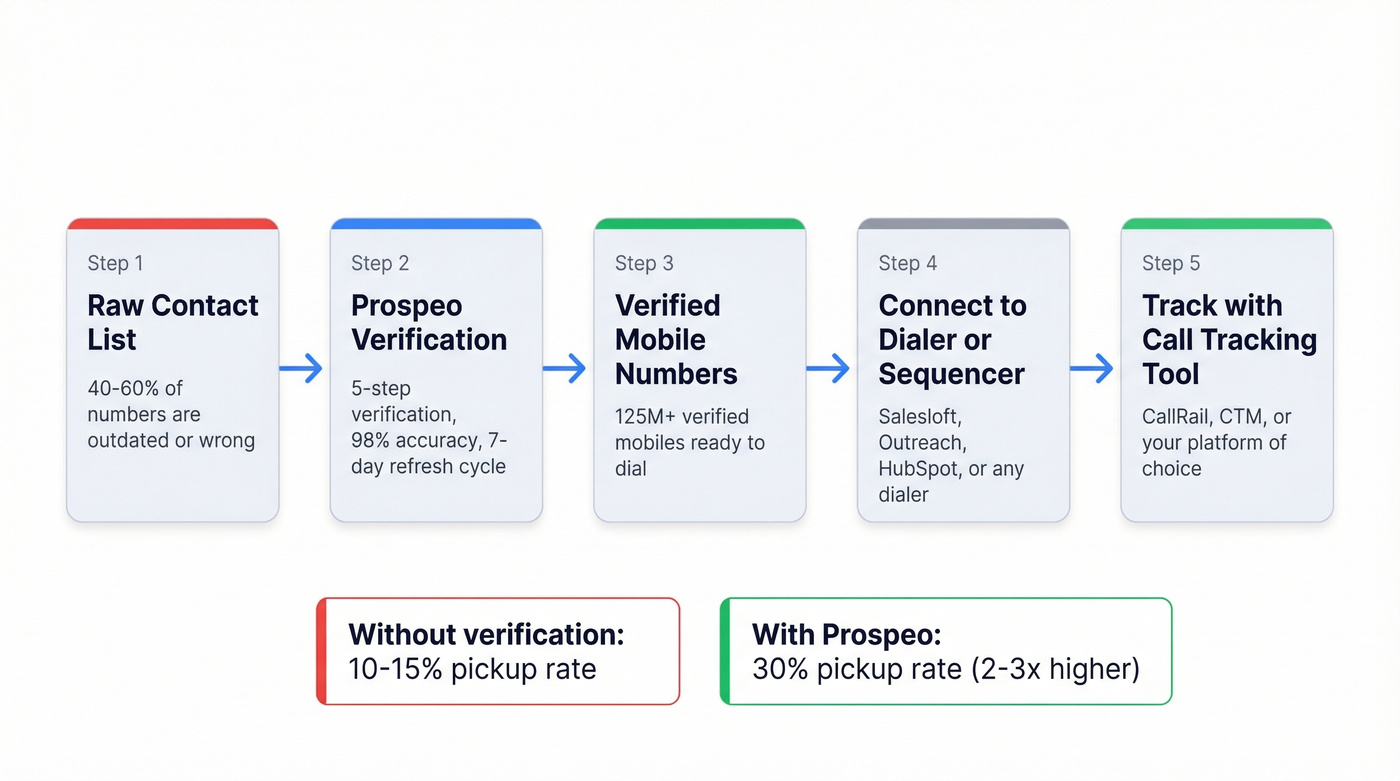
The database covers 300M+ professional profiles with 125M+ verified mobile numbers and 143M+ verified emails at 98% accuracy. Teams see a 30% mobile pickup rate - 2-3x what unverified lists deliver. Every record runs through a 5-step verification process and refreshes on a 7-day cycle, compared to the 6-week industry average. Meritt tripled their weekly pipeline from $100K to $300K after switching, with connect rates jumping to 20-25%.
Pricing starts free with 75 emails and 100 Chrome extension credits per month. Paid plans run about $0.01 per email. No contracts, no sales calls required. Native integrations with Salesforce, HubSpot Sales Hub, Salesloft, Outreach, Lemlist, and Clay mean it slots into whatever dialer or sequencer you're already running. Pair it with CallRail for inbound or Salesloft for outbound and you've got end-to-end coverage.
CallRail - Inbound Attribution
Use this if you're a marketing team that needs to prove which campaigns drive phone calls. Skip this if you're running outbound cold call sequences - CallRail wasn't built for that.
CallRail is the default pick for inbound attribution, and for good reason. DNI, conversation intelligence, form tracking, and multi-touch attribution are all baked in. The 14-day free trial lets you test before committing.
Typical pricing is $45/mo for basic call tracking (5 numbers, 250 minutes), $90/mo to add conversation intelligence or form tracking, and $135/mo for the complete package. Watch the overages - additional numbers cost $3 each, extra minutes are $0.05, and toll-free numbers jump to $5/number. Expect $200-$400/mo at moderate volume once you factor in usage. CallRail isn't a cold-calling dialer; it's an inbound attribution engine, and it's one of the best at that specific job.
CallTrackingMetrics - Agencies
CallTrackingMetrics (CTM) has one of the deepest feature sets and one of the most transparent pricing pages in this category. For agencies managing multiple client accounts, it's the obvious choice.
Every plan includes unlimited users - a rarity. Pricing tiers scale from Marketing Lite at $79/mo up to Enterprise at $1,999/mo. Marketing Pro ($179/mo) includes 25 sub-accounts, and Sales Engage and Enterprise offer unlimited sub-accounts. CTM also runs a "Pay $0 in Plan Fees for the First Month" promotion.
The AskAI feature adds AI-powered conversation analysis, and transcription runs $0.02/minute with 3,000 minutes/sub-account included on higher tiers. Where CTM gets tricky is usage-based billing - minutes, numbers, form submissions, and transcription all carry per-unit costs beyond included allotments. A high-volume agency can see their $179/mo plan balloon to $400+ once usage kicks in. For a single marketing team, CallRail is simpler. For an agency managing 10+ client accounts, CTM's unlimited sub-accounts and users make it the better deal.

SalesLoft - Enterprise Outbound
Here's the thing about Salesloft: it's genuinely excellent outbound tracking wrapped in genuinely frustrating pricing practices. No public pricing. No free trial. You have to talk to sales just to find out what it costs.
Based on third-party estimates, expect $20,000-$120,000/year depending on team size. Per-user cost runs roughly $1,000/user/year with a 3-seat minimum, and the dialer add-on tacks on another $200/user/year. For a 10-rep team, budget $15K-$25K annually before platform fees.
What you get is real: conversation intelligence, call coaching, CRM sync, multi-channel sequencing, and analytics that tie call activity to pipeline outcomes. For enterprise teams with 20+ reps, it's a legitimate all-in-one outbound platform. For teams under 20, it's overkill.
HubSpot Sales Hub - CRM-Native Calling
If your CRM is HubSpot, adding call tracking through Sales Hub eliminates integration headaches entirely. Starter plans begin at $15/user/mo, but recording, transcription, and advanced coaching features typically require Professional or above.
Calls auto-log to contact records, recordings attach to deals, and reps never leave the HubSpot interface. For teams already paying for HubSpot Marketing or Service Hub, the incremental cost is easier to justify than bolting on a separate tool. Just know that HubSpot's call tracking is a feature inside a CRM, not a dedicated platform - it won't match CallRail for inbound attribution or Salesloft for outbound coaching depth.
Salesforce Sales Cloud - Salesforce Shops
Salesforce Sales Cloud starts at $25/user/mo. Einstein AI adds call insights and next-step recommendations on higher tiers. According to Salesforce's State of Sales report, 80% of reps who use AI say it's easier to get the customer insights needed to close a deal, compared with 54% of reps who don't.
Full call tracking capabilities require higher-tier licenses plus add-ons. By the time you've got recording, transcription, and conversation intelligence, you're well above $25. If you're already a Salesforce shop, it's the path of least resistance. If you're not, don't adopt Salesforce just for call tracking.
WhatConverts - Best Value for SMBs
WhatConverts starts at $30/mo with a $30 usage credit included - effectively free for low-volume teams in the first month. It tracks calls, forms, and chat in one platform, and the 14-day free trial requires no commitment.
It's primarily an inbound attribution tool, so outbound teams won't find dialer workflows or conversation intelligence here. The HIPAA-capable Pro tier at $100/mo is a standout for healthcare marketing teams. Plans run $30 (Call Tracking), $60 (Plus), $100 (Pro), and $160 (Elite). Agency plans with unlimited accounts start at $500/mo.
Aircall - Cloud Phone + Tracking
Aircall is a VoIP phone system first, call tracking platform second. At $30/month for 3 licenses, it integrates with most CRMs and includes call monitoring and analytics. Good for teams that need a cloud phone system with basic tracking built in, but it won't replace a dedicated attribution tool like CallRail.
Salestrail - Mobile Call Tracking
Salestrail tracks calls made from personal and mobile phones via SIM-based logging - including WhatsApp calls. At ~$15/user/mo, it's the niche pick for field sales teams whose reps dial from their own devices. Limited analytics compared to full platforms, but nothing else solves this specific problem as cleanly.
Calldrip - Speed-to-Lead
Calldrip's entire value proposition is instant callback: when an inbound lead submits a form, it triggers an immediate call to your sales rep, who's connected to the lead within seconds. Pricing typically falls in the $100-$200/mo range depending on volume, with custom quotes for high-volume teams. Narrow focus, but for industries where response time directly correlates with close rate - real estate, insurance, home services - it's a specialist worth evaluating.
Other tools worth a look depending on your stack: Gong (conversation intelligence), Outreach (outbound sequencing), Close ($35/user/mo CRM with built-in calling).

Call tracking tells you what happened on the call. It can't tell you why 320 dials never connected. Prospeo's 125M+ verified mobile numbers refresh every 7 days and deliver a 30% pickup rate - 2-3x what unverified lists produce.
Stop tracking calls that never connect. Fix the data before you dial.
Pricing Comparison
| Tool | Best For | Starting Price | Free Trial | Contract |
|---|---|---|---|---|
| Prospeo | Pre-call data quality | Free tier | Yes (free tier) | None |
| CallRail | Inbound attribution | $45/mo | 14 days | Monthly |
| CallTrackingMetrics | Agencies | $79/mo | 1st month free | Monthly |
| Salesloft | Enterprise outbound | ~$20K/yr | No | Annual |
| HubSpot Sales Hub | CRM-native calling | $15/user/mo | Free tools | Monthly |
| Salesforce Sales Cloud | Salesforce ecosystem | $25/user/mo | 30 days | Annual |
| WhatConverts | SMB value | $30/mo | 14 days | Monthly |
| Aircall | Cloud phone + tracking | $30/mo (3 seats) | 7 days | Monthly |
| Salestrail | Mobile/SIM tracking | ~$15/user/mo | Yes | Monthly |
| Calldrip | Speed-to-lead | ~$100-$200/mo | Demo | Custom |
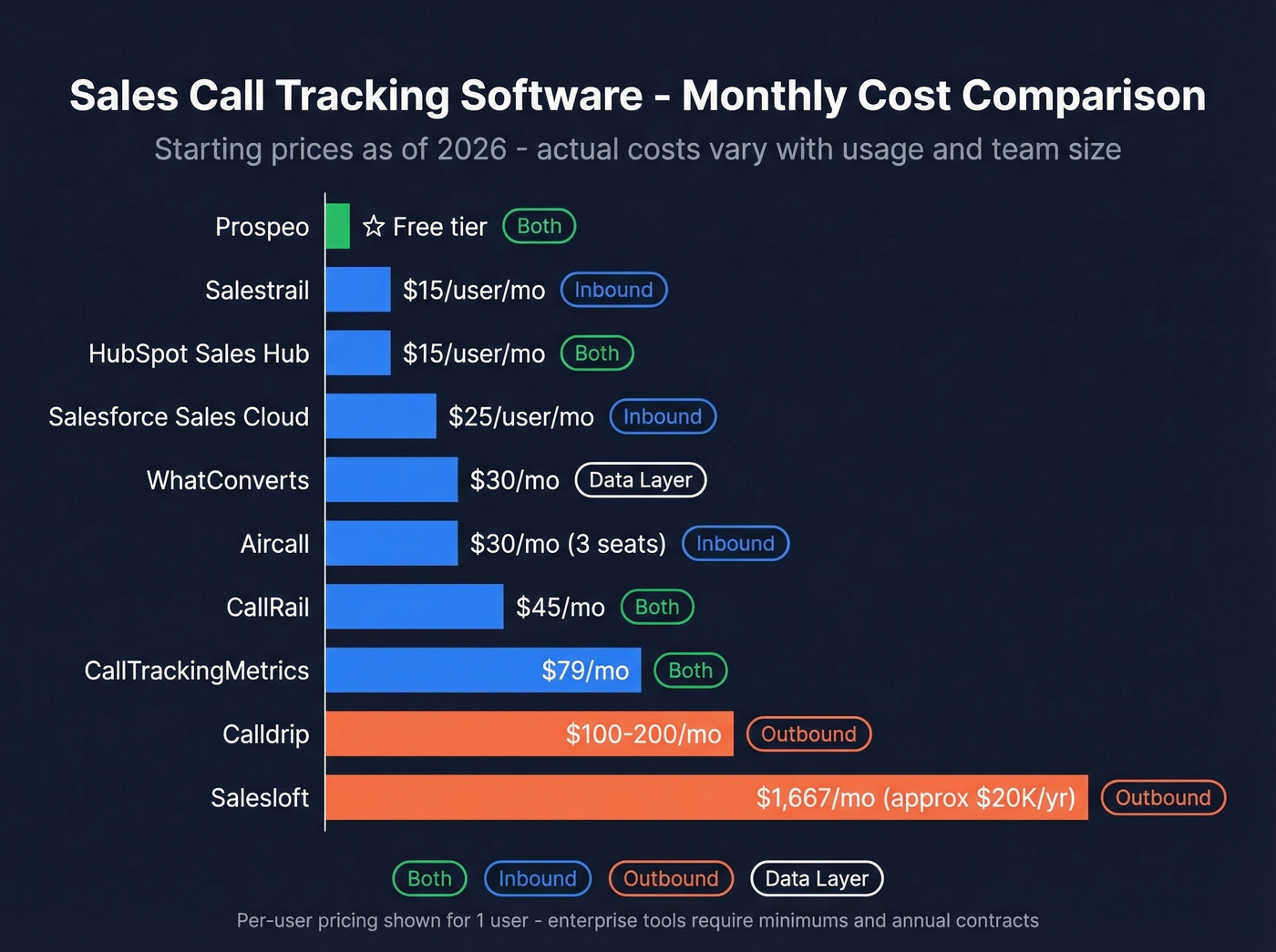
CallRail, CTM, and WhatConverts all charge usage fees on top of base plans. Budget an extra 30-50% above the base price for a realistic monthly cost at moderate volume.
Features That Actually Matter
We've evaluated dozens of these tools. These are the features that separate useful from noise.
Call recording and transcription are table stakes for coaching and compliance. Most tools on this list offer them, but check per-minute costs - CTM charges $0.02/min while some tools include it free.
CRM auto-sync is non-negotiable. If calls don't auto-log to Salesforce or HubSpot, reps won't log them manually. One practitioner on r/techsales described spending 30+ minutes after each call on admin before adopting proper automation. That's dead time your tracking platform should eliminate.
Dynamic number insertion is essential for inbound attribution and irrelevant for outbound-only teams. Don't pay for it if you don't need it.
AI conversation intelligence is where the category is moving fastest. Transcription is step one; AI-powered coaching insights, sentiment analysis, and automated next steps are step two. Contact centers using AI resolve 14% more issues per hour and cut average handle time by 9%. With 50% of businesses already using AI-driven call tools, this isn't a future feature - it's a current competitive requirement.
Call scoring and lead qualification automatically flag high-intent calls so reps prioritize callbacks. In our experience, teams that implement automated scoring see reps spend 20-30% less time on low-value follow-ups.
Compliance varies by state and country. Recording consent laws, HIPAA for healthcare, GDPR for EMEA - check that your tool handles consent prompts natively before you sign anything.
Local presence dialing displays a local area code and increases pickup rates. Critical for outbound teams dialing cold.
Why Data Quality Beats Your Dialer
A practitioner test on r/sales showed cold calling delivering a 17% reply rate and 6.5% meeting rate - roughly 3x the conversion of cold email. But those numbers assume you're reaching real people at real numbers. When 30-40% of your contact list has stale or wrong phone numbers, your expensive tracking platform is logging failures with perfect fidelity.
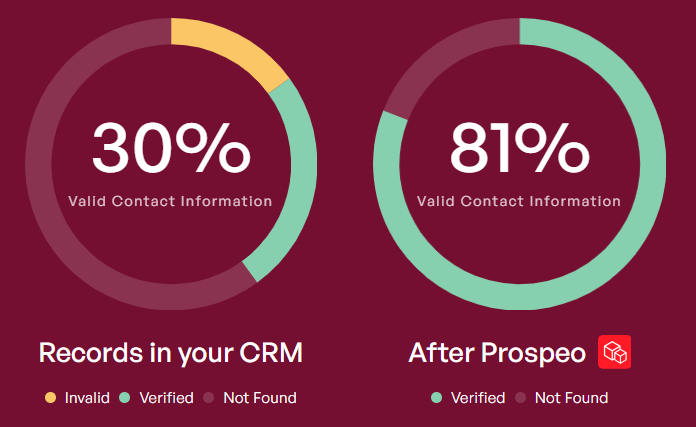
We've watched teams waste months of dialer budget before realizing their contact data was the bottleneck. A 30% mobile pickup rate versus the 10-15% typical on unverified lists is the difference between a rep booking 2 meetings per day and booking 6. Meritt's pipeline jumped from $100K to $300K per week - the dialer didn't change, the data did.
Verify your data upstream, then track what happens downstream. That order matters.
Meritt tripled pipeline from $100K to $300K/week and hit 20-25% connect rates after switching to Prospeo's verified data. At $0.01 per email and 10 credits per mobile, it costs less than one month of most call tracking tools.
Every dollar on tracking is wasted if the number isn't real.
FAQ
What's the difference between call tracking and conversation intelligence?
Call tracking logs and attributes calls - who called, from which campaign, how long it lasted. Conversation intelligence analyzes what was said, including transcription, sentiment, and coaching insights. Many platforms now bundle both, but they solve different problems.
Do I need separate tools for inbound and outbound?
Usually, yes. Inbound tools like CallRail excel at marketing attribution via dynamic number insertion. Outbound tools like Salesloft focus on dialer workflows and rep coaching. CallTrackingMetrics bridges both better than most, but expect trade-offs on depth.
How much does call tracking cost in 2026?
Entry-level inbound tracking starts at $30/mo with WhatConverts. Mid-range tools like CallRail run $45-$135/mo. Enterprise outbound platforms like Salesloft cost $20K-$120K/year. Budget 30-50% above listed prices for realistic costs after usage fees.
Can these tools integrate with my CRM?
Nearly all modern call tracking tools integrate with Salesforce and HubSpot natively. The key distinction is native versus Zapier-only integrations - native syncs are faster, more reliable, and automatically log calls without manual configuration.
How do I improve connect rates on outbound calls?
Start with verified phone numbers - unverified lists waste 30-40% of your dials. Combine clean data with local presence dialing and optimal call timing (Tuesday-Thursday, 10-11 AM local) for the best results.