

The Best Sales CRM Platforms in 2026: Honest Picks, Real Pricing
Your sales manager pulls a pipeline report and half the contacts have no email or phone number. The other half? Stale data from 18 months ago. That's the reality for a lot of teams shopping for sales CRM platforms - 91% of companies with 11+ employees already use a CRM, but "we have one" doesn't mean "it helps us sell."
The CRM market's huge and still growing, which means every vendor wants your contract and every review site wants your click. Most "best CRM" lists read like copy-pasted feature grids with zero point of view. This one's different.
We've run CRM evaluations for sales teams from 3 reps to 300. The pattern's boring but consistent: the tool matters less than the data inside it and whether reps actually open it every morning. Let's break this down like we'd do it for our own RevOps team.
Our top picks
You don't need 27 tools on a shortlist. You need three things: a CRM your reps will use, a data layer that keeps it accurate, and maybe an engagement tool on top.
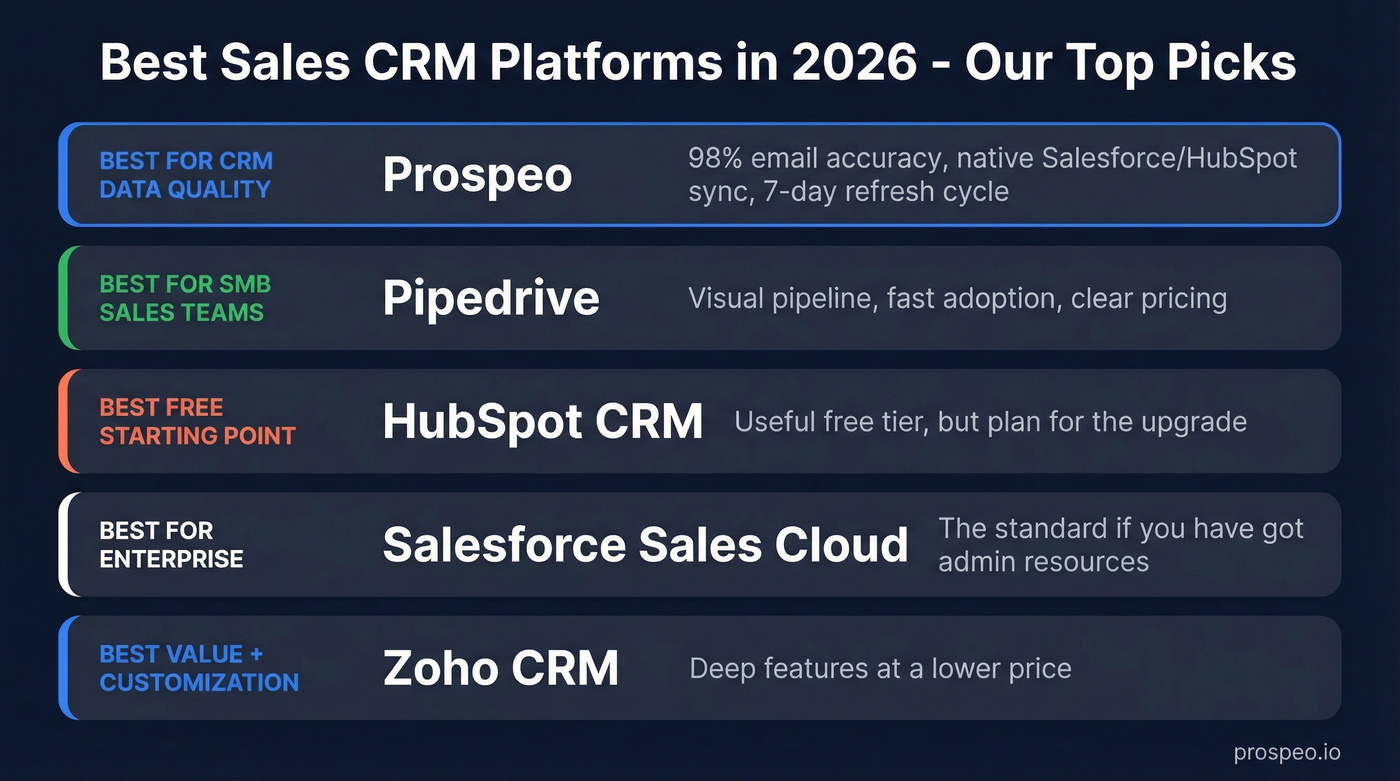
| Category | Pick | Why |
|---|---|---|
| Best for CRM data quality | Prospeo | 98% email accuracy, native Salesforce/HubSpot sync, 7-day refresh cycle |
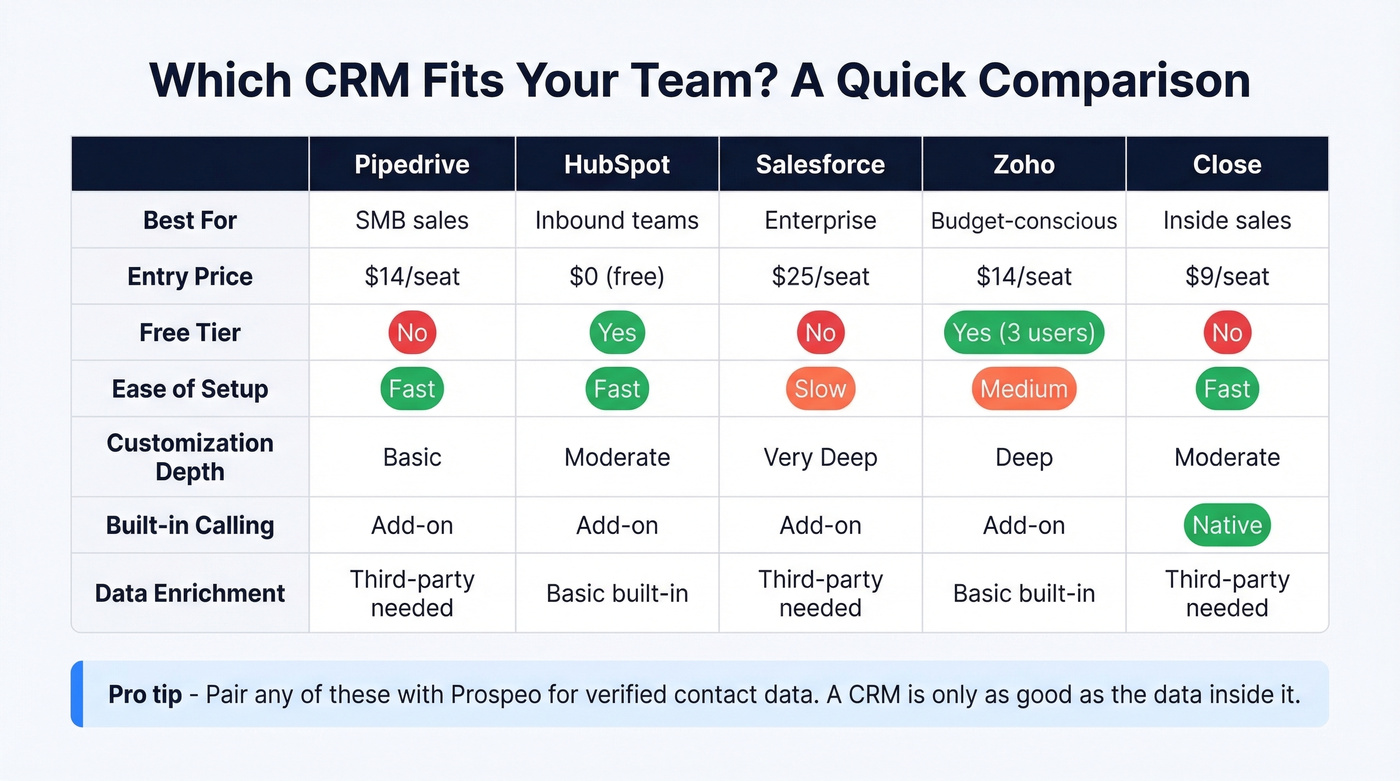
| Best for SMB sales teams | Pipedrive | Visual pipeline, fast adoption, clear pricing |
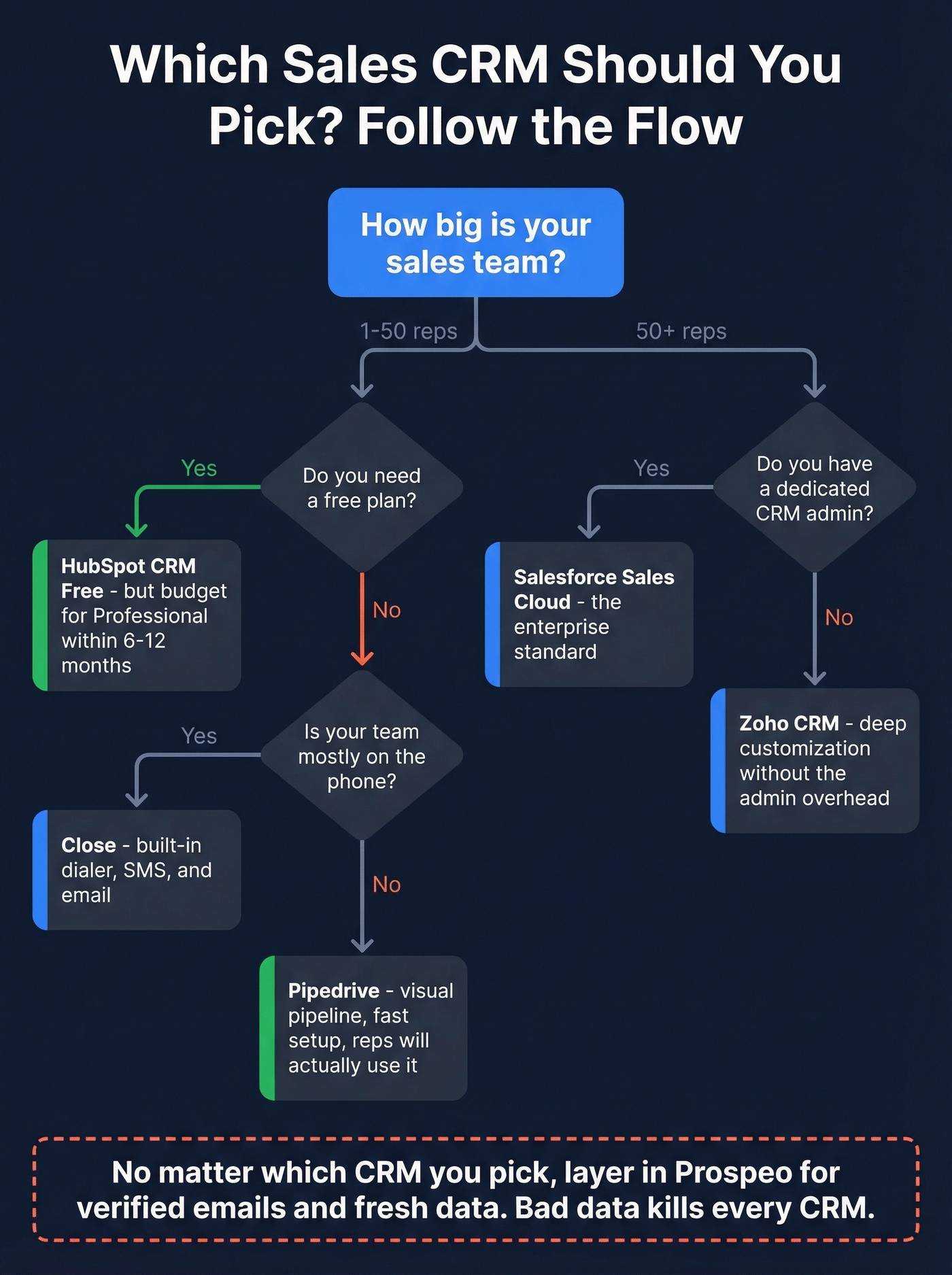
| Best free starting point | HubSpot CRM | Useful free tier, but plan for the upgrade |
| Best for enterprise | Salesforce Sales Cloud | The standard if you've got admin resources |
| Best value + customization | Zoho CRM | Deep features at a lower price |
Look, if we had to stand up a sales team tomorrow on a $50/user budget, we'd run Pipedrive as the CRM and use Prospeo to keep contacts verified and fresh. That's the difference between "we bought a CRM" and "our sequences actually land."
What a sales CRM actually costs
You'll see pricing ranges like $12-$200/user/month. That's technically true, and also not that helpful unless you know where the real spend shows up: tier upgrades, add-ons, extra seats for non-sales teams, and the admin time nobody budgets for.
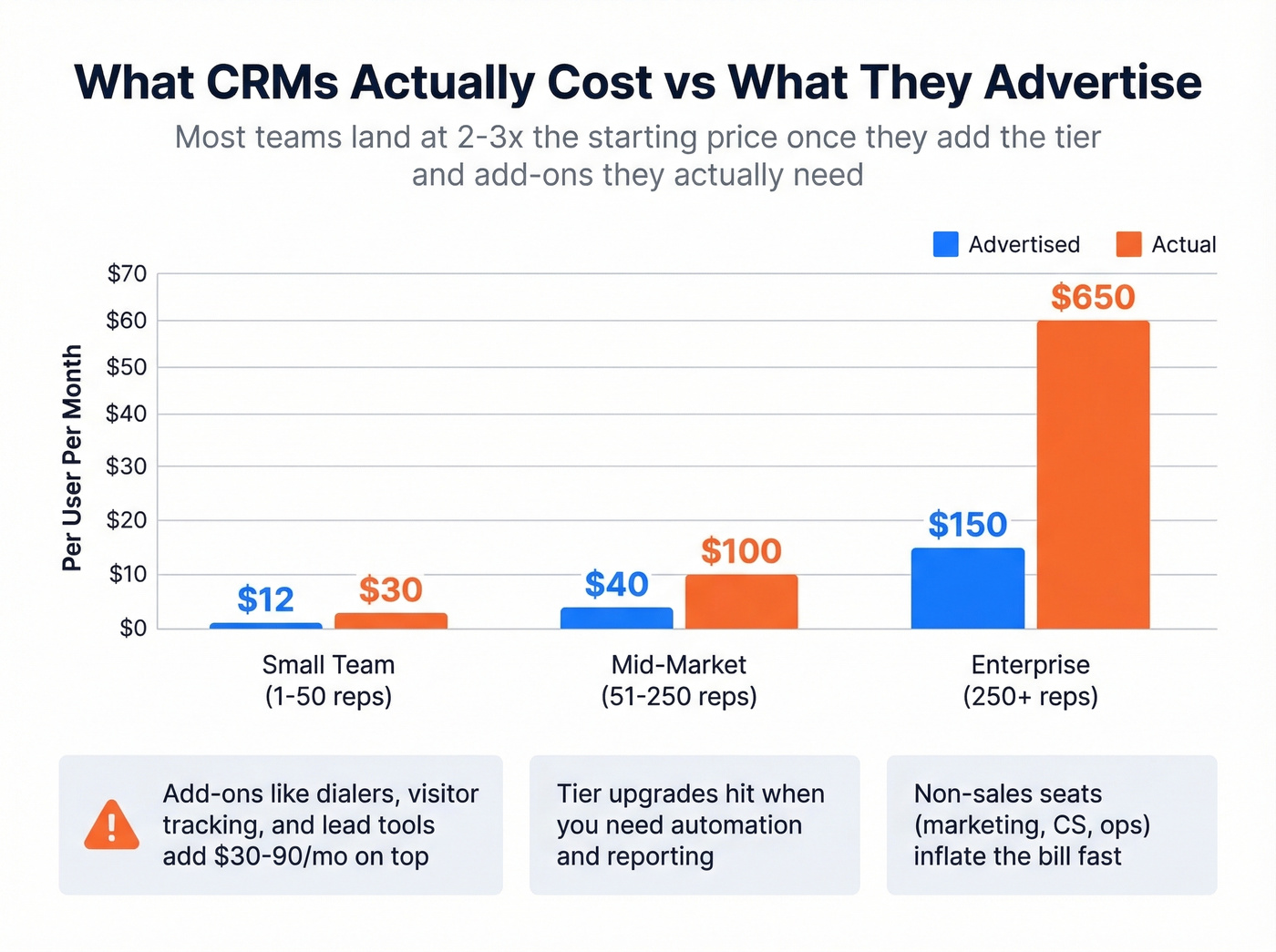
Here's the practical breakdown by company size.
| Company size | Typical spend | What you get |
|---|---|---|
| Small (1-50 reps) | $10-$30/user/mo | Pipeline, contacts, basic automation |
| Mid-market (51-250) | $40-$100/user/mo | Forecasting, workflows, integrations |
| Enterprise (250+) | $150-$650/user/mo | Custom objects, advanced reporting, dedicated admin |
Here's the trap: every CRM advertises a "starting at" price that almost nobody pays once the team gets serious. Pipedrive's entry tier looks cheap, then you add LeadBooster or visitor tracking and suddenly you're paying a meaningful monthly add-on before you've even bought your first extra seat. HubSpot's free tier is genuinely useful, then automation and reporting live behind Professional and the bill jumps.
And yes, Reddit's blunt about this. The recurring theme on r/sales and r/salesops is that per-seat pricing punishes collaboration: you buy seats for reps, then marketing, CS, and ops end up living in Slack because they "don't have a login." That's how handoffs get messy and your CRM turns into a half-truth machine.
Real talk: the "starting at" price is marketing. The price where most teams land is 2-3x higher once you include the tier you actually need and the add-ons you quietly can't live without.
Best sales CRM platforms reviewed
Prospeo - Best for CRM data quality
A CRM's a container. Prospeo is what keeps the container from filling up with junk.
Prospeo covers 300M+ professional profiles, including 143M+ verified emails and 125M+ verified mobile numbers, and refreshes records on a 7-day cycle. That cadence matters more than most teams expect: if your data's stale, your reps stop trusting the CRM, then they stop updating it, then forecasting turns into vibes.

Use Prospeo if bounced emails are wrecking deliverability or your reps waste hours hunting for direct dials. You get 98% email accuracy, a 92% API match rate, and CRM/CSV enrichment that returns 50+ data points per contact. It also layers intent across 15,000 topics, so your team can prioritize accounts that are actually in-market instead of blasting everyone with the same sequence.
One scenario we see constantly: a team migrates to a new CRM, imports an old spreadsheet, and then wonders why reply rates crater. Meritt had that exact problem - bounce rate at 35% - and dropped it under 4% after switching to verified data, which is the kind of change you feel immediately in meetings booked and domain health.
Pair it with any CRM on this list. Prospeo isn't trying to replace your pipeline tool; it's the data layer that makes your pipeline tool worth opening. There's a free tier (75 verified emails/month plus Chrome extension credits), and paid usage runs around ~$0.01 per email with self-serve onboarding and no contracts.
Pipedrive - Best for SMB teams
Pipedrive's whole pitch is simple: reps will actually use it. In our experience, that's mostly true, and it's why we keep recommending it for small and mid-sized teams that want speed over complexity.
The visual pipeline is the best part. Drag deals across stages, see what's stuck, and keep moving. It feels more like a sales board than a database, which is exactly what most teams need early on. What it does well
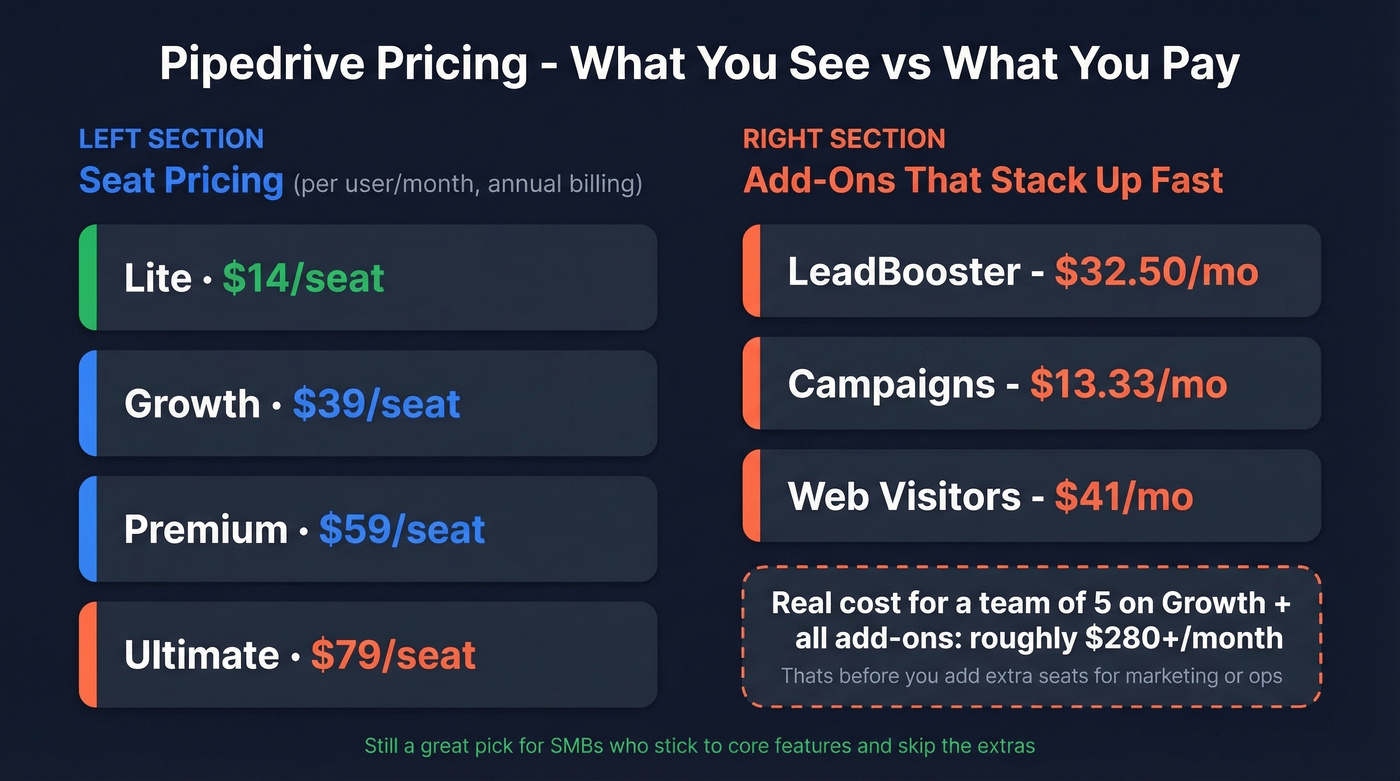
- Straightforward tiers on annual billing: $14 (Lite), $39 (Growth), $59 (Premium), $79 (Ultimate) per seat/month
- 14-day trial with no credit card
- Fast adoption because the UI doesn't feel like homework
What to watch
- Add-ons stack up fast: LeadBooster ($32.50), Campaigns ($13.33), Web Visitors ($41). It's common to end up with $70-$90+/company/month on top of seat costs.
- Reporting's fine, not deep. Larger orgs outgrow it.
- No free forever plan
Skip Pipedrive if you need deep customization or complex multi-object relationships. It's built for velocity, not complexity.
HubSpot CRM - Best free starting point
HubSpot's free tier is the gateway drug of the sales stack. You can run a small operation on it for a while: a basic pipeline, contact management, and enough structure to stop living in spreadsheets.
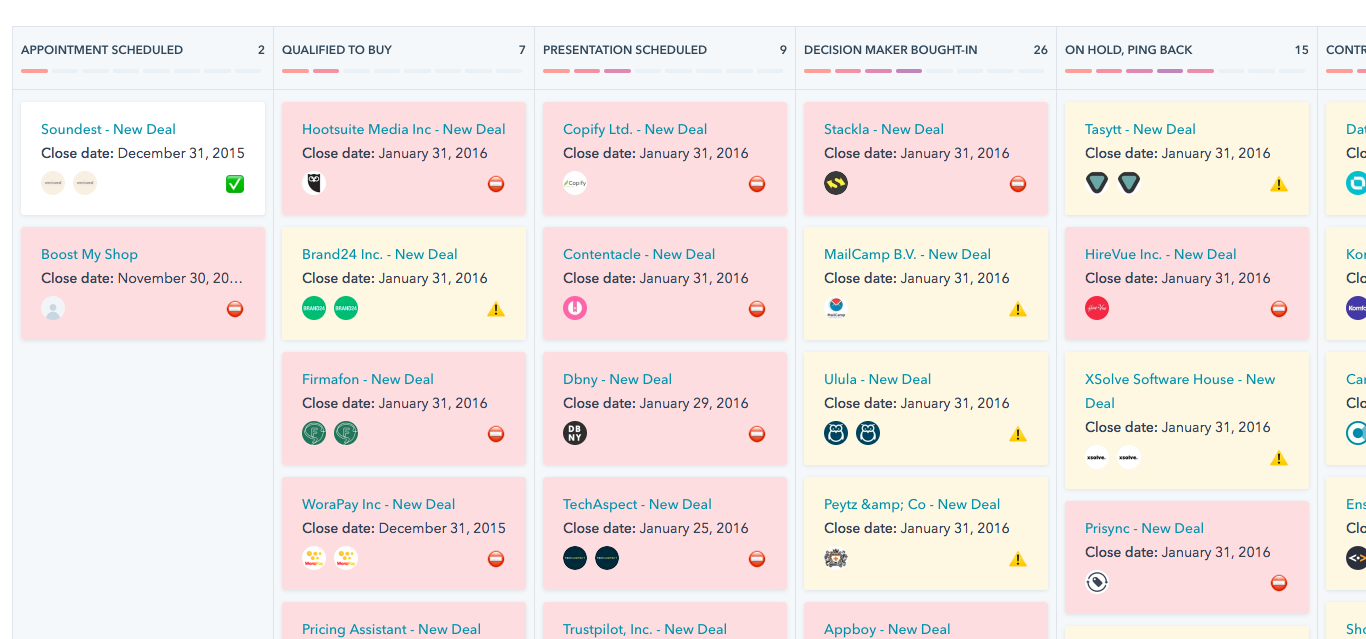
The jump from free to paid is where the bill shows up. Starter's reasonable. But most teams end up needing Professional for workflows, sequences, and reporting, and that's where HubSpot starts to feel like a "real platform" price-wise.
HubSpot's biggest advantage is the marketing connection. If you're running inbound, the CRM-to-marketing handoff is clean and native. If you're outbound-heavy and just want a lightweight pipeline, you'll feel the feature gating sooner than you'd like.
The common complaint (and yeah, Reddit repeats it weekly) is that HubSpot gets expensive as you grow: contact limits, automation caps, and tiered features push you upward faster than you'd expect. Our advice is simple: even if you start free, budget like you'll be on Professional within 6-12 months. That way the upgrade's a plan, not a surprise.
Salesforce Sales Cloud - Best for enterprise
Salesforce is still the default enterprise answer. IDC has kept it at the top for market share for years, and you can build almost anything on it if you've got the admin horsepower.
Use Salesforce if you've got 50+ reps, complex processes, and someone who owns the system full-time. You'll get custom objects, approval workflows, deep reporting, and an ecosystem that can handle messy reality.
Skip Salesforce if you're a team of 10 hoping to "grow into it." That plan fails all the time. You'll pay for complexity you don't need, implementation drags, and reps resent the logging burden. The most consistent complaint we see on r/sales isn't even the UI - it's renewal pain once you're locked into the ecosystem and the price steps up.
Salesforce can be the right answer. It's just not the right default answer.
Zoho CRM - Best value
Zoho's the quiet overachiever. PCMag has repeatedly rated it highly, and the reason's obvious once you use it: you get serious customization without paying enterprise premiums.
Free covers up to 3 users. Paid plans often start around $14/user/month and scale into the ~$40-$50+/user/month range depending on features. Zoho CRM Plus bundles CRM with other Zoho apps for teams that want a broader suite.
What it does well
- Strong customization: custom modules, layouts, validation rules, and process automation
- Useful AI features (Zia) for lead scoring and workflow suggestions
- Great value if you want "Salesforce-ish" flexibility without Salesforce pricing
What to watch
- UI polish lags behind Pipedrive and HubSpot, and onboarding takes longer
- Zoho works best when you commit to the Zoho ecosystem; mixed stacks can feel clunky
If your team wants control and doesn't mind setup work, Zoho's a smart buy.
Close - Best for inside sales
Close is built for teams that live on the phone. Dialer, SMS, and email sit inside the CRM, so reps aren't bouncing between tabs all day.
| Plan | Price | Best for |
|---|---|---|
| Solo | $9/seat/mo | Freelancers (1 user, 10K leads) |
| Essentials | $35/seat/mo | Small teams needing core CRM + calling |
| Growth | $99/seat/mo | Scaling teams with workflows and coaching |
| Scale | $139/seat/mo | Larger inside sales orgs |
All plans include unlimited contacts and leads, which is a real differentiator if you're used to contact caps elsewhere. Add-ons matter, though: premium phone numbers run $19/line/month, and Call Assistant adds $50/org/month plus usage.
Skip Close if your team sells mostly through email or field sales. You'll be paying for a dialer-centric workflow you won't fully use.
Freshsales - Best budget AI CRM
Freshsales packs Freddy AI into plans that start at $9/user/month, and there's a free tier for up to 3 users. For teams that want AI-assisted lead scoring and deal insights without jumping to $100+/seat tiers, Freshsales is one of the better deals.
It's not as deep as Salesforce and not as polished as HubSpot. But if budget's tight and you still want modern automation, it's a solid pick.
monday CRM - Best for visual workflows
monday CRM starts at $12/seat/month and feels like monday.com's project boards because it is. If your team already runs projects and ops in monday, adding CRM can be a clean move: shared dashboards, automations, and a familiar interface.
In our experience, reporting and pipeline analytics lag behind the more mature CRM suites. It's a great ops-friendly CRM for teams that want everything in one workspace, but it's not our first choice for a sales org that lives and dies by forecasting accuracy.
Less Annoying CRM - Simplest option
$15/user/month. Contacts, pipeline, tasks, and not much else.
If you want something your team can learn in an hour and never complain about again, this is it. Skip it if you need automation, complex reporting, or anything beyond the basics.
Copper - Best for Google Workspace
Copper starts at $29/user/month and fits teams that live in Gmail and Google Calendar. If your org runs on Google Workspace and you want the CRM to feel like part of that daily flow, Copper's a good match.

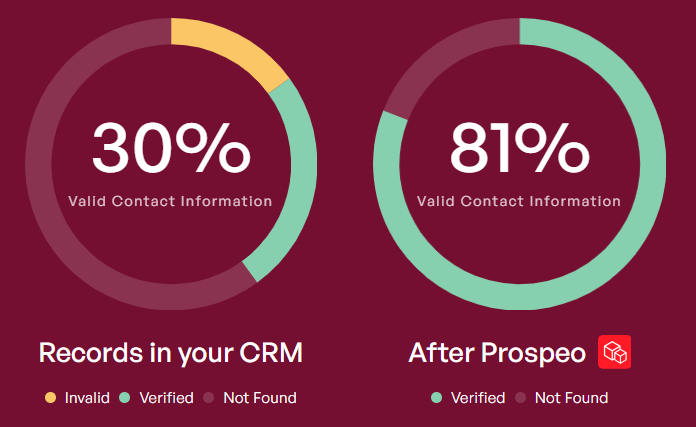
Half the contacts in your CRM have no email or phone. Prospeo's native Salesforce and HubSpot enrichment fills those gaps with 98% verified emails, 125M+ direct dials, and a 7-day refresh cycle - so your pipeline stays accurate without manual work.
Stop selling into stale data. Enrich your CRM for ~$0.01 per email.
Pricing comparison
These are typical annual billing prices. Monthly billing's usually higher.
| Tool | Free tier | Starting price | Mid-tier (where teams land) | Key add-ons |
|---|---|---|---|---|
| Pipedrive | No | $14/seat/mo | $39/seat/mo | LeadBooster $32.50 |
| HubSpot CRM | Yes | $15/seat/mo | $50/seat/mo | Contacts, sequences |
| Salesforce Sales Cloud | No | $25/user/mo | Varies by edition | Einstein, add-on clouds |
| Zoho CRM | Yes | ~$14/user/mo | ~$40/user/mo | CRM Plus $57/user |
| Close | No | $9/seat/mo | $99/seat/mo | Phone $19/line |
| Freshsales | Yes | $9/user/mo | ~$39/user/mo | Minimal |
| monday CRM | No | $12/seat/mo | ~$20/seat/mo | Automation quotas |
| Less Annoying CRM | No | $15/user/mo | $15/user/mo | None |
| Copper | No | $29/user/mo | $69/user/mo | Minimal |
The mid-tier column is the one to budget against. That's the number that shows up after the honeymoon period.
Why CRM implementations fail
CRM tools don't fail. CRM rollouts do. Here are the patterns we keep seeing, and yes, it's frustrating because they're preventable.
Poor adoption. If the CRM feels like extra work, reps stop using it within weeks. The fix is boring: pick a tool your team will open daily, then run a 14-day trial with real deals and real activity logging. Pipedrive and Close tend to win here because the UI doesn't punish reps for doing the right thing.
Bad data quality. Duplicates, bounced emails, missing phone numbers - garbage in, garbage out. This is where most CRMs quietly die. If your sequences bounce, your deliverability drops, and reps stop trusting the system. A verification + enrichment layer that refreshes records weekly keeps the pipeline usable without someone playing data janitor all Friday.
Feature gating surprises. Automation locked behind higher tiers. Sequences only on certain plans. AI features are the newest gating tactic, and they're often priced like a luxury add-on. Read the feature matrix before you commit, not after procurement signs.
No integration strategy. A CRM that doesn't talk to your email, dialer, enrichment, and data warehouse creates silos. Map your core workflows first, then pick the CRM that fits them.
Over-customization. Complex objects, 47 required fields, and a 12-step deal process kill adoption. Start simple. Add complexity only when the team asks for it and you've got proof it improves outcomes.
How to choose the right platform
Forget feature matrices. Three questions matter more than anything else.
Will reps use it daily? This predicts success better than any "AI" checkbox. If the honest answer is "maybe, with training," pick something simpler.
Is the data inside it accurate? A CRM full of stale contacts is worse than a spreadsheet because it creates false confidence. Build your data layer early, and keep it on a refresh cycle that matches how fast people change roles and numbers.
Can you afford it in 12 months? Not today's price - the price after you've added seats, upgraded tiers, and bolted on the add-ons you didn't know you'd need. The Reddit heuristic is right: don't buy the biggest name by default. Match the tool to your workflow and your budget trajectory.
One more opinion we feel strongly about: every vendor is plastering "AI-powered" across their marketing in 2026, and most teams won't use predictive scoring in year one. Don't pay $50/seat extra for AI you won't configure. Buy the CRM that fits your process today, keep your contact data clean, and add intelligence later once you've got the basics working.
Meritt cut their bounce rate from 35% to under 4% and tripled pipeline to $300K/week - just by fixing the data layer under their CRM. Prospeo returns 50+ data points per contact at a 92% match rate, with no contracts and self-serve onboarding.
Your CRM doesn't need replacing. It needs verified data behind it.
FAQ
What's the best free CRM in 2026?
HubSpot's free tier is the strongest starting point for most teams. Zoho CRM Free and Freshsales Free are also solid if you want a lighter setup. If you also need verified contact data, Prospeo's free plan includes 75 verified emails per month plus Chrome extension credits.
How much does a CRM cost per user?
Small teams usually spend $10-$30/user/month. Mid-market teams often land in the $40-$100/user range once they move to the tier they actually need. Enterprise budgets can run $150-$650/user/month after add-ons and admin costs.
When should I switch from a spreadsheet to a CRM?
Switch once you've got more than 2 salespeople or roughly 200+ active contacts. Spreadsheets break the moment multiple reps touch the same pipeline and you need an audit trail.
How long does CRM implementation take?
Simple tools like Pipedrive or Less Annoying CRM can be live in 1-2 days. HubSpot or Zoho often take 1-4 weeks once you include migration and workflow setup. Salesforce implementations can run 1-6 months depending on customization.
How do I keep CRM data clean?
Run an enrichment pass before migration so you don't import dirty data into a clean system. After launch, dedupe on a schedule, enforce required fields at the point of entry, and refresh contact data regularly so your reps aren't calling dead numbers.