

How to Run a Sales Demo That Actually Closes
You nailed the sales demo. Every feature landed. The champion was nodding along, asking great questions. Then - silence. Two weeks of follow-up emails into the void. Your champion couldn't sell it internally because the economic buyer never saw the demo, and the procurement lead didn't even know your company existed.
That's not a presentation problem. It's a prep problem.
What You Need (Quick Version)
Most demos fail because of bad prep, not bad presenting. An analysis of 67,149 recorded demos across 10 weeks shows that winning demos are longer, more interactive, and mirror discovery topics in priority order. This guide gives you the frameworks, scripts, benchmarks, and pre-demo checklist to fix that.
- The #1 lever: mirror your demo to discovery topics - in priority order
- The #1 mistake: monologuing past 76 seconds without a speaker switch
- The #1 prep step: verify every stakeholder's contact data before the invite goes out
What Is a Sales Demo?
A sales demo is a live or interactive presentation tailored to a specific prospect's pain points, buying context, and decision timeline. It sits at the bottom of the funnel - the moment where a qualified lead decides whether your product solves their problem well enough to buy.
Don't confuse it with a product demo. A product demo is a general feature walkthrough, often used for marketing or onboarding. A sales demonstration is surgical: it maps your solution to the prospect's stated priorities, addresses objections in real time, and advances the deal toward a decision. The skills, prep, and structure are completely different.
What 67,149 Demos Reveal
This dataset is the closest thing we have to a controlled study of what separates demos that close from demos that don't.
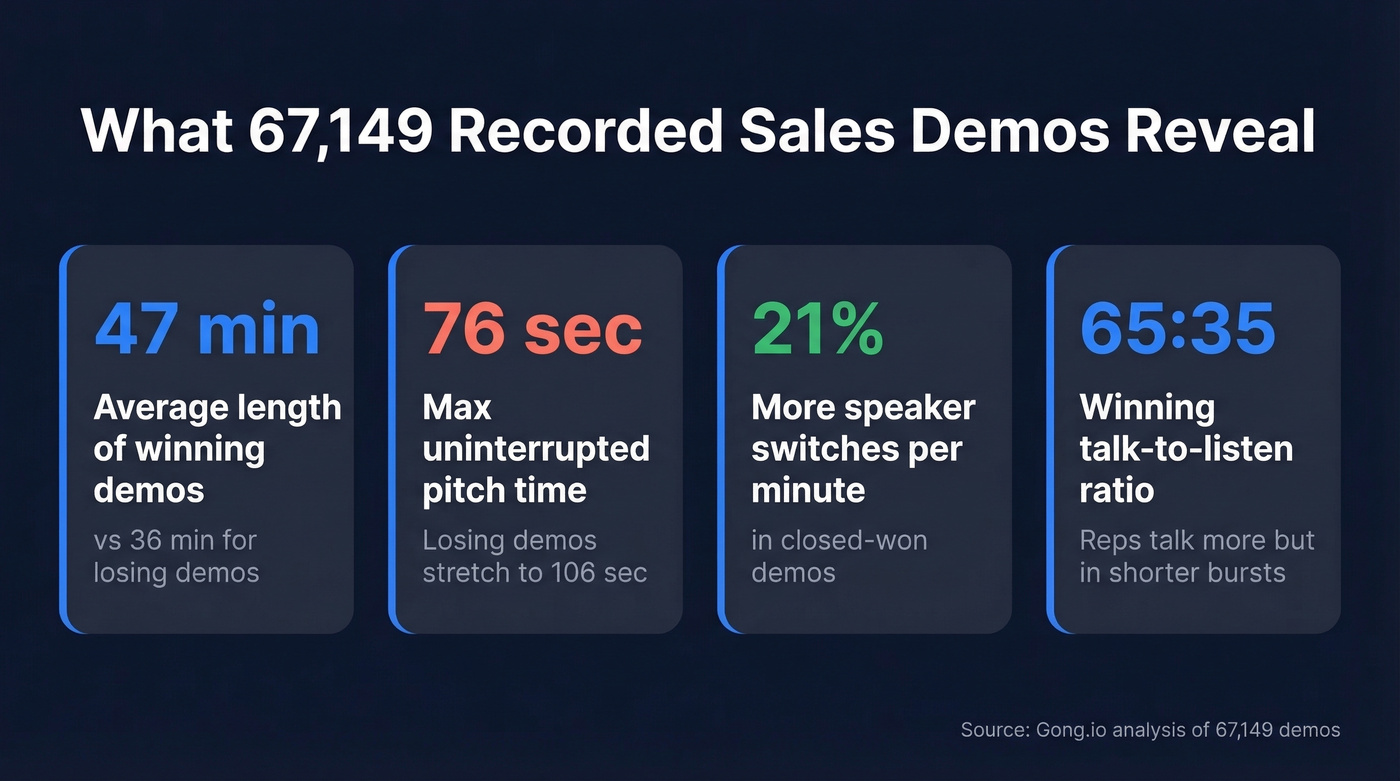
Winning Demos Run Longer
Successful demos average 47 minutes versus 36 minutes for unsuccessful ones. Shorter isn't better - more interaction is. The extra time comes from dialogue, not monologuing.
The 76-Second Rule
No closed-won demo in the dataset had more than 76 seconds of uninterrupted pitching. Unsuccessful demos stretched to 106 seconds. That's the difference between a conversation and a lecture.
Speaker Switches Matter Most
The winning talk-to-listen ratio is roughly 65:35 - reps do talk more. But successful demos have 21% more speaker switches per minute. The rep speaks in shorter bursts, checks in, asks questions, and lets the prospect react. It's not about talking less. It's about talking in shorter intervals.
Solution Mapping Is Key
Winning demos mirror the priority order of problems discussed in discovery. If the prospect's biggest pain was reporting accuracy, that's the first feature you show - not the last. The opposite pattern is the "upside down demo," and it's one of the most common reasons deals stall.
None of this is about charisma. It's about structure and preparation - which brings us to the work that happens before you ever share your screen.
Pre-Demo Work That Decides the Outcome
Discovery Frameworks
Two common B2B discovery frameworks are SPICED and MEDDIC.
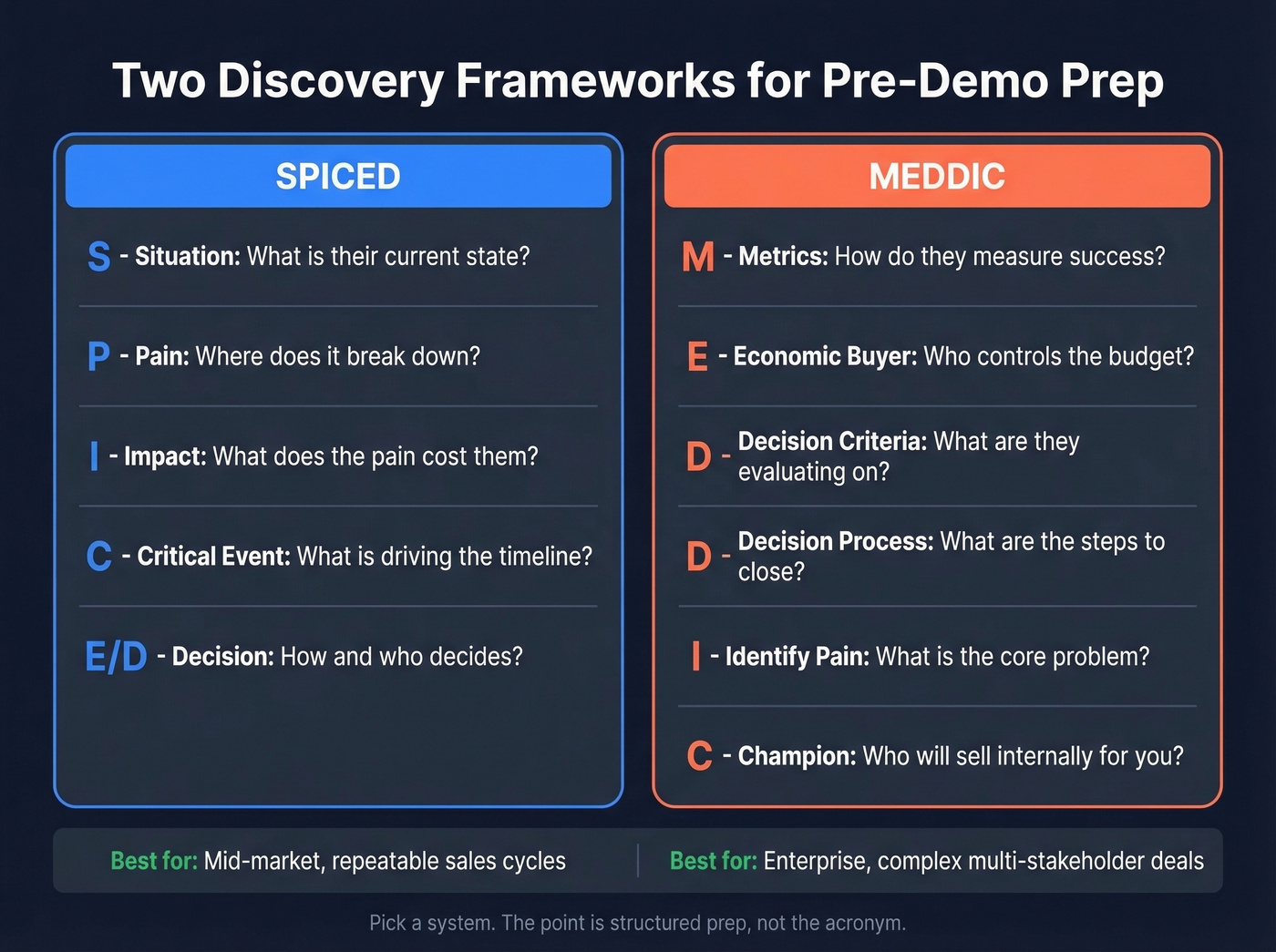
SPICED walks you through five stages: Situation, Pain, Impact, Critical Event, and Decision. Attributed to Winning by Design, it works well for mid-market deals and gives you a repeatable sequence. A few prompts that actually work:
- Situation: "I saw you just opened a new office in Austin - how's that changing your sales hiring timeline?"
- Pain: "Walk me through what happens when a rep needs a verified contact list today. Where does it break down?"
- Impact: "If that process takes 3 hours instead of 30 minutes, what does that cost you across 20 reps per week?"
- Critical Event: "Is there a board review or renewal date driving the timeline here?"
MEDDIC covers Metrics, Economic Buyer, Decision Criteria, Decision Process, Identify Pain, and Champion. It's widely used in enterprise sales. Teams that execute MEDDIC rigorously reduce forecast variance from 30-50% to under 10%. For competitive RFPs, MEDDICC adds Competition. For procurement-heavy enterprise deals, MEDDPICC layers in Paper Process.
The point isn't which acronym you pick. It's that you have a system ensuring you walk into the demo knowing the prospect's priorities, decision process, and who else needs to be convinced.
Stakeholder Mapping
Across 1.8 million opportunities, 77% of deals involve multiple contacts. Closed-won deals have roughly 2x as many buyer contacts as lost deals. Strategic enterprise deals average 17 contacts.
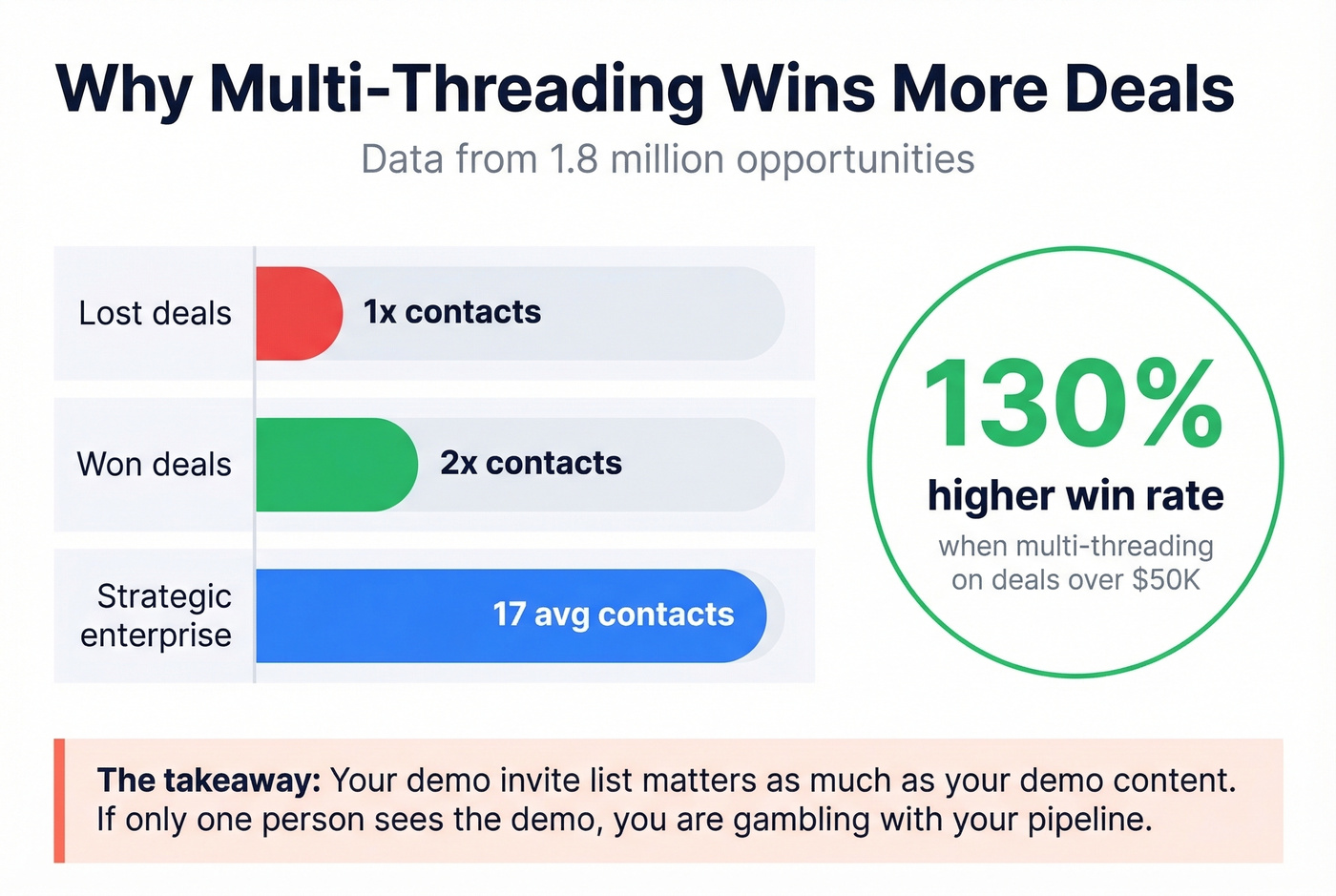
Multi-threading - engaging multiple stakeholders on the buying side - boosts win rates by 130% on deals over $50K. Your demo invite list matters as much as your demo content. If you're presenting to one person and hoping they'll relay the message, you're gambling with your pipeline.
Verify Your Prospect Data
Demo no-show rates commonly run 15-30%. Bad contact data makes that worse.
Here's the thing: an SDR books 12 demos in a week. Half evaporate. Two had wrong email addresses on the invite - the prospect never saw it. One had a phone number that rang to a receptionist who couldn't transfer. Two more went to a single champion who left the company three weeks ago. We've watched this exact scenario play out with teams we work with, and it's maddening.
Data quality is the silent killer of demo pipelines. Before any invite goes out, verify every contact on the list. Prospeo handles this with 98% email accuracy across 143M+ verified emails and 125M+ verified mobile numbers, all on a 7-day refresh cycle. Upload your prospect list, verify in bulk, and make sure every stakeholder on that buying committee actually gets the invite. The free tier gives you 75 emails per month - enough to validate your next week of demos without spending a dollar.


77% of deals involve multiple contacts, and closed-won deals have 2x more buyer touchpoints. Multi-threading only works if you have verified contact data for every stakeholder on the buying committee. Prospeo gives you 98%-accurate emails and 125M+ verified mobile numbers - refreshed every 7 days, not every 6 weeks.
Stop losing demos to bad data. Verify your entire buying committee in seconds.
How to Structure Your Demo Agenda
The 47-minute average for winning demos isn't accidental. Here's a minute-by-minute agenda you can steal.
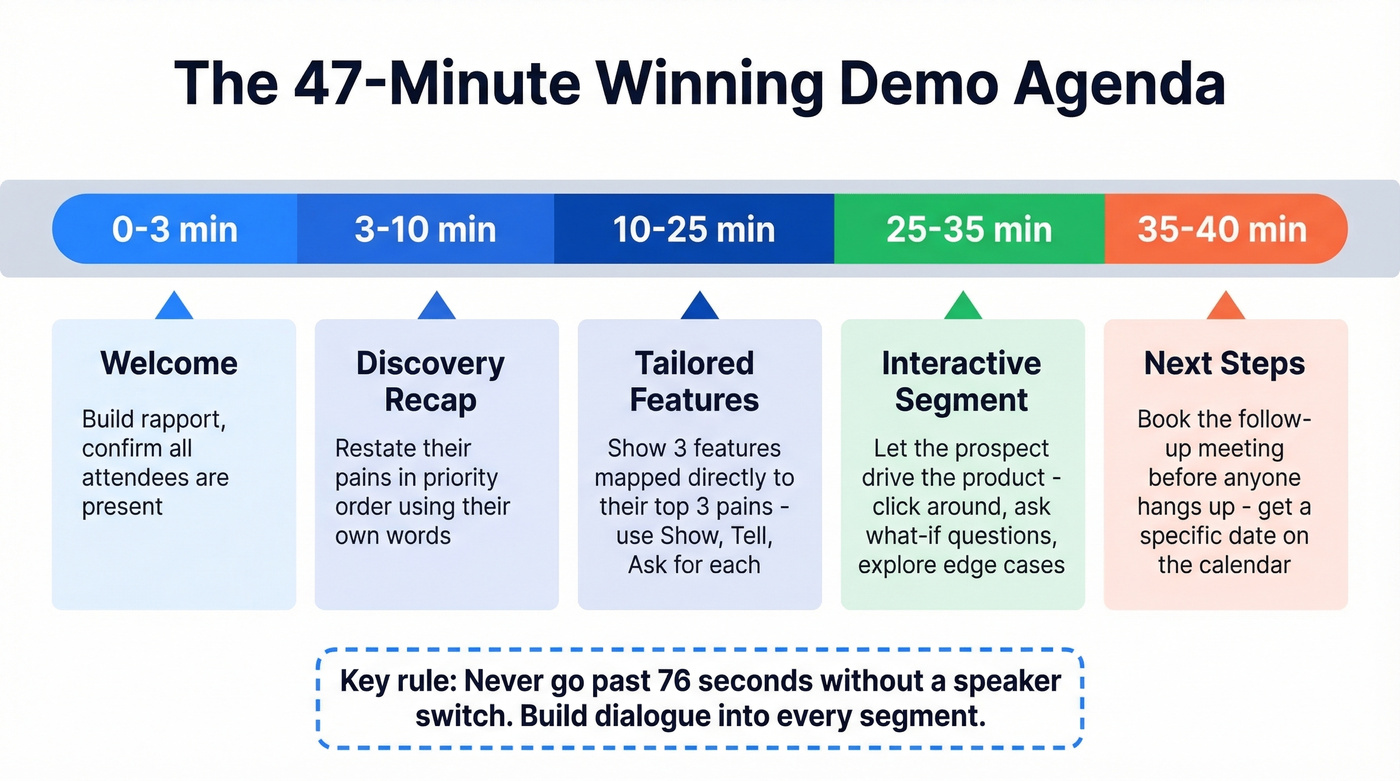
| Segment | Time | What to Do |
|---|---|---|
| Welcome | 0-3 min | Build rapport, confirm attendees |
| Discovery recap | 3-10 min | Restate pains in priority order |
| Tailored features | 10-25 min | Show 3 features mapped to pains |
| Interactive segment | 25-35 min | Prospect drives, asks questions |
| Next steps | 35-40 min | Book follow-up before hanging up |
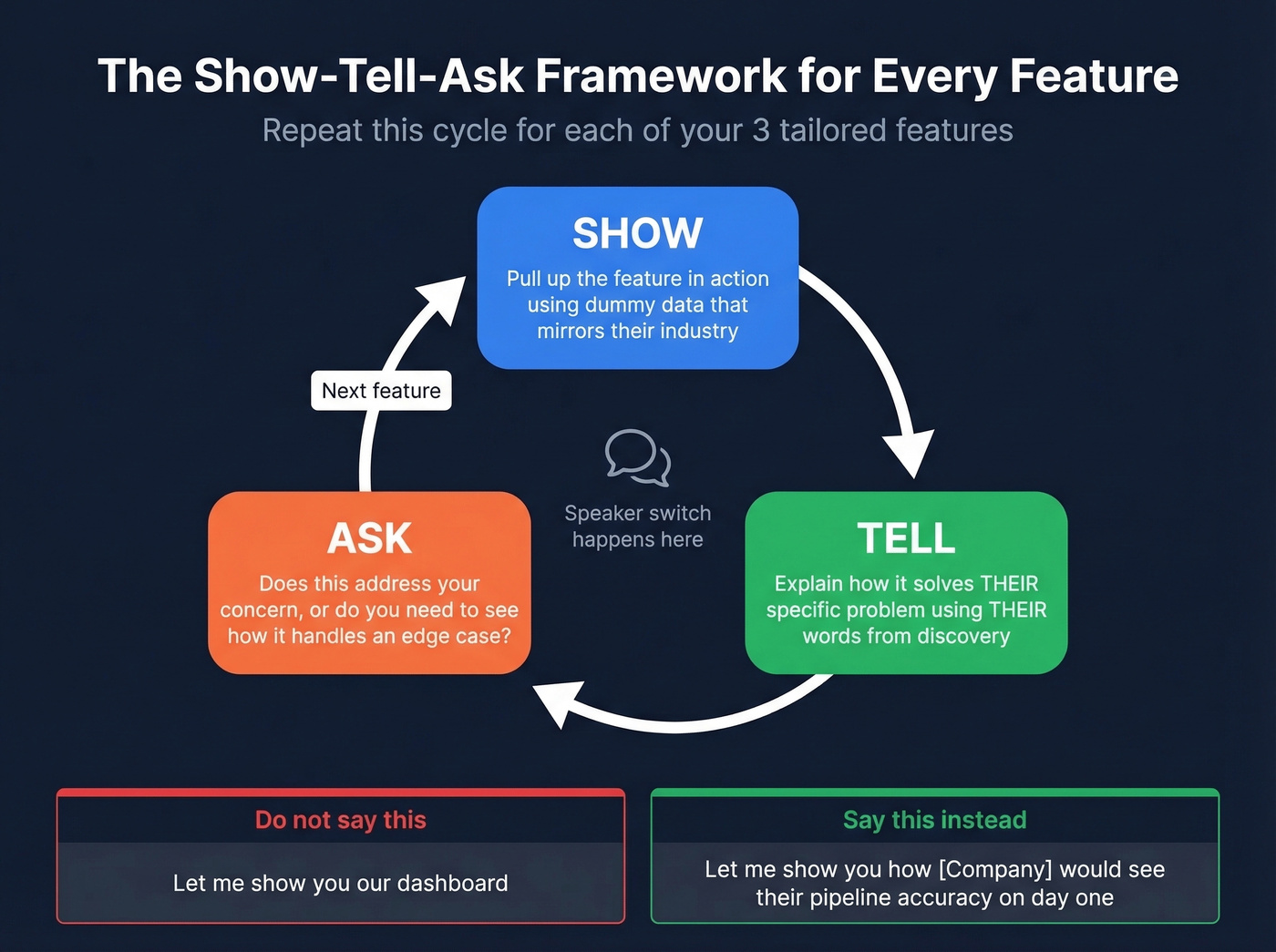
For each feature segment, use the Show-Tell-Ask framework. Show the feature in action. Tell the prospect how it solves their specific problem using their words from discovery. Ask if it addresses their concern or if they need to see more. This creates the speaker switches that matter - you're building dialogue into the structure rather than hoping it happens organically.
Before you share your screen: close Slack, pre-load every tab you'll need, use dummy data that mirrors the prospect's industry, and have a backup browser window ready in case something crashes. Never build a report or run a query live. Pre-load everything. One loading spinner and you've lost momentum.
The interactive segment is where most reps under-invest. Let the prospect click around, ask "what if" questions, and explore edge cases. A prospect who's driven the product themselves is far more likely to champion it internally than one who watched a 30-minute slideshow.
Demo no-show rates run 15-30%, and bad contact data makes it worse. Every invite that bounces is a deal that stalls. Prospeo's 5-step verification and 7-day refresh cycle ensure every stakeholder on your list actually receives the calendar invite - starting at $0.01 per email.
Your next demo pipeline deserves data that doesn't expire in a week.
A Script Template You Can Steal
Core Script Structure
Opening (tie to pain): "Thanks for joining, [Name]. Last time we spoke, you mentioned [specific pain - e.g., your team spends 4 hours a day manually verifying contact data]. I want to make sure today's demo focuses on that. Does that still feel like the right priority, or has anything shifted?"
Agenda setting: "Over the next 35 minutes, I'll show you three things: how we solve [Pain 1], how that connects to [Pain 2], and what implementation looks like for a team your size. Sound good?"
Pain recap (before any feature): "Before I share my screen - you mentioned [Pain 1] costs your team roughly [X hours/dollars] per week. Is that still accurate? And is [Stakeholder Name] still the one feeling that most?"
Feature presentation (Show-Tell-Ask, repeat for each):
- Show: "Let me pull up [feature]. Here's what it looks like when [specific use case]."
- Tell: "For your team, this means [specific outcome tied to their pain]."
- Ask: "Does this address what you described, or do you need to see how it handles [edge case]?"
A quick "say this, not that" rule: instead of "Let me show you our dashboard," say "Let me show you how [Company] would see their [specific metric] on day one." Generic phrasing signals a canned demo. Specific phrasing signals you did the homework.
Objection handling:
- Missing feature: "Fair point. Here's how customers handle that today - [workaround or roadmap context]."
- Budget: "Let's map the ROI against [Pain 1] - if we save [X hours/week], what's that worth over a quarter?"
- Implementation: "Most teams our size are live in [X weeks]. I'll connect you with onboarding to walk through specifics."
Close: "Based on what we've covered, [Pain 1] and [Pain 2] are the priorities. The next step is [specific action - e.g., a technical review with your IT lead]. Can we get that on the calendar for [specific date]?"
Three Script Variations
Problem-solution (best for SMB): Lead with the prospect's biggest pain, show the fix immediately, then expand. "You told me [problem]. Here's exactly how we solve it. Now let me show you what else opens up once that's handled."
Competitive edge (best for RFPs): Acknowledge the alternative without trashing it. "You're also evaluating [competitor]. Here's where we're genuinely different - [specific differentiator]. Let me show you that in the product."
Customer-centric (best for six-figure deals): Lead with a case study from a similar company. "Your peer [Company X] had the same challenge. Here's what their workflow looks like now." Enterprise buyers want proof that someone like them has already taken the risk.
Selling to the Buying Committee
Remember the perfect demo that went silent? That's what happens when you sell to one person instead of a committee.
Closed-won deals have roughly 2x as many buyer contacts as lost deals. Selling teams for won deals are 67% larger than for lost deals. A common benchmark is about 3 demos to close a deal, and complex enterprise deals can require up to 15 across different stakeholders.
If you're running one demo and waiting for a decision, you're not selling to a buying committee. You're hoping your champion does the selling for you.
Bring in a sales engineer for technical validation on enterprise deals - it can increase win rates by up to 30%. Multi-thread by running separate sessions for different stakeholder groups: a technical deep-dive for IT, an ROI walkthrough for finance, a workflow demo for end users. The practical move: ask your champion directly, "Who else needs to see this before a decision gets made? Can we schedule separate sessions for [technical lead] and [economic buyer]?" Most champions will help you if you make it easy for them.
Live vs. Interactive vs. Pre-Recorded
Demo formats have shifted fast. Interactive demos - self-guided product walkthroughs embedded on your website - now deliver 7.9x higher website conversion than static content (24.35% vs. 3.05%) and shorten sales cycles by 18%.
| Format | Best For | Conversion Signal |
|---|---|---|
| Live | Complex deals, enterprise | Highest close rate |
| Interactive | Website, top-of-funnel | 7.9x site conversion |
| Pre-recorded | Follow-up, async stakeholders | Scales to committees |
"Take a Tour" CTA usage grew 29.2% year-over-year across roughly 5,000 B2B websites. Demo center usage is up 3.75x. Ungated interactive demos have 10% higher engagement than gated ones - which makes sense, because nobody wants to fill out a form just to see if your product is even relevant.
Our take: interactive demos replace the first live demo, not all live demos. They qualify prospects before your AE ever gets on a call, which means fewer wasted demos with unqualified buyers. Demo automation vendors will tell you live demos are dead. They're not - they're just expensive, which is why you should reserve them for qualified, multi-stakeholder conversations. The high-stakes presentation that closes a $200K deal is still live, still tailored, still human.
On AI in demos: An analysis of 7.1 million opportunities found sellers who frequently use AI generate 77% more revenue. That doesn't mean AI runs your demo. It means AI handles prep, follow-up summaries, and CRM updates so you can focus on the conversation. If you're still manually writing demo recaps and updating Salesforce after every call, you're spending time on work a machine does better.
Five Mistakes That Kill Deals
1. Feature dumping. You're not a tour guide. Prioritize roughly 3 features tied to the prospect's top pain points. Keep 2 backup features ready if the conversation shifts, but don't show everything just because you can.
2. Monologuing past 76 seconds. The data is clear. Build speaker switches into your structure with Show-Tell-Ask. If you've been talking for a minute straight, stop and ask a question.
3. Skipping discovery at the start. Even if you ran discovery last week, reconfirm pains at the top of the demo. Priorities shift. New stakeholders join. Spending 5 minutes recapping saves you from demoing the wrong thing for 30 minutes.
4. Demoing to one person. The 130% win rate lift from multi-threading isn't theoretical. If only one person is on the call, ask who else needs to see this - then book those sessions before you hang up.
5. No clear next step. Never end a demo with "I'll send over some materials." Book the follow-up meeting, the technical review, or the proposal walkthrough while everyone's still on the call. Momentum dies the second you hang up.
Benchmarks to Track
Knowing what "good" looks like prevents you from optimizing the wrong thing.
| Metric | Healthy | Strong | Elite |
|---|---|---|---|
| Demo to Qualified | 60-70% | 70-80% | 90%+ |
| Qualified to Meeting | 50-60% | 60-70% | 70%+ |
| Talk-to-listen ratio | 65:35 | 60:40 | 55:45 |
| SQL to Closed (B2B SaaS) | ~37% | 40-45% | 50%+ |
These inbound funnel benchmarks come from RevenueHero's dataset. Vertical performance varies wildly: Real Estate Software hits 93.84% qualification rates, while Healthcare Software runs closer to 52.11%. Don't benchmark your healthcare SaaS against a real estate platform's numbers.
For broader funnel context, B2B SaaS averages show SQL-to-Closed rates around 37%. Even if your demo is perfect, roughly 6 out of 10 qualified opportunities won't close. The goal isn't perfection - it's systematic improvement at each stage.
Track demo-to-next-step conversion religiously. If prospects love the demo but don't book a follow-up, your close is weak. If they book follow-ups but deals stall, your multi-threading is weak. The benchmarks tell you where to look.
Tools Worth Knowing
You don't need a $50K demo platform. Here's what actually matters.
| Category | Tool | Price | When to Use |
|---|---|---|---|
| Screen recording | Loom | $15/user/mo | Async follow-ups, recaps |
| Interactive demo | Navattic | $500/mo (5 builder licenses) | Website demos, self-serve |
| Live demo | Zoom | Free-~$15/user/mo | Standard live demos |
| Live demo | Livestorm | Free-~$80+/mo | Webinar-style demos |
| Demo automation | Consensus | ~$1,000-$3,000/mo | Scaling to committees |
Loom plus Zoom covers 80% of use cases for most teams. Add Navattic when you're ready to put interactive demos on your website - the conversion data justifies the spend once you have enough traffic. Livestorm is worth a look if your demos double as webinars or you need built-in registration pages. Consensus makes sense when you're running 10+ demos per deal across large buying committees and need to automate the repetitive ones.
Let's be honest: we've seen teams spend months evaluating demo platforms when the real bottleneck was bad prospect data and weak discovery. Skip the tool comparison until you've fixed the fundamentals. The tools are the easy part.
FAQ
How long should a sales demo be?
Winning demos average 47 minutes versus 36 for losing ones. Aim for 40-50 minutes with a structured agenda that includes an interactive segment. The extra time comes from dialogue and speaker switches, not longer monologues.
What's the difference between a sales demo and a product demo?
A sales demo is tailored to a specific prospect's pain points and decision timeline, requiring discovery, stakeholder mapping, and a close. A product demo is a general feature walkthrough used for marketing or onboarding - no deal context needed.
How many demos does it take to close a deal?
Three is a common benchmark for mid-market deals, while complex enterprise deals can require up to 15 across different stakeholders. Each session should target a different audience - technical validation for IT, ROI for finance, workflow for end users.
How do I reduce demo no-shows?
Verify every contact's email and phone number before sending invites - no-show rates run 15-30%, and bad data makes it worse. Tools like Prospeo let you bulk-verify before the invite goes out, catching stale addresses before they cost you a meeting.
What's a good demo-to-meeting conversion rate?
For inbound requests, 60-70% qualification is healthy and 70%+ is strong. Qualified-to-booked-meeting typically runs 50-60%, with 70%+ being exceptional. Always benchmark against your own vertical - healthcare SaaS and real estate software have wildly different baselines.