

Sales Documents: Build Less and Win More in 2026
72% of a sales professional's day gets swallowed by admin and document work. Templafy, citing Salesforce research, puts it at exactly that - a stat that should make every sales leader uncomfortable. Worse, Forrester found that most sales documents get used fewer than 10 times. Your team is spending the majority of its day creating collateral that almost nobody reads.
The fix isn't more documents. It's fewer, better ones - tracked, maintained, and sent to verified contacts who actually receive them.
What You Actually Need
Start with three assets: a one-pager, a case study, and a proposal template. These cover 80% of buyer interactions from first touch to decision.
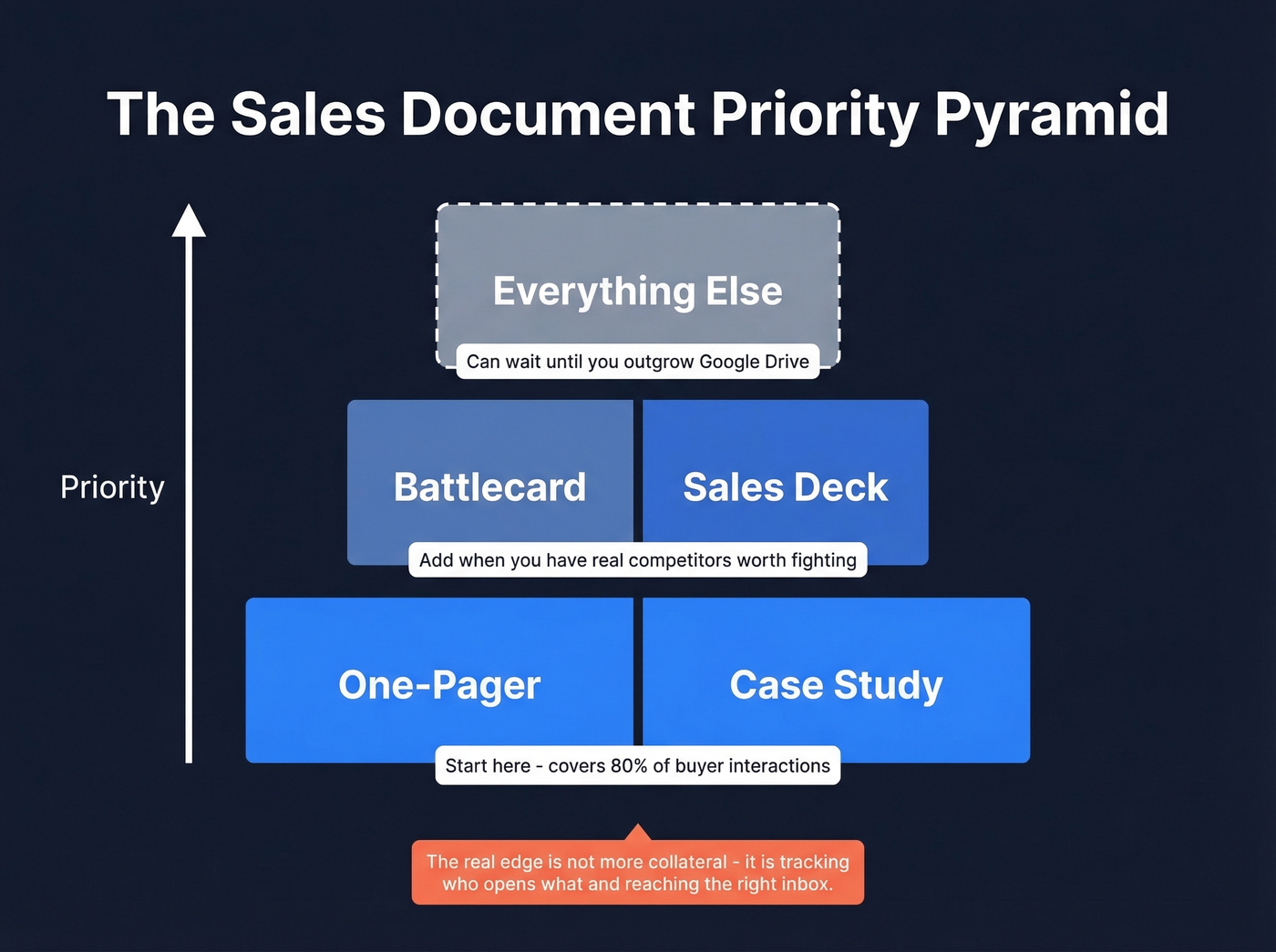
Add two more when you have real competitors worth fighting: a battlecard and a sales deck. Everything else - the 16-type listicles, the elaborate playbook libraries - can wait until your team outgrows a well-organized Google Drive. The real edge isn't more collateral. It's tracking who opens what and making sure it reaches the right inbox.
Types That Move Deals Forward
The cleanest way to think about your doc library is splitting everything into two buckets: what buyers see and what reps use internally.
Customer-Facing Collateral
| Document | Purpose | When to Send |
|---|---|---|
| One-pager | Quick value prop | First outreach |
| Sales deck | Full story + demo | Discovery/demo call |
| Proposal | Pricing + scope | Post-discovery |
| Case study | Social proof | Evaluation stage |
| Pricing sheet | Transparent costs | Negotiation |
| Contract | Legal terms | Close |
Don't build all six on day one. A one-pager and a case study will carry you through the first dozen deals. Add the rest as your pipeline demands them.
Internal Playbooks and Training Material
A sales playbook isn't a PDF that collects dust in Drive. Done right, it's in-the-moment guidance - what to say, share, and do at each deal stage. Salesforce's playbook framework covers the essentials: buyer personas, talk tracks, competitor analysis, product positioning, and process stages for each deal type. This kind of training material is what separates reps who ramp in weeks from those who flounder for months.
Battlecards and objection guides sit alongside the playbook. Keep them short - one page per competitor, refreshed monthly. If a rep can't scan a battlecard in 30 seconds during a live call, it's too long.
Building a Sales Toolkit That Gets Used
Five steps. That's it.
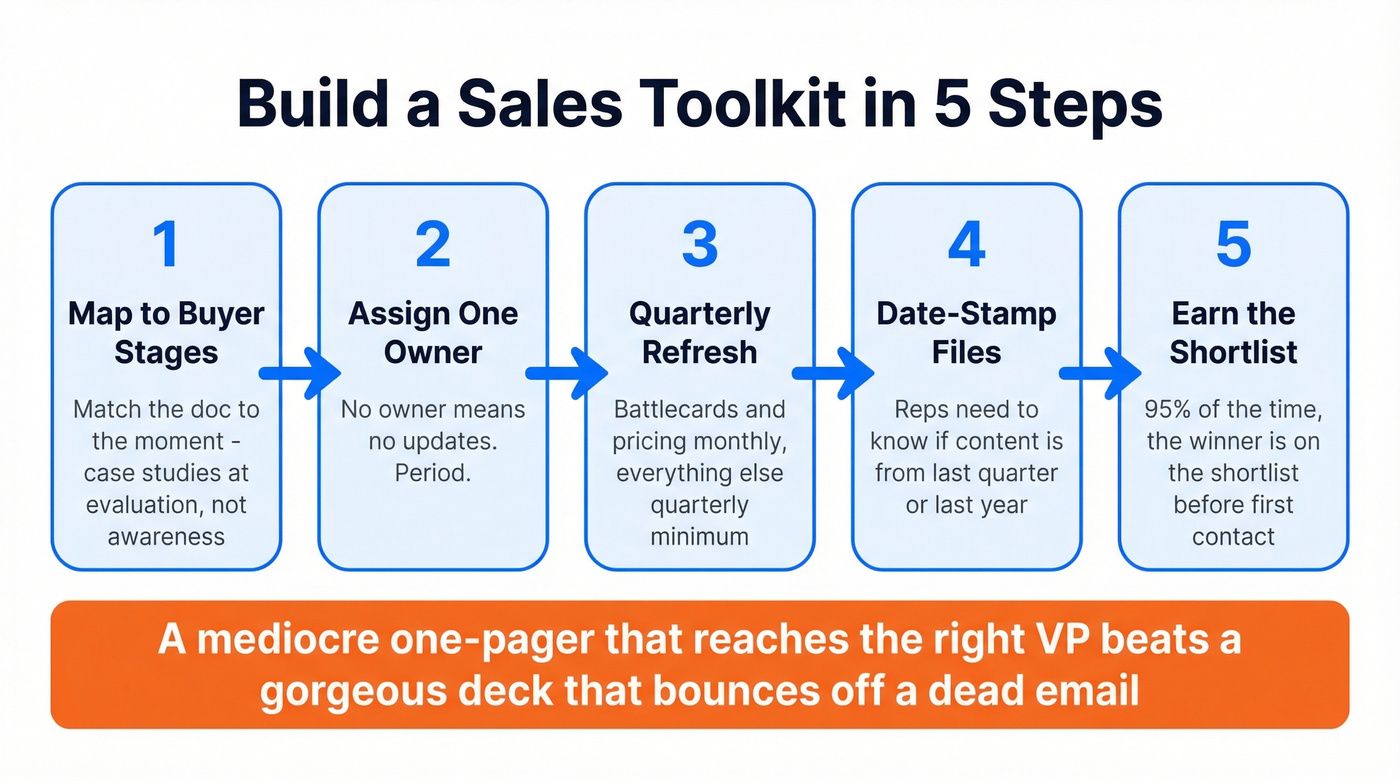
- Map to buyer stages. A case study at the awareness stage is wasted. A one-pager during contract negotiation is insulting. Match the doc to the moment.
- Assign one owner. No owner means no updates. Period.
- Quarterly refresh. Battlecards and pricing sheets need monthly review if your market moves fast. Everything else, quarterly minimum.
- Date-stamp files. Reps need to know if they're sending something from last quarter or last year.
- Earn the shortlist. 95% of the time, the winning vendor is already on the buyer's shortlist before first contact. Buying cycles compressed from 11.3 to 10.1 months in the past year, and buyers now make first contact 6-7 weeks earlier than before. Your collateral is doing the selling before anyone picks up the phone.
Here's the thing most teams get wrong: they obsess over document design when the real problem is document delivery. A mediocre one-pager that reaches the right VP beats a gorgeous deck that bounces off an outdated email address every single time. The best sales toolkits we've seen are ruthlessly simple - three to five core assets, each mapped to a specific deal stage, with clear ownership and a refresh cadence.

You just mapped docs to deal stages and assigned owners. Now fix the last-mile problem: delivery. Prospeo's 98% email accuracy and 7-day data refresh mean your one-pagers, proposals, and case studies actually reach the right VP - not a dead inbox.
Stop perfecting documents that bounce. Start reaching verified buyers.
Turn Static PDFs Into Intelligence
A PDF attachment is a black hole. You send it, and you have no idea what happens next.
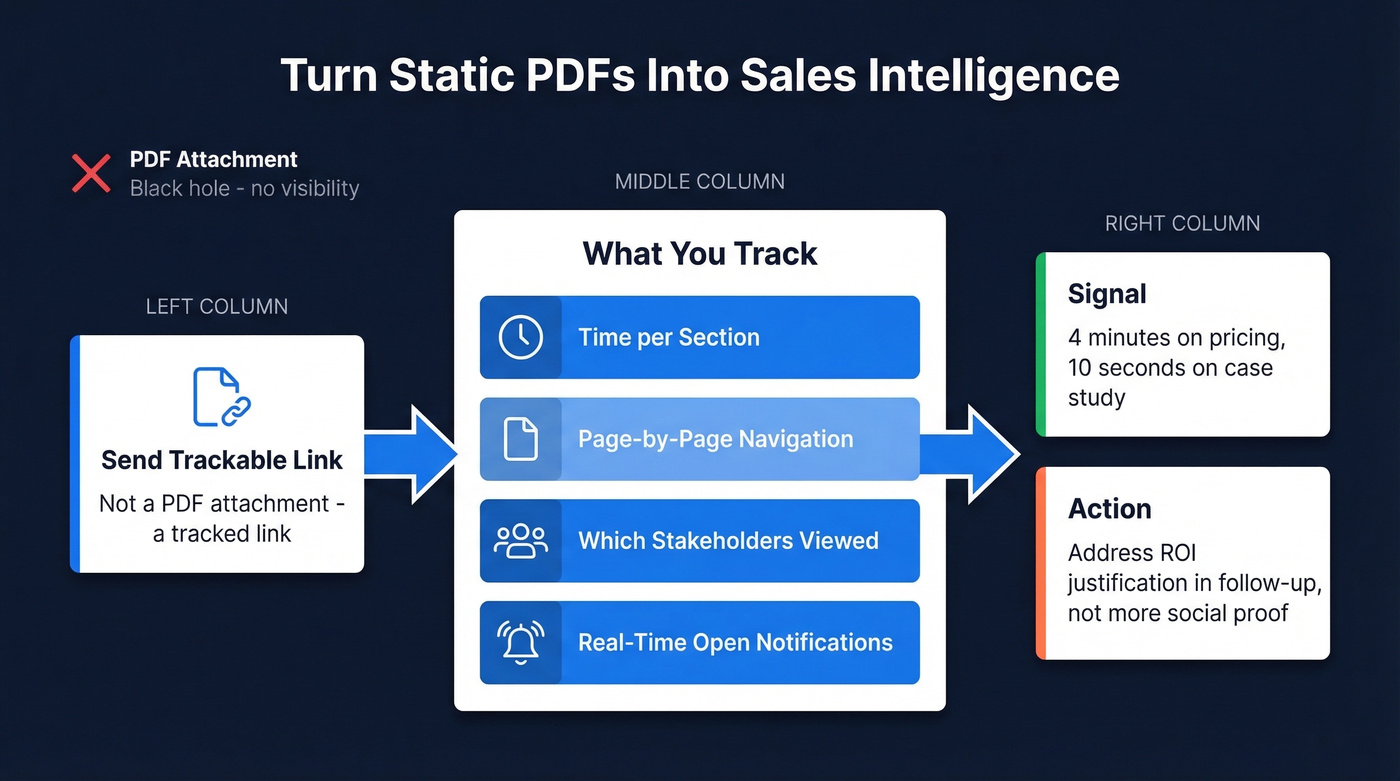
Send a trackable link, not a file. GetAccept and DocBeacon have been preaching this for years, and they're right. What to track: time per section, page-by-page navigation, which stakeholders are viewing, and real-time open notifications. If a prospect spends four minutes on your pricing page and 10 seconds on your case study, that tells you exactly what to address in the follow-up - ROI justification, not more social proof.
When rolling out standardized templates, test them with a handful of prospects before pushing company-wide. The reps who helped build them will actually use them, and that kind of crowdsourced sales enablement content sticks better than top-down mandates from marketing.
How AI Changes Sales Docs in 2026
Sales pros save roughly 2 hours and 15 minutes daily using AI and automation tools - that's a quarter of the workday reclaimed. Bain's research puts it bluntly: sellers spend about 25% of their time actually selling, and teams pairing AI with genuine process redesign see 30%+ win-rate improvement.
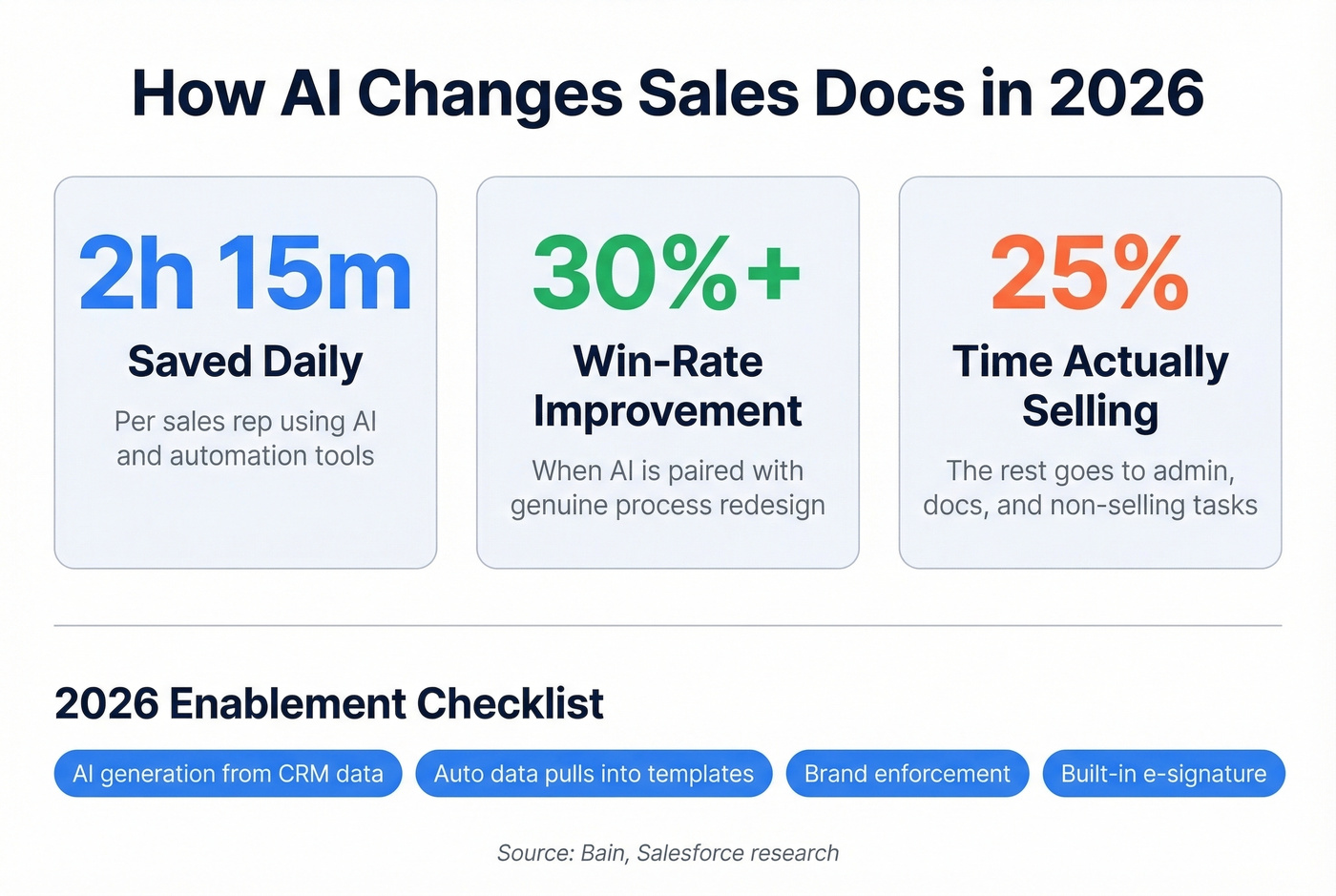
The 2026 enablement feature checklist looks like this: AI-assisted generation from live CRM data and call transcripts, automatic data pulls into templates, brand enforcement across all assets, and built-in e-signature. Deal-specific briefs generated from your last three calls with a prospect - that's the frontier right now. AI also accelerates onboarding: new hires can get auto-generated playbooks tailored to their territory and vertical within hours of joining.
The tools exist. The bottleneck is process redesign, not technology.
Three Mistakes That Kill Your Doc Library
The Findability Disaster
A common r/SaaSSales thread is painfully predictable: reps can't find the content they need. Assets scatter across Slack threads, shared drives, and Notion pages. Marketing creates collateral that reps never discover.
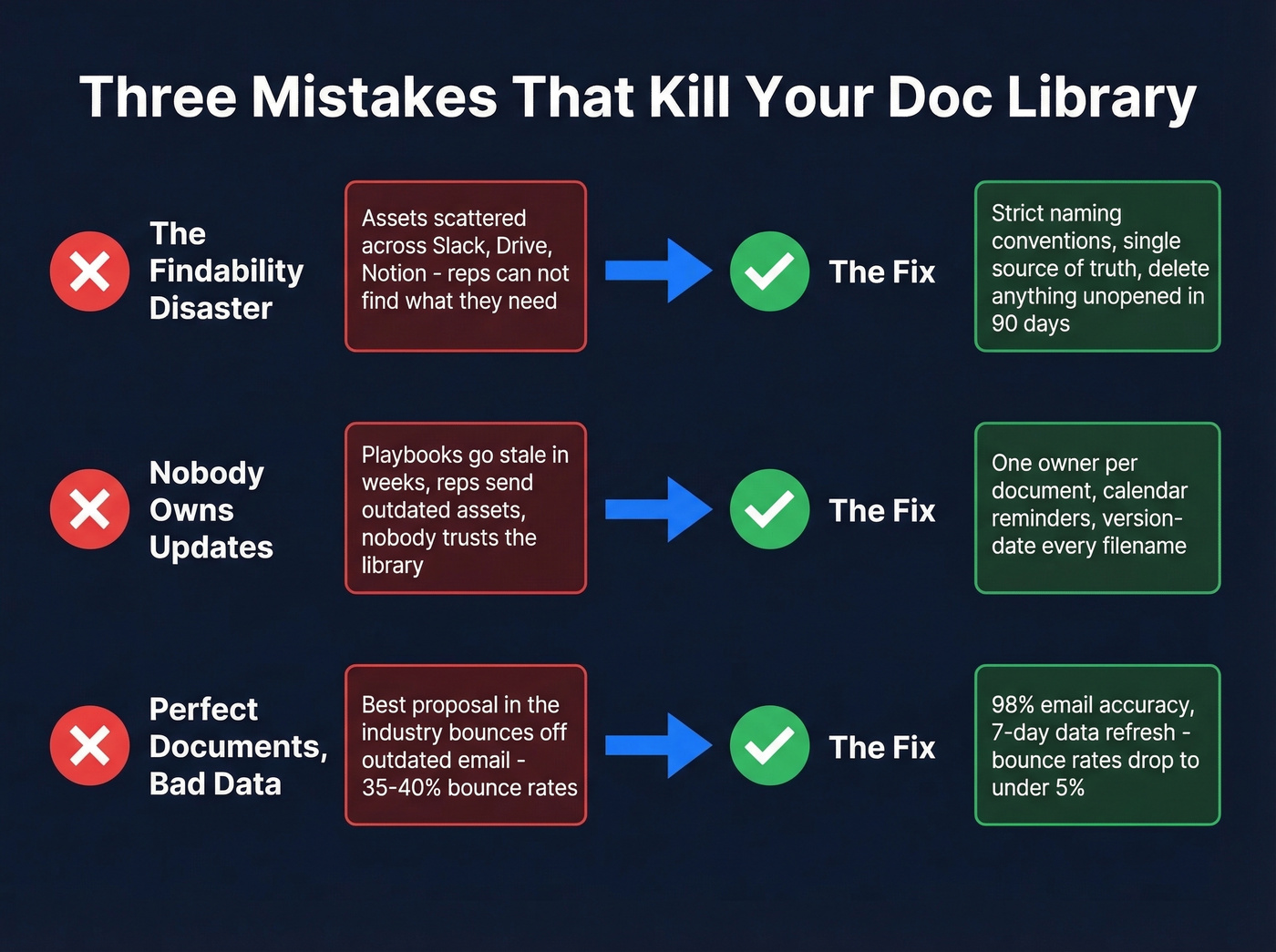
The fix is boring but effective. Strict naming conventions, a single source of truth, and a quarterly audit where you delete anything that hasn't been opened in 90 days. Most files get used fewer than 10 times. Kill the dead weight.
Nobody Owns Updates
A playbook goes stale within weeks if nobody's responsible for it. We've seen this play out at companies of every size - reps send outdated assets, marketing can't keep content fresh, and nobody trusts the library anymore. This is enablement bloat in action.
Assign one person per document. Set calendar reminders. Version-date every filename. Not glamorous, but it's the difference between a living library and a graveyard.
Perfect Documents, Bad Data
You can build the best proposal in your industry. If it bounces, it never existed.
Let's be honest - this is the last-mile problem nobody talks about enough. Bounce rates of 35-40% happen fast when your contact data is outdated. Snyk's 50-person AE team was dealing with exactly this before switching their data source: bounce rates dropped from 35-40% to under 5%, and AE-sourced pipeline jumped 180%. Prospeo's 98% email accuracy and 7-day data refresh cycle solve this at the root. Your sales documents are only as good as the contact data delivering them.

Snyk's 50 AEs cut bounce rates from 35-40% to under 5% and grew AE-sourced pipeline 180% - because every tracked link and polished proposal actually landed. Prospeo gives you 300M+ profiles with verified emails at $0.01 each. No contracts.
Your sales docs can't close deals from a spam folder.
FAQ
What should a sales proposal include?
An executive summary, problem statement, proposed solution, pricing, timeline, social proof, and clear next steps. Proposals under five pages close 20%+ faster - shorter documents get read, longer ones get skimmed or ignored entirely.
How often should sales documents be updated?
Quarterly minimum for most assets. Pricing sheets and battlecards need monthly review in fast-moving markets. Date-stamp every filename so reps instantly know whether they're sending current or stale collateral.
How do I share templates across a sales team?
Store templates in one accessible location - your CRM's template library, a shared Notion page, or a dedicated Drive folder. Let reps suggest edits and flag what's working so sharing becomes a feedback loop, not a one-way push from enablement.
What's the best tool for a small sales team's doc stack?
A well-organized Google Drive with clear naming conventions handles documents fine. Skip the $30K+ enablement platform until you have enough reps and content to justify it. For contact data, Prospeo's free tier covers 75 verified emails per month - enough for early-stage prospecting without a contract.