

The Sales Playbook Template That Actually Gets Used
Your VP of Sales just quit. She took 11 years of institutional knowledge with her - the discovery framework that actually works, the objection responses that close enterprise deals, the unwritten rules about when to loop in the SE. Two new AEs start Monday. Nothing is written down.
A sales playbook template would've made this a speed bump instead of a crisis.
Only 28% of reps met quota in 2023. That climbed to roughly 43% by late 2024, which still means more than half of reps missed target. Average rep tenure sits around 1.5 years. Buying committees have ballooned to 6-10 stakeholders, and buyers complete nearly 80% of their research before they ever talk to a rep. The playbook isn't optional anymore.
What Is a Sales Playbook?
It's not a 50-page PDF collecting dust in a shared drive. Some guides recommend 50-80 pages. That's how you build a playbook nobody reads.
A founder on r/sales defined it well: "a map of your sales process, scripts, objection handling, email message follow-ups, ROI use-case mapping." That's it - the operating system your reps run on.
Most templates floating around are useless: locked inside proprietary tools, gated behind signup walls, or so generic they don't save you any time. What follows is the actual structure - 15 components organized by priority, with methodology picks and measurement frameworks baked in. Copy the H3 headings below into Google Docs or Notion. Each one becomes a section in your playbook. No signup wall, no gated download. Build it this weekend. Ship it Monday.
Quick-Start Summary
Stop trying to build the perfect playbook. Build a minimum viable one in a weekend, then iterate. Here's what you need on day one:
- ICP and buyer personas - who you're selling to, by role and segment (use an ideal customer profile template if you need a starting point)
- Discovery questions and objection responses - these do 80% of the work (steal from a proven set of discovery questions)
- Your top 4 sales plays - inbound, outbound cold, expansion, renewal
- A defined sales process - stages, exit criteria, CRM mapping
- Methodology and qualification framework - Challenger for most teams, BANT for SMB, MEDDIC for enterprise
Format it in whatever tool your team already uses. Google Docs for teams under 10. Notion for 10-50. Iterate quarterly.
The Complete 15-Component Checklist
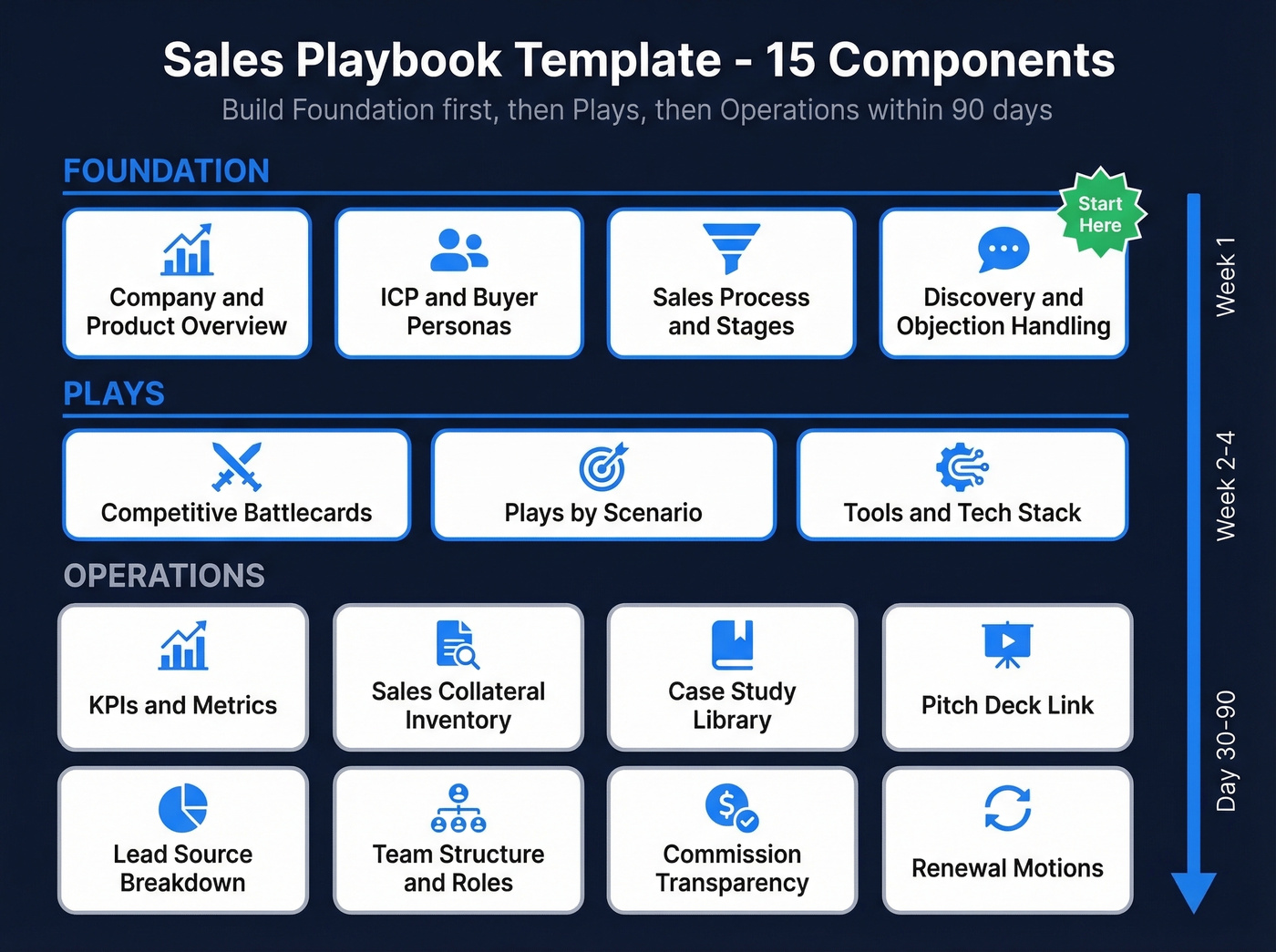
Fifteen components, organized into three tiers. Foundation gets built first. Plays come next. Operations rounds it out. You don't need all 15 on day one, but you need all 15 within 90 days.
Foundation
Company and Product Overview
Two paragraphs, max. What your company does, who it serves, and why it exists. This isn't for your current reps - it's for the AE who starts in three months and needs context before their first discovery call. Include your positioning statement and top three differentiators.
ICP and Buyer Personas
Enterprise deals involve an economic buyer, a technical evaluator, a champion, an end user, and procurement. That's five roles minimum, and average buying committees run 6-10 stakeholders deep.
Your playbook needs a one-page persona for each role that matters: their title patterns, what they care about, what keeps them up at night, and how they evaluate vendors. Don't write novels - write enough that a new rep can prep for a call in five minutes.
Sales Process and Stages
Define every stage from first touch to closed-won. Each stage needs three things: a definition ("what's true when a deal is here"), exit criteria ("what must happen before it moves forward"), and a CRM mapping ("what field gets updated").
Here's the thing: if your stages don't map to your CRM, reps won't update them. And if reps don't update them, your pipeline data is fiction (track it with pipeline health metrics, not vibes).
Discovery and Objection Handling
These two sections do 80% of the work. If you only build two sections this week, build these.
Your discovery framework should include 10-15 questions organized by what they uncover - pain, impact, timeline, decision process. Your objection responses should cover the 8-10 objections your reps hear most, with a recommended response and a proof point for each. We've found that teams who nail these two sections first get the fastest adoption, because reps feel the value immediately on their next call.
Plays
Competitive Battlecards
Structure each card the same way: competitor name, their pitch in one sentence, your counter-positioning, two proof points, and landmines to set early in the deal. Keep battlecards to one page per competitor. Update them quarterly - competitors change fast.
If you need a structure, use a simple sales battle cards format and keep it consistent.
Plays by Scenario
You need at least four plays: inbound lead response, outbound cold prospecting, expansion/upsell, and renewal. Each play should specify the trigger ("when does this play fire?"), the sequence of actions, the messaging, and the expected outcome.
Here's a stat that should change how you think about enterprise plays: an analysis of 1.8M opportunities shows closed-won deals have roughly 2x as many buyer contacts as lost deals. For deals over $50K, multi-threading boosts win rates by 130%. If your enterprise play doesn't include a multi-threading step, you're leaving money on the table.
Tools and Tech Stack
Your playbook should specify your team's data stack - CRM, sequencing tool, and data provider. Data quality is non-negotiable. If reps are bouncing emails and calling dead numbers, no script saves you (fix the root cause with an email deliverability guide).
For the data layer, we've had the best results with Prospeo: 98% email accuracy, 125M+ verified mobile numbers, and a 7-day data refresh cycle versus the industry average of six weeks. It starts free with no contracts and integrates natively with Salesforce, HubSpot, Lemlist, and Instantly.

Operations
KPIs and Metrics
Define what success looks like: quota attainment, win rate, pipeline coverage ratio, and activity metrics. Every rep should know their numbers and how those numbers connect to the plays in the playbook.
If you want a clean baseline, start with sales operations metrics and trim to what you can actually review weekly.
The Remaining Components
Round out your playbook with: sales collateral inventory, case study library, pitch deck link, lead source breakdown, team structure and roles, commission transparency, and SaaS-specific renewal motions. These don't need deep treatment - a paragraph and a link to the living resource is enough for each.
Choose Your Sales Methodology
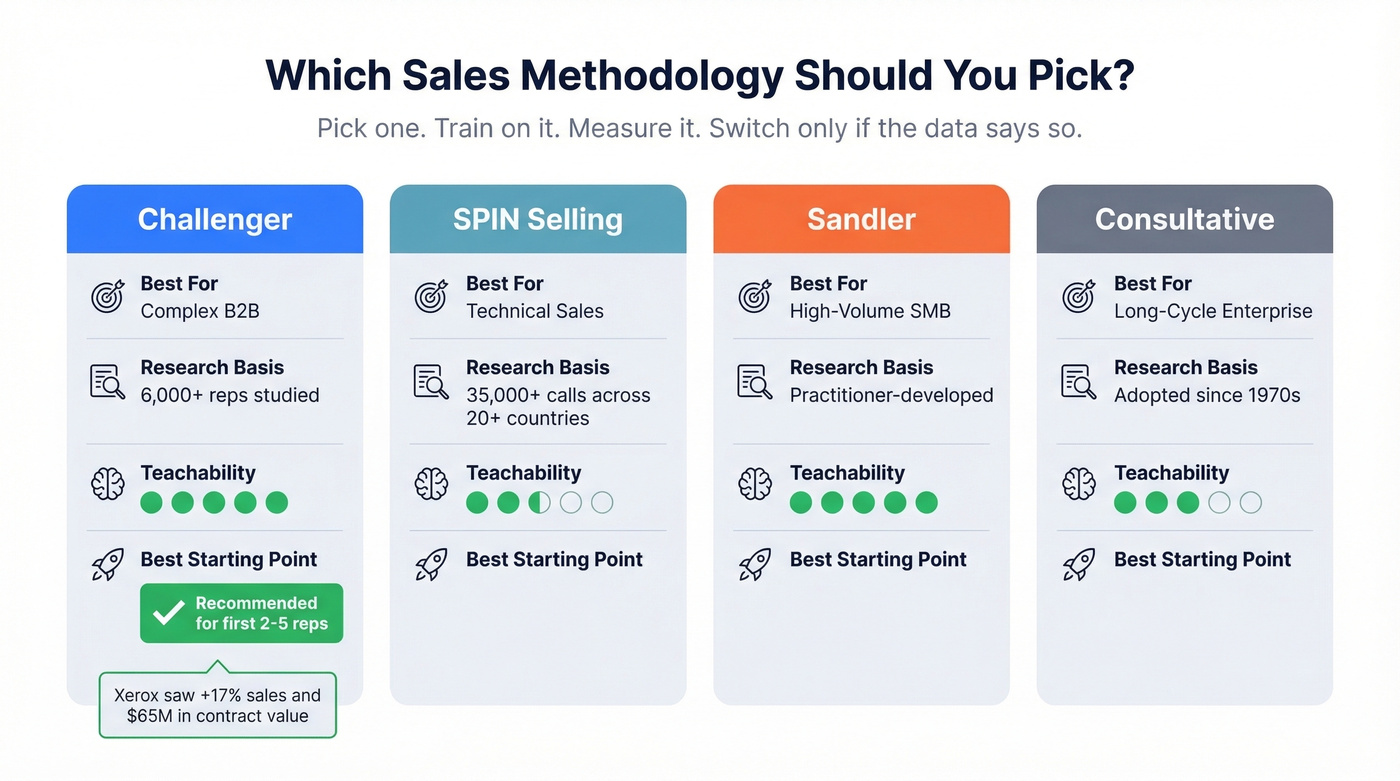
Don't blend methodologies. Pick one. Train on it. Measure it. Switch only if the data says so.
| Methodology | Best For | Research Basis | Teachability | Recommended When |
|---|---|---|---|---|
| Challenger | Complex B2B | 6,000+ reps studied | High | First 2-5 reps |
| SPIN Selling | Consultative | 35,000+ calls, 20+ countries | Medium | Technical sales |
| Sandler | Transactional | Practitioner-developed | High | High-volume SMB |
| Consultative | Relationship | Adopted since 1970s | Medium | Long-cycle enterprise |
If you're a startup with your first 2-5 reps, start with Challenger. It's the most teachable and the most researched. Xerox reported a 17% increase in sales and $65M in contract value after implementing it. That's not marginal.

Your playbook's Tools and Tech Stack section needs a data provider that won't tank your reps' deliverability. Prospeo gives your team 98% email accuracy, 125M+ verified mobiles, and a 7-day refresh cycle - so the contacts in every play actually connect. 15,000+ companies already run on it.
Start free with 75 verified emails. No contracts, no sales calls.
Pick Your Qualification Framework
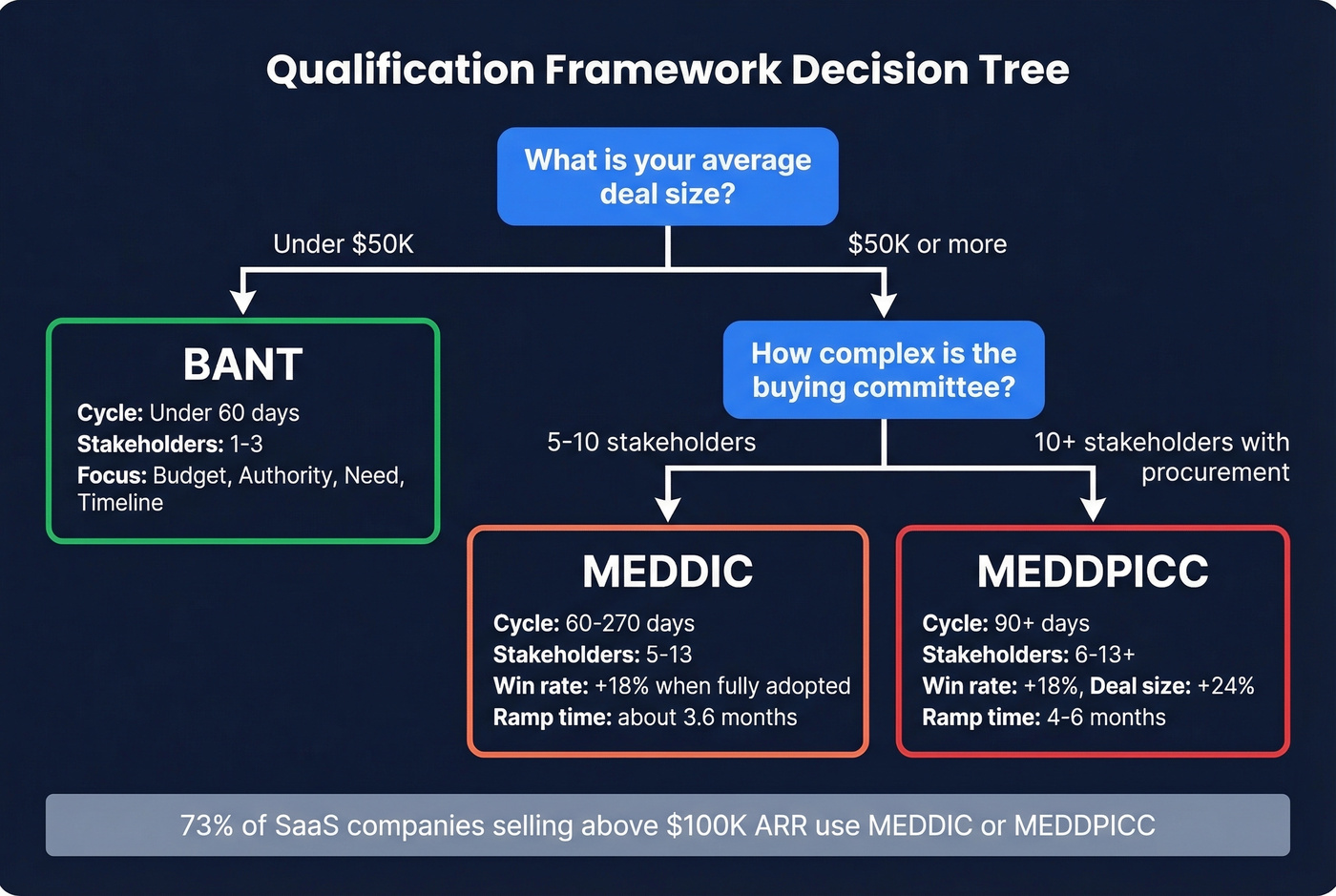
BANT for deals under $50K with short cycles. MEDDIC for everything else. Don't overthink it.
| Framework | Deal Size | Cycle Length | Stakeholders | Win Rate Impact |
|---|---|---|---|---|
| BANT | Under $50K | Under 60 days | 1-3 | Baseline |
| MEDDIC | $50K-$500K+ | 60-270 days | 5-13 | +18% win rate when fully adopted |
| MEDDPICC | $100K+ | 90+ days | 6-13+ | +18% win, +24% deal size when fully adopted |
MEDDIC proficiency takes about 3.6 months to develop, and MEDDPICC takes 4-6 months. That's a real investment. But 73% of SaaS companies selling above $100K ARR now use some version of MEDDIC/MEDDPICC - because it forces reps to map the buying committee and identify the economic buyer before they're deep in a deal with no champion and no path to a signature.
Customize by Segment
An SMB playbook and an enterprise playbook are fundamentally different documents. Trying to serve both with one is how you end up with something nobody uses. The best sales playbook examples we've studied from high-performing teams always split by segment.
| Dimension | SMB Playbook | Enterprise Playbook |
|---|---|---|
| Cycle length | 30-90 days | 90-270 days |
| Buying committee | 1-4 people | 6-13 stakeholders |
| Qualification | BANT | MEDDIC/MEDDPICC |
| Key plays | Speed-to-lead, demo-first | Multi-thread, champion-build |
| Renewal motion | Auto-renew + upsell | QBRs, multi-year negotiation |
| Data needs | Volume + speed | Precision + org charts |
75% of B2B buyers prefer a rep-free experience early in their journey, and 80% of interactions happen through digital channels. Your SMB playbook should lean into this - self-serve content, fast follow-up, minimal friction (keep a set of sales follow-up templates inside the playbook so reps don’t reinvent them).
Your enterprise playbook needs procurement workflows, legal review processes, and multi-threading strategies. Deals over $50K with multi-threaded contacts close at more than double the rate of single-threaded ones. Build that into every enterprise play.
Five Mistakes That Kill Adoption
Playbooks can improve productivity by 15%, but only if reps actually use them. 60% of employees don't even read their company's handbook. Here are the five patterns that kill adoption:
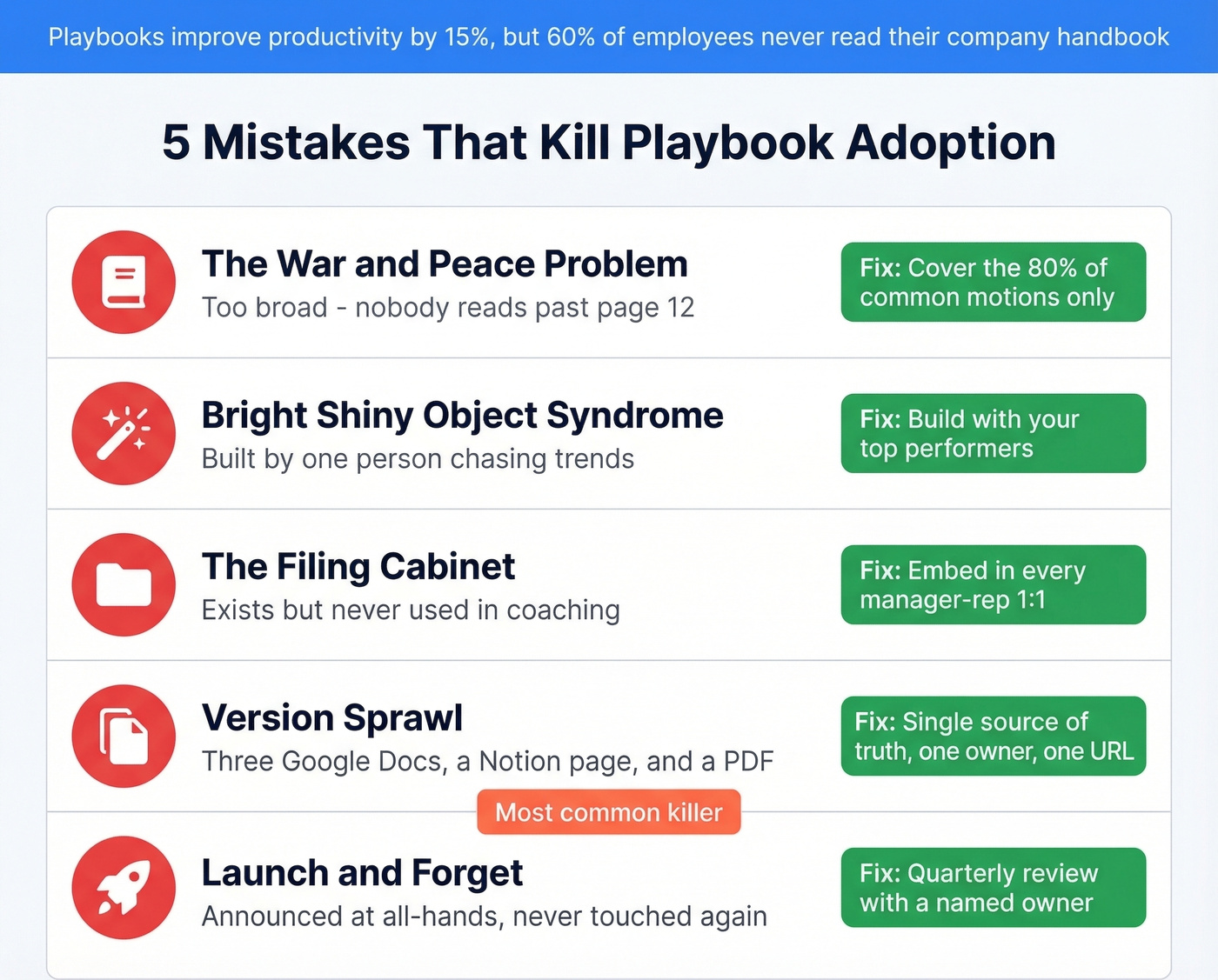
The War and Peace Problem. Too broad. Covers every edge case and nobody reads past page 12. Fix: cover the roughly 80% of common sales motions. Leave edge cases for coaching.
Bright Shiny Object Syndrome. Built by one person chasing the latest trend instead of documenting what works. Fix: build with your top performers and seasoned leaders.
The Filing Cabinet. Exists but isn't integrated into coaching. The number one failure is lack of integration into manager-rep 1:1s. Fix: embed playbook references into every deal review.
Version Sprawl. Three Google Docs, a Notion page, and a PDF from last year's SKO. Fix: single source of truth, one named owner, one URL.
Launch and Forget. Announced at the all-hands, never touched again. Fix: quarterly review cadence with a named owner from Enablement or RevOps.
Let's be honest - most playbooks die from mistake #5. The launch gets all the energy. The maintenance gets none.
Measuring Playbook Effectiveness
If you can't measure whether the playbook is working, it's just a document. Our recommendation: run one team on the playbook, one without, for 60 days. If you can't measure the difference, the playbook isn't good enough yet.
| Metric | Target | How to Measure |
|---|---|---|
| Win rate lift | +5% per month | CRM reporting, cohort comparison |
| Next-step compliance | >90% | Call review + CRM field audit |
| Call script adherence | Tracked weekly | Conversation intelligence tool |
| Pipeline velocity | Improving trend | Stage-to-stage conversion rates |
| Playbook usage rate | >80% of reps | Page views, quiz completion |
Use cohort testing to isolate impact. Compare teams, segments, or time periods. The goal isn't perfection - it's a measurable trend in the right direction.
Where to Build It
Use whatever your team already lives in. A playbook in Notion that nobody opens is worse than a Google Doc pinned in Slack.
| Tool | Best For | Cost |
|---|---|---|
| Google Docs | Teams under 10 | Free |
| Notion | 10-50 people | ~$10/user/mo |
| Confluence | 50+ people | Free under 10, ~$6/user/mo |
| Guru | Knowledge management | Free tier available |
| Trainual | Onboarding-heavy | ~$250+/mo |
| Highspot | Enterprise enablement | ~$30-60/user/mo |
Skip Highspot or Trainual if your average deal is under $30K. Google Docs with a disciplined owner will outperform any fancy enablement platform that nobody logs into. The tool is never the bottleneck - the habit is.
A playbook without accurate contact data is just a strategy doc. Teams using Prospeo book 26% more meetings than ZoomInfo users and 35% more than Apollo - because 98% of their emails land and 30% of their mobile dials get picked up. At $0.01 per email, your new AEs starting Monday can prospect on day one.
Give your reps the data layer that makes every play actually work.
FAQ
How long should a sales playbook be?
Fifteen to twenty-five pages covers the 5-7 plays that handle 80% of your sales motions. If it takes more than 30 minutes to read front-to-back, it's too long and adoption will suffer. Start lean, then add sections only when reps ask for them.
How often should you update it?
Quarterly - January, April, July, October. Assign a single owner in Enablement or RevOps and tie updates to win/loss review data. Stale playbooks erode trust faster than no playbook at all.
Who should own the sales playbook?
Sales Enablement if you have one. Otherwise, your top-performing rep and sales manager co-own it. Never delegate to marketing alone - the playbook will drift toward messaging docs and lose operational relevance.
What's the best tool for building a sales playbook template?
Google Docs for teams under 10, Notion for 10-50, Confluence or a dedicated enablement platform for 50+. Avoid PDFs - version sprawl starts within a month. The best playbook examples share one trait: they live where reps already work.
How do I make sure reps have accurate prospect data?
Bad data kills even the best-documented plays. Pair your playbook with a data provider that refreshes weekly and verifies emails before delivery. Credit-based pricing with a free tier lets you test without commitment - look for 98%+ email accuracy and native CRM integrations so reps pull fresh contact data without leaving their workflow.