

Sales Email Subject Lines: What Actually Works (According to 5.5M Emails)
You spent an hour crafting the perfect cold email body. Personalized opener, sharp value prop, clean CTA. Then 33% of your recipients decided whether to open it based on the subject line alone - and 69% flagged it as spam for the same reason. The subject line isn't a detail. It's the entire gate.
Here's the uncomfortable truth: 17% of cold emails never reach the inbox. They bounce or get filtered before a human ever sees them. Ask around on r/sales and you'll hear the same frustration - subject lines matter less than most guides claim because the real variable is whether your email arrives at all. So before you obsess over word choice, you need to understand what the data says and what's happening beneath the surface.
Three Rules from 5.5M Emails
Belkins analyzed 5.5M cold emails from January through December 2024. The short version:
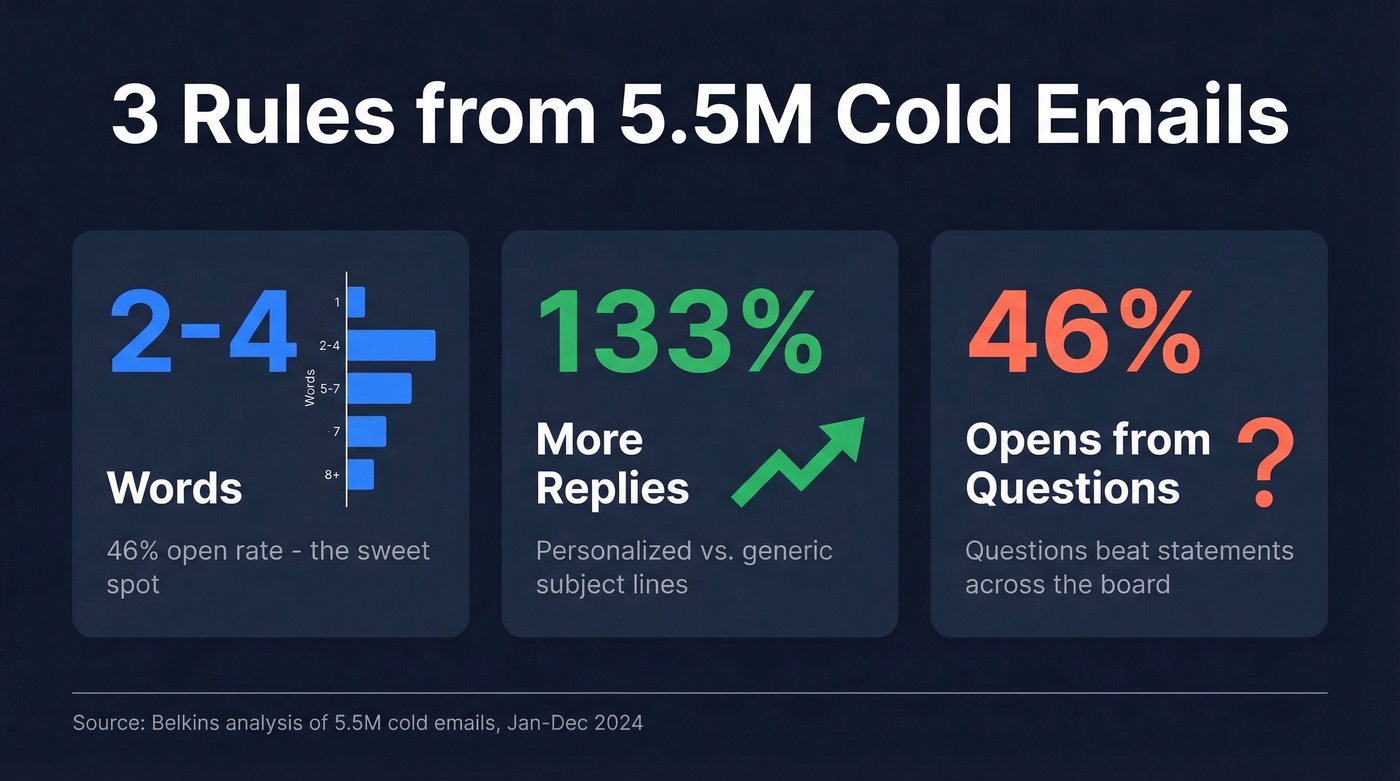
- Keep it to 2-4 words. That length hit a 46% open rate - the highest in the dataset. One-word subjects dropped to 38%.
- Personalize beyond first name. Personalized subject lines pulled a 7% reply rate vs. 3% without. That's a 133% increase in replies.
- Frame it as a question. Questions averaged 46% opens, outperforming statements across the board.
The contrarian kicker: none of this matters if your email lands in spam. Deliverability is the prerequisite your subject line strategy sits on top of.
What Actually Works in 2026
These aren't opinions. They're patterns from 5.5M real emails, and whether you're writing your first cold outreach subject or refining a sequence that's already running, the data points in the same direction.
Personalize It
Personalized subject lines hit 46% opens vs. 35% without - a 31% lift. But the reply rate delta is more telling: 7% vs. 3%. That 133% increase in replies is where the money is. Open rates can be gamed by curiosity. Replies require relevance.
The key word is "personalized," not "merge-tagged." Dropping {first_name} into a template isn't personalization. Referencing a prospect's recent funding round, a job change, or a specific challenge their company faces - that's what moves the needle.
Keep It to 2-4 Words
The length curve is surprisingly steep. One-word subjects hit 38% opens. Two to four words jumped to 46%. After seven words, performance drops fast - nine words landed at 35%, ten at 34%.
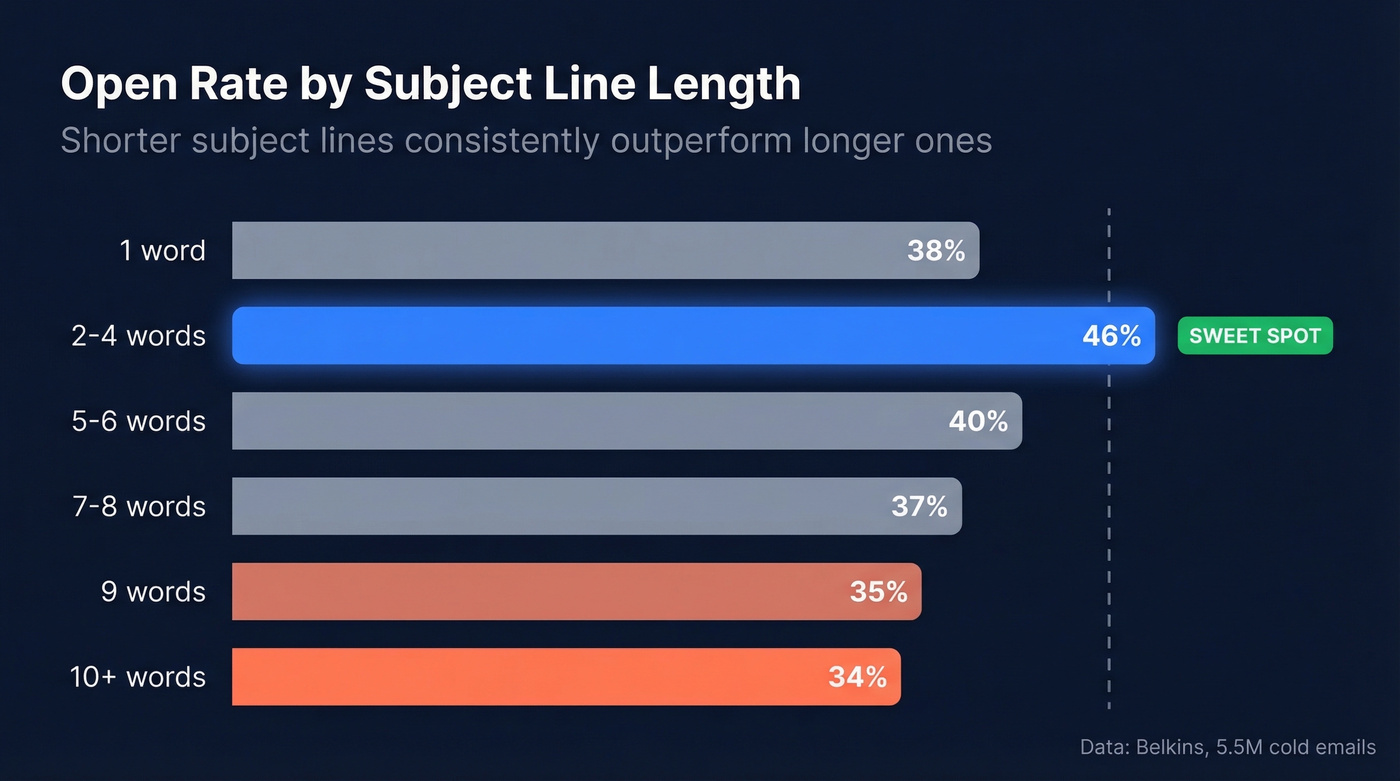
In our testing, the 2-4 word range consistently outperforms longer alternatives. Short subject lines look like internal emails. They don't scream "marketing." Something like "Quick sync?" or "Saw the news" reads like a message a colleague would send, and that camouflage effect is powerful.
Ask a Question
Questions averaged 46% opens in the Belkins dataset. They trigger what psychologists call an "open loop" - the brain wants resolution, and the only way to get it is to open the email. This is the same mechanism behind pattern-interrupt lines like "Saying no?" that exploit curiosity and mild social pressure. "Hiring for Q3?" works better than "Your Q3 hiring plan" because the question format implies a conversation, not a pitch.
Skip Numbers and Hype
Subject lines with numbers actually performed slightly worse - 27% opens vs. 28% without. Marketing hype words like "ASAP," "exclusive," and "limited time" pushed opens below 36%. Generic greetings like "Hello, friend" performed even worse.
The data confirms what experienced reps already know. Your subject line should sound like a human wrote it to another human. Not like a newsletter blast.
Why Your Open Rate Is Lying
Stop tracking open rates. They're broken.
Apple Mail Privacy Protection pre-loads tracking pixels, inflating "opens" even when nobody reads the message. Apple Mail holds roughly 46% of email client share, so this distortion is massive. HubSpot's study of 80,000+ email marketing accounts found open rates increased by 18 points to 40%+ six months after MPP rolled out - and while that study covered opt-in marketing email, the MPP mechanism affects cold email identically since Apple Mail doesn't distinguish between the two.
The 2024 average reply rate across 16.5M cold emails was 5.8%, down 15% from 6.8% in 2023. Replies are harder to fake. They're your real metric.
Belkins tested disabling open-tracking pixels entirely and saw response rates improve by 3%. Fewer tracking pixels means better deliverability, which means more emails actually reaching humans. We've started recommending this to every team we work with - strip the pixel, trust the replies.
The 33-Character Rule
Your subject line might be brilliant at 60 characters. But on a Pixel 7 running Gmail, your recipient only sees the first 33.
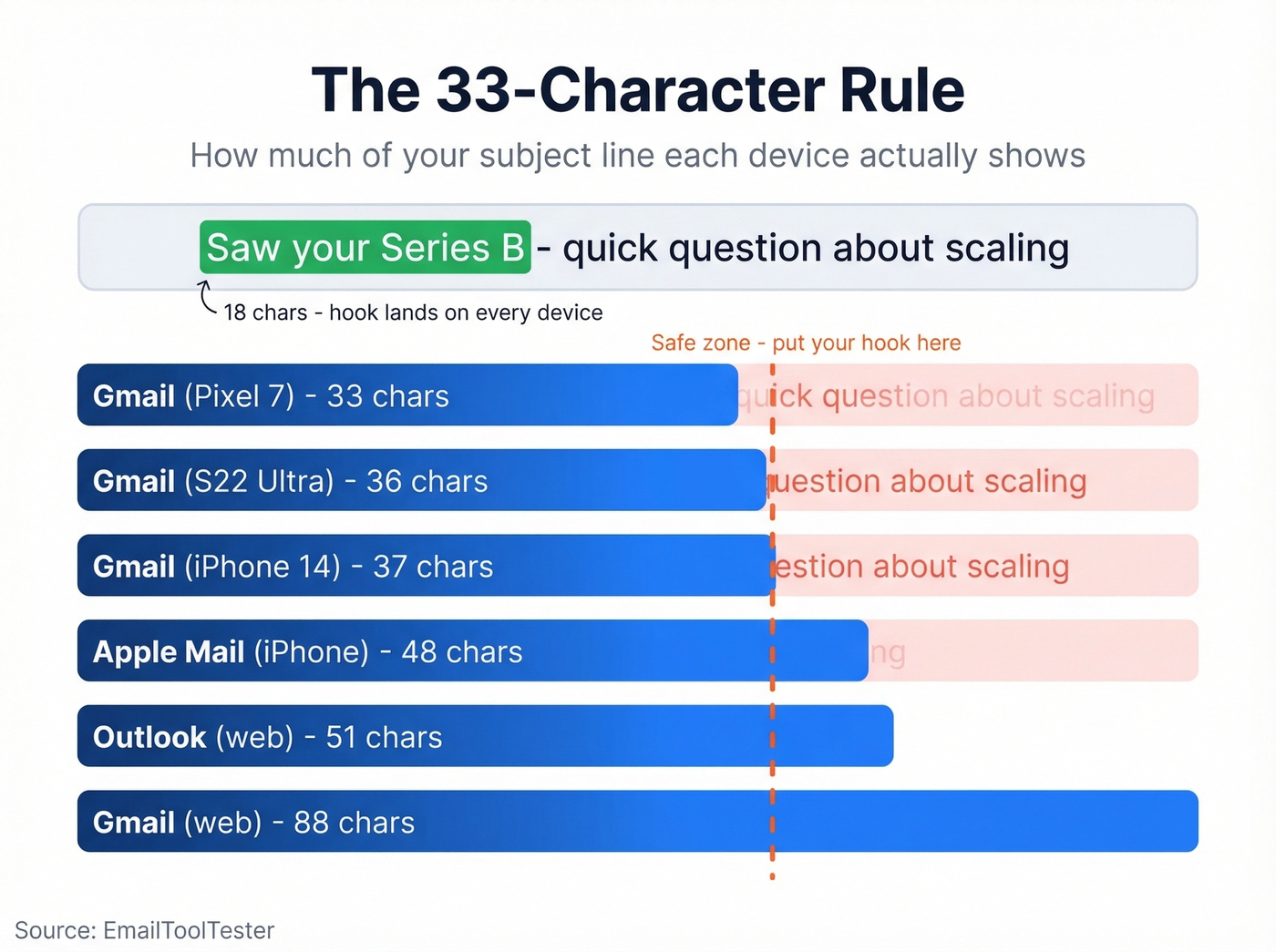
Here's what EmailToolTester found across devices:
| Device / Client | Characters Shown |
|---|---|
| Gmail (Pixel 7) | ~33 |
| Gmail (S22 Ultra) | ~36 |
| Gmail (iPhone 14) | ~37 |
| Apple Mail (iPhone) | ~48 |
| Outlook (web) | ~51 |
| Gmail (web) | ~88 |
Put your hook in the first 33 characters. Everything after that is bonus text most mobile readers won't see. "Saw your Series B - quick question" works because the hook lands in 18 characters. "I wanted to reach out regarding your recent Series B funding" buries the lead past every mobile cutoff.
Your subject line doesn't work alone, either. The preview text - the first line visible in the inbox - acts as a second headline. If your subject is "Quick question," your preview text should deliver context, not "Hi [FIRST NAME], I hope this email finds you well."

Personalized subject lines earn 133% more replies - but only if your email reaches the inbox. 17% of cold emails bounce before anyone sees your carefully crafted subject line. Prospeo's 5-step email verification and 98% accuracy rate means your subject lines actually get judged by humans, not spam filters.
Stop writing subject lines for emails that never arrive.
Subject Lines That Earned Replies
Proven Performers
Cognism published actual campaign results with metrics - rare in a sea of articles that are just someone's guesses.
| Subject Line | Read Rate | Reply Rate |
|---|---|---|
| [FIRST NAME]'s Invitation | 55.39% | 10.18% |
| Disruptive Start-Ups Needed | 53.70% | 6.52% |
| Collaborating with [COMPANY NAME] | 47.84% | 5.24% |
Notice the pattern. "[FIRST NAME]'s Invitation" is three words, personalized, and implies exclusivity. "Disruptive Start-Ups Needed" reads like an internal Slack message. "Collaborating with [COMPANY NAME]" implies a peer relationship, not a pitch.
By Scenario
Each follows the data-backed principles: short, human, and either personalized or question-framed.
Cold outreach (first touch):
- "Quick question, [FIRST NAME]"
- "Saw the [COMPANY] news"
- "[COMPANY]'s growth plan?"
- "Idea for [COMPANY]"
- "Congrats on the raise"
Follow-up (no response):
- "Bumping this up"
- "Still relevant?"
- "Did this land?"
- "One more thought"
If you're sending more than 3 follow-ups, you're wasting sends. Belkins data shows follow-up #4 drops reply rates by 55%.
Meeting request:
- "15 min this week?"
- "Worth a call?"
- "Coffee Tuesday?"
Trigger-event-based:
- "Saw the VP hire"
- "Re: your Series B"
- "[COMPANY] + [YOUR COMPANY]?"
- "New stack, new problems?"
Re-engagement:
- "Things change?"
- "Different angle"
No exclamation marks, no hype words, no numbers. Just short, human, and relevant.
Writing Signal-Based Subject Lines
66% of B2B buyers are more likely to open an email personalized with their name or company. But that's the floor, not the ceiling.
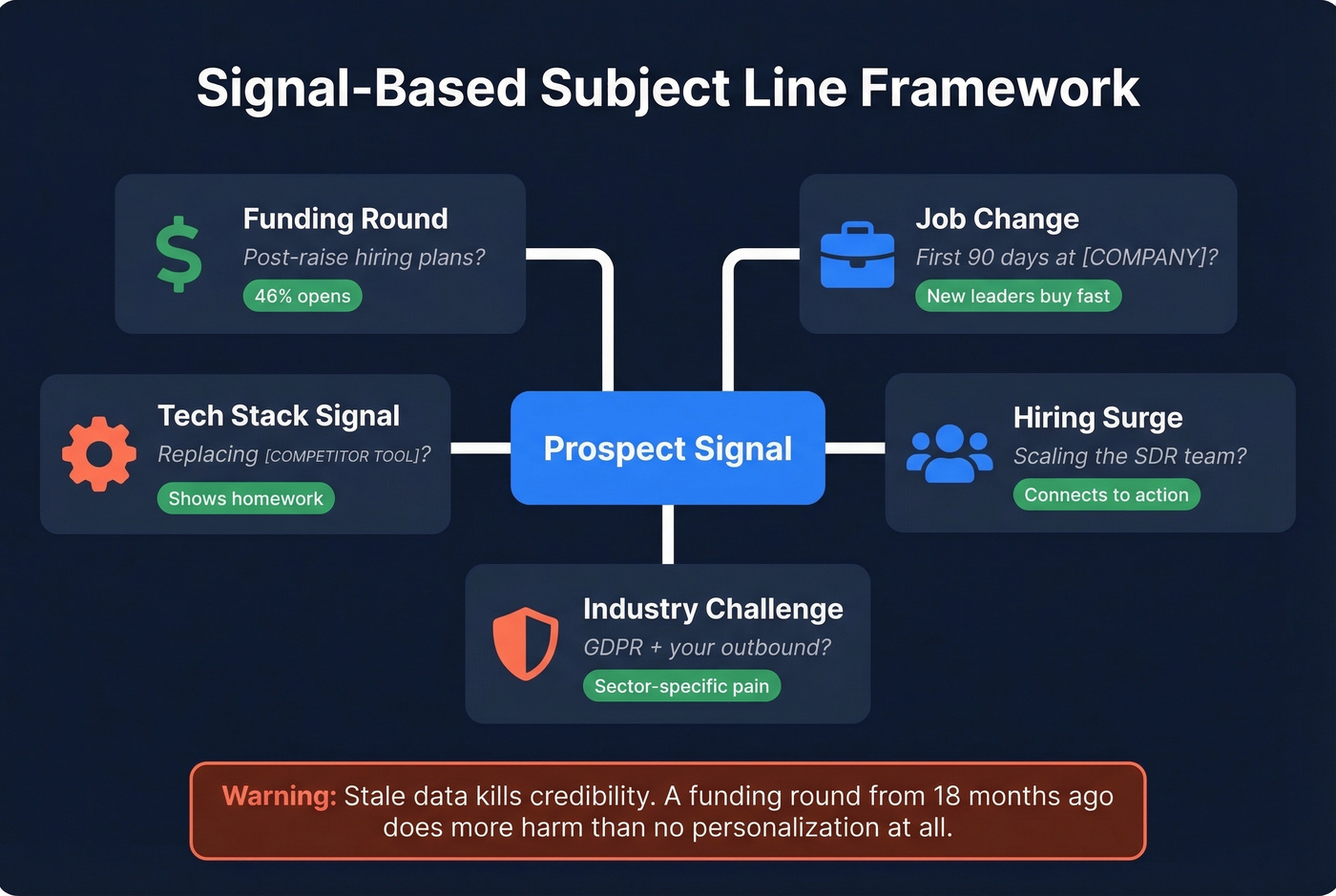
Anchor your sales email subject line to a specific signal about the prospect's world:
- Funding round: "Post-raise hiring plans?" - references something they're proud of and acting on.
- Job change: "First 90 days at [COMPANY]?" - new leaders actively seek solutions.
- Tech stack signal: "Replacing [COMPETITOR TOOL]?" - shows you've done homework.
- Hiring surge: "Scaling the SDR team?" - connects your solution to an observable action.
- Industry challenge: "GDPR + your outbound?" - sector-specific pain that feels relevant.
Two warnings. Getting the signal wrong is worse than not personalizing at all - referencing a funding round from 18 months ago kills credibility instantly. Stale data is the enemy. And there's a line between "informed" and "invasive." Referencing a public funding round is smart. Referencing someone's vacation photos is not.
Deliverability: The Part Nobody Talks About
Remember: 17% of cold emails never reach the inbox. Even the most compelling subject line won't generate replies if it never reaches a human.
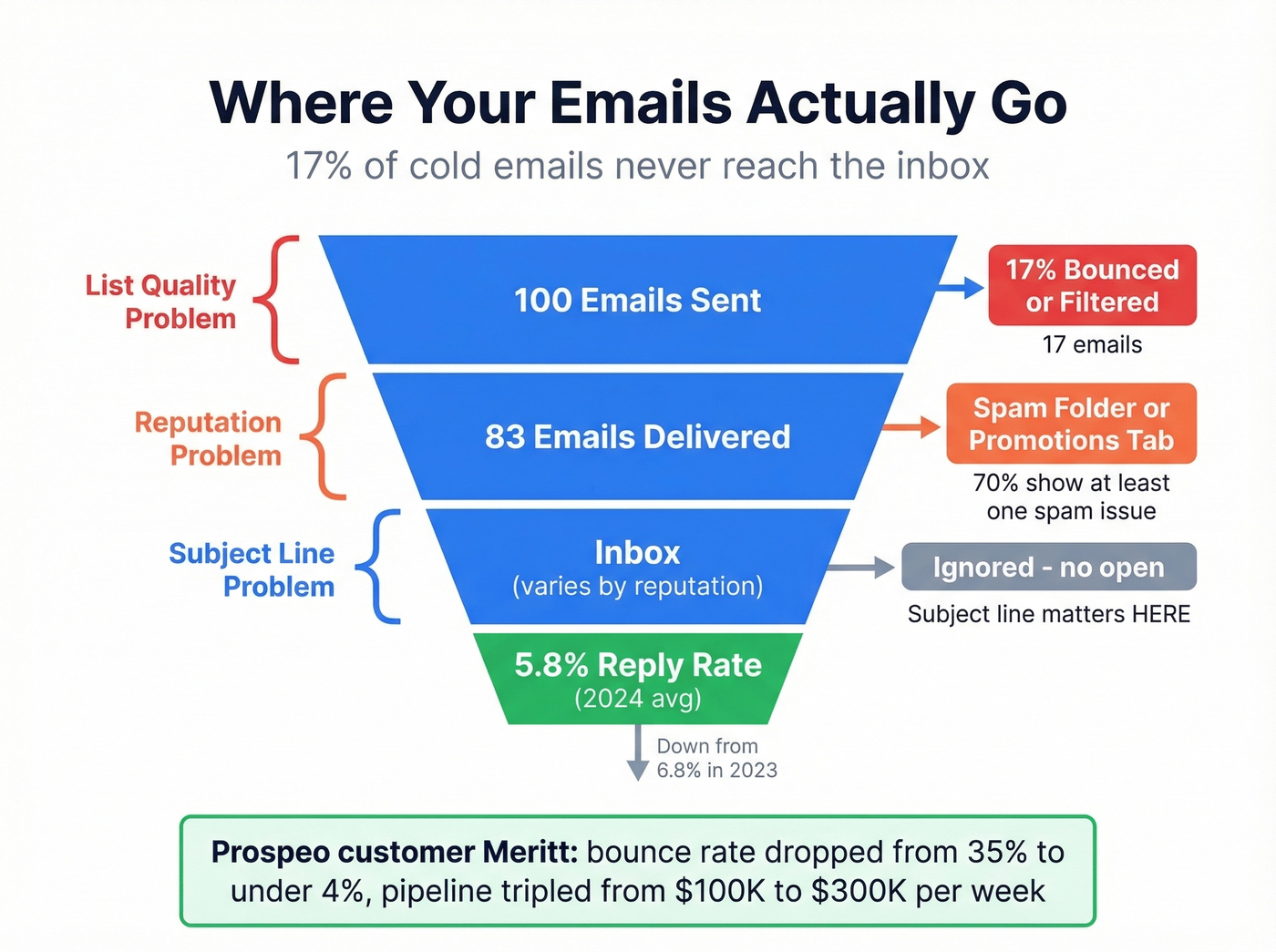
Litmus defines delivery as the email being accepted by the receiving server - no bounce. Deliverability is where it lands after that: inbox, promotions tab, or spam folder. That gap is where subject line performance goes to die. Their research found that 70% of emails show at least one spam-related issue.
Spam filters don't just scan for trigger words anymore. They weigh three signal categories: content signals like words, formatting, ALL CAPS, and emoji strings; reputation signals like domain age, authentication, and complaint rates; and engagement signals like opens, replies, and spam reports. No single word guarantees spam - but combining trigger words with poor sender reputation is a recipe for the junk folder.
Let's be honest about something we've seen firsthand: teams with great subject lines getting 15% reply rates, and teams with the same lines getting 2%, purely because of list quality. Bounces from bad email data destroy your sender reputation. Once reputation drops, future emails get filtered, and your subject line becomes irrelevant because nobody sees it. One customer, Meritt, saw their bounce rate drop from 35% to under 4% after switching to Prospeo's verified data - and their pipeline tripled from $100K to $300K per week.
Trigger-event subject lines like "Saw the VP hire" and "Re: your Series B" crush generic outreach - but you need real-time signals to write them. Prospeo tracks job changes, funding rounds, and headcount growth on a 7-day refresh cycle, so your personalization is never stale.
Fresh data makes every subject line hit harder.
Testing Your Subject Lines
Most teams skip A/B testing because it feels like overkill. It's not - but you need to do it right or the data is meaningless.
Start with a minimum of 1,000 recipients per variant. Anything less and you're reading noise. Run tests for 1-2 weeks to account for day-of-week variance, and change only one variable at a time - test length OR personalization OR question format, never all three at once. Measure reply rate, not open rate. Opens are inflated by Apple MPP. Replies are real.
Directional lifts to expect: personalization swings opens 1-5%, length changes can move opens up to 5% in either direction, and emojis can lift opens up to 10% in B2C contexts but hurt credibility in B2B cold outreach. One surprising finding from the data: B2B email CTRs run 62% higher on weekends. Worth testing if your audience checks email on Saturdays.
Skip A/B testing entirely if your list is under 500 contacts. The sample size won't produce reliable results, and you're better off just following the 2-4 word, question-framed, signal-based framework above.
FAQ
How long should a sales email subject line be?
Two to four words hits the sweet spot - 46% open rate across 5.5M emails. Front-load your hook in the first 33 characters for mobile visibility. After seven words, open rates drop to 35% or below.
What's the best subject line for cold sales outreach?
Short, personalized, question-framed lines consistently win. "[FIRST NAME]'s Invitation" pulled a 10.18% reply rate in Cognism's published results - the highest documented. Signal-based personalization outperforms generic templates every time.
Do personalized subject lines actually work?
Yes - personalized lines earned 7% reply rates vs. 3% without, a 133% lift. The key is referencing relevant signals like funding rounds or job changes, not just inserting a first name via merge tag.
Why are my open rates high but replies low?
Apple Mail Privacy Protection inflates open rates by roughly 18 points across 46% of email clients. Nearly half your "opens" are phantom pixel loads. Switch to reply rate as your primary metric.
How do I keep sales emails out of spam?
Verify your list before sending - catch invalid addresses, spam traps, and honeypots before they tank your sender reputation. Authenticate your domain with SPF, DKIM, and DMARC. Avoid stacking trigger words with poor sender reputation, and strip unnecessary tracking pixels.