

Sales Enablement and Marketing: The Alignment Playbook That Actually Works
Marketing sends 500 MQLs. Sales says they're garbage. Nobody can prove who's right, so the whole thing resets next quarter with the same finger-pointing. The gap between sales enablement and marketing costs businesses $1 trillion annually, and it's not a communication problem - it's an infrastructure problem.
Here's what makes it worse: 82% of C-level executives say their teams are aligned, while 65% of the practitioners actually doing the work say alignment doesn't exist. That gap isn't a perception issue. It's proof that leadership confuses shared Slack channels with shared accountability.
We've spent years watching this cycle repeat across dozens of B2B orgs. The fixes that stick aren't cultural - they're operational. Enforceable SLAs, shared KPIs, and a data foundation that makes all of it work.
The Three Things That Actually Matter
If you don't read another word, do these three things:
Shared KPIs with enforceable SLAs. Not a handshake agreement - actual documented commitments with weekly review cadences. Marketing commits to lead volume and quality. Sales commits to follow-up speed. Someone is accountable when either side misses.
A stage-appropriate owner for enablement. Who owns it depends on your company size. Get this wrong and enablement becomes everyone's side project, which means it's nobody's job.
Clean contact data. Every lead marketing hands off needs to be reachable. If the data is stale, your SLAs are fiction. Prospeo's 98% email accuracy and 7-day refresh cycle across 143M+ verified emails means reps aren't wasting sequences on dead addresses.
Where the Lines Blur
These terms get tangled constantly. On r/sales and r/marketing, practitioners regularly ask where product marketing ends and enablement begins - and whether marketing even belongs in the conversation.
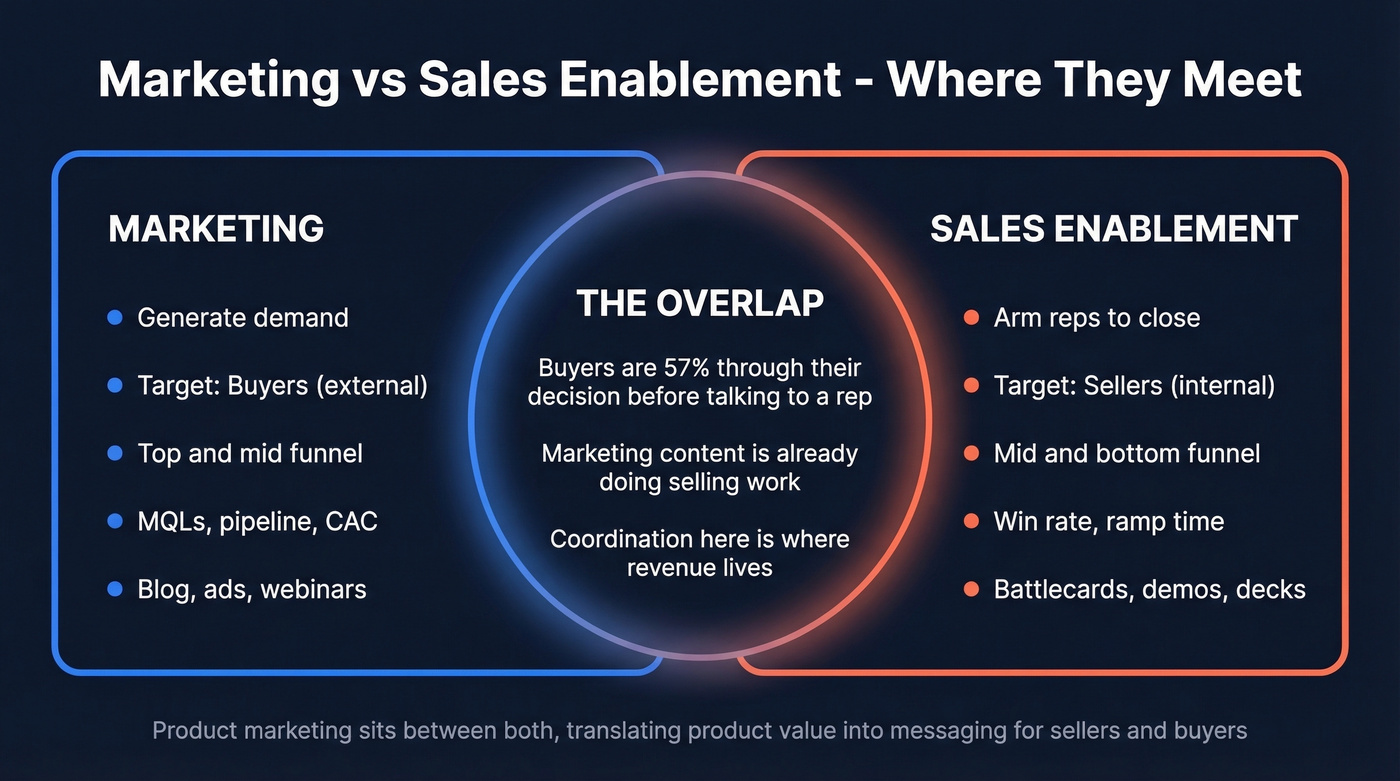
Marketing generates demand. It owns the top of the funnel, builds buyer personas, runs campaigns, and measures pipeline contribution. Sales enablement equips reps to close the deals marketing helped create - through training, coaching, onboarding, competitive intel, and content tailored to specific deal stages. Product marketing sits between both, translating product value into messaging that both teams use. Some people call this product marketing sales enablement because it serves sellers and buyers simultaneously.
| Marketing | Sales Enablement | |
|---|---|---|
| Goal | Generate demand | Arm reps to close |
| Audience | Buyers (external) | Sellers (internal) |
| Key metrics | MQLs, pipeline, CAC | Win rate, ramp time |
| Funnel stage | Top/mid | Mid/bottom |
| Content | Blog, ads, webinars | Battlecards, demos, decks |
The critical overlap: buyers are [57% through their purchase decision](https://www.linkedin.com/business/sales/blog/b2b-sales/this-popular-stat-is-wasting-your-time - the-57 - engagement-myth) before they ever talk to a rep. Marketing content is doing selling work whether anyone labels it "enablement" or not. The question isn't whether these functions overlap - it's whether they're coordinated when they do.
Why Alignment Fails
Every alignment article tells you to "communicate more" and "share goals." That's like telling someone with a broken leg to walk it off. The real failures are structural.
Attribution Is Broken
When marketing runs HubSpot and sales lives in Salesforce, the black hole between MQL and closed-won swallows everything. Marketing can't prove which leads converted. Sales can't trace which content influenced a deal. Both teams build their own dashboards that tell different stories, and the quarterly blame cycle continues uninterrupted.
Content Nobody Uses
80% of marketing content never gets used in sales. Marketing and product marketing build beautiful one-pagers, case studies, and campaign assets. Enablement turns the best of it into stage-specific talk tracks, decks, and battlecards. And still - most of it never gets opened because nobody asked reps what they actually need in the deal cycle.
Sellers spend up to 15 hours per week digging through content and disconnected tools instead of selling, while 50% of prospect engagement comes from just 10% of enablement content. Most of the library is dead weight. Understanding how to support sales as product marketing starts with sitting in on deal reviews before creating a single asset.
Misaligned Incentives
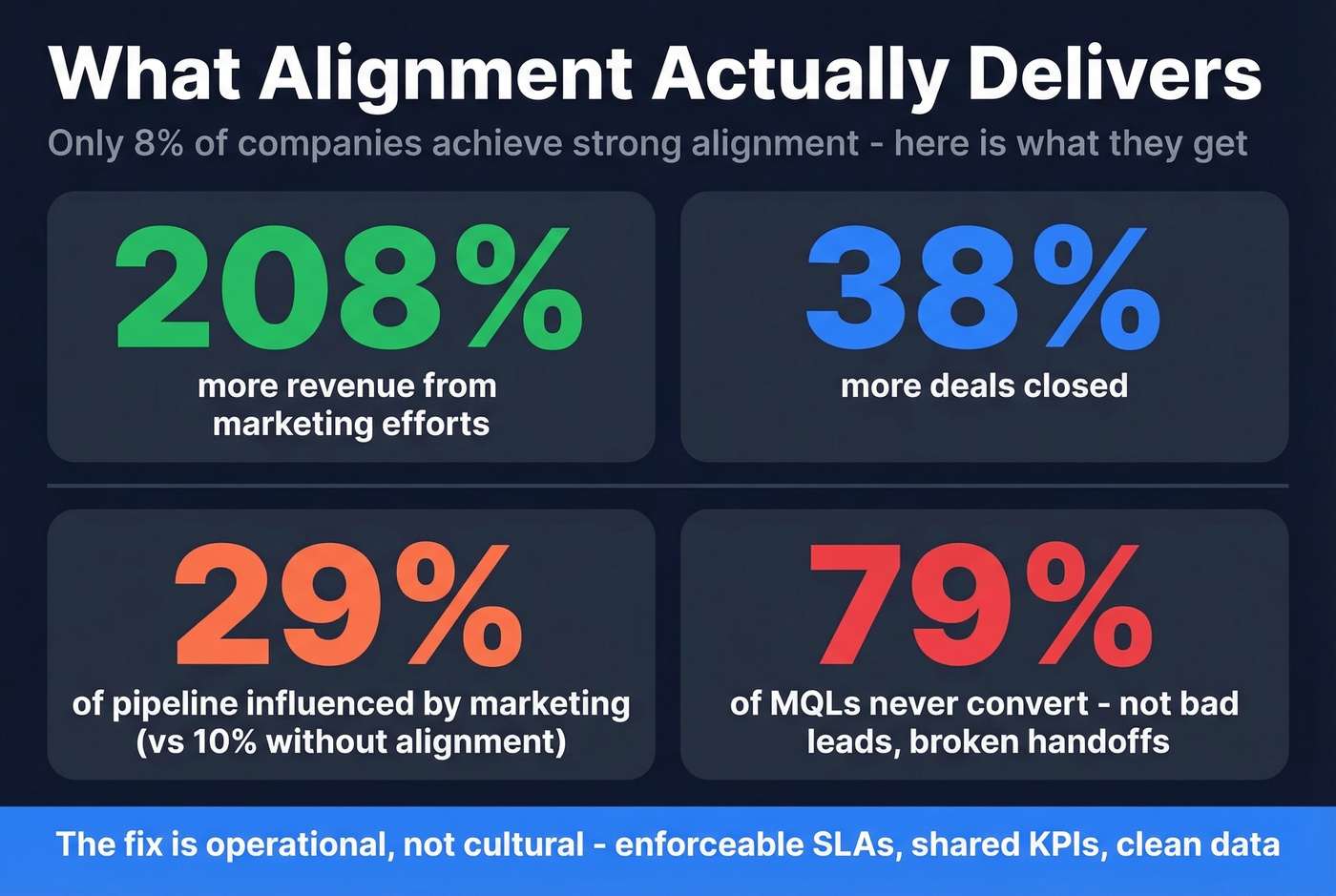
53% of organizations report misalignment specifically at the nurture-to-sales handoff. Less than 35% of engaged contacts get follow-up. And 79% of MQLs never convert - not because they were bad leads, but because the handoff process doesn't enforce accountability. Marketing gets credit for generating the lead. Sales gets credit for closing the deal. Nobody owns the middle.
The Alignment Playbook
Only 8% of companies have strong alignment between their revenue teams. The ones that do generate up to 208% more revenue from marketing efforts, close 38% more deals, and see marketing influence 29% of pipeline versus just 10% when alignment is weak.
Here's what they do differently.
Map the Revenue Model
Stop thinking in funnels. Map the entire revenue lifecycle: First Touch, Marketing Engagement, Sales Handoff, Opportunity Creation, Closed-Won, Retention/Expansion.
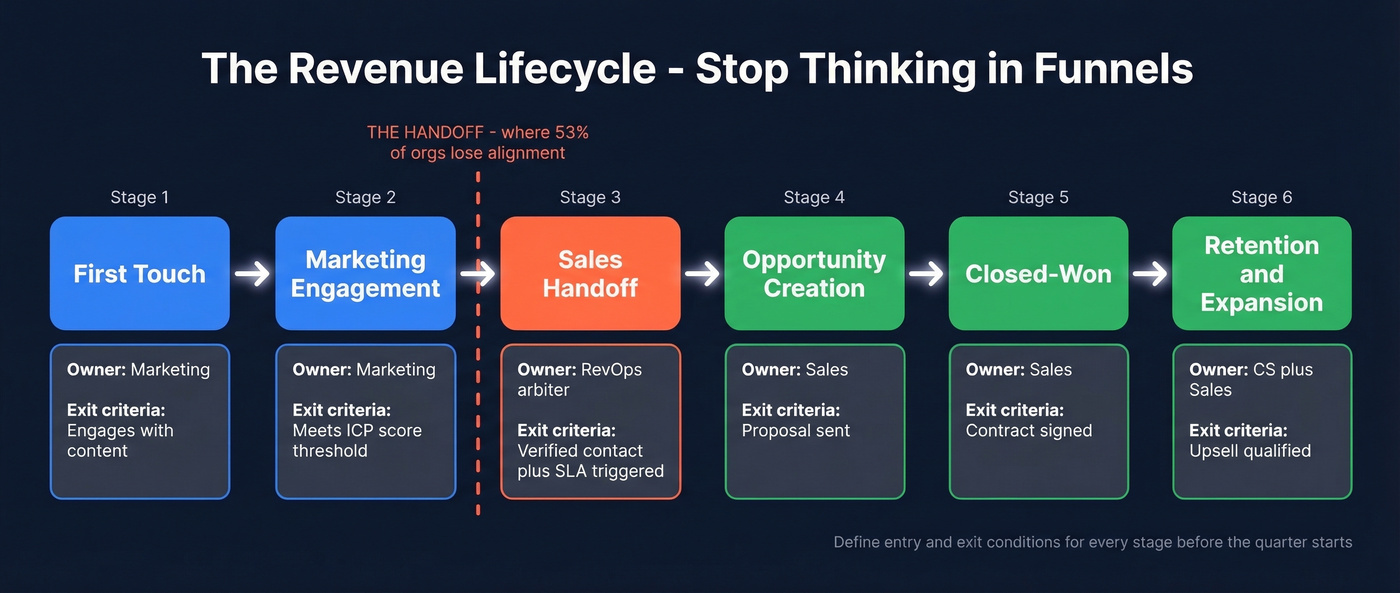
For each stage, define three things. First, entry and exit conditions - what qualifies a lead to move forward. A lead from a 500-person SaaS company in your target geography scores higher than a 10-person agency outside your ICP. Second, clear ownership, with RevOps as the neutral arbiter. Third, what success looks like - measurable, not vibes.
This eliminates the pipeline-review arguments where marketing says "we sent you qualified leads" and sales says "none of them were ready." If both teams agreed on what "qualified" means before the quarter started, the argument doesn't happen.
Build Enforceable SLAs
SLAs aren't suggestions. They're commitments baked into workflows and reporting.
A sample structure:
- Marketing commits to: 200 qualified leads/month meeting agreed ICP criteria, with verified contact data
- Sales commits to: First follow-up within 4 hours of handoff, minimum 3 touches per qualified lead
- Enablement commits to: Updated battlecards within 5 business days of competitive changes
Here's a RACI framework to make ownership explicit:
| Activity | Marketing | Enablement | Sales | RevOps |
|---|---|---|---|---|
| Lead scoring | A | C | R | I |
| Content creation | R | A | C | I |
| Follow-up SLA | I | C | A | R |
| Data quality | C | I | I | A |
| KPI reporting | C | C | C | A |
R = Responsible, A = Accountable, C = Consulted, I = Informed.
Share Five KPIs (Minimum)
Both teams review the same five numbers every week. Non-negotiable.
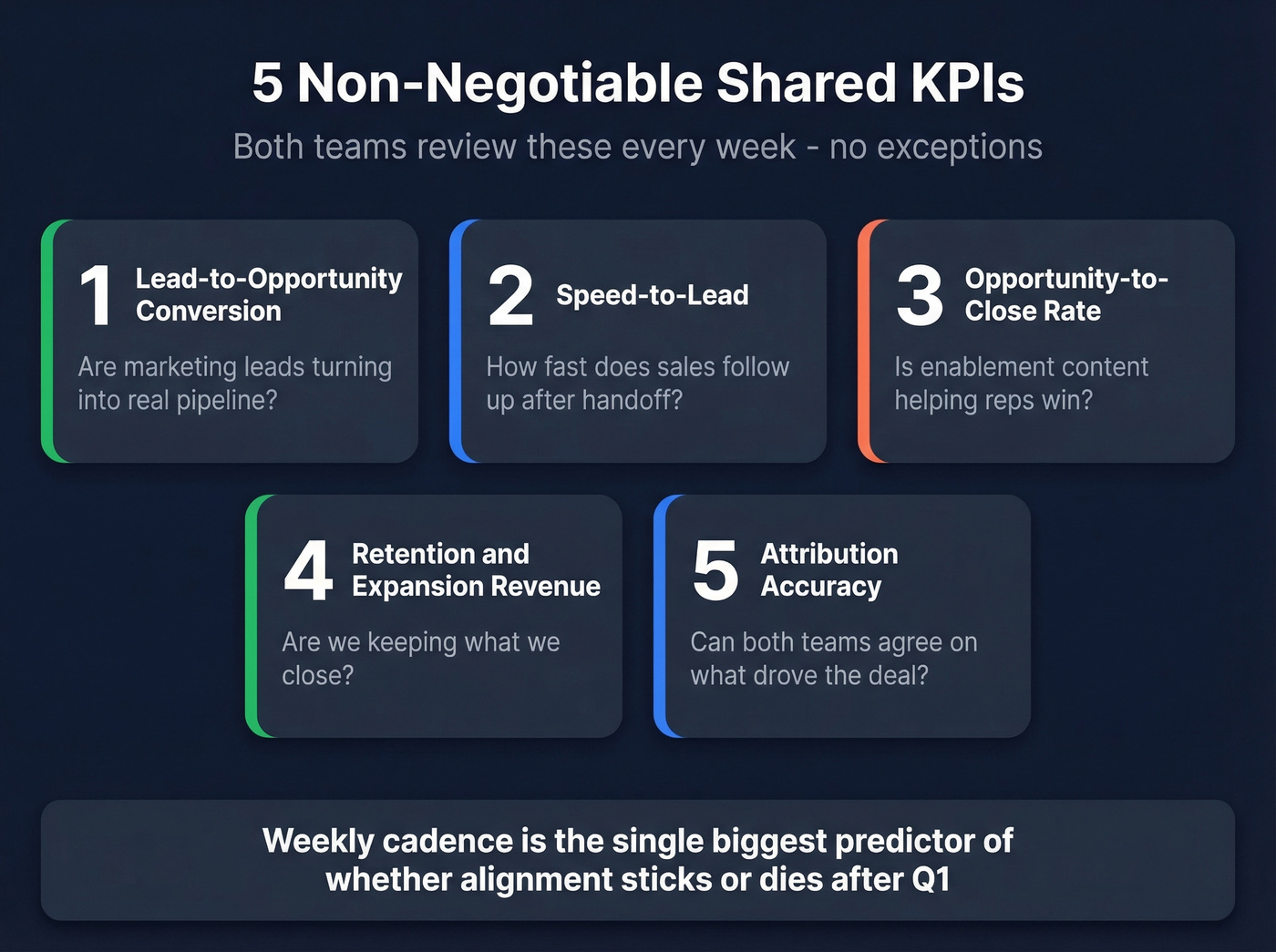
- Lead-to-Opportunity conversion - Are marketing's leads turning into real pipeline?
- Speed-to-lead - How fast does sales follow up after handoff?
- Opportunity-to-Close rate - Is enablement content helping reps win?
- Retention/Expansion revenue - Are we keeping what we close?
- Attribution accuracy - Can both teams agree on what drove the deal?
In our experience, the weekly cadence is the single biggest predictor of whether alignment sticks or dies after Q1. You spot leaks early or you don't spot them at all.

Your marketing-to-sales SLA falls apart the moment a rep sequences a dead email. Prospeo's 7-day data refresh and 98% email accuracy across 143M+ verified contacts means every MQL marketing hands off is actually reachable - so your speed-to-lead SLA measures rep performance, not data quality.
Stop letting stale data sabotage your alignment playbook.
Who Owns Enablement?
It depends on your stage. Forcing a structure that doesn't match your company size creates more problems than it solves. The good news: over 80% of organizations now have a formal enablement role, up from 58% in 2017. The function has earned its seat.
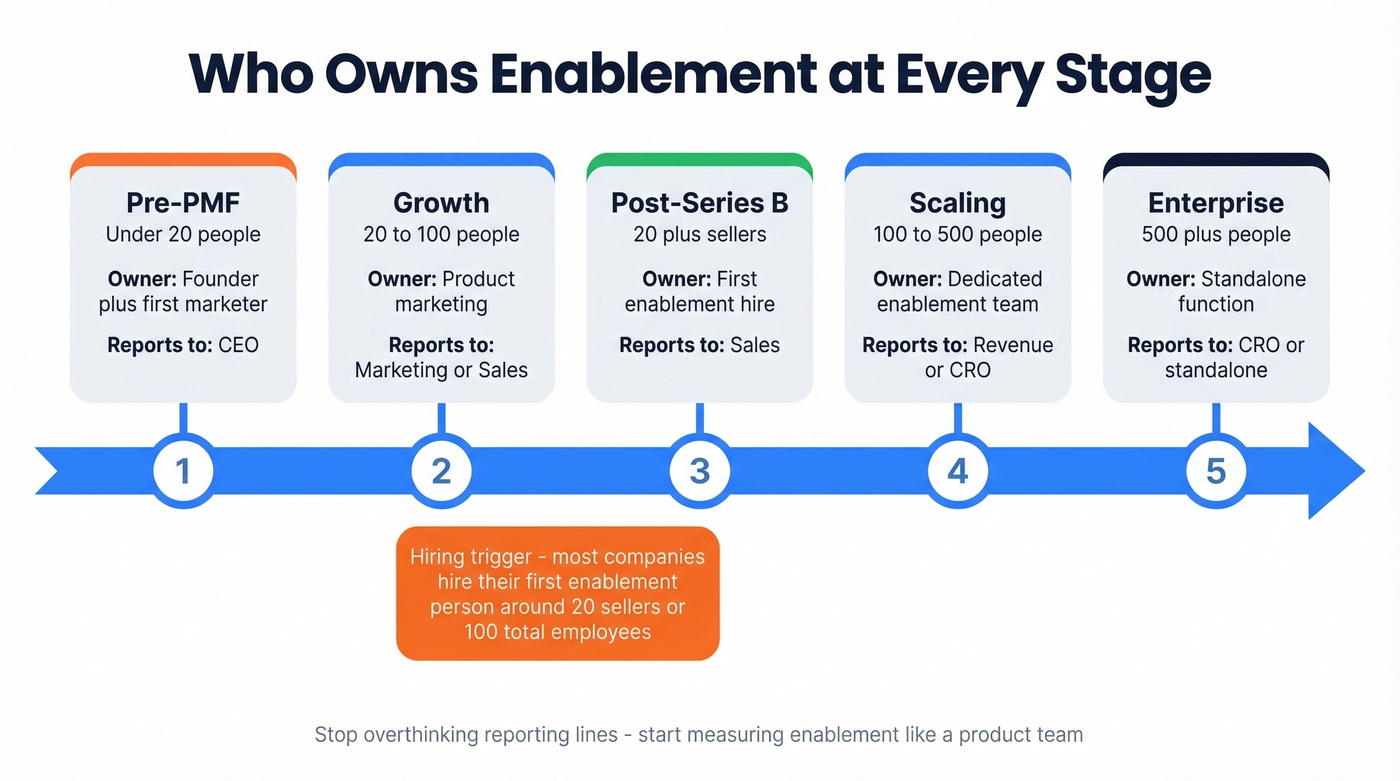
| Company Stage | Enablement Owner | Reports To |
|---|---|---|
| Pre-PMF (<20 people) | Founder + first marketer | CEO |
| Growth (20-100) | Product marketing | Marketing or Sales |
| Post-Series B (~20+ sellers) | First enablement hire | Sales |
| Scaling (100-500) | Dedicated enablement team | Revenue/CRO |
| Enterprise (500+) | Standalone function | CRO or standalone |
The practical hiring trigger: most companies bring on their first dedicated enablement person around 20 sellers or 100 total employees. Before that, product marketing carries the enablement load until headcount justifies a specialist.
Let's be honest about something the org chart debates miss: most companies overthink reporting lines and underthink the measurement model. Treat enablement like a product team. Enablement materials are the "product," sales reps are the "customers." Measure adoption, satisfaction, and impact on outcomes - just like a PM would. If your enablement team can't quantify "speeding up onboarding by 40% saved us $X in ramp costs," they're not structured to prove their value.
How Marketing Supports Sales at Every Stage
The best-performing orgs don't treat marketing as a lead factory that goes quiet after handoff. Marketing supports sales throughout the entire deal cycle - from first touch to closed-won - by supplying stage-specific content, competitive intelligence, and buyer insights that reps deploy in real conversations.
The shift that matters: instead of marketing producing assets and hoping sales finds them, marketing embeds in the deal process. Weekly content syncs, shared win/loss analysis, and co-created battlecards fuel reps with intelligence that actually maps to what buyers ask in discovery calls. One mid-market team we worked with saw their close rate jump 31% after marketing started attending weekly deal reviews - not to present slides, but to listen and then build assets around the objections reps kept hearing.
When marketing actively supports the deal cycle, organizations see the 38% lift in close rates the data promises.
Measuring What Matters
Organizations with a dedicated enablement strategy achieve a 49% higher win rate on forecasted deals and cut onboarding time by 40-50%. But you only get those numbers if you're tracking the right things.
Track these:
- Rep usage of enablement content - who's opening what, and when in the deal cycle
- Buyer engagement with shared content - viewing time, shares, return visits
- Deal influence - which content pieces appear in won deals vs. lost deals
- Demo-to-close rates specifically, since 65.3% of salespeople say product demos are the most effective enablement content
Stop tracking these:
- Volume of content produced - more isn't better when most goes unused
- Generic "enablement satisfaction" surveys - reps will say it's fine and keep using their own decks
- Downloads without engagement data - a PDF download means nothing if nobody reads past page two
Skip the vanity metrics entirely. If a number doesn't connect to revenue or rep behavior change, it's noise.
Tools That Bridge the Gap
The enablement platform market hits $8.79B by 2029. That's a lot of tools competing for your budget, and most of them solve the wrong problem first.
The Stack You Need
| Category | Tool | Pricing |
|---|---|---|
| CRM | HubSpot | Free - ~$20/user/mo+ |
| CRM | Salesforce | ~$25 - $330/user/mo |
| Enablement | Highspot | Custom; typically mid-two digits per user/month |
| Enablement | Seismic | $100K+/yr (enterprise) |
| Digital Sales Rooms | Dock | $350 - $750/mo |
| Data/Prospecting | Kaspr | $46/user/mo |
| Sales CRM | Membrain | $49/user/mo |
| Data Quality | Prospeo | ~$0.01/email, free tier |
Enterprise enablement platforms like Seismic and Highspot are powerful, but they're six-figure commitments designed for large organizations. For mid-market teams, prioritize implementation speed and adoption over feature depth. A tool nobody uses is worse than no tool at all.
The Data Foundation
Look - if reps are armed with stale emails and dead phone numbers, alignment is theater. Marketing can build the perfect SLAs, enablement can create flawless battlecards, and none of it matters when the first outreach bounces.
Enterprise enablement platforms cost $100K+/year. Verified contact data - the foundation all of it sits on - runs about $0.01/email with Prospeo, which covers 300M+ professional profiles at 98% email accuracy on a 7-day refresh cycle. That's the highest-ROI line item in your entire enablement stack. When Snyk's 50 AEs cleaned up their data foundation, AE-sourced pipeline jumped 180% and they started generating 200+ new opportunities per month.

Teams aligned on Prospeo close 38% more deals because reps spend zero time hunting for contact info. With 300M+ profiles, 30+ filters including buyer intent and job changes, and 125M+ verified mobiles, your enablement stack finally has the data foundation that makes shared KPIs meaningful.
Give your reps contacts that actually pick up the phone.
FAQ
What's the difference between sales enablement and marketing enablement?
Sales enablement arms reps with content, training, and tools to close deals. Marketing enablement gives marketers the systems and data to execute campaigns efficiently. Both serve revenue - enablement focuses internally on sellers, marketing focuses externally on buyers. They overlap at content creation and buyer intelligence.
How do you measure alignment between these teams?
Track five shared KPIs weekly: lead-to-opportunity conversion, speed-to-lead, opportunity-to-close rate, retention/expansion revenue, and attribution accuracy. If both teams can't agree on the same numbers in the same dashboard, alignment is performative. Weekly cadence is non-negotiable.
What tools do you need for a sales enablement program?
At minimum: a CRM with shared dashboards like HubSpot or Salesforce, a content repository with usage tracking, and a data quality tool to ensure reps aren't prospecting with dead emails. Enterprise teams add Highspot or Seismic for content management and analytics at scale.
How does product marketing support sales enablement?
Product marketing bridges the gap between what the product does and what reps need to say in a deal. PMMs create competitive battlecards, positioning guides, and objection-handling frameworks that enablement distributes. The most effective product marketing teams attend deal reviews, analyze win/loss data, and iterate messaging based on what buyers actually care about - not what internal stakeholders assume they care about.