

Sales Enablement Collateral: Stop Creating More Assets and Start Governing What You Have
You open the shared drive and there they are: 14 pitch decks named FINAL_v7_REALLYFINAL. Three have different pricing. One still references a product you sunset last year. A rep sent the wrong version to a prospect yesterday, and now you're negotiating against your own outdated numbers.
Forrester found [60-70% of B2B content goes unused](https://www.forrester.com/blogs/its-not-content-its-a-lack-of-buyer-insights-thats-the-problem/), with some clients reporting rates above 80%. Meanwhile, reps spend just 28% of their time actually selling - the rest disappears into admin, searching for assets, and recreating content that already exists somewhere. Sales enablement collateral isn't an asset problem. It's an operating system problem.
What You Need (Quick Version)
Three operational moves that matter most:
- Naming convention + assigned owner. Every asset gets a standardized filename and a single person accountable for its accuracy.
- ROT cleanup + quarterly review cadence. Redundant, obsolete, and trivial content gets archived. Anything untouched for 90+ days gets flagged.
- Minimum viable tracking. UTM links on shared assets, tracked document links, and a spreadsheet logging which content gets used in deals.
If you only do these three things, you'll outperform most teams who've spent $25-60k/year on an enablement platform and never configured it.
Sales Collateral vs. Enablement Collateral
These terms get used interchangeably, and that's where the mess starts.
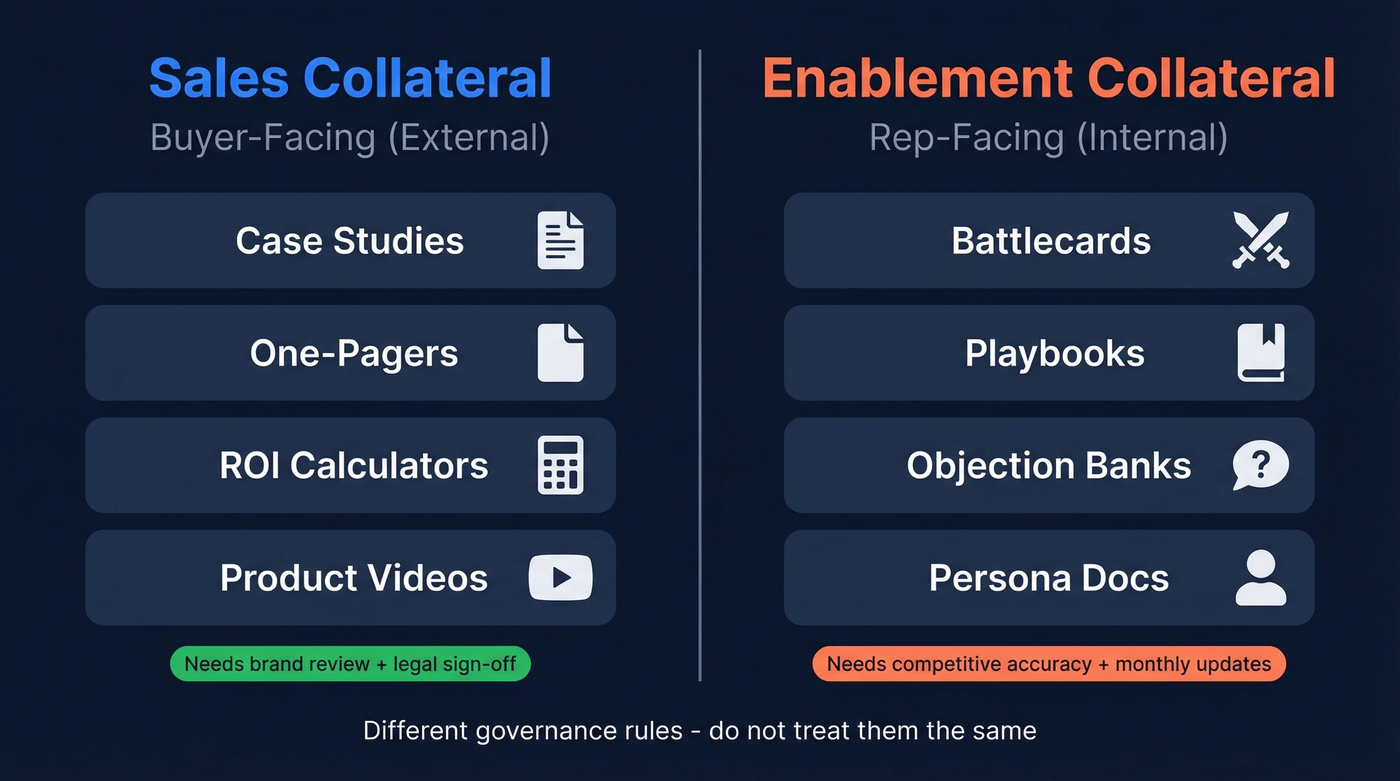
| Sales Collateral | Enablement Collateral | |
|---|---|---|
| Audience | Buyer-facing (external) | Rep-facing (internal) |
| Purpose | Persuade the prospect | Arm the seller |
| Examples | Case studies, one-pagers, ROI calculators, product videos | Battlecards, playbooks, call scripts, objection banks, persona docs |
| Sensitivity | Shareable externally | Often contains competitive intel, internal pricing, positioning |
The distinction matters because governance rules differ. A buyer-facing case study needs brand review and legal sign-off. A battlecard needs competitive accuracy and monthly updates. Treating them identically guarantees one category gets neglected.
The Minimum Viable Stack
You don't need 23 types of sales collateral. You need seven that are current, findable, and measured.
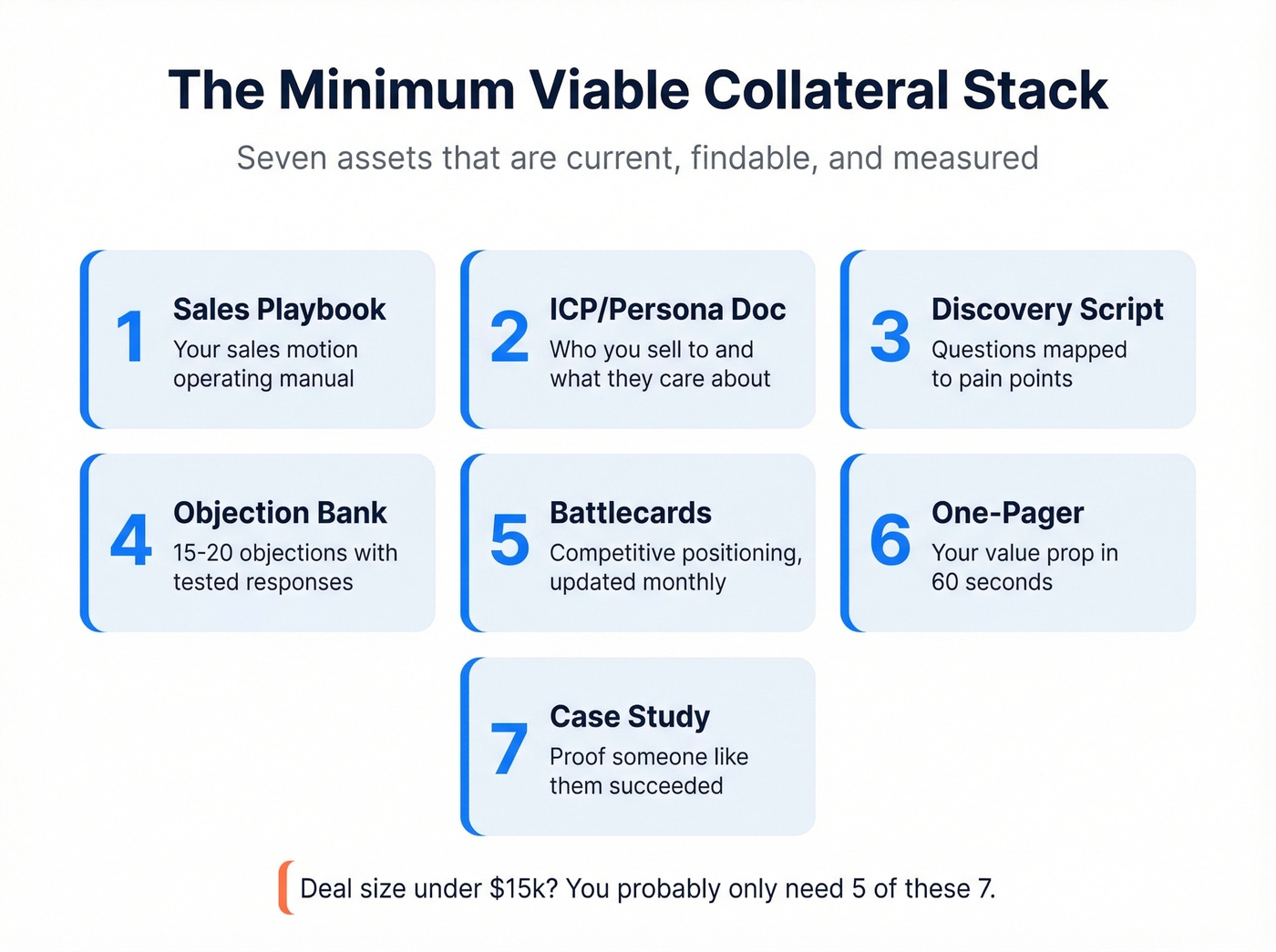
- Sales playbook - the operating manual for your sales motion, not a 90-page PDF nobody reads
- ICP/persona document - who you're selling to, what they care about, what language they use
- Discovery script - a framework of questions mapped to pain points, not a rigid teleprompter
- Objection bank - the 15-20 objections reps hear weekly, with tested responses
- Battlecards - competitive positioning updated monthly, not annually
- One-pager - the leave-behind that summarizes your value prop in 60 seconds
- Case study - proof that someone like the prospect succeeded with you
Don't forget post-sale collateral either. Onboarding guides, retention playbooks, and upsell one-pagers are enablement assets too - they just serve a different stage of the customer lifecycle.
Prioritization depends on your motion. An SMB outbound team needs the objection bank and one-pager first, while an enterprise ABM team needs battlecards and case studies. Build for your reps' actual workflow, not a theoretical content matrix.
Here's the thing: if your average deal size is under $15k, you probably don't need more than five of these seven. The playbook and persona doc can live as a single Notion page until you hit 10 reps. Overbuilding your collateral stack before you have governance is just creating more things to go stale.
Collateral by Buyer Stage
Dock's framework groups collateral into four practical buckets - and after reviewing a dozen models, we've found it's one of the cleanest ways to decide what to build next.
| Stage | Buyer Mindset | Example Assets |
|---|---|---|
| Problem-aware | "I have a problem" | Assessment tools, survey reports, educational webinars |
| Solution-aware | "Solutions exist" | Comparison guides, explainer videos, industry one-pagers |
| Product-aware | "Your product might work" | Demo videos, ROI calculators, detailed case studies |
| Internal-facing | "I need to sell this internally" | Business case templates, security/compliance docs, executive summaries |
That last row is where most teams have a gap. Your champion needs ammunition to sell internally, and if you don't give it to them, they'll write their own - poorly.
Consider role-based variants too: a new hire needs the discovery script and objection bank on day one, while a veteran rep needs updated battlecards and fresh case studies. Same enablement resources, different entry points.

Your ICP docs, persona sheets, and discovery scripts are useless if reps can't reach the right buyers. Prospeo gives you 300M+ profiles with 98% verified emails and 125M+ direct dials - so the collateral you spent months building actually connects to real conversations.
Stop perfecting the deck. Start reaching the decision-maker.
Governance That Stops Deck Chaos
Version control kills more deals than bad design ever will. A beautiful deck with last quarter's pricing is worse than an ugly deck with accurate numbers, because it creates confident misinformation. The Reddit consensus is painfully clear: "everyone has their own version saved locally" and nobody knows which is current.
Naming Conventions
Forrester's findability research makes a powerful point: file naming is durable metadata that travels with the asset everywhere it goes. Generic names like "Sales Deck Final" are useless. Use a formula:
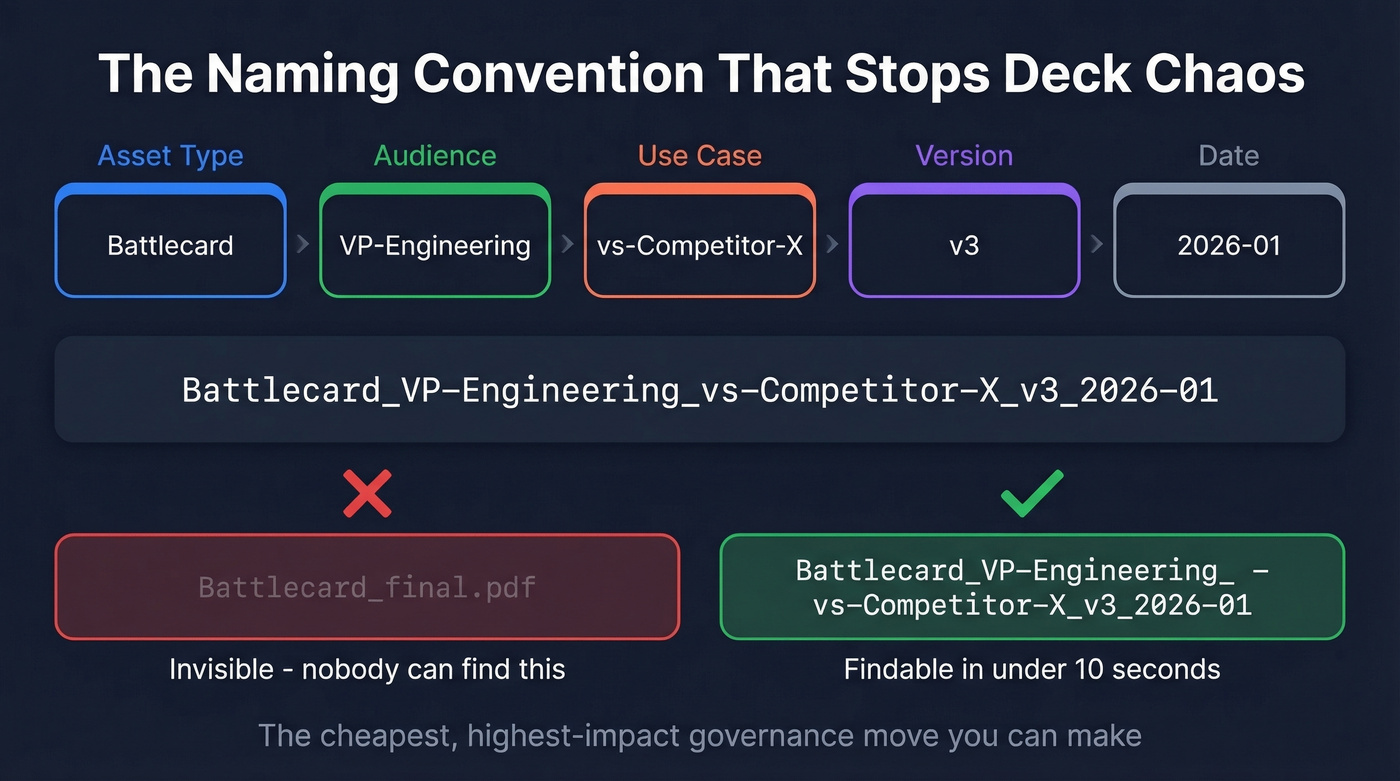
[Asset Type]_[Audience]_[Use Case]_[Version]_[Date]
Example: Battlecard_VP-Engineering_vs-Competitor-X_v3_2026-01
If reps can't find it in 10 seconds, it doesn't exist. This is the cheapest, highest-impact governance move you can make.
Tagging Schema
For anything stored in a CMS or shared drive with search, you need multi-dimensional tagging across stage, industry, use case, company size, and region. A battlecard tagged Stage=Product-Aware, Persona=VP Engineering, Industry=FinTech, Use Case=Competitive Displacement, Region=NA, Size=Enterprise, Updated=2026-01 is instantly findable. An untagged file named "Battlecard_final.pdf" is invisible.
ROT Cleanup Cadence
Assign an owner - content ops manager, digital asset librarian, whatever fits your org chart. Their job is to audit assets quarterly, flag anything untouched for 90+ days, and archive the ROT. Free audit templates from ContentCamel can structure this process by funnel stage and content type.
Stop creating new assets until you've cleaned up what you have.
Measuring What Actually Matters
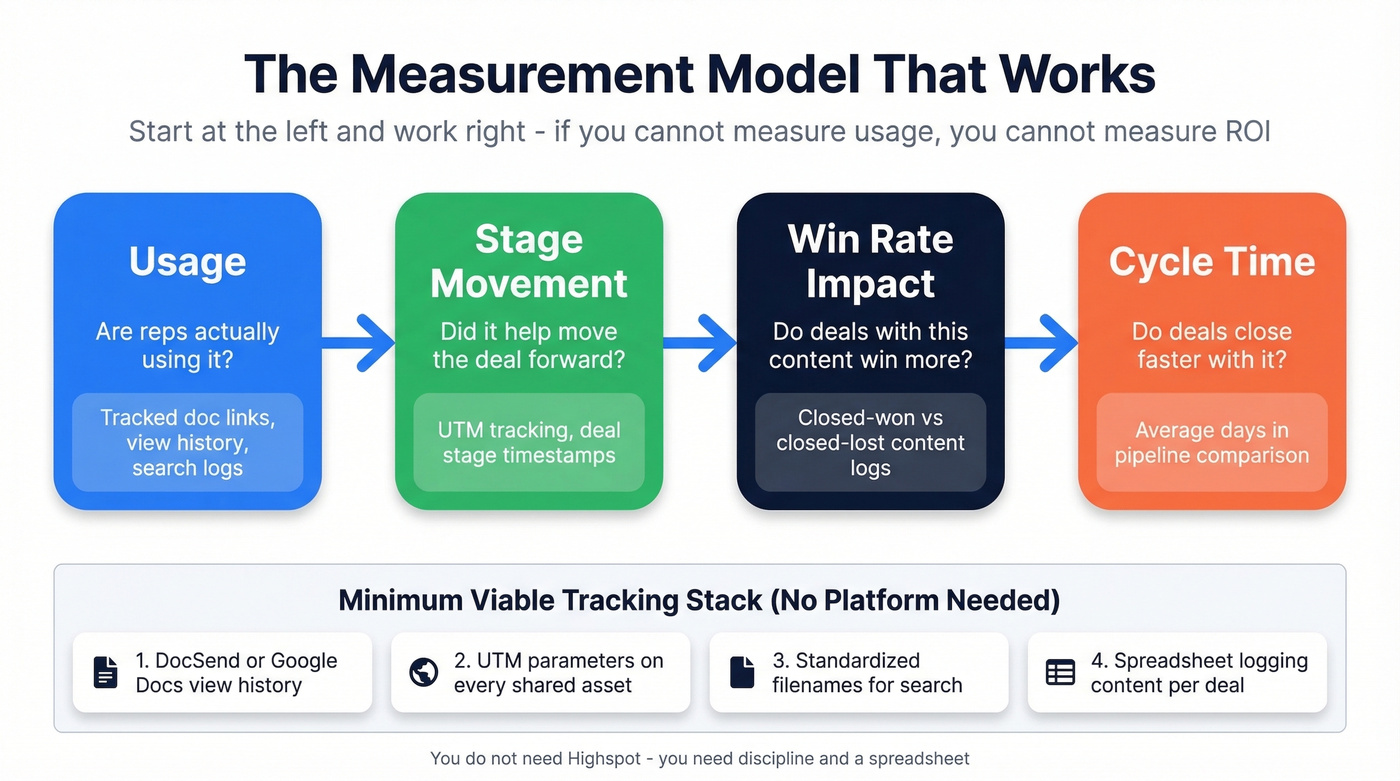
The measurement model that works: usage -> influenced stage movement -> win rate and cycle time impact. Start at the left and work right. If you can't measure usage, you definitely can't measure ROI.
Highspot's 2026 State of Sales Enablement report found that unified platform users are 42% more likely to improve win rates. That's compelling, but let's be honest - leadership demands ROI proof for enablement content while refusing to fund the tracking infrastructure that would produce it. We've seen this pattern at dozens of companies, and it's maddening.
For budget-constrained teams - which is most teams, based on what we see on r/ProductMarketing - here's the minimum viable tracking stack:
- Tracked document links via DocSend, Notion, or Google Docs view history
- UTM parameters on every shared asset to trace content back to deals
- Standardized filenames that make search and reporting possible
- A simple spreadsheet logging which content was used in closed-won vs. closed-lost deals
You don't need Highspot to prove collateral matters. You need discipline and a spreadsheet.
AI and Distribution in 2026
AI for Creation
Ninety percent of organizations are using or planning to use AI for GTM efforts. Tools like Gamma turn a rough doc into a polished deck in minutes - and the output is genuinely good. But AI speeds up creation; it doesn't create a source of truth. If you generate 50 AI decks without governance, you've just automated the chaos.
Distribution That Lands
The digital sales room concept - putting proposals, case studies, and next steps in one buyer-facing workspace instead of scattered email attachments - is becoming standard for enterprise teams. Trumpet's model is a good example.
But collateral strategy falls apart at the last mile: delivery. You can build the perfect battlecard, tag it flawlessly, and track its usage, but if the rep sends it to an invalid email address, it's wasted work. In our experience, arming sales reps with content only matters if that content reaches the right person. That's where verified contact data comes in - tools like Prospeo, with 98% email accuracy and a 7-day refresh cycle, keep your best assets landing in decision-maker inboxes instead of bouncing.
Tools at a Glance
| Platform | Best For | Estimated Cost |
|---|---|---|
| Highspot | Coaching + methodology adherence | ~$25-60k+/yr (enterprise) |
| Seismic | Content source of truth + Deal Rooms | ~$25-60k+/yr (enterprise) |
| Showpad | Video + conversation monitoring | ~$15-40k+/yr |
| Gamma | AI deck generation, fast and cheap | Free tier; paid ~$10-15/mo |
| Google Drive + naming conventions | Lightweight teams, pre-platform | Free |
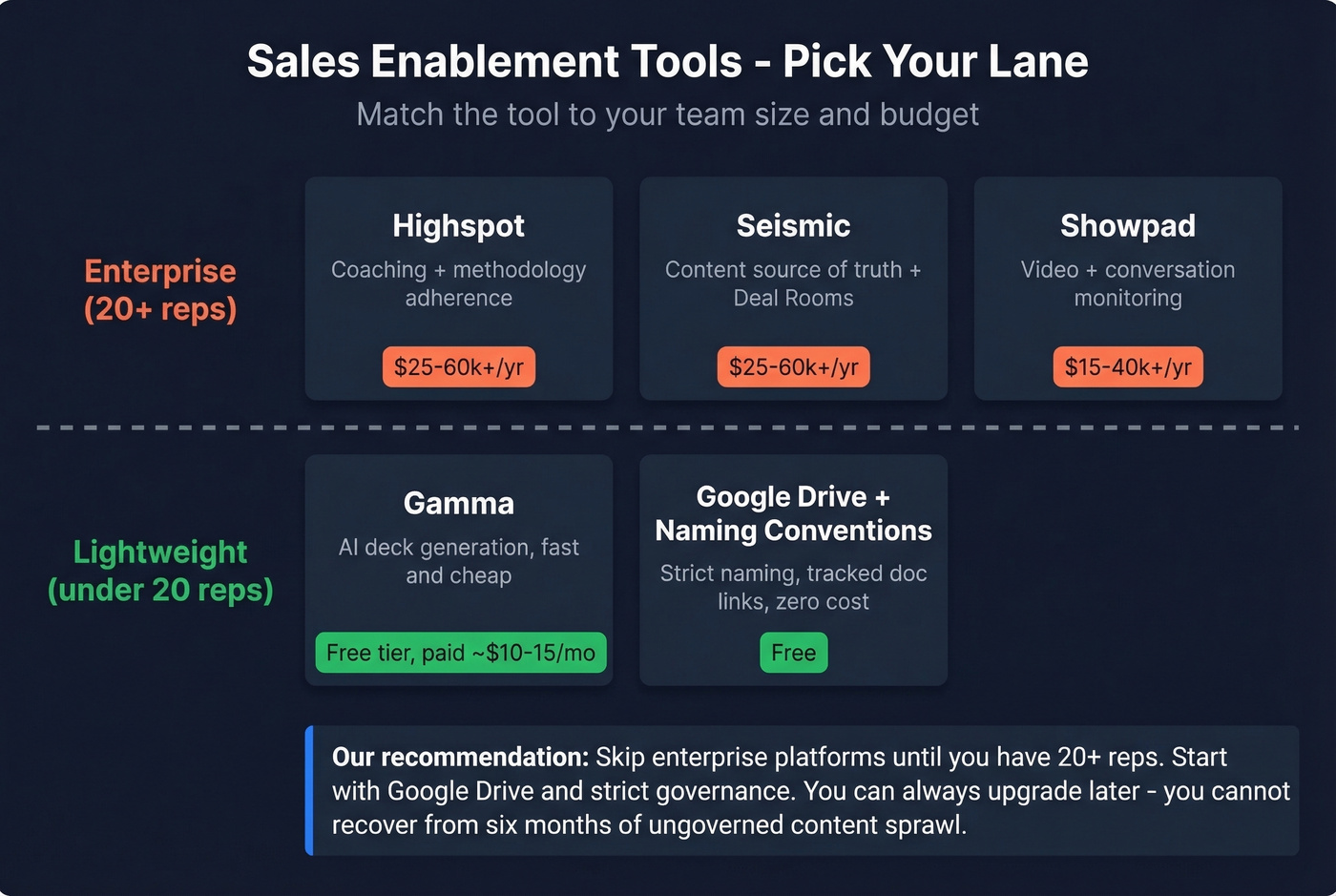
Skip the enterprise platforms if you're a team under 20 reps. Start with Google Drive, a strict naming convention, and tracked document links. You can always upgrade later. What you can't do is recover from six months of ungoverned content sprawl.
If you want the deck itself to perform (not just exist), invest in sales deck storytelling and keep the narrative consistent across versions.
You've built the battlecards, mapped the personas, and cleaned up the shared drive. Now your reps need accurate contact data that matches those ICPs. Prospeo's 30+ search filters - buyer intent, technographics, headcount growth - let you turn persona docs into targeted prospect lists at $0.01 per email.
Turn your enablement collateral into pipeline for a penny per lead.
FAQ
Who should own sales enablement collateral?
A content ops manager who sets naming standards, audits quarterly, and trains authors on governance. Without a single owner, assets drift into conflicting versions within weeks. Even a part-time owner beats no owner.
How often should collateral be reviewed?
Quarterly at minimum for the full library. Battlecards and pricing assets need monthly reviews - markets and competitors move faster than quarterly cycles allow.
What's the difference between enablement content and marketing content?
Marketing content attracts leads. Enablement content arms reps to convert - battlecards, objection banks, and playbooks that never reach the buyer directly. The governance, update cadence, and success metrics differ completely.
How do I track collateral usage without an enterprise platform?
Use tracked document links (DocSend or Google Docs view history), UTM parameters on shared assets, standardized filenames, and a spreadsheet logging access frequency and deal association. Total cost: $0.
How do I make sure collateral reaches the right prospects?
Verified contact data is the prerequisite. Without it, even your best-governed assets bounce or land in abandoned inboxes. A 7-day data refresh cycle - rather than the 6-week industry average - is the difference between a delivered case study and a wasted send.