

How to Build a Sales Enablement Strategy That Doesn't Waste Your Reps' Time
Your CRO asks why win rates dropped last quarter. The enablement team's answer: "We're rolling out more training sessions." That's the moment you know your sales enablement strategy is broken.
Teams with formal enablement programs see 49% higher win rates on forecasted deals. Teams without one watch reps spend 70% of their week on everything except selling. The gap isn't effort - it's architecture.
Sellers on Reddit describe enablement as 2-3 mandatory video calls per week, each running 1-3 hours, stretching well beyond SKO season. That's 20-25% of the selling week consumed by internal meetings. Revenue teams burn 440 hours per year just searching for or creating content - roughly 11 work weeks. Your reps don't need more enablement. They need better enablement.
The Short Version
- Define enablement around outcomes, not activities. Win rate and quota attainment matter. "Trainings completed" doesn't.
- Build five pillars: content governance, training and coaching, technology stack, data quality, and measurement.
- Give it a home under RevOps, not Marketing. 39.4% of enablement teams already report there.
- Roll out in 30/60/90-day phases. Don't launch everything at once.
- Subtract before you add. Consolidation is the 2026 trend - orgs are running 2 fewer tools on average.
What Enablement Means in 2026
76% of organizations now have a dedicated enablement function, up from 32% five years earlier. The enablement platform market hit $5.23B in 2024 and is projected to reach $12.78B by 2030, growing at a 16.3% CAGR. The category itself is shifting - "sales enablement" is becoming "revenue enablement," expanding beyond sellers to include marketing, CS, and post-sale teams.
The reason is buyer behavior. 61% of B2B buyers now prefer a rep-free buying experience. 73% actively avoid suppliers who send irrelevant outreach. And 69% report inconsistencies between what a company's website says and what the seller tells them. An enablement program exists to close those gaps - to make every touchpoint consistent, relevant, and worth the buyer's time.
Here's the thing: most teams don't need a bigger enablement budget. They need to stop treating enablement as a content factory and start treating it as revenue infrastructure. If your average deal size is under $15K and your reps can't find the right case study in under a minute, no amount of AI tooling will save you. Fix the foundation first.
Five Pillars of a Strong Enablement Program
Content Governance
Only 30% of marketing-created content gets used by sales. Reps recreate existing content 40% of the time. That's not a content problem - it's a governance problem.
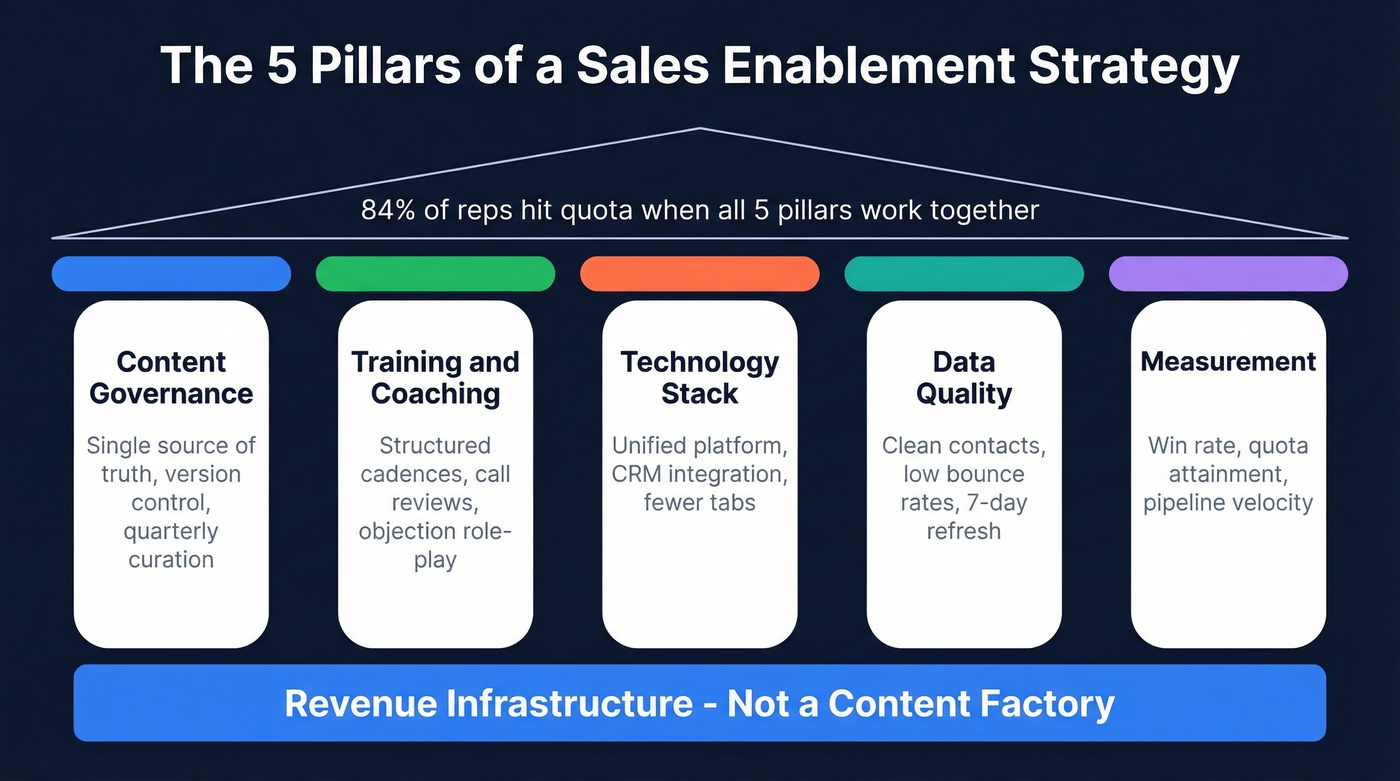
The fix isn't more content. It's a single source of truth with version control, role-based access, and a curation cadence that retires stale assets quarterly. If a rep can't find the right deck in under 60 seconds, your governance has failed. We've seen teams cut content search time by 80% just by tagging assets by deal stage and buyer persona - no new platform required, just a shared drive with actual structure.
Training and Coaching
Picture this: your reps are told their role is increasingly consultative, but nobody's trained them to sell that way. A Salesforce survey found 74% of sellers say their jobs are more consultative, yet only 29% have been trained on virtual selling. Managers spend roughly 13 hours per week coaching reps, per Highspot's research, but coaching without a framework is just conversation.
Structured coaching cadences beat ad-hoc "how's your pipeline?" check-ins every time - weekly 1:1s tied to specific deal stages, call reviews with scoring rubrics, and role-play on objection handling. 63% of teams using AI for coaching report measurable quality improvements, so layer that in once the framework exists. But don't start there.
Technology Stack
Organizations are using 2 fewer tools on average compared to last year. Companies with unified enablement platforms are 42% more likely to improve win rates. Seismic and Highspot announced a definitive merger in February 2026, Showpad merged with Bigtincan in October 2025, and Gong expanded into full revenue enablement in early 2026.
When evaluating your stack, think in five capability buckets: content management, learning management, sales intelligence, deal rooms, and AI coaching. Expect to budget $30-$100 per user per month for a mid-market enablement platform, or $25K-$250K annually depending on seat count and modules.
Before you add anything, ask three questions. Does it integrate with our CRM? Does it reduce the number of tabs a rep has open? Does it produce data we actually review? If the answer to any of those is no, skip it.
Data Quality

This is the pillar most enablement programs ignore, and it quietly kills everything else. You can build the perfect playbook and invest in a six-figure platform, but if your contact data is stale and emails bounce, reps lose confidence, domains get flagged, and pipeline stalls.
A concrete example: GreyScout cut rep ramp time from 8-10 weeks to 4 weeks after fixing bounce rates (38% down to under 4%) and cleaning up outbound data. That kind of improvement doesn't come from training - it comes from giving reps data they can trust from day one. Tools like Prospeo keep bounce rates under 4% with 98% email accuracy and a 7-day data refresh cycle, so your outbound foundation stays clean while you build everything on top.
Measurement
If you're tracking "trainings completed," you're measuring activity, not impact. Five KPIs actually move the needle:
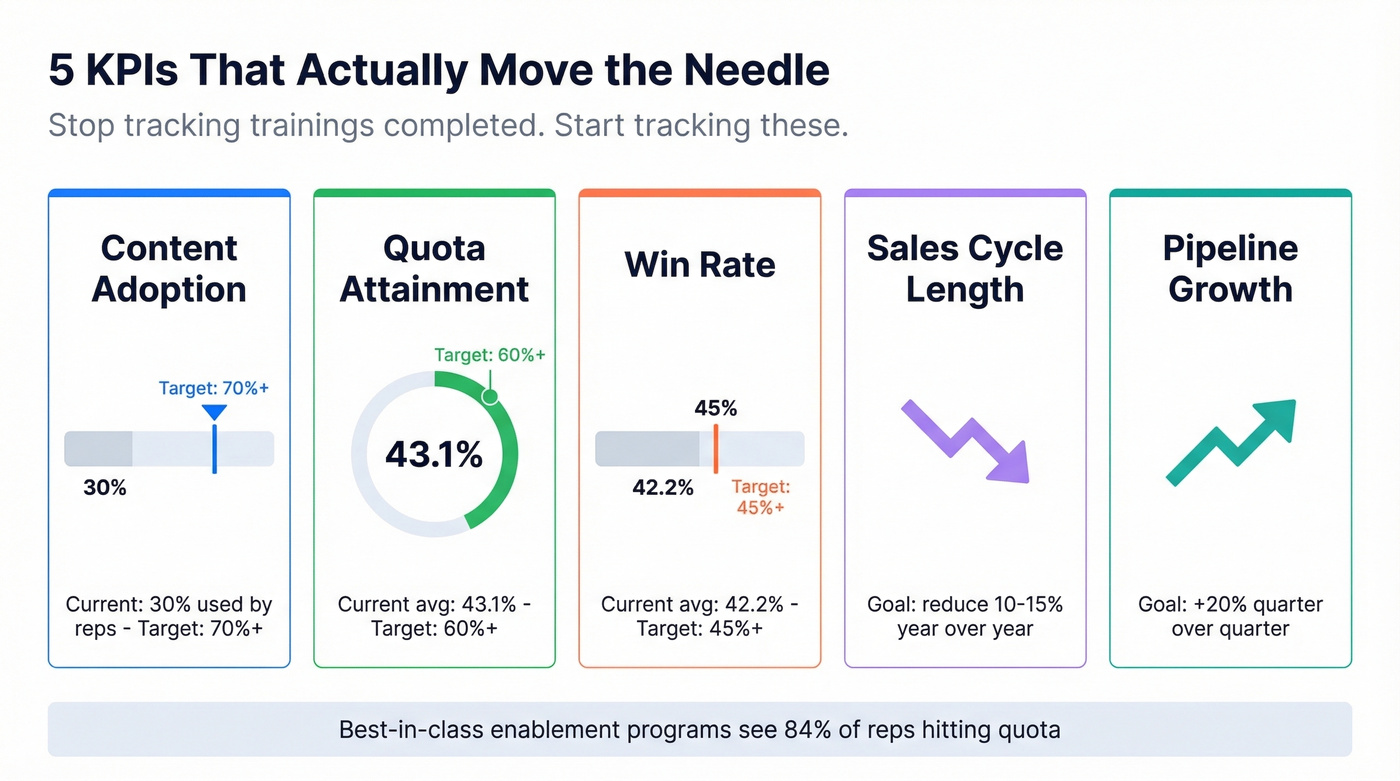
| KPI | What It Measures | Teams Tracking It | Recommended Target |
|---|---|---|---|
| Content adoption | Reps using approved content | 50% | >70% |
| Quota attainment | Reps hitting quota | 43.1% | >60% |
| Win rate | Deals won / deals worked | 42.2% | >45% |
| Sales cycle length | Days to close | 33.6% | -10-15% YoY |
| Pipeline growth | New qualified pipeline | 23.2% | +20% QoQ |
Targets are practitioner benchmarks, not industry averages. Source data from the Sales Enablement Landscape Report.
The best enablement programs see 84% of reps hitting quota. If your program can't move at least two of these KPIs within 180 days, something's structurally wrong.

Data quality is the enablement pillar most teams ignore - and the one that silently kills rep confidence. Prospeo's 98% email accuracy and 7-day refresh cycle keep bounce rates under 4%, so your reps trust their outbound from day one. GreyScout cut ramp time in half after fixing this exact problem.
Stop building enablement programs on top of broken data.
Who Should Own Enablement?
Enablement teams report to RevOps (39.4%), Sales (25.4%), C-Suite (16.6%), and Marketing (5.2%).
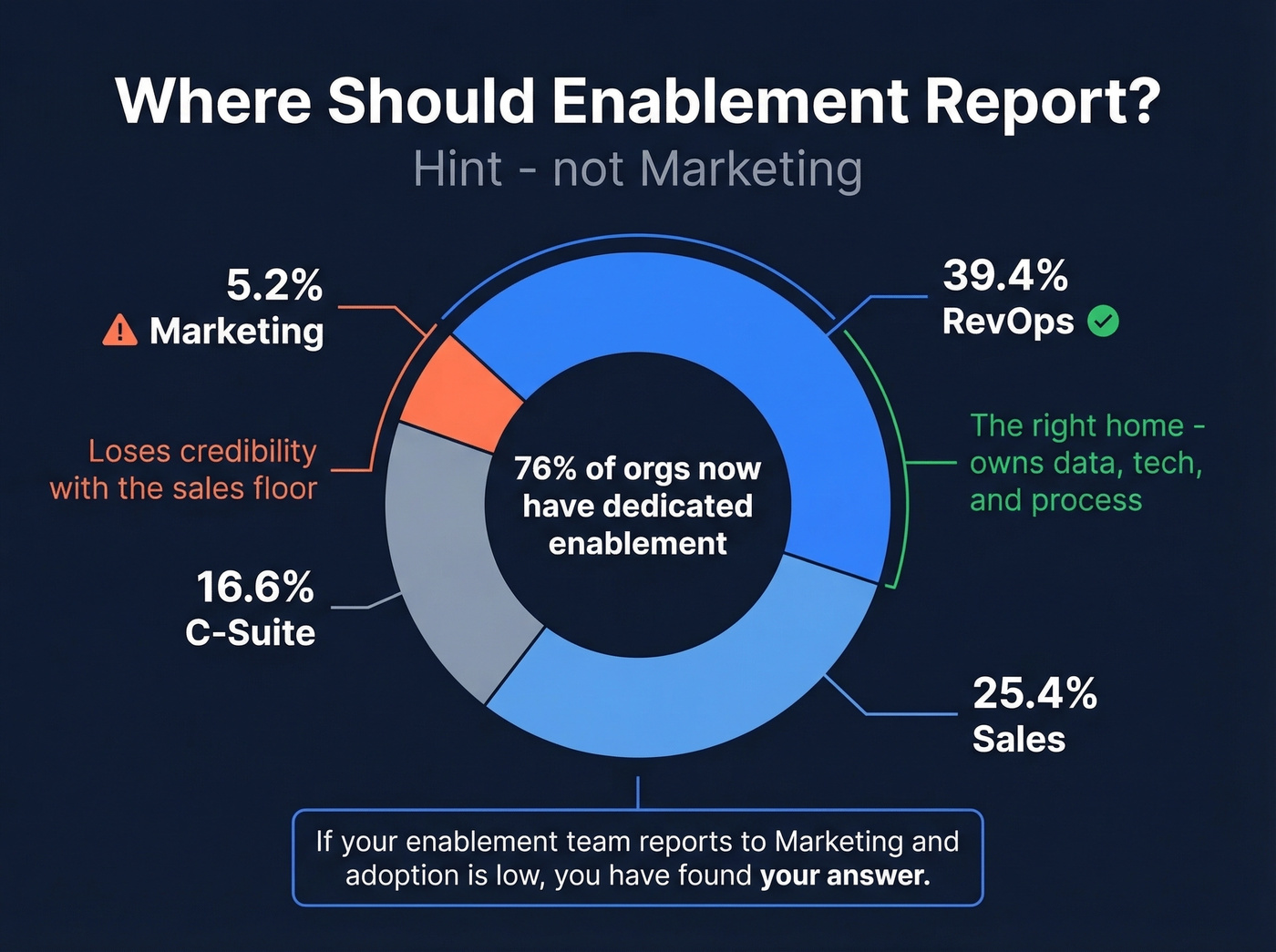
That Marketing number should tell you something. When enablement reports to Marketing, it loses credibility with the sales floor. RevOps is the right home. It sits at the intersection of sales, marketing, and customer success, and it owns the data, the tech stack, and the process. Enablement under RevOps has the authority to change workflows, not just suggest them. If your enablement team reports to Marketing and you're wondering why adoption is low, you've found your answer.
30/60/90-Day Rollout Framework
Don't launch a full enablement program on day one. 69% of new employees are more likely to stay 3+ years with structured onboarding, and a phased rollout protects both your reps and your program. Building your sales enablement strategy in stages also lets you course-correct before small problems compound.
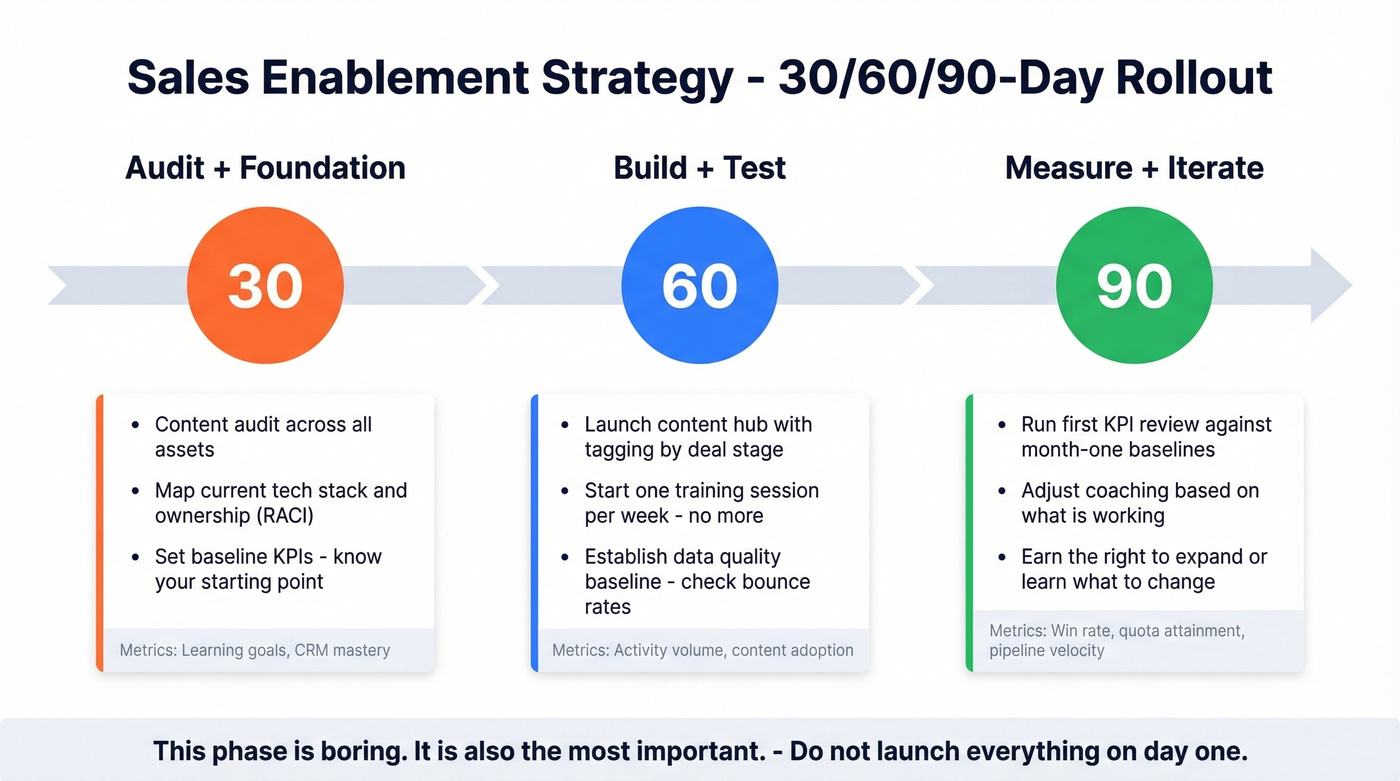
| Days 1-30 | Days 31-60 | Days 61-90 | |
|---|---|---|---|
| Focus | Audit + foundation | Build + test | Measure + iterate |
| Deliverables | Content audit, charter, RACI, baseline KPIs | Content hub launch, first training cadence, tech stack selection | Full program live, coaching cadence, first KPI review |
| Metrics | Learning goals, CRM mastery | Activity volume, content adoption | Win rate, quota attainment, pipeline velocity |
Days 1-30: Understand what you have and what's broken. Audit every piece of sales content. Map your current tech stack. Define ownership with a RACI. Set baseline KPIs so you can measure change. This phase is boring. It's also the most important.
Days 31-60: Build. Launch the content hub. Start one training session per week - no more. Select your tech stack or consolidate what you already have. Establish a data quality baseline: what's your current bounce rate? How many CRM contacts have valid emails?
Days 61-90: Shift entirely to measurement. Run your first KPI review against month-one baselines. Adjust coaching based on what's working. This is where you earn the right to expand - or learn what needs to change.
Seven Mistakes That Kill Programs
1. Treating enablement as training. Enablement is a system - content, tools, data, coaching, and measurement working together. A training calendar alone isn't a strategy.
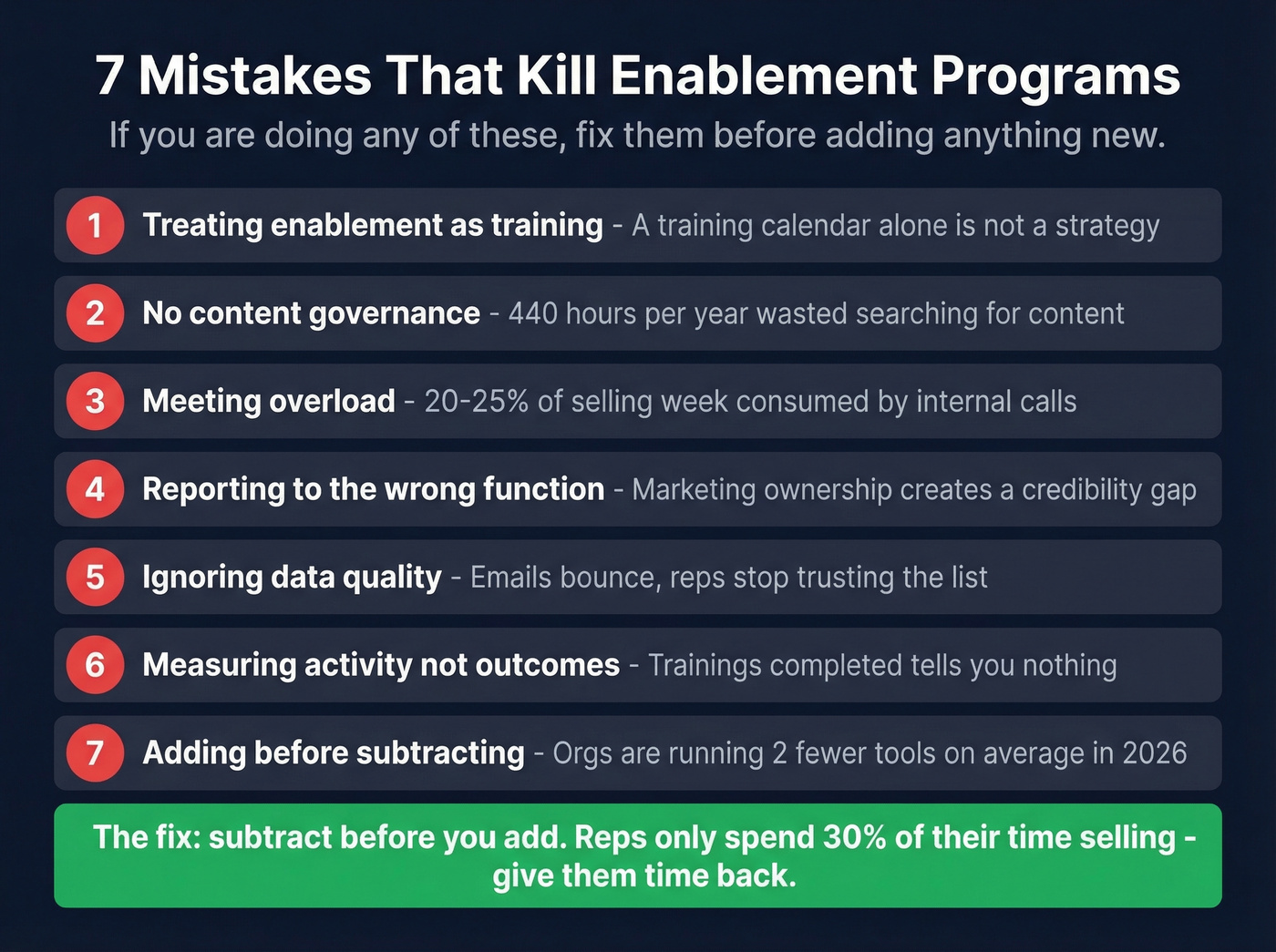
2. No content governance. 440 hours per year wasted searching for content. Outdated decks destroy buyer trust. No version control means no governance.
3. Meeting overload. The consensus on r/sales is brutal: mandatory enablement calls eat 20-25% of the selling week. Every meeting you add should replace something, not stack on top.
4. Reporting to the wrong function. Marketing ownership creates a credibility gap with sales. Enablement needs operational authority, not just content production.
5. Ignoring data quality. The best playbooks fail when emails bounce and reps stop trusting the list. Clean data is the foundation - without it, your enablement investment never reaches the buyer.
6. Measuring activity, not outcomes. "Trainings completed" tells you nothing. Track win rate and quota attainment. Those are the numbers your CFO cares about.
7. Adding before subtracting. The 2026 trend is consolidation. Before you add another initiative, kill one that isn't working. Reps spend only 30% of their time selling - effective enablement increases that by around 20%. Give them time back.
Your reps already waste 440 hours a year on non-selling tasks. Don't let bad contact data add to the pile. Prospeo delivers verified emails at $0.01 each and 125M+ direct dials - so the playbooks, coaching, and content you invest in actually reach real buyers.
Give your enablement strategy the data foundation it deserves.
AI and Enablement - What's Real
Every single one of 346 surveyed revenue enablement leaders now uses GenAI, up from 62% in 2024, per Allego's 2025 report. 81% use AI to create content like presentations and emails. 60% use it for real-time feedback during sales calls. The outcomes are tangible: 47% report AI boosted revenue, and 51% say it shortened sales cycles and onboarding time.
Let's be honest though - AI doesn't replace your enablement framework. It accelerates it. AI-generated content still needs governance. AI call coaching still needs a scoring rubric. AI-enriched data still needs verification. The teams winning with AI built the foundational pillars first and then layered intelligence on top. They didn't buy an AI tool and call it a strategy.
If you're building outbound sequences alongside enablement, pair governance with sales follow-up templates and a clear sequence management process.
FAQ
What's the difference between sales enablement and revenue enablement?
A sales enablement strategy arms sellers with content, training, and tools to close deals. Revenue enablement expands that scope to marketing, customer success, and post-sale teams - aligning the entire revenue organization. In 2026, the Seismic-Highspot merger and Gong's platform expansion signal that the category is converging toward full-funnel enablement.
How long before an enablement program shows results?
Expect early signals like content adoption and training completion within 30-60 days. Outcome metrics - win rate, quota attainment, pipeline velocity - typically shift within 90-180 days. The 30/60/90-day framework above gives you phase-specific benchmarks to track progress without waiting a full quarter.
What tools do you need for enablement?
Start with three layers: a CRM (Salesforce or HubSpot), a content and training platform (evaluate Allego, Salesloft, or the post-merger Seismic-Highspot offering), and a data quality tool to ensure reps reach prospects with verified emails and direct dials. Expand only after you've maxed out what those three can do.