

Sales Enablement Templates That Actually Get Used
New reps ramp for 90 days because nobody documented the talk track, the ICP, or what to send after the demo. 88% of sales leaders call enablement extremely important, but only 51% have actually implemented it. That gap isn't a strategy problem. It's a templates problem.
Most enablement templates are useless because they aren't tied to a specific sales moment. The templates below are different - each one maps to a deal stage, includes the exact fields your reps need, and takes under 60 seconds to use during a live conversation. If a template can't be used that fast, it's not a template. It's documentation nobody reads.
If You Only Build Three
Here's the thing: you don't need 11 templates to start changing outcomes. You need three.
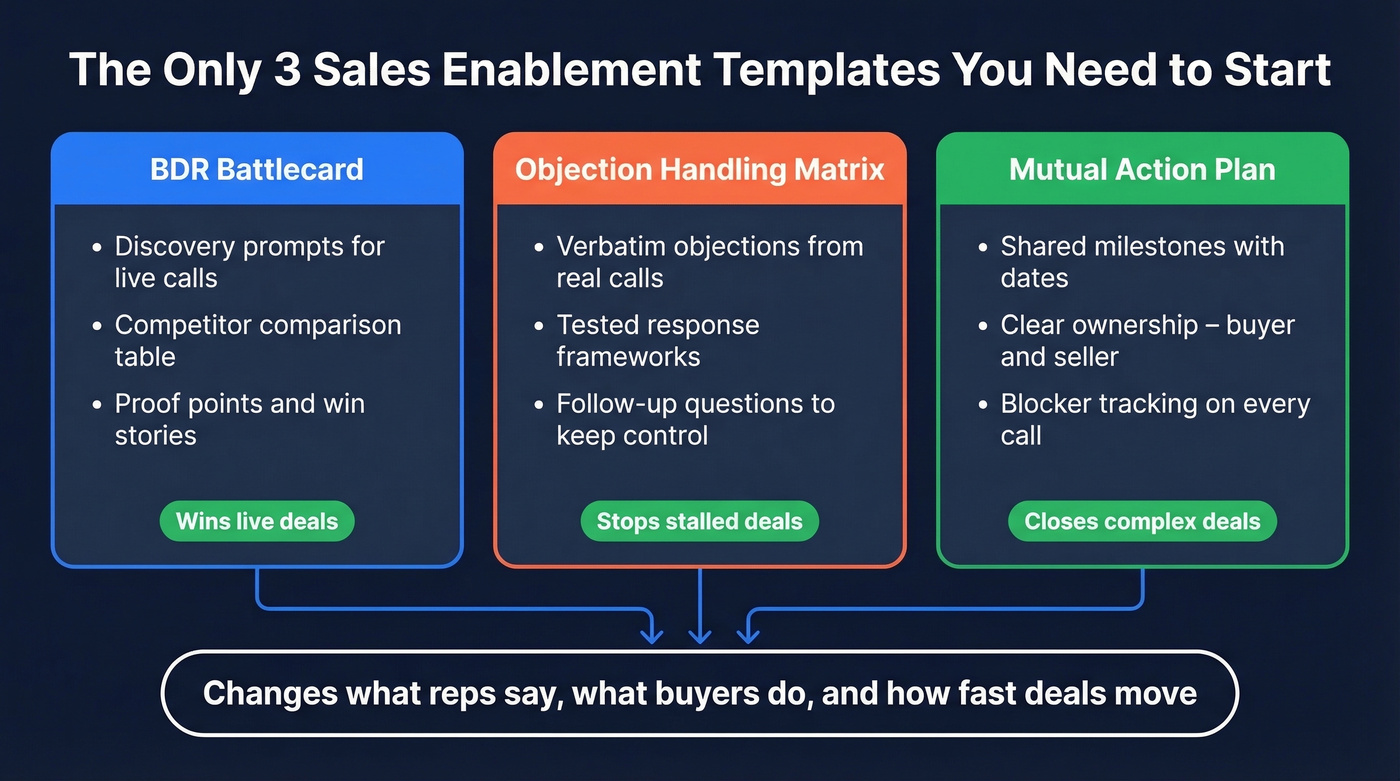
- BDR Battlecard - wins live deals by giving reps discovery prompts, competitor comparisons, and proof points in one scannable doc
- Objection Handling Matrix - stops stalled deals by pairing verbatim objections with tested responses and follow-up questions
- Mutual Action Plan - closes complex deals by creating shared accountability between buyer and seller on milestones and dates
These three directly change what reps say, what buyers do next, and how fast deals move. The rest of this article gives you 8 more, plus how to measure and maintain all of them.
Internal vs External Templates
Before building anything, know who the template is for. Internal templates arm your reps. External templates arm your buyers between sales touches. The distinction matters because format, depth, and update cadence are completely different.
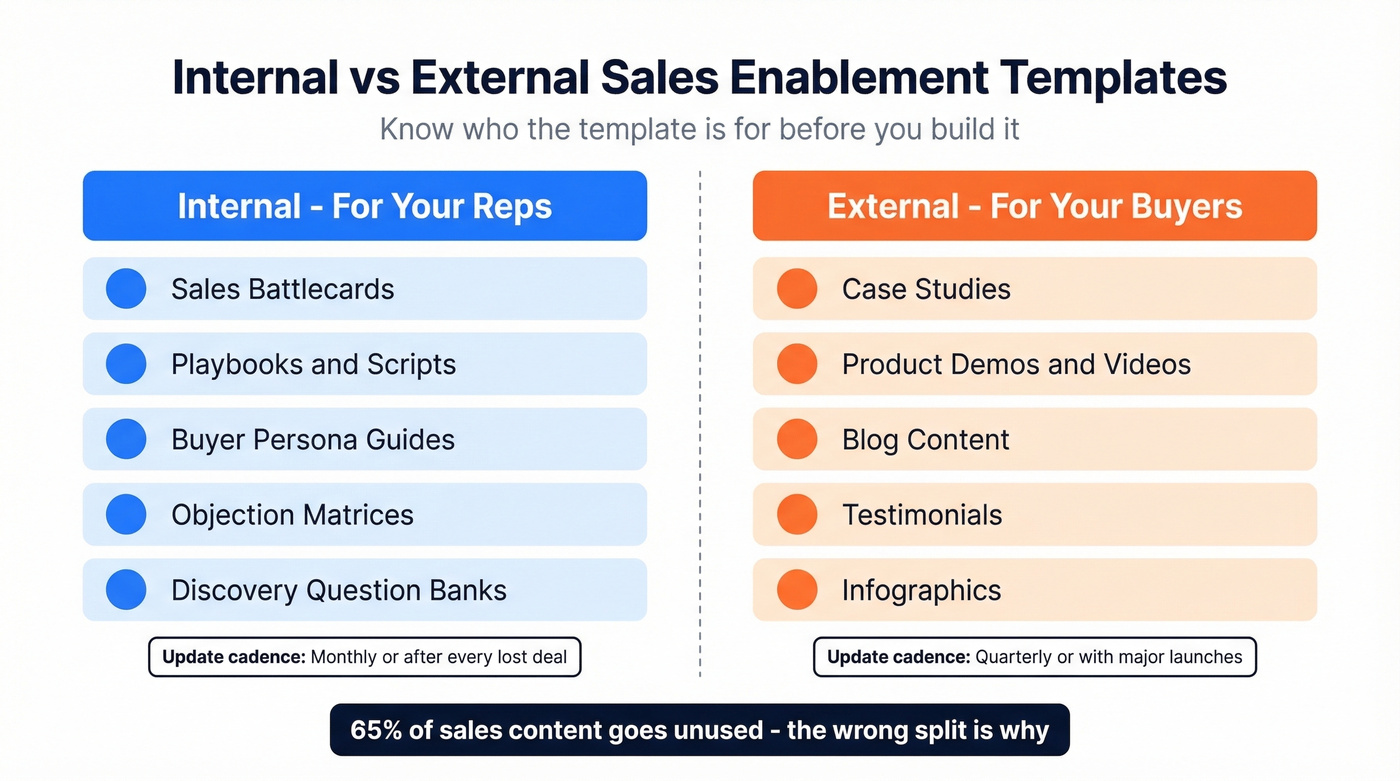
The enablement content market is growing at a 17.4% CAGR, which means the volume of content your team produces will roughly double about every 4.3 years, and 76% of organizations now have a dedicated enablement function, up from 32% five years ago. The problem isn't adoption anymore - it's execution. Without a clear internal/external split, you'll drown reps in buyer-facing case studies they don't need and starve them of the battlecards they do.
| Internal (for reps) | External (for buyers) |
|---|---|
| Sales battlecards | Case studies |
| Playbooks & scripts | Product demos / videos |
| Buyer persona guides | Blog content |
| Objection matrices | Testimonials |
| Discovery question banks | Infographics |
11 Copy-Ready Templates for Every Deal Stage
Here are 11 templates covering the full sales cycle. Each one lists the exact fields to include so you can build it in Google Docs, Notion, or Slides today. Copy the fields, customize for your ICP, and ship.
Sales Enablement Strategy Template
This is your foundation document. Without it, enablement becomes a reactive service desk for whatever the loudest leader wants.
Start with a one-sentence mission statement, then get sign-off from sales, marketing, and RevOps sponsors. Define your coaching cadence - weekly 1:1s, monthly ride-alongs, or async video reviews - and assign content ownership: who creates, who updates, who retires. Lock in 2-3 KPIs and commit to reviewing the charter itself quarterly.
Needs Assessment Worksheet
Before you build templates, figure out what's actually broken. This worksheet forces that conversation with data instead of opinions.
- Current process gaps - where do deals stall or die?
- Tool inventory - what do reps actually use daily?
- Rep feedback themes - top 3 complaints from the last QBR
- Customer feedback themes - top 3 objections from lost deals
- Priority ranking - stack-rank gaps by revenue impact
Buyer Persona One-Pager
We've watched teams build 12-page persona decks that nobody reads. Reps need a one-pager they can scan before a call. Build one per ICP segment covering role and title, industry, the 3-4 pain points they'll admit to on a discovery call, buying triggers like new funding or a missed quarter, common objections and why they push back, preferred content format, and the decision criteria they'll evaluate you on - price, integrations, time-to-value.
BDR Battlecard
Your VP asks for battlecards after losing three deals to the same competitor - by next week. Sound familiar? The best battlecards include embedded coaching, not just feature comparisons. Think "Ask this / Listen for..." prompts that guide reps through discovery.
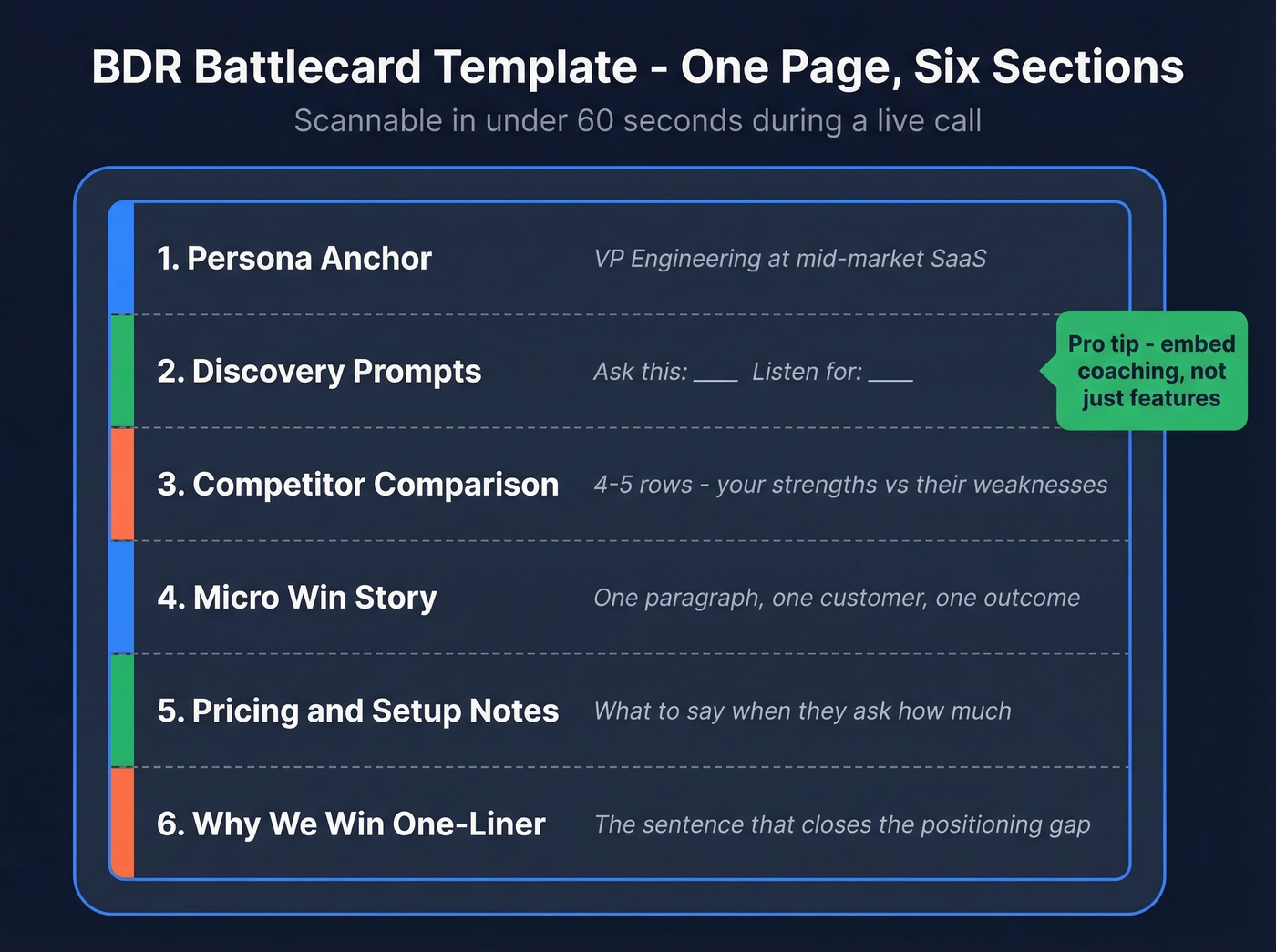
- Persona anchor - who this battlecard is for, like "VP Engineering at mid-market SaaS"
- Discovery prompts - "Ask this: ___. Listen for: ___."
- Competitor comparison table - 4-5 rows, your strengths vs their weaknesses
- Micro win story - one paragraph, one customer, one outcome
- Pricing/setup notes - what to say when they ask "how much?"
- "Why we win" one-liner - the sentence that closes the positioning gap
Late-Stage Battlecard
Different from the BDR version. This one's for AEs in final evaluations where the buyer is comparing you head-to-head with a named competitor.
- Competitor strengths - be honest; reps lose credibility if they pretend competitors have none
- Competitor weaknesses - where they consistently fall short
- Objection responses - the 3-4 things the competitor's champion will say about you
- Depositioning talk track - how to reframe without trash-talking
- Executive snapshot - competitor's recent funding, leadership changes, product moves
- Recent developments - anything from the last 90 days that changes the matchup
Objection Handling Matrix
This is the template that pays for itself fastest. Build it as a table your reps can Ctrl+F during a live call.
| Objection (verbatim) | Root cause | Response framework | Proof point | Follow-up question |
|---|---|---|---|---|
| "We're locked into a contract" | Switching cost fear | Acknowledge, quantify cost of staying, offer migration support | [Customer] migrated in 2 weeks | "When does your renewal come up?" |
| "Your competitor is cheaper" | Price anchoring | Reframe to total cost of ownership | ROI case study | "What's included in their quote?" |
Add 8-10 rows covering your most common objections. Update monthly based on call recordings. In our experience, teams that refresh this matrix monthly see the biggest stage-to-stage conversion gains within the first quarter.
Discovery Question Bank
Structure discovery questions by stage so reps know what to ask and what the answers mean.
| Stage | Question | What it reveals | Red flag | Green flag |
|---|---|---|---|---|
| Early | "What prompted this evaluation?" | Urgency level | "Just exploring" | "We lost a deal because of X" |
| Mid | "Who else is involved?" | Buying committee size | "Just me" (enterprise) | Names + roles |
| Late | "What would stop you?" | Hidden objections | Vague deflection | Specific concern |
Prospect List Build Checklist
Templates fail at the last mile when reps have bad contact data. This checklist ensures outreach doesn't undermine everything upstream.
- ICP criteria defined - industry, headcount, revenue range, tech stack
- Target account list sourced from CRM, intent signals, or manual research
- Contact data sourced and verified - tools like Prospeo verify emails in real time with 98% accuracy and refresh records every 7 days, which keeps your outreach from bouncing before it starts
- Sequence tool configured in Instantly, Lemlist, Outreach, or similar
- Send volume set - start at 30-50/day per mailbox, scale from there
- Reply handling assigned - who monitors and routes responses?
Mutual Action Plan
Complex deals die when nobody owns the next step. A mutual action plan creates shared accountability between buyer and seller, and it's the single best tool we've found for unsticking late-stage deals that have gone quiet.
| Milestone | Owner | Due date | Status | Blocker |
|---|---|---|---|---|
| Technical evaluation | Buyer (IT lead) | Jan 15 | Complete | - |
| Security review | Buyer (CISO) | Jan 22 | In progress | Waiting on SOC 2 |
| Business case to CFO | Seller + Buyer | Feb 1 | Not started | - |
| Contract review | Buyer (legal) | Feb 10 | Not started | - |
Share this as a living Google Doc or Notion page. Update it on every call.
Win/Loss Story Template
Win/loss stories are the most underrated enablement asset. They aren't case studies - they're internal learning docs that help reps pattern-match. Capture the deal context (size, industry, competitor involved), the real reason you won or lost (not the CRM dropdown), verbatim buyer quotes from the champion or detractor, one actionable lesson, and what changed in process, messaging, or product as a result.
Content Retirement Log
Let's be honest: enablement teams should delete more content than they create. 65% of sales content goes unused. Reps spend an estimated 440 hours per year searching for or recreating content that already exists somewhere. This log prevents that.
| Asset name | Requester | Date requested | Status | Last used | Notes |
|---|---|---|---|---|---|
| Q3 Battlecard v2 | Sales Dir | Mar 2026 | Active | Mar 2026 | - |
| Old pricing PDF | Marketing | Nov 2025 | Retired | Aug 2025 | Replaced by new pricing page |
If an asset hasn't been opened in 90 days, retire it. No exceptions.

Your Prospect List Build Checklist has a single point of failure: bad data. Prospeo's 300M+ profiles with 98% email accuracy and 125M+ verified mobiles mean your reps actually reach the buyers those battlecards were built for.
Templates don't close deals. Conversations do. Start with data that connects.
Which Template to Use When
Don't build all 11 at once. Match templates to your current symptoms.
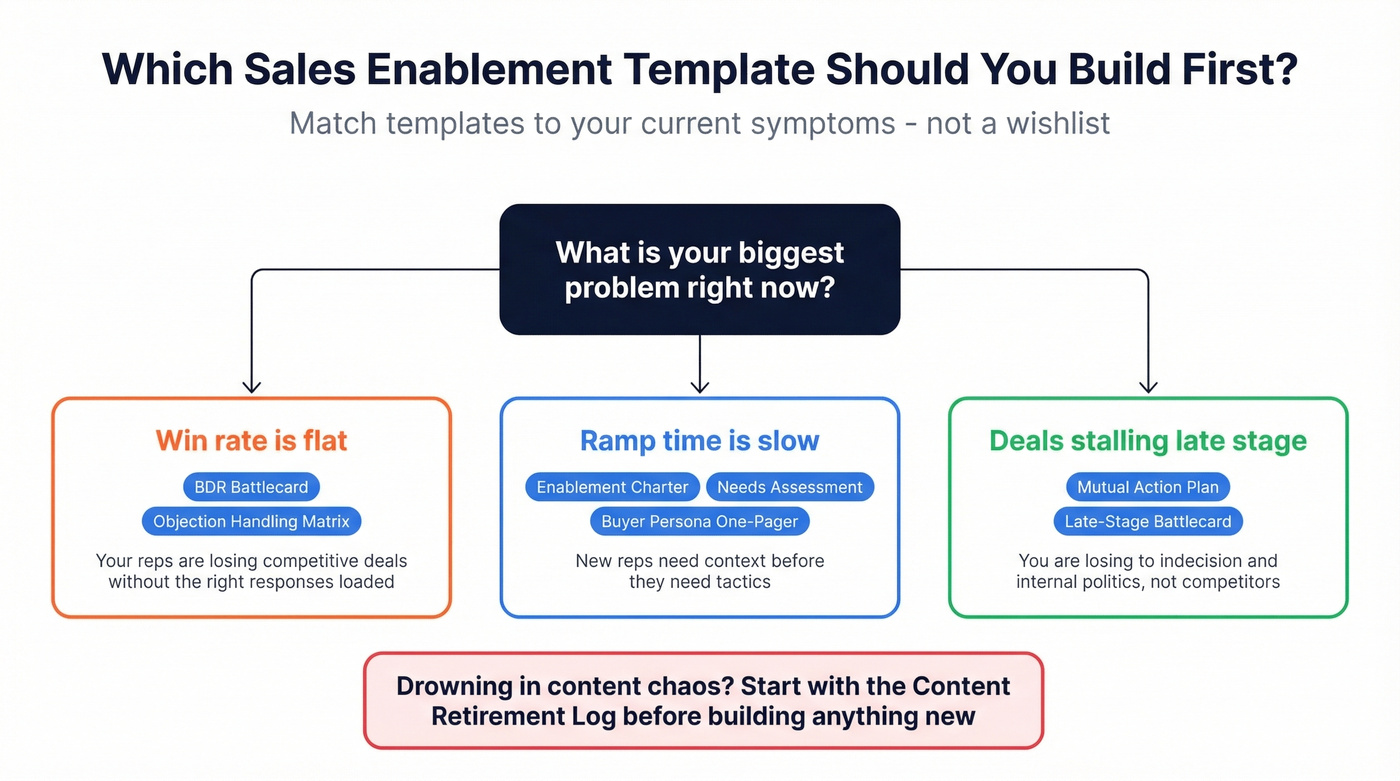
Win rate is flat? Start with the BDR battlecard and objection handling matrix. Your reps are losing competitive deals because they don't have the right responses loaded.
Ramp time is slow? Build the enablement charter, needs assessment worksheet, and buyer persona one-pager. New reps need context before they need tactics.
Deals stalling in late stages? Deploy the mutual action plan and late-stage battlecard. You're losing deals to indecision and internal politics, not competitors.
For teams drowning in content chaos, implement the content retirement log immediately. You can't build new templates responsibly until you've cleaned up the old ones.
Why Enablement Templates Fail
We've seen teams spend months building beautiful enablement libraries that nobody opens. The pattern is almost always the same, and Gong's enablement team documented the four core mistakes cleanly: no definition of enablement (so it becomes whatever the loudest stakeholder demands), reactive task-focused work (every product launch triggers a new deck nobody asked for), wrong investments at the wrong time (resources follow politics instead of the customer journey), and wrong metrics (measuring "assets created" instead of behavior change tied to funnel outcomes).
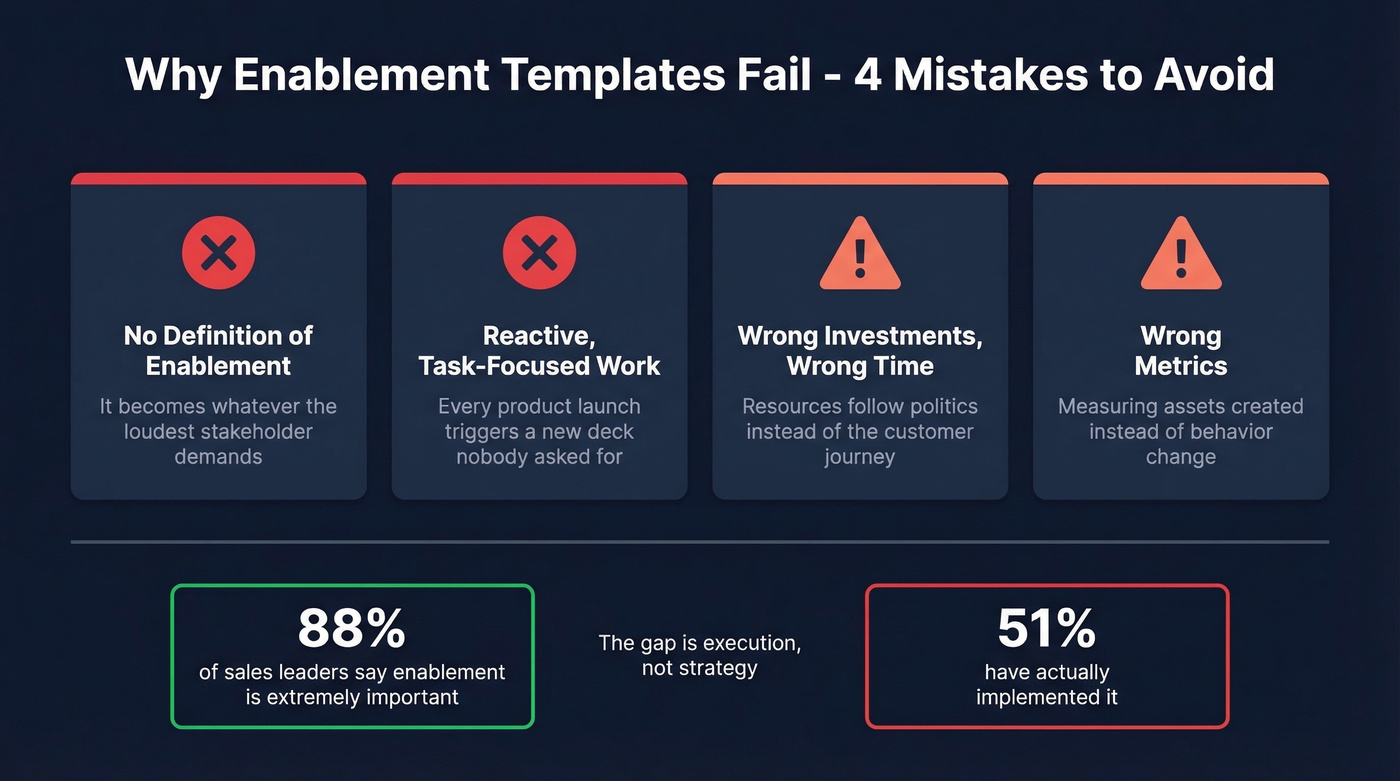
If you're tracking slide deck downloads instead of discovery-to-demo conversion, you're optimizing for busywork. Only 30% of marketing-created content gets used by sales. The information overload problem compounds every other failure mode.
Stop publishing template libraries. Publish template systems with ownership, update cadence, and a KPI tied to each asset. That single shift separates teams that build enablement content from teams that build enablement infrastructure.
Measuring Template Impact
The most common metrics teams track: content adoption (50%), quota attainment (43.1%), win rate (42.2%), revenue generated (37.9%), and sales cycle length (33.6%).
| Template type | Primary metric | Benchmark |
|---|---|---|
| Battlecards | Win rate | 49% with enablement vs 42.5% without |
| Objection matrix | Stage-to-stage conversion | Track monthly trend |
| Mutual action plan | Sales cycle length | 10-15% cycle reduction |
| Persona one-pager | Ramp time to first deal | 40-50% onboarding reduction |
| Content log | Content adoption rate | 25% higher usage with centralized libraries |
Programs with best-in-class enablement see 38% higher quota achievement, with reps hitting 75% quota attainment. Sales training programs deliver a 353% average ROI - but only when the training is reinforced by templates reps actually use in the field.
Picking the Right Format
Format matters more than people think. A great sales pitch deck template follows the same rule as every other enablement asset: it maps to a specific moment in the deal.
Use Google Slides for exec-facing one-pagers and pitch decks that need to look polished. Use Google Docs or Notion for living playbooks that get updated weekly. Use Sheets for anything tabular - account plans, objection matrices, content logs. Enterprise teams running Highspot or Seismic (~$30-100k+/year) get analytics and governance baked in, but most teams under 50 reps don't need that yet. Skip the enterprise platform until you've outgrown Notion.
For your sales presentation template, keep it to 8-12 slides max: problem, impact, solution, proof, pricing, next steps. Anything longer and you're presenting at your buyer, not with them.
Review competitive battlecards monthly - markets shift fast. Review persona docs and messaging frameworks quarterly. Assign a clear owner per template and schedule recurring reviews; Slack's enablement hub template is built around a dedicated enablement space and a monthly review cadence, with top teams updating weekly. The owner isn't responsible for all updates, but they're accountable for keeping the template current.
If you don't schedule the review, it won't happen. Put a recurring calendar invite on the template owner's calendar. Centralized libraries see 25% higher content usage rates, but only if the content in them is actually fresh. Store shared templates in a single source of truth - one folder, one workspace - so reps never have to guess which version is current.
You just built discovery question banks, objection matrices, and mutual action plans. Now your BDRs need direct dials and verified emails to use them. Prospeo gives you 30+ filters - intent data, tech stack, headcount growth - at $0.01 per email.
Stop enabling reps with great templates and garbage contact data.
FAQ
What's the difference between a sales playbook and a sales enablement template?
A playbook is the full strategy document covering process, methodology, and messaging for a specific sales motion. A template is a single reusable asset within that playbook - like a battlecard or objection matrix - designed for one specific sales moment. You need the playbook for context, but reps use templates in the field.
How many templates does a sales team actually need?
Start with three: a battlecard, an objection matrix, and a mutual action plan. Most mature teams maintain 10-15 active templates total. More than that usually signals you need a retirement process, not more content - 65% of sales content goes unused.
How often should enablement templates be updated?
Monthly for competitive battlecards. Quarterly for persona docs and messaging frameworks. Retire any template that hasn't been opened in 90 days. If you aren't reviewing on a cadence, your templates are already stale.
What tools do teams use to build and store these templates?
Most teams use Google Docs or Notion for living documents, Google Slides for exec-facing decks, and Sheets for matrices and account plans. Enterprise teams use Highspot or Seismic ($30-100k+/year) for analytics. For contact data feeding your outreach templates, Prospeo's free tier (75 emails/month) pairs well with any of these setups.
How do I make sure reps actually use the templates I build?
Tie each template to a specific deal moment, not a training session. Measure content adoption rates weekly - teams with centralized, regularly updated libraries see 25% higher usage. The consensus on r/sales is pretty consistent here too: reps ignore anything that isn't immediately useful during a live conversation. If it takes more than a minute to find and use, it's dead on arrival.