

Sales Engagement Platform vs CRM: How to Decide (2026)
About 45% of sales professionals say they're overwhelmed by the number of tools in their stack. The most common confusion? Whether a sales engagement platform vs CRM is an either-or decision - or whether you need both.
Short answer: they do different jobs. The real question is which combination fits your team right now.
What You Need (Quick Version)
- Under 5 reps, moderate outbound: Your CRM's built-in sequences, like HubSpot Sequences, are enough. Don't add another tool yet.
- 5+ reps running standardized cadences: You need a standalone SEP. Apollo ($59/user/mo) or Mixmax ($34/user/mo) for value; Outreach or Salesloft for enterprise.
- Either way: Fix your contact data first. A SEP sending emails to stale addresses destroys your sender reputation.
What Each Tool Actually Does
Max Altschuler, former VP of Marketing at Outreach, calls the CRM your "data warehouse." The SEP is where all the activity happens. Gartner frames it similarly - sales engagement applications are becoming the primary "system of action" for daily B2B seller workflows, while CRMs remain the system of record. Understanding this distinction matters before you spend a dollar on either.
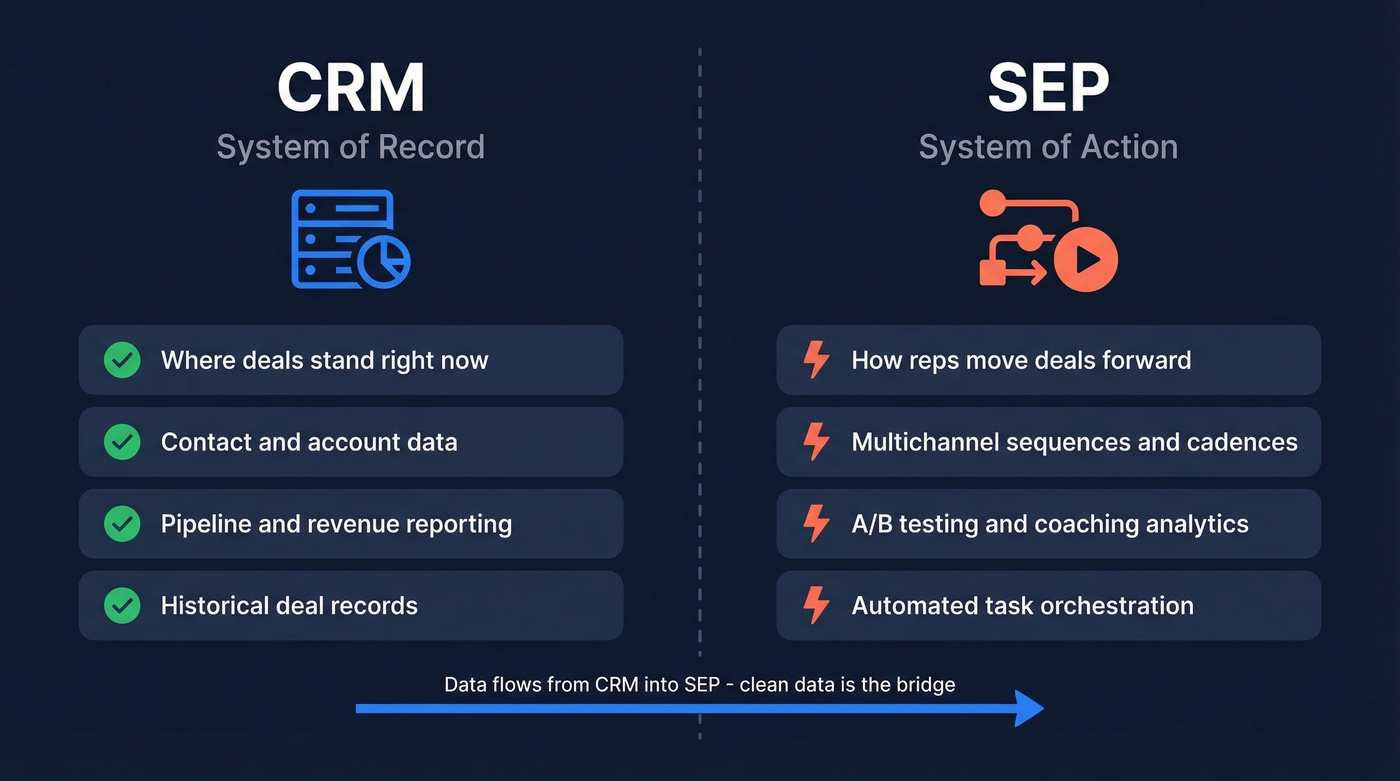
| Capability | CRM | SEP |
|---|---|---|
| Contact management | ✅ Core | ❌ Syncs from CRM |
| Pipeline tracking | ✅ Core | ❌ Limited |
| Revenue reporting | ✅ Core | ⚠️ Activity-level |
| Multichannel sequences | ⚠️ Basic | ✅ Core |
| A/B testing outreach | ⚠️ Limited | ✅ Core |
| Coaching analytics | ⚠️ Limited | ✅ Advanced |
| Task orchestration | ⚠️ Manual | ✅ Automated |
The CRM tells you where a deal stands. The SEP helps reps actually move it forward.
When Your CRM Is Enough
If you're running under 10 reps doing moderate outbound, HubSpot's built-in Sequences feature is genuinely solid. It handles basic email cadences, tracks opens and replies, and lives inside the CRM your reps already use. For many early-stage teams, CRM-native engagement workflows are all they need.
Salesforce's Sales Engagement is a different story. The consensus on r/salesforce is blunt - one practitioner called it "total trash" compared to HubSpot, citing clunky UX and weak reporting. We've heard similar complaints from teams we've worked with who tried to make it stick.
CRM-native engagement works until you need standardized playbooks across 10+ reps with coaching visibility and multichannel orchestration. Managers want rep-level analytics; reps want fewer clicks. Once those needs diverge, a standalone SEP pays for itself.
The ROI Case for a Standalone SEP
Opportunities closed within 50 days hit a 47% win rate - after 50 days, that drops to 20% or lower. SEPs compress that timeline by automating follow-ups and keeping deals from going cold.
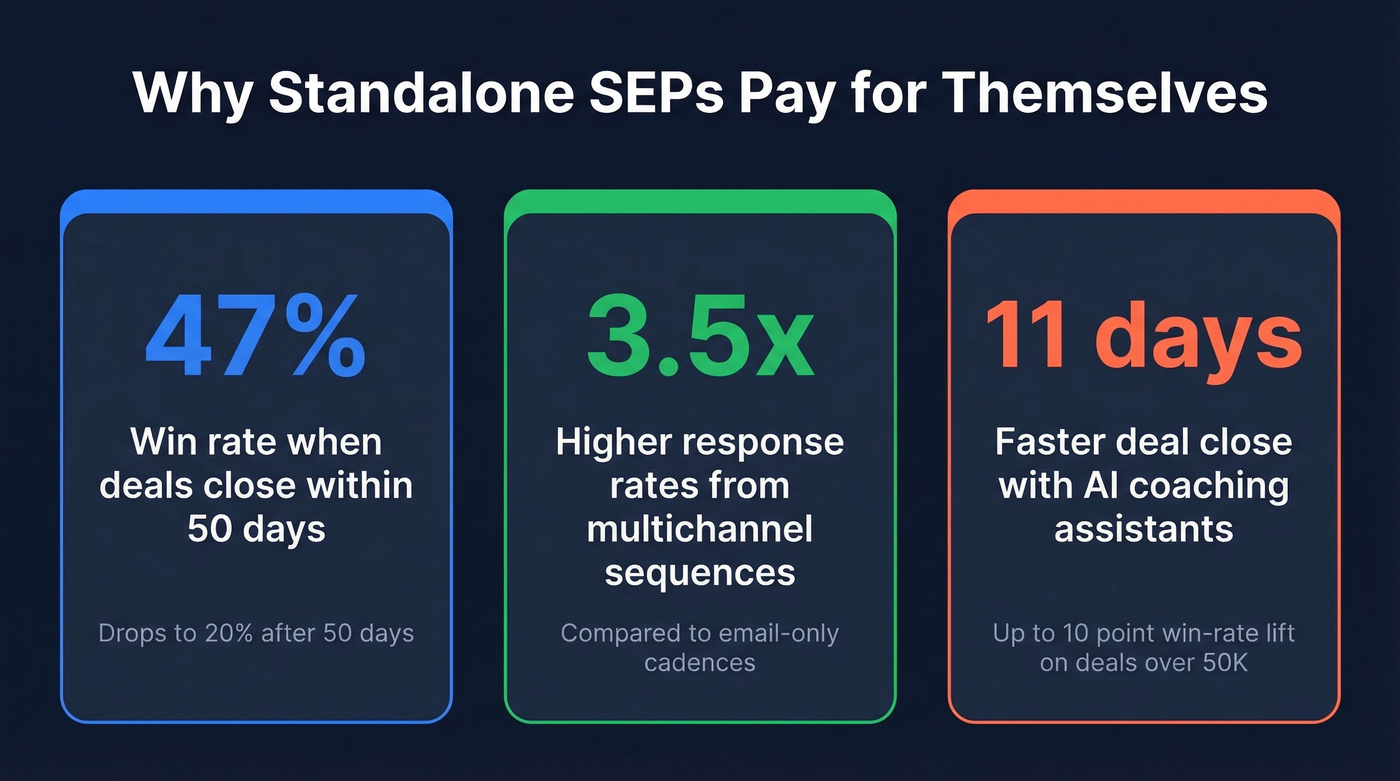
Multichannel sequences drive 3.5x higher response rates compared to email-only cadences. That lift justifies a $59-100/mo per-seat investment pretty quickly. Outreach's Kaia coaching assistant closes deals 11 days faster on average, and for deals over $50K, users see up to a 10 percentage point win-rate lift. Meanwhile, 45% of teams now run a hybrid AI-SDR model, making the SEP the orchestration hub for both human and AI-driven outreach.
Let's be honest: when you compare dedicated engagement tools against CRM capabilities in isolation, the activity-layer ROI isn't even close.

Multichannel sequences drive 3.5x higher response rates - but only when emails actually land. Prospeo's 5-step verification delivers 98% email accuracy with a 7-day refresh cycle, feeding clean data directly into Outreach, Salesloft, HubSpot, and Salesforce.
Stop paying $100/seat for a SEP that bounces 25% of your emails.
SEP Pricing at a Glance
| Tool | Starting Price | Notes |
|---|---|---|
| SmartReach | $29/user/mo | Budget pick |
| Mixmax | $34/user/mo | Free plan available |
| Instantly | $47/user/mo | Cold email focus |
| Apollo | $59/user/mo | Free tier; built-in data |
| Reply.io | $59/user/mo | Multichannel |
| Klenty | $60/mo | Mid-market |
| Lemlist | $79/user/mo | Deliverability focus |
| Skylead | $100/seat/mo | LinkedIn + email |
| HubSpot Sales Hub | $15/seat/mo | CRM-native |
| Salesforce SE | $50/user/mo | Add-on to SFDC |
| Outreach | ~$100-150/user/mo | Custom quotes only |
| Salesloft | ~$100-150/user/mo | Custom quotes only |
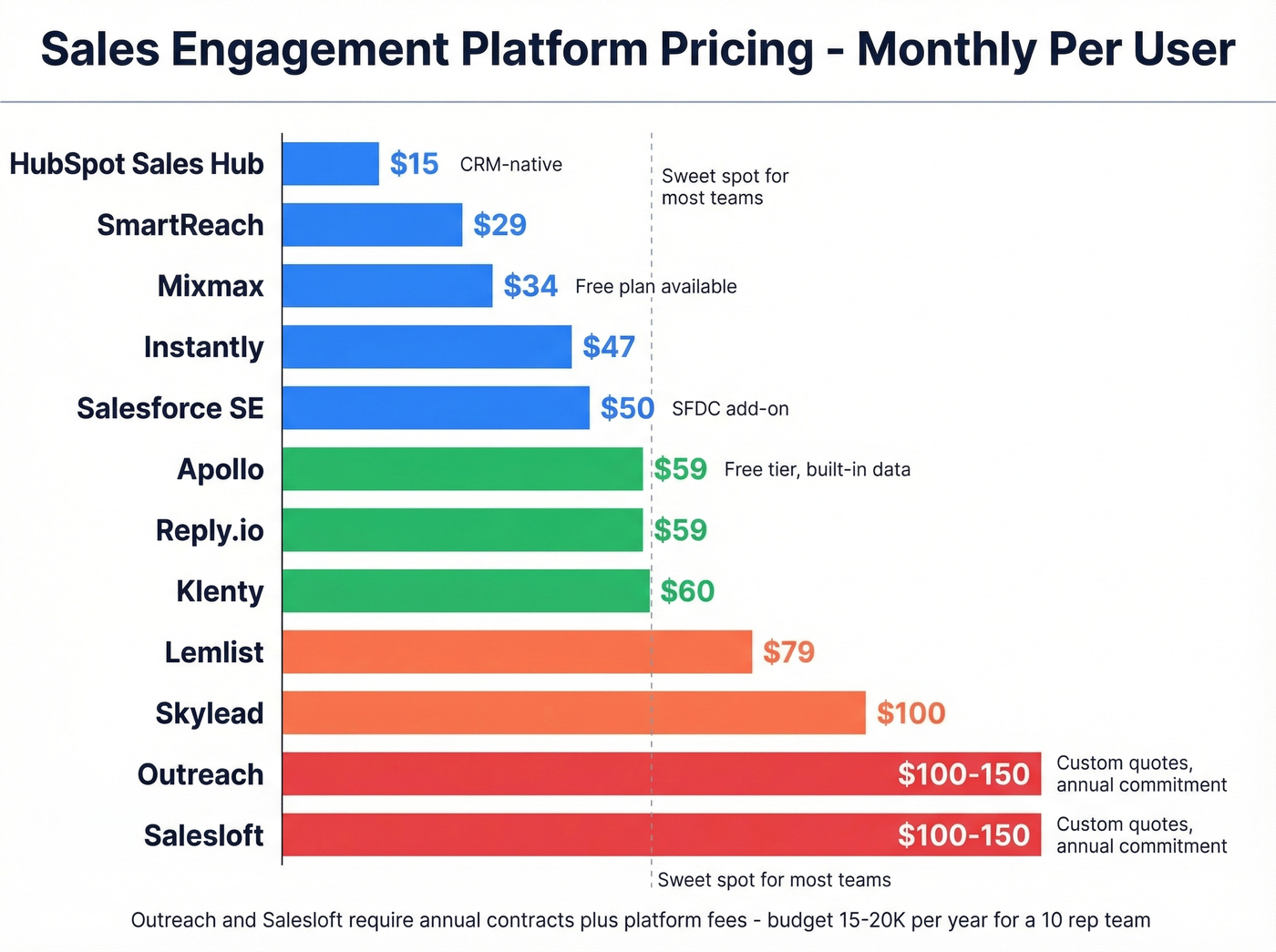
Outreach and Salesloft don't publish pricing. Expect annual commitments and platform fees on top of per-seat costs. For a 10-rep team, budget $15-20K/year minimum with either.
Skip both if you're under five reps and your outbound volume doesn't justify the spend - HubSpot's $15/seat Sales Hub tier is a fraction of the cost and covers the basics.
Integration Reality Check
Buying a SEP is one decision. Getting it to talk to your CRM cleanly is another.
We've seen teams lose weeks on this. On HubSpot, know that Outreach's connector was actually built by HubSpot, not Outreach, and it doesn't get the support level you'd expect. Salesloft built theirs in-house, but deal and opportunity sync is a known sticking point teams run into during evaluation. Chrome extension conflicts, duplicate records, and field-mapping mismatches are the norm - budget for a dedicated CRM admin or RevOps resource before you sign anything.
The Data Layer Everyone Forgets
Here's a scenario we see constantly: a team buys a shiny new SEP, reps start running sequences, and the bounce rate sits at 25%. The SEP is working as designed - it's just sending emails to garbage addresses.
Neither your CRM nor your SEP fixes bad contact data. That's a separate problem entirely.

Prospeo sits underneath your stack as that data layer. Its 5-step verification delivers 98% email accuracy, and records refresh on a 7-day cycle versus the six-week industry average. It integrates natively with Salesforce, HubSpot, Salesloft, Outreach, Lemlist, and Instantly - so verified contacts flow directly into whatever CRM and SEP combination you're running. At roughly $0.01/email with a free tier, it's the cheapest insurance against domain reputation damage you'll find.
If you're seeing bounce spikes, start with email bounce rate benchmarks and fixes, then work backward into list quality and sending behavior.
Why You Need Both
Stop asking "SEP or CRM." They're different tools for different jobs:
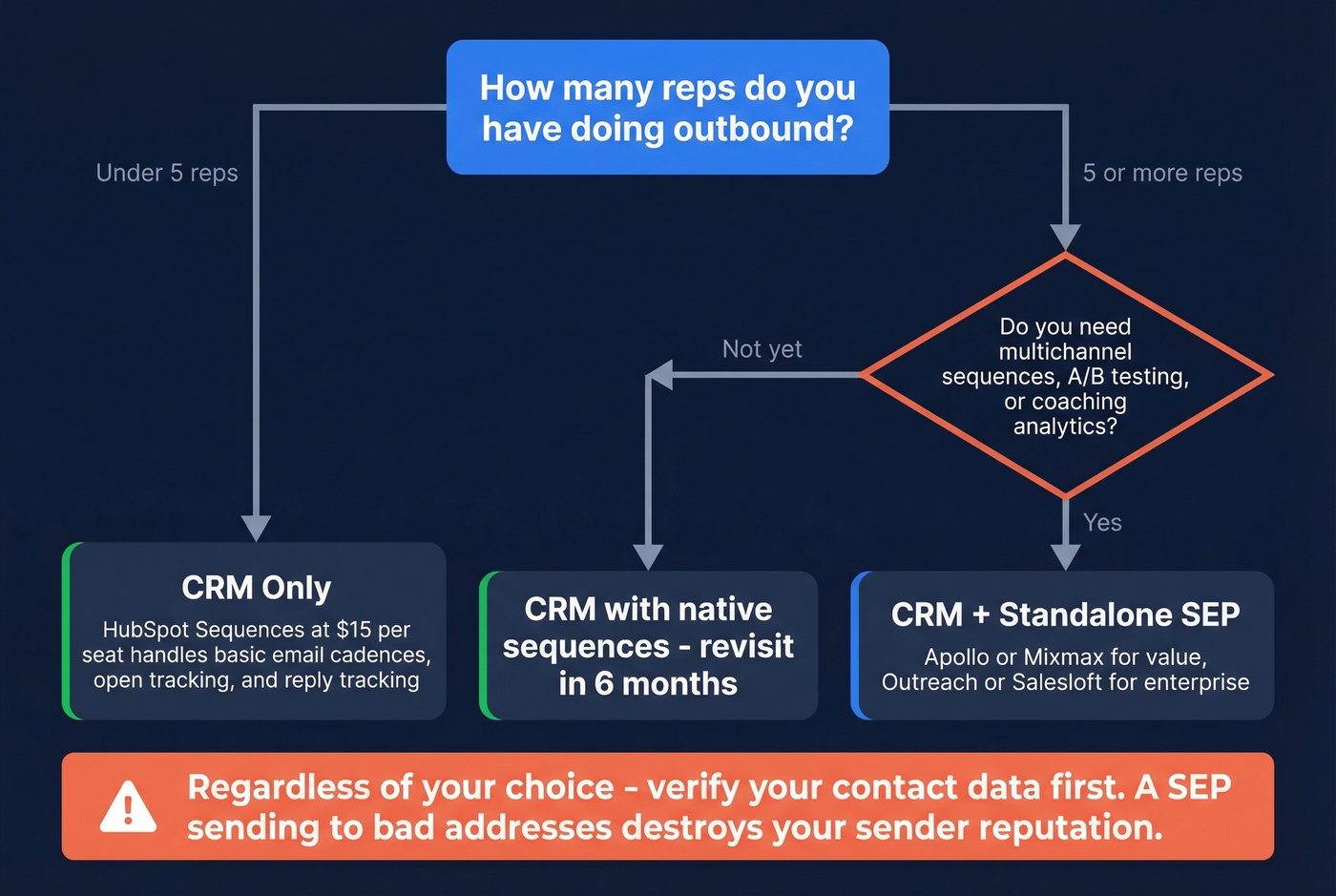
- Small team, light outbound: CRM-only with HubSpot Sequences.
- Growing team, standardized cadences: CRM + standalone SEP.
- Regardless of tier: Verify your data before it touches any sequence. A $100/mo SEP is worthless if a quarter of your emails bounce.
For B2B teams scaling outbound, the sales engagement platform vs CRM debate resolves quickly once you realize each tool covers a gap the other can't. A stack where both systems share clean, verified data is the foundation every high-performing revenue team builds on.
Here's the hot take nobody wants to hear: most teams debating which tool to buy should actually be asking whether their data is good enough to justify either investment.
If you're building repeatable outbound, it helps to standardize your sequence management and keep reps aligned on sales activities that actually move pipeline.
You just compared SEPs and CRMs. Neither one fixes stale contact data. Prospeo integrates natively with both layers of your stack - verified emails and direct dials flow into your CRM and sequences automatically, at roughly $0.01 per email.
Build the data layer your entire sales stack depends on.
FAQ
Can a CRM replace a sales engagement platform?
For teams under 10 reps doing light outbound, yes - HubSpot Sequences handles basic email cadences without an extra tool. Once you need multichannel sequencing, A/B testing, or coaching analytics across 5+ reps, a standalone SEP becomes necessary. Expect to add one once reps spend more than 30% of their day on manual follow-up tasks.
Do Outreach and SalesLoft integrate with HubSpot?
Both integrate, but with caveats. Outreach's HubSpot connector was built by HubSpot and gets limited support; Salesloft's is in-house but deal sync is a common pain point. Test thoroughly during a trial before signing annual contracts - broken sync creates more problems than it solves.
How do I keep my CRM data clean enough for a SEP?
Use a dedicated verification tool before connecting your SEP. A 7-day refresh cycle ensures records flowing from your CRM into sequences stay current and deliverable - preventing the bounce-rate spikes that tank outbound results. Teams using verified data typically see bounce rates drop from 25-35% to under 5%.