

The Sales Engagement Process You Can Actually Use in 2026
You've read five articles about the sales engagement process and still don't have a cadence you can copy on Monday morning. Most guides burn 2,000 words defining terms you already understand and zero words on the actual sequence, timing, and tools that make outbound work. Meanwhile, reps spend 60% of their time on non-selling tasks - and a broken engagement workflow is usually the culprit.
Here's our hot take: the stage most teams skip - data verification - is the one that breaks everything downstream. Below you'll find six stages, two cadences you can steal today, the KPIs that actually matter, and what tools cost in real dollars.
What Is a Sales Engagement Process?
It's the system layer inside your sales process optimization that governs how reps interact with prospects. Which channels, what timing, what signals trigger action, and what cadences structure the outreach. Think of it as the interaction playbook sitting on top of your pipeline stages.
The confusion usually starts here: enablement vs. engagement. Enablement happens before reps sell - training, content, playbooks, tool access. Engagement happens during selling - timing, channels, messaging, and signal-based prioritization. Different teams usually own each function, and conflating them creates gaps nobody notices until pipeline stalls.
83% of sales leaders say their sellers struggle to adapt to changing customer needs. That's an engagement problem, not an enablement one. Your reps might have the right content and still send it at the wrong time, through the wrong channel, to the wrong person.
Why Engagement Matters in 2026
The category has evolved fast: email sequencing (2014-2018), then multi-channel cadences (2018-2022), then revenue platforms (2022-2025), and now AI-native SDR platforms. Your process needs to keep pace.
73% of B2B buyers actively avoid sellers who send irrelevant outreach, and buyers spend roughly 45% of their time researching independently - only 17% meeting sellers. Your engagement process competes for a shrinking slice of attention, which means every touchpoint has to earn its place.
Signal-personalized outreach achieves 15-25% reply rates vs. 3-5% for generic cold email. Yet only 25% of B2B companies use intent or signal data tools. That gap is your competitive advantage - if you build for it.
6 Stages You Need to Nail
Most B2B deals require 8-15 meaningful touchpoints before closing. Complex enterprise sales can need 20+. Let's walk through each stage.
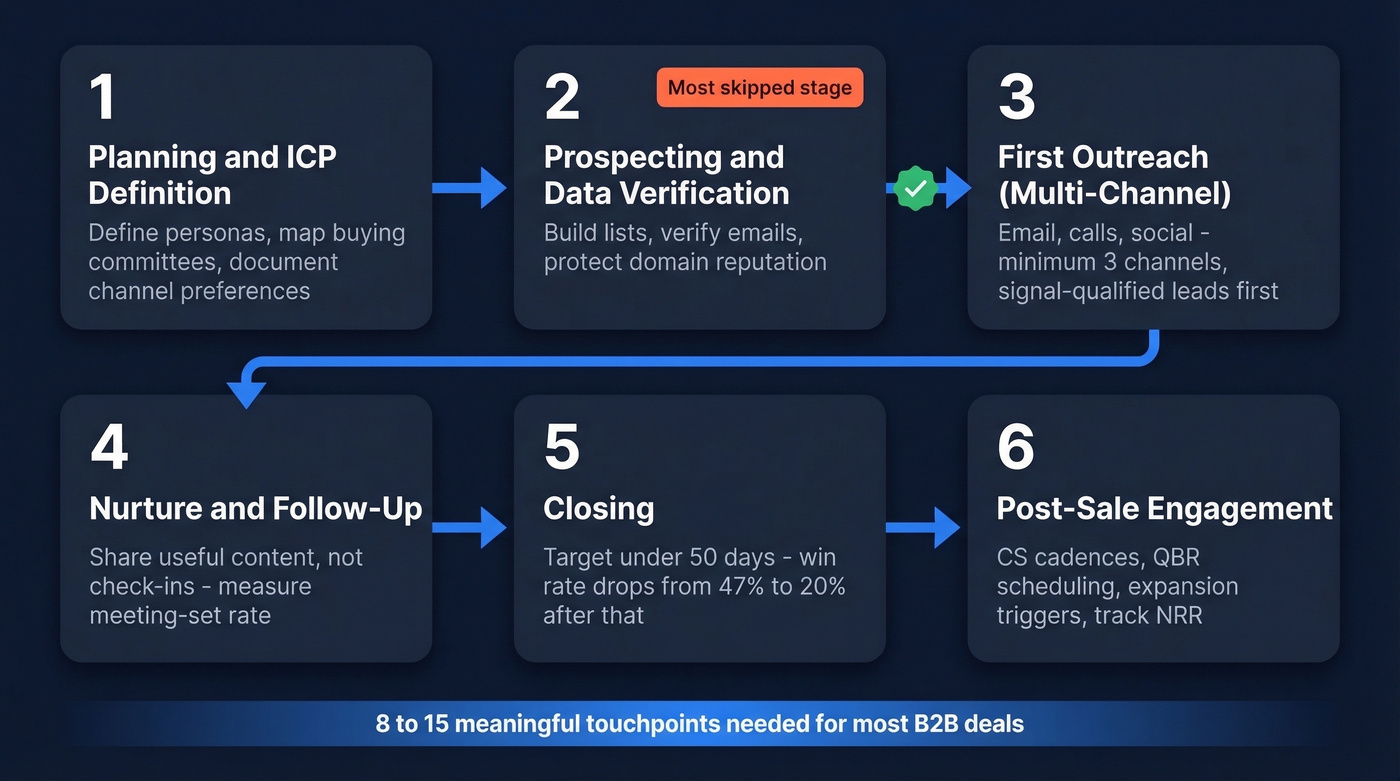
1. Planning & ICP Definition
A VP of Engineering doesn't want the same outreach cadence as a CFO. Define your ideal customer profile, map the buying committee roles, and document channel preferences by persona. Get this wrong and every downstream stage wastes effort. Your ICP match rate across the pipeline tells you whether you nailed it or guessed.
2. Prospecting & Data Verification
Here's a scenario we've watched play out dozens of times: an SDR sends 200 emails from a "verified" list and 35 bounce. Domain reputation tanks. The next 500 emails - including ones to real prospects - land in spam. The whole week's pipeline evaporates because someone skipped a five-minute verification step.
3. First Outreach (Multi-Channel)
World-class SDR teams use at least three channels and average 15.5 touches per contact. In practice, your first touches should be tight and multi-channel - email, calls, and social - not "email-only and hope."
Signal-qualified leads convert 47% better and close 43% larger deals. If you have intent data or job-change signals, lead with those. Beyond your core cadences, build sequences for trial-not-converted, website hand-raisers, and auto-reply re-engagement.
4. Nurture & Follow-Up
Three months into a deal with a VP of Engineering. Two great calls. Then silence. You send a check-in. Nothing. Another. Nothing.
This is where most pipelines go to die.
Stay relevant by sharing genuinely useful content - not "just checking in" emails. Measure meeting-set rate and pipeline velocity; if both stall, your nurture content isn't earning attention. A relevant industry report or a short Loom video showing how you'd solve their specific problem beats a templated nudge every time.
5. Closing
Opportunities closed within 50 days have a 47% win rate; after 50 days, it drops to 20% or lower. Meanwhile, 34% of revenue teams report average cycles of one to two full quarters.
The 50-day close threshold is the single most useful benchmark we've found. If your deals drag past it, your engagement workflow has a leak somewhere upstream.
6. Post-Sale Engagement
The process doesn't end at closed-won - it shifts channels. Customer success cadences, QBR scheduling, and expansion triggers like usage milestones and team growth all belong here. Track NRR and expansion revenue. If your engagement process is working, CAC should trend down as pipeline velocity improves.

Stage 2 breaks everything downstream - you just read why. Prospeo's 5-step email verification delivers 98% accuracy and keeps bounce rates under 3%, so your cadences actually reach real inboxes. At $0.01 per email, bad data is no longer an excuse.
Stop killing your domain reputation before the first cadence even runs.
Two Cadences You Can Copy Today
Use these as templates. Adapt the timing and channels to your buyer persona, but keep the structure intact.
5-Touch Email + Call Cadence
| Day | Action |
|---|---|
| 1 | Email 1 - personalized, low-friction CTA |
| 3 | Call 1 - reference the email, leave voicemail |
| 7 | Email 2 - new value like a case study or insight |
| 10 | Call 2 |
| 14 | Email 3 - breakup email |
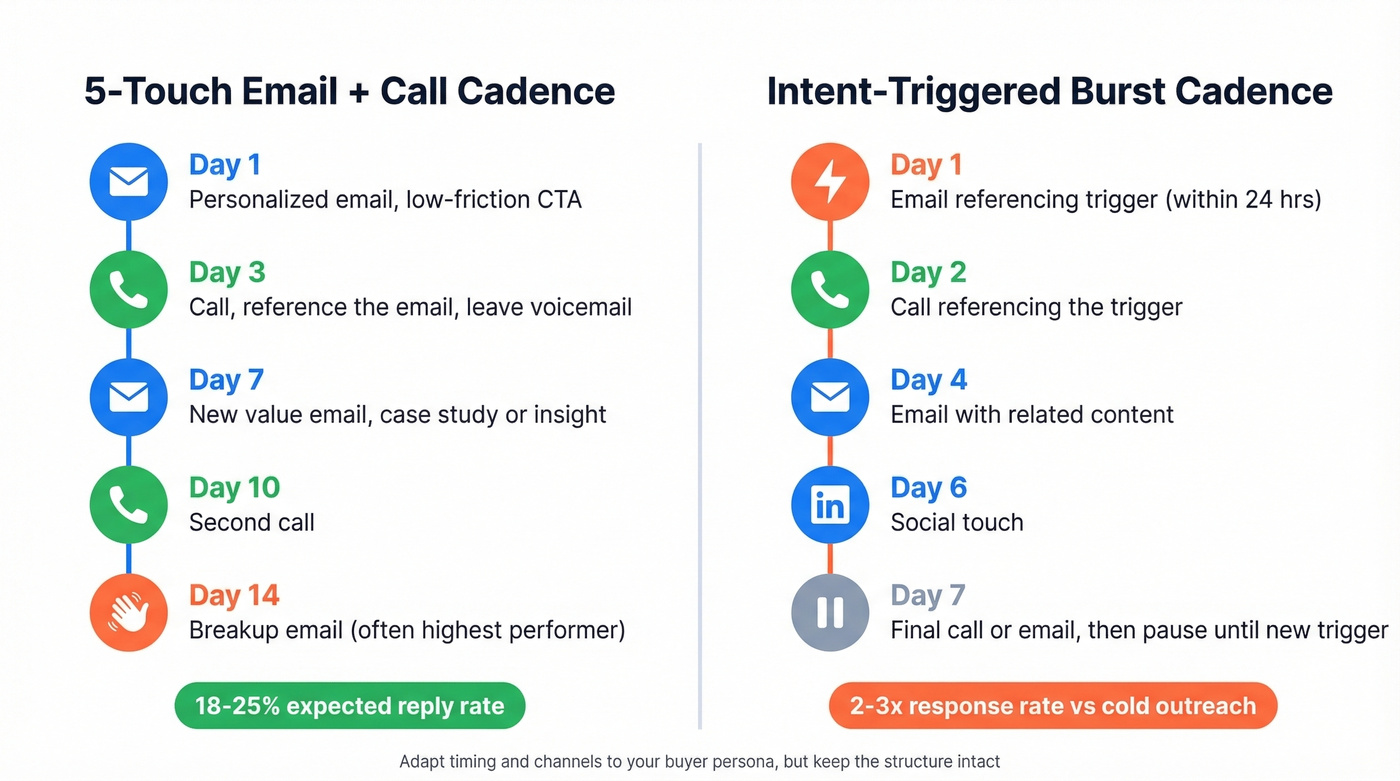
Expected reply rate: 18-25% for SaaS companies. The breakup email is often the highest-performing touch - use it.
Intent-Triggered Burst Cadence
| Day | Action |
|---|---|
| 1 | Email referencing the trigger (within 24 hrs of signal) |
| 2 | Call referencing the trigger |
| 4 | Email with related content |
| 6 | Social touch |
| 7 | Final call/email, then pause until new trigger |
Expected lift: 2-3x response rate vs. cold outreach. Without the signal, you're just running a faster cold sequence - don't bother.
How to Measure Your Engagement
Only 14% of sales metrics are actually manageable. Pick the ones that drive behavior, not the ones that look good in a board deck.
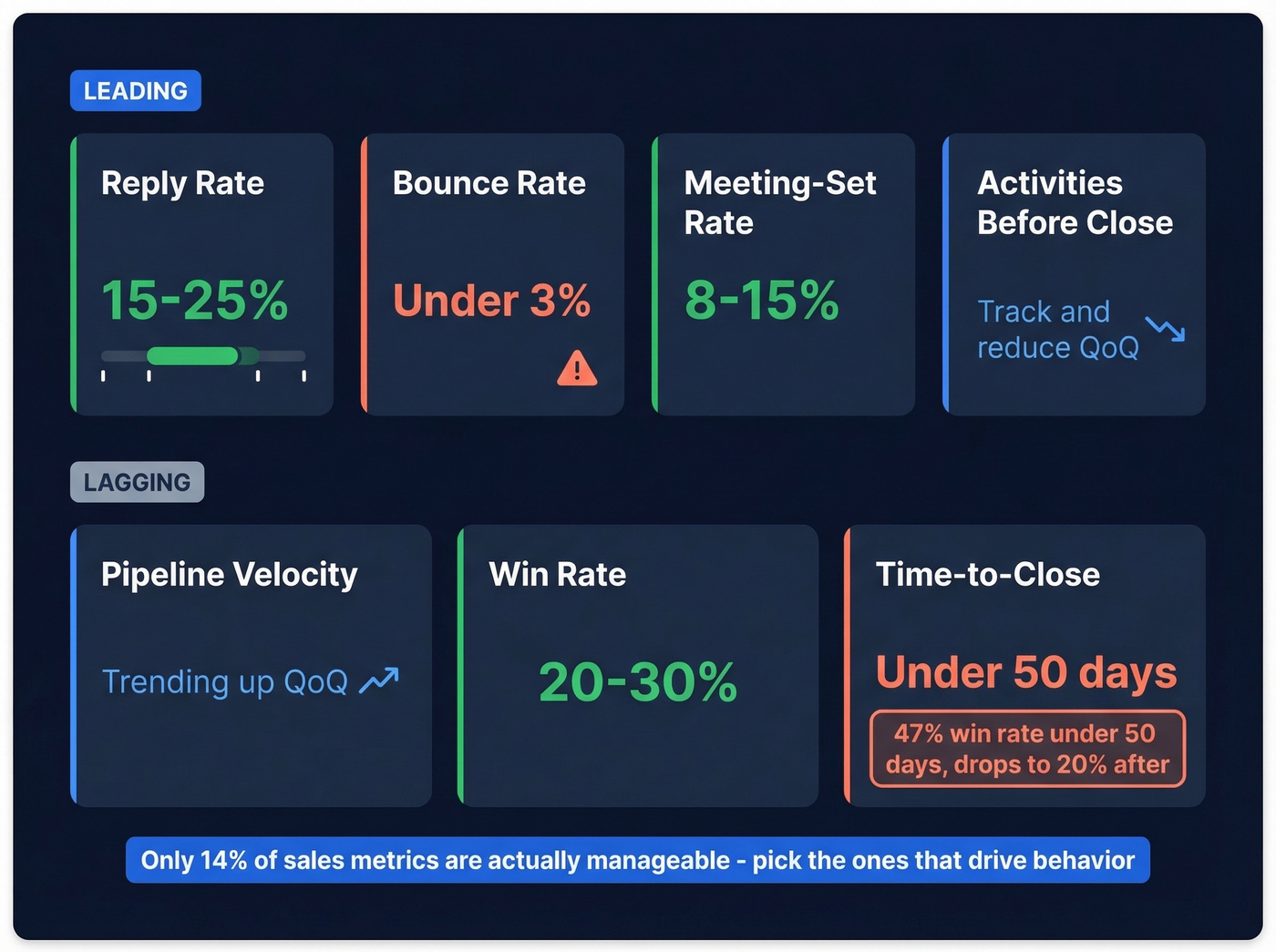
| Metric | Type | Target |
|---|---|---|
| Reply rate | Leading | 15-25% |
| Bounce rate | Leading | Under 3% |
| Meeting-set rate | Leading | 8-15% |
| Activities before close | Leading | Track and reduce QoQ |
| Pipeline velocity | Leading | Trending up QoQ |
| Win rate | Lagging | 20-30% |
| Time-to-close | Lagging | Under 50 days |
If you track nothing else, track time-to-close against that 50-day threshold. Everything else is noise until you know whether deals are closing fast enough.
Common Mistakes That Kill Engagement
Over-automation at scale. That 73% avoidance stat? That's what happens when you blast 5,000 generic emails because your tool makes it easy. Personalization doesn't mean {{first_name}} - it means relevance. 88% of reps using AI agents say it increases their odds of hitting targets, but only when the AI personalizes rather than just accelerates.
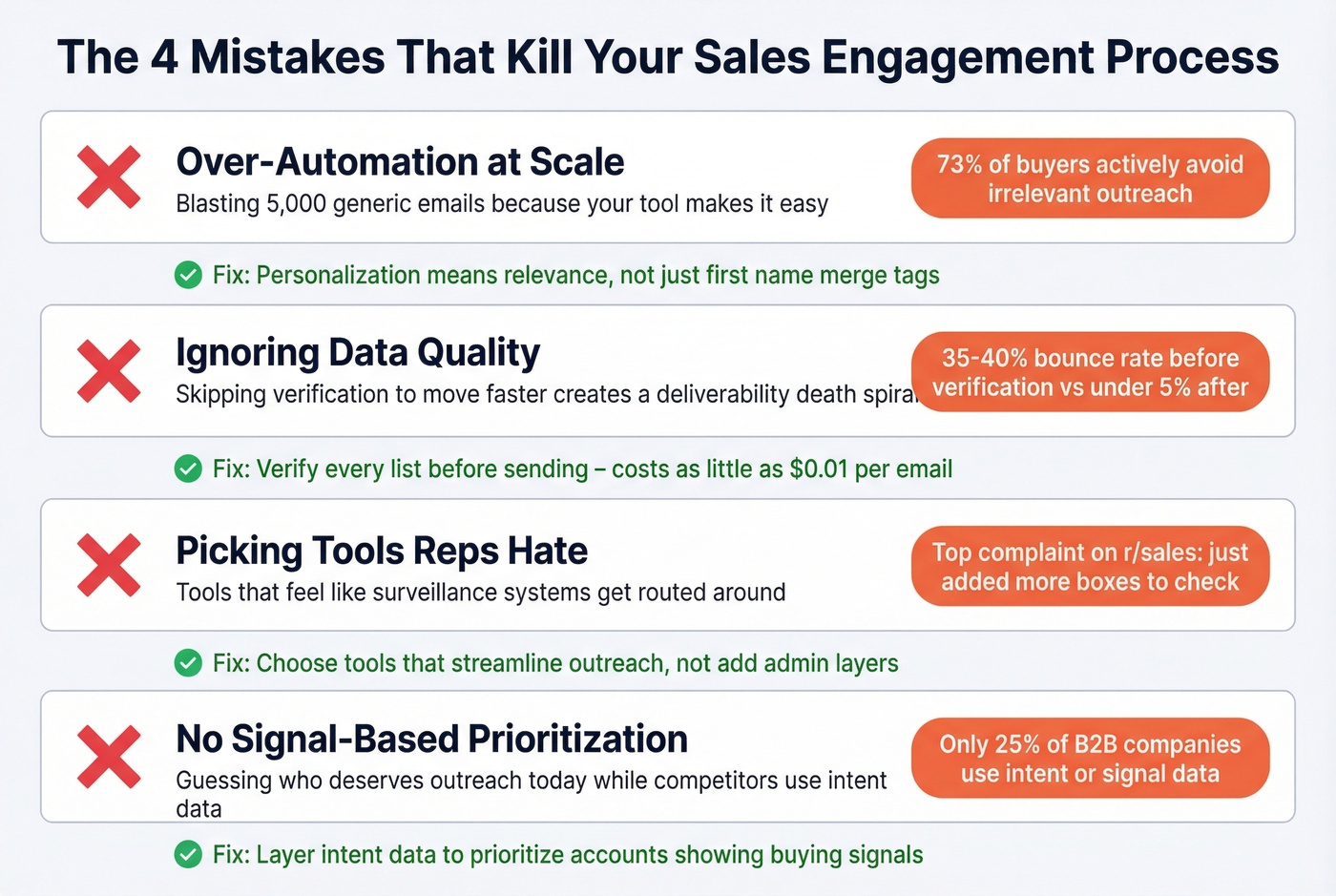
Ignoring data quality. Bounced emails lead to domain reputation damage, which leads to a deliverability death spiral. This is the most preventable failure in outbound, and teams still skip verification to "move faster." One of our customers, Snyk, saw bounce rates drop from 35-40% to under 5% after adding real-time verification - and AE-sourced pipeline jumped 180%.
Picking tools reps hate. Look, the #1 complaint on r/sales about engagement platforms is that they "felt like a surveillance system for management" and "just added more boxes to check." If your tool increases admin work, reps will route around it. The goal is to streamline outreach orchestration, not add layers of busywork.
No signal-based prioritization. The 2026 problem isn't "execute outreach faster" - it's "who deserves outreach today." Only 25% of B2B companies use intent or signal data. If you're in the other 75%, you're guessing while competitors aren't.
Tools & What They Cost
| Tool | Starting Price | Best For |
|---|---|---|
| Prospeo | Free (75 emails/mo); ~$0.01/email paid | Email/phone verification, data accuracy |
| Apollo | Free; $49/user/mo | SMB database + sequences |
| Instantly | $30/user/mo | Budget outbound sending |
| HubSpot Sales Hub | $50/user/mo | CRM-native engagement |
| Outreach | ~$100-$160/user/mo | Mid-market orchestration |
| Salesloft | ~$125-$180/user/mo | Enterprise + coaching |
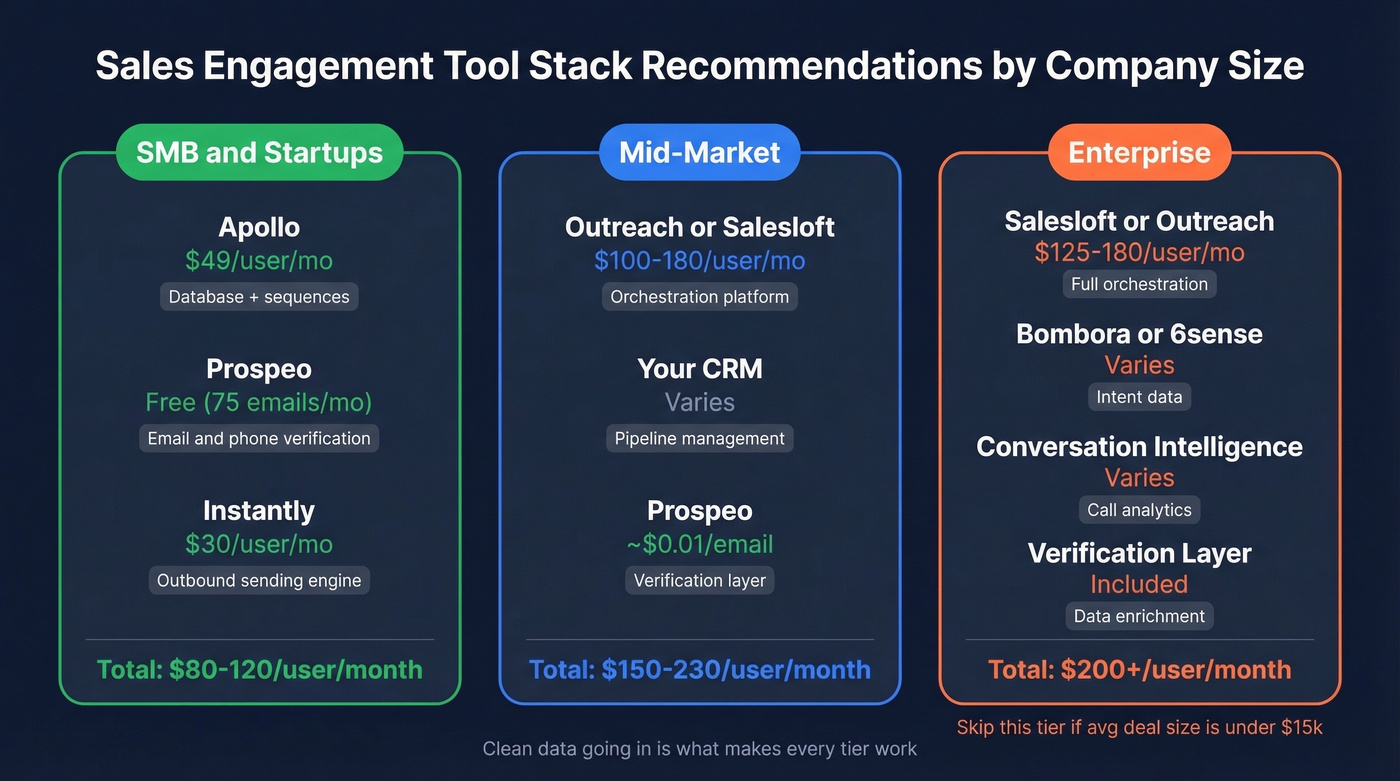
For SMBs and startups: Apollo + Prospeo + Instantly. That's roughly $80-$120/user/month depending on verification credits beyond the free tier. You've got a database, verified data, and a sending engine - the core outbound workflow covered.
For mid-market teams: Outreach or Salesloft plus your CRM plus a verification layer. The engagement platform handles orchestration; clean data going in is what makes it work.
For enterprise: Salesloft or Outreach plus intent data from Bombora or 6sense, plus conversation intelligence. Budget $200+/user/month all-in. Skip this tier if your average deal size is under $15k - the SMB stack will outperform on ROI.
Intent-triggered cadences only work when you have verified contact data ready the moment a signal fires. Prospeo combines Bombora intent data across 15,000 topics with 143M+ verified emails - refreshed every 7 days - so you reach in-market buyers within hours, not weeks.
Turn buyer signals into booked meetings with data that's never stale.
FAQ
What's the difference between sales engagement and enablement?
Enablement equips reps before they sell - training, content, playbooks. Engagement governs how reps interact with prospects during selling: timing, channels, cadences, and signal-based prioritization. If reps have great content but send it at the wrong time, that's an engagement gap.
How many touchpoints close a B2B deal?
Most B2B deals require 8-15 meaningful touchpoints across email, calls, and social. Complex enterprise sales can need 20+. Ten generic check-in emails don't count - mix channels and vary the value delivered at each step.
Do I need an expensive platform to run this?
No. Apollo at $49/mo, Prospeo's free verification tier with 75 emails/month at 98% accuracy, and Instantly at $30/mo cover the core workflow for under $100/user. Start there, then upgrade to Outreach or Salesloft when your team outgrows it.
What's the fastest way to improve my sales engagement process?
Fix your data quality first. Teams that add real-time verification have cut bounce rates from 35%+ to under 4%, which immediately lifts deliverability and reply rates across every downstream stage. Clean data is the highest-return change you can make.