

Sales Force Automation Market: What the Analyst Forecasts Actually Say
Sales reps spend only 30% of their time actually selling. The rest disappears into data entry, CRM updates, pipeline grooming, and chasing approvals. That's not a minor inefficiency - it's a structural problem that costs organizations millions in lost selling hours every quarter.
The sales force automation market exists because of this gap. SFA platforms automate lead management, forecasting, activity tracking, and reporting so reps can reclaim 5-10 hours per week and focus on revenue. And the money flowing into this space tells you how seriously companies are taking the problem.
The Numbers, Fast
The global SFA market sits between $9.3B and $13.9B depending on which analyst you ask, growing at roughly 9-10% CAGR into the early 2030s. Cloud deployment and AI integration are the two biggest growth drivers. Salesforce, Microsoft, and Oracle lead the Gartner Magic Quadrant for SFA platforms.
On the outcomes side, commonly cited benchmarks include a 26% employee productivity increase and 299% average ROI over three years from a Forrester TEI study. The biggest risk isn't picking the wrong platform - it's feeding it bad data.
Market Size and Growth Forecasts
Three major analyst firms have published SFA forecasts recently, and their numbers don't agree. That's normal. They use different base years, inclusion criteria, and forecast horizons.
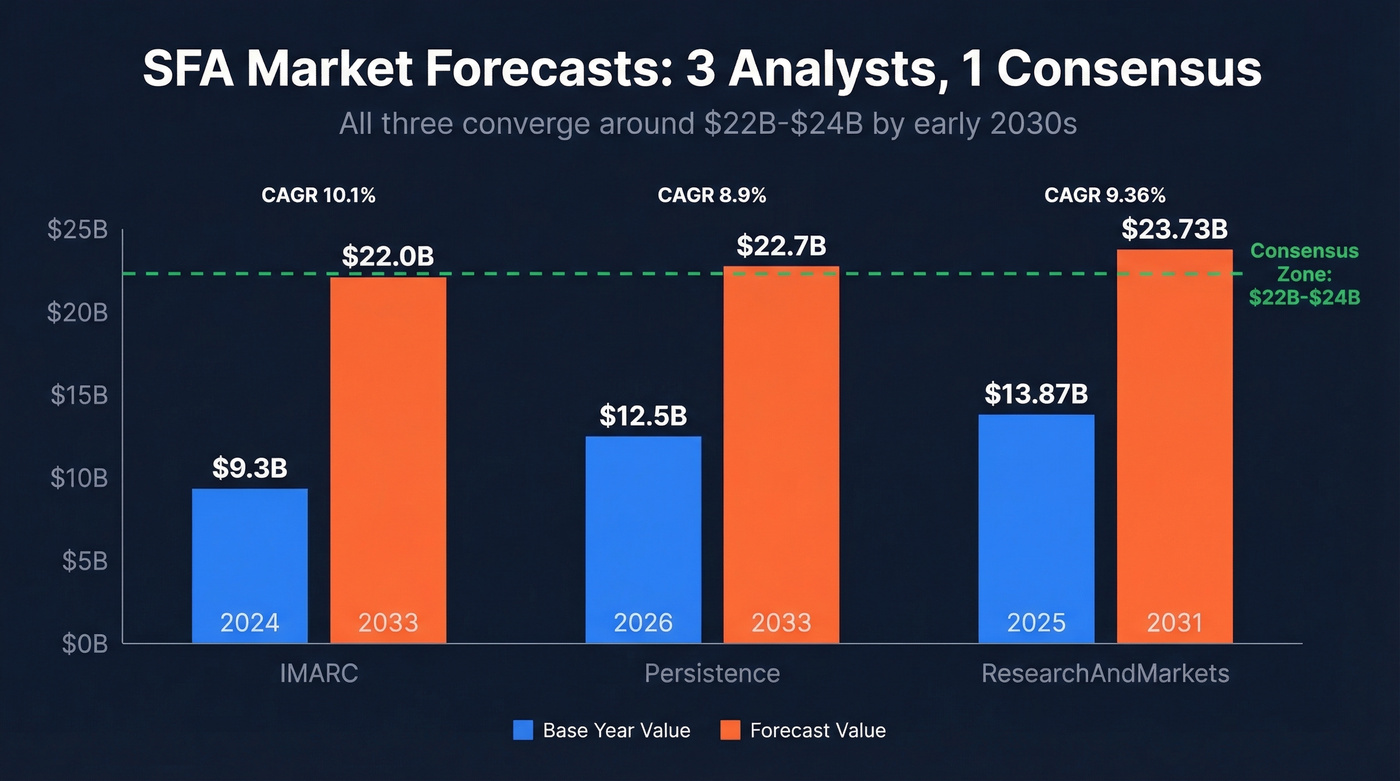
| Analyst | Base Year Value | Forecast Value | CAGR |
|---|---|---|---|
| IMARC | $9.3B (2024) | $22.0B (2033) | 10.1% |
| Persistence | $12.5B (2026) | $22.7B (2033) | 8.9% |
| ResearchAndMarkets | $13.87B (2025) | $23.73B (2031) | 9.36% |
The variance at the bottom end ($9.3B vs. $13.87B) comes down to what each firm counts as "SFA." Some include adjacent revenue intelligence and CPQ tools; others stick to core pipeline and contact management. All three converge around $22B-$24B by the early 2030s, with a CAGR in the 9-10% range. That's the consensus number worth anchoring to.
SFA Market Segmentation
Persistence provides a granular segment breakdown using its 2026 baseline.
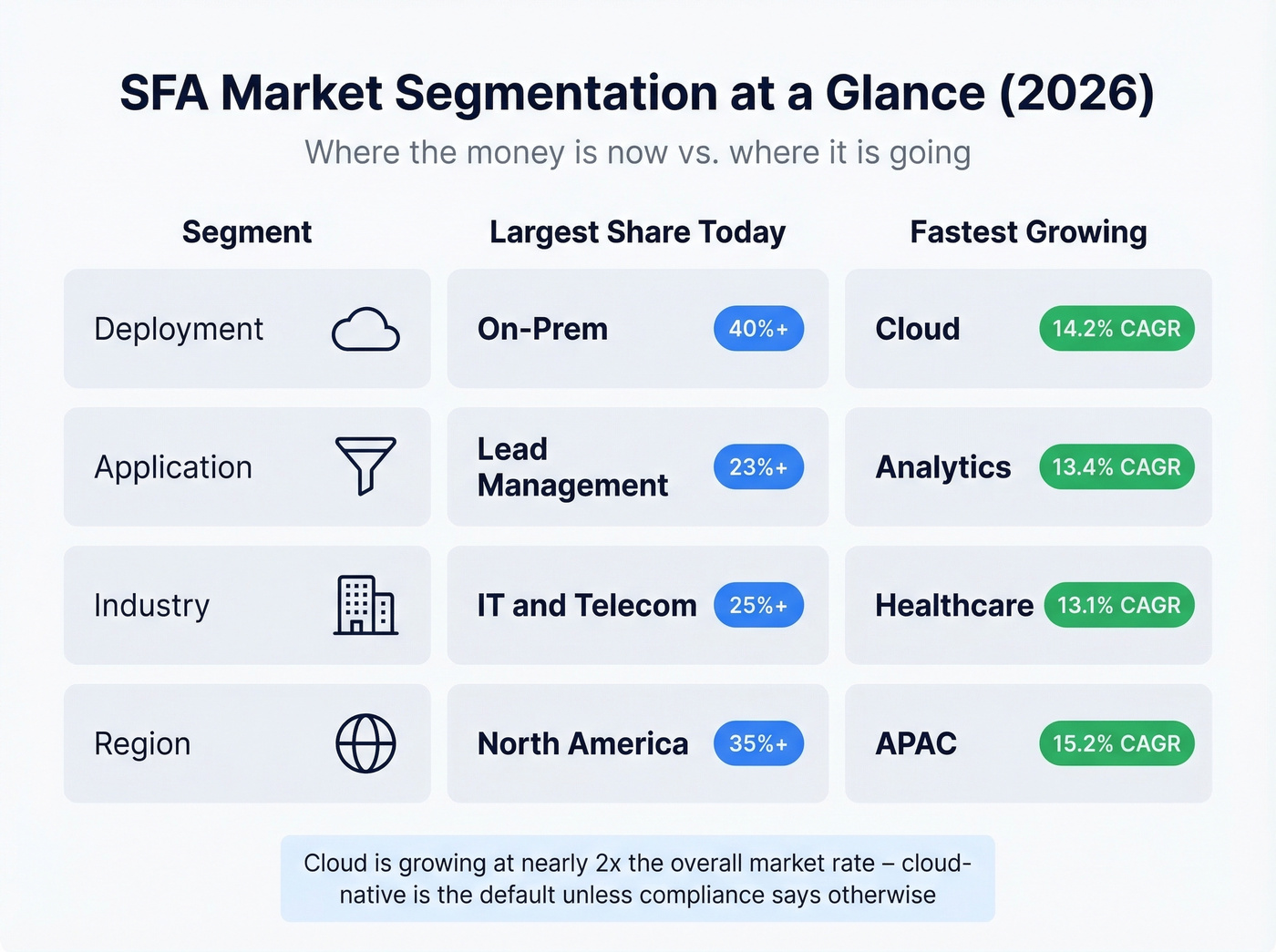
| Segment | Largest Share | Fastest Growing |
|---|---|---|
| Deployment | On-prem (40%+) | Cloud (14.2% CAGR) |
| Application | Lead mgmt (23%+) | Analytics (13.4% CAGR) |
| Industry | IT & Telecom (25%+) | Healthcare (13.1% CAGR) |
| Region | North America (35%+) | APAC (15.2% CAGR) |
On-premises still holds the largest deployment share because regulated industries move slowly. But cloud is growing at nearly double the overall market rate. If you're evaluating SFA platforms today, cloud-native is the default unless compliance mandates otherwise.
Europe holds 21%+ of the market, while APAC's 15.2% CAGR makes it the fastest-growing region - driven by digital transformation spending across India, Southeast Asia, and ANZ. We've noticed this firsthand working with teams in those markets: the appetite for modern sales tooling is enormous, but vendor maturity varies widely.

Analyst reports agree: bad data is the #1 reason SFA deployments fail. Prospeo's 5-step verification and 7-day refresh cycle mean your CRM stays clean automatically - 98% email accuracy, 125M+ verified mobiles, and 50+ data points per enriched contact.
Stop feeding your SFA platform stale data. Start with contacts that connect.
Who's Winning: Gartner MQ for SFA
The 2025 Gartner Magic Quadrant for SFA Platforms names the same three Leaders as the prior year: Salesforce, Microsoft Dynamics 365 Sales, and Oracle. Salesforce holds 20.7% of the global CRM market. Microsoft earned its 15th consecutive year as a Leader. Oracle hit its 9th.
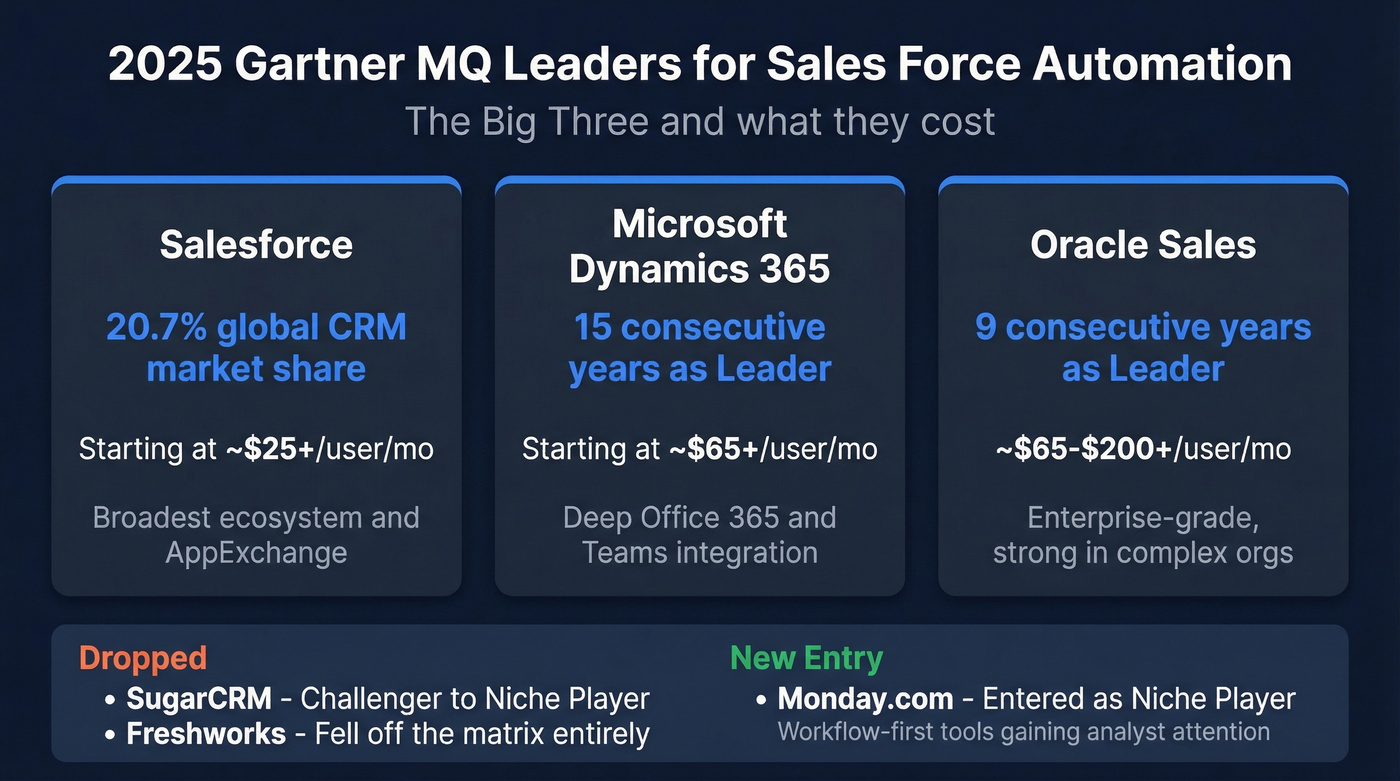
Approximate pricing for context: Salesforce pricing starts at ~$25+/user/month on entry tiers. Microsoft Dynamics 365 Sales runs ~$65+/user/month. Oracle Sales pricing typically falls in the ~$65-$200+/user/month range depending on edition.
The interesting movement happened below the Leaders quadrant. SugarCRM dropped from Challenger to Niche Player. Freshworks fell off the matrix entirely. Monday.com entered as a new Niche Player - a sign that lightweight, workflow-first tools are getting analyst attention even if they lack enterprise depth. These shifts show how competitive the SFA vendor field has become, with newer entrants challenging incumbents on usability and time-to-value rather than feature checklists.
All three Leaders are converging on embedded AI agents that research accounts, qualify leads, draft outreach, and surface deal risks autonomously. That's where the real arms race is happening.
AI Is the Growth Engine (and the Risk)
Here's the thing about AI in SFA: the numbers are genuinely impressive, but the implementation gap is massive.
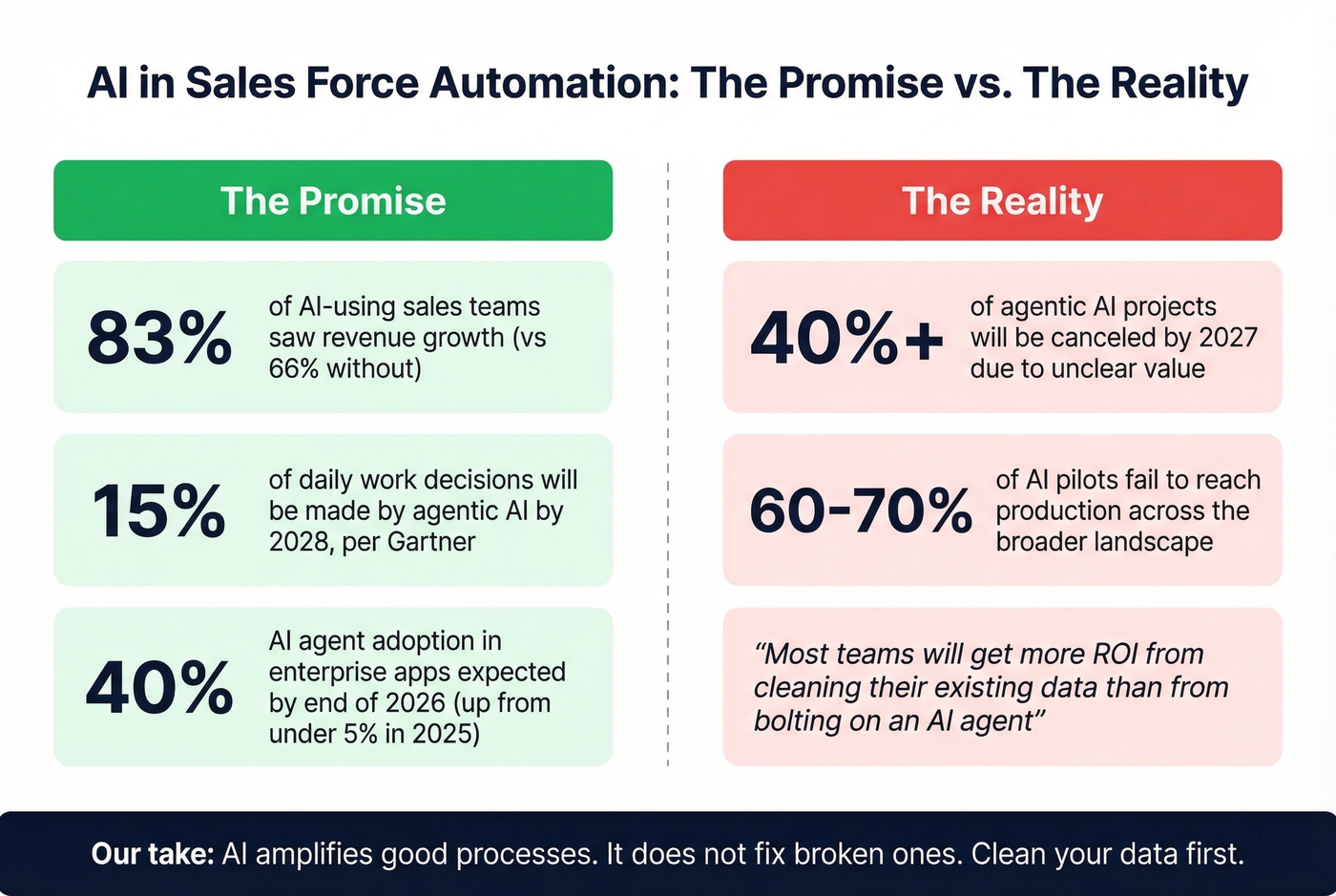
83% of sales teams using AI experienced revenue growth versus 66% without. Gartner predicts that by 2028, 15% of day-to-day work decisions will be made autonomously via agentic AI - up from 0% in 2024. AI agent adoption in enterprise apps is expected to jump from under 5% in 2025 to 40% by end of 2026.
But Gartner also warns that 40%+ of agentic AI projects will be canceled by 2027 due to unclear value and runaway costs. Across the broader AI landscape, 60-70% of pilots fail to reach production.
Our honest read: AI is the best thing happening to SFA and the most overpromised. The vendors selling "AI-powered everything" aren't lying about the potential - they're glossing over the implementation reality. Most teams will get more ROI from cleaning their existing data than from bolting on an AI agent. That's not a popular opinion on vendor webinars, but the consensus on r/sales and r/salesoperations backs it up: garbage in, garbage out, no matter how smart the model.
What the Reports Leave Out
Every paid analyst report covers market size and vendor rankings. Almost none talk about what actually goes wrong after you buy.
Enterprise SFA deployments take 6-12 months. Organizations typically see a 15-25% productivity decline during the transition, and 38% cite insufficient data integration as a major obstacle. Let's be honest - that's a polite way of saying the data was a mess before the project started, and nobody wanted to deal with it.
The common failure modes are predictable: misalignment with real sales workflows, over-customization that creates a Frankenstein CRM, poor data quality, and weak change management. Data quality is the one that actually sinks deployments. You can fix a bad workflow in a sprint. You can't fix 200,000 stale contacts overnight.

This is where the data layer matters more than the platform layer. Prospeo plugs directly into Salesforce and HubSpot, verifying contact data with 98% email accuracy on a 7-day refresh cycle. We've seen this play out concretely: Meritt went from a 35% bounce rate to under 4% after switching their data source. That's the difference between an SFA system that automates outreach and one that automates embarrassment.
Skip the AI agent upsell until your contact data is clean. Seriously. A $200/month data verification tool will outperform a $50,000/year AI add-on if your CRM is full of dead email addresses and disconnected phone numbers. If you want to go deeper on the data layer, start with data enrichment and a shortlist of data enrichment services.
You just read that 38% of teams cite data integration as their biggest SFA obstacle. Prospeo plugs directly into Salesforce, HubSpot, and 10+ tools - enriching your CRM with 300M+ verified profiles at $0.01/email. No contracts, no sales calls.
Clean data is the highest-ROI investment in your entire sales stack.
FAQ
How big is the sales force automation market?
Analyst estimates range from $9.3B to $13.9B for 2024-2026, depending on scope. All major forecasts converge around $22B-$24B by the early 2030s at roughly 9-10% CAGR. Cloud-native deployment and embedded AI are the primary growth accelerators.
Who are the leading sales force automation companies?
Salesforce, Microsoft Dynamics 365, and Oracle are the three Leaders in the 2025 Gartner Magic Quadrant for SFA Platforms. HubSpot and Zoho are strong options for SMBs, while newer entrants like Monday.com are gaining traction with workflow-first approaches.
What's the biggest reason SFA implementations fail?
Poor data quality. 38% of organizations cite insufficient data integration as a major obstacle during deployment. Verifying contact data before it enters your CRM prevents automation from targeting dead addresses - tools like Prospeo reduce bounce rates from 35%+ to under 4% with 98% email accuracy and a 7-day refresh cycle.
Will AI replace traditional SFA platforms?
Not replace - reshape. By 2028, Gartner expects 15% of routine sales decisions to be handled by agentic AI. But 40%+ of AI projects will be scrapped by 2027 due to unclear ROI. AI amplifies good SFA processes; it doesn't fix broken ones.