

Digital Transformation Sales: The Honest Guide to What Actually Works
A VP comes back from a conference, fires up a Slack channel called #digital-transformation, and drops a link to an AI-powered sales platform that "basically sells itself." Three months later, the tool has 11% adoption, the rollout is quietly shelved, and the team goes back to the spreadsheet they never stopped using.
We've seen this play out dozens of times. 70% of digital transformations fail, and only 48% hit their business outcome targets. The cause is almost never the technology. It's the sequence, the change management, and - more often than anyone admits - the data underneath everything. If you're rethinking digital transformation sales strategy for your org, this is the honest version of what works.
What You Need Before Evaluating a Single Vendor
Audit your data quality. If your CRM is full of stale contacts and bounced emails, every tool you layer on top will underperform. Fix the foundation first. (If you need a benchmark, start with email bounce rate.)
Standardize your sales process. You can't digitize what isn't defined. Map your stages, handoffs, and qualification criteria on paper before software. A good next step is sales process optimization.
Run a 90-day pilot on one team. Not a company-wide rollout. One team, one use case, measurable KPIs. Prove value, then scale. If you want a structure for this, use a 30-60-90 day plan.
What Sales Transformation Actually Means
There's a difference between digitization (converting paper to digital), digitalization (using digital tools to improve existing processes), and transformation (fundamentally rewiring how your sales org creates and captures value). Most companies think they're doing the third when they're really doing the first.
McKinsey frames transformation as "rewiring the organization" - changing how decisions get made, how data flows, and how teams operate. In sales, that means shifting from rep-dependent, intuition-driven selling to a model where data-driven selling, automation, and buyer behavior signals drive pipeline creation and deal progression. It's not about replacing reps. It's about making every rep dramatically more effective by removing busywork - automatic data capture, pre-populated fields, faster access to customer context - so they spend more time actually selling.
There's a useful concept here: Martec's Law. Technology changes exponentially; organizations change logarithmically. That gap is where transformations die.
Why Going Digital-First Isn't Optional
The buyer has already transformed. Your sales org is catching up.
80% of B2B sales interactions now happen in digital channels. 33% of buyers prefer purchasing without talking to a rep at all - among Millennials, that jumps to 44%. Global digital transformation spending hit $2.58 trillion in 2025, projected to reach $3.9 trillion by 2027. Deloitte's longitudinal survey shows technology budgets climbing from 8% of revenue in 2024 to 14% in 2025 - a pace that, if sustained, would reach 32% by 2028. And 74% of surveyed organizations invested in AI and generative AI in the past year, the highest of 20 tracked capabilities.
Companies that don't invest aren't saving money. They're falling behind competitors compounding efficiency gains quarter over quarter. For B2B orgs especially, this isn't a nice-to-have - it's the baseline for staying competitive in a market where buyers expect self-serve research, instant pricing, and frictionless purchasing.
Why Most Transformations Fail
The 70% failure rate isn't a technology problem. It's a people and process problem. Every single time.
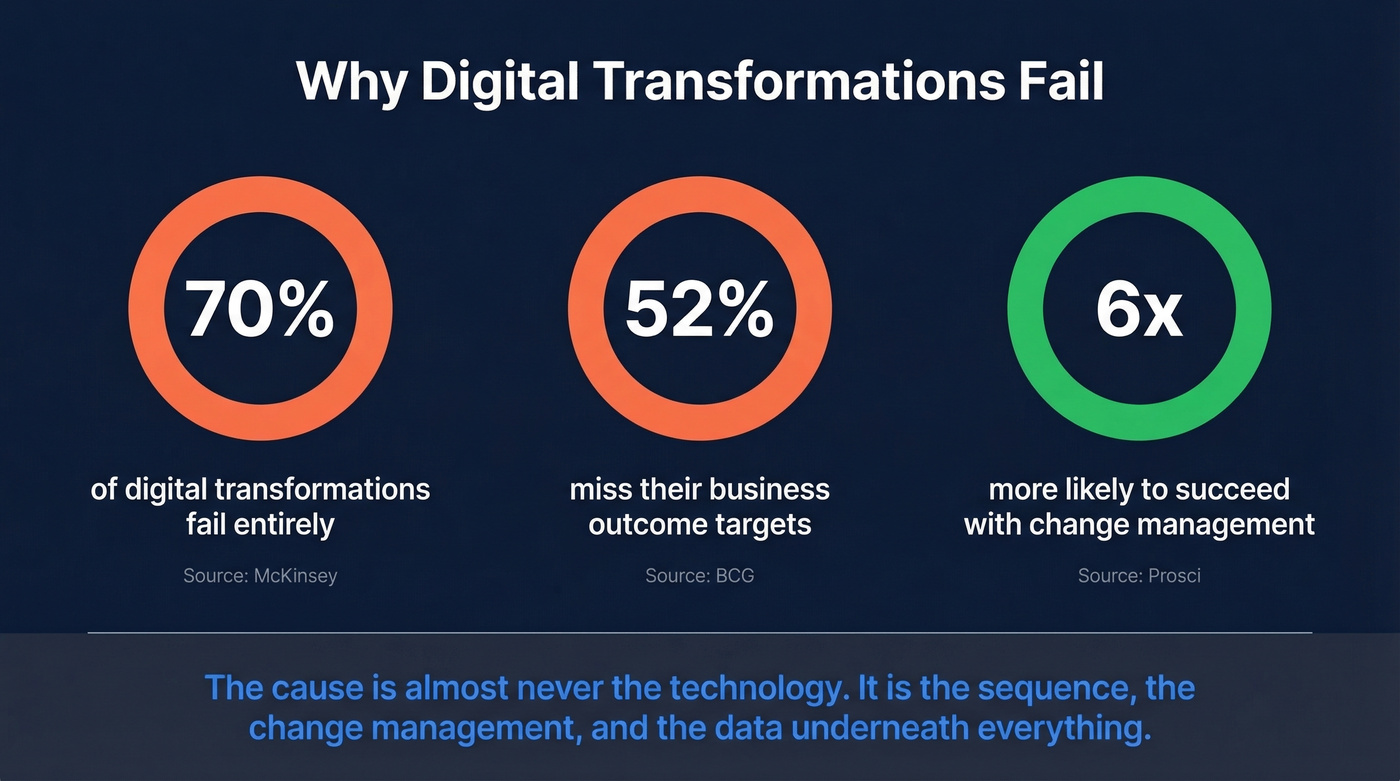
Tech before process is the most common killer. Mercedes spent millions building a dealer inventory system nobody used - it didn't fit dealer workflows. The technology was solid. Adoption was zero. This happens constantly in sales orgs that buy a shiny engagement platform before mapping their actual sales process.
The second pattern is subtler. Organizations with a clear change management strategy are 6x more likely to achieve transformation goals. Yet most sales leaders treat change management as a training session and a Loom video. The math is brutal: skip change management and you're statistically doomed. (This is where sales enablement and manager coaching matter most.)
"Don't feel bad - everyone is lying about digital transformation." That's the top post on r/ITProfessionals. The consensus is that most "success stories" are small pilots that got quietly shelved when the internal champion moved on. Transformation is a program, not a project. It never ends.
Then there's the quiet killer nobody talks about: bad data, compounding silently. Your reps stop trusting the CRM, sequences start bouncing, and the team avoids the tools that were supposed to make them faster. One Reddit thread described a $100M revenue company still running paper logs with spreadsheet re-entry and stale operational data while leadership delayed foundational fixes. You can't layer intelligence on top of ignorance. And beyond broken processes, there's mindset inertia - teams that have been burned by past rollouts develop a confidence deficit that poisons adoption before it starts. (If you're rebuilding the foundation, start with lead enrichment.)

Bad data is the quiet killer of digital transformation. If your CRM is full of stale contacts and bounced emails, every tool you layer on top will underperform. Prospeo refreshes 300M+ profiles every 7 days - not every 6 weeks - so your foundation stays clean. 98% email accuracy. 83% enrichment match rate. 50+ data points per contact.
Fix the foundation before you stack the tools.
The 5-Phase Roadmap
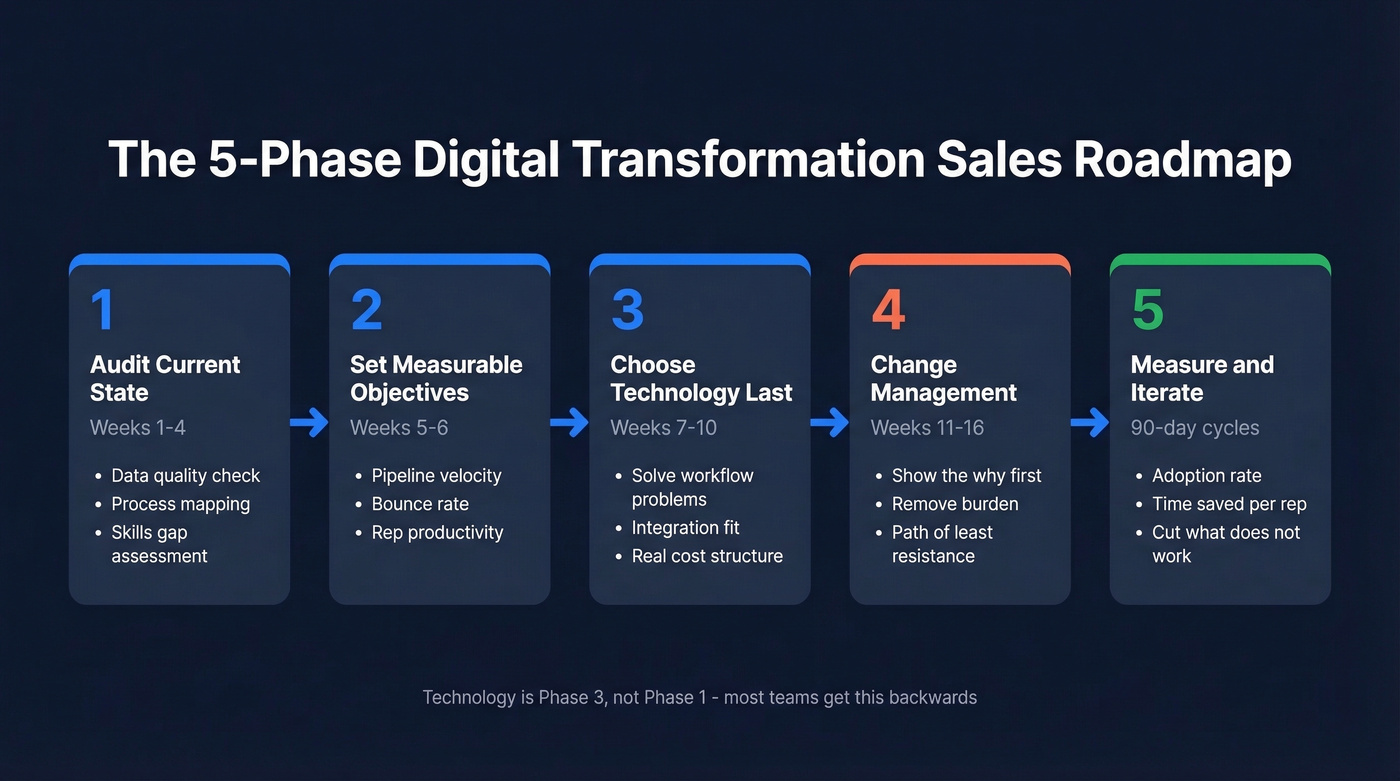
Phase 1 - Audit Your Current State (Weeks 1-4)
Run three audits in parallel. Data quality: what percentage of your CRM contacts have valid emails, current job titles, and accurate company data? If you don't know, that's your answer. Process mapping: document your actual sales process - the one reps follow, not the one on the slide deck. Skills gap assessment: where do reps need enablement? This phase costs almost nothing and prevents you from buying tools that solve problems you don't have.
Phase 2 - Set Measurable Objectives
Pick KPIs tied directly to revenue: pipeline velocity, email bounce rate, rep productivity measured in hours spent selling vs. administrating, and conversion rates by stage. Avoid vanity metrics like "logins per week." Nobody cares how often reps log in if pipeline isn't moving. (To pressure-test your KPIs, use pipeline health.)
Phase 3 - Choose Technology Last
Technology is the easy part. Does it solve a core workflow problem? Does it integrate with your existing CRM and engagement tools? What's the real cost structure - per-seat, per-credit, annual commitment? Buy for the process you defined in Phase 1, not for the demo that looked coolest. And don't overlook deal desk governance: CPQ tools that automate approval workflows and pricing guardrails prevent the "shadow discounting" that erodes margins during transformation. (If you're evaluating CRM options, see examples of a CRM.)
Phase 4 - Change Management and Enablement
Here's the thing: reps need to understand why before they'll care about what. They need to see how new tools make their lives easier, not just that leadership decided to buy them. Sales digitalization succeeds when it removes burden - automatic data capture, pre-populated fields, one-click exports - rather than adding new tasks to an already-packed workflow. The most effective adoption strategies make the digital path the path of least resistance.
Phase 5 - Measure and Iterate
Set a 90-day pilot review cadence. Track adoption rate, efficiency gains in time saved per rep per week, customer satisfaction impact, and ROI against stack cost. If a tool isn't moving the needle after 90 days with proper enablement, cut it. Don't let sunk cost keep bad tools alive.
Building Your Sales Tech Stack
The stack matters less than the data feeding it. But you still need to pick the right tools. Here's what a modern sales tech stack looks like in 2026:
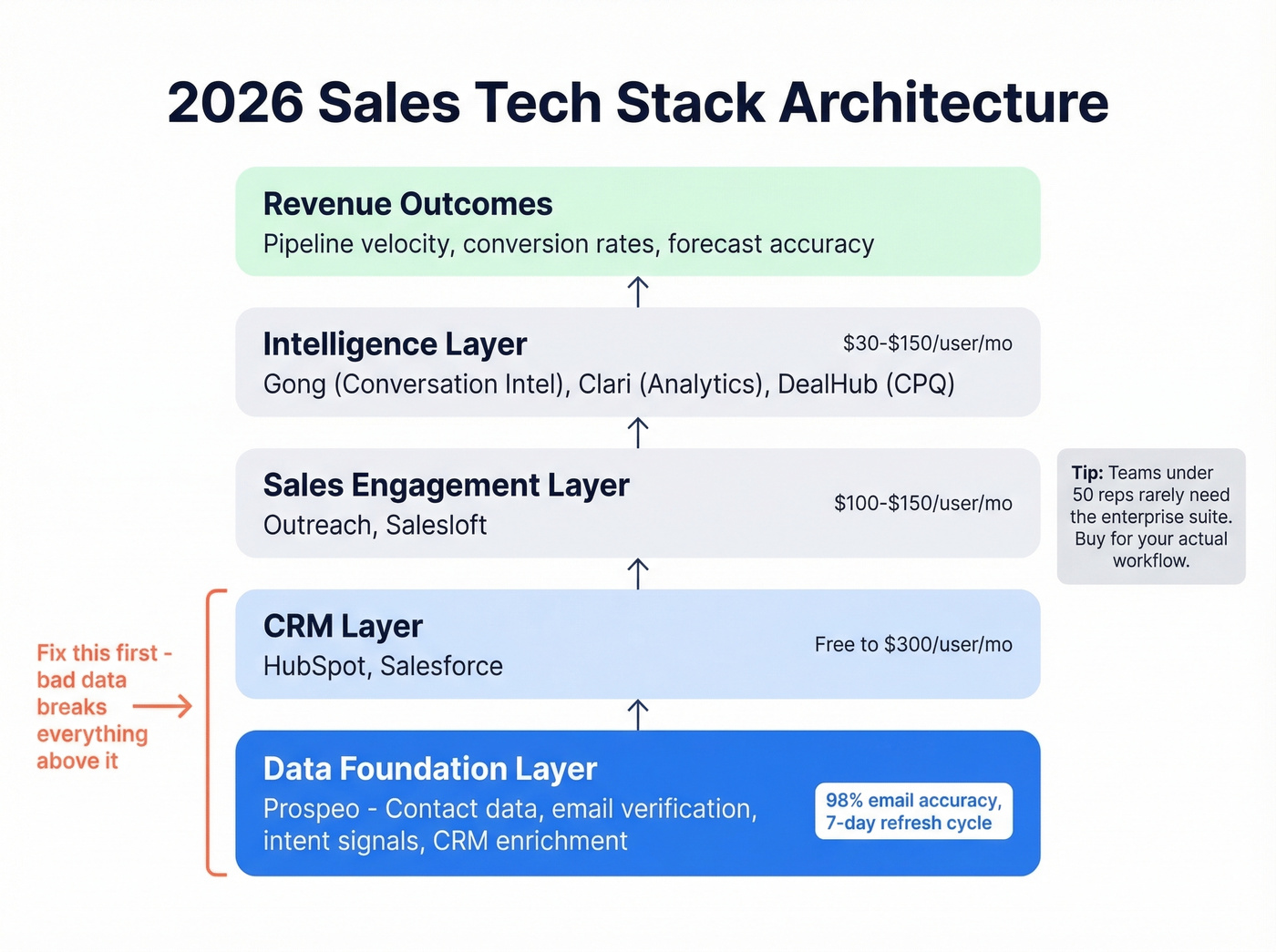
| Category | Tools | Typical Cost |
|---|---|---|
| CRM | HubSpot, Salesforce | Free-$300/user/mo |
| Sales Engagement | Outreach, Salesloft | $100-$150/user/mo |
| Conversation Intel | Gong | $100-$150/user/mo |
| CPQ | DealHub, Salesforce CPQ | $30-$150/user/mo |
| Sales Analytics | Clari, InsightSquared | $50-$100/user/mo |
The prospecting and data layer deserves a closer look because it's the foundation everything else depends on. In our experience, teams that fix data quality first see every downstream tool perform better - engagement rates climb, forecasts sharpen, and reps actually trust what they're looking at. Prospeo covers 300M+ professional profiles with 98% email accuracy and 143M+ verified emails, all refreshed on a 7-day cycle while the industry average sits at six weeks. It also includes 125M+ verified mobile numbers, real-time verification, CRM enrichment, intent data across 15,000 topics, and API access, with native integrations for Salesforce, HubSpot, Smartlead, Instantly, Lemlist, Clay, Zapier, and Make. (If you're comparing vendors, start with data enrichment services.)
When selecting any tool, prioritize three criteria: core functionality tied to a specific workflow problem, native integrations with your CRM and engagement platform, and transparent cost structure. A tool that does one thing brilliantly and integrates cleanly beats an all-in-one platform your team uses at 20%.
Let's be honest: most teams under 50 reps don't need a $30K/year all-in-one data platform. They need accurate emails, direct dials, and a clean CRM. Overbuying is the most expensive mistake in sales process automation - not because of the license cost, but because of the complexity tax on adoption. Skip the enterprise suite if your team isn't big enough to justify the overhead.

What AI Actually Changes
Gartner's 2026 priorities for Chief Sales Officers center on three actions: build a sales-centric AI portfolio roadmap tied to commercial outcomes, redesign GTM motions to match buyer preferences, and invest in sales manager enablement. Notice what's not on the list: "buy an AI tool and hope for the best." (If you're building that roadmap, see generative AI sales tools.)
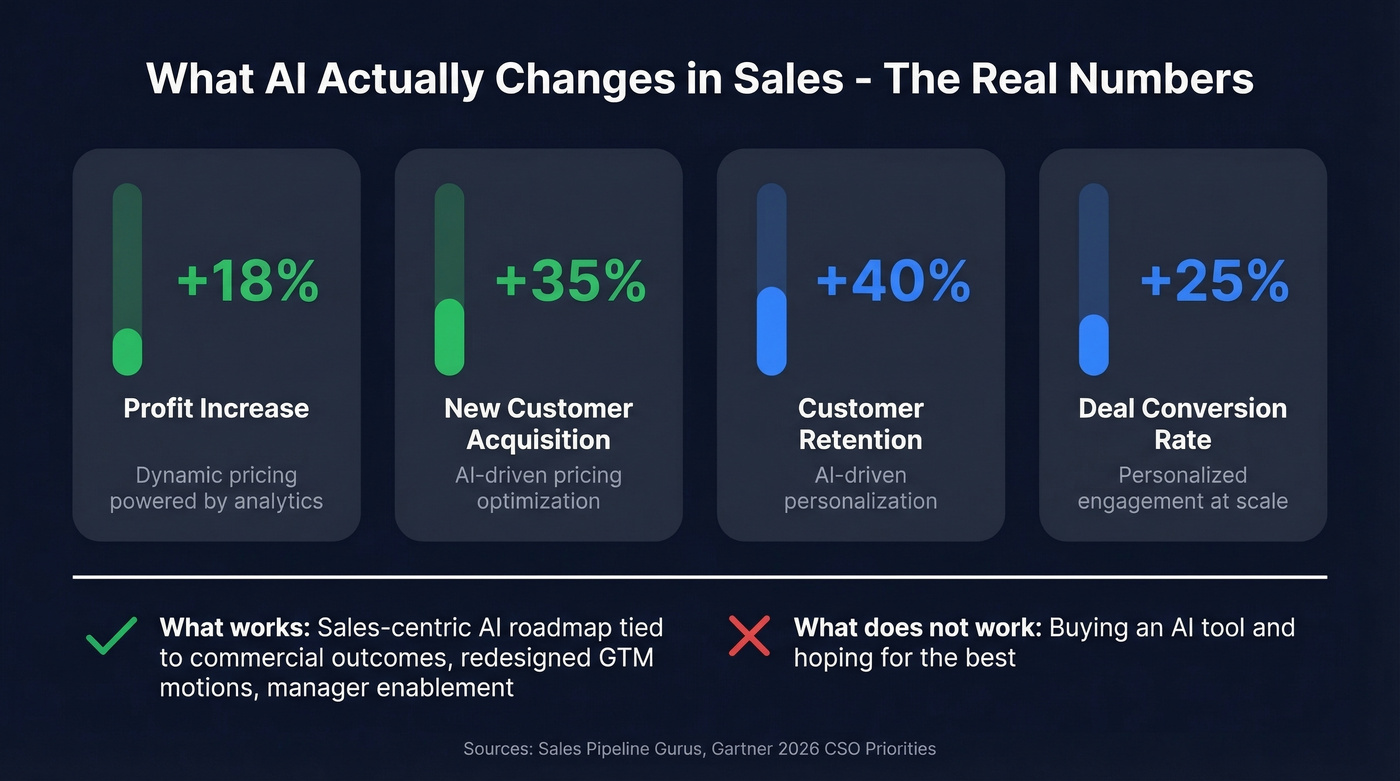
The practical applications are real, though. Dynamic pricing powered by analytics has driven +18% profits and +35% new customer acquisition in documented examples. AI-driven personalization is lifting retention by up to 40% and deal conversion by 25% for teams that implement it well. By 2027, 20% of B2B sales organizations will employ digital twins of customers. By 2028, 15 billion connected products will act as autonomous purchasing agents.
But AI trained on garbage data produces garbage forecasts. Every AI capability - lead scoring, deal prediction, dynamic pricing, personalized outreach - is only as good as the data layer underneath it. The teams getting real results aren't the ones with the fanciest models. They're the ones who fixed their data first. Digitization in sales starts with clean, verified, and current data. Everything else is a layer on top.
What Success Looks Like
On the B2B side, Snyk deployed Prospeo across 50 AEs and saw AE-sourced pipeline increase 180%, with bounce rates dropping from 35-40% to under 5%. That's what happens when reps trust their data enough to actually use the tools.
A professional services firm digitized client engagement workflows and saw satisfaction jump 23%, with retention climbing from 91% to 97% within the first year. The key wasn't the technology - it was removing manual burden so consultants spent time on clients instead of CRM entry.
CRM integration projects consistently show +20% sales efficiency and -25% manual data entry when done right. The pattern across every success story is the same: start narrow, prove value, then scale. That's the real playbook for digital transformation sales success - not a big-bang rollout, but compounding wins from a clean foundation.
Phase 1 says audit your CRM data quality. Prospeo makes that actionable - enrich your entire CRM at 92% match rate, flag stale contacts, and replace bounced emails with verified ones at $0.01 each. No annual contracts. No sales calls. The transformation starts when reps trust the data again.
Stop layering intelligence on top of ignorance.
FAQ
How long does a digital sales transformation take?
Focused pilots show measurable results within 90 days. Full organizational transformation typically takes 12-18 months, depending on team size and process complexity. Start with one team and one use case to build momentum.
What's a realistic budget for 2026?
Technology budgets now average 14% of revenue for companies actively investing. Mid-market sales teams should expect $50-150K in year one, with prospecting data tools starting free and scaling to roughly $0.01/email - far less than legacy platforms charging $15-40K annually.
What's the first step?
Audit your data quality and map your actual sales process - the one reps follow daily, not the one on the slide deck. If more than 10% of your CRM emails bounce, fix that before buying any new tool.
Why do most sales transformations fail?
Lack of change management is the primary cause - organizations with a clear strategy are 6x more likely to succeed. Other killers include absent executive sponsorship and trying to transform everything at once instead of proving value through focused pilots.
What role does data quality play?
Data quality is the silent make-or-break factor. Every tool in your stack - CRM, engagement platform, AI scoring - depends on accurate contact and company data. Stale records undermine even the best-designed programs, which is why a weekly refresh cycle matters more than feature count.