

Sales Forecasting and Budgeting: Build Plans That Don't Fall Apart by Q2
It's the second week of April. The annual budget you spent six weeks building in November is already fiction - two enterprise deals slipped, a new competitor appeared, and marketing shifted spend to a channel that didn't exist when you set targets. You're not alone. Only 7% of sales organizations achieve forecast accuracy of 90% or higher. Meanwhile, 69% of sales ops leaders say forecasting is getting harder, not easier. Gartner expects 65% of B2B sales orgs to complete the shift from intuition-based to data-driven planning by end of 2026. That shift starts with understanding how sales forecasting and budgeting actually connect - and where most teams break the chain.
What You Need (Quick Version)
Your forecast predicts revenue. Your budget allocates it. Most teams get both wrong because they start with gut feel instead of pipeline data. Use weighted pipeline forecasting, build three scenarios (worst/base/best), update monthly via a rolling forecast, and anchor everything to a 13-week cash flow. The benchmarks, methods, and step-by-step template are all below.
Sales Budget vs. Sales Forecast
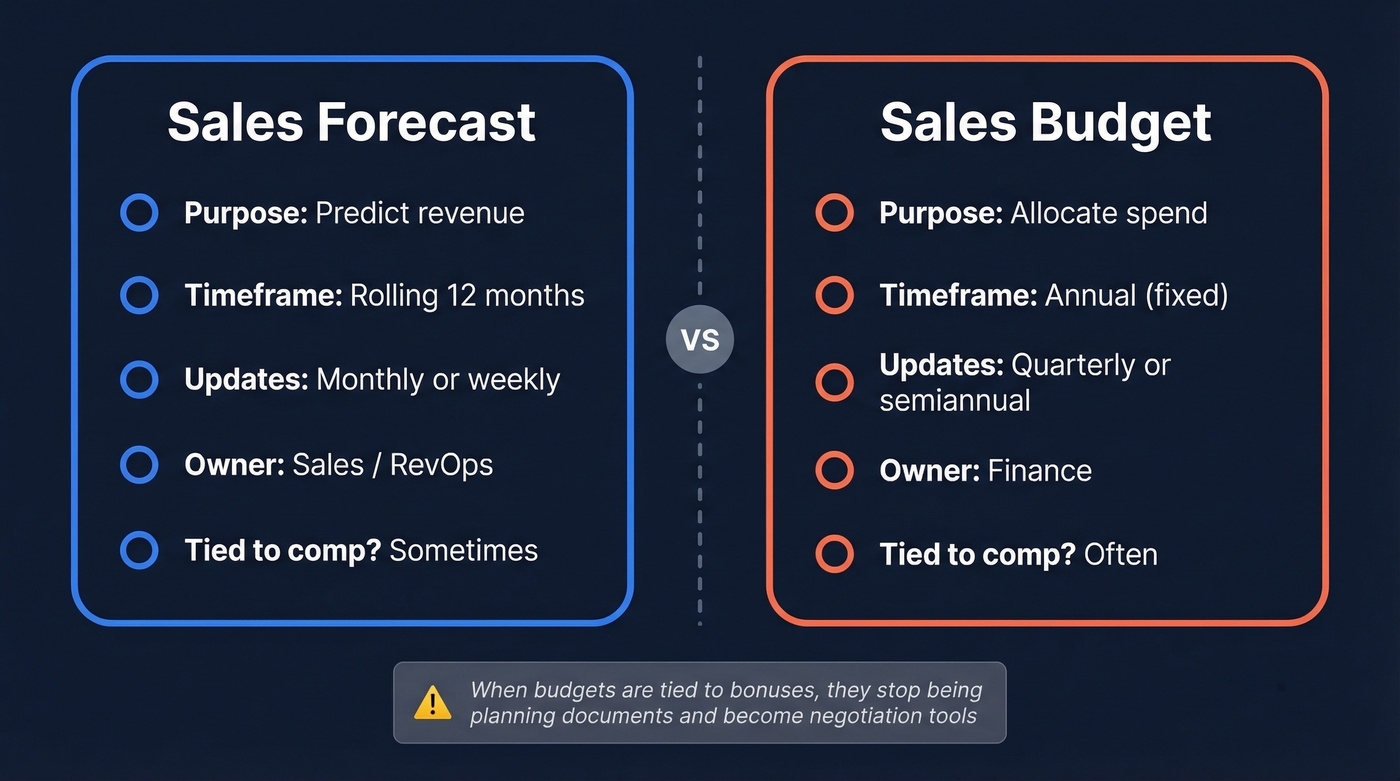
A forecast is your best estimate of what will happen. A budget is your plan for what you'll spend to make it happen. They sound similar, but they serve different masters and break in different ways.
| Dimension | Forecast | Budget |
|---|---|---|
| Purpose | Predict revenue | Allocate spend |
| Timeframe | Often rolling 12 months | Often annual (fixed) |
| Update cadence | Monthly or weekly | Quarterly or semiannual in many companies |
| Owner | Sales/RevOps | Finance |
| Tied to comp? | Sometimes | Often |
That last row is where things get political. When budgets are tied to bonuses, they stop being planning documents and become negotiation tools. Sales pushes for lower targets; finance pushes for stretch. The difference between a sales budget and a sales forecast matters here: one is a spending commitment, the other is a prediction, and conflating them invites dysfunction.
One FP&A team on Reddit described being $1M off budget by September - at which point the business stopped benchmarking against budget entirely. Their workaround was a "3+9" model: 3 months actual + 9 months forecast, shared only with senior leaders. The budget stays as the bonus target. The forecast stays honest. It's messy, but it works.
Forecast Accuracy Benchmarks
Let's put numbers on "good" and "bad." 79% of sales organizations miss their forecast by more than 10%. The median B2B forecast lands in the 70-79% accuracy range, though the broad middle band stretches lower:
| Tier | Accuracy Range |
|---|---|
| World-class | 80-95% |
| Average B2B | 50-70% |
| Lagging | Below 50% |
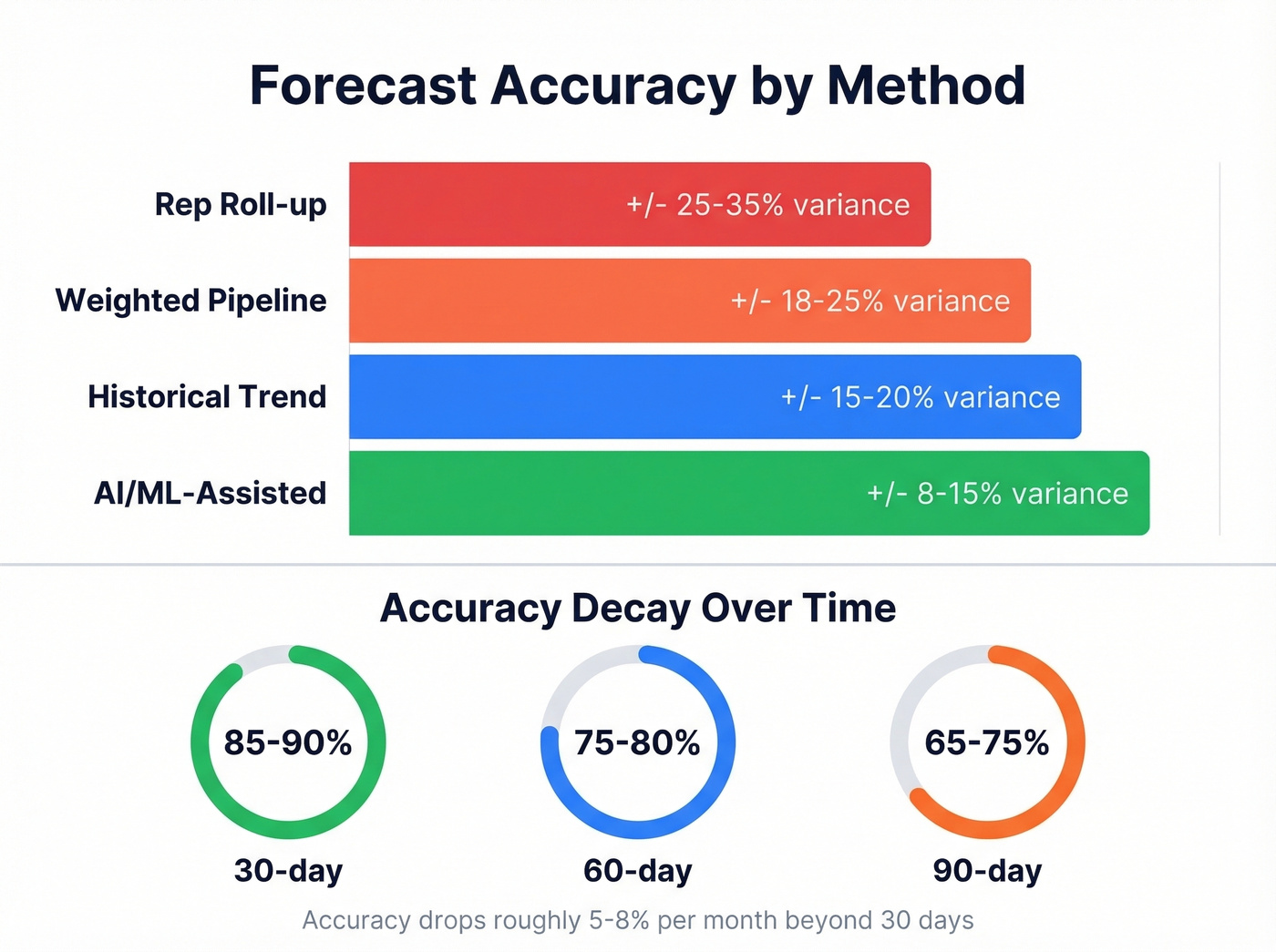
Your method matters enormously. We've seen teams jump an entire tier just by switching from rep roll-ups to weighted pipeline:
| Method | Typical Variance |
|---|---|
| Rep roll-up | +/-25-35% |
| Weighted pipeline | +/-18-25% |
| Historical trend | +/-15-20% |
| AI/ML-assisted | +/-8-15% |
Accuracy also decays the further out you look:
| Horizon | Typical Accuracy | Drop per Month |
|---|---|---|
| 30-day | 85-90% | Baseline |
| 60-day | 75-80% | ~5-8% |
| 90-day | 65-75% | ~5-8% |
On measurement, MAPE (mean absolute percentage error) is the default metric, but it distorts when actual values are small. Revenue-weighted alternatives like WAPE or WMAPE give you a cleaner picture. A reliable revenue plan depends on choosing the right accuracy metric from the start.
Forecasting Methods Compared
Qualitative (Delphi, deal reviews, expert panels)
Use this if you're launching a new product, entering a new market, or have less than two years of historical data. Skip it if you have clean CRM data and a repeatable sales motion - you'll get tighter numbers from quantitative methods.
Quantitative (time series, weighted pipeline, regression)
This is the workhorse for teams with 24-36 months of historical data and a stable sales cycle. Weighted pipeline is straightforward: deal value x stage probability, using historical win rates rather than guessed percentages. A quick example - a $200K deal at Stage 3 with a 40% historical win rate contributes $80K to your weighted forecast. That's essentially how to calculate budgeted sales from pipeline data: multiply expected deal values by empirical close rates, then sum across your pipeline. Skip this if your pipeline data is messy or your stages aren't consistently defined.
AI/ML-assisted
Use this if you have clean CRM data, enough deal volume for pattern recognition, and budget for tools like Clari or Aviso. The +/-8-15% variance is genuinely better than anything manual. Skip this if your CRM is a mess - AI amplifies bad data faster than humans do.
The real answer: hybrid. Quantitative models flag the numbers; qualitative reviews catch the context. Upwork uses this approach in weekly deal reviews, achieving 95% forecast accuracy. That's an outlier, but it shows what's possible when you combine both disciplines.

Weighted pipeline forecasting only works when your pipeline is real. Bad contact data means phantom deals, inflated stage values, and forecasts that miss by 25%+. Prospeo's 98% email accuracy and 7-day data refresh give you a pipeline built on verified buyers - not stale records.
Stop forecasting on top of bad data. Start with contacts that connect.
How to Prepare a Sales Budget
The forecast tells you what's coming in. The budget tells you what goes out. In practical terms, a sales budget is a financial plan that translates your revenue expectations into specific spending commitments across headcount, tools, commissions, and operations. Here's a driver-based template that actually holds up:
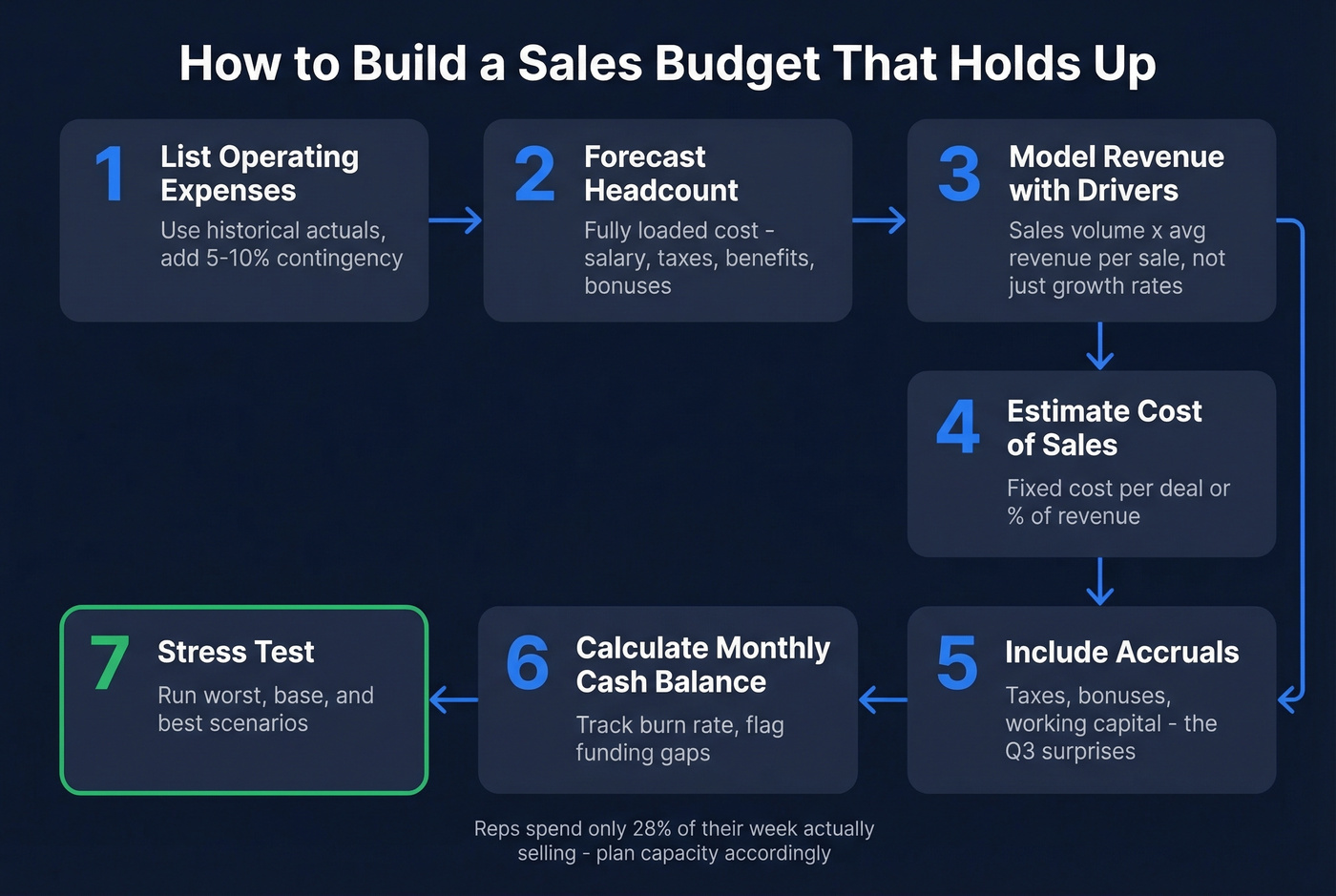
- List operating expenses. Use historical actuals as your baseline. Add a contingency line - 5-10% is standard.
- Forecast headcount. Fully loaded: salary + taxes + benefits + bonuses. Build in monthly flexibility for hiring timelines.
- Model revenue using drivers. Sales volume x average revenue per sale, with adjustable input cells for scenario modeling. Don't just project a growth rate - tie it to pipeline drivers.
- Estimate cost of sales. Either fixed cost per deal or a percentage of revenue covering processing fees, commissions, and tools.
- Include accruals and adjustments. Taxes, bonuses, working capital shifts. These are the line items that surprise you in Q3.
- Calculate monthly cash balance. Track burn rate and highlight months where funding gaps appear.
- Stress test. Run worst/base/best scenarios. Excel's Scenario Manager handles this natively - you don't need an enterprise planning tool for three scenarios.
Structure your revenue forecast across five funnels: new business, upsells, retention, cross-sells, and renewals. Each has different conversion rates, cycle times, and cost profiles. Lumping them together is how budgets blow up - a 20% increase in new business costs very differently than a 20% increase in renewals.
One capacity reality check worth internalizing: the average sales rep spends only 28% of their working week actually selling. The rest is admin, CRM updates, and meetings. If your plan assumes 100% selling capacity, your revenue projections are fiction before they start.
Rolling Forecasts vs. Annual Budgets
Annual budgets become obsolete by March in any fast-changing business. Rolling forecasts fix this by always showing the next 12 months, updated monthly or quarterly. But they only work if they're lighter-weight than the annual budget - focus on key drivers and major line items. The moment you demand the same granularity as an annual plan, teams stop updating and the forecast goes stale.
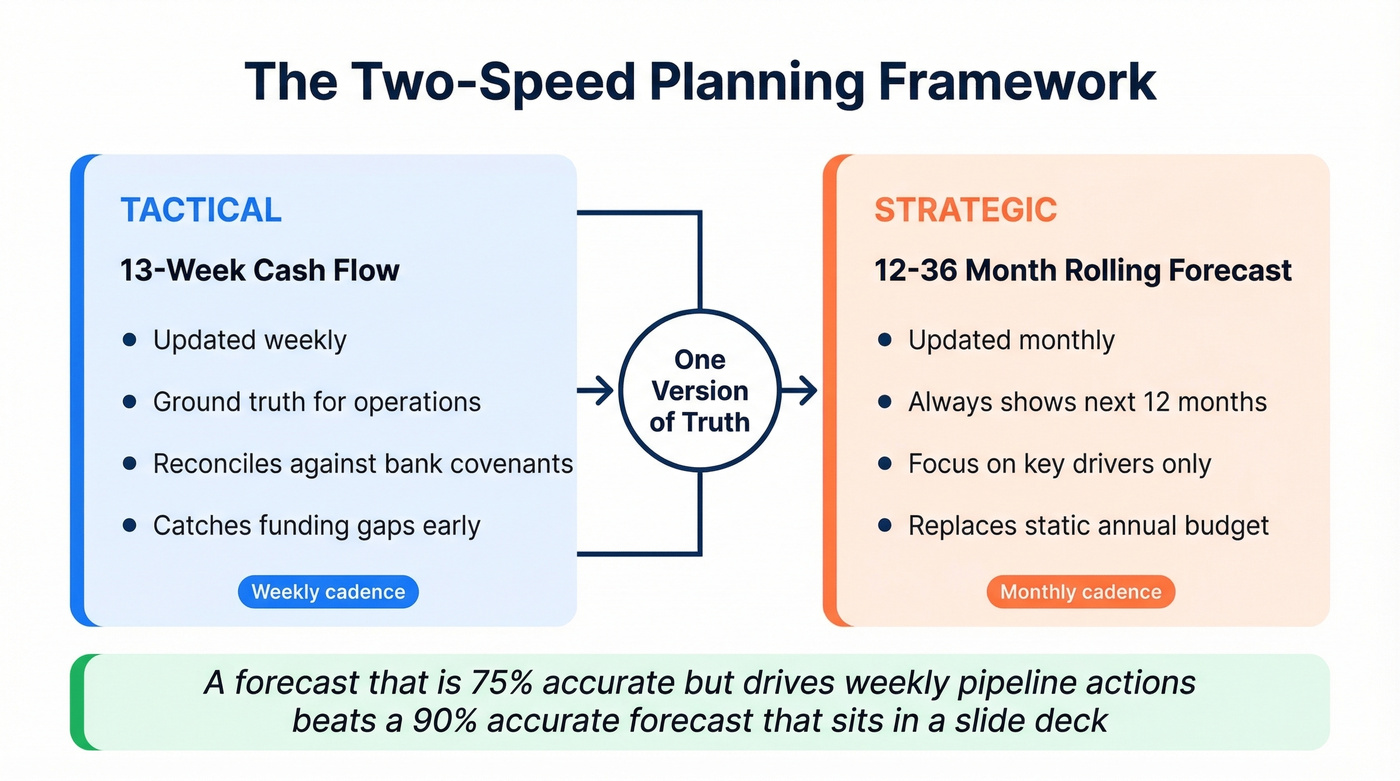
The practical framework is two-speed planning: a tactical 13-week cash flow updated weekly, plus a strategic 12-36 month rolling forecast updated monthly. The 13-week view is your ground truth - it reconciles against board models, bank covenants, and internal targets so you don't end up with three versions of reality.
Here's the thing: stop trying to make your forecast more accurate. Start making it more useful. A forecast that's 75% accurate but drives weekly pipeline actions beats a 90% accurate forecast that sits in a slide deck until the board meeting.
Forecasting Mistakes That Kill Budgets
Relying on rep gut feel. "I feel good about this deal" isn't a data point. Use pipeline metrics and stage-weighted probabilities instead.
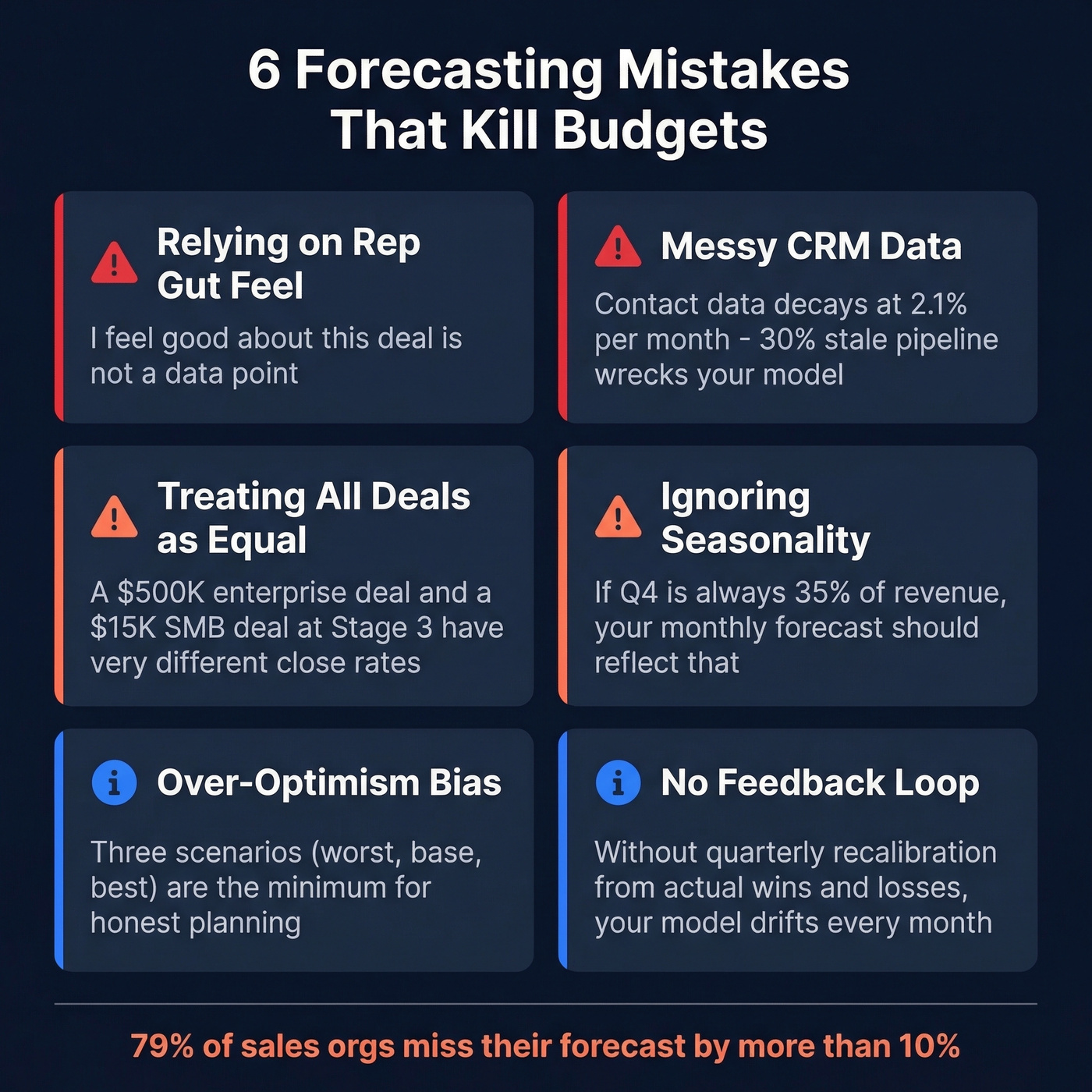
Messy CRM data. B2B contact data decays at roughly 2.1% per month. If 30% of your pipeline contacts have outdated info, your conversion assumptions are fiction. In our experience, data decay tanks forecast accuracy faster than any methodology gap. Prospeo's enrichment API matches 92% of records on a 7-day refresh cycle, keeping pipeline inputs clean before they ever hit your forecast model.
Treating all deals as equal. A $500K enterprise deal and a $15K SMB deal at "Stage 3" don't have the same close probability. Use historical win rates segmented by deal size, segment, and source.
Ignoring seasonality. If Q4 is always 35% of revenue, your monthly forecast should reflect that - not spread evenly across 12 months.
Over-optimism bias. Ground projections in empirical data and scenario planning, not aspirational targets. Three scenarios aren't optional; they're the minimum for honest planning.
Static annual budgets. If you're still running a fixed annual budget in a market that shifts quarterly, adopt rolling forecasts. We covered the two-speed framework above - use it.
No feedback loop. When you're not doing quarterly model recalibration based on actual wins and losses, your forecast drifts further from reality every month. Tracking budget performance against actuals and feeding those variances back into the model is what separates teams that improve from teams that repeat the same errors.
The consensus on r/SalesOperations is telling: even teams with Salesforce and Gong still default to spreadsheets for detailed forecast submissions. The tool isn't the problem - the process is.
Tools for Forecasting and Budget Planning
The right tool depends on your stage. Don't buy Anaplan when a spreadsheet will do, and don't run a 200-rep org on Google Sheets.
| Stage | Tools | Price Range |
|---|---|---|
| SMB | Excel + Pipedrive/HubSpot | Free-$100/user/mo |
| Mid-market | Salesforce + Clari or Aviso | ~$50-150/user/mo |
| Enterprise | Anaplan or Workday Adaptive | $30K-150K+/year |
| Data quality | Prospeo | ~$0.01/email, free tier |
For SMBs, Excel's built-in Forecast Sheet feature handles basic time-series projections. Pair it with Pipedrive Growth at $39/user/mo or HubSpot's free CRM - HubSpot's forecasting features are part of its Professional tier. Mid-market teams typically land on Salesforce plus Clari or Aviso for AI-weighted forecasts. Enterprise orgs running complex, multi-BU planning often use Anaplan or Workday Adaptive in the $30K-150K+/year range.
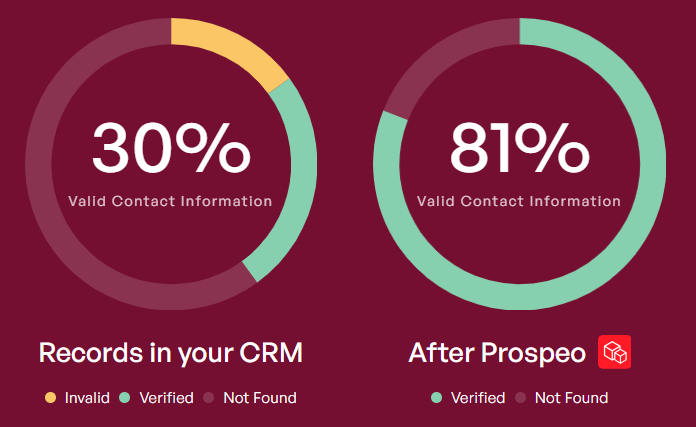
Underneath all of it sits data quality - the layer most teams neglect. Forecast accuracy depends on pipeline quality. Pipeline quality depends on contact data freshness. A 7-day refresh cycle versus the 6-week industry average is the difference between forecasting on current reality and forecasting on stale assumptions.
Look, if your average deal size is under $10K, you probably don't need a dedicated forecasting tool at all. A well-maintained CRM with weighted pipeline math in a spreadsheet will get you to 75-80% accuracy. Spend the tool budget on data enrichment services instead - bad inputs break expensive models just as easily as cheap ones.
Your budget allocates spend against revenue you expect to close. But if your reps waste 4-6 hours a week chasing wrong numbers and bounced emails, that's a line item you didn't plan for. Prospeo gives your team 300M+ verified profiles at $0.01/email - so headcount spend converts to pipeline, not busywork.
Cut prospecting costs and protect your budget with data that actually works.
FAQ
What's the difference between a sales forecast and a sales budget?
A forecast predicts revenue based on pipeline data and historical trends; a budget allocates spend to hit those targets. The forecast informs the budget - not the other way around. Reversing this order is how budgets become political fiction instead of planning tools.
How often should I update my sales forecast?
Monthly at minimum, weekly for the near-term 13-week cash flow. Rolling forecasts updated monthly outperform annual budgets because they reflect current pipeline reality. Keep updates lightweight - focus on driver changes, not line-by-line re-forecasting.
Why is my sales forecast always wrong?
The most common causes are stale CRM data that decays at roughly 2.1% per month, reliance on rep gut feel over pipeline metrics, and static stage probabilities that ignore actual win rates by segment. Fix the data decay problem first, then fix the methodology.
What's the objective of sales budgeting?
The primary objective is translating revenue expectations into a concrete spending plan that aligns headcount, tools, and go-to-market investments with realistic targets. A well-built budget creates accountability - it gives every team a financial guardrail so spending decisions happen proactively, not reactively when cash runs short.