

The Best Sales Forecasting Software for 2026 - With Pricing Nobody Else Publishes
Your VP told the board $4.2M. You're sitting at $2.8M with three weeks left in the quarter. The pipeline says $5.1M, but half those deals haven't had a meeting in 30 days. Sound familiar? This isn't a forecasting software problem - it's a data problem wearing a forecasting costume.
Four in five sales and finance leaders missed a quarterly forecast in the past year, according to Xactly's benchmark survey of 400 professionals. Over half missed it twice or more. And 66% point to the same root cause: reporting systems that can't access reliable CRM and performance data. The market sits at roughly $15 billion and is projected to reach $45 billion by 2033 at a 12% CAGR, so there's no shortage of tools. The problem is that most teams buy the wrong one, or buy the right one and feed it garbage data.
You shouldn't need a 45-minute demo to find out if a tool costs $30/month or $30,000/year. We dug up the real numbers.
Our Picks (TL;DR)
If you want the short version before the deep dive:
- Clari - Best dedicated forecasting platform for mid-market and enterprise teams with budget to match.
- Salesforce Einstein - Best CRM-native option. Included with Salesforce Enterprise ($165/user/month for the CRM), and the most underrated tool on this list for teams under 50 reps.
- Forecastio - Best for HubSpot teams. Starts at $149/month flat, not per user.
Still on spreadsheets? Start with Weflow ($30/user/month) or Forecastio (from $149/month). Both get you off the Monday fiction cycle without a five-figure commitment.
Here's the thing: most teams don't need a $70K forecasting platform. They need clean CRM data and a $149/month tool. If your average deal size is under $25K and you have fewer than 50 reps, you're almost certainly better off spending on data quality than on a premium forecasting engine.
CRM-Native vs. Dedicated vs. Enterprise Platforms
Stop comparing 22 tools. Your decision tree has three branches, and each branch has two or three real options.
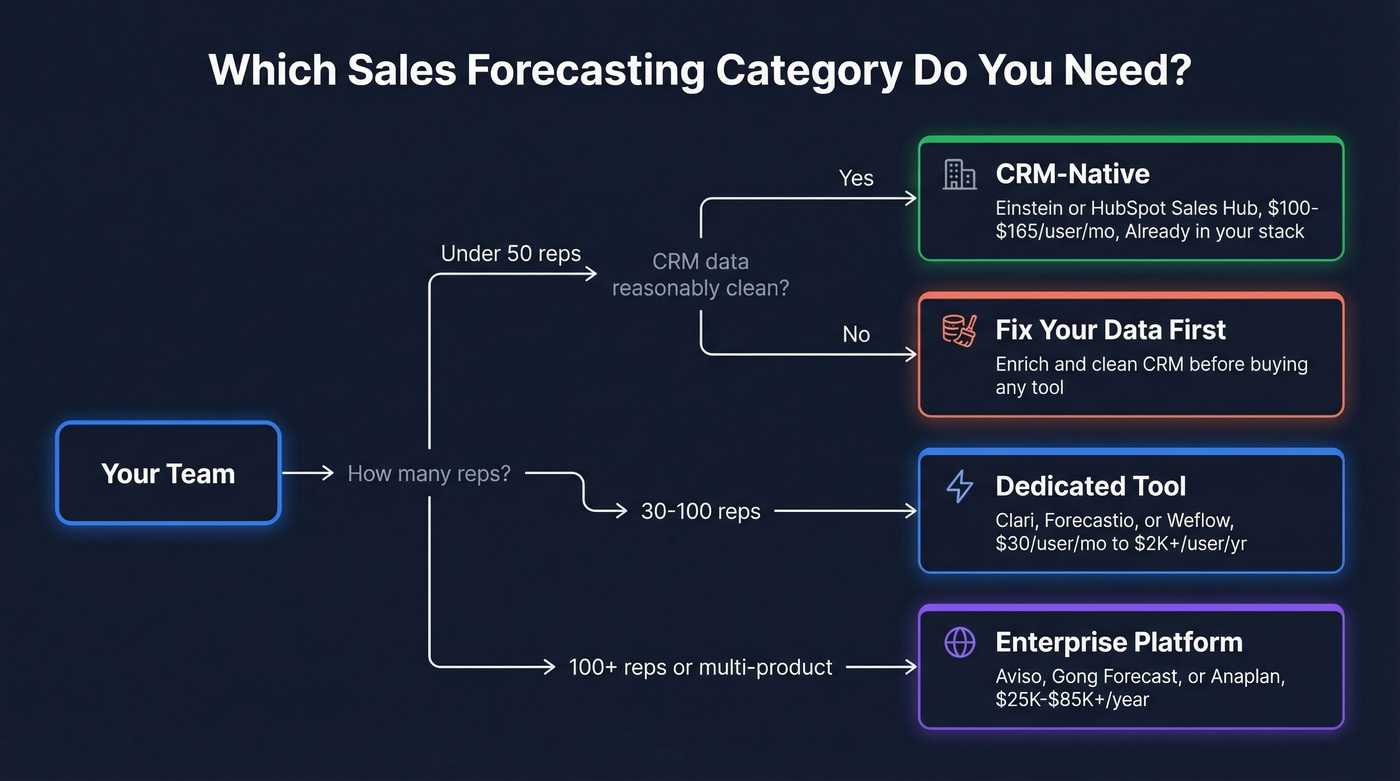
CRM-native forecasting lives inside your existing CRM. Salesforce Einstein and HubSpot Sales Hub both include forecast features as part of your CRM license. If you're under 50 reps with reasonably clean data, this is where you start. You're looking at $100-$165/user/month - money you're already spending.
Dedicated forecasting tools bolt onto your CRM and add AI-driven predictions, pipeline inspection, and deal-level analytics. Clari, Forecastio, and Weflow live here. Expect anything from $30/user/month to a few hundred dollars per user per month for premium platforms, with some tools priced as a flat monthly fee instead of per seat.
Enterprise platforms like Aviso, Gong Forecast, and Anaplan serve large RevOps orgs running multi-model forecasting across business units. Budget starts at $25K/year and climbs past $85K. If you're not running 100+ reps or multi-product forecasting, you're overpaying.
The most common failure mode isn't the tool. It's that teams buy a platform and still end up in spreadsheets because the CRM data feeding it is incomplete. The gap between what a forecasting tool promises and what it delivers comes down almost entirely to input quality.
When to move off spreadsheets: If you have 5+ reps, 100+ open deals, forecast variance above 15-20%, or spend 3+ hours a week on forecast prep, you've outgrown manual methods. Those are the thresholds where a dedicated tool starts paying for itself.
| Category | Best For | Tools | Price Range |
|---|---|---|---|
| CRM-native | Teams < 50 reps | Einstein, HubSpot | $100-$165/user/mo |
| Dedicated | Scaling teams | Clari, Weflow, Forecastio | $30/user/mo to enterprise pricing (plus flat-fee options) |
| Enterprise | 100+ rep orgs | Aviso, Gong, Anaplan | $25K-$85K+/year |
What These Tools Actually Cost
It's 2026 and Clari, Aviso, Gong, and Outreach still won't publish pricing publicly. That's frustrating for everyone except their sales teams. Here's what we've found through Vendr benchmarks, community discussions, and third-party analysis.
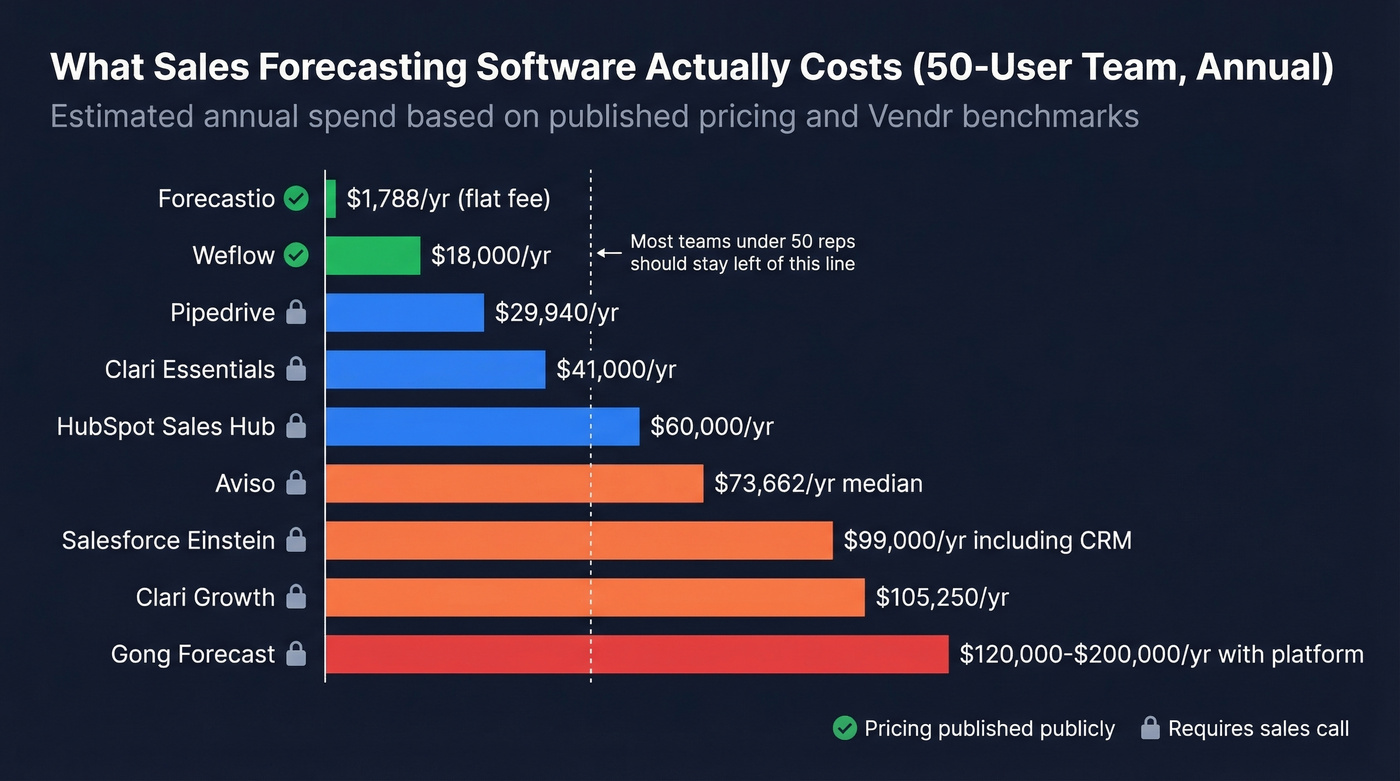
| Tool | Best For | Starting Price | Transparent? | Hidden Costs |
|---|---|---|---|---|
| Clari | Dedicated forecasting | ~$820/user/year | No | Renewal uplifts |
| Salesforce Einstein | CRM-native | $165/user/mo (CRM) | Yes | CRM license req'd |
| Gong Forecast | Existing Gong customers | $120-$250/user/mo | No | $5K-$50K platform |
| Aviso | AI-first enterprise | ~$73K/year median | No | Implementation |
| Forecastio | HubSpot teams | From $149/mo | Yes | None |
| Weflow | Budget Salesforce | From $30/user/mo | Yes | None |
| Outreach | Outreach users | ~$100-$200/user/mo | No | Platform fees |
| HubSpot Sales Hub | HubSpot-native | $100/seat/mo | Yes | None |
| Pipedrive | SMBs | $49.90/user/mo | Yes | None |
The pattern is clear: the tools that cost the most are the ones that won't tell you what they cost. Gong's first-year total can double once you add platform fees and implementation.

66% of missed forecasts trace back to unreliable CRM data. Prospeo enriches your pipeline with 98% verified emails, direct dials, and 50+ data points per contact - so your forecasting tool actually has something accurate to work with.
Stop forecasting on incomplete data. Enrich your CRM for $0.01 per lead.
The Best Tools Reviewed
Clari - Best Dedicated Platform
Clari is the default answer when someone says "we need accurate revenue predictions," and for good reason. Its pipeline inspection, AI-driven predictions, and deal-level risk scoring are best-in-class for mid-market and enterprise teams. We've seen it become the standard recommendation in RevOps communities, and the consensus on r/sales is that it earns its price - if you have the team to run it.
Vendr benchmarks put the Essentials tier at ~$820/user/year and Growth at ~$2,105/user/year post-negotiation. Volume discounts kick in at 75+ users, with bigger breaks at 150+ and 300+. A 50-user deployment with Copilot and add-ons runs roughly $72K/year.

Use this if: You have 30+ reps, a dedicated RevOps function, and budget for a purpose-built platform. Clari earns its price when you're running multi-quarter forecasting across segments.
Skip this if: You're under 30 reps or don't have someone to own the implementation. Clari is overkill for teams that just need better pipeline visibility.
Salesforce Einstein - Most Underrated Option
Most Salesforce shops already have Einstein Forecasting and don't know it. It's included with Salesforce Enterprise ($165/user/month for the CRM), which makes it the cheapest forecasting capability on this list for teams already in the ecosystem.
The AI layer analyzes deal history, pipeline changes, and rep behavior to generate predictions. Pipeline inspection shows you which deals are slipping before your reps admit it. For teams under 50 reps with reasonably clean Salesforce data, Einstein is good enough - and it's already in your tech stack. Turn it on, configure your forecast types, and you're running within a week. The configurability is solid too: you can define custom forecast categories, set up multiple forecast types by product line or territory, and adjust rollup hierarchies without touching code.
The limitation is straightforward. Einstein can't fix bad inputs. If your Salesforce data is a mess, the predictions will reflect that mess with impressive-looking confidence scores. And if you need multi-CRM forecasting across business units, you'll need something else.
Gong Forecast - Only If You Already Pay for Gong
Gong's forecasting isn't a standalone product - it's a paid application layered on top of the Gong Foundation core license. You buy Foundation first, then add Forecast Essentials or full Gong Forecast. Collaborator seats are free, which helps with cost management for managers who just need visibility.
The conversation intelligence angle is Gong's real differentiator. Forecast predictions factor in what reps actually said on calls, not just what they logged in the CRM. That's powerful for catching deals where the rep says "looking great" but the buyer said "we're evaluating three other vendors."
The math problem: At $120-$250/user/month plus $5K-$50K in platform fees and $15K-$65K implementation, the first-year cost can double what you'd expect. Buying Gong specifically for forecasting is backwards economics. As an add-on to an existing deployment where you're already using it for coaching and deal intelligence, it makes sense.

Aviso AI - Enterprise at a Surprising Price
Here's a number most people don't know: Aviso's median contract value sits at $73,662/year, ranging from $24,938 to $85,310 depending on scope and seats. That's 14.71% cheaper than Clari's $80,334 median contract - surprising given Aviso's AI-first positioning and claims of 98%+ revenue forecast accuracy.
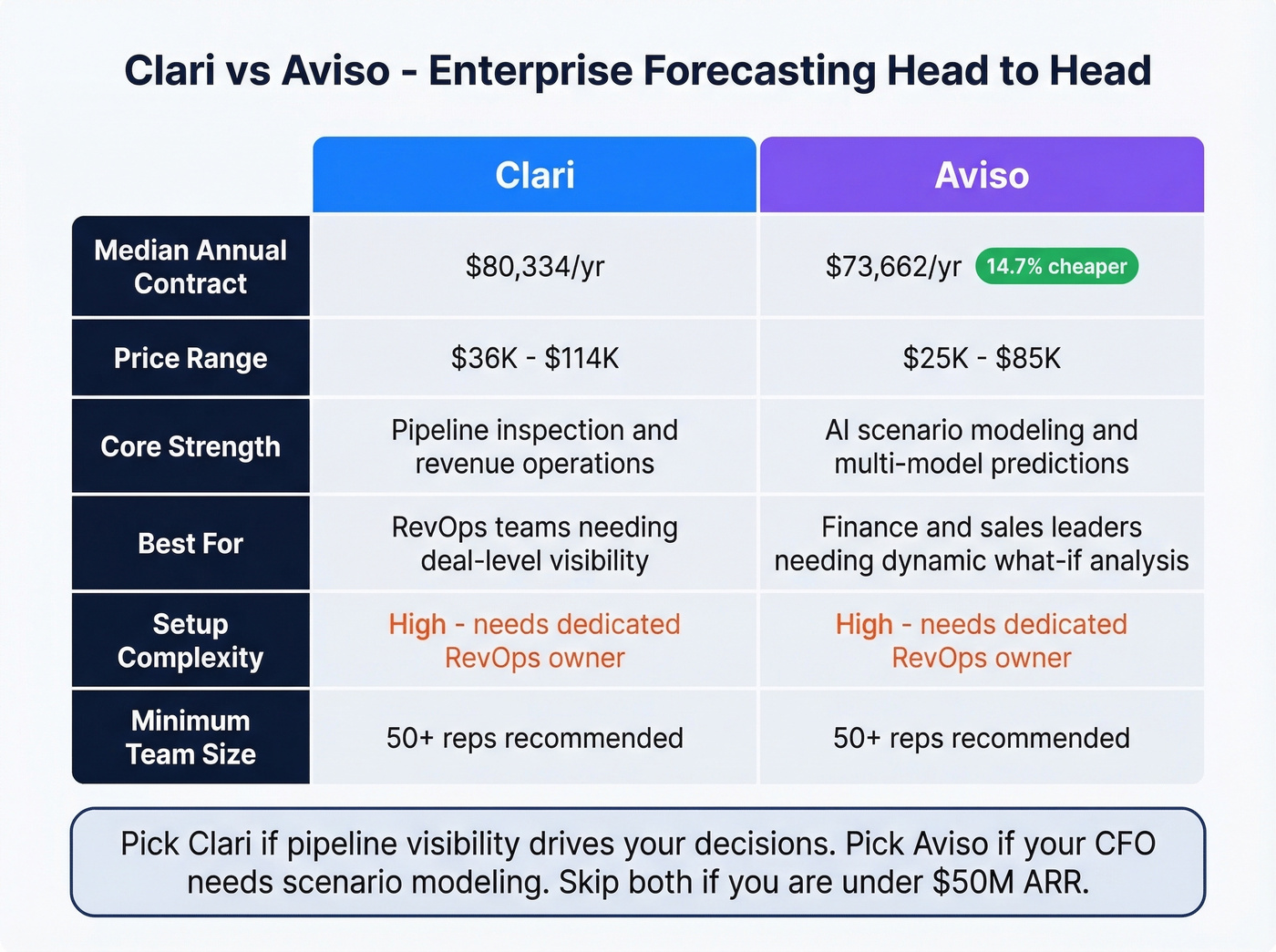
Aviso's multi-model approach blends CRM data, engagement signals, and external factors. The accuracy numbers are impressive on paper, but ask for case studies with methodology during your eval, not just headline stats. Where Aviso shines is dynamic scenario modeling across segments that updates as conditions change. If your CFO wants to see what happens to the forecast when you lose two enterprise deals and add three mid-market ones, Aviso handles that natively.
| Clari | Aviso | |
|---|---|---|
| Median contract | ~$80K/year | ~$73K/year |
| Best for | Pipeline inspection + RevOps | AI scenario modeling |
| Winner | Clari (if you need pipeline visibility) | Aviso (if you need predictive modeling) |
Skip both if: You're under $50M in ARR or don't have a RevOps team to configure and maintain the models.
Forecastio - Best for HubSpot Teams
Forecastio is purpose-built for HubSpot and it shows. Pricing starts at $149/month flat - paid plans start at $199/month billed annually - which makes it one of the most cost-effective dedicated forecasting tools for scaling teams. The HubSpot-native integration means setup takes hours, not weeks. Real-time updates flow directly from your HubSpot pipeline, so predictions adjust as deals progress rather than waiting for a nightly sync.
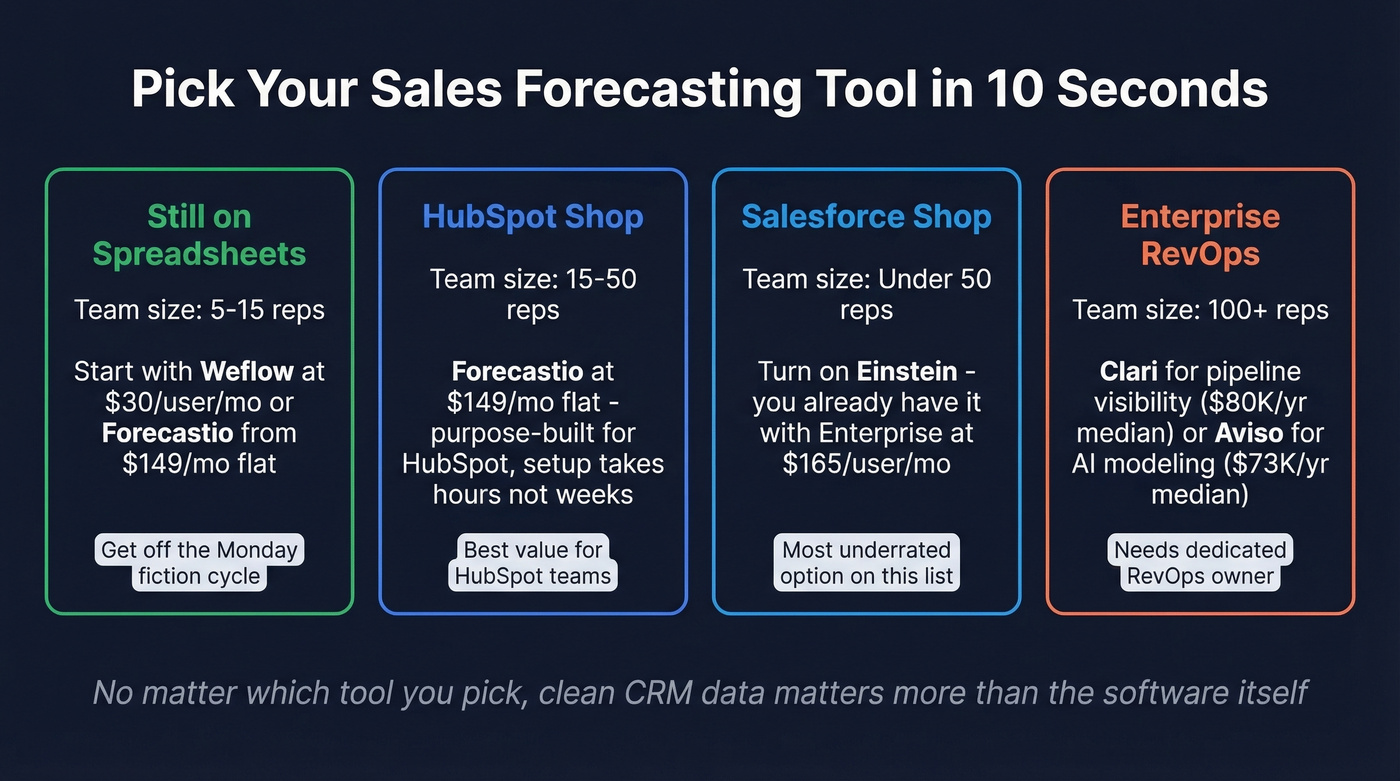
For 15-50 rep teams that have outgrown HubSpot's built-in forecasting but don't need Clari-level complexity, Forecastio is the right fit.
Weflow - Best Budget Option for Salesforce
Weflow starts at $30/user/month and focuses on making Salesforce data actually usable for forecasting. Per-rep forecast tracking, pipeline updates, and activity capture happen inside a clean interface that reps don't hate. For Salesforce teams that need better forecast hygiene without a five-figure annual commitment, Weflow is the obvious starting point.
Outreach Forecast
Outreach's forecasting module makes the most sense if you're already running sequences and deal management on the platform. Pricing runs ~$100-$200/user/month depending on your package. The value is in connecting execution data - email opens, call outcomes, meeting completions - directly to forecast predictions. Buying Outreach solely for forecasting doesn't make sense, but as part of an existing deployment, it's solid.
HubSpot Sales Hub
HubSpot Professional ($100/seat/month) includes built-in forecasting that covers the basics: weighted pipeline, category-based forecasts, and team roll-ups. It won't match Forecastio's depth or Clari's sophistication, but for HubSpot-native teams under 30 reps, it's already included in your license. Start here before adding another tool.
Pipedrive
Pipedrive's visual pipeline makes forecasting intuitive for small teams. Professional ($49.90/user/month) includes revenue forecasting; Enterprise ($99/user/month) adds more customization. Best for SMBs with straightforward sales cycles who want forecasting without complexity. Skip it if you need multi-team roll-ups or AI-driven predictions.
Anaplan
Enterprise connected planning for finance-led forecasting at large organizations. Starts ~$30K/year. If your CFO is driving the forecasting initiative and needs it tied to headcount planning, budgeting, and supply chain, Anaplan is the tool. Overkill for sales-led teams.
ForecastX
Excel-based statistical forecasting. Lite at $59/month, Full at $99/month plus $500 setup. If your team lives in spreadsheets and wants better math without leaving Excel, ForecastX bridges the gap. It's not a CRM-connected tool.
Finmark
SaaS and startup financial forecasting starting at $50/month. Finmark is a financial modeling tool, not a pipeline forecasting platform - but it's useful for founders who need revenue projections tied to burn rate and runway calculations.
LivePlan
Small business planning at ~$20-$30/month. LivePlan includes basic forecasting as part of its business plan builder. If you're a pre-revenue startup writing a business plan, it works. For active sales teams, look elsewhere.
Your Forecast Is Only as Good as Your Data
That Xactly stat bears repeating: 66% of leaders cite data access as their top forecasting roadblock. Not the algorithm. Not the UI. The data.
We've watched teams spend months evaluating Clari vs. Gong vs. Aviso, only to realize their CRM data was so stale that no tool could produce accurate predictions. One team we spoke with had 40% of their pipeline contacts listing job titles from two roles ago - every forecast built on that foundation was fiction, and no amount of AI sophistication was going to fix it.
The fix isn't more sophisticated technology. It's cleaner inputs. When your pipeline is full of contacts with outdated titles, invalid emails, and companies that were acquired six months ago, every prediction is built on sand.

Prospeo's CRM enrichment tackles this directly. It returns 50+ data points per contact at a 92% API match rate, with every record refreshed on a 7-day cycle compared to the industry average of six weeks. The 98% email accuracy means your pipeline contacts are actually reachable - not phantom opportunities padding your forecast. Native Salesforce and HubSpot integrations mean enrichment runs continuously, not as a one-time cleanup project that decays within weeks.
Before you commit to any forecasting platform on this list, audit your pipeline data. If more than 10% of your contacts have invalid emails or outdated titles, fix that first.
No forecasting tool fixes garbage in, garbage out. Prospeo's CRM enrichment returns contact data on 83% of leads with a 7-day refresh cycle - turning your Salesforce or HubSpot into a source of truth your forecast can rely on.
Clean pipeline data is the forecasting upgrade nobody talks about.
Common Forecasting Mistakes
Dirty CRM data. Stale contacts and wrong titles inflate pipeline value. Run enrichment weekly, not quarterly.
Batch-updating reps. Reps who update 30 deals every Friday afternoon are guessing, not forecasting. Enforce real-time updates with pipeline review cadences.
Missing key fields. No close date, no next step, no decision maker identified. Make these required fields and audit weekly.
Optimism bias. Reps overweight deals they're emotionally invested in. Track historical accuracy per rep and calibrate accordingly. The flip side is sandbagging - reps hiding upside to beat quota easily. Compare forecast-to-close ratios by rep over time to catch both patterns.
Spreadsheet version chaos. Three people editing the same Google Sheet creates the Monday fiction where forecasts are outdated by Wednesday. Move to a tool with a single source of truth.
Treating forecasts as certainties during disruptions. No model predicted COVID demand shifts. Tools that support scenario ranges help here - build multiple projections, not single-number commitments.
How to Choose and Implement
Let's break this down into steps that actually work:
Audit your CRM data quality first. Pull a random sample of 200 pipeline contacts. Check email validity, title accuracy, and last activity date. If more than 15% are stale, fix data quality before buying a forecasting tool. In our experience, this single step saves more forecast accuracy than any platform switch.
Pick your category. CRM-native if you're under 50 reps with clean data. Dedicated tool if you're scaling past that. Enterprise platform only if you have 100+ reps and a RevOps team to own it.
Run a two-week pilot with real pipeline data. Don't evaluate on demo data. Import your actual pipeline and see if the tool's predictions match reality. Two weeks gives you enough deal movement to test, and it'll expose data quality gaps you didn't know you had.
Measure forecast variance for one quarter. Compare the tool's predictions against actual closed revenue at 30, 60, and 90 days. If variance isn't meaningfully better than your current method, the tool isn't earning its cost.
Roll out with CRM SLAs. Define required fields, update cadences, and pipeline review schedules before going live. Sales forecasting software without process discipline is just an expensive dashboard. Plan for a 90-day implementation timeline, aligned to your sales process.
FAQ
What is sales forecasting software?
It's a category of tools that use CRM pipeline data, historical close rates, and - in advanced versions - AI and engagement signals to predict revenue for a given period. These platforms replace spreadsheet guesswork with data-driven projections, giving sales leaders and finance teams a shared view of expected results.
What's the best free forecasting tool?
Salesforce Einstein Forecasting is included with Enterprise licenses - you're paying $165/user/month for the CRM, but forecasting costs nothing extra. HubSpot Professional also includes basic forecasting at $100/seat/month.
Can I use Excel for sales forecasting?
You can, but you shouldn't past 10 reps or $1M in pipeline. Spreadsheets break when multiple people edit them, can't pull real-time CRM data, and create the Monday fiction problem where forecasts are outdated by Wednesday. ForecastX ($59-$99/month) bridges the gap if you're not ready to leave Excel entirely.
How accurate is AI-powered forecasting?
AI-driven forecasting is typically 20-50% more accurate than manual methods and can reach 95%+ accuracy on 30-day horizons. But accuracy depends entirely on CRM data quality - AI amplifies whatever's in your pipeline, good or bad.
How much does forecasting software cost?
CRM-native options are effectively free if you already pay for Salesforce Enterprise or HubSpot Professional. Dedicated tools range from $30/user/month (Weflow) to $149/month flat (Forecastio). Enterprise platforms like Clari ($820-$2,105/user/year) and Gong ($120-$250/user/month plus platform fees) cost significantly more.