

The Sales Funneling Process - With the Numbers Most Guides Leave Out
79% of marketing leads never convert into sales. And 68% of companies surveyed by Salesforce say they haven't even identified a sales funnel. That's not a pipeline problem - it's a measurement problem disguised as a lead gen problem. Every guide on the sales funneling process walks you through the same stages. None of them hand you a number to aim for or a formula to diagnose what's broken.
Let's fix that.
What You Need (Quick Version)
Most teams do well with a practical five-stage funnel model: Awareness, Interest, Trust, Decision, Action. The one formula worth memorizing is sales velocity: (Opportunities x Win Rate x Avg Deal Size) / Sales Cycle Length. And the single biggest lever you can pull? Disqualify early. A team with 50% stage progression needs 160 pitches to close 10 deals. Drop that to 33% progression and you need 810. That's a 5x difference in effort for the same outcome.
Jump to the benchmarks table if you want industry numbers, or the KPI formulas if you need something to paste into a spreadsheet today.
What Is a Sales Funnel?
A sales funnel maps the buyer's journey from first awareness to closed deal. It's a diagnostic tool - a way to see where prospects drop off and where your process actually works.
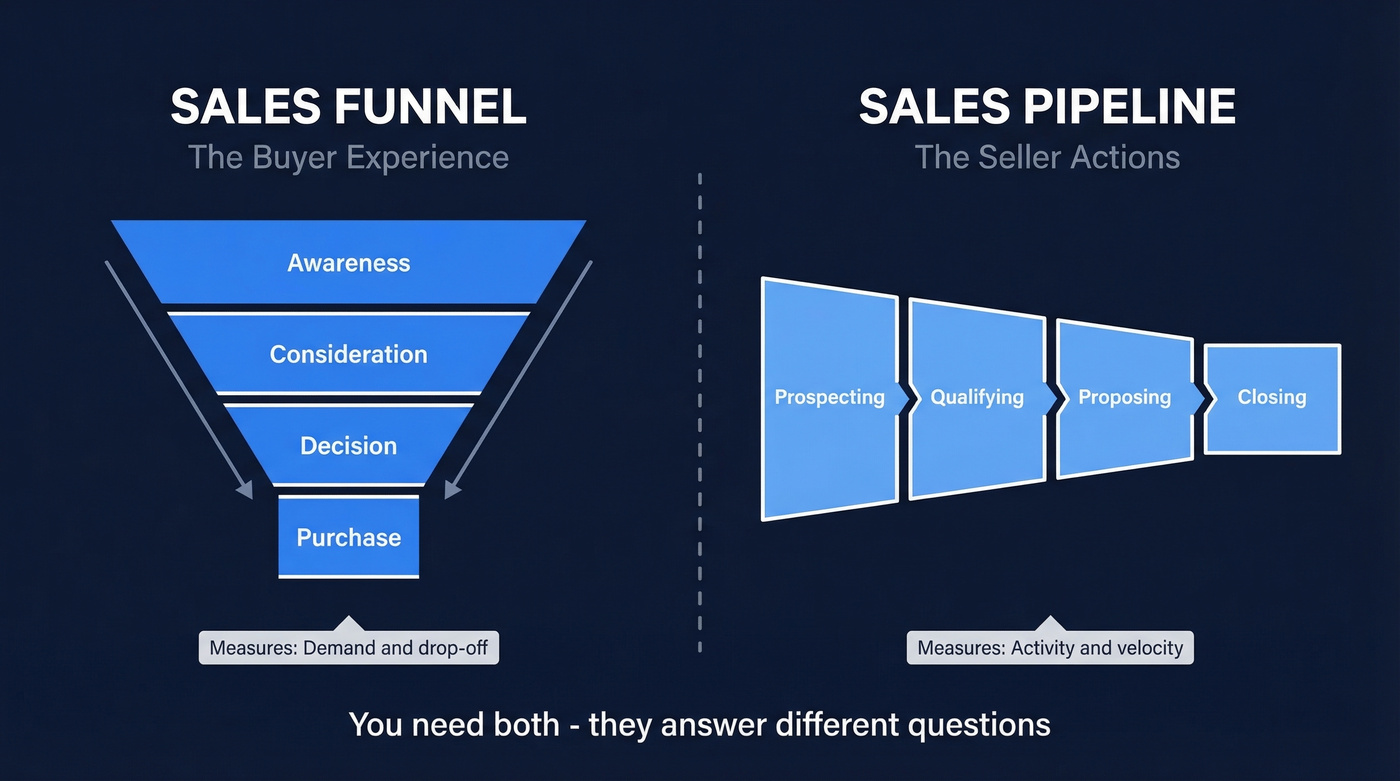
People confuse funnels with pipelines constantly. The funnel describes the buyer's experience: awareness, consideration, decision. The pipeline describes the seller's actions: prospecting, qualifying, proposing, closing. One measures demand, the other measures activity. You need both, but they answer different questions.
You'll sometimes hear this framed as TOFU (top of funnel), MOFU (middle), and BOFU (bottom). That shorthand works for marketing teams mapping content to stages. For sales ops, the stage-by-stage model below is more actionable because it gives you conversion rates to measure at each transition.
Funnel Stages Explained Step by Step
Most guides list four or five stages and call it done. Practitioners on r/SaaS push back on that - a lot of real-world teams prefer a simpler five-stage model that adds a clear Trust step and often extends into onboarding.
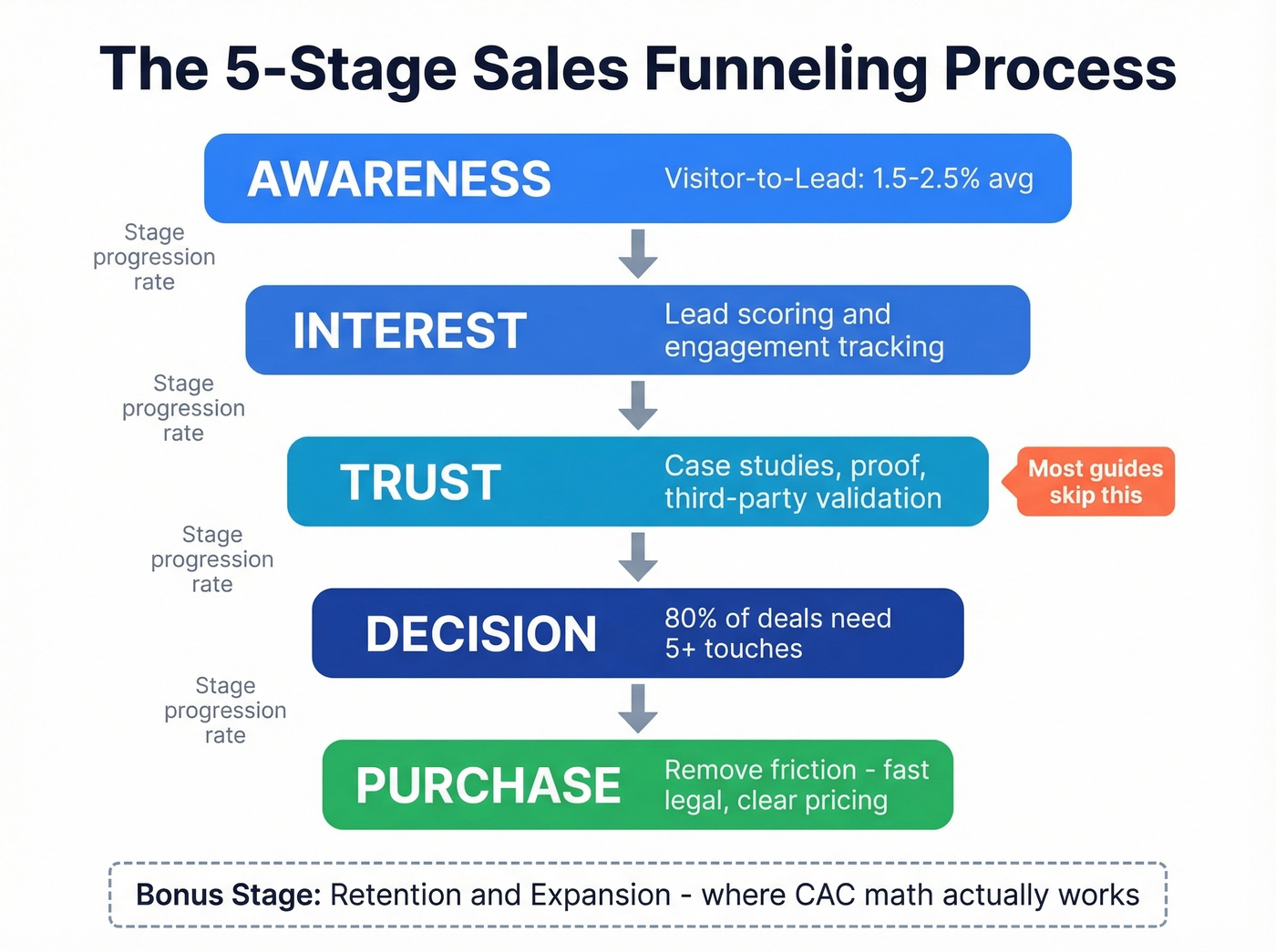
Awareness
The prospect learns you exist. This happens through content, ads, referrals, cold outreach, or organic search. Your job here isn't to sell - it's to be relevant enough that someone pauses. Visitor-to-lead conversion at this stage averages 1.5-2.5% for SaaS. Top 10% teams hit 8-15%.
Interest
The prospect engages - downloading a resource, attending a webinar, replying to an email, or visiting your pricing page. This is where lead scoring kicks in. The content that works here is educational: comparison guides, use-case breakdowns, ROI calculators.
Trust (The Stage Most Guides Skip)
Here's the thing: interest doesn't equal intent. Between "I'm curious" and "I'm ready to buy" sits a trust gap that most funnel models ignore entirely. Case studies, testimonials, proof of outcomes, and third-party validation do the heavy lifting here. A practitioner on r/SaaS put it well - great funnels aren't built by adding more steps, they're built by removing confusion between the few steps that truly matter. Trust is the step that removes confusion.
Take Twilio as an example. Their developer-first approach builds trust by letting prospects use the product before ever talking to sales. By the time a champion brings Twilio to their buying committee, the trust stage is already complete. That's the model to aim for - let proof do the selling before your reps get involved.
Intent & Decision
The prospect signals buying intent - requesting a demo, asking for pricing, involving other stakeholders. For B2B, this is where the buying committee often expands to 6-10 decision-makers. Your content shifts to proposals, competitive comparisons, and ROI documentation. 80% of deals require five or more touches to close, so persistence matters here.
Purchase
The deal closes. In eCommerce, this is checkout. In B2B SaaS, it's contract signature. The biggest killer at this stage is friction - slow legal reviews, unclear pricing, clunky procurement processes.
Retention & Expansion
Most funnel guides stop at the purchase. That's a mistake. Onboarding, first-value delivery, and expansion revenue are where the real economics play out. A customer who churns in 90 days cost you money. A customer who expands in year two is where your CAC math actually works.
The Math That Changes Everything
Let's run two scenarios that show why funnel efficiency matters more than funnel volume.
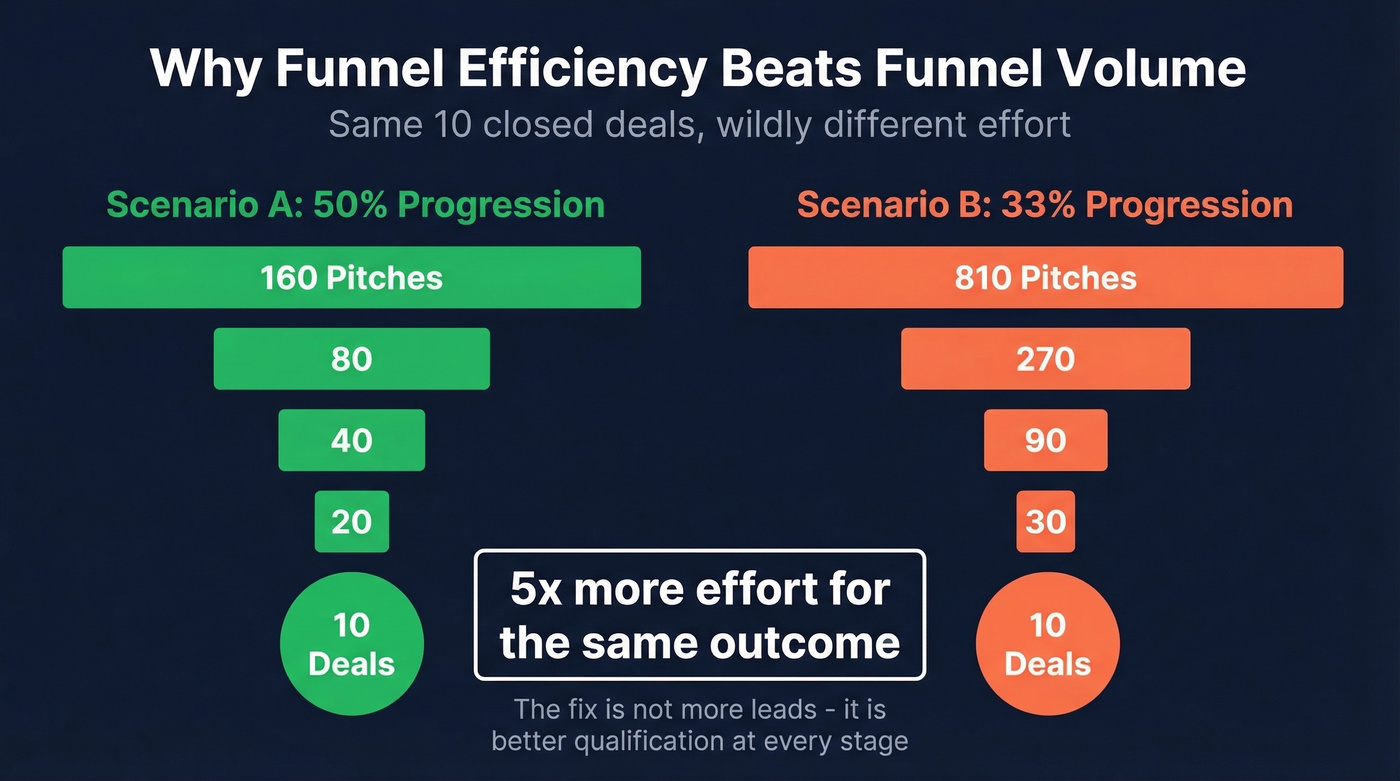
Scenario A: 50% progression per stage. You need 10 closed deals. Working backward through four stages at 50% conversion each: 10 -> 20 -> 40 -> 80 -> 160 pitches at the top.
Scenario B: 33% progression per stage. Same 10 deals, same four stages, but at 33% conversion: 10 -> 30 -> 90 -> 270 -> 810 pitches.
That's 160 pitches versus 810 for the same outcome. The difference isn't more leads - it's better qualification at every stage. Disqualifying early is more valuable than generating more volume. We've seen teams pour money into top-of-funnel lead gen when the real problem was a 25% MQL-to-SQL rate sitting well below the 38% B2B SaaS average. Fix the conversion, not the volume.
Look, if your average deal size is under $10K, you probably don't need a seven-stage funnel with lead scoring matrices and buying committee maps. A three-stage model - qualified lead, demo, close - will outperform the enterprise playbook every time. Complexity is a luxury you earn at scale, not a strategy you start with.

You just saw the math: 160 pitches vs 810 for the same 10 deals. The fastest way to improve stage progression is starting with verified contacts. Prospeo's 98% email accuracy and 30% mobile pickup rate mean fewer dead leads clogging your funnel - so your reps spend time on prospects who actually convert.
Stop feeding bad data into a good funnel. Fix the input.
Benchmarks by Industry
Numbers without context are useless. Let's put your funnel against real benchmarks.
Stage-by-Stage Conversion Rates
Data from First Page Sage's benchmark report covering 2017-2025 client data, roughly 65% B2B:
| Industry | Lead to MQL | MQL to SQL | SQL to Opp | SQL to Close |
|---|---|---|---|---|
| B2B SaaS | 39% | 38% | 42% | 37% |
| eCommerce | 23% | 58% | 66% | 60% |
| Higher Ed | 45% | 46% | 61% | 66% |
| Construction | 17% | 37% | 50% | 54% |
Channel matters too. SEO-sourced leads convert at 2.1% visitor-to-lead with a 41% Lead-to-MQL rate. PPC leads convert at 0.7% visitor-to-lead but only 36% Lead-to-MQL. Organic traffic is lower volume but dramatically higher quality through the funnel.
PLG and SaaS Benchmarks
If you're running a product-led motion, the benchmarks look different. CRM free-trial-to-paid conversion averages 29%. Freemium-to-paid sits much lower at 3.4%. General free-trial-to-paid ranges from 18-29% depending on trial length and activation design.
MQL-to-close rates shift dramatically by company stage: early-stage startups see 1-2%, while mature enterprise companies hit 4-7%. Know which benchmark applies to you before you panic about your numbers.
How Long Each Stage Should Take
Time-to-convert benchmarks for B2B SaaS in 2026:
| Stage Transition | SMB | Enterprise |
|---|---|---|
| Visitor to Lead | 1-3 days | 1-3 days |
| MQL to SQL | 8-15 days | 8-15 days |
| Opportunity to Close | 30-45 days | ~120 days |
If your enterprise deals are closing in 30 days, you're either selling something very transactional or your reps are discounting too aggressively. If SMB deals drag past 60 days, something in your qualification or proposal stage is broken.
Where Do You Stand?
In our experience, teams that track stage-by-stage conversion weekly catch problems 2-3x faster than those reviewing monthly. Here are the tiers to measure yourself against:
| Metric | Bottom 25% | Average | Top 10% |
|---|---|---|---|
| Visitor to Lead | <0.7% | 1.5-2.5% | 8-15% |
| MQL to SQL | <20% | 32-40% | 39-40% |
| SQL to Close | <15% | 20-25% | 30%+ |
If you're below the bottom 25% on any metric, that's your bottleneck. Don't optimize everywhere - find the worst stage and fix it first.
KPI Formulas You Can Copy
These are the formulas that actually matter for funnel management. Paste them into a spreadsheet and fill in your numbers.
MQL to SQL Conversion Rate (SQLs / MQLs) x 100 Example: 150 SQLs from 500 MQLs = 30%
Lead to Customer Conversion Rate (Customers / Total Leads) x 100
Drop-Off Rate (per stage) (Leads leaving stage / Total leads entering stage) x 100
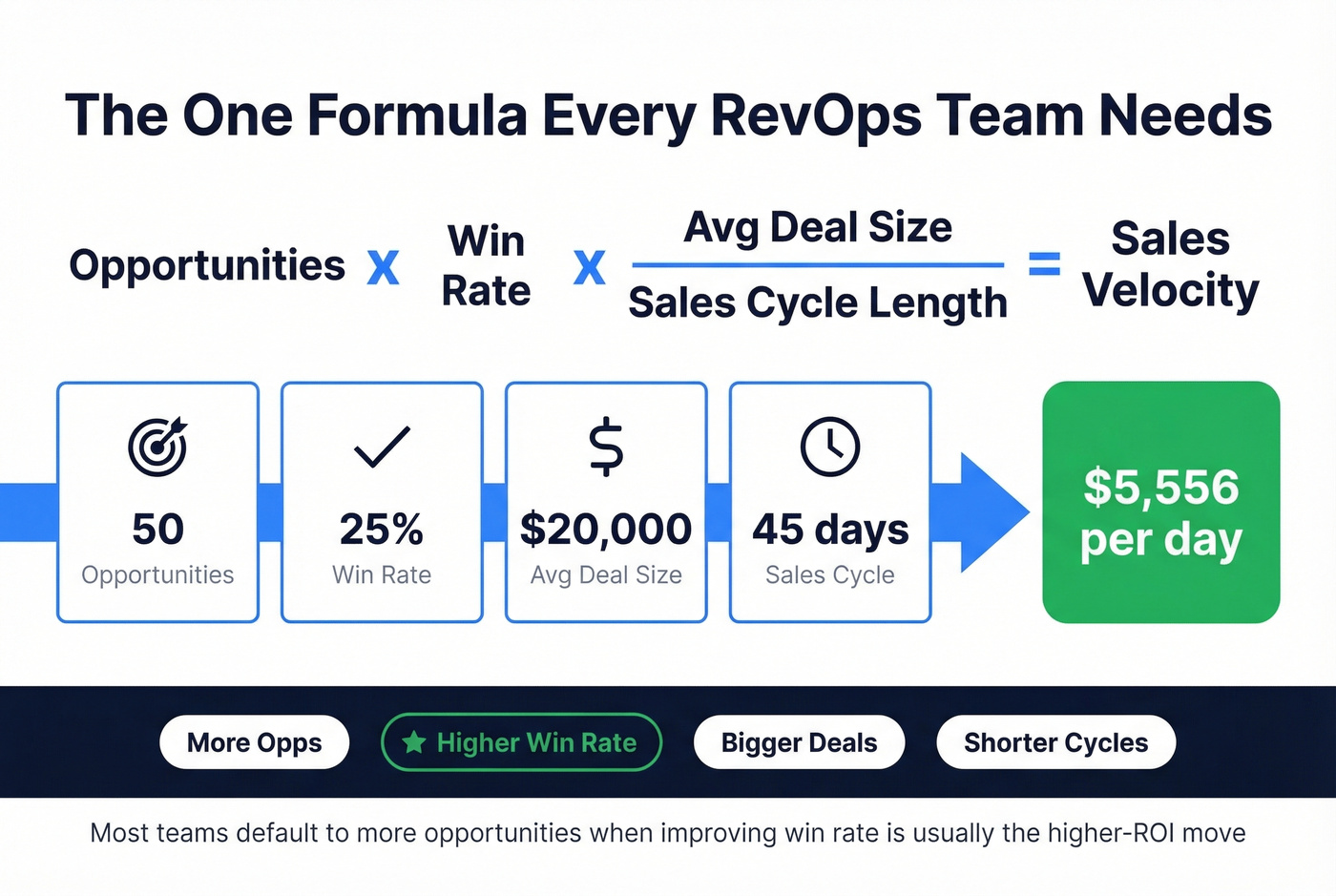
Sales Velocity - the one formula every RevOps team should track:
(Opportunities x Win Rate x Avg Deal Size) / Sales Cycle Length
Worked example: 50 opportunities x 25% win rate x $20,000 average deal / 45-day cycle = $5,556/day in pipeline velocity. Want to double that number? You have four levers: more opportunities, higher win rate, bigger deals, or shorter cycles. Most teams default to "more opportunities" when improving win rate is usually the higher-ROI move.
B2B vs B2C Funnel Differences
The sales funneling process looks fundamentally different depending on who you're selling to.
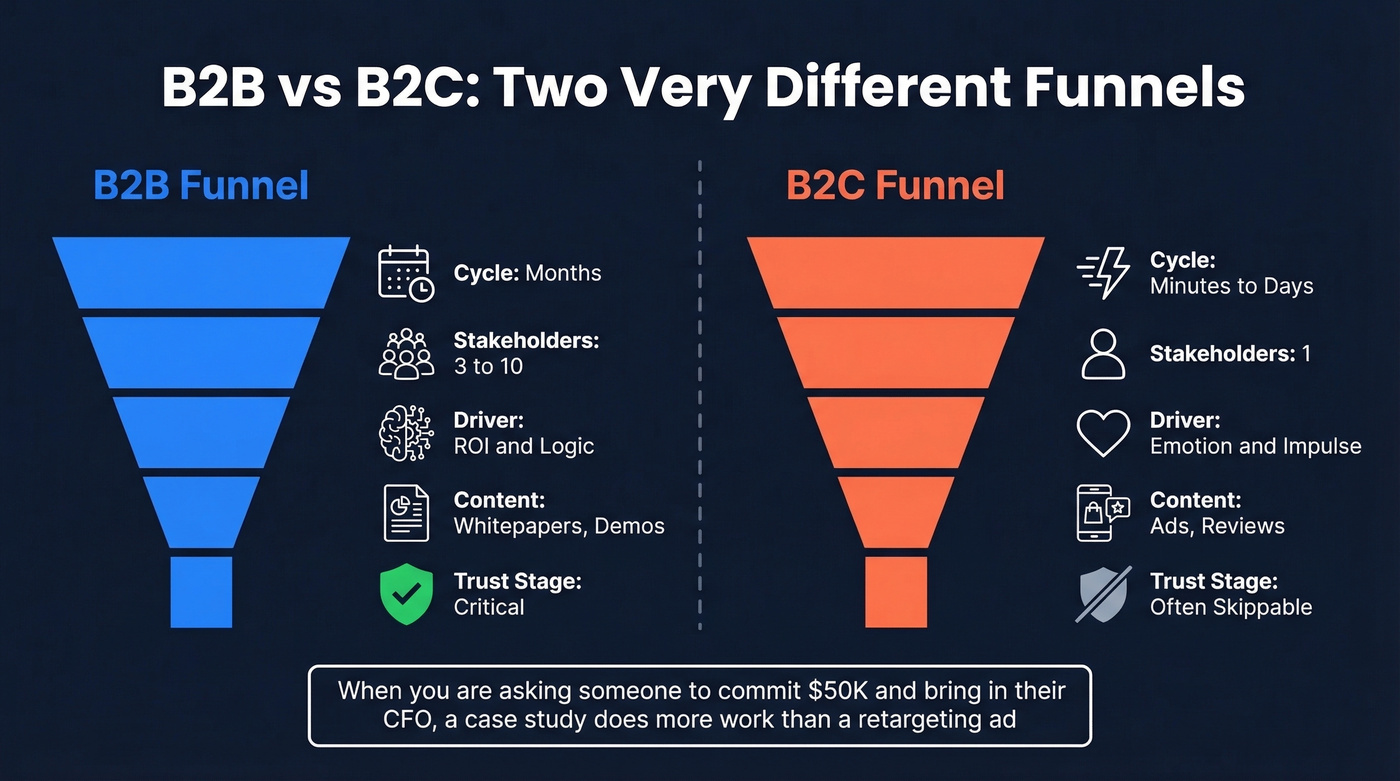
| Dimension | B2B | B2C |
|---|---|---|
| Stages | 6 (incl. evaluation) | 4 (AIDA model) |
| Cycle length | Months | Minutes to days |
| Stakeholders | 3-10 | 1 |
| Decision driver | ROI & logic | Emotion & impulse |
| Key content | Whitepapers, demos | Ads, reviews |
The biggest practical difference: B2B funnels need a trust-building stage that B2C funnels can often skip entirely. When you're asking someone to commit $50K and bring in their CFO, a case study does more work than a retargeting ad.
Common Funnel Mistakes
Overcomplicating the Stages
The instinct is to add more - more stages, more emails, more landing pages. It feels like strategy. It's usually just complexity. A practitioner on Reddit nailed it: they kept adding steps thinking it meant sophistication, and results didn't move until they simplified. Start with five or six stages. Measure each one. Only add complexity when the data tells you a specific transition needs a new step.
Bad Data at the Top
If your email bounce rate is above 5%, your funnel isn't broken - your data is. Every bounced email is a prospect who never entered the funnel at all. It's invisible waste that compounds through every stage.
Prospeo verifies emails in real time with 98% accuracy on a 7-day refresh cycle. Meritt, a Prospeo customer, dropped their bounce rate from 35% to under 4% and tripled pipeline from $100K to $300K/week. That's not a funnel optimization - it's fixing the input so the funnel can actually work.
Ignoring Speed-to-Lead
Reps spend only 28% of their time actually selling. The rest is admin, research, and data entry. When a lead raises their hand, response time matters enormously - contact within five minutes is the standard many high-performing teams aim for. And don't rely on a single channel: multichannel outreach increases response rates by 287% compared to single-channel approaches. Phone, email, and social touches in the first hour beat a single email drip every time.
Stopping at the First Purchase
Cart abandonment averages ~70% across industries. Two-step checkout processes lift conversion 20-40% compared to single-step forms. But the bigger mistake is treating the purchase as the end. Retention, upsell, and expansion are where unit economics actually work. Build post-purchase into your funnel model from day one.
Your MQL-to-SQL rate won't hit the 38% B2B SaaS benchmark if half your leads have stale emails. Prospeo refreshes 300M+ profiles every 7 days - not the 6-week industry average - so the contacts entering your funnel are current, verified, and reachable. At $0.01 per email, better conversion math costs less than one bad campaign.
Fresher data means fewer drop-offs at every single stage.
Tools to Manage Your Funnel
CRM
You need a CRM to track stage progression and measure conversion rates. HubSpot offers a genuinely useful free tier, with Sales Hub paid plans starting around $15-$20/seat/month when you need sequences and automation. Pipedrive is a strong pure-play sales CRM at roughly $15-$25/user/month - less marketing bloat, more pipeline focus.
For larger teams, Salesforce entry tiers start around $25/user/month but realistically cost $75-150/user once you add the features you actually need. Skip Salesforce if you're under 20 reps and don't have a dedicated admin. Zoho CRM offers a free plan for up to three users, with paid plans around $15-$30/user/month - PCMag's top overall pick for teams that want depth without Salesforce complexity.
Funnel Builders
ClickFunnels starts around $80-$100/month and remains the category default for dedicated landing pages and conversion flows. Systeme.io has a free plan with paid tiers around $27/month - best value for solopreneurs. GoHighLevel runs about $97/month and bundles CRM, funnels, and automation into one platform. Perspective starts at $62/month with a mobile-first approach that works well for high-volume B2C funnels.
Data & Prospecting
For top-of-funnel data, accuracy is everything. Prospeo gives you 300M+ profiles with 30+ search filters including buyer intent and technographics, and a free tier of 75 emails/month. Native integrations with Salesforce, HubSpot, Smartlead, Instantly, and Lemlist mean verified contacts flow straight into your CRM and sequencing tools.
Apollo offers a solid free tier and paid plans from ~$49/month per user. Good for teams that want prospecting and sequencing in one tool, though email accuracy runs lower than dedicated verification platforms. ZoomInfo is the enterprise standard at $15-40K/year - powerful but expensive, and most teams use about 30% of what they're paying for. AI-driven lead generation scoring and funnel analytics are increasingly built into all three platforms, so look for intent signals and predictive features when evaluating.
FAQ
What are the stages of the sales funneling process?
Most B2B teams use five stages: Awareness, Interest, Trust, Decision, and Action. Adding a sixth stage for Retention & Expansion captures post-purchase economics that drive real profitability. Measure conversion at each transition and only add complexity when data reveals a specific gap.
What's the difference between a sales funnel and a sales pipeline?
A funnel maps the buyer's journey from awareness to purchase; a pipeline maps the seller's actions from prospecting to closing. They overlap but measure different perspectives - the funnel is demand-side, the pipeline is activity-side. You need both to diagnose performance accurately.
What's a good MQL-to-SQL conversion rate?
B2B SaaS averages 38%. Top-performing teams hit 39-40%. If you're below 20%, your lead scoring or sales-marketing alignment needs work - that puts you in the bottom 25%.
How long does it take to build a sales funnel?
A basic funnel can be mapped in a day. Instrumenting it with tracking, stage-by-stage benchmarks, and conversion metrics takes two to four weeks for most teams. The mapping is easy - the measurement infrastructure is what takes time.
How do I fix a leaky top of funnel?
Start with data quality. If your email bounce rate exceeds 5%, leads aren't even entering the funnel. Verify contacts in real time so reps reach real people instead of dead addresses. Fix the input before optimizing the stages.