

Sales Goals That Actually Get Hit: Frameworks, Math, and 2026 Benchmarks
A RevOps Manager lead posted on r/sales about inheriting an enterprise SaaS team. Twenty-two reps, ~$250K average deal size, $1.7M quotas. Six of roughly 18 hit their number. Leadership's response? Expand headcount to 45, cut everyone's book in half, keep quotas the same. The pipeline math required opening opportunities with 80% of target accounts - something the top performer called "unheard of." If more than half your team misses, you've got a sales goals problem, not a performance problem.
What You Need (Quick Version)
You need 3 targets, not 15. Everything else is a supporting metric.
- One revenue target backed by capacity math
- One pipeline coverage target tied to historical conversion
- One activity target reverse-engineered from the pipeline target
Fifteen goals is zero goals.
What Are Sales Goals?
Sales goals are the specific, measurable targets a sales organization sets to drive revenue and growth over a defined period. They bridge company strategy and daily rep behavior.
The terms overlap but aren't interchangeable. A goal is a strategic target - grow revenue 20%, enter a new market. A quota is the number assigned to an individual rep, derived from the broader goal. KPIs are the metrics you monitor to know whether you're on track. Goals set direction. Quotas set accountability. KPIs give early warning signals.
SMART - Specific, Measurable, Achievable, Realistic, Time-bound - is the default framework most teams reach for. It's a fine starting point, but a perfectly SMART goal built on bad assumptions is still a bad goal.
Why Most Targets Fail
54% of sales reps say it's harder to sell compared to previous years. That's not an excuse - it's context. When you layer tougher selling conditions on top of unrealistic targets, you get the situation playing out across r/sales right now: widespread quota misses, anxiety, and attrition.
One thread captures it perfectly. An SDR reports that only 2 of 10 reps hit their number each quarter. The company's solution? Offering "unpaid swing shifts" - work your 8 hours, then put in another 4 unpaid at home. That's not goal-setting. That's a broken system demanding free labor to compensate for bad math.
Look, roughly 40-60% of B2B reps miss quota in any given year. That number has been stubbornly consistent for a decade. If your attainment rate looks similar, the problem probably isn't your people - it's your targets.
The "Harvard Goals Study" Is Fake. You've heard that a 1953 Yale (or 1979 Harvard) study found that the 3% of graduates who wrote down goals earned more than the other 97% combined. It never happened. Yale's own law library confirmed no such study occurred. The real research? Dr. Gail Matthews at Dominican University, 149 participants. Her finding: writing goals down and sharing them with an accountability partner significantly improves achievement. Less dramatic, but actually true - and more actionable.
Frameworks That Work
SMART Goals (The Baseline)
You know the acronym. It works for individual quotas because it forces precision: "Increase quarterly closed-won revenue from $2.1M to $2.5M by Q2 2026" is a SMART goal. "Grow revenue" isn't.
Our take: SMART is necessary but not sufficient. It's a formatting tool, not a strategy tool. A perfectly SMART goal built on fantasy pipeline assumptions will still fail - it'll just fail with better documentation.
OKRs for Team-Level Strategy
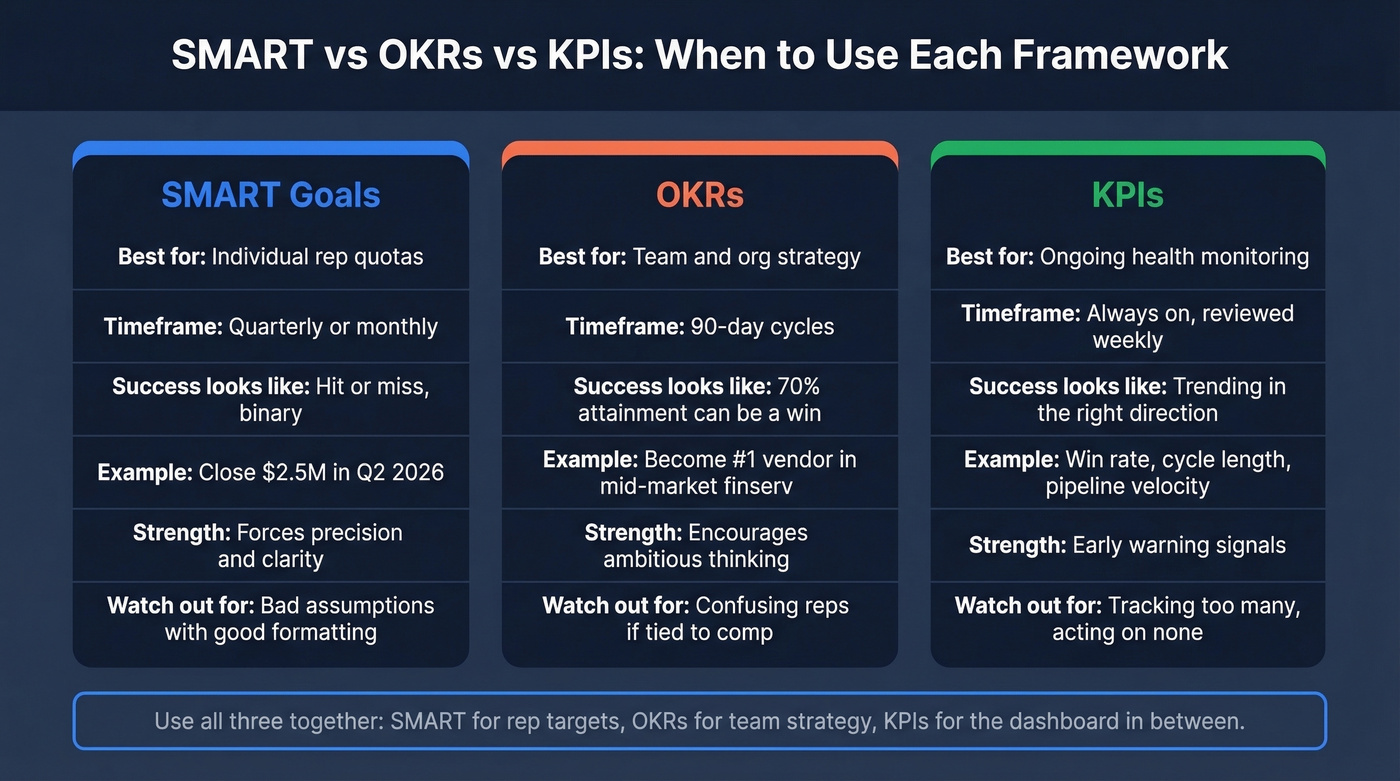
Objectives and Key Results work differently. You set an ambitious objective, then attach 1-4 measurable key results on 90-day cycles. The key difference: OKRs are designed as stretch targets where hitting 70% can still count as success.
Use OKRs for team-level strategic objectives - "Become the #1 vendor in mid-market financial services" with key results around pipeline, win rate, and logo count. Don't use them for individual rep quotas. Reps need clear, achievable numbers tied to comp, not aspirational stretch targets that leave them guessing whether 70% means a bonus or a PIP.
When to Use Which
SMART for individual quotas and rep-level targets. OKRs for team and org-level strategic objectives on 90-day cycles. KPIs for ongoing health monitoring like win rate, cycle length, and pipeline velocity. If your team finds SMART too rigid, look at the FAST framework - Frequently discussed, Ambitious, Specific, Transparent - which emphasizes ongoing conversation over static documentation.
How to Set Sales Goals That Get Hit
Start With Capacity Math
Every revenue target should start with this formula:
Sales Capacity = # Reps x (Quarterly Quota x Avg Quota Attainment)
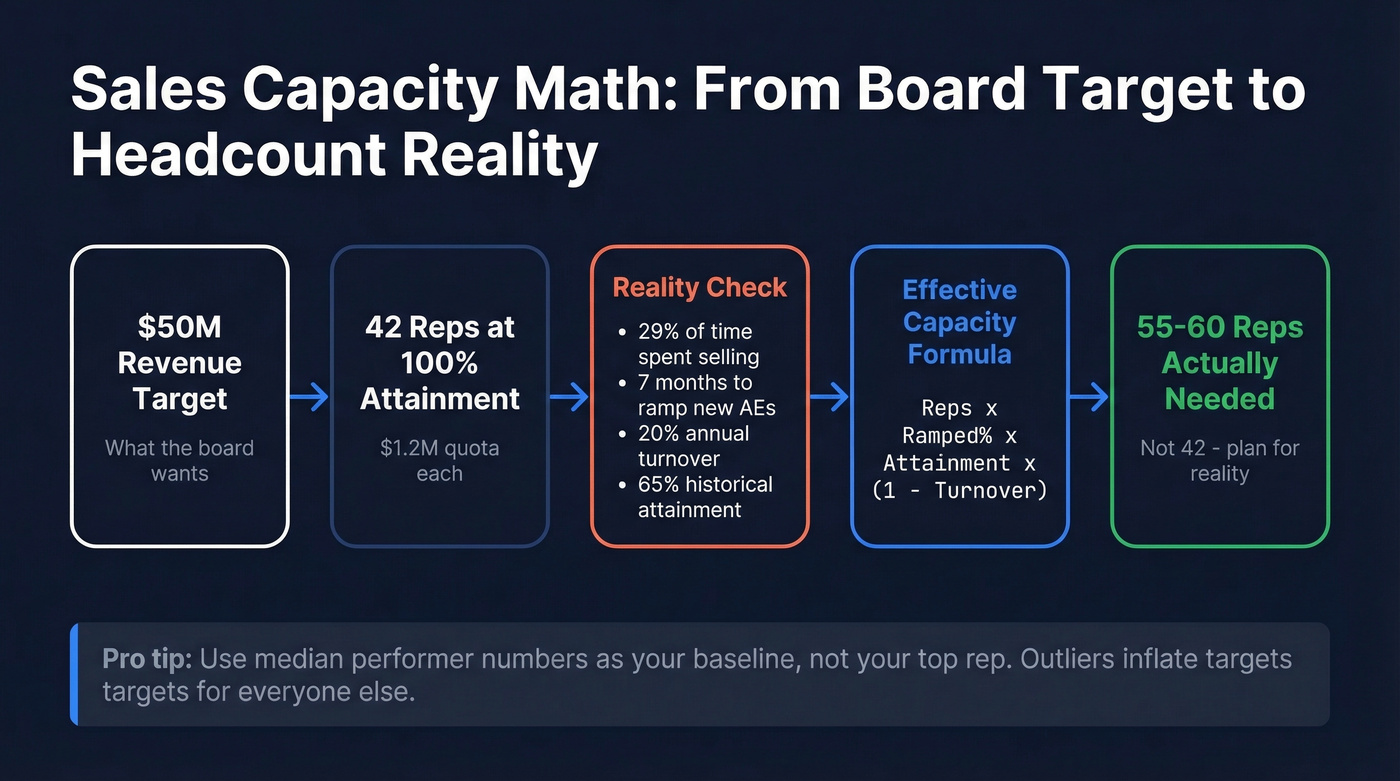
Effective Capacity = Total Reps x Ramped % x Avg Attainment x (1 - Turnover Rate)
Let's work a real example. Your board wants $50M in annual revenue. Average quota is $1.2M per rep. At 100% attainment, that's ~42 reps. But nobody runs at 100%.
Reps spend only about 29% of their time actually selling - the rest goes to admin, meetings, and CRM updates. New AEs typically take 7 months to reach full productivity. Factor in ~20% annual turnover and historical attainment of 65%, and that $50M target might require 55-60 reps, not 42. One critical calibration step: don't let your top performer's numbers inflate everyone else's quota. Filter out outliers when calculating historical attainment - the median performer's numbers are your planning baseline.
Reverse-Engineer Activity Targets
Start from revenue and work backward. If you need $50K in monthly revenue and your average deal is $10K, that's 5 closed deals. At a 20% close rate, you need 25 qualified opportunities. At a 40% meeting-to-opportunity rate, that's ~63 meetings. If it takes 8 touches on average before a meaningful connection, your team needs roughly 500 outbound touches to generate those meetings.
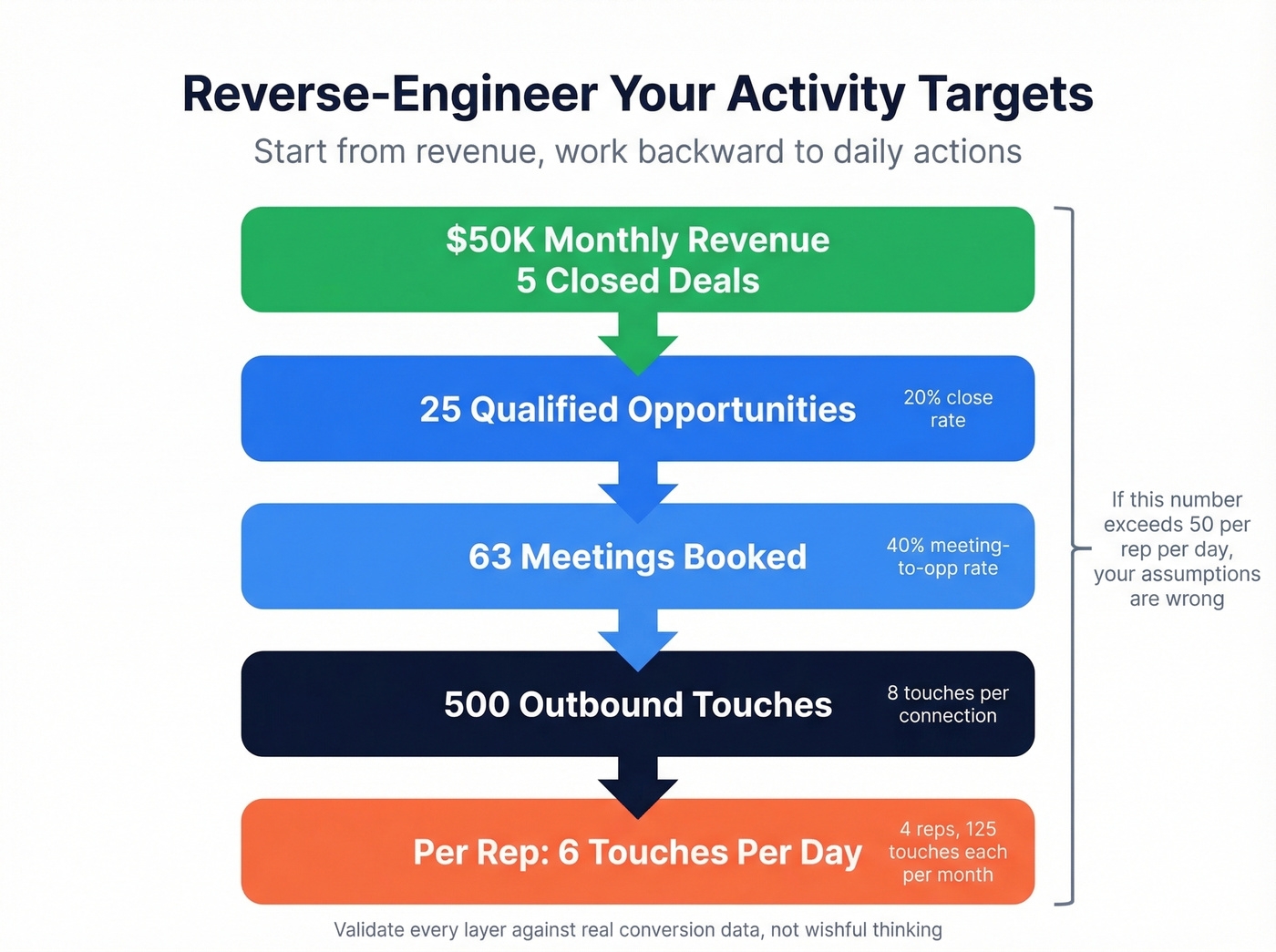
Now validate against time. Four reps means 125 touches per rep per month - about 6 per day. Totally doable. If the math says 50 touches per rep per day, something's wrong with your assumptions.
Activity targets are only as good as your contact data. If 30% of emails bounce, your rep made 70 real touches, not 100. That's where data quality tools like Prospeo's email finder matter - 98% email accuracy means nearly every send actually counts toward your activity target.

Hot take: AI SDR tools are compressing prospecting time - 40% of teams now save 4-7 hours per week on research alone. If you're still setting 2024-era activity targets without accounting for AI-assisted workflows, your numbers are already stale. Recalculate.
Calibrate With Benchmarks
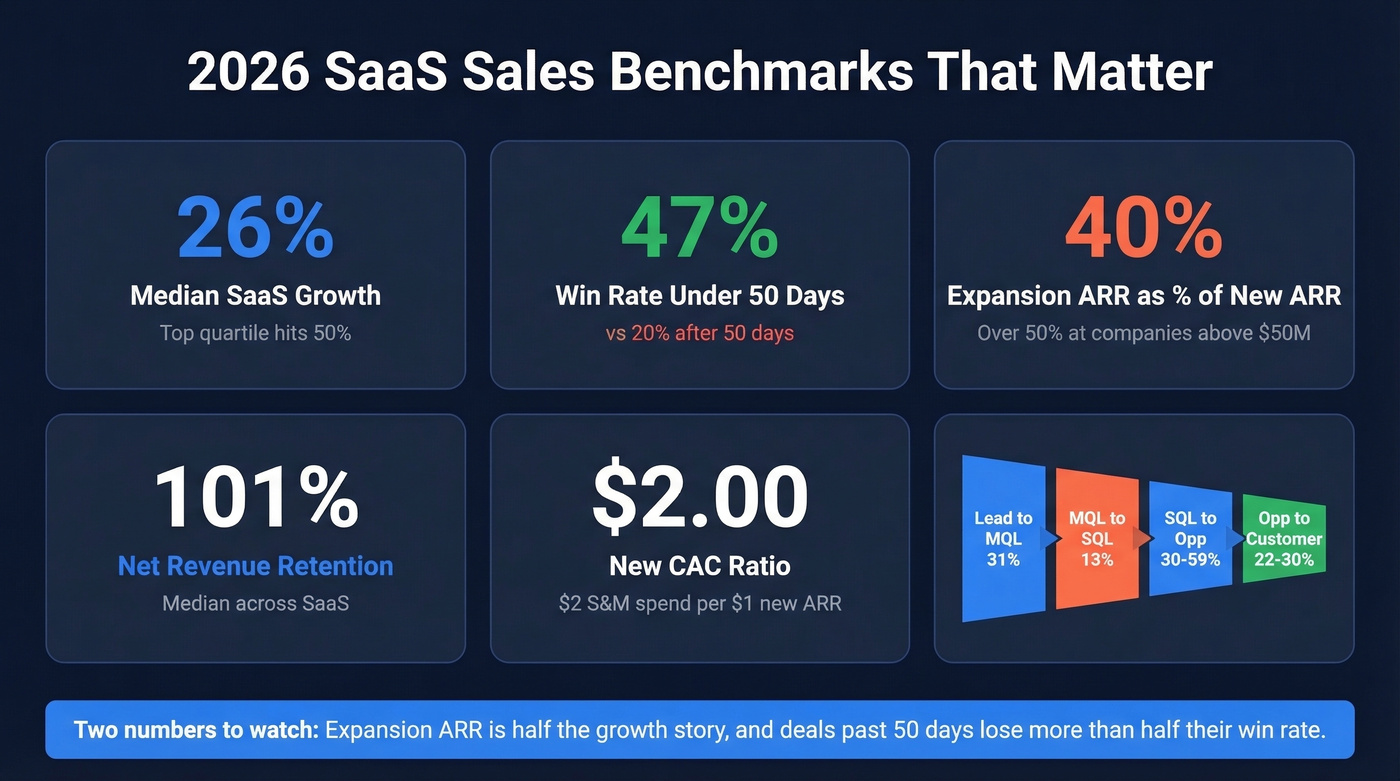
Don't set goals in a vacuum. If median SaaS growth is 26% and you're targeting 50%, you need to know you're aiming for top-quartile performance - and resource accordingly. Stretch targets are fine. Stretch targets without stretch resources are just wishful thinking.

You just reverse-engineered your activity targets. Now ask: how many of those touches actually land? Bad data inflates every number in your funnel. Prospeo delivers 98% email accuracy with a 7-day refresh cycle, so every send counts toward quota.
Stop padding activity goals to compensate for bad contact data.
2026 Benchmarks
| Metric | Benchmark | Source |
|---|---|---|
| Median SaaS growth | 26% (top quartile: 50%) | BenchmarkIT |
| Net Revenue Retention | 101% | BenchmarkIT |
| Expansion ARR % of new ARR | 40% (>$50M cos: 50%+) | BenchmarkIT |
| New CAC Ratio | $2.00 S&M per $1.00 ARR | BenchmarkIT |
| ARR per FTE | $200K ($50-100M), $300K (>$100M) | BenchmarkIT |
| Sales cycle (1-2 quarters) | 34% of teams | Outreach |
| Win rate (<50 days) | 47% | Outreach |
| Win rate (>50 days) | 20% | Outreach |
| Median B2B conversion rate | 2.9% | Ruler Analytics |
| Lead to MQL | 31% | SERPsculpt |
| MQL to SQL | 13% | SERPsculpt |
| SQL to Opportunity | 30-59% | SERPsculpt |
| Opportunity to Customer | 22-30% | SERPsculpt |
Two numbers jump out. First, expansion ARR now represents 40% of total new ARR at the median - and over 50% for companies above $50M. If your targets are 100% new-logo focused, you're leaving half the growth on the table. Build expansion and retention targets into your framework.
Second, look at the win-rate cliff. Deals closed within 50 days convert at 47%. Past 50 days? That drops to 20%. Setting cycle-length goals isn't just about efficiency - it directly impacts win rates.
12 Sales Goal Examples
Revenue and Outcome Goals
Using our $50M company as the running example, here's how these cascade:
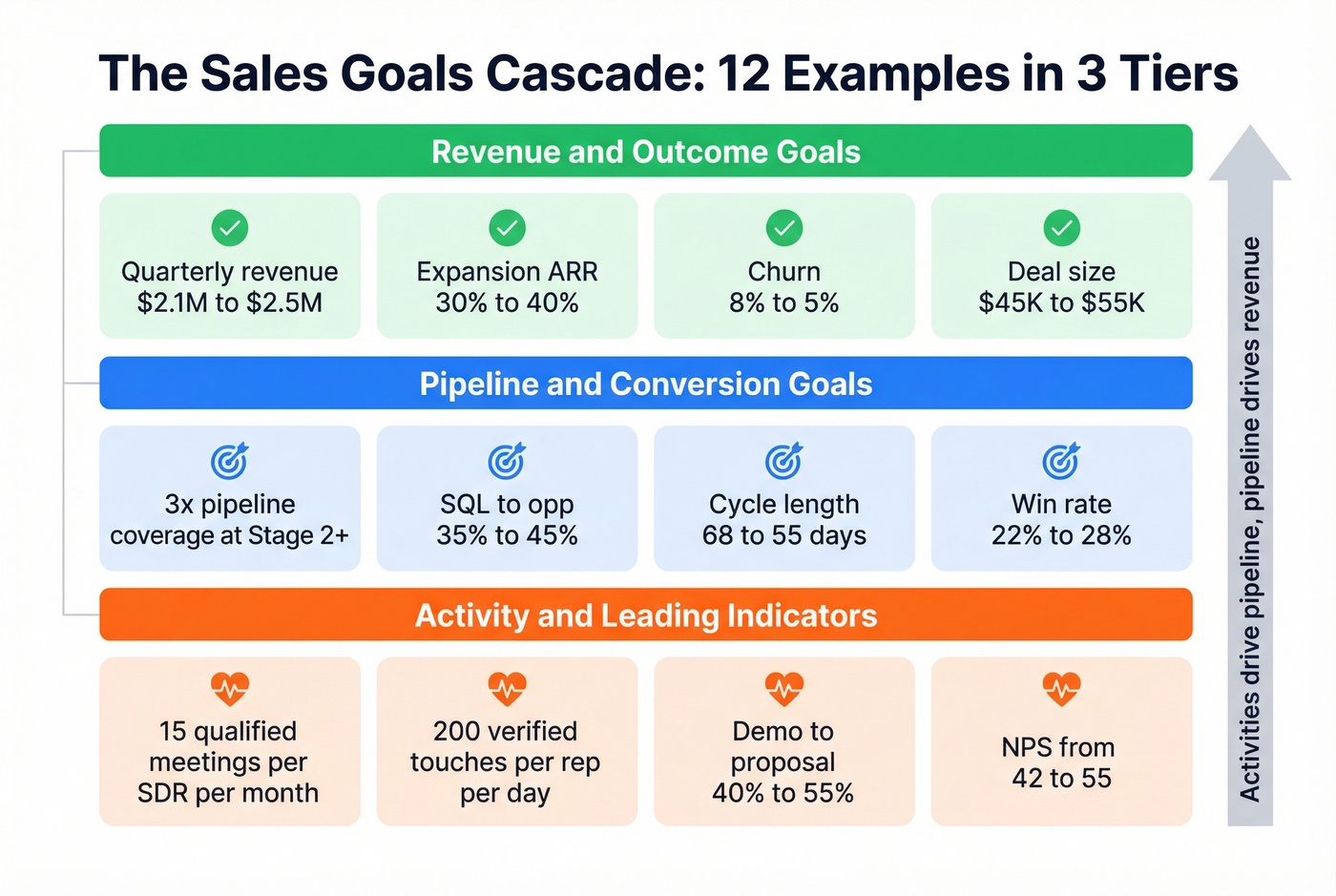
- Increase quarterly revenue from $2.1M to $2.5M - a 19% lift. Capacity math shows this needs 2 additional ramped reps or a 15% higher close rate from the existing team.
- Grow expansion ARR from 30% to 40% of total new ARR - aligning with the median SaaS benchmark. Requires a dedicated CS-to-sales handoff process.
- Reduce customer churn from 8% to 5% annually - on a $10M ARR base, that's $300K in retained revenue.
- Increase average deal size from $45K to $55K - via multi-threading into additional stakeholders and packaging upsell plays into the initial proposal.
Pipeline and Conversion Goals
- Maintain 3x pipeline coverage with qualified opportunities - emphasis on qualified. Inflated stage-1 deals don't count. Measure coverage at stage 2+.
- Improve SQL-to-opportunity conversion from 35% to 45% - tighten qualification criteria so fewer junk deals enter the pipeline.
- Shorten average sales cycle from 68 to 55 days - targeting the 47% win-rate sweet spot.
- Increase win rate from 22% to 28% - through competitive battlecards and engaging 3+ stakeholders per deal.
Activity and Leading Indicators
- Book 15 qualified meetings per SDR per month - reverse-engineered from pipeline target, validated against touch-to-meeting conversion rate.
- Achieve 200 verified outbound touches per rep per day - "verified" is the key word. Unverified touches that bounce don't count.
- Increase demo-to-proposal rate from 40% to 55% - a leading indicator of deal quality and rep qualification skills.
- Improve NPS from 42 to 55 - a leading indicator for retention and expansion goals.
Even small incremental targets compound over a quarter. Improving call-to-connect rate by 5% or adding one more discovery question per demo won't show up in a board deck, but they'll show up in your pipeline 60 days later.
Five Mistakes That Guarantee Failure
1. Conflicting goals across departments. Marketing optimizes for MQLs, sales for revenue, CS for retention. Nobody owns the handoff gaps. Run an integrated goal review where every team's targets are visible and dependencies are explicit.
2. Incentives misaligned with goals. "Try to break" your comp plan before rollout. If a rep can game it by sandbagging deals or cherry-picking accounts, they will. We've seen comp plans that accidentally penalized reps for selling the company's highest-priority product - the exact opposite of what leadership intended.
3. Overly aggressive targets without resources. The r/sales pattern is depressingly common: territories get halved, quotas stay the same, and management wonders why attainment craters. Use stretch vs. commit goals - a commit target that's achievable plus a stretch target that unlocks accelerators.
4. Goals disconnected from strategy. A team can have just three targets and still fail if those targets don't connect to the company's actual strategic priorities. Hitting a new-logo number while the board cares about NRR is motion without progress. Every goal should trace back to a company-level objective in one step - if it takes two, it's probably a vanity metric.
5. Ignoring data quality in activity goals. If a third of your emails bounce, your "200 touches/day" goal is really 130. Bad data silently kills activity targets. This is one of those problems that's invisible until you audit it - and by then you've already missed the quarter.
How to Track and Adjust
Split your metrics into two buckets. Lagging indicators tell you what already happened: revenue, bookings, win rate, churn, quota attainment. Leading indicators tell you what's about to happen: leads created, calls made, meetings booked, proposals sent, opportunities advancing through stages.
Review leading indicators weekly. If meeting volume drops in week 2, you can course-correct before it shows up as a revenue miss in week 8. Review lagging indicators monthly or quarterly. Adjust sales goals mid-cycle only if market conditions materially change - not because of one bad month.
Your CRM - Salesforce, HubSpot, whatever you're running - is the tracking infrastructure. But the real insight from the Dominican University study isn't about tools. It's about accountability. Reps who wrote down goals and shared progress with an accountability partner performed significantly better. Build that into your cadence: weekly 1:1s where reps report against leading indicators, not just pipeline reviews where managers interrogate lagging numbers.
Capacity math only works when reps spend their time selling, not chasing dead leads. Teams using Prospeo book 35% more meetings than Apollo users - because 300M+ verified profiles and 125M+ direct dials mean reps connect on the first attempt, not the eighth.
Hit your sales goals with data that actually connects to real buyers.
Sales Goals FAQ
What's the difference between a sales goal and a quota?
A goal is a strategic target - revenue growth, market expansion. A quota is the specific number assigned to an individual rep, derived from the broader goal. Goals set direction; quotas set accountability. They're related but not interchangeable.
How many sales goals should a team have?
Three. One revenue goal, one pipeline goal, one activity goal. Everything else is a supporting metric you monitor but don't optimize against directly. Fifteen targets dilute focus and guarantee none get hit.
How often should you review targets?
Leading indicators weekly, lagging indicators monthly or quarterly. Adjust mid-cycle only if market conditions materially change - a new competitor, a macro shift, a pricing overhaul. Don't adjust because of one bad month.
How do you set realistic goals for reps?
Use capacity math: revenue target divided by average quota equals reps needed, adjusted for ~7-month ramp time, turnover, and historical attainment. Filter out top-performer outliers - the median rep's numbers are your planning baseline, not the president's club winner.
What tools help teams hit activity-based targets?
A CRM for tracking, a sales engagement platform like Outreach or Salesloft for sequencing, and a verified contact data provider so emails land and calls connect. When a third of your outbound bounces, activity goals become fiction - which is why data accuracy matters more than most teams realize.