

Sales Incentive Plans: 12 Examples With Real Numbers and Formulas (2026)
A RevOps lead we worked with last year spent six weeks building what she called the "perfect" comp plan. Three months later, 70% of her reps couldn't explain how their payout was calculated. The plan wasn't bad on paper - it was bad in practice, which is the only place that matters.
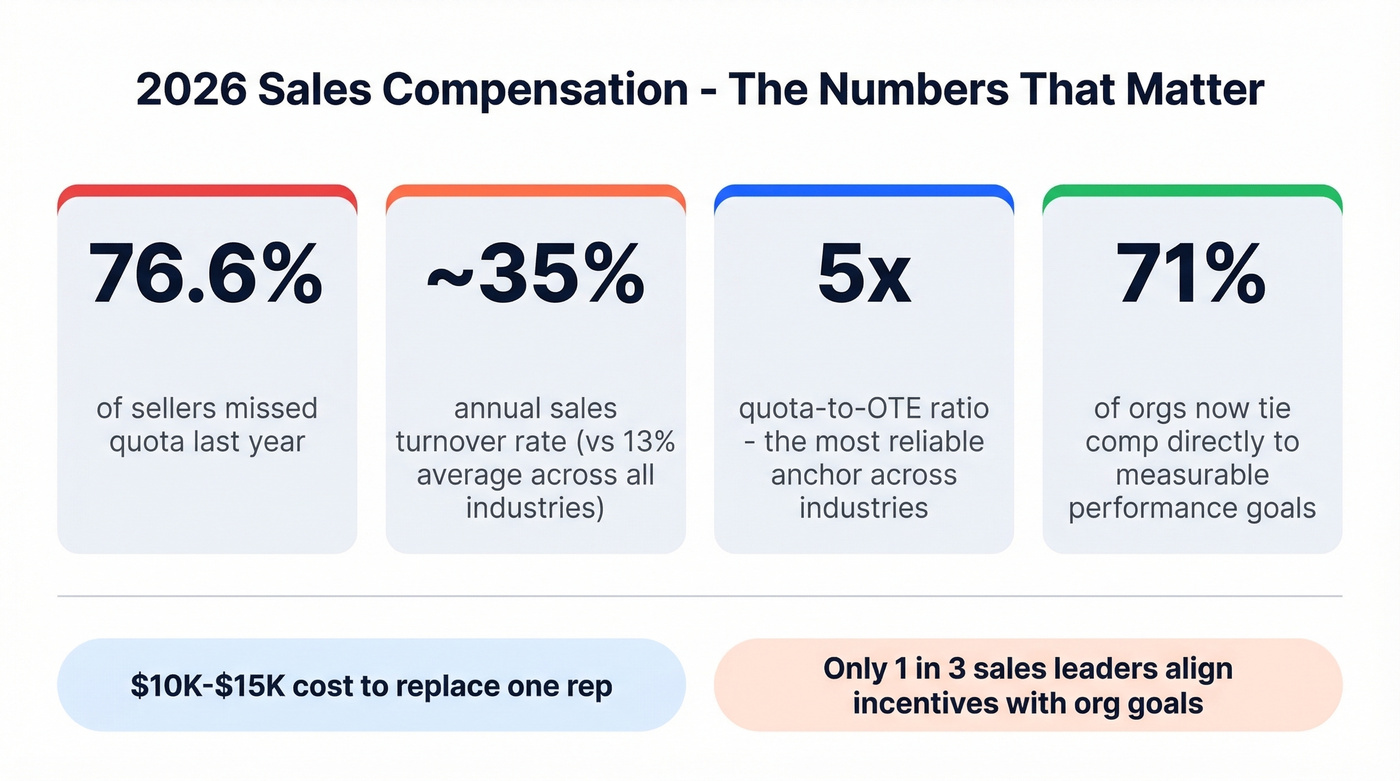
She's not alone. 76.6% of sellers missed quota last year, and sales turnover runs ~35% - nearly triple the 13% average across all industries. Only 1 in 3 sales leaders actually align incentives with organizational goals. When replacing a single rep costs $10K-$15K and median tenure sits just over three years, a broken comp plan isn't an HR problem. It's a P&L leak.
The Quick Version If You're Building Your First Plan
If you're designing your first SaaS plan, start with a 50/50 base-to-commission split and a 5x quota-to-OTE ratio. That means $120K OTE = $600K quota = $60K in commissions at 10%. It's the industry default for a reason.
For SDR teams, activity-based bonuses outperform pure commission because SDRs don't control the close. Tie incentives to qualified outcomes - demos booked, meetings held - not raw dials.
2026 Benchmarks by Role
Anchor your numbers before you design anything.
| Role | Pay Mix | Base Range | OTE Range | Commission % | Quota:OTE |
|---|---|---|---|---|---|
| SDR | 60/40-70/30 | $55K-$65K | $75K-$85K | N/A (bonus) | 3-4x |
| Mid-Market AE | 50/50 | $75K-$100K | $150K-$200K | ~10% | 5x |
| Enterprise AE | 50/50 | $130K-$150K | $260K-$300K | 5-6% | 5x |
| Account Mgr | 60/40 | $80K-$96K | $140K-$160K | 1-8% | 3-5x |
| CSM | 80/20-90/10 | ~$141K (US avg) | N/A | N/A (bonus) | N/A |
| Sales Manager | 50/50 | $100K | ~$200K | ~2.65% (team) | 90% of team |
Commission rates vary wildly by industry. SaaS hovers around 10% for standard deals. Real estate and financial services run 10-20%. Retail and manufacturing sit at 1-5%. The 5x quota-to-OTE ratio is the most reliable anchor across all of them.
71% of organizations now tie compensation directly to measurable performance goals. If your plan doesn't, you're in the minority - and you're losing reps to companies that do.
Which Plan Fits Your Stage?
Before getting into the 12 examples below, match your company stage to the right structure.
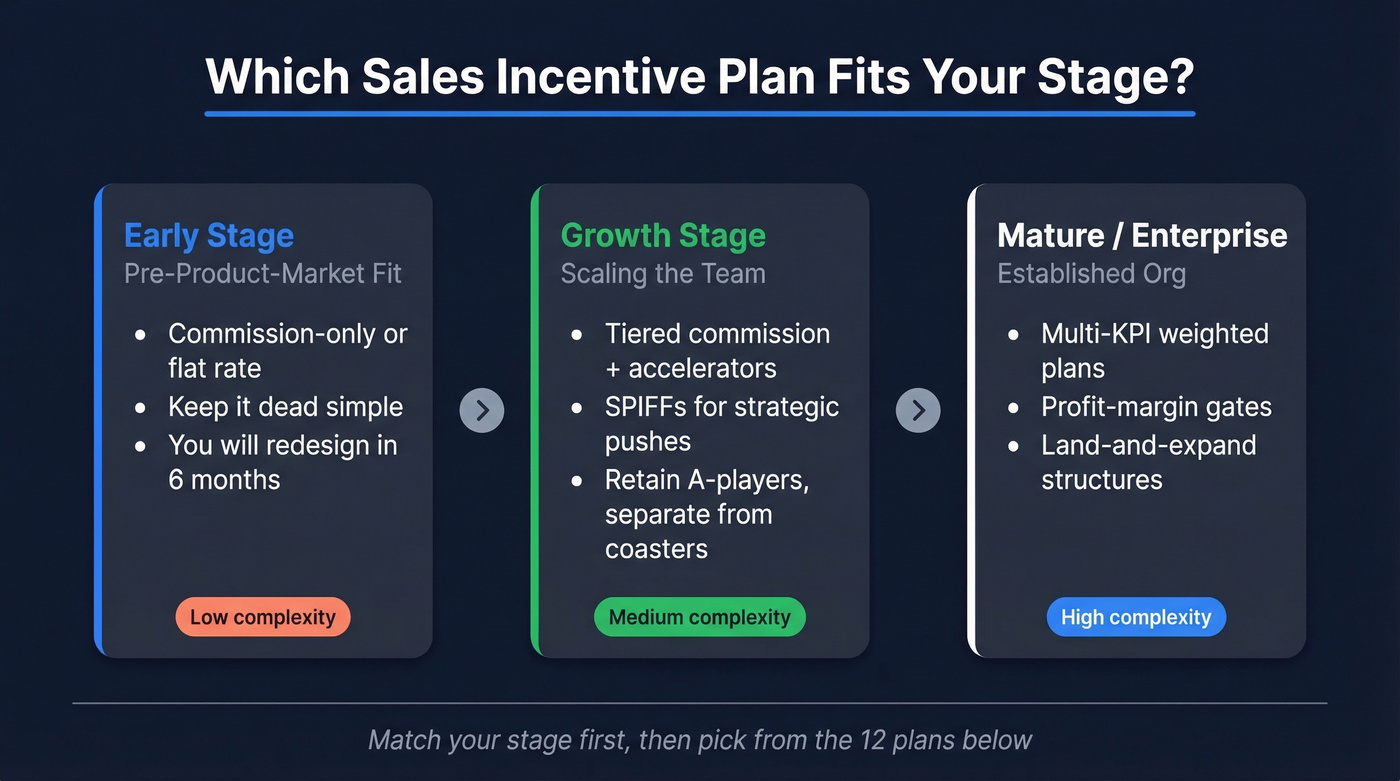
Early stage (pre-product-market fit): Keep it simple. Commission-only or base + commission with a flat rate. You don't have enough data for tiers or accelerators yet, and you'll redesign the plan in six months anyway.
Growth stage (scaling the team): Tiered commission with accelerators. You need to retain top performers and create separation between A-players and coasters. Add SPIFFs for strategic pushes. This is where most SaaS companies live, and where plan design starts to really matter.
Mature / enterprise: Multi-KPI plans, profit-margin gates, and land-and-expand structures. You have the data infrastructure to track complex metrics and the deal volume to make tiered payouts statistically meaningful.
12 Sales Incentive Plans That Work
1. Commission-Only
Formula: Earnings = Revenue x Commission %
A rep closing $600K at 10% takes home $60K. No base, no safety net. This works for experienced closers in short-cycle, transactional environments where reps control the outcome.
Skip this if your deal cycles stretch past 90 days. Reps will panic about rent instead of working strategic accounts. And never cap commissions here - if you're asking reps to absorb all the downside risk, let them capture the upside.
Best for: Independent closers, real estate, insurance, short sales cycles.
2. Base + Commission (50/50)
This is the workhorse of enterprise SaaS. An enterprise AE earning $140K base with a $280K OTE and a $1.4M quota (5x ratio) typically earns 5-6% on closed revenue.
At 100% quota, that's $1.4M x 5% = $70K (or $1.4M x 6% = $84K) in commission on top of base, with the rest of variable often delivered through tiers, bonuses, or kicker mechanics depending on the org. The 50/50 split gives reps enough stability to work long deal cycles without watching their bank account every Friday.
Skip this if you're compensating SDRs or CSMs. A 50/50 split on roles that don't directly close revenue creates misaligned incentives.
Best for: Enterprise AEs, mid-market reps, any role with a 3+ month sales cycle.
3. Base + Commission (70/30)
For SDRs, the math: $60K base, $85K OTE, $25K variable. The variable portion ties to qualified meetings or pipeline generated - not closed revenue. SDRs don't control the close, so paying them like closers creates frustrated reps who game handoff criteria.
Best for: SDRs, BDRs, early-career reps, roles where output is activity, not revenue.
4. Tiered / Escalating Commission
Accelerators reward overperformance and keep your best reps from coasting after hitting quota. Here's the thing: the marginal rate above 100% is what changes behavior, not the blended payout.
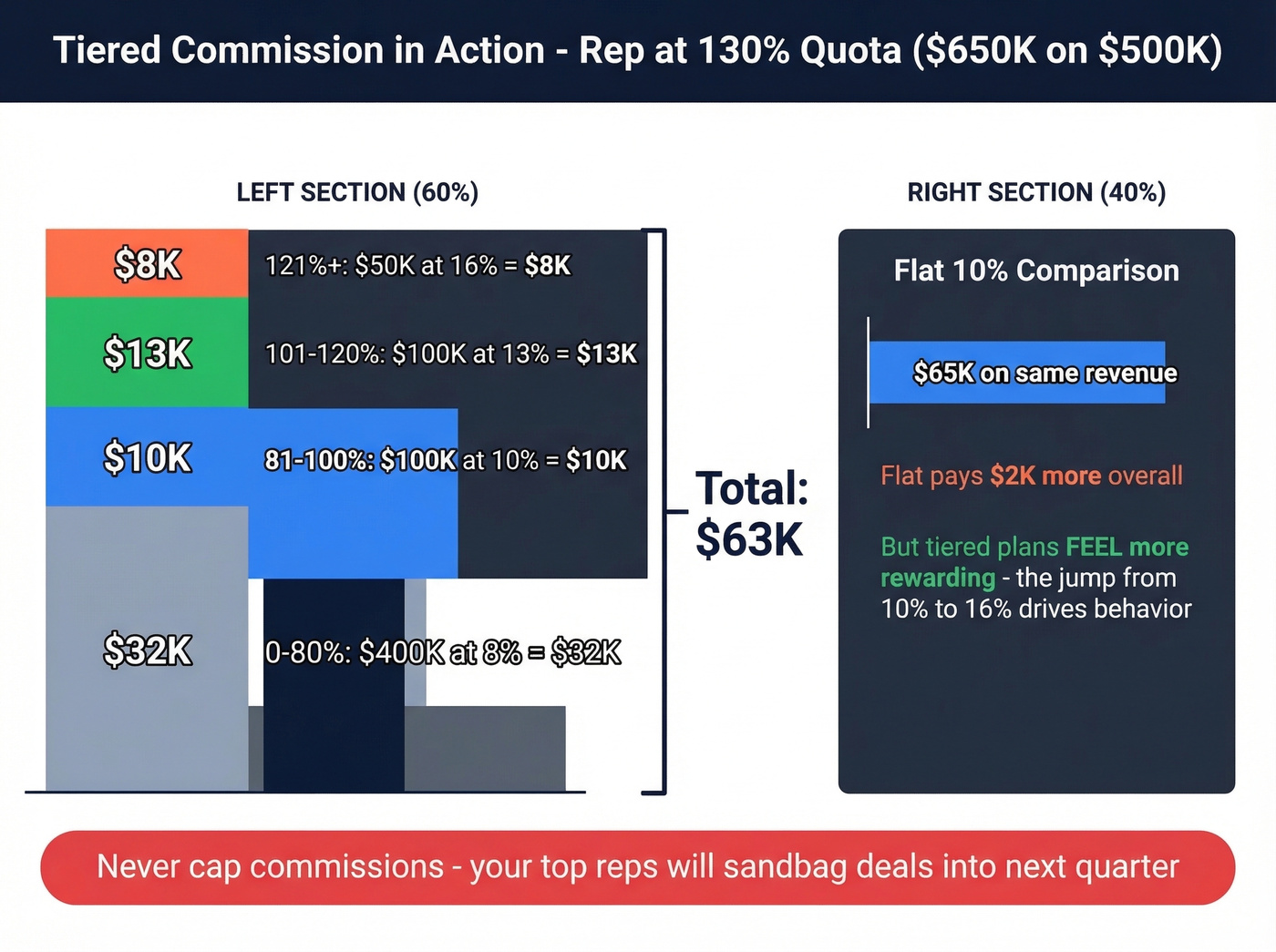
| Attainment % | Commission Rate |
|---|---|
| 0-80% | 8% |
| 81-100% | 10% |
| 101-120% | 13% |
| 121%+ | 16% |
A rep at 130% of a $500K quota earns: $400K x 8% + $100K x 10% + $100K x 13% + $50K x 16% = $32K + $10K + $13K + $8K = $63K in commission.
A flat 10% plan pays $65K on the same revenue - slightly more in total. But reps feel each incremental dollar more when the rate jumps from 10% to 16%. That psychological pull is the whole point.
Commission caps destroy this entire dynamic. Cap at 120%, and your top performers will sandbag deals into next quarter. We've seen it happen repeatedly.
Common mistake: Setting the first tier too high. If reps earn nothing below 50% attainment, they disengage by month two of a bad quarter. Start paying from dollar one.
Best for: Retaining top reps, any team where the gap between average and top performers matters.
5. Profit-Margin-Based
Instead of paying on revenue, you pay on margin. A rep closing a $200K deal at 60% margin earns commission on $120K, not $200K. This kills the discounting problem overnight.
A WorldatWork case study tracked a manufacturer using profitability gates with 1x, 1.5x, and 2x accelerators based on profit percentage - productivity jumped 25% and turnover dropped 15% over three years.
Skip this if your reps don't have pricing authority. Penalizing reps for discounts that their VP of Sales approved is a fast track to resentment.
Best for: Companies where reps control pricing and discounting is eroding margins.
6. Activity-Based
Typical KPIs for phone-sales teams: 100-150 outbound calls/day, 3-4 hours of talk time, 1 contract signed/day. Bonus structures run $25-$50 per qualified demo for SDRs, paid weekly or biweekly to keep the feedback loop tight.

Activity incentives only work when your contact data is accurate. Reps dialing dead numbers can't hit 150-call targets no matter how motivated they are. We've seen teams switch to Prospeo's B2B database and immediately see activity KPIs become achievable - 98% email accuracy and a 7-day data refresh cycle mean reps aren't burning hours on stale records.
Skip this if your reps are enterprise AEs running 6-month deal cycles. Activity metrics at that level feel like micromanagement.
Best for: SDR teams, phone-sales teams, outbound-heavy orgs.
7. Team-Based
The "100% Club" concept: the team earns a bonus only if every member hits goal. This creates peer accountability and works well in pod structures where reps share territories or hand off deals. The risk is obvious - one underperformer tanks the bonus for everyone. Pair it with individual accelerators to avoid resentment.
Common mistake: Using team bonuses with groups larger than six. Peer accountability breaks down when reps can't directly influence each other's output.
Best for: Collaborative selling environments, pod structures, account-based teams.
8. Revenue-Based (Enterprise)
A flat percentage on all revenue closed, sometimes with kickers by revenue type. One enterprise software rep on Reddit shared their structure: 5-6% commission on a $2M quota, with a +1% kicker on all revenue once quota is hit, plus 1-3% on other revenue types like services, renewals, and partner-sourced deals. A rep can calculate their payout on a napkin - and that transparency is worth more than clever tier structures most reps can't decode.
Skip this if your average contract value is under $30K. At low deal sizes, a flat 5% commission doesn't generate enough variable pay to motivate behavior.
Best for: Enterprise software, high-ACV transactional sales.
9. SaaS Land-and-Expand
Take "Jasmine," an account manager with $160K OTE on a 60/40 split ($96K base, $64K variable), managing $1M ARR with an 80% GRR target. Her commission structure: 1.2% on renewals up to $800K GRR, 5% on renewals above that threshold, 8% on expansion ARR, 4% on services revenue, and a 1% SPIFF on referral ARR.
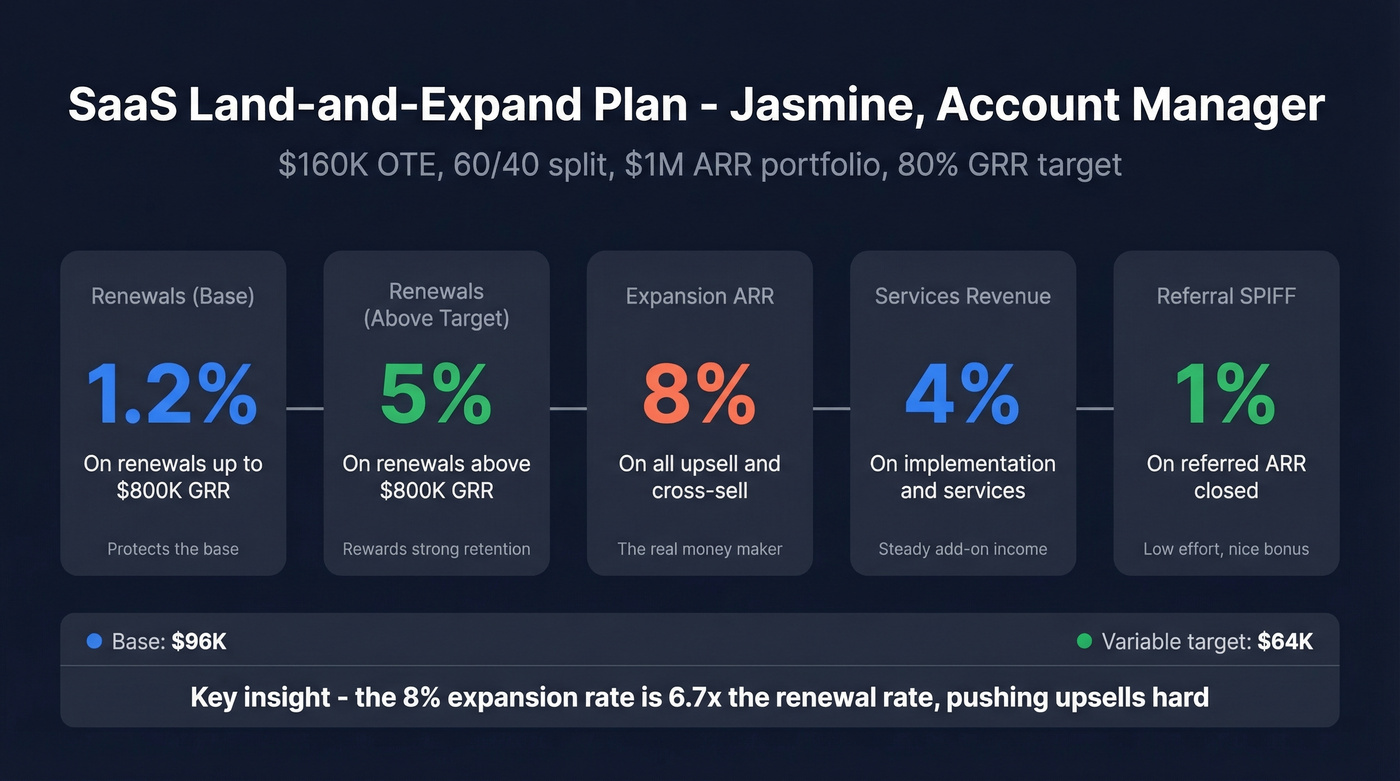
The tiered renewal rate incentivizes retention while the 8% expansion rate pushes upsells hard. This is the plan structure that makes net revenue retention a team sport, not just a CSM metric.
Best for: Account managers, CSMs with expansion targets, any SaaS company where NRR matters more than new logos.
10. Sales Manager
Managers shouldn't carry the same quota as the sum of their team. The standard approach: set manager quota at 90% of the team total. Six reps at $175K/quarter = $1.05M. Manager quota: $945K.
With a $200K OTE ($100K base + $100K variable), the commission rate works out to ~2.65% on all deals the team closes. This gives managers breathing room for ramp-ups, PIP situations, and the inevitable mid-quarter departure.
Best for: Frontline sales managers running teams of 5-10 reps.
11. Multi-KPI Performance
Weighted scoring across multiple dimensions: 60% revenue attainment + 25% pipeline coverage + 15% activity metrics. Each component pays out independently against its own target.
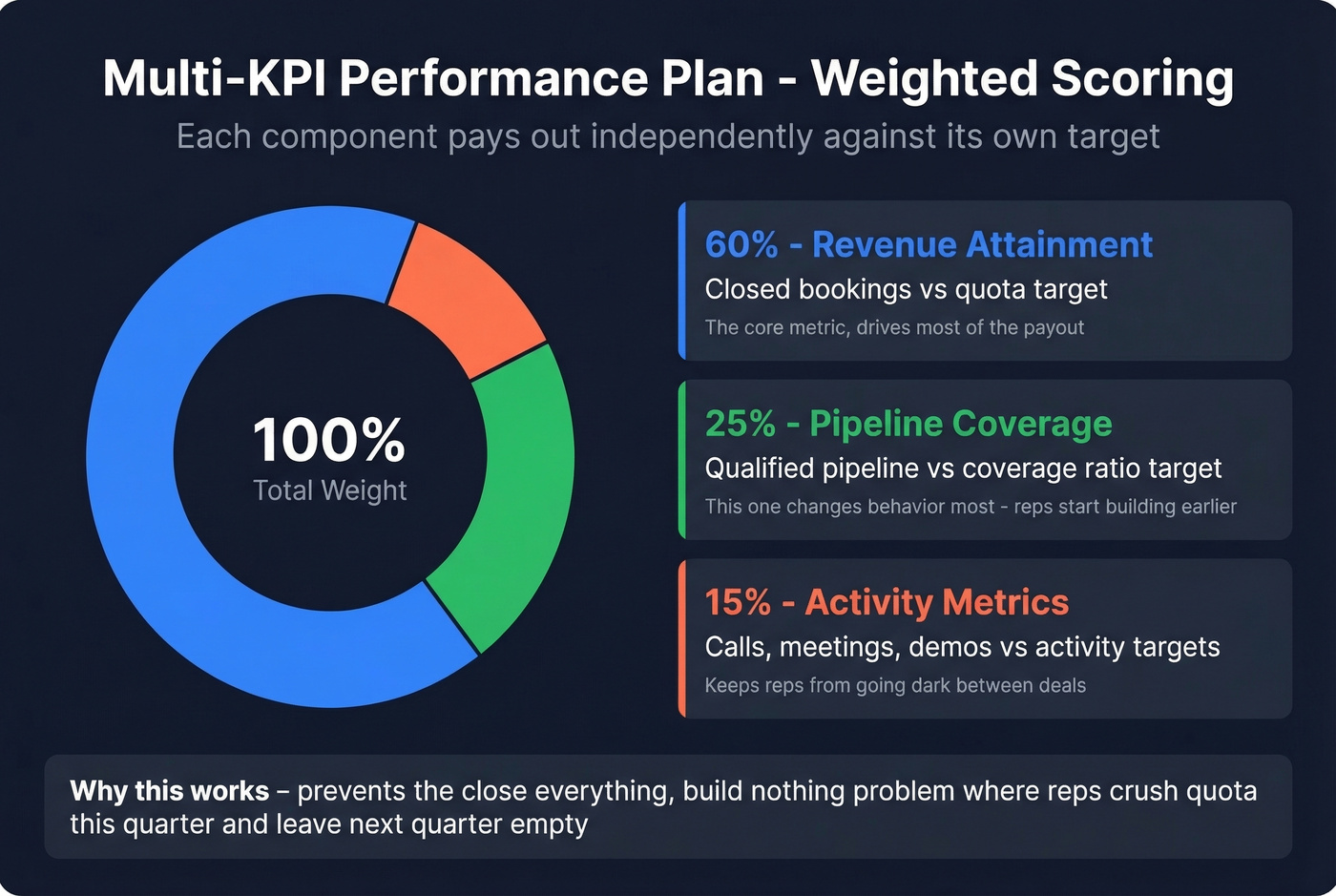
This prevents the "close everything, build nothing" problem where reps crush quota this quarter and leave next quarter's pipeline empty. In our experience, the pipeline coverage component is the one that changes behavior most - reps start building earlier in the quarter instead of scrambling in week 10.
Skip this if you can't measure all three components reliably. A multi-KPI plan built on shaky pipeline data is worse than a single-metric plan built on solid bookings numbers.
Best for: Orgs wanting balanced behavior, not just bookings.
12. Hybrid Milestone + Commission
Combine a base commission rate with fixed bonuses at milestone thresholds. Example: 8% flat commission plus $2,000 bonus at 100% attainment, $5,000 at 120%, and $10,000 at 150%.
The fixed bonuses create psychological targets that feel more tangible than marginal rate increases. Reps think in milestones, not percentages. This is a great bridge plan for teams transitioning from flat commission to tiered structures, or orgs where the math literacy of the team varies widely.

Activity-based incentive plans fall apart when reps burn hours dialing wrong numbers and bouncing emails. Prospeo's 98% verified emails and 125M+ direct dials mean your team actually reaches the prospects they're compensated to contact.
Stop paying bonuses for activity that never connects. Start with accurate data.
SPIFFs You Can Run Next Month
SPIFFs work best when they're short, specific, and tracked in your CRM. Keep timeframes to 1-4 weeks - anything longer loses urgency.
Fastest Closer: $500 to the first rep who closes 3 deals in a week. Simple, competitive, creates energy on the floor.
Tiered Demos: 5 demos = $50, 10 = $150, 15+ = $300. Rewards volume without being all-or-nothing.
100% Club: Team bonus only if everyone hits goal. Works best with teams of 4-6 where peer pressure is constructive, not toxic.
New Product Launch: 30-day window, $50 cash per add-on sale, top 3 performers get an extra $250 prepaid card. Track via CRM logging and an automated leaderboard.
Leaderboard Contest: 1st place gets $1,000, 2nd gets premium headphones, 3rd gets an extra PTO day. Mix cash and non-cash rewards - some reps value time off more than money.
The implementation detail that matters most: if reps can't see their progress in real time, the SPIFF is dead on arrival. Build the dashboard before you announce the contest.
What Your Plan Document Needs
Every comp plan needs a written document that reps can reference without asking their manager. Limit it to 2-3 core components - anything more creates disputes.
Your plan doc should cover: a one-paragraph plan summary explaining the philosophy, eligibility criteria including start dates and role transitions, OTE and pay mix with the split clearly stated, performance metrics with data sources, payout formulas with worked examples at 80%, 100%, and 120% attainment, payment timing so reps know when commissions hit the bank, clawback provisions for deals that churn within 90 days, and the accelerator/decelerator table with exact rates at each tier.
If a rep can't estimate their payout within 60 seconds, the plan is too complicated.
7 Mistakes That Kill Plans
No line-of-sight. If reps can't calculate their payout mid-quarter, the incentive doesn't exist. It's just math they'll see on a paycheck they can't predict.
Single-metric reliance. Revenue-only plans incentivize discounting. Reps will slash price to hit quota and leave margin on the table every time.
Ignoring edge cases. Splits, territory transfers, role transitions, retroactive amendments - these aren't edge cases, they're every quarter. Plan for them upfront.
Plan operability failures. Too many tiers and exceptions mean manual calculations, which mean payout delays, which mean trust erosion. If your comp analyst needs a PhD in Excel, simplify.
Cross-functional misalignment. Finance adds retroactive caps because the plan is "too expensive." Reps who earned their accelerator get clawed back. Morale craters. Involve finance before launch, not after.
No stress-testing on historical data. Run your new plan against last year's actuals. What does your top rep earn? Your worst? If the spread doesn't make sense, neither does the plan.
Mid-year plan changes. Real talk: nothing destroys trust faster than changing the rules after reps have already built pipeline against the original plan. If you must adjust mid-cycle, grandfather existing pipeline under the old terms. In regulated industries, compliance guardrails need to be baked in from day one - not bolted on after legal reviews the plan in Q2.
Measuring Incentive Plan ROI
Most companies launch a comp plan and never measure whether it moved the needle. That's a mistake.
The Incentive Research Foundation published a case where a dealer incentive program cost $3.5M and generated $37.2M in incremental purchases. At a 20% gross margin, that's $7.44M in incremental profit - a 112.5% ROI. The math: (incremental profit - program cost) / program cost. A separate IRF case tracked a hand tools manufacturer that saw net sales climb ~7.5%, accounts receivable drop from 59 to 32 days, and inventory shrink from 89 to 70 days - generating an extra $328K/month in cash flow from the incentive program alone.
A WorldatWork case study tracked a manufacturer's pay-for-performance plan over three years: productivity up 25%, seller turnover down 15%. The plan used a 60/40 base-to-variable split with monthly payouts against annual quota and profitability gates.
The gold standard is a treatment vs. control framework - run the new plan with one team and compare against a control group on the old plan. Most companies won't do this because it feels unfair. At minimum, compare attainment distributions, payout accuracy, and voluntary turnover quarter over quarter. If your plan costs more but turnover drops and quota attainment rises, it's working.
Let's be honest: most teams over-engineer their comp plans. If your average deal size is under $50K and your team is under 15 reps, a simple base + flat commission with one accelerator tier will outperform any multi-KPI weighted scorecard. Save the complexity for when you have the data infrastructure and deal volume to support it.
You just designed a comp plan that rewards 150 calls a day and 3 demos booked per week. Now make sure your reps can actually hit those numbers. Prospeo refreshes 300M+ contacts every 7 days - so your team dials real buyers, not dead leads.
Great incentive plans deserve data that keeps up. Prospeo does, at $0.01 per email.
FAQ
What's a good commission rate for SaaS sales?
The SaaS standard is ~10% with a 50/50 pay mix. Enterprise AEs typically earn 5-6% on larger quotas ($2M+), while SMB reps earn 10-15% on smaller deal sizes. Use the 5x quota-to-OTE ratio as your anchor - it keeps commission rates and quotas in balance regardless of deal size.
How often should you review your incentive plan?
Quarterly reviews at minimum. Check quota attainment distribution, payout accuracy, and behavioral alignment each quarter. Companies that wait until annual planning miss problems for three quarters. But avoid mid-cycle changes that destroy rep trust - apply fixes to the next quarter, not the current one.
What makes the best sales incentive plans stand out?
The best plans share three traits: reps can calculate their payout in under 60 seconds, the structure rewards behaviors aligned with company strategy, and payouts are delivered on time without disputes. Complexity isn't sophistication - clarity is.
How do you set activity-based incentives for SDR teams?
Tie bonuses to qualified outcomes - demos booked, meetings held - rather than raw call volume. Pay weekly or biweekly to keep the feedback loop tight. Make sure your contact data is current so reps aren't burning hours on disconnected numbers; stale data makes any activity target feel impossible.
What's the difference between a SPIFF and a commission?
Commission is the ongoing, structural payout tied to quota attainment - the backbone of the comp plan. A SPIFF is a short-term bonus lasting 1-4 weeks, designed to drive a specific behavior like selling a new product or booking demos in a target segment. SPIFFs create urgency; commissions create consistency.