

The 12 Best Sales Intelligence Tools in 2026, Honestly Ranked
You just pulled your quarterly bounce report. 23% of your "verified" contacts bounced. Your sequences are tanking, your domain reputation is sliding, and the sales team is blaming marketing for bad data.
The sales intelligence tool market will hit $9B by 2034, up from $3.3B in 2024. G2 lists 418 products in the category. You don't need 418 options - you need the right two or three. We've tested most of the major players, run bake-offs, and watched teams waste months on the wrong platform. Here's what actually works.
Our Picks (TL;DR)
| Buyer type | Pick | Why |
|---|---|---|
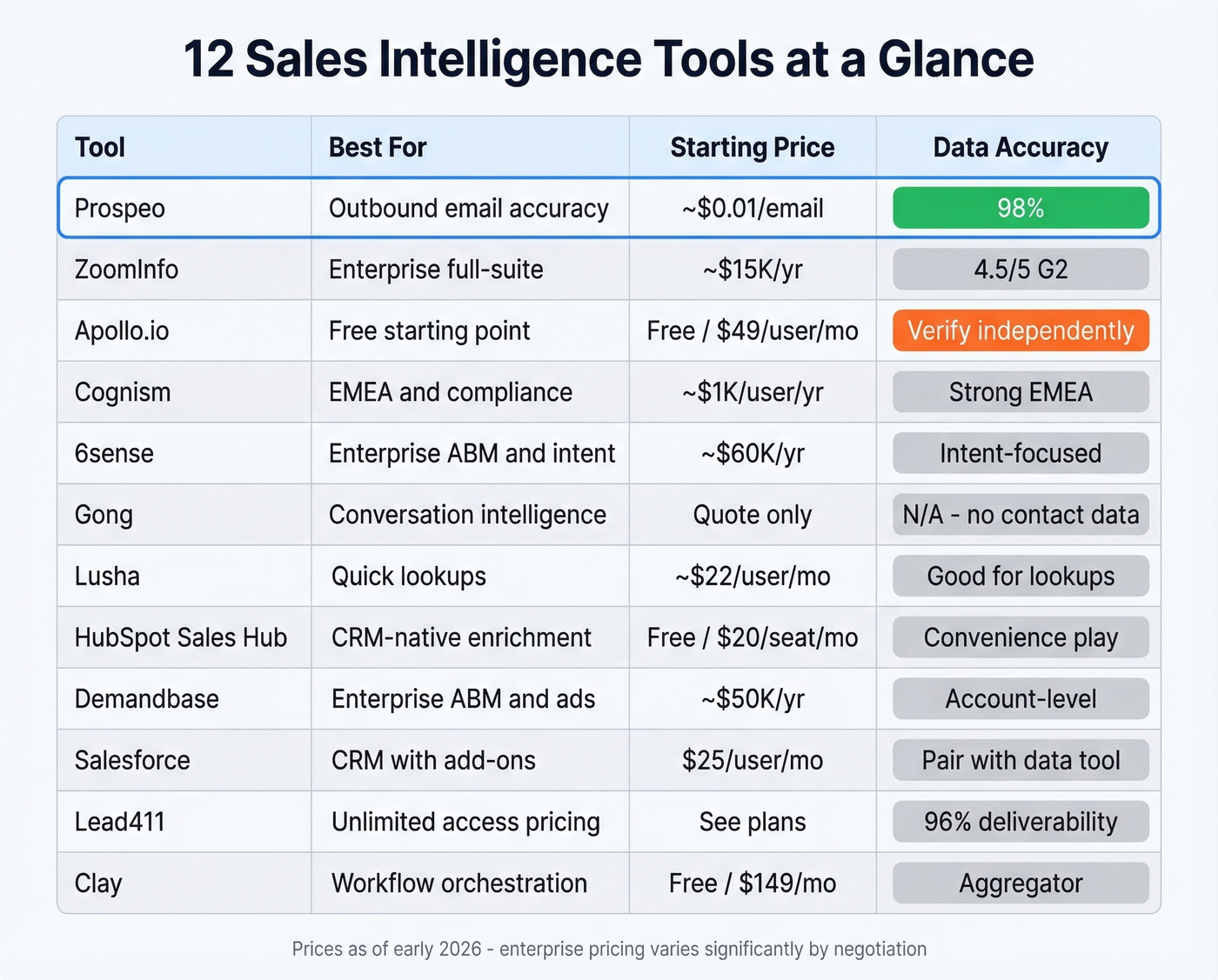
| Data accuracy & outbound | Prospeo | 98% email accuracy, 7-day refresh, ~$0.01/lead |
| Free tier to get started | Apollo.io | Generous free plan - but verify data independently |
| EMEA-focused teams | Cognism | Strong EMEA coverage, compliance-first workflows, phone data options |
Enterprise teams with $50K+ budgets should look at ZoomInfo or 6sense - but negotiate hard on the renewal. Those contracts inflate 20-30% if you don't push back.
What Sales Intelligence Actually Means
Sales intelligence is the umbrella term for any technology that helps you find, qualify, and prioritize buyers. It breaks into five buckets: contact data (emails, phones, job titles), firmographics (company size, revenue, industry), technographics (what software a prospect runs), intent data (who's actively researching your category), and conversation intelligence (what's happening on calls).
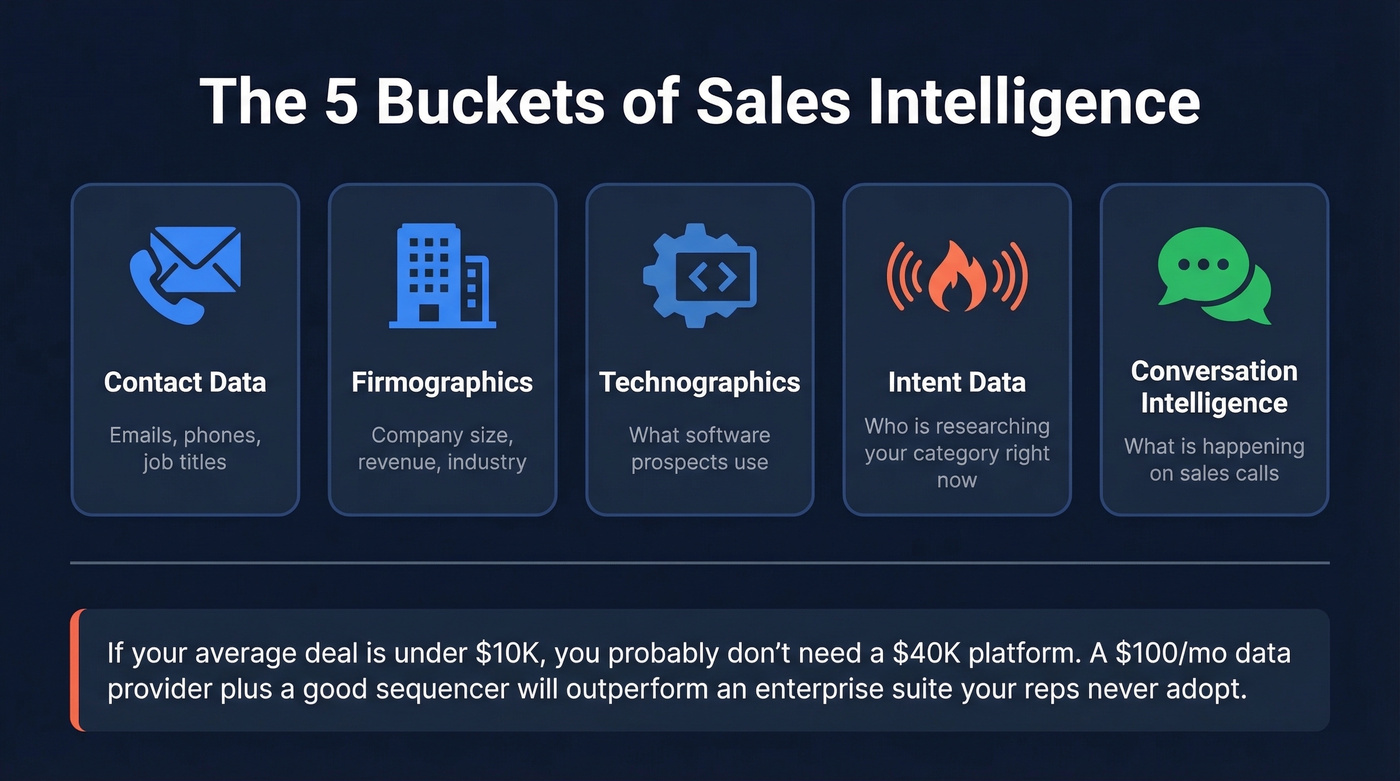
Here's the thing: if your average deal size is under $10K, you almost certainly don't need a $40K/year platform. A $100/month data provider paired with a good sequencer will outperform an enterprise suite your reps never fully adopt.
12 Top Sales Intelligence Tools Ranked
1. Prospeo
Prospeo's database covers 300M+ professional profiles - curated from 800M+ collected records through a 5-step verification process - with 143M+ verified emails and 125M+ verified mobile numbers, all refreshed on a 7-day cycle. That verification pipeline includes catch-all handling, spam-trap removal, and honeypot filtering, delivering 98% email accuracy and a 30% mobile pickup rate across regions. In our testing, teams using Prospeo book 26% more meetings than ZoomInfo users and 35% more than Apollo users.

The search filters go deep: 30+ options including buyer intent powered by 15,000 Bombora topics, technographics, job changes, headcount growth, and funding signals. The Chrome extension has 40,000+ users, and CRM enrichment returns 50+ data points per contact with a 92% API match rate.
Use this if: You're running outbound and can't afford bounced emails destroying your domain. Snyk's 50 AEs dropped their bounce rate from 35-40% to under 5% after switching, and AE-sourced pipeline jumped 180%. Stack Optimize built from $0 to $1M ARR using Prospeo data, maintaining 94%+ deliverability with zero domain flags.
Pricing: ~$0.01 per email. Free tier gives you 75 emails/month. No contracts, no sales calls, cancel anytime.
2. ZoomInfo
ZoomInfo is the default enterprise platform, and for good reason - 235M+ professional profiles and real-time buying signals, plus 9,031 G2 reviews at 4.5/5 stars. The breadth is real. The price tag is also real.
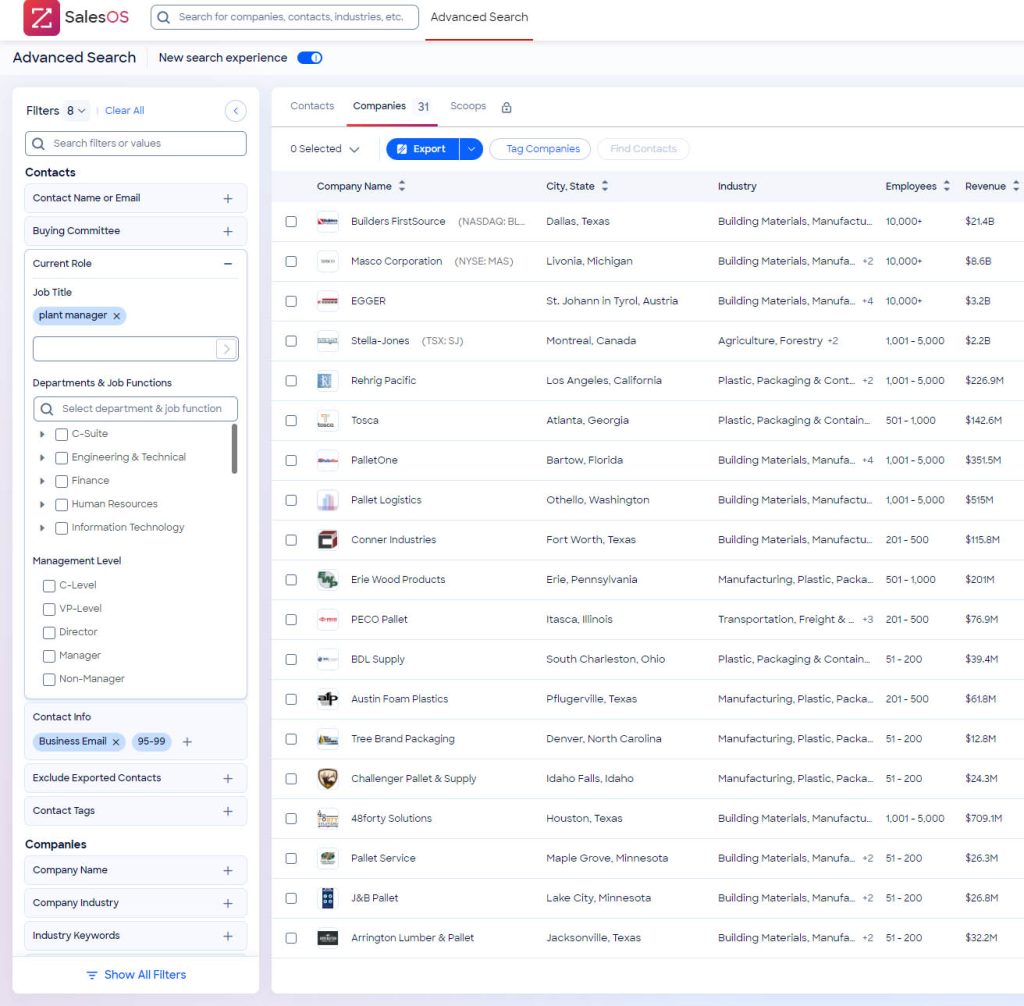
Use this if: You're a 50+ person sales org with budget for a $25K-$60K annual contract and need deep US coverage plus intent, chat, and workflow features under one roof.
Skip this if: You're mid-market and only need contact data. A Professional plan starts at ~$15K/year, Advanced runs ~$25K, and Elite hits ~$40K - all annual contracts. Add extra seats and modules, and mid-market teams routinely spend $40K-$60K. The #1 complaint on G2? High pricing. The #2? Occasional inaccuracies in contact data, which means you're still verifying anyway.
Pricing: ~$15K-$40K/year depending on tier. Annual contracts only. Expect to negotiate.
3. Apollo.io
Apollo is the obvious starting point for teams with zero budget. The free tier is genuinely useful - 210M+ contacts, 35M companies, 65+ search filters, and enough credits to start prospecting today.
But Apollo's contact data is largely user-contributed. They aren't running independent verification on most of it. A practitioner on r/sales described it as "jack of all trades, master of none" - and that tracks with our experience. The Twilio VoIP dialer gets spam-flagged regularly, and their email infrastructure has a reputation for hurting deliverability if you use open/click trackers.
Use this if: You need a free starting point and you're willing to run every export through independent email verification before sequencing.
Skip this if: You're sending high-volume outbound and can't afford domain reputation damage.
Pricing: Free / Basic from $49/user/mo / Professional from $79 / Organization from $119 (min 3 seats). Credits don't roll over.
4. Cognism
Cognism is a top choice for EMEA-focused teams. GDPR and CCPA compliance are baked in, and it checks against DNC lists across the US, UK, Canada, Australia, and European countries as standard.
Rather than a head-to-head comparison, think of it this way: Cognism tends to win on EMEA coverage and compliance-first workflows, while ZoomInfo still leads on US database depth and workflow breadth. If your entire TAM is North America, Cognism's thinner US coverage means you're paying a premium for compliance features you won't use domestically.
Pricing: ~$1,000/user/year starting. Typical small team contracts land $12K-$30K/year. Quote-based, annual contracts.
5. 6sense
Enterprise intent and ABM platform. If you're running account-based plays at scale and have the budget, 6sense's intent signals and account identification are best-in-class. The free plan - 50 credits/month, no rollover - is barely a taste.
Use this if: You're an enterprise ABM team with $60K+ to spend and a RevOps team to implement it.
Skip this if: You're under 50 reps or don't have a dedicated ops person. Pricing starts at $60K-$100K/year, and one example deal cited was $120K for year one with a 2-year commitment.
6. Gong
Gong isn't a contact data provider - it's conversation intelligence. It records, transcribes, and analyzes sales calls to surface what's working and what isn't. Deals closed within 50 days have a 47% win rate vs 20% after that threshold, and Gong-style AI coaching can shave roughly 11 days off sales cycles while boosting win rates up to 10 percentage points on deals over $50K.
Use this if: You have a team of 10+ reps and want to understand why deals stall. Skip this if: You need emails and phone numbers - Gong doesn't do that. Pricing is quote-only.
7. Lusha
Lusha covers 280M+ contacts with a Chrome extension that's fast for one-off lookups. Pro runs ~$22/user/month on annual billing, or ~$36/month paid monthly. Premium hits ~$52/user/month. Credits cost 1 per email, 5 per phone number. Dramatically cheaper than ZoomInfo but shallower on firmographic and intent data - think of it as the "quick lookup" tool, not a full prospecting platform.
Pricing: Free / Pro ~$22-$36/user/mo / Premium ~$52/user/mo.
8. HubSpot Sales Hub
The CRM-native option. If you're already on HubSpot, Sales Hub plus Breeze Intelligence - the Clearbit acquisition - adds enrichment without a separate vendor. Breeze credits run 100 for ~$30/month, 1,000 for ~$150, and 10,000 for ~$700. HubSpot's contact data doesn't compete with dedicated providers, but if your stack already lives there, the convenience factor is real.
Pricing: Free / Starter $20/seat/mo / Professional $100 / Enterprise $150.
9. Demandbase
Enterprise ABM platform competing directly with 6sense. Strong on account identification and B2B advertising, weaker on individual contact-level data. Demandbase tends to edge out on advertising capabilities while 6sense leads on intent signal depth. Pair it with a dedicated data provider for the contact layer.
Pricing: ~$50K/year starting, with enterprise deployments often running $50K-$150K depending on modules.
10. Salesforce Sales Cloud
Not a data provider - a CRM with intelligence features bolted on. Plans run $25/$100/$175/$350 per user/month, and Einstein AI add-ons tack on $50-$550/user/month extra. Most teams pair Salesforce with a dedicated data tool for prospecting.
11. Lead411
Lead411 touts 96% email deliverability and offers unlimited data access on higher-tier plans. It's a solid niche player for teams wanting simple, unlimited-access pricing without credit math. The database is smaller than ZoomInfo or Apollo, but the unlimited model means you never worry about running out of lookups mid-quarter.
12. Clay
Workflow orchestration tool, not a standalone database. Clay pulls from multiple data providers and layers enrichment across sources. Free tier available, paid plans from $149/month. Best as the glue between your data providers, not a replacement for them.
Notable omissions: LinkedIn Sales Navigator is a networking tool, not a data provider. Seamless.AI, Kaspr, and RocketReach are solid niche options - a practitioner on r/recruiting recently called RocketReach their go-to for quick lookups - but none cracked our top 12 for most teams.
Pricing Comparison
| Tool | Starting price | Billing | Contract | Credits roll over? |
|---|---|---|---|---|
| Prospeo | Free / ~$0.01/email | Monthly | None | N/A (pay per use) |
| ZoomInfo | ~$15K/yr | Annual | Yes | No |
| Apollo.io | Free / from $49/user/mo | Monthly or annual | No | No |
| Cognism | ~$1K/user/yr | Annual | Yes | N/A (quote-based) |
| 6sense | ~$60K/yr | Annual | Yes (often 2-yr) | No |
| Gong | Not public | Annual | Yes | N/A |
| Lusha | Free / ~$22/user/mo | Monthly or annual | No | No |
| HubSpot Sales Hub | Free / $20/seat/mo | Monthly or annual | No | No |
| Demandbase | ~$50K/yr | Annual | Yes | N/A |
| Salesforce | $25/user/mo | Annual | Yes | N/A |
| Lead411 | See plans | Monthly or annual | No | Unlimited tiers |
| Clay | Free / $149/mo | Monthly | No | No |
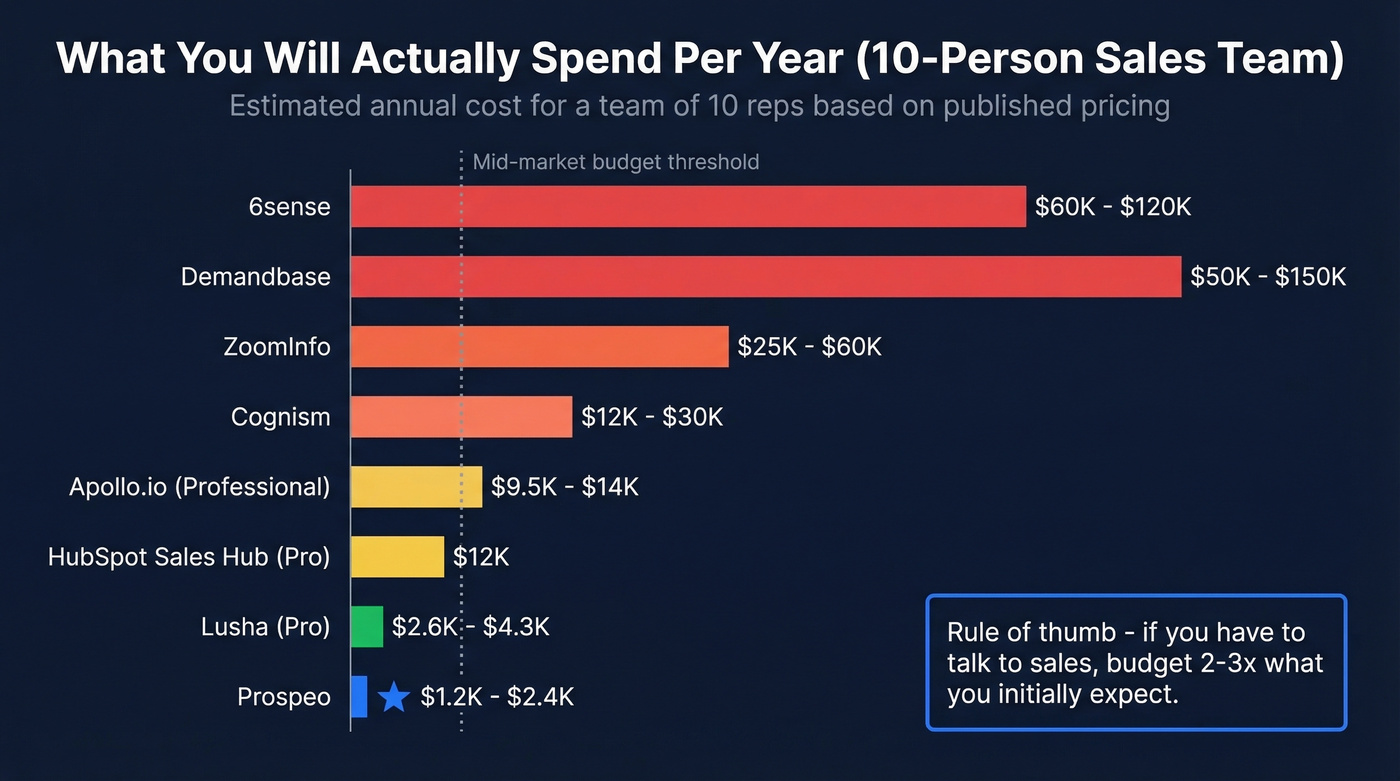
A rule of thumb: if you have to talk to sales, budget 2-3x what you initially expect. ZoomInfo "starts at $15K" the way a car "starts at $25K" - by the time you add the features you actually need, you're at $40K.

Your sales intelligence tool is only as good as its data. Prospeo delivers 98% email accuracy through 5-step verification, 125M+ verified mobiles, and a 7-day refresh cycle - while the tools above charge 90x more for data that bounces.
See why teams book 26% more meetings than ZoomInfo users.
The Credit-Model Trap
Most platforms in this category run on credits. Apollo charges one credit per email, another per phone number. 6sense gives free users 50 credits/month. And in both tools, unused credits expire at the end of each billing cycle.
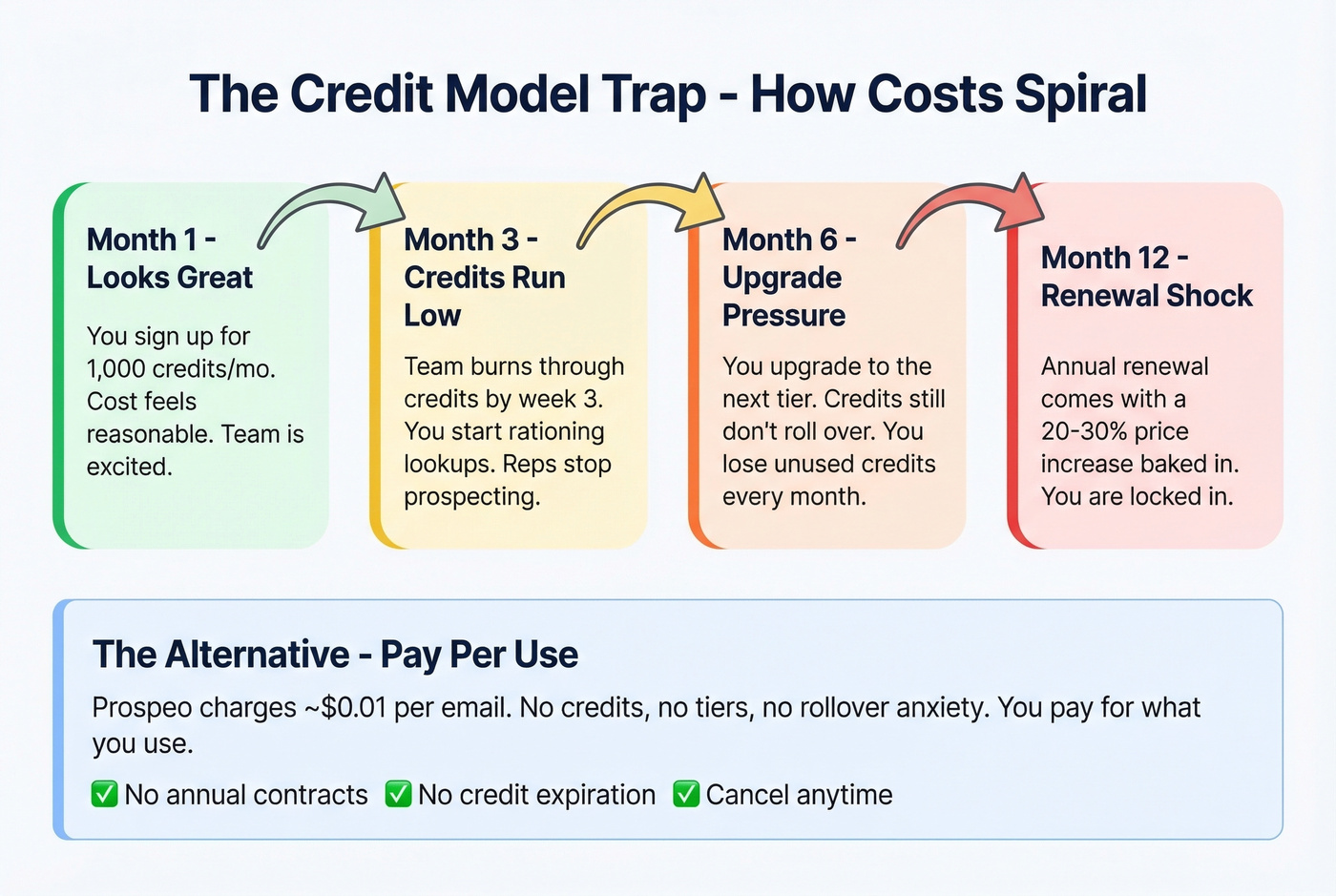
This creates artificial scarcity. Reps either hoard credits and under-prospect, or blow through them in week one and sit idle for three weeks. Neither outcome is what you're paying for.
The math on 10,000 verified emails tells the story pretty clearly. With Prospeo, that's ~$100. ZoomInfo on a Professional plan with 5,000 annual credits? You'd need to upgrade or buy more - easily $10,000+ in effective cost. Apollo Professional is variable, but credit consumption adds up fast when you're pulling emails and phones together.
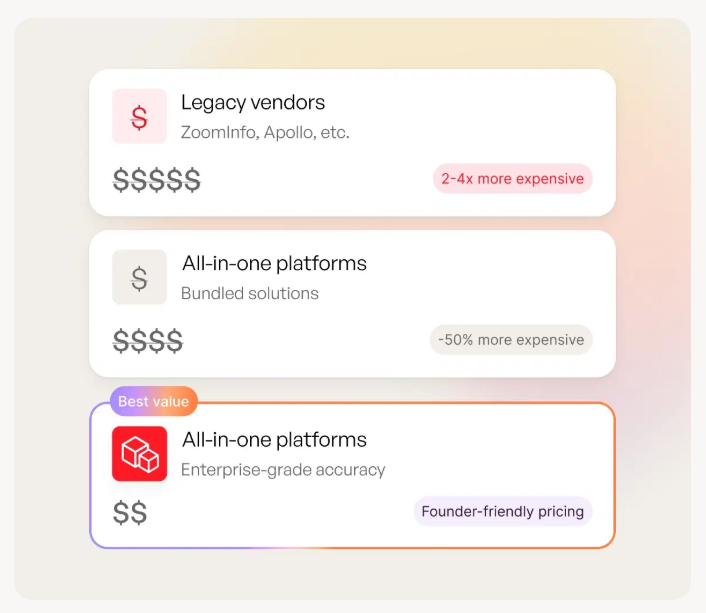
Transparent-pricing tools let you model costs before you commit. The "Contact Sales" tools don't - and that opacity is by design.
Snyk's 50 AEs cut bounce rates from 35% to under 5% and grew AE-sourced pipeline 180%. Stack Optimize hit $1M ARR with zero domain flags. The difference isn't the sales intelligence strategy - it's the data underneath it.
Get 75 verified emails free and test the accuracy yourself.
Data Accuracy and Freshness
This is where the real differentiation lives. Database size is a vanity metric without freshness context. B2B data decays at roughly 2.1% per month - that's 22.5% annually. A 300M-record database refreshed every 7 days beats a 300M-record database refreshed every 6 weeks, even if the second one has more total records.
| Metric | Prospeo | ZoomInfo | Apollo |
|---|---|---|---|
| Email accuracy | 98% | ~87% | ~79% |
| Mobile pickup rate | 30% | ~12.5% | ~11% |
| Data refresh cycle | 7 days | ~4-6 weeks | Varies |
The gap matters more than it looks. A 98% vs 79% email accuracy difference on a 10,000-contact campaign means 200 bounces vs 2,100 bounces. That's the difference between a healthy domain and one that's flagged by ESPs. We've watched teams burn sender domains in a single week because they trusted unverified data from a free-tier export. It's a frustrating, expensive mistake that's entirely preventable.
How to Choose by Team Size
Solo or SMB (1-5 reps, under $500/month): Start with a free tier and validate the data before sequencing. Your domain reputation isn't worth the savings on unverified exports.
Mid-market (5-50 reps, $500-$5K/month): Pair a strong data provider with your sequencer of choice - Lemlist, Instantly, Outreach. For teams selling into EMEA, Cognism deserves a serious look for compliance-first workflows and strong regional coverage.
Enterprise (50+ reps, $15K+/year): ZoomInfo or 6sense if you need ABM and intent at scale. But 60-70% of sales intelligence implementations fail to deliver promised value, and 76% of companies cite poor adoption of sales tools as a primary reason they miss quota. Let's be honest - a tool your team actually uses beats a tool with the best feature list every time. Negotiate hard and make sure you have an ops person dedicated to rollout.
2026 Trends Worth Watching
AI agents are coming fast. Gartner predicts 40% of enterprise applications will feature AI agents by end of 2026, up from under 5% in 2025. Already, 45% of teams run a hybrid AI-SDR model, and that number is climbing. Expect your prospecting software to start recommending next actions, not just serving data.
Data decay is accelerating. Job-hopping rates keep climbing, which means static databases go stale faster. Seven-day refresh cycles are becoming table stakes, not a differentiator.
Stack consolidation is real. Fragmented stacks cost 20-30% of revenue in lost signals because data lives in different tools that don't talk to each other. Teams are moving from four or five point solutions to two or three integrated ones. Pick tools that play well together - native integrations matter more than feature checklists.
FAQ
What is a sales intelligence tool?
Software that provides B2B contact data, company firmographics, and buying signals so sales teams can find and prioritize prospects. The category spans contact databases, intent data platforms like 6sense, and conversation intelligence tools like Gong.
How much does sales intelligence software cost?
Most mid-market teams spend $500-$5,000/month, while enterprise platforms like ZoomInfo start at ~$15,000/year but typically land at $25K-$60K with add-ons. Self-serve options start free and scale at ~$0.01 per email with no contracts.
Which sales intelligence tool has the most accurate data?
Prospeo leads with 98% verified email accuracy and a 7-day data refresh cycle. ZoomInfo benchmarks around 87% and Apollo around 79%. On a 10,000-contact campaign, that 19-point gap means nearly 2,000 fewer bounces - the difference between a healthy sender domain and a flagged one.
Do I need a separate data provider if I have a CRM?
Yes. CRMs store data but don't source it. Without a dedicated provider feeding verified contacts into your CRM, your database decays at ~2.1% per month and becomes unreliable within a year. Pair your CRM with a prospecting and enrichment tool to keep records fresh.
What's the difference between sales intelligence and intent data?
Sales intelligence is the broad category covering contact data, firmographics, and technographics. Intent data is a subset that tracks which companies are actively researching topics related to your product, signaling buying readiness. Tools like 6sense specialize in intent; others combine contact data with Bombora-powered intent signals for a fuller picture.