

Sales Lead Qualification: The Operational Playbook for 2026
Marketing handed sales 200 leads last month. Sales booked four meetings. Everyone's pointing fingers, and the CRM is full of "leads" who were never going to buy.
The problem isn't your reps, and it isn't your marketing team - it's that nobody built a sales lead qualification process that actually works.
What You Need (Quick Version)
Pick one framework that fits your sales motion - BANT for velocity, MEDDIC for enterprise, CHAMP for mid-market - and enforce consistency. Build a scoring model with actual point values (we give you a copy-paste rubric below). And fix your contact data before you score anything. Qualifying leads on stale records is theater.
What Is Lead Qualification, Really?
Lead qualification is the process of filtering your pipeline down to the people who can and will buy. It's the opposite of lead generation. Lead gen fills the top of the funnel; qualification clears out the noise so reps spend time on deals that close.
Think of it as a revenue-generating filter, not a checkbox exercise. Every lead that gets disqualified early frees up an hour for a lead that's actually ready. The teams that qualify ruthlessly don't just close more - they close faster, because reps aren't dragging dead weight through the pipeline.
Why Qualification Matters
Most B2B teams dramatically overestimate how many of their "leads" will ever become revenue.
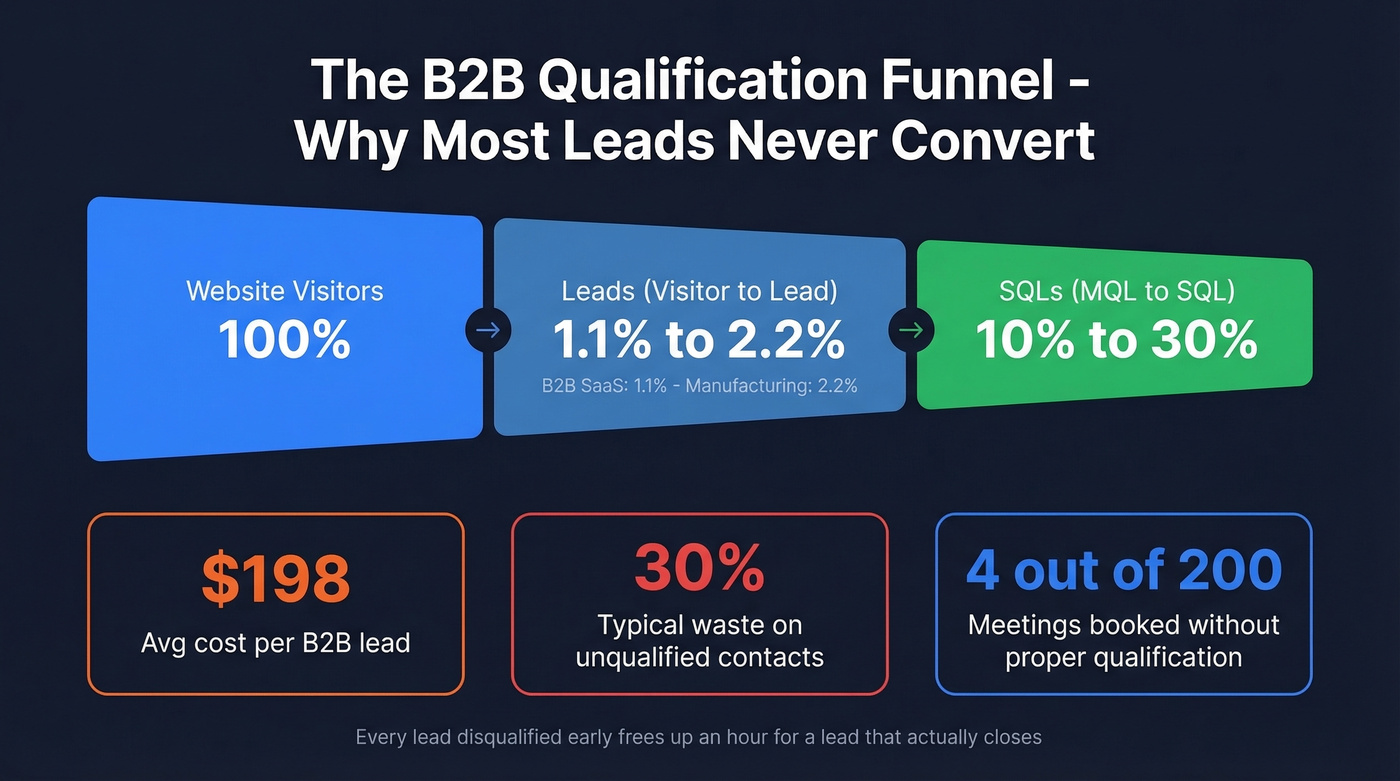
First Page Sage tracks website visitor-to-lead conversion rates across industries. The numbers are sobering:
| Industry | Visitor-to-Lead Rate |
|---|---|
| B2B SaaS | 1.1% |
| IT & Managed Services | 1.5% |
| Financial Services | 1.9% |
| Manufacturing | 2.2% |
| Legal Services | 7.4% |
Those are top-of-funnel numbers. Layer on the MQL-to-SQL conversion, which runs roughly 10-30% for most B2B motions, and you're looking at a massive compression from "showed interest" to "actually buying."
Here's what bad qualification costs you: wasted rep hours chasing leads who were never ICP, pipeline forecasts built on fiction, and a sales team that stops trusting marketing's handoffs. Across B2B industries, average cost per lead runs around $198. Burning even 30% of those on unqualified contacts is real money.
Lead Types Explained
If marketing and sales define "qualified" differently, your pipeline is fiction.
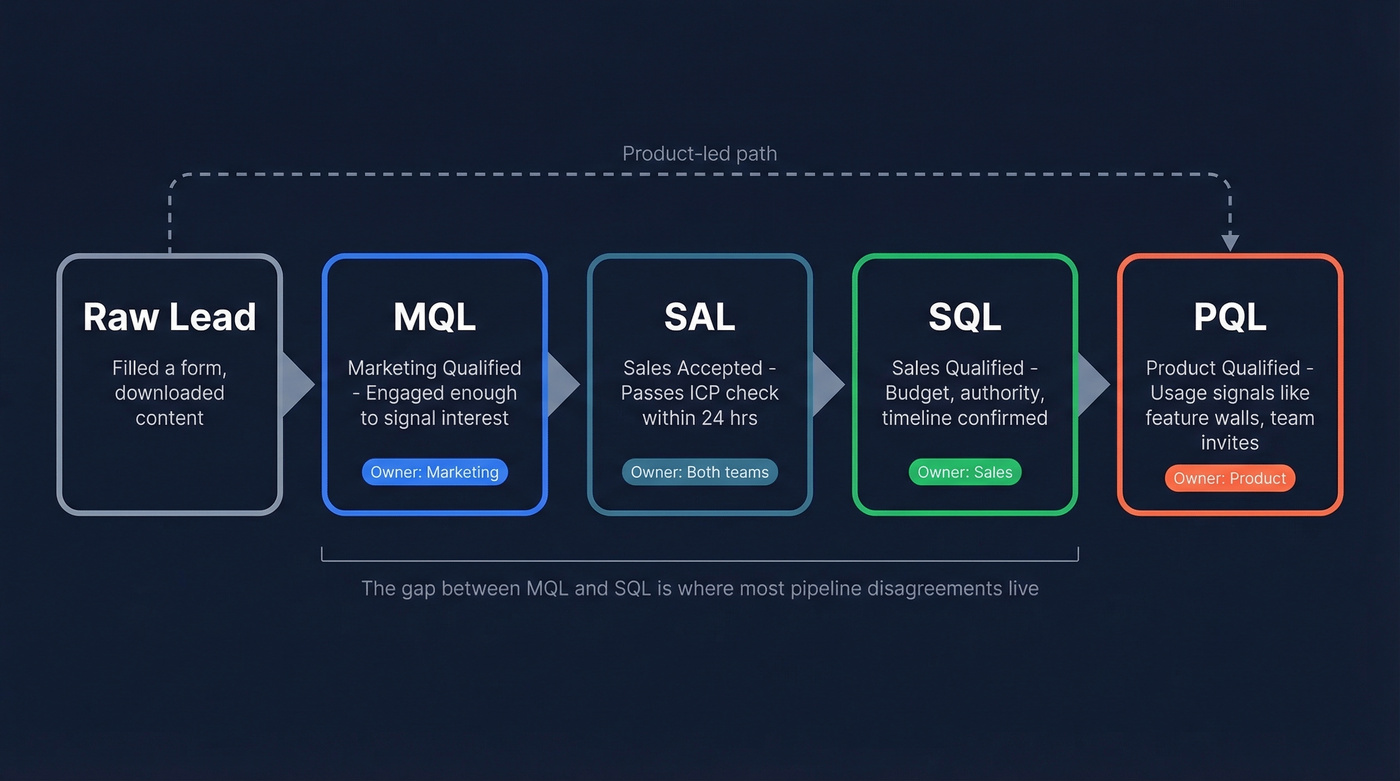
MQL - Marketing's Call
A marketing-qualified lead has engaged enough to signal interest - downloaded a whitepaper, attended a webinar, visited the pricing page three times. Marketing owns this definition and the automation that tags it. The key word is interest, not intent. An MQL isn't ready for a sales call. They're ready for a closer look.
SAL - The Handoff
The sales-accepted lead is the bridge. Sales reviews the MQL against basic criteria - right company size, right industry, right persona - and either accepts it into their pipeline or kicks it back. This stage needs an SLA: best practice is sales accepts or rejects within 24 hours. Without that commitment, leads sit in limbo for days while both teams assume the other is handling it.
SQL - Sales's Call
A sales-qualified lead has been vetted through discovery. They have budget authority, a real timeline, and a problem your product solves. Sales owns this definition entirely. The gap between MQL and SQL is where most pipeline disagreements live - marketing says "we sent 500 qualified leads," sales says "we got 50 worth calling." Confirming real buying signals at this stage, not just engagement metrics, is what separates pipeline fact from fiction.
PQL and Service-Qualified Leads
Product-qualified leads come from usage data - a free-tier user who hits a feature wall or invites teammates. For product-led teams, demo completion rates and feature-wall triggers are stronger PQL signals than simple sign-ups. Service-qualified leads come from existing customers flagged by support or success teams for expansion or upsell. Both bypass the traditional marketing funnel and often convert at significantly higher rates because the prospect already knows your product.
Framework Decision Matrix
"They're All Basically the Same"
The consensus on r/sales is blunt: BANT, MEDDIC, CHAMP, Sandler, Challenger - they all converge on the same fundamentals. Need, budget, stakeholders, timeline. The framework you pick matters less than whether your team actually uses it consistently. We've seen teams spend months debating methodology when the real problem was that nobody enforced any qualifying process at all.
BANT, MEDDIC, and CHAMP Compared
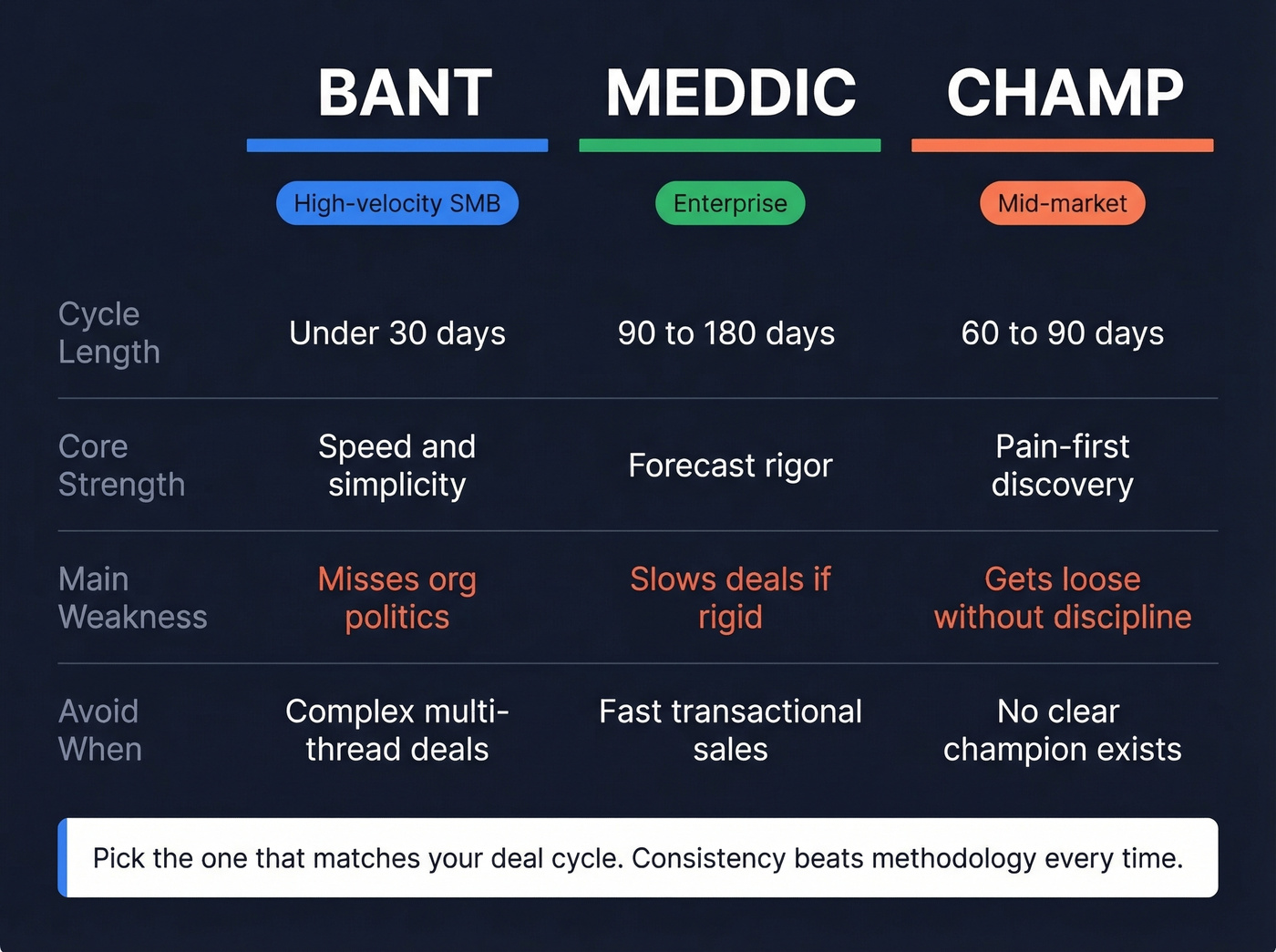
| BANT | MEDDIC | CHAMP | |
|---|---|---|---|
| Best for | High-velocity SMB/inbound | Enterprise, multi-stakeholder | Mid-market consultative |
| Cycle length | Under 30 days | 90-180 days | 60-90 days |
| Strength | Speed, simplicity | Forecast rigor | Pain-first discovery |
| Weakness | Misses politics | Slows deals if rigid | Gets loose without discipline |
| Avoid when | Complex multi-thread deals | Fast transactional sales | No clear champion exists |
The 3-Criteria Field Model
A 20-year sales veteran on Reddit boiled qualification down to three criteria that actually predict outcomes: (1) Requirements - what they need, why they need it, and when; (2) Budget - can they pay, and do they have authority to spend; (3) Competition - who else are they talking to, and how do you stack up.
"Relationship" gets demoted to a nice-to-have. That's a controversial take in a world that worships rapport-building, but the logic holds: a great relationship with someone who has no budget and no urgency is a coffee chat, not a deal.
Which Framework Fits Your Motion
The framework choice is a 10-minute decision. Pick the one that matches your average deal cycle and enforce it. Teams that standardized on any framework saw forecast accuracy jump from 62% to 89% in one case, and 58% to 84% in another. The lift came from consistency, not from the specific acronym.
Here's the thing: if your average deal is under $10k, you don't need MEDDIC. You need BANT and a faster dial speed. The teams that over-engineer qualification for transactional deals waste more time on process than they save on pipeline quality. For enterprise deals with procurement committees, MEDDIC's rigor pays for itself. Mid-market consultative sales? CHAMP's pain-first approach works well. Stop debating and start enforcing.

Your scoring model is only as good as the data underneath it. Qualifying leads on outdated contacts means reps waste hours chasing bounced emails and disconnected numbers. Prospeo's 7-day refresh cycle and 98% email accuracy ensure every lead you score is actually reachable.
Stop scoring ghosts. Start qualifying leads you can actually reach.
Build Your Lead Scoring Model
This is where most articles go vague. Here are actual point values you can copy into your CRM today. HubSpot, Salesforce, and most modern CRMs support custom lead scoring with these exact fields - HubSpot Professional caps at 100 points, Enterprise at 500.
Fit Score vs. Engagement Score
Split your total score into two halves: Fit (firmographic and demographic match) and Engagement (behavioral signals). A 50/50 split out of 100 total points is the right starting point. A perfect-fit company that hasn't engaged isn't ready for sales. A highly engaged contact at the wrong company is a waste of time. You need both signals.
Sample Point Values
Fit scoring - 50 points max:
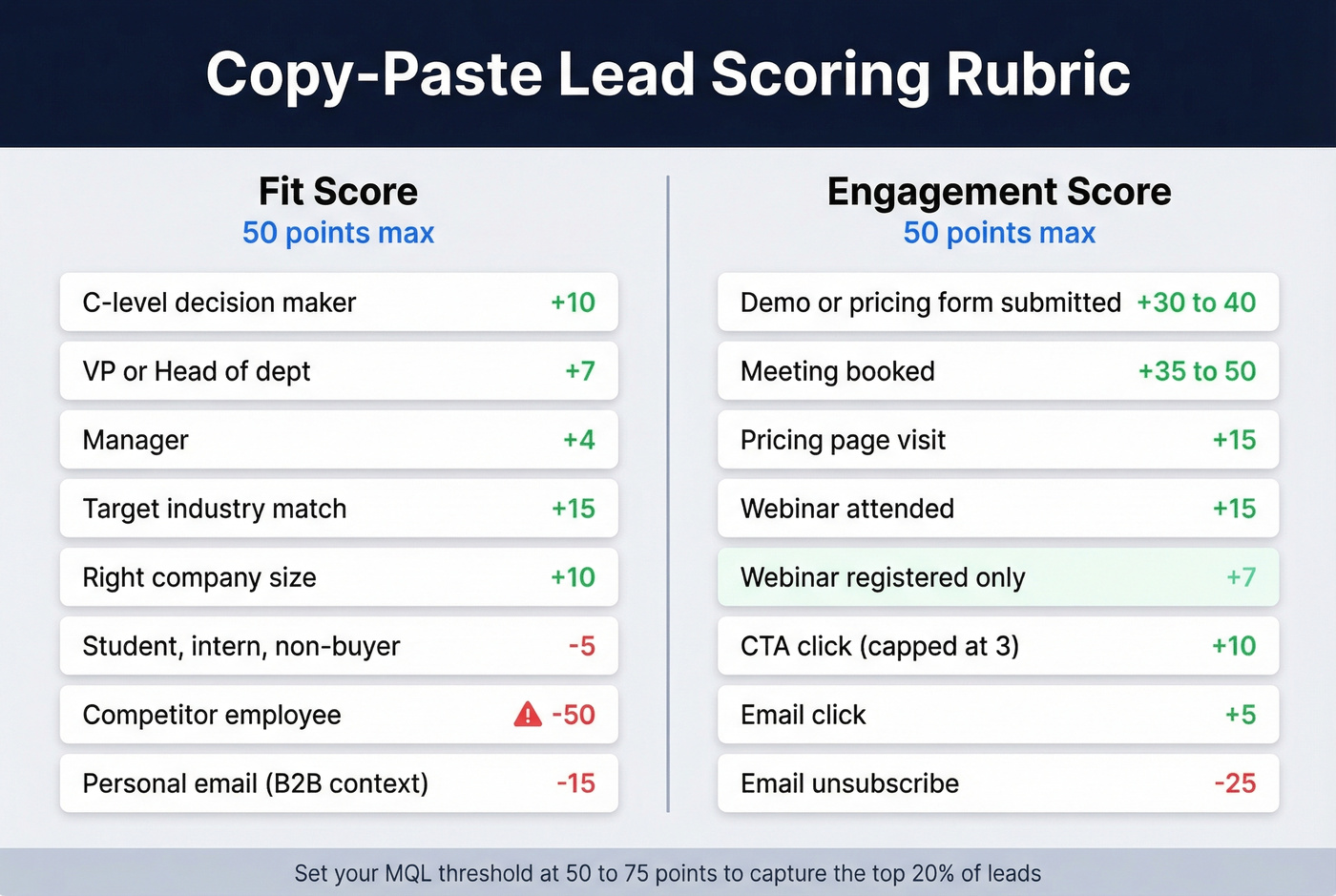
- C-level decision maker: +10
- VP / Head of department: +7
- Manager: +4
- Student, intern, or non-buyer persona: -5
- Target industry match: +15
- Right company size: +10
- Competitor employee: -50
- Personal email address in a B2B context: -15
Engagement scoring - 50 points max:
- Pricing page visit: +15
- Demo or pricing form submitted: +30-40
- Meeting booked: +35-50
- Webinar attended: +15; registered only: +7
- CTA click: +10, capped at 3 clicks
- Email click: +5
- Email unsubscribe: -25
Thresholds, Decay, and the Handoff Grid
Set your MQL threshold to capture the top 20% of leads by score. That typically lands between 50-75 points on a 100-point scale, yielding a 15-25% conversion rate from qualified leads to closed deals.
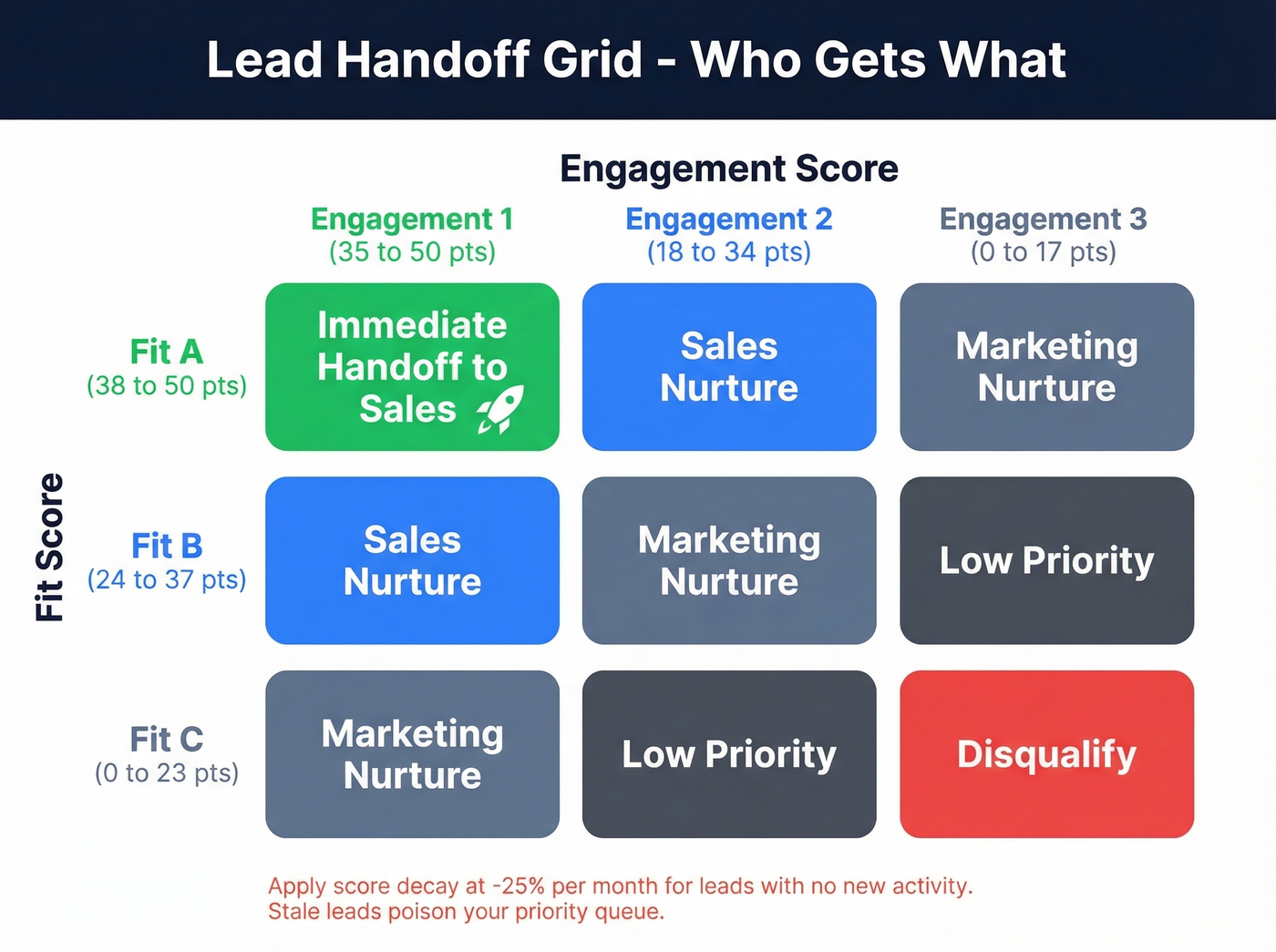
Build a handoff grid using letter-number bands:
| Engagement 1 (35-50) | Engagement 2 (18-34) | Engagement 3 (0-17) | |
|---|---|---|---|
| Fit A (38-50) | Immediate handoff | Sales nurture | Marketing nurture |
| Fit B (24-37) | Sales nurture | Marketing nurture | Low priority |
| Fit C (0-23) | Marketing nurture | Low priority | Disqualify |
Apply score decay at -25% per month for leads with no new activity. Without decay, a lead who downloaded a whitepaper eight months ago keeps outranking someone who just requested a demo. Stale leads poisoning your priority queue is one of the most common scoring failures we see.
Discovery Questions That Work
Forget organizing questions by framework acronym. Group them by what they actually reveal. And remember: 80% of buyers are more likely to engage when outreach reflects their specific situation, so personalized discovery isn't optional - it's the baseline.
Urgency and Requirements
The goal is to uncover the agenda behind the stated need. Don't ask "what are you looking for?" - dig into what's driving the timeline:
- "What triggered this evaluation now? Regulatory deadline, audit finding, something else?"
- "What happens if you don't solve this by Q3?"
- "Is this a top-down mandate or a team-level initiative?"
For SaaS-specific discovery, add: "What's the day-to-day impact of the current problem on your team?" and "What have you tried before, and why didn't it work?" These surface both pain severity and competitive context.
Budget Discovery
Two approaches work. The direct route: "We tailor solutions to different investment levels - what range are you working with?" The indirect route: "For a project of this scope, companies typically invest $X-$Y. Does that align with your expectations?" Both beat the awkward "what's your budget?" that makes prospects clam up.
Authority and Competition
- "Who else needs to sign off before this moves forward?"
- "Are you evaluating other solutions? What's your shortlist look like?"
- "What criteria will the final decision come down to - price, features, support, something else?"
Compare their answers against your strengths. If they're optimizing for the one thing you don't do well, that's a disqualification signal, not a discovery opportunity.
When to Disqualify
Disqualification is a revenue-generating skill. Every hour on a lead that was never going to close is an hour stolen from one that would.
Disqualify immediately when:
- They're outside your ICP - wrong industry, wrong company size, wrong geography
- No budget authority and no path to the person who has it
- No timeline - "maybe next year" isn't a timeline
- Already committed to a competitor with a signed contract
- The contact is a student, job seeker, or competitor doing research
The hardest part isn't knowing when to disqualify - it's actually doing it. Reps hate removing leads from their pipeline because it makes the numbers look smaller. But a pipeline of 50 qualified deals beats a pipeline of 200 maybes every single time. Build disqualification into your process as a positive metric, not a failure.
AI-Powered Qualification in 2026
When Manual Scoring Breaks
Manual qualification works fine up to about 800-1,000 leads per month. Beyond that, quality drops fast - reps start skimming instead of scoring, and the bottom third of the pipeline gets ignored entirely. AI-powered scoring handles 15,000+ leads per month without degradation.
McKinsey's "The state of AI in 2025" report found that 88% of organizations now use AI regularly in at least one business function, with marketing and sales consistently ranking among the highest-adoption functions.
What AI Actually Changes
Manual qualification typically runs 60-70% accuracy. AI-enhanced scoring pushes that to 75-90% by learning from historical win/loss patterns and weighting signals humans miss. The emerging concept is the AQL - the AI-qualified lead - where machine learning models handle the initial scoring pass and surface only the highest-probability opportunities for human review.
AI doesn't replace the discovery call. It replaces the manual triage that decides who gets a discovery call. That's where the real time savings live.
Case Studies Worth Knowing
U.S. Bank deployed AI lead scoring using 200+ data points. Results: +260% lead conversion, -35% sales cycle length, and +40% revenue per rep.
HubSpot's predictive scoring hit 85% SQL accuracy compared to 55% with manual methods and cut time-to-first-contact by 50%. Their scoring capabilities start at roughly EUR45/user/month.
Salesforce Einstein delivers a 26% win rate improvement and 90%+ prioritization accuracy across 150,000+ companies. Einstein starts at roughly EUR150/user/month.
Enforce It Through Coaching
Frameworks and scoring models are useless if reps ignore them on calls. Record discovery calls and review them against your framework criteria weekly. Pull up the actual conversation: did the rep confirm budget authority, or did they just ask about "the process"? Did they surface a timeline, or accept "we're exploring options" as an answer?
Let's be honest - the teams with the best qualification discipline aren't the ones with the fanciest methodology. They're the ones where managers enforce the process in weekly 1:1s and call reviews. Make qualification adherence a coaching metric, not just a CRM field.
The Data Quality Problem
Every qualification framework assumes your data is right. In practice, B2B databases decay at 2-3% per month. That means roughly a quarter of your contact records go stale every year - wrong emails, outdated titles, people who left the company six months ago. You're scoring ghosts.
The downstream damage goes beyond wasted rep time: emailing bad addresses tanks your domain reputation, which tanks deliverability for every future campaign. It's a compounding problem that gets worse the longer you ignore it.
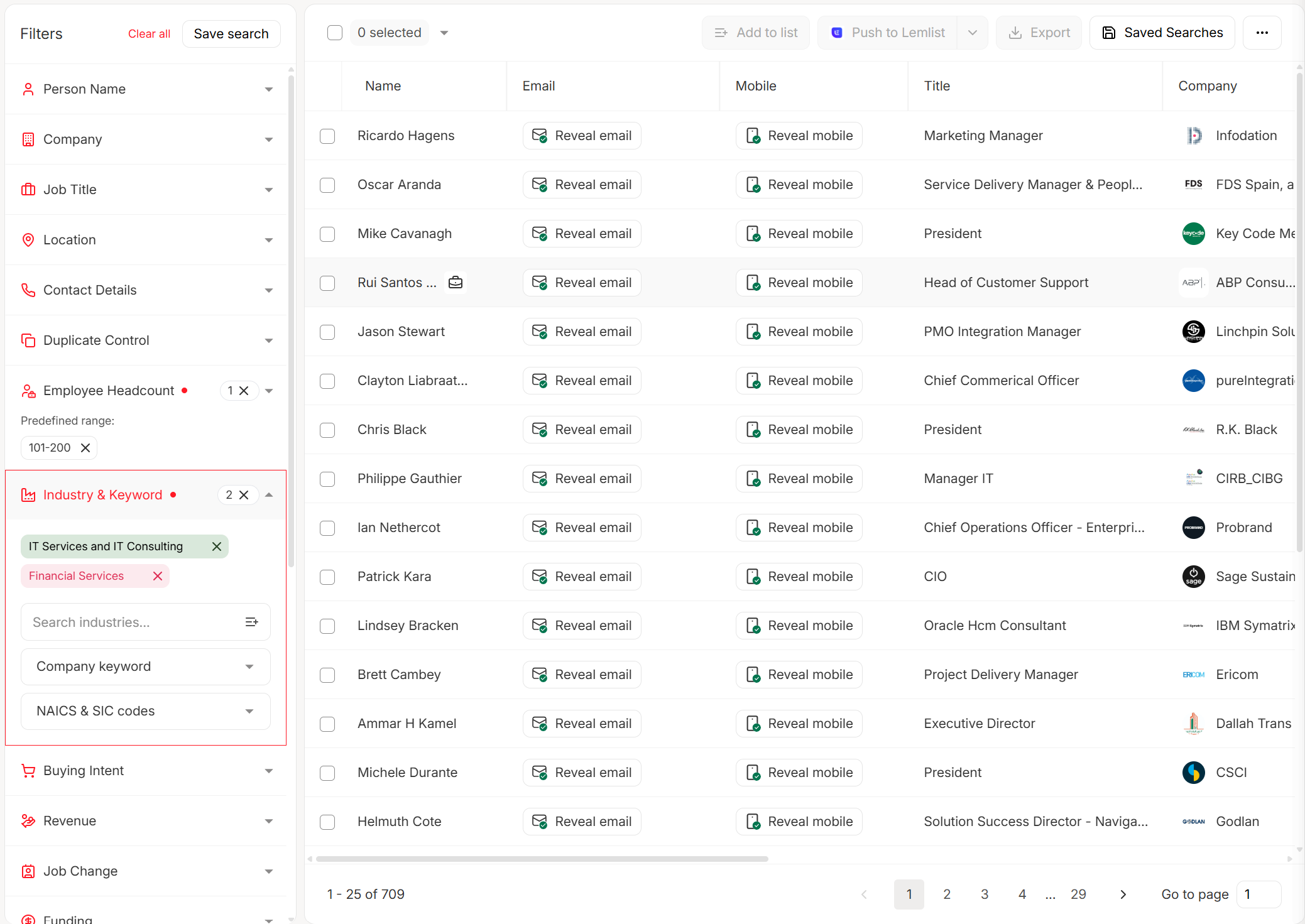
This is where Prospeo fits into the qualification stack. With 300M+ professional profiles, 98% email accuracy, and a 7-day data refresh cycle versus the six-week industry average, it ensures you're qualifying real people at real companies with current titles. Snyk's sales team saw this firsthand - their bounce rate dropped from 35-40% to under 5% after switching, AE-sourced pipeline jumped 180%, and they went from chasing dead contacts to generating 200+ new opportunities per month. Before you invest in scoring models and frameworks, fix the data underneath them. Sales lead qualification on verified records is qualification. Everything else is guesswork.
Framework enforcement falls apart when 35% of your emails bounce. Prospeo's 5-step verification and proprietary email infrastructure cut bounce rates below 4% - so your BANT, MEDDIC, or CHAMP process runs on contacts that connect, not dead records.
Qualification without deliverability is just pipeline theater.
FAQ
What's the difference between MQL and SQL?
An MQL is flagged by marketing based on engagement - content downloads, webinar attendance, repeat site visits. An SQL has been vetted through sales discovery and confirmed to have budget, authority, need, and timeline. Marketing owns MQL definitions; sales owns SQL. The gap between them is where most pipeline disagreements live.
What's the best qualification framework for SaaS?
BANT works for high-velocity SaaS with sub-30-day cycles and deal sizes under $15k. MEDDIC suits enterprise SaaS with multi-stakeholder buying committees. CHAMP fits mid-market consultative motions. The framework matters less than consistent enforcement - pick one and make every rep use it.
How many leads can you qualify manually before accuracy drops?
Manual qualification holds up to roughly 800-1,000 leads per month. Beyond that, reps start triaging by gut feel instead of criteria. AI-powered scoring handles 15,000+ leads monthly while maintaining 75-90% accuracy versus 60-70% for manual methods.
What's a good MQL-to-SQL conversion rate?
For most B2B motions, 10-30% is the realistic range. Below 10% means your MQL definition is too loose - marketing is passing unqualified contacts. Above 30% suggests overly strict criteria that leave winnable deals stuck in nurture too long.
How do you keep bad data from ruining your scoring model?
Enrich and verify contact records before they enter scoring. B2B data decays 2-3% monthly, so quarterly hygiene isn't enough. A 7-day refresh cycle and verified email infrastructure keep records current - Snyk cut bounce rates from 35-40% to under 5% after switching to verified data, which directly improved their pipeline quality.