

Sales Leadership Coaching: What Works, What Doesn't, and What It Costs
90% of sales leaders say they coach their reps at least monthly. Meanwhile, 38% of reps say they rarely or never receive coaching - and 14% say they get none at all. That's not a gap. That's a different reality.
If you're a sales leader who's been told to "coach more" but never given a framework, a budget, or a realistic cadence, this is the guide you actually need.
The Quick Version
Fix the structure first. Most sales "coaching" is pipeline review wearing a coaching hat. Your reps know the difference. Before you spend a dollar on a program, audit whether your 1:1s are actually developing skills or just inspecting deals.
If you want a formal program: HubSpot Academy (free) to build a foundation, NASP CPSL at $895 for certification, Harvard DCE at $2,990 for prestige and network. Full pricing breakdown is below.
If you want 1:1 coaching: Budget $300-$800 per session for a senior coach, or $7,500-$30,000 for a structured 4-6 month engagement. Group coaching runs $2,500-$5,000 per participant.
Coaching vs. Training: The Real Difference
Sales leadership coaching gets conflated with sales training constantly, and the confusion costs teams real money.
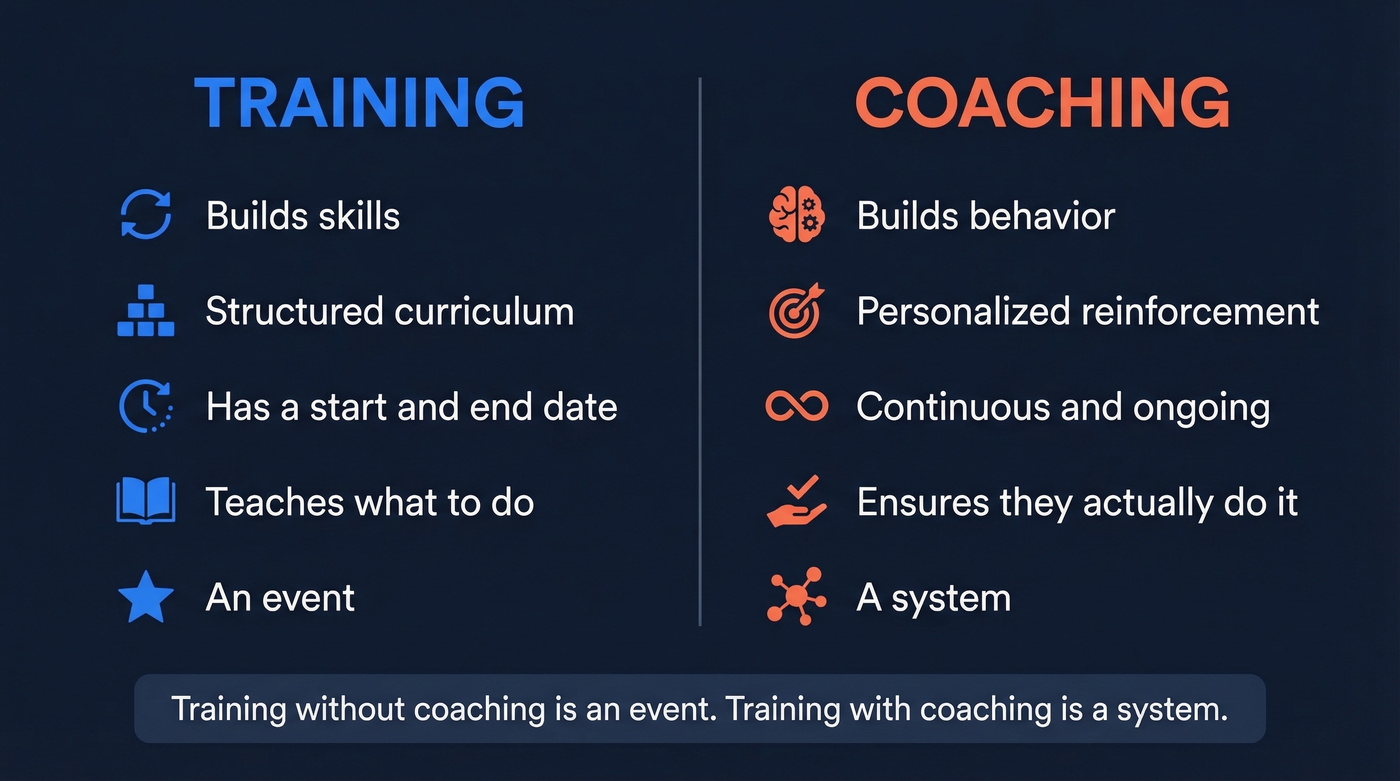
Training builds skills. Coaching builds behavior. Training is a structured curriculum - a workshop, a course, a certification that teaches reps what to do. Coaching is the ongoing, personalized reinforcement that ensures they actually translate knowledge into action. One is an event with a start and end date; the other is continuous.
Think of it this way: coaching is the weekly 1:1 where you listen to a call together, identify a pattern, and work on changing it. Training gives your team a new playbook. Coaching makes sure they run it.
Why Training Alone Doesn't Stick
Here's the uncomfortable stat: 72% of sales leaders say training fails because it's one-size-fits-all. You fly the team to a two-day offsite, everyone gets energized, and within a month the new techniques have evaporated. Gartner's widely cited finding is that B2B reps forget 70% of training content within a week.
Training without coaching is an event. Training with coaching is a system.
The ROI Case for Coaching
Let's talk numbers, because "coaching matters" isn't a budget justification.
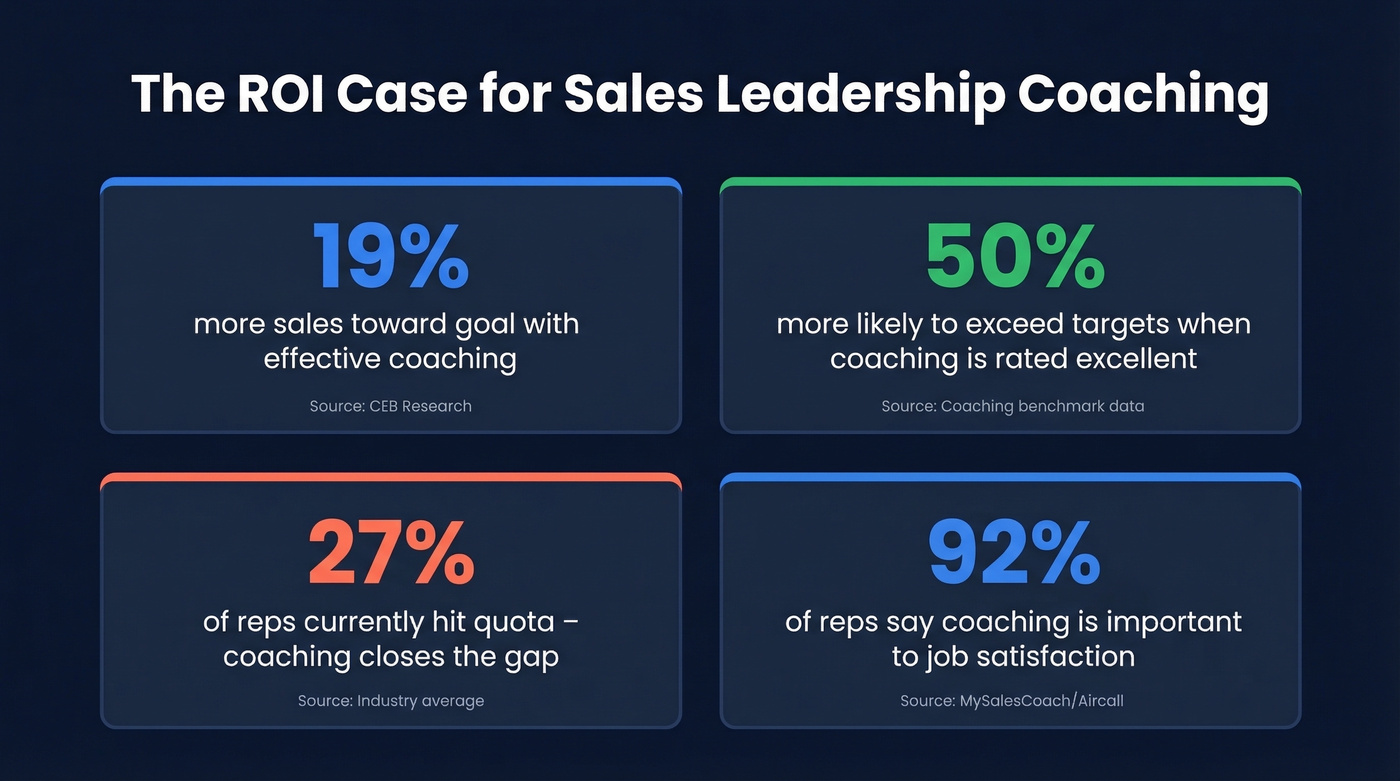
CEB research shows that sellers with a highly effective coach achieve 19% more sales toward goal. That's not a soft metric - it's quota attainment, the number your board actually cares about. A MySalesCoach/Aircall survey found that 96% of sales leaders said coaching influenced quota attainment, with 42% calling the impact "significant." And 92% of reps say coaching is important to job satisfaction, which means coaching doesn't just move quota - it helps retention.
Now layer in the ramp math. For mid-market teams, average rep ramp time hovers around 3 months and average tenure around 12 months. That gives you roughly 9 months of productive selling per rep. If investing in training plus coaching shortens ramp by even a few weeks - and Sandler's framing is that investing in both can cut ramp by 30-50% - you're adding productive selling days that compound across your entire team.
Only 27% of reps currently hit quota. Reps who rate their coaching as "excellent" or "very good" are 50% more likely to exceed their targets. The gap between coached and uncoached reps isn't marginal.
In our experience, the teams that see the biggest coaching ROI aren't the ones with the fanciest programs - they're the ones that protect coaching time on the calendar like it's a board meeting. 93% of managers say they need more training on how to coach effectively. The ROI is there. The capability often isn't. That's the real problem to solve.
Three Coaching Mistakes That Kill Performance
Most coaching doesn't fail because the leader lacks good intentions. It fails because the structure is wrong.
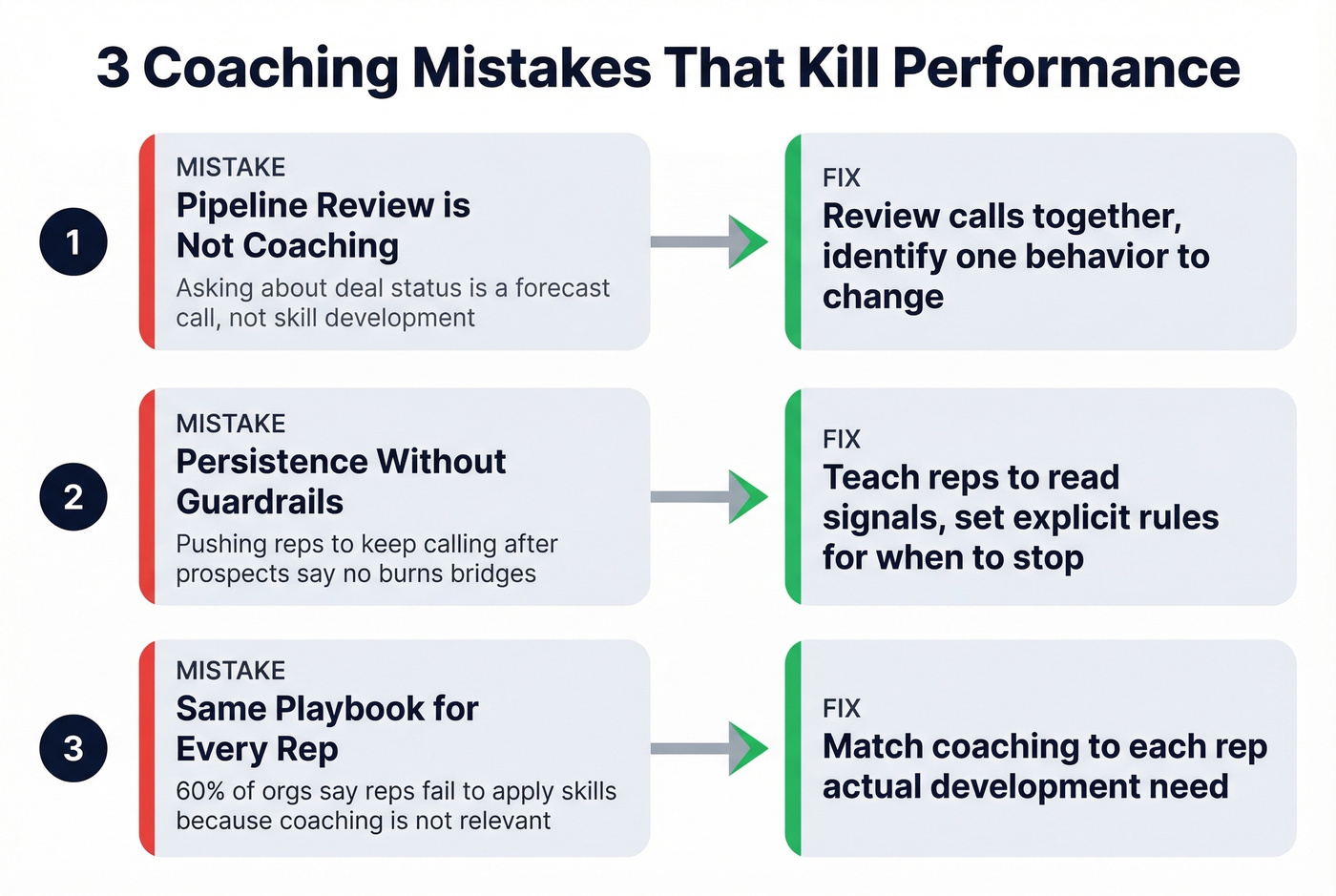
Pipeline Review ≠ Coaching
The consensus on r/salesdevelopment is blunt: most "coaching sessions" are just deal inspection with a nicer calendar invite. The manager pulls up the pipeline, asks "what's happening with the Acme deal," the rep gives a status update, and everyone calls it coaching.
That's not coaching. That's a forecast call.
Coaching means watching a rep run a discovery call, identifying that they're asking closed-ended questions instead of open ones, and working together to change the pattern. It's behavioral, not transactional. If your 1:1s don't include at least one moment of skill development - reviewing a call, practicing an objection handle, diagnosing a lost deal for technique rather than blame - you're not coaching.
Persistence Without Guardrails
A thread on r/sales captured a scenario that plays out constantly: a rep was instructed to keep calling after procurement confirmed the deal was dead. The prospect felt chased. The relationship was damaged. The rep knew it was wrong but followed the coaching anyway.
This is what happens when coaching defaults to "increase activity" without clear rules for when to stop. Great coaching teaches reps to read signals, not just push harder. If your framework doesn't include explicit guidance on when to walk away, you're training reps to burn bridges.
Same Playbook for Every Rep
That 72% stat about one-size-fits-all training applies to coaching too. Your top performer who struggles with enterprise discovery needs different coaching than your new hire who can't get past gatekeepers. Nearly 60% of organizations say the #1 barrier to effective training is reps failing to apply skills learned - and the application gap isn't about motivation. It's about relevance. If the coaching doesn't match the rep's actual development need, they won't use it.

Coaching shortens ramp time - but only if reps can actually reach buyers. Teams using Prospeo's 98% accurate emails and 125M+ verified mobiles book 26% more meetings than ZoomInfo users. Stop coaching reps on persistence and start giving them data that connects.
Fix the data before you fix the coaching cadence.
Tactics That Actually Work
Knowing what fails is useful. Knowing what to do instead is better.
Know Your Leadership Style
Integrity Solutions uses a 2x2 framework worth internalizing: people-focus on one axis, goal-focus on the other. High people / low goal leaders avoid hard conversations. High goal / low people leaders drive results but burn out their team. The sweet spot is high on both - holding reps accountable to targets while investing in their development as individuals.
Before you design a coaching cadence, run a quick self-assessment:
- In your last five 1:1s, how many included skill development vs. deal review? If the answer is zero, you're in the high-goal/low-people quadrant - and your reps feel it.
- When did you last listen to a full rep call and give technique-specific feedback? If you can't remember, your coaching is abstract, not actionable.
- Do your reps come to 1:1s with questions about how to improve, or just status updates? If it's the latter, they've learned that your "coaching" sessions are really inspection sessions.
A Coaching Cadence That Works
Here's a practical cadence that balances depth with reality:
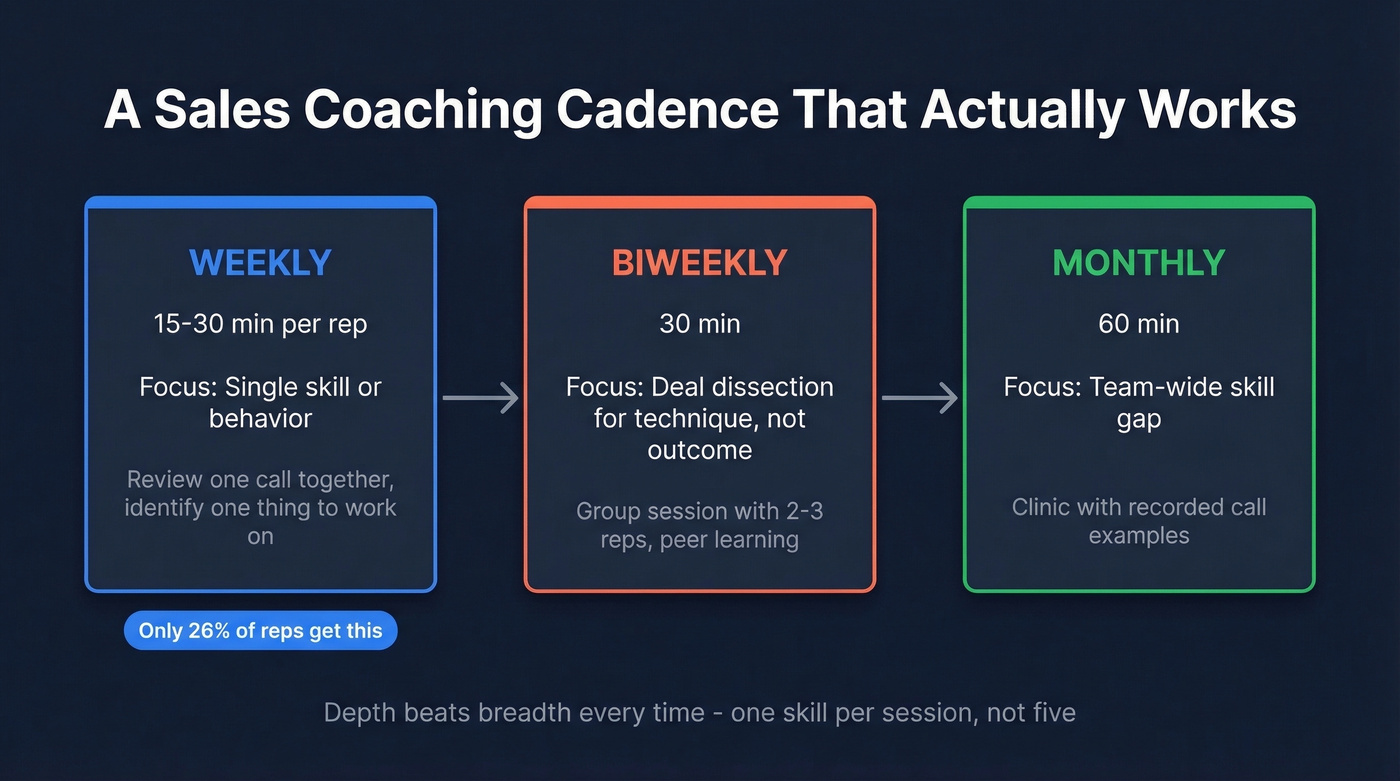
| Frequency | Duration | Focus | Format |
|---|---|---|---|
| Weekly | 15-30 min per rep | Single skill or behavior | 1:1 call review, one takeaway |
| Biweekly | 30 min | Deal dissection (technique, not outcome) | Group session, 2-3 reps |
| Monthly | 60 min | Team-wide skill gap | Clinic with recorded call examples |
Only 26% of reps receive weekly 1:1 coaching. That means 74% of sales teams are leaving the highest-impact coaching frequency on the table. The weekly session doesn't need to be complicated - review one call together, identify one thing to work on. Depth beats breadth every time.
Coaching When You Manage 12+ Reps
Manager span of control keeps rising - from 10.9 direct reports in 2024 to 12.1 in 2025, per Gallup data cited in Hyperbound's benchmarks. Frontline managers spend 30-60% of their time on admin and meetings, leaving 10-40% for people management and development.
With 12+ reps, weekly 1:1s for everyone aren't realistic. Prioritize. Your bottom-third performers and newest hires need the most coaching time. Your top performers need less frequent but higher-quality sessions - challenge them, don't just check in.
Use group formats to scale your impact without multiplying your calendar. A biweekly call review with three reps takes the same time as three individual sessions but adds the benefit of peer learning, which accelerates development faster than top-down feedback alone.
AI-Assisted Sales Coaching
81% of sales teams now use AI in some capacity, and coaching is one of the fastest-growing use cases. AI-using teams report 83% revenue growth vs. 66% for non-AI teams. The appeal is obvious: AI can analyze 100% of your team's calls, not just the handful a manager has time to review.
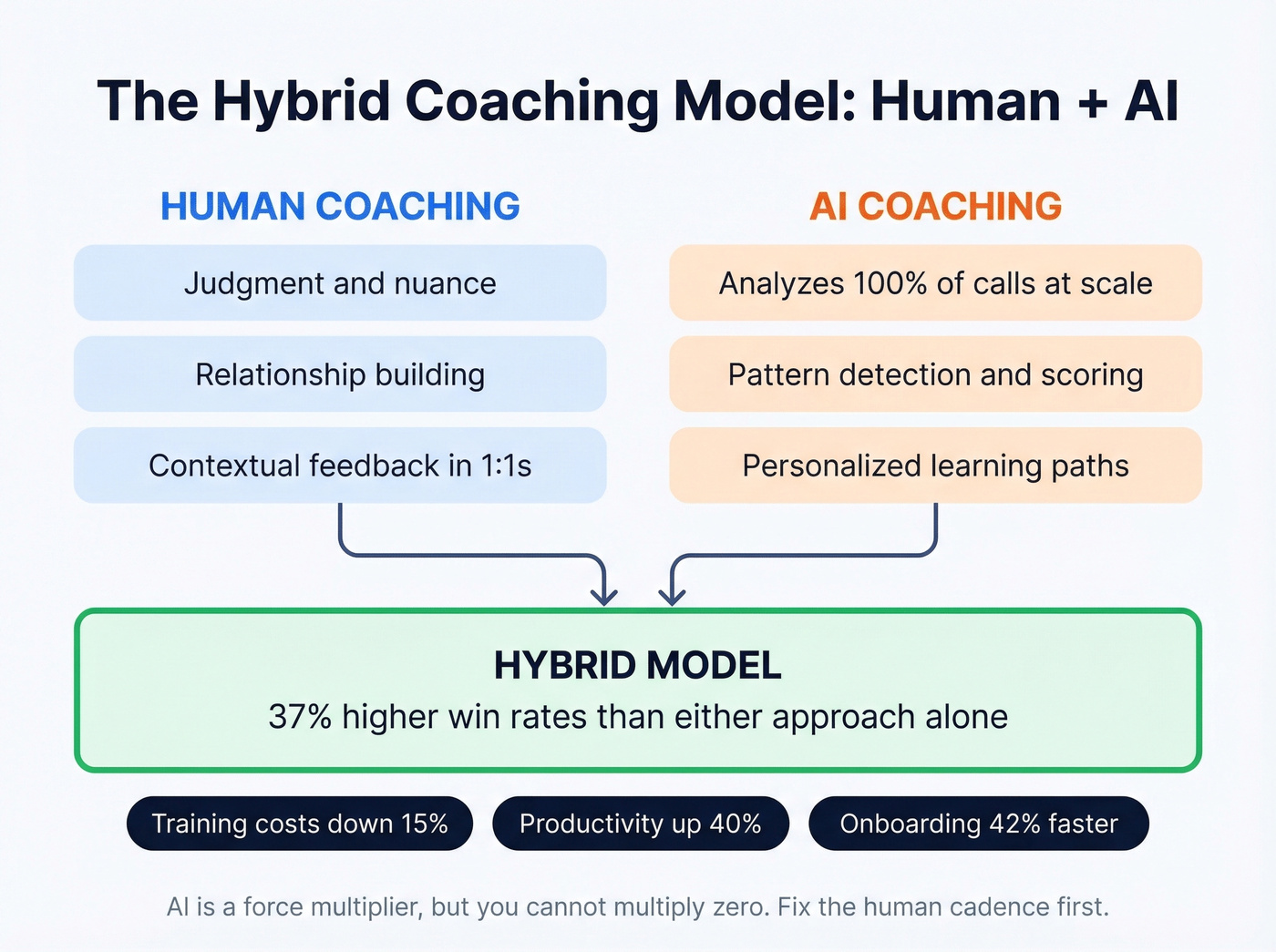
The components have matured quickly. Conversation intelligence platforms score calls on talk-to-listen ratio, question quality, and objection handling. Roleplay simulations let reps practice discovery or negotiation against an AI buyer. Skill scoring tracks development over time. Personalized learning paths adapt to each rep's gaps.
Performance claims from vendors are aggressive but directional: AI coaching reduces training costs by ~15%, improves productivity by ~40%, and can shorten onboarding by up to 42%. The most interesting stat is that hybrid models - human coaching augmented by AI - yield 37% higher win rates than either approach alone.
AI isn't replacing your sales coaches. It's extending them. A manager who can only review 3 calls a week can now get AI-flagged highlights from 30. The judgment, the relationship, the nuance - that's still human. The pattern detection and scale? That's where AI earns its keep.
Here's the thing: most teams buying standalone AI coaching tools would get more ROI from simply protecting 30 minutes of weekly 1:1 time per rep. AI is a force multiplier, but you can't multiply zero. Fix the human coaching cadence first, then layer in AI to scale it.
What Sales Leadership Coaching Costs
Almost no coaching provider publishes pricing. We'll save you the discovery call.
Programs Compared
| Program | Price | Duration | Format | Best For |
|---|---|---|---|---|
| HubSpot Academy | Free | 4.5 hours | Self-paced online | First-timers |
| Coursera / WVU | Free | 2 months | Online, ~10 hours/week | Structured self-study |
| NASP CPSL | $895 | 6 weeks | Online, 20-30 min/day | Best value certification |
| Dale Carnegie | $2,195 | 3 days | Online + in-person | Workshop learners |
| Harvard DCE | $2,990 | 2 days | Online + in-person | Executive credibility |
| Mike Weinberg Cohort | $17,000 | 6 months | Monthly group + 1:1 + retreat | Deep commitment |
HubSpot Academy is the obvious starting point if you've never had formal coaching training - it's free and takes about 4.5 hours. NASP's CPSL certification at $895 is the best value for a credentialed program. Harvard DCE at $2,990 buys you prestige and a network, which matters if you're building executive credibility. Mike Weinberg's cohort program at $17,000 is the deep end - six months of monthly group sessions, monthly 1:1 coaching, and a 2-day in-person retreat.
1:1 Session Rates
| Level | Per Session | Per Program |
|---|---|---|
| Mid-career coaches | $150-$400/hr | $5K-$10K (3 months) |
| Senior / specialized | $400-$800/hr | $7.5K-$30K (4-6 months) |
| C-suite / high-demand | $800-$1,200+/hr | $30K-$60K (12 months) |
| Group coaching | - | $2.5K-$5K/participant |
| Monthly retainer | - | $2.5K-$10K/month |
What Drives the Price Difference
Three factors explain 90% of the price variation. First, coach experience and specialization - a former CRO who's scaled three companies from $10M to $100M ARR commands $800/hour because they've done the thing you're trying to do. Second, format and access - a monthly retainer with async Slack access costs more than a biweekly Zoom call. Third, scope: are you coaching one VP of Sales, or building a coaching methodology for 15 frontline managers?
For most mid-market sales leaders, the sweet spot is a 4-6 month structured engagement in the $7,500-$15,000 range. That's enough time to change behavior and enough sessions to build accountability. Enterprise engagements commonly exceed $50,000 depending on scope, but those typically include organizational design, not just individual coaching.
Skip the C-suite tier unless you're a VP+ at a company doing $50M+ in revenue. For everyone else, the senior/specialized tier gives you 90% of the value at a third of the cost.
Building a Coaching-First Culture
Individual coaching sessions are valuable. A coaching culture is what actually moves the number. The difference is structural.
Protect coaching time. Block it on the calendar. If coaching gets bumped every time a forecast review or QBR appears, your reps learn that coaching is optional. We've seen teams go from zero coaching cadence to consistent weekly 1:1s just by making the calendar hold non-negotiable.
Develop your managers as coaches. 48% of leaders are asking for more training on how to coach - that's self-awareness, not weakness. Give your frontline managers the same investment you give your reps. A manager who can't coach is a bottleneck for every rep on their team, and promoting top reps into leadership without coaching them through the transition is a recipe for losing both a great seller and a struggling manager.
Build accountability systems. 60% of organizations say the #1 barrier is reps failing to apply what they learn. Without follow-up mechanisms - documented action items, skill tracking, peer accountability - coaching becomes a conversation that evaporates by Friday.
Fix the data infrastructure. You can coach a rep to run a perfect discovery call, nail their objection handling, and multi-thread like a pro. But if they're working a list where 35% of emails bounce and half the phone numbers are disconnected, those skills never reach a real conversation. Coaching teaches the right behaviors; bad data prevents reps from executing them. Pair your coaching cadence with a platform like Prospeo that gives reps verified contacts with 98% email accuracy, refreshed every 7 days. When outbound actually reaches real people, the coaching investment translates directly into pipeline.
If you're diagnosing why emails bounce in the first place, start with bounce rate benchmarks and fixes.
Only 27% of reps hit quota, and bad contact data makes every coaching investment harder to justify. Prospeo delivers 300M+ verified profiles refreshed every 7 days - so the skills your reps build in coaching sessions actually translate to live conversations, not bounced emails.
Give your coached reps contacts that actually pick up.
FAQ
What's the difference between sales coaching and sales training?
Training builds skills through structured curriculum; coaching builds behavior through ongoing, personalized reinforcement. Training teaches reps what to do, while coaching ensures they actually do it consistently. The best organizations invest in both - training as the event, coaching as the system.
How often should leaders coach their reps?
Weekly 1:1s of 15-30 minutes plus biweekly group call reviews. Only 26% of reps get weekly coaching - those who do are 50% more likely to exceed quota. Prioritize newest hires and bottom-third performers for the most frequent sessions.
How much does a sales leadership coach cost?
Individual sessions run $150-$800 per hour depending on experience. Structured 4-6 month engagements cost $7,500-$30,000. Free options like HubSpot Academy cover fundamentals, and group coaching runs $2,500-$5,000 per participant.
Can AI replace a human sales coach?
Not yet. Hybrid models - human coaching augmented by AI - yield 37% higher win rates than either approach alone. AI extends coaching capacity by analyzing every call at scale, but human judgment and relationship-building aren't going anywhere.
How do you measure coaching ROI?
Track quota attainment, ramp time, rep retention, and win rates before and after implementation. Reps with highly effective coaches achieve 19% more sales toward goal. Also make sure reps are reaching verified prospects - stale data silently kills the return on every coaching dollar you spend.