

Sales Management Objectives That Actually Get Hit
You just got promoted from top rep to sales manager. Your first quarter starts Monday. You've got a team of eight, a CRM full of stale data, and a VP who wants "aggressive but achievable" targets. Here's the problem: 84% of sales reps didn't meet quota last year. That's not a reps problem. That's a sales management objectives problem.
The gap between teams that hit and teams that miss almost always traces back to how objectives are set, measured, and reinforced - not the talent, not the tech stack. It's the objectives themselves, and whether anyone actually manages to them weekly.
What Are Sales Management Objectives?
Sales management objectives are the strategic outcomes a sales leader commits to delivering. They're not goals (specific numeric targets), quotas (individual revenue assignments), or KPIs (the metrics you watch). Objectives sit above all of those - they're the "what we're optimizing for" layer that cascades from company strategy down to team priorities and into individual rep targets.
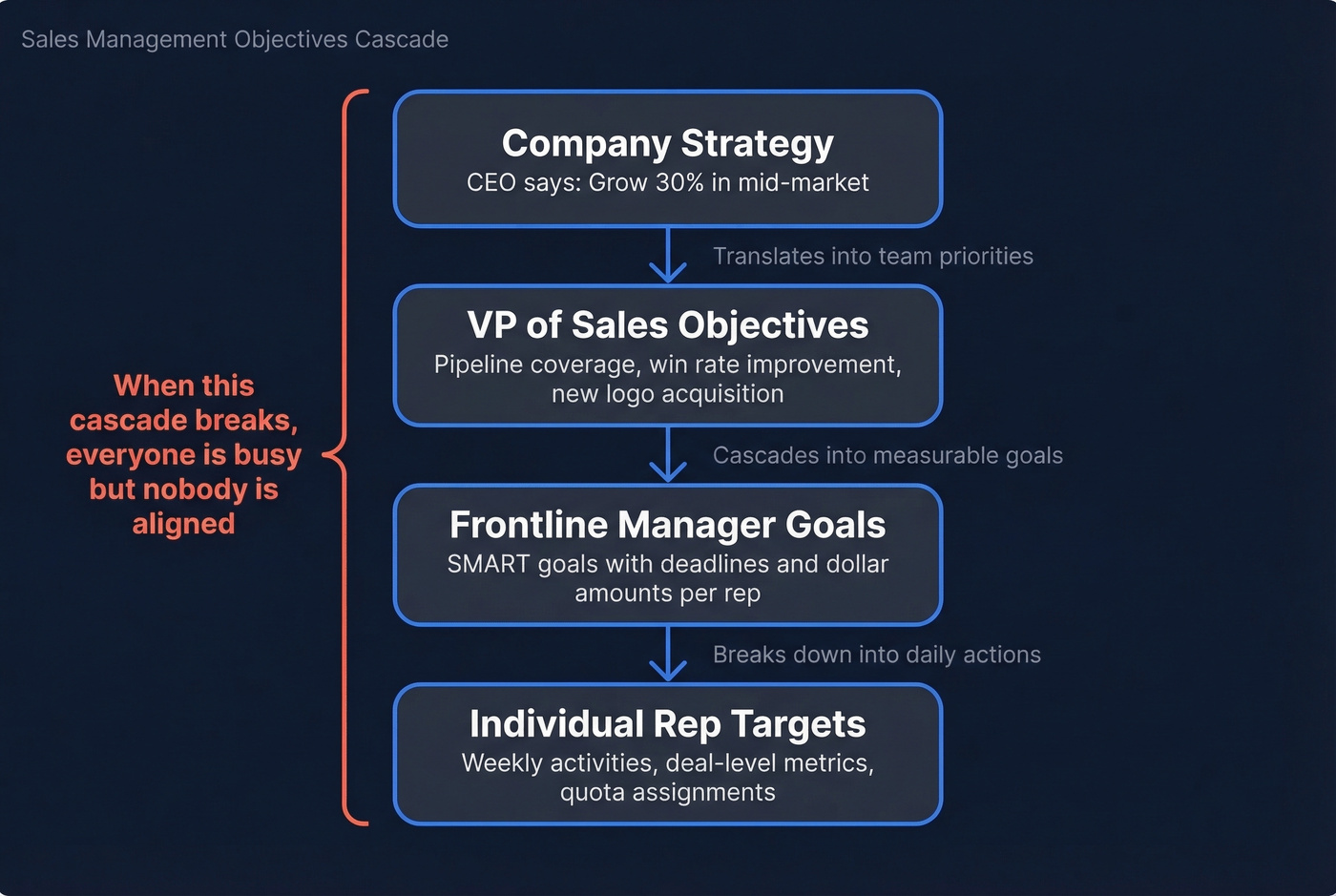
Think of it as a waterfall. The CEO says "grow 30% in mid-market." The VP of Sales translates that into team objectives: pipeline coverage, win rate improvement, new logo acquisition. The frontline manager turns those into rep-level SMART goals with deadlines and dollar amounts. When this cascade breaks, everyone's busy but nobody's aligned.
Leaders who nail their go-to-market strategy are 2x more likely to meet or exceed revenue expectations, with 74% achieving or surpassing goals. Only 52% of CEOs actually believe in their own growth plans. That confidence gap starts right here.
The Quick-Start Version
If you're setting objectives for the first time, start with three:
- Revenue target - the number your team needs to hit
- Pipeline coverage - 3x minimum
- Win rate - the conversion metric that tells you if pipeline quality is real
Use SMART for individual rep objectives. Use OKRs for team-level objectives. Review weekly, not quarterly. And if your pipeline data is garbage - bounced emails, stale contacts, phantom opportunities - none of it matters. Fix that first.
The 12 Core Objectives Every Sales Leader Needs
1. Revenue Growth
Most teams set this wrong. They assign a number without connecting it to the inputs that drive it. 67% of reps don't think they'll hit quota this year.
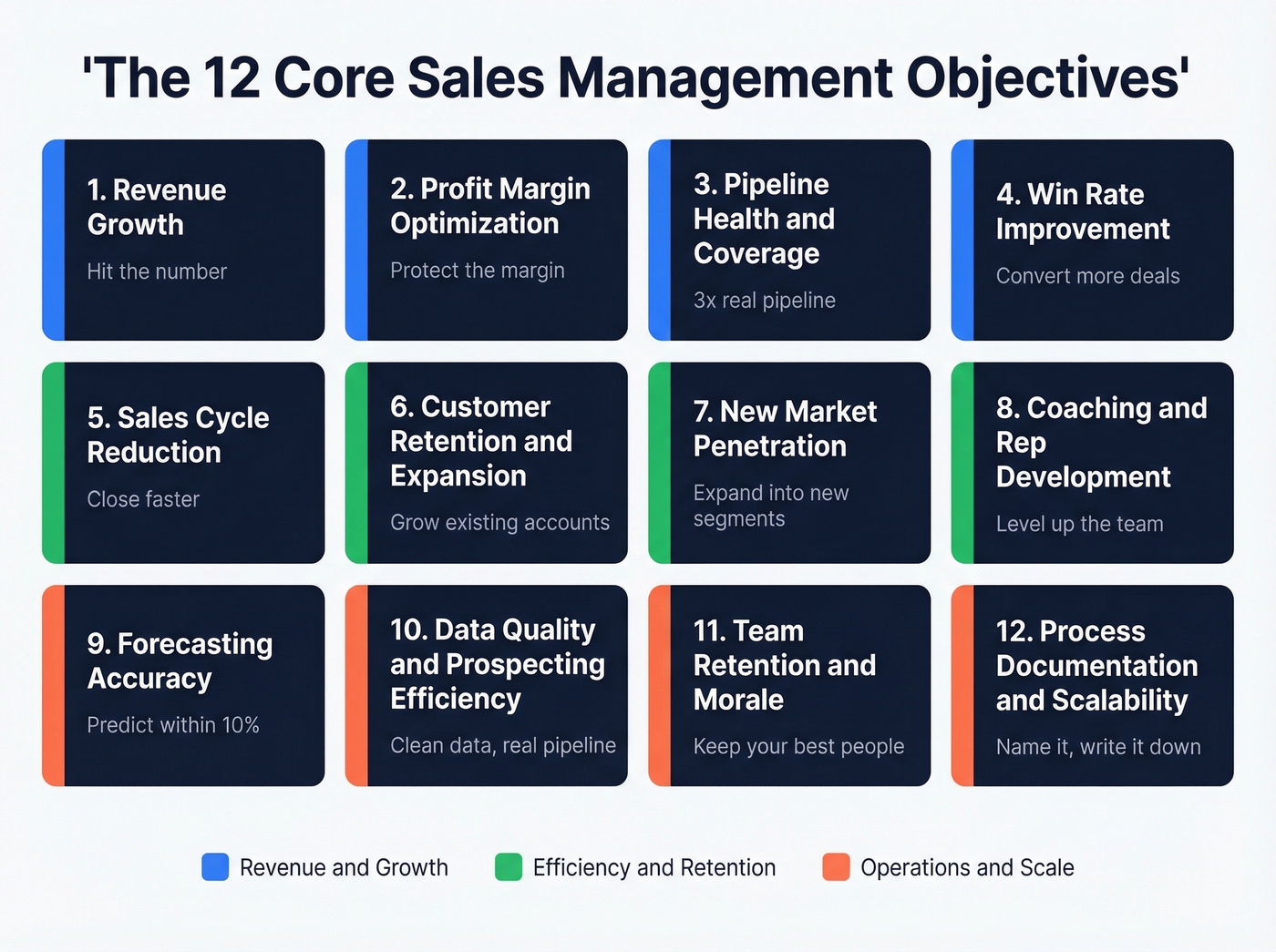
A SMART version: "Increase Q3 revenue 15%, from $500K to $575K, tracked in CRM by September 30." The key is the tracking mechanism - if it's not in the CRM, it doesn't exist. Strong leading indicators to manage weekly include pipeline velocity, stage-to-stage conversion, average deal size, and win rate.
2. Profit Margin Optimization
Revenue growth means nothing if your team gives away steep discounts on every deal. This objective forces discipline around pricing and value selling.
SMART example: "Reduce average discount from X% to Y% by end of quarter while maintaining close rate above 25%." The metric that exposes this is gross margin per deal. This is what separates revenue leaders from revenue-at-any-cost leaders.
3. Pipeline Health and Coverage
Here's what bad looks like: a rep in enterprise SaaS (average deal around ~$250K ACV) reported on Reddit that only 6 of 18 salespeople hit goal while management kept pushing 3x coverage expectations even as addressable accounts were cut. The "3x pipeline coverage" standard is useful until management demands it while simultaneously shrinking territories.
The fix is qualifying what counts as pipeline. SMART example: "Maintain 3x pipeline coverage with deals that have had activity in the last 14 days." Dead opportunities inflating your coverage number is the fastest way to blow a forecast.
A contrarian OKR worth considering: increase early-stage disqualification rate from 15% to 30%. Most teams avoid this because it shrinks the pipeline on paper, but it makes every remaining number real.
4. Win Rate Improvement
Win rates are 4.4x higher when reps discuss next steps on calls. That's not marginal - it's a behavioral change that compounds across every deal.
OKR example: "Objective: Increase win rate from 22% to 30%. KR1: 100% of discovery calls include documented next steps. KR2: Stage-to-stage conversion improves 5 points at each gate." Track win rate by rep and by segment. The variance tells you exactly where coaching is needed.
5. Sales Cycle Reduction
28% of prospects back out because the sales process takes too long. That's a process problem, not a buyer problem.
OKR example: "Decrease enterprise time-to-decision from 90 to 65 days." Key results: reduce security review cycles by 50%, achieve 85% MEDDIC adherence across opportunities. Monitor stage duration to find exactly where deals stall.
6. Customer Retention and Expansion
Average retention rate is 75%, ranging from 55% to 84% by industry. For SaaS teams, net revenue retention is one of the most important metrics. Retention isn't just a CS objective - sales managers who ignore it are leaving the easiest revenue on the table.
OKR example: "Improve NRR from 105% to 120%." Your leading indicators are churn rate and expansion revenue percentage.
7. New Market Penetration
This is the growth objective that forces your team beyond the comfort zone of existing segments. SMART example: "Acquire 25 new enterprise customers in [target vertical] by end of Q4."
The trap: counting "new logos" that are actually referrals from existing accounts in the same vertical. Define "new" clearly before you start measuring. Track new logo count and revenue from new segments separately.
8. Coaching and Rep Development
30% of sales teams rely on a single rep for more than half their revenue. The gap between top and bottom producers averages 10x. That's a coaching problem. And only 26% of reps receive weekly coaching, despite Accenture research showing corporate training delivers 353% ROI.
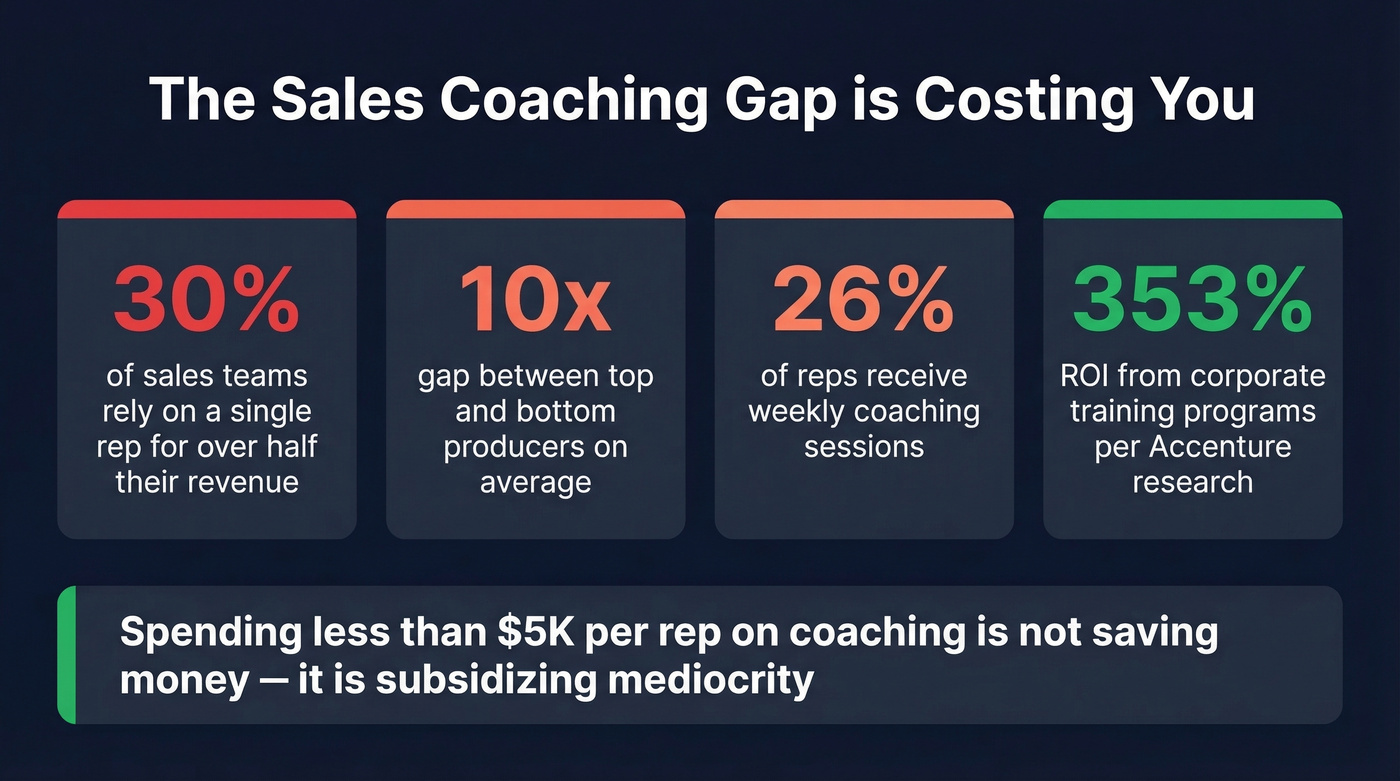
Here's the thing: if you're spending less than $5K per rep on coaching and training, you're not saving money. You're subsidizing mediocrity. OMG's research suggests you could spend up to $30K per rep and still see 10x ROI.
A coaching-style management approach works best. Directive management ("do exactly this") has its place during onboarding, but reps who are coached rather than commanded develop the judgment to handle deals independently. OKR example: "Bottom-quartile reps improve to 70%+ quota attainment within two quarters." The metric that matters isn't coaching sessions completed - it's the distribution of quota attainment across the team, not just the average.
9. Forecasting Accuracy
A CRO on Reddit framed it well: "Helping people sell well is a management skill. Forecasting the outcome is an exec leadership skill."
SMART example: "Achieve forecast accuracy within +/-10% of actual revenue for three consecutive quarters." If your forecast is consistently off by more than 15%, the problem isn't the model. It's the pipeline data feeding it. Track forecast variance percentage and commit-to-close ratio weekly, not quarterly.
10. Data Quality and Prospecting Efficiency
Reps spend only a third of their time actually selling. A big chunk of the rest goes to chasing bad contact data, cleaning up bounced emails, and rebuilding lists that should've been accurate in the first place.
Your 3x pipeline coverage is fiction if 30% of emails bounce. Data quality is a management objective, not an ops task.

GreyScout cut rep ramp time from 8-10 weeks to 4 weeks and grew pipeline 140% after switching to verified data with Prospeo, which delivers 98% email accuracy on a 7-day refresh cycle compared to the 6-week industry average. When your contact data is reliable, pipeline metrics stop being aspirational and start being actionable. Your KPIs here are email bounce rate, contact data freshness, and connect rate.
11. Team Retention and Morale
55% of the U.S. workforce is experiencing burnout, and burnt-out employees are nearly 3x more likely to leave within the year. Highly engaged teams drive 21% greater profitability.
Make quota derivation visible. Share the methodology, not just the number. Run bidirectional feedback systems where reps evaluate management too. Track voluntary turnover rate and eNPS. Does every rep understand how their number was derived? If not, you've already lost trust.
12. Process Documentation and Scalability
One of the best pieces of advice from a CRO on Reddit: "Name everything. Names matter." When your discovery process has a name, your pipeline stages have defined exit criteria, and your playbook is written down, the whole operation becomes coachable and scalable.
SMART example: "Document complete sales playbook - discovery through close - with named stages and exit criteria by end of Q1." Track playbook completion percentage and process adherence rate.

You can't hit revenue objectives with a CRM full of stale contacts. Prospeo refreshes 300M+ profiles every 7 days - not every 6 weeks - so your pipeline coverage numbers reflect real, reachable buyers. 98% email accuracy means your reps spend time selling, not chasing bounces.
Clean pipeline data is the prerequisite to every objective on this list.
SMART vs. OKRs: Which Framework Fits
Pick one framework per level. Don't blend them into an unmanageable hybrid.
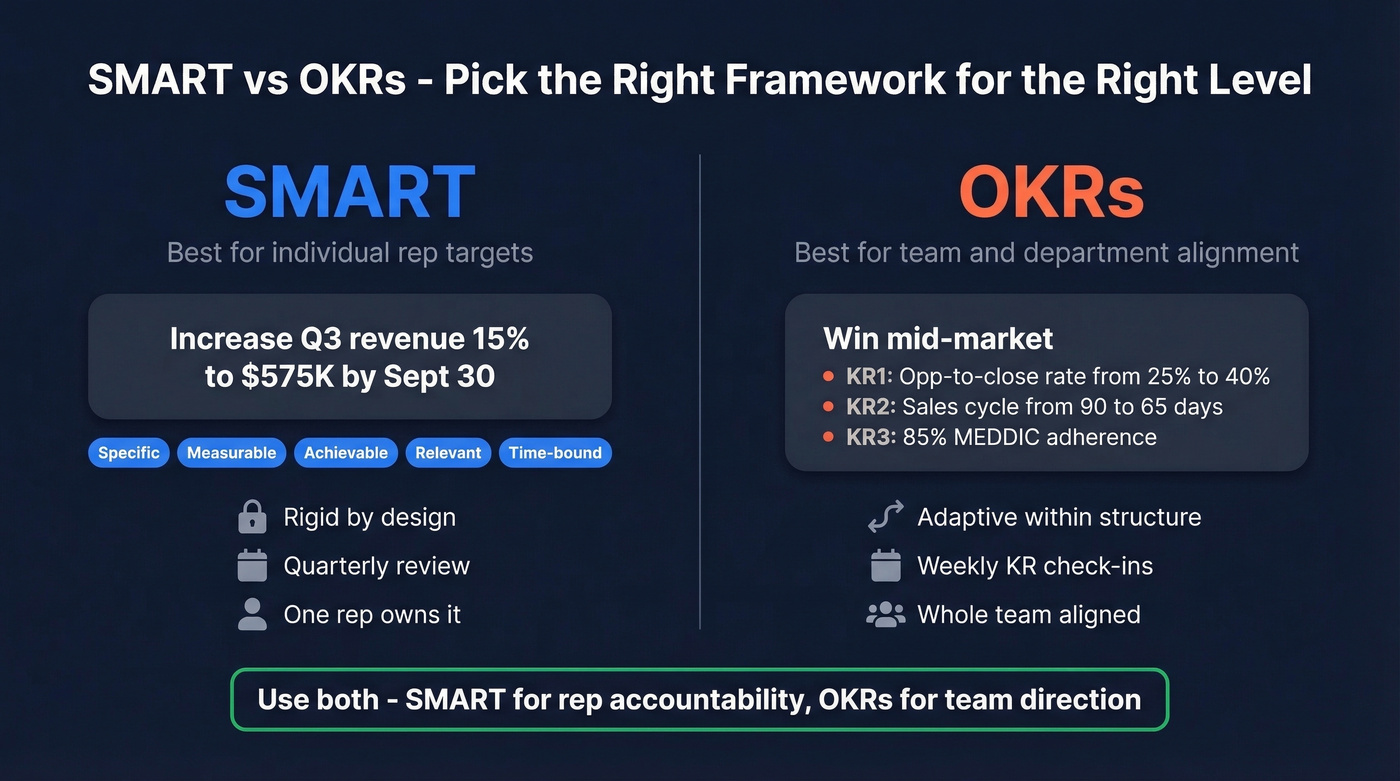
| Dimension | SMART | OKRs |
|---|---|---|
| Best for | Individual rep targets | Team/dept alignment |
| Structure | One goal, 5 criteria | Objective + 3-5 Key Results |
| Cadence | Quarterly | Quarterly, weekly KR check-ins |
| Flexibility | Rigid by design | Adaptive within structure |
SMART in practice: "Increase Q3 revenue 15% to $575K by Sept 30." One goal, five criteria - Specific, Measurable, Achievable, Relevant, Time-bound - owned by one rep. Each criterion acts as a filter. If the goal doesn't pass all five, rewrite it until it does.
OKRs in practice: Perdoo's sales example is one of the better templates we've seen. Objective: "Win mid-market." KR1: Increase opportunity-to-close rate from 25% to 40%. KR2: Reduce sales cycle from 90 to 65 days. KR3: Achieve 85% MEDDIC adherence. Multiple moving parts, one strategic direction.
SMART drives rep accountability. OKRs drive team direction. For most sales orgs, use both at different levels. With 81% of sales teams now using AI tools, both frameworks benefit from automated tracking rather than manual spreadsheet updates - automation alone increases efficiency by 10-15%.
Sales Management Benchmarks (2026)
| Metric | Benchmark |
|---|---|
| Quota attainment | 84% of reps missed quota |
| AI adoption | 81% of teams using AI |
| Workforce burnout | 55% experiencing it |
| Training ROI | 353% (Accenture) |
| Time spent selling | 33% of rep time |
| Win rate lift with next steps | 4.4x higher (Gong) |
| Pipeline coverage standard | 3x ACV minimum |
| Avg. customer retention | 75% (55-84% range) |
| CEOs who believe in their growth plans | 52% |
These aren't aspirational numbers. They're the baseline reality your objectives need to account for. If your reps aren't consistently discussing next steps, that tells you exactly which objective to prioritize first.
Five Mistakes That Kill Sales Teams
Setting annual objectives without quarterly sprints. Annual objectives are a relic. Markets shift, territories change, products launch. Set annual direction, but break objectives into quarterly sprints with monthly checkpoints. If you're only reviewing objectives in December, you've already lost three quarters of correction time.
Measuring activity over outcomes. A rep making 80 cold calls a day with zero meetings booked isn't productive. They're busy. Activity metrics without outcome gates create the illusion of effort. Measure meetings booked, opportunities created, and pipeline generated instead.
Raising targets while cutting resources. The consensus on r/sales is clear: demanding 3x pipeline coverage while simultaneously shrinking territories, cutting accounts, and changing comp plans is the fastest way to destroy team trust. If you're going to raise the bar, give people the tools and territory to clear it.
Ignoring coaching because "there's no time." Only 26% of reps get weekly coaching. The average company spends less than $2K per salesperson on training. We've seen teams where the bottom quartile never gets coached because managers are too busy firefighting deals. That's how you end up with 30% of revenue coming from one rep.
Treating pipeline numbers as real without verifying data quality. If your reps are prospecting with stale emails and disconnected phone numbers, your pipeline coverage metric is a fantasy. Pipeline numbers built on verified data are pipeline numbers you can actually forecast against. Skip this step and every other objective in this article falls apart.
Coaching and forecasting won't save a team built on phantom opportunities. When Snyk's 50 AEs switched to Prospeo, bounce rates dropped from 35-40% to under 5% and AE-sourced pipeline jumped 180%. Real contacts create real pipeline - at $0.01 per verified email.
Stop inflating coverage with dead leads. Build pipeline that converts.
Turning Objectives Into Weekly Behaviors
Objectives don't fail at the strategy level. They fail at the execution cadence. Here's the rhythm that works:
Weekly: 1:1 coaching with every rep. Pipeline review focused on deal movement, not deal count. KPI check against leading indicators. Apply the pipeline purge rule - if a deal hasn't moved in two weeks, it's not real. Remove it or re-qualify it.
Monthly: Forecast accuracy review. Strategy adjustment based on what's working and what isn't. Process audit: are reps following the playbook or freelancing?
Quarterly: Full objective reset. Territory and comp review. Team health check covering eNPS, turnover signals, and burnout indicators. This is where you recalibrate the cascade from company targets down to rep goals.
In our experience, the managers who hold the weekly cadence consistently outperform those with better strategies but inconsistent execution. Let's be honest - most sales strategies aren't that different from each other. The difference is who actually runs the operating rhythm. Give clear direction you can compress to a sentence. Then repeat it every week until it's muscle memory.
FAQ
What's the difference between sales objectives and sales goals?
Objectives are strategic outcomes you're optimizing for, like improving win rate or reducing sales cycle length. Goals are the specific numeric targets attached to those objectives - "hit 30% win rate by Q3." Objectives set direction; goals measure whether you're getting there.
How many objectives should a sales team have?
Three to five. More than that dilutes focus and makes weekly reviews impossible to manage. Start with revenue, pipeline coverage, and win rate. Add coaching or retention objectives once your data infrastructure supports the measurement.
How often should sales objectives be reviewed?
Weekly for leading indicators like pipeline movement and activity-to-outcome ratios. Monthly for lagging metrics like revenue and win rate. Quarterly for strategic resets, territory adjustments, and comp plan reviews. Annual-only reviews sacrifice three quarters of correction time.
What's the best framework - SMART or OKRs?
Use SMART for individual rep targets where you need specific, measurable, time-bound accountability. Use OKRs for team-level objectives where cross-functional alignment matters more than individual precision. Most high-performing orgs run both at different levels simultaneously.
How does data quality affect sales objectives?
If 30% of your emails bounce, your pipeline coverage is inflated and your forecasts are unreliable. Verified contact data - with accuracy rates above 95% and refresh cycles measured in days, not weeks - is the foundation every other objective depends on.