

Sales Motions: The Decision Framework Nobody Else Gives You
Up to 70% of B2B sales reps missed quota last year. That's not a people problem - it's a motion problem. Every guide on sales motions gives you the same five pipeline stages and calls it a framework. That's like handing someone a map of the highway system and calling it a driving lesson.
The real question isn't "what are the stages?" It's "which motion fits my ACV, my team size, and my stage - and how do I know it's actually working?"
The Quick Version
A sales motion is the strategic combination of your sales process, methodology, and go-to-market approach - not just a list of stages. It's the operating system that determines how your team finds, engages, and closes buyers.
Choose your motion based on ACV: under $5K = self-serve/PLG, $5K-$25K = hybrid, over $25K = sales-led. Complex buying committees mean sales-led regardless of deal size. The core health check is simple: CAC payback under 12 months and LTV:CAC above 3:1. If both are healthy, your motion is economically sound. If either one is broken, the motion needs surgery.
What Is a Sales Motion?
Sales motions and sales processes get conflated constantly. They're not the same thing.
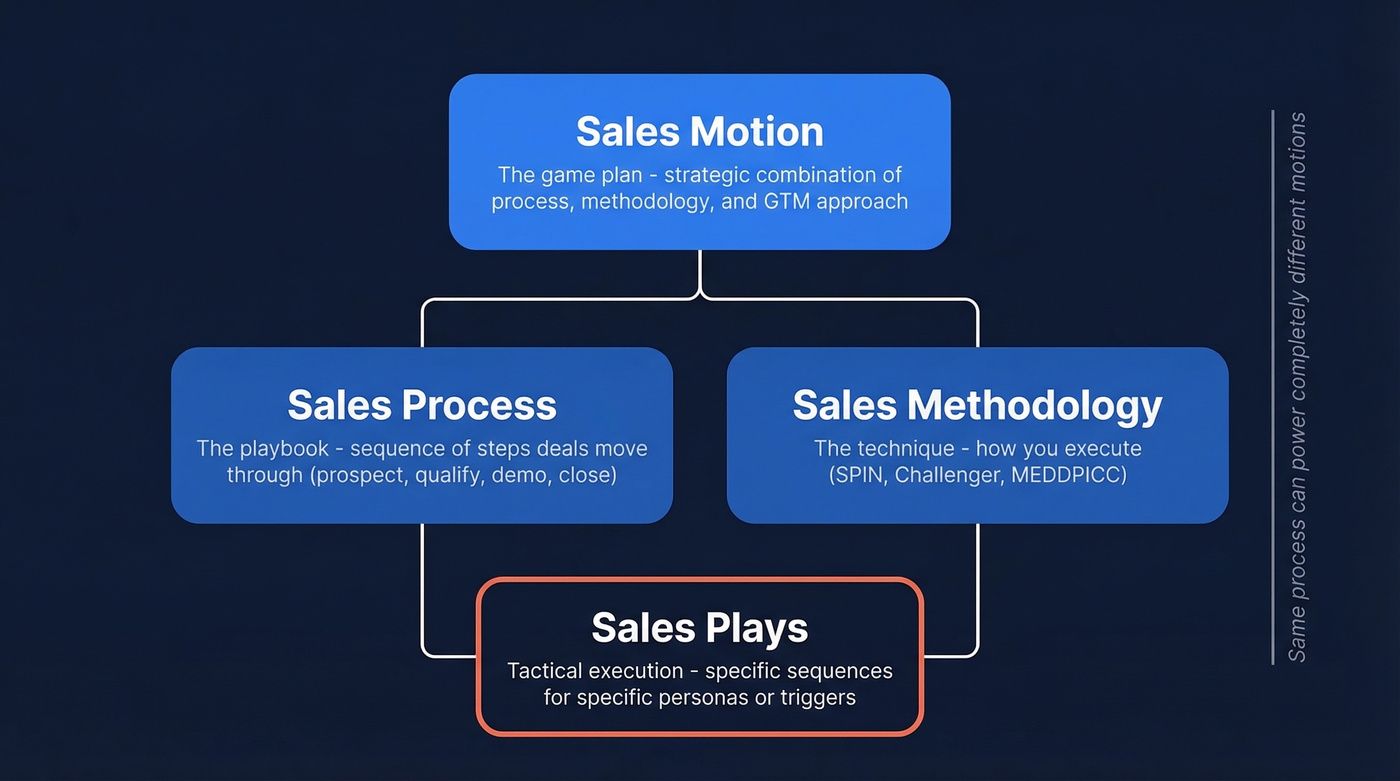
A sales process is the sequence of steps your deals move through - prospect, qualify, demo, negotiate, close. It's the "what happens when." A sales methodology is how you execute within those steps - SPIN Selling for discovery, Challenger for reframing, MEDDPICC for qualification rigor. A sales motion sits above both. It's the strategic combination of process, methodology, and GTM approach, tailored to your market, your ACV band, and your buyer's purchasing behavior.
Your process is the playbook, your methodology is the technique, and your motion is the game plan. A sales play, by contrast, is a tactical execution within a motion - a specific sequence aimed at a specific persona or trigger event. You can run the same process (demo, trial, close) with completely different motions: one self-serve, one rep-assisted, one enterprise field sales. The motion determines which levers you pull and how resources get allocated across the buyer journey.
Types of Sales Motions (With Examples)
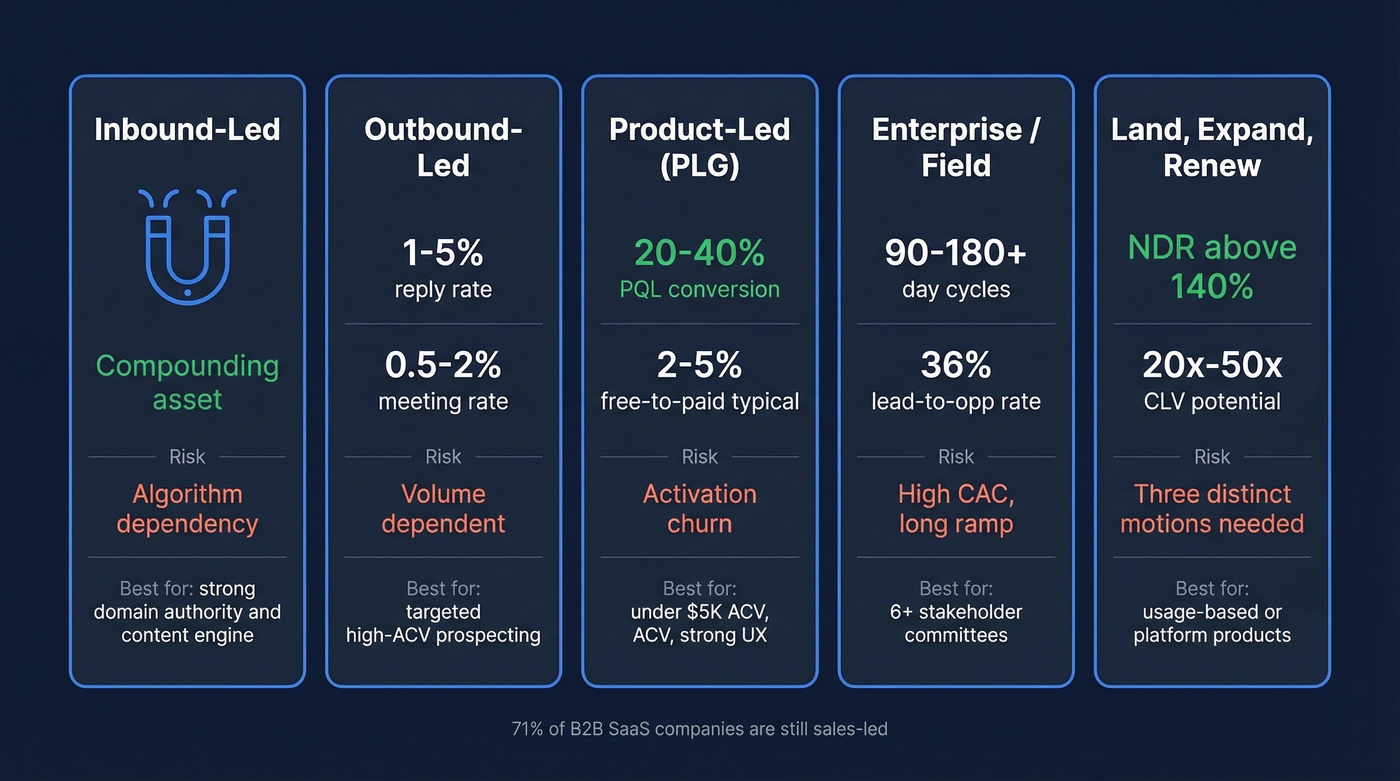
Despite the PLG hype cycle, 71% of B2B SaaS companies are still sales-led. Only 29% run a true product-led motion. That doesn't mean PLG is wrong - it means most companies' economics still require a human in the loop. Here are the most common sales motion examples and when each one fits.
Inbound-Led
Inbound motions rely on content, SEO, paid media, and brand to generate MQLs that get qualified into SQLs and handed to AEs. It works beautifully when you've got strong domain authority and a content engine. The risk? You're at the mercy of algorithm changes and lead volume fluctuations. Inbound is a compounding asset, but it can't be turned on like a faucet.
Outbound-Led
SDR-driven, cold outreach-powered pipeline. This is the motion most B2B teams default to, and the one most reps feel least prepared for. Cold email reply rates run 1-5%, and meeting-booked rates hover around 0.5-2%. That math only works with volume, targeting precision, and verified data. The consensus on r/techsales is that switching from inbound to outbound is one of the hardest transitions a rep can make - it's a fundamentally different skill set, and most teams underestimate the learning curve by months.
Product-Led (PLG)
Self-serve acquisition where the product is the primary sales vehicle. Users sign up, experience value, hit a usage limit or feature gate, and become a product-qualified lead. Free-to-paid conversion ranges from 2-25%, with 2-5% being typical and anything above 10% signaling strong activation. PQL-to-customer conversion jumps to 20-40% because these buyers have already experienced the product. Sales cycles average 40-84 days, stretching to 170 for larger deals.
PLG is fast but fragile. It requires obsessive product UX and a clear value moment within the first hour.
Enterprise / Field Sales
Complex deals with buying committees of 6+ stakeholders, 90-180+ day cycles, and heavy multi-threading. Roughly 36% of leads become qualified opportunities in enterprise contexts - meaning two-thirds of your pipeline effort evaporates before a real conversation starts. This is where methodologies like MEDDPICC earn their keep. You're not selling a product; you're navigating an organization. The motion demands senior AEs, solution engineers, and executive sponsors.
Land, Expand, Renew
Here's the thing: these aren't phases of one motion. They're three distinct motions with different goals, skills, and processes. Treating renewal and expansion as automatic extensions of the initial land leads to high churn and anemic expansion rates. Companies that nail all three - Snowflake, Twilio, Elastic - hit NDR above 140% and unlock 20x-50x CLV versus the initial contract. The land gets the logo. The expand and renew motions build the business.
| PLG | Sales-Led (SLG) | Hybrid | |
|---|---|---|---|
| ACV Band | Under $5K | Over $25K | $5K-$25K |
| Cycle Length | 40-84 days | 90-180+ days | 45-120 days |
| Key Metric | Free-to-paid 2-5% | Opp-to-close 20-40% | PQL-to-SQL rate |
| Team Structure | Product + growth | SDRs + AEs + SEs | Growth + AEs |
| Risk Profile | Activation churn | Long ramp, high CAC | Complexity creep |
How to Choose the Right Motion
Stop trying to run three motions at once. Focus on one until you hit $2M ARR.
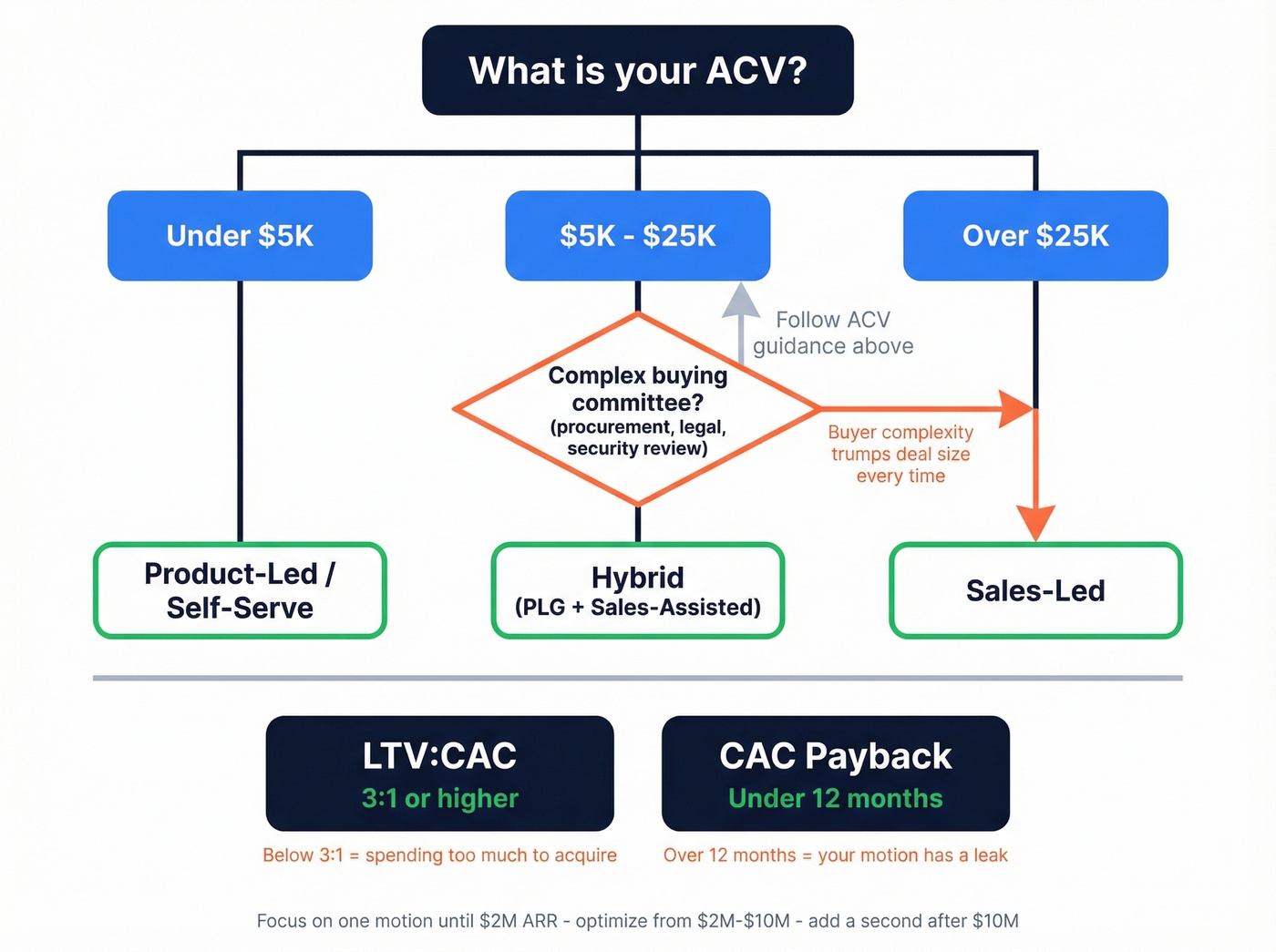
The decision starts with ACV. If your average deal is under $5K, you can't afford a rep touching every deal - go product-led or self-serve. Between $5K and $25K, a hybrid motion works: PLG for acquisition, sales-assisted for expansion and enterprise upsells. Above $25K, you need a sales-led approach. But if your buyer has a complex purchasing committee - procurement, legal, security review - go sales-led regardless of deal size. Buyer complexity trumps deal size every time. A $12K deal that requires a security questionnaire and three sign-offs will eat your team alive on a PLG motion.
Two metrics serve as your health check. LTV:CAC should be 3:1 or higher - anything below means you're spending too much to acquire customers relative to what they're worth. CAC payback should be under 12 months - if it takes longer than a year to recoup acquisition costs, your motion has a leak. These aren't aspirational targets. They're table stakes for a scalable GTM.
The scaling path looks like this: from $0-$2M ARR, run one motion and learn everything about it. From $2M-$10M, optimize that motion - don't add complexity. From $10M-$50M, consider adding a second. PLG companies add enterprise sales; SLG companies add self-serve. We've seen teams try to run inbound, outbound, and PLG simultaneously at $1M ARR. They end up doing all three poorly instead of one well.
Most companies layer on a second GTM motion too early. If your first one isn't hitting the core health metrics, a second motion won't save you - it'll split your team's focus and double your diagnostic surface area. Fix the first one or admit it's the wrong motion entirely.

Outbound motions live or die on data quality. Cold email reply rates of 1-5% assume your emails actually land. Prospeo delivers 98% email accuracy with a 7-day refresh cycle, so your SDRs spend time selling - not bouncing. Teams using Prospeo book 35% more meetings than Apollo users.
Fix your outbound motion at the source - start with verified data.
Building a Repeatable Motion
Founder-Led Phase
Every repeatable motion starts with the founder selling. Not because founders are great salespeople - most aren't - but because the feedback loop between product, market, and customer needs to be as tight as possible in the early days. Run 30-50 opportunities yourself before you hire anyone. Document what works: which personas respond, which objections kill deals, which channels produce pipeline.
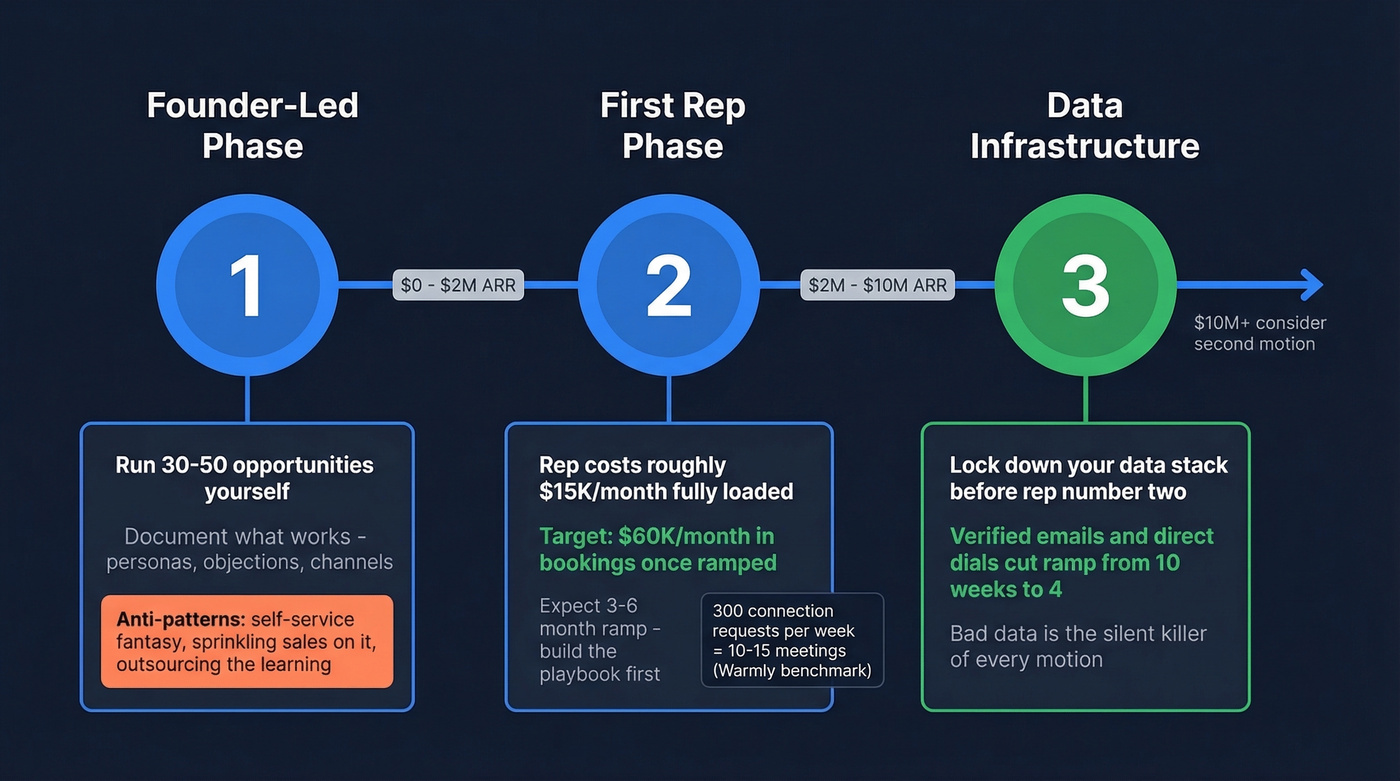
The anti-patterns are well-documented. The "self-service fantasy" - assuming docs and a signup page will do the selling - kills startups that need feedback to iterate. "Sprinkling sales on it" - hiring one rep before you understand the motion - wastes six months and $90K. Don't outsource the learning.
First Rep Phase
A sales rep costs roughly $15K/month fully loaded. They should generate $60K/month in bookings once ramped. If the math doesn't work, the motion isn't ready for a rep - it's still a founder problem.
Warmly provides a useful benchmark here. They went from zero to 100+ paying customers after a pivot, targeting $10-15K ACV deals with a 30-45 day sales cycle. Their outbound engine ran on 300 connection requests per week, with roughly half accepting and one-eighth replying, producing 10-15 meetings per week from a single channel. That's a clear signal the motion was repeatable before they scaled headcount.
Ramp risk is real. Poor onboarding can push rep ramp from 3 months to 6+. That's $45K-$90K in salary before the rep is productive. Build the playbook before you hire.
Data Infrastructure
Before you hire your second rep, lock down your data stack. Bad data is the silent killer of every motion - outbound sequences that bounce, enrichment that returns stale titles, phone numbers that ring dead lines. This is where we've seen the biggest gap between teams that scale smoothly and teams that stall. GreyScout cut rep ramp time from 8-10 weeks to 4 weeks after deploying Prospeo for verified emails and direct dials - that's the difference infrastructure makes.
Mistakes That Break Sales Motions
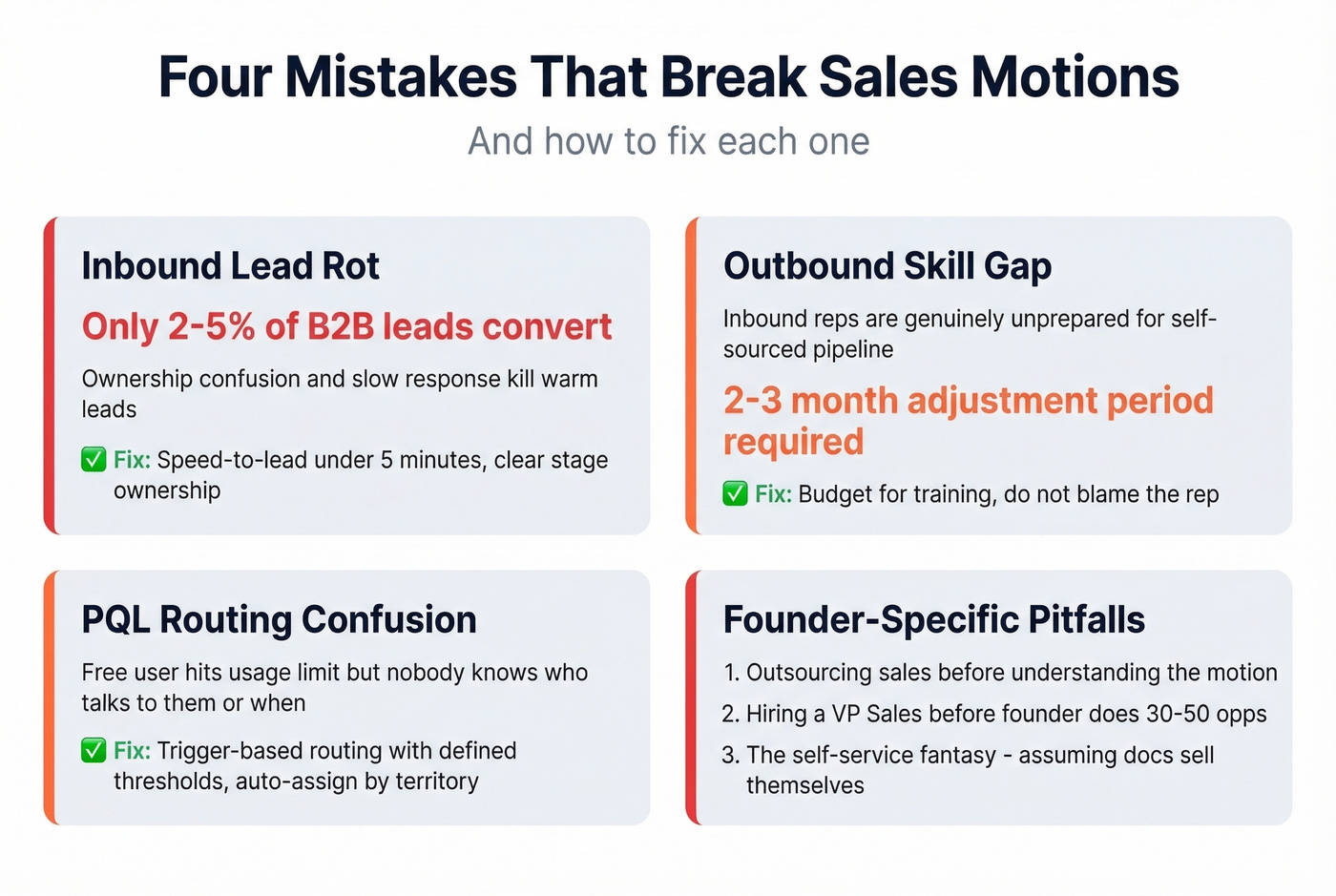
Inbound Lead Rot
The most common inbound failure isn't lead quality - it's ownership confusion. Marketing generates the lead, but sales doesn't respond for days. Prospects end up chasing reps for quotes. The fix is simple: define an SLA with speed-to-lead under 5 minutes, assign clear ownership at each stage, and measure response time as a KPI. Only 2-5% of B2B leads convert to customers. You can't afford to waste the ones that raise their hand.
The Outbound Skill Gap
Look, reps who've spent their careers working inbound leads are genuinely unprepared for self-sourced pipeline. Outbound is a different muscle - sales prospecting, sequencing, handling cold objections, managing rejection volume. If you're shifting to an outbound motion, budget for training and expect a 2-3 month adjustment period. Don't blame the rep when the real problem is a motion change without a skill change.
PQL Routing Confusion
A free user hits their usage limit on your product. They're clearly interested. But who talks to them, and when? Most PLG companies don't have a clean answer. Build trigger-based routing: when a user hits a defined threshold - usage limit, team invite, API call volume - auto-assign to a rep based on territory or account ownership. Round-robin within segments for unowned accounts.
Founder-Specific Pitfalls
Three mistakes kill early-stage GTM motions before they have a chance to work. First, outsourcing sales too early - hiring a VP of Sales or an agency before the founder has personally closed 30+ deals means you're delegating a process nobody understands yet. Second, starting with too large a market segment. Targeting "all mid-market SaaS" when you should be targeting "Series A fintech companies with 50-200 employees" dilutes your messaging and your data.
Third - and this is the one that quietly destroys startups - mistaking a pilot for a customer. A pilot is an experiment. A customer has signed a contract, paid money, and integrated your product into a workflow. Treating pilots as closed-won inflates your pipeline and masks a broken motion.
Bad Data Breaks Every Motion
Your SDR team is burning through 500 emails a day. Half bounce. Your sequences tank, your domain reputation craters, and your reps lose confidence in the tools. This is the most common and most preventable motion failure.
Snyk's 50 AEs were prospecting 4-6 hours per week with 35-40% bounce rates. After switching to Prospeo, bounce dropped to under 5%, AE-sourced pipeline jumped 180%, and the team generated 200+ new opportunities per month. That's not a tool upgrade - it's a motion rescue.
Benchmarks That Prove It's Working
Numbers without context are useless. Here's what "good" looks like for each motion type.
| Metric | PLG Benchmark | SLG Benchmark | What "Good" Looks Like |
|---|---|---|---|
| Free-to-paid conversion | 2-5% | N/A | Above 5% is excellent |
| PQL-to-customer | 20-40% | N/A | Below 20% = routing issue |
| Lead-to-opportunity | N/A | 15-30% | Below 15% = qualification gap |
| Opp-to-close rate | N/A | 20-40% | Below 20% = demo/proposal issue |
| Sales cycle | 40-84 days | 90-180+ days | Match to ACV band |
| CAC payback | Under 12 months | Under 12 months | Over 18 months = red flag |
| Quota attainment | N/A | Above 70% | Below 50% = motion is broken |
| NDR | Above 110% | Above 110% | Above 140% = elite |
| Outbound reply rate | N/A | 1-5% | Below 1% = data/messaging issue |
In our experience, teams that hit the core economics benchmarks - CAC payback and LTV:CAC - rarely have motion problems. They have scaling problems. That's a much better problem to have.
If your CAC payback is over 18 months and your NDR is below 100%, no amount of hiring will fix the motion. You've got a structural problem - either your ACV is too low for your sales cost, or your product isn't retaining well enough to justify the acquisition spend. Start by auditing your ACV-to-motion fit using the decision framework above.
AI and the Future of Sales Motions
Traditional reps spend 20-30% of their time on revenue-generating activities. With AI handling CRM updates, call notes, pipeline admin, and research, that number can hit 70-80%. Owner, a ~$10K ACV company, reported a 25-30% productivity lift from AI automation alone.
The SaaStr prediction that CROs will manage 50/50 human-AI teams by end of 2026 is bold. The reality is more grounded: only about 2% of companies are successfully implementing AI SDRs right now. Most attempts are hands-off experiments that produce spam at scale. Gartner's research on AI in sales confirms the gap between hype and execution remains wide.
Let's be honest: AI won't fix a broken motion. It'll scale the brokenness faster. If your targeting is off, AI will send bad emails faster. If your qualification criteria are wrong, AI will route bad leads more efficiently. Get the motion right first, then let AI amplify it. Forrester's B2B buying research backs this up - the fundamentals of buyer alignment still drive outcomes, regardless of the tools.
Running a sales-led or hybrid motion with 6+ stakeholders per deal? Prospeo's 300M+ profiles and 125M+ verified mobiles let you multi-thread into any buying committee. Use 30+ filters - intent data, job changes, headcount growth - to find the right contacts before your competitor does.
Stop losing enterprise deals because you can't reach the full committee.
FAQ
What's the difference between a sales motion and a sales process?
A sales process is the step-by-step sequence - prospect, qualify, demo, close. A sales motion is the strategic layer above it, combining process, methodology, and GTM approach based on your ACV and buyer behavior. The process is the "what"; the motion is the "how and why."
How many sales motions should a startup run?
One - until you hit $2M ARR. Optimize that single motion until $10M, then consider adding a second. Running multiple motions prematurely makes it impossible to diagnose what's working and doubles your diagnostic surface area.
How do you measure if a sales motion is working?
Track CAC payback (under 12 months) and LTV:CAC (above 3:1) first. Then layer in net dollar retention - above 110% means your expand and renew motions are healthy. Below 100% NDR signals a structural retention problem no amount of new pipeline can fix.
What tools do you need for an outbound sales motion?
A verified contact database for accurate emails and direct dials, a sequencing platform (Outreach, Salesloft, or Instantly), and a CRM. Data quality matters more than tool count - 98% email accuracy and weekly data refreshes prevent the bounce-rate spirals that destroy outbound motions.
Can you share some sales motion examples?
Slack's PLG motion lets users adopt organically, then sales steps in at a team-size threshold. Snowflake runs classic enterprise field sales with solution engineers and multi-threaded buying committees. HubSpot pioneered a hybrid - inbound content generates leads, freemium captures self-serve users, and AEs close mid-market deals. Each maps to the ACV and buyer-complexity framework above.