

Sales Orchestration: What It Is, What It Costs, and How to Build It Right
Your SDR team just ran a 5,000-contact outbound sequence. 800 bounced. 200 went to people who'd left their companies six months ago. Your domain reputation took a hit, and your "orchestration platform" dutifully orchestrated all of it - the bad data, the wasted touches, the sender score damage. That's not sales orchestration. That's automated failure at scale.
The Short Version
Sales orchestration coordinates data, signals, and workflows across your revenue team so every buyer interaction is timely and contextual. Most teams don't need a $100k platform. They need clean data, a routing layer, and two or three execution tools. Start with data quality, add signal aggregation, then layer automation.
What Does Sales Orchestration Actually Mean?
The term means different things depending on who's selling you what.
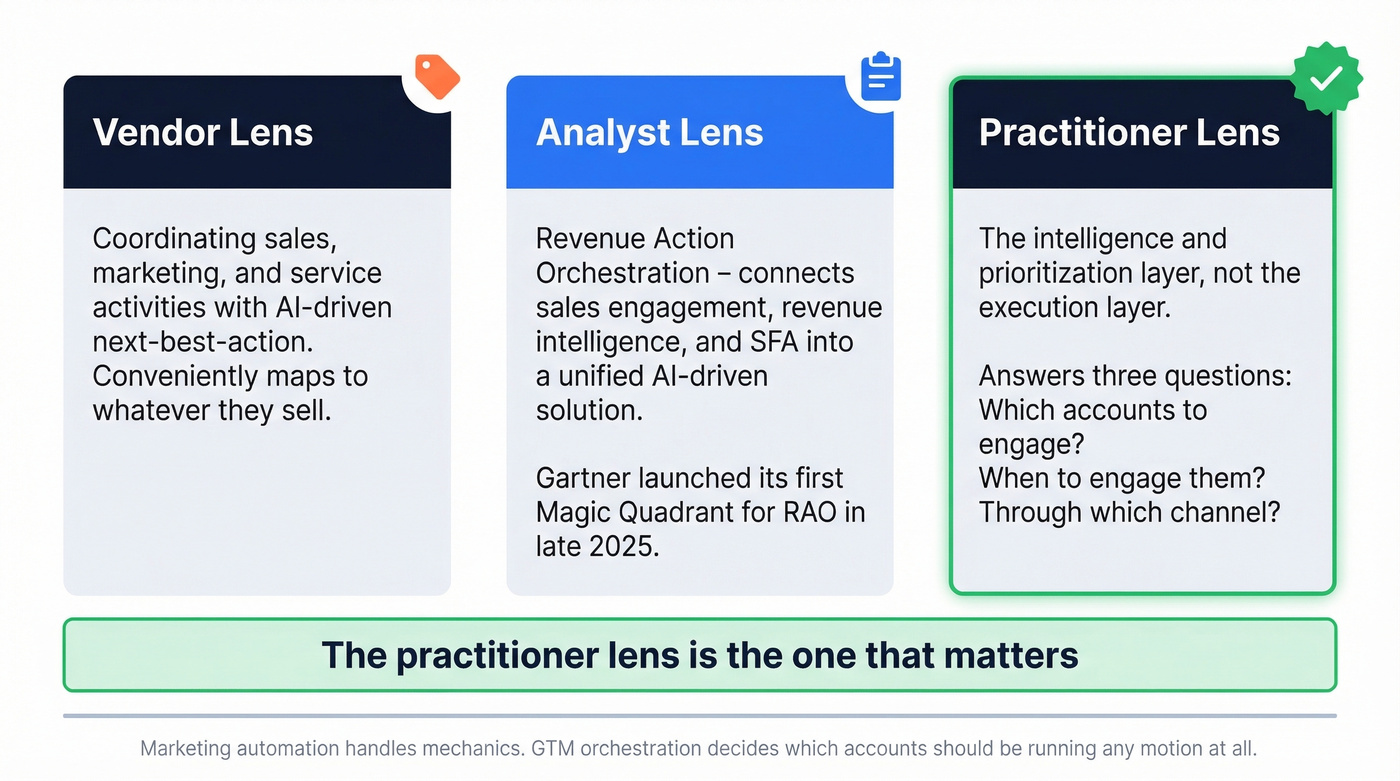
The vendor lens: Oracle defines it as coordinating "sales, marketing, and customer service activities" to guide buyers through each stage with AI-driven next-best-action recommendations. Every vendor's definition maps to whatever they sell. Funny how that works.
The analyst lens: Gartner launched its first-ever Magic Quadrant for Revenue Action Orchestration (RAO) in late 2025. In Gartner's framing, RAO connects previously siloed capabilities across sales engagement, revenue intelligence, and SFA markets into a unified, AI-driven solution. The analyst community now treats orchestration as a distinct category, not a feature of something else.
The practitioner lens - the one that matters. On r/sales and r/RevOps, the consensus is sharp: orchestration is the intelligence and prioritization layer, not the execution layer. One practitioner summed it up well: "Most marketing automation platforms have added an intent data tab and called it orchestration. That's not orchestration." Real orchestration answers three questions before any sequence fires - which accounts to engage, when to engage them, and through which channel.
Here's the boundary that trips people up: marketing automation handles mechanics like scheduling, nurturing, and time-delay triggers. GTM orchestration decides which accounts should be running any motion at all, based on actual behavioral signals. The orchestration layer sits between them - the system that makes your selling motions intelligent rather than just automated.
Why It Matters in 2026
Four catalysts converged in 2025-2026 to push orchestration from "nice to have" to table stakes.
Agentic AI. Agents now execute complex, multi-step workflows autonomously - routing, personalization, real-time response. This isn't AI that suggests. It acts.
Signal density shift. First-party intent data is replacing spray-and-pray. Teams that aggregate signals from multiple sources have a structural advantage over those relying on a single vendor's intent feed.
Compliance tightening. TCPA enforcement and evolving privacy regulations mean you can't blast lists anymore. Orchestration provides the governance layer that keeps your outbound legal and your domains healthy.
Platform convergence. Sales tech consolidation is accelerating, and platforms are bundling engagement, intelligence, and workflow capabilities into single products.
Research consistently shows that companies with poor sales-marketing alignment lose 10%+ in annual revenue, while those with strong alignment see 20%+ growth. Many sellers juggle 10+ tools across their workflow, creating more friction than they solve. Gartner's first RAO Magic Quadrant legitimized what practitioners already knew: the market demands unified systems, or at least systems that talk to each other.
What Orchestration Delivers
A Forrester TEI study commissioned by Salesloft modeled a composite $7B enterprise with a 1,500-person revenue org over three years: 3.3x ROI, 12% higher close-won rates, 50% higher conversion from engagement to opportunity, and $1.3M in savings from tool consolidation. Reps saw 40% more selling activity without adding headcount. Teams typically reclaim 5-10 hours per rep per week through reduced admin and context switching.
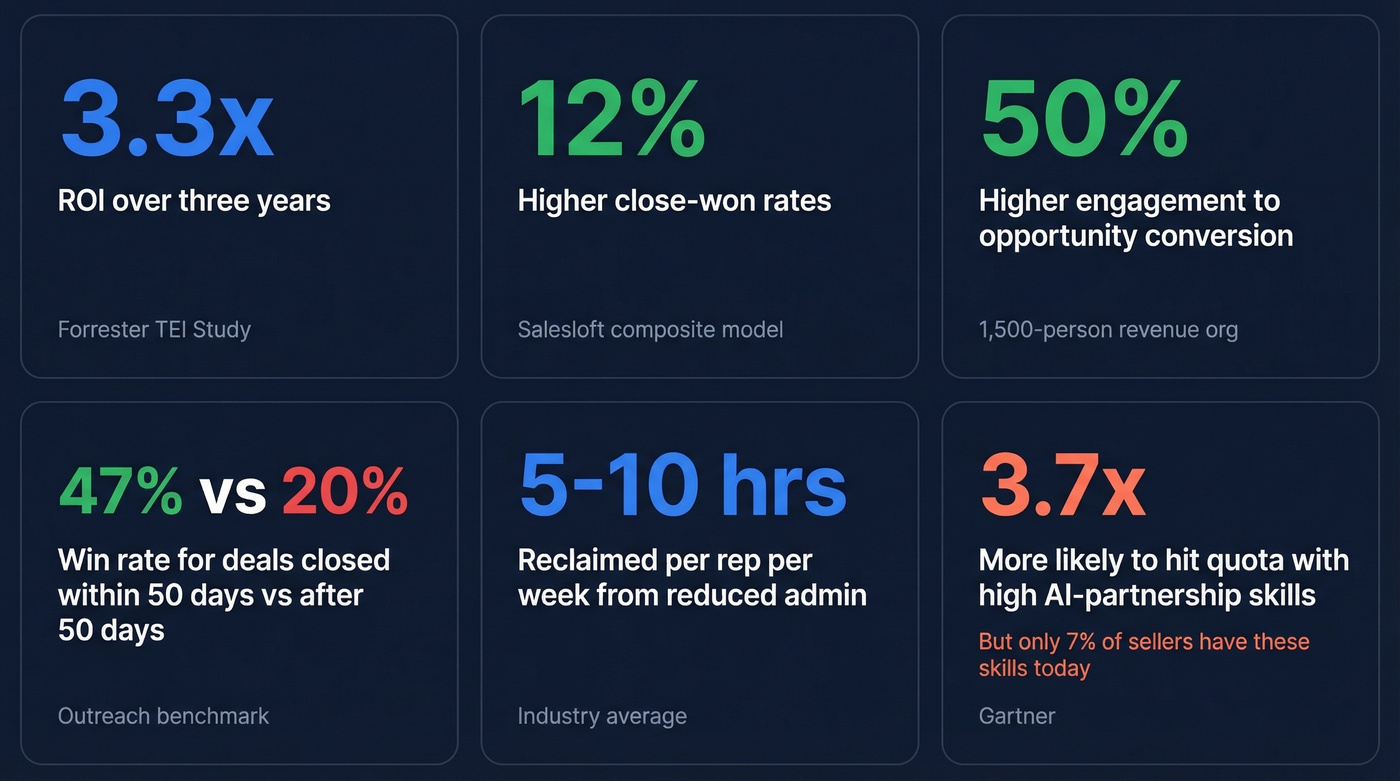
Outreach's data adds cycle-time context. Opportunities closed within 50 days carry a 47% win rate. After 50 days, that drops to 20% or lower. Their AI coaching assistant closes deals 11 days faster on average with up to a 10-point win-rate lift on deals over $50K.
The uncomfortable stat nobody talks about enough: Gartner found that sellers with high AI-partnership skills are 3.7x more likely to hit quota. But only 7% of sellers currently have those skills. The tools are getting smarter faster than the teams using them. Platforms that include coaching and enablement aren't a luxury - they're closing the capability gap.
5 Components of an Orchestration Stack
Every orchestration stack - whether it's a $150k enterprise platform or a $5k DIY build - has five layers. Skip one and the whole thing underperforms.
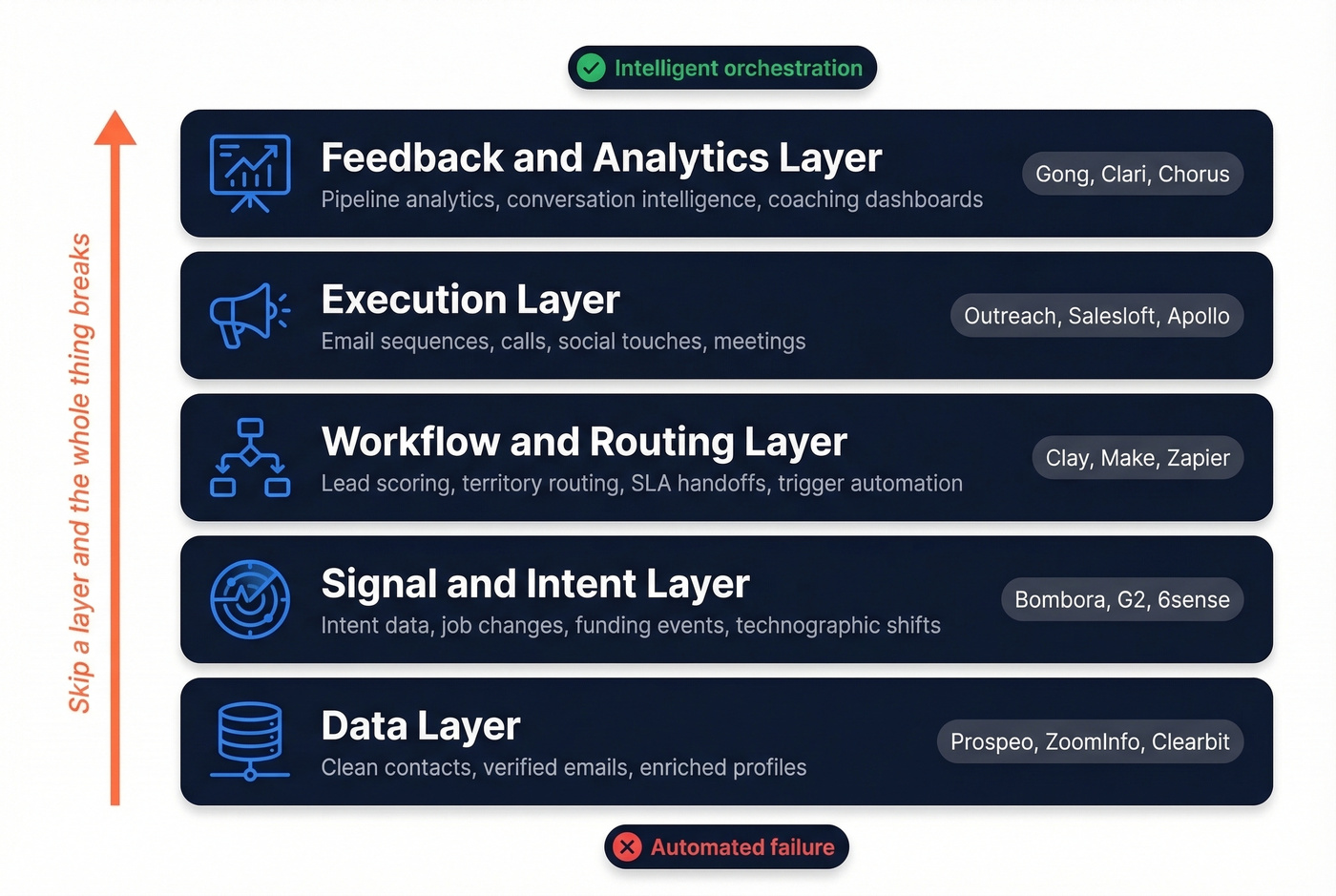
Data Layer
Your stack is only as good as the data feeding it. Stale emails and wrong numbers poison every automated sequence downstream. Reps spend just 28% of their time actually selling - bad data makes that worse by generating bounces, wrong-person conversations, and hours of manual cleanup.
We've seen this firsthand with teams migrating from other providers: bounce rates of 35-40% that drop to under 5% once the data foundation is fixed. Prospeo anchors this layer with 300M+ professional profiles, 98% email accuracy, and a 7-day refresh cycle at roughly $0.01 per email. Its 5-step verification process includes catch-all handling, spam-trap removal, and honeypot filtering - so every sequence starts with contacts that actually exist at their current companies.
Signal and Intent Layer
Raw data isn't enough. You need to know which accounts are actively researching solutions. This layer aggregates behavioral signals from intent providers, website visits, job changes, funding events, and technographic shifts. The goal: answer "who should we talk to right now?" before a rep ever opens their sequencer.
Workflow and Routing Layer
This is where logic lives. Lead scoring, territory routing, SLA-based handoffs between SDRs and AEs, and trigger-based automation. Companies that respond within 5 minutes see conversion rates jump 8x versus waiting 5-24 hours - and the average B2B response time is still 42 hours. That gap is where deals die. Clay, Make, or Zapier handle this for mid-market teams. Enterprise platforms bake it in.
Execution Layer
Multichannel outreach - email sequences, calls, social touches, meetings. Outreach, Salesloft, Apollo, and similar tools operate here. Most people think of this as the orchestration layer, but without the layers beneath it, you're just sending emails faster to the wrong people.
Feedback and Analytics Layer
Pipeline analytics, conversation intelligence, coaching dashboards. This layer turns orchestration from a one-way broadcast into a learning system. Without feedback loops, you can't identify bottlenecks, improve sequences, or close the gap between your best and worst reps.

You read the stat: bounce rates of 35-40% that drop to under 5% when the data foundation is fixed. Prospeo's 7-day refresh cycle, 5-step verification, and 300M+ profiles ensure your orchestration stack never automates failure. At $0.01 per email with 98% accuracy, your sequences start clean.
Stop orchestrating bad data. Start with contacts that actually exist.
What Buyers Actually Want
We've watched dozens of orchestration demos. The pattern is predictable: slick UI, vague intent heatmaps, and a sequence builder that looks like every other sequence builder. Reddit threads match our experience - "Every vendor claims to be a GTM platform but it's usually a sequence tool with a prettier dashboard and an intent feed nobody explains clearly."
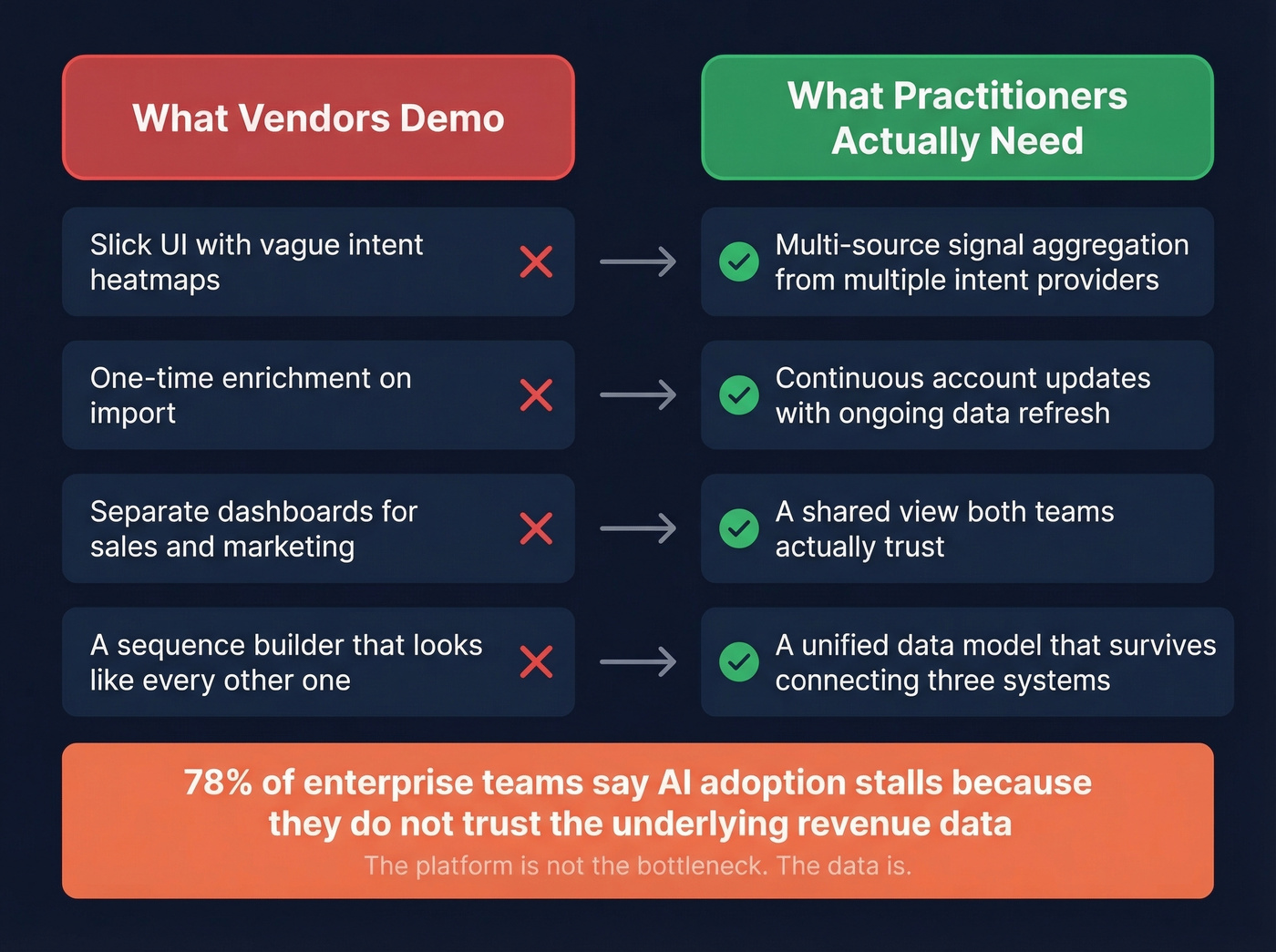
What practitioners actually need is straightforward but rare:
- Multi-source signal aggregation - not just one vendor's proprietary intent feed. Single-source intent is a guess. Multi-source intent is a signal.
- Continuous account updates - not enrichment on import, but ongoing refresh. B2B contact data decays fast, and one-time enrichment is a depreciating asset.
- A shared sales and marketing view that both teams will actually trust, not two dashboards telling different stories.
- A unified data model that doesn't fall apart when you connect three systems.
78% of enterprise teams say AI adoption stalls because they don't trust the underlying revenue data. The platform isn't the bottleneck. The data is. Fix the foundation before you buy the penthouse.
Tools Compared for 2026
| Tool | Category | G2 Rating | Pricing Range | Best For |
|---|---|---|---|---|
| Prospeo | Data & enrichment | - | ~$0.01/email, free tier | Data foundation |
| Apollo.io | Full-stack SEP | 4.7/5 | Free-$79/user/mo | SMB/mid-market all-in-one |
| Gong | Revenue intelligence | 4.8/5 | $5K-$50K/yr + ~$1,400/user/yr | Coaching & deal analytics |
| Salesloft | SEP + revenue | 4.5/5 | ~$1,200-$1,800/user/yr | Mid-market to enterprise |
| Outreach | SEP + AI coaching | 4.3/5 | ~$1,200-$1,800/user/yr | Enterprise sequences |
| Clari | Revenue platform | 4.5/5 | ~$30K-$100K+/yr | Pipeline forecasting |
| 6sense / Demandbase | ABM + intent | 4.3-4.4/5 | ~$30K-$100K+/yr | Enterprise ABM |
| HubSpot Ops Hub | CRM + ops | 4.4/5 | Free-$2K/mo | HubSpot-native teams |
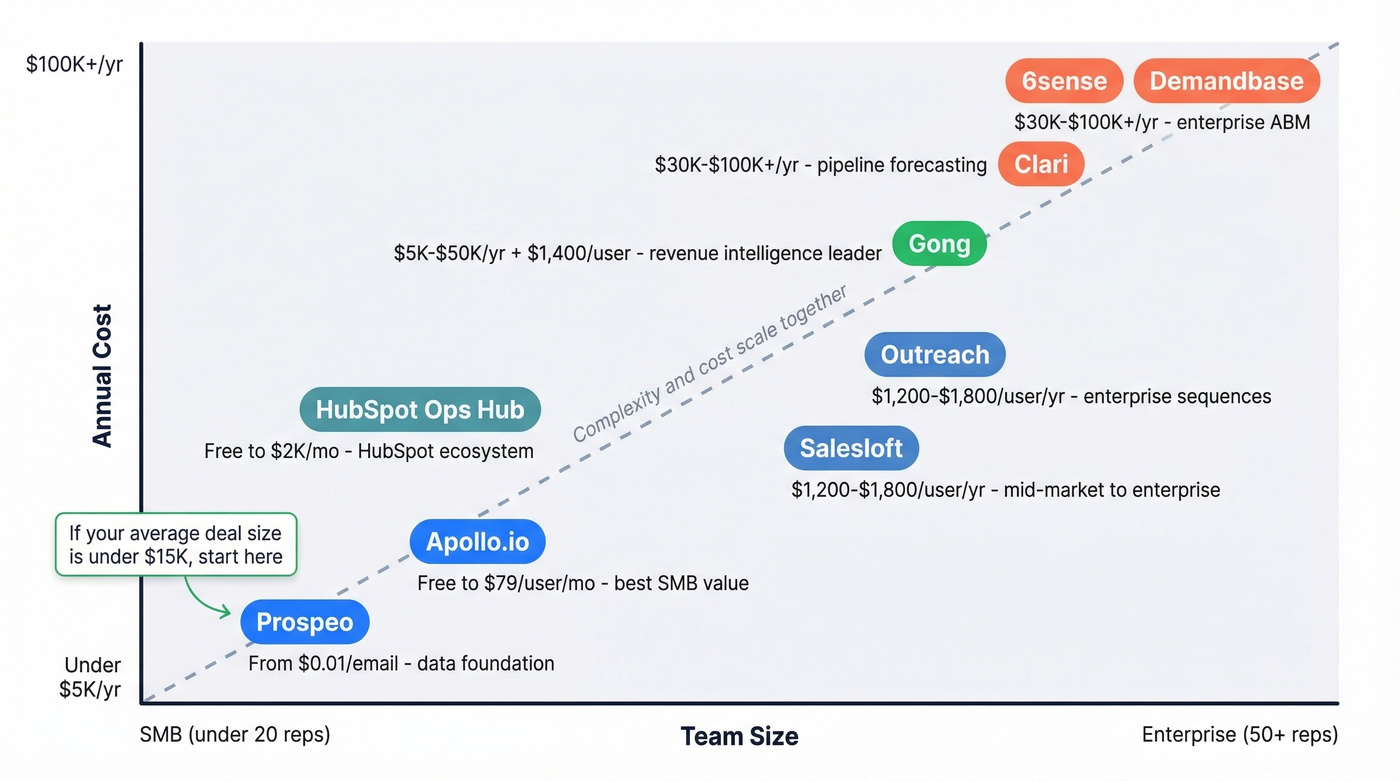
Apollo.io is the obvious starting point for SMB and mid-market teams. The free tier gets you in the door, and paid plans at $49-$79/user/month give you a database, sequencer, and basic intent signals in one platform. It won't match Outreach's enterprise workflow depth, but for teams under 20 reps, it's hard to beat on value.
Gong leads on revenue intelligence. With the RAO Magic Quadrant naming it a Leader, it's positioning as a full orchestration platform. Expect a $5K-$50K/year platform fee plus roughly $1,400/user/year. Worth it if coaching and deal visibility are your primary gaps.
Salesloft vs. Outreach is the perennial question. Salesloft's Forrester TEI numbers are strong, and the Drift acquisition adds conversational marketing. Outreach's cycle-time benchmarks and AI coaching are compelling. Both run ~$1,200-$1,800/user/year. Pick based on your existing tech stack and which workflow your team will actually adopt.
Let's be honest: if your average deal size is under $15k, you probably don't need Salesloft, Outreach, or Gong. Apollo plus a solid data layer will get you 80% of the results at 20% of the cost. Save the enterprise tooling for when you have the deal complexity and team size to justify it.
Clari, 6sense, and Demandbase are enterprise plays at $30K-$100K+/year. Skip these if your team is under 50 reps or your ACV is under $25k - you'll spend more time configuring them than selling. HubSpot Operations Hub is the accessible entry point if you're already in that ecosystem, but its orchestration depth is limited compared to purpose-built tools.
How Much Does It Cost?
License cost is 40-60% of your true year-one cost. The rest is implementation, ops headcount, and ongoing maintenance.
SMB/startup (under $5K/year): Apollo's free or Basic tier handles sequencing and basic data. Pair that with Prospeo for verification and enrichment - 98% accuracy and a 7-day refresh cycle versus the 6-week industry average. Add Make or Zapier for routing. Total: under $5K/year for 80% of the value.
Mid-market ($25K-$80K/year license): Salesloft or Outreach as the execution layer, plus a dedicated RevOps hire ($80K-$120K salary) to manage the stack. Intent data from Bombora or 6sense adds $15K-$30K. Total loaded cost: ~$120K-$250K/year including headcount.
Enterprise ($80K-$100K+ license alone): Full RAO platform, $20K-$100K in implementation services, a dedicated ops team. Reddit threads consistently flag the sticker shock: "$50K minimum, most quoting $80-100K once you added features" - and that's before six months of services, a dedicated ops person, and constant maintenance.
Here's the thing: mid-market teams don't need propensity scores and 50 different attribution models. They need clean data, aggregated signals, and automated workflows. Right-size the stack before you right-size the budget.
How to Implement It
Enterprise platforms take 3-6 months. A right-sized stack takes 6-12 weeks.
Phase 1 - Data Foundation (Weeks 1-3). Audit your CRM. How many contacts have valid emails? Current job titles? Working phone numbers? Enrich and verify your existing database before adding any automation. If your bounce rate is above 5%, nothing else matters until you fix it.
Phase 2 - Routing and Scoring (Weeks 4-8). Connect your data sources. Build lead scoring based on firmographic fit and intent signals. Set up routing logic: form submit triggers a webhook, enrichment runs in roughly 30 seconds, routing assigns the lead, and a Slack notification hits the rep with a research brief within minutes. One team we worked with cut their average lead response time from 4 hours to under 3 minutes with this exact flow.
Phase 3 - Execution and Feedback (Weeks 8-12). Activate multichannel sequences. Enable AI coaching if your platform supports it. Build dashboards showing pipeline velocity, conversion by source, and rep activity. The feedback loop separates orchestration from automation - without it, you're running sequences blind.
Sales orchestration needs all five layers working together - and the data layer is where most stacks quietly break. Prospeo combines verified emails, 125M+ mobile numbers with 30% pickup rates, and intent data across 15,000 topics so your routing and execution layers have something real to work with.
Every orchestration layer above your data inherits its quality. Make it count.
The Future: Agentic Orchestration
EY, Snowflake, and Canva announced an agentic sales orchestration platform in early 2026, targeting enterprise AI fragmentation. The trajectory is clear: workflow automation to AI-assisted orchestration to fully autonomous agent orchestration. Deal orchestration - the ability to coordinate every touchpoint within a single opportunity from first meeting to signed contract - is emerging as the next frontier.
About 45% of teams now use a hybrid AI-SDR model, but full autonomy is still early. The gap isn't technology. It's trust and data quality.
The ultimate promise of agentic orchestration is closing deals automatically - routing proposals, handling objections with AI-generated responses, and triggering contract workflows without manual intervention. We're not there yet, but the building blocks are falling into place faster than most teams realize.
Our closing take: you don't need a "sales orchestration platform." You need orchestrated sales. Map the buyer journey, clean the data, connect three tools with clear triggers. Buy the platform when you've outgrown the duct tape - not before.
FAQ
What's the difference between sales orchestration and sales automation?
Automation handles individual tasks - sending emails, logging calls, scheduling follow-ups. Orchestration designs the end-to-end system: which accounts to target, when to engage, through which channel, and how to hand off between teams. Automation is a component of orchestration, not a synonym for it.
How long does implementation take?
A right-sized stack takes 6-12 weeks. Enterprise revenue orchestration platforms typically require 3-6 months including professional services, integrations, and change management across the org.
What's the most important prerequisite?
Data quality - by a wide margin. If your contact records have stale emails and wrong phone numbers, orchestration just automates bad outreach at scale. Verify and enrich your database first with a tool that refreshes weekly, not monthly. Everything else depends on that foundation.