

How to Build a Sales Persona Your Team Will Actually Use
A RevOps lead we know documented nine personas last year. When we asked which one changed a single outreach decision, the answer was silence. That's the problem with most sales personas - they're strategy documents that never touch a pipeline.
Here's the thing: a persona that doesn't change how your reps prospect, sequence, or qualify is just a Google Doc collecting dust. We've watched teams spend weeks on persona workshops only to send the same generic emails the following Monday. What follows is a framework, filled-out templates, interview questions, and the step everyone skips - turning your persona into a verified prospect list.
What Is a Sales Persona?
A sales persona is a semi-fictional representation of the individual buyer your sales team targets. It captures their job title, strategic priorities, KPIs they're measured on, the objections they'll raise, and how they make purchasing decisions. Think of it as a cheat sheet that helps your reps speak the buyer's language from the first touchpoint.
There's a second meaning worth flagging. Some teams use the term to describe the seller archetype - how your reps sell, not who they sell to. That's the Challenger Sale framework, and we'll cover it later. For now, we're focused on the buyer side, because that's where the money is.
When your VP of Sales says "persona," make sure everyone in the room is talking about the same thing. Confusing the two derails entire planning sessions.
Sales Persona vs. Buyer Persona vs. ICP
These three terms get swapped around constantly, and it creates real confusion. The cleanest way to think about it, borrowed from HubSpot's framing: "Personas tell you who you're speaking to. ICPs tell you which companies are worth speaking to in the first place."
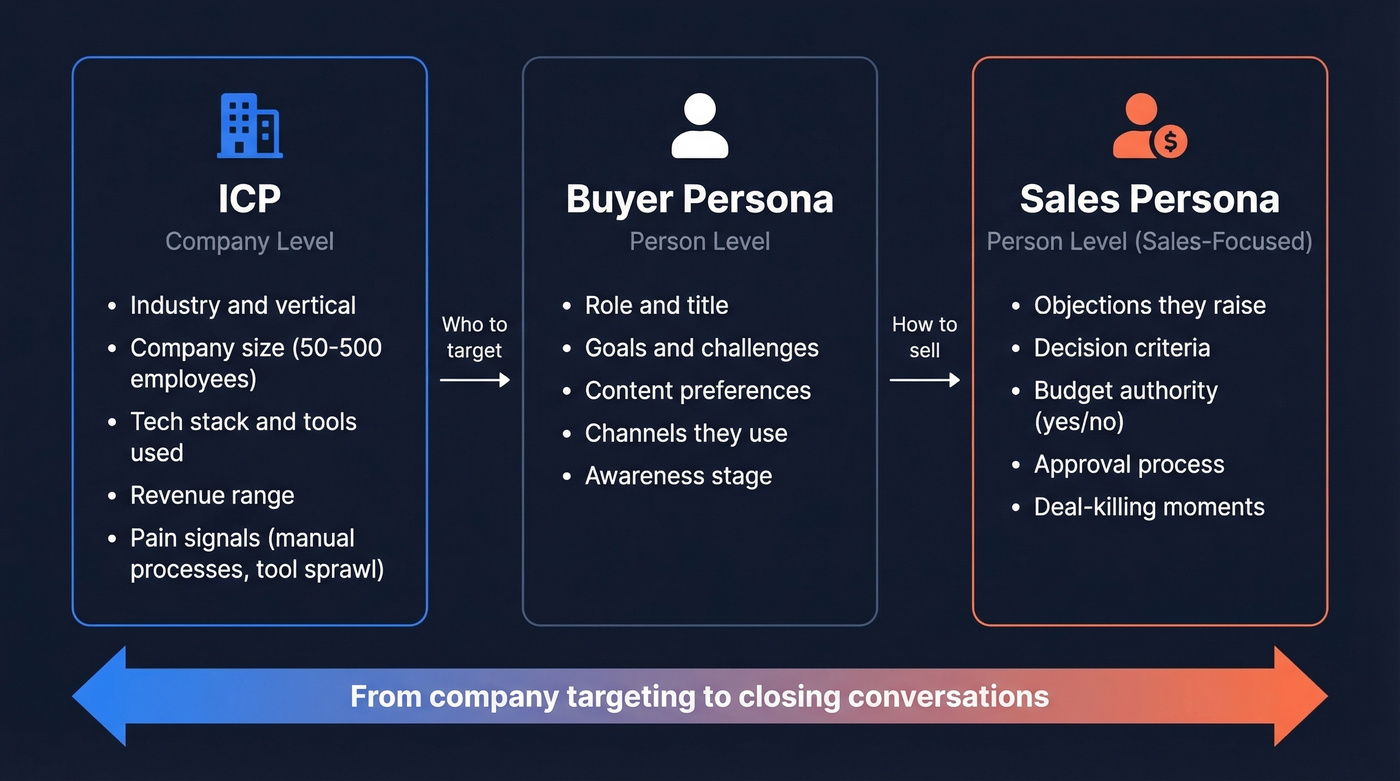
A concrete ICP example: 50-500 employees, uses 5+ disconnected tools, has dedicated ops teams, loses 10+ hours/week to manual data entry between systems. That's a company profile, not a person.
| ICP | Buyer Persona | Sales Persona | |
|---|---|---|---|
| Scope | Company-level | Person-level | Person-level (sales-focused) |
| Unit | Organization | Role/archetype | Role + buying behavior |
| Example fields | Industry, size, tech stack | Goals, challenges, channels | Objections, decision criteria, budget authority |
A buyer persona gets sharpened for outbound when it becomes a sales-specific persona. It emphasizes the fields your reps need on a call - objections, approval process, deal-killing moments - not the fields your content team uses for blog targeting.
Why Personas Drive Revenue
The business case isn't theoretical. McKinsey's personalization research found that 71% of buyers expect personalized interactions, and 76% get frustrated when they don't get them. Companies that personalize well see a 10-15% revenue lift on average, with top performers hitting 25%.
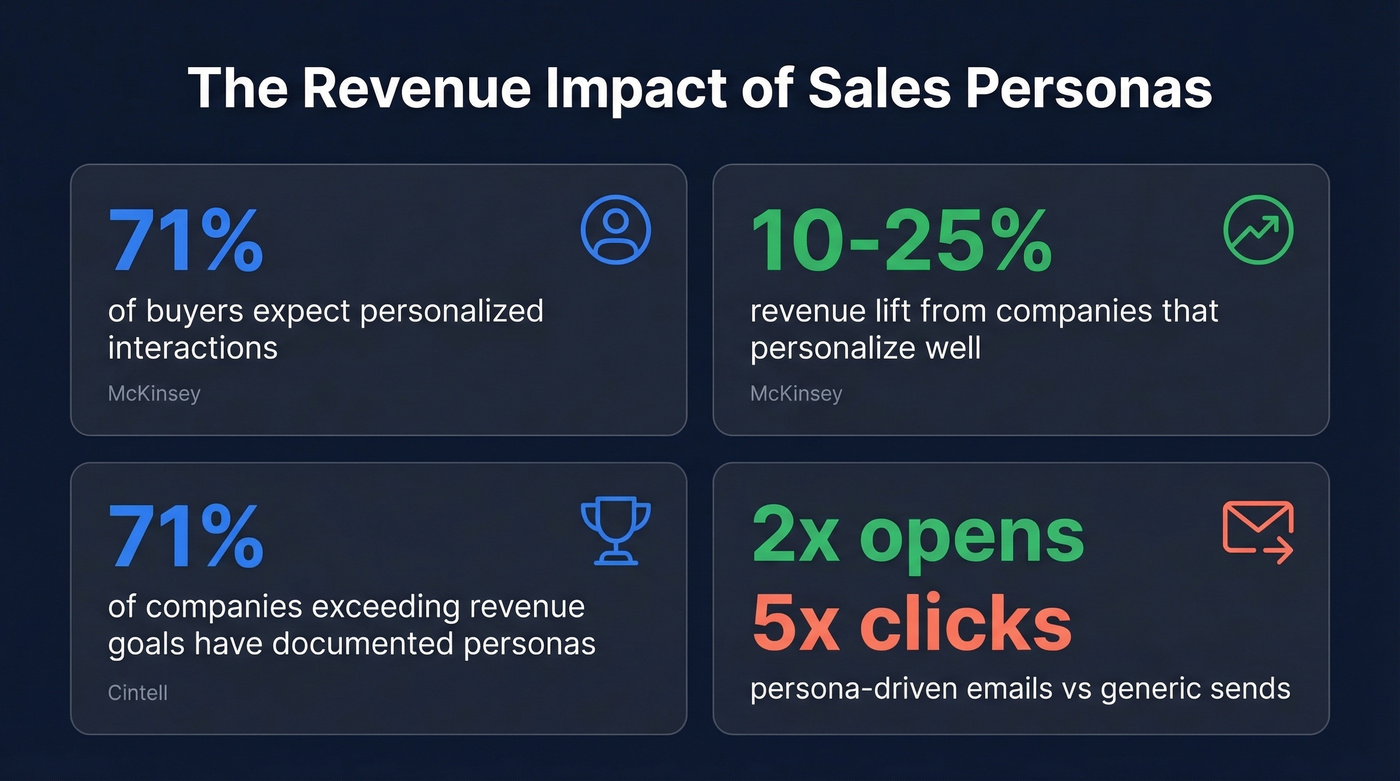
Personas are the engine behind that personalization. A Cintell study found that 71% of companies exceeding revenue and lead goals have documented personas, compared to just 37% of those merely meeting targets and 26% of those missing them. Persona-driven email campaigns see 2x open rates and 5x click-through rates versus generic sends.
The proof extends to individual companies. Intel built persona-driven campaigns that beat internal benchmarks by 75% and were 48% more cost-efficient. Thomson Reuters saw a 175% increase in marketing-attributed revenue after implementing persona-based programs. These aren't marginal improvements - they're the kind of numbers that get budget approved.
How to Create a Sales Persona in 5 Steps
Step 1: Start With Internal Interviews
Most companies interview customers first. That's backwards.
Your sales reps and account managers talk to buyers every day - they already know the objections, the deal-killers, and the questions that signal a prospect is serious. Sit down with your top three reps and your longest-tenured account manager. Ask them who their best customers are, what those people care about, and what makes a deal die. You'll get 80% of your persona in an hour. Customer interviews refine it; they don't create it from scratch. This methodology comes from the Clariant Creative framework, and it's the most efficient approach we've seen.
If you want a first draft faster, AI persona generators like HubSpot's Make My Persona or UXPressia can scaffold the structure. They can't replace the qualitative insight from your own team, though.
Step 2: Map the Buying Committee
B2B deals don't have a single buyer. They have a committee, and each role behaves differently. You need to identify at least these five:
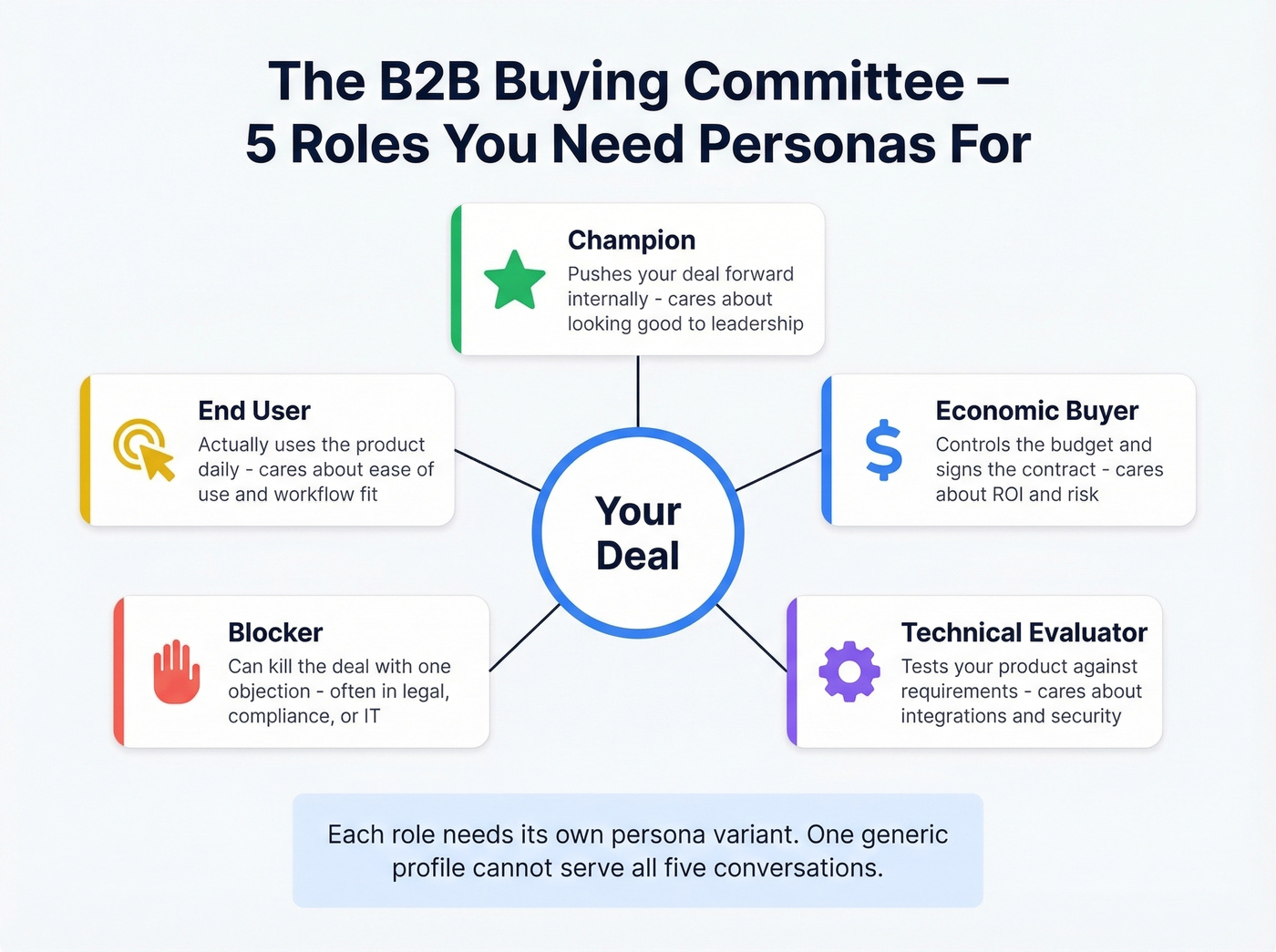
- Champion - the internal advocate who pushes your deal forward
- Economic buyer - controls the budget and signs the contract
- Technical evaluator - tests your product against requirements
- Blocker - the person who can kill the deal with a single objection
- End user - the person who actually uses the product daily
Each role needs its own persona variant. Your champion cares about looking good internally. Your economic buyer cares about ROI and risk. Your technical evaluator cares about integrations and security. One generic profile can't serve all three conversations, and that's exactly why buyer personas for sales need to be role-specific rather than one-size-fits-all.
Step 3: Fill In What Actually Matters
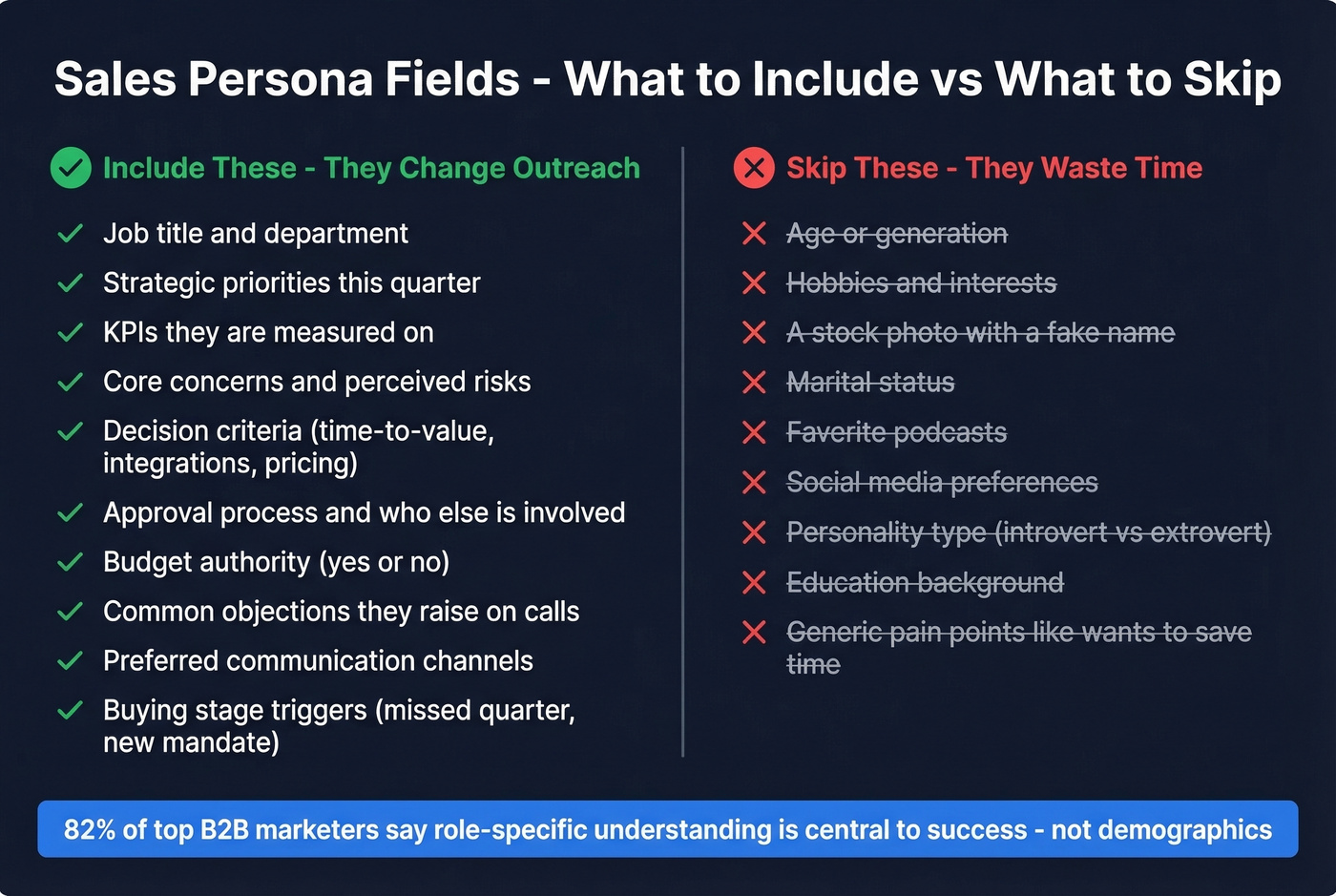
Stop giving your personas names and stock photos. "Marketing Mary, 34, loves hiking" tells your SDR nothing useful.
Zendesk identifies five persona types: demographic, journey-based, role-based, psychographic, and technographic. For sales teams, role-based and technographic personas deliver the most value because they map directly to outreach decisions. Demographic-only personas don't just waste time - they create blind spots by excluding buyers who don't fit a narrow profile but match your ICP perfectly.
Fields that belong in a sales persona: job title, department, strategic priorities, KPIs they're measured on, core concerns and risks, decision criteria, approval process, budget authority, common objections, preferred communication channels, and buying stage triggers.
Fields that don't: age, hobbies, a stock photo, marital status, or what podcasts they listen to. Those are B2C persona artifacts that have no place in a sales context. 82% of top-performing B2B marketers say role-specific audience understanding is central to their success - and "role-specific" means job function and buying behavior, not demographics.
Step 4: Build a Negative Persona
This is the step most teams skip, and it costs them pipeline quality. A negative persona defines who you don't want - the prospects who waste SDR time, never close, or churn within 90 days.
Per Lead Forensics' guidance, common negative persona traits include companies below your minimum deal size, roles without budget authority, industries where your product lacks fit, or prospects who are "just researching" with no timeline. Document these explicitly. Your SDRs will thank you when they stop chasing dead ends.
Step 5: Validate and Operationalize
Pull your last 20 closed-won deals. Does your persona match the actual buyer in at least 15 of them? If not, revise. A persona that doesn't reflect reality is fiction, and fiction doesn't close deals.
Once validated, share it with sales - not just marketing. SugarCRM's operational guidance recommends reviewing personas once a year at minimum, or immediately when you launch a new product or enter a new market. The biggest failure mode isn't building the wrong persona. It's building the right one and then letting it collect dust in a Google Doc nobody opens after the kickoff meeting.

Your sales persona maps the buyer. Prospeo finds them. Use 30+ filters - job title, department, buyer intent, tech stack, headcount growth - to turn every persona into a verified prospect list with 98% email accuracy.
Stop documenting personas that never touch your pipeline.
Interview Questions for Persona Research
Most guides don't give you actual questions to ask. Here are the ones that matter.
Role & Responsibilities
- What does a typical day look like in your role?
- What are you personally measured on?
- Who do you report to, and what do they care about most?
Goals & Challenges
- What's the biggest problem you're trying to solve this quarter?
- What would make you look like a hero internally?
- What's the most frustrating part of your current workflow?
Decision-Making Process
- When you've bought software before, what did the process look like?
- Who else is involved in the decision? Who can kill it?
- What's your typical budget approval process?
- How long does a purchase decision usually take?
Objections & Concerns
- What would make you hesitate to buy a solution like ours?
- What's gone wrong with past vendor purchases?
- What would your boss's biggest concern be?
Information Sources
- Where do you go to learn about new tools or solutions?
- Do you trust peer recommendations, analyst reports, or demos more?
- What content format do you actually consume - webinars, blogs, podcasts, none of the above?
These questions are curated from the Clariant Creative 38-question framework. You don't need all 38. You need the ones that map directly to outreach decisions.
Template and Example
Below is a filled-out example for a mid-market SaaS buyer, modeled after the SellingSignals template structure. Notice there's no stock photo, no hobbies, no "favorite social media platform."
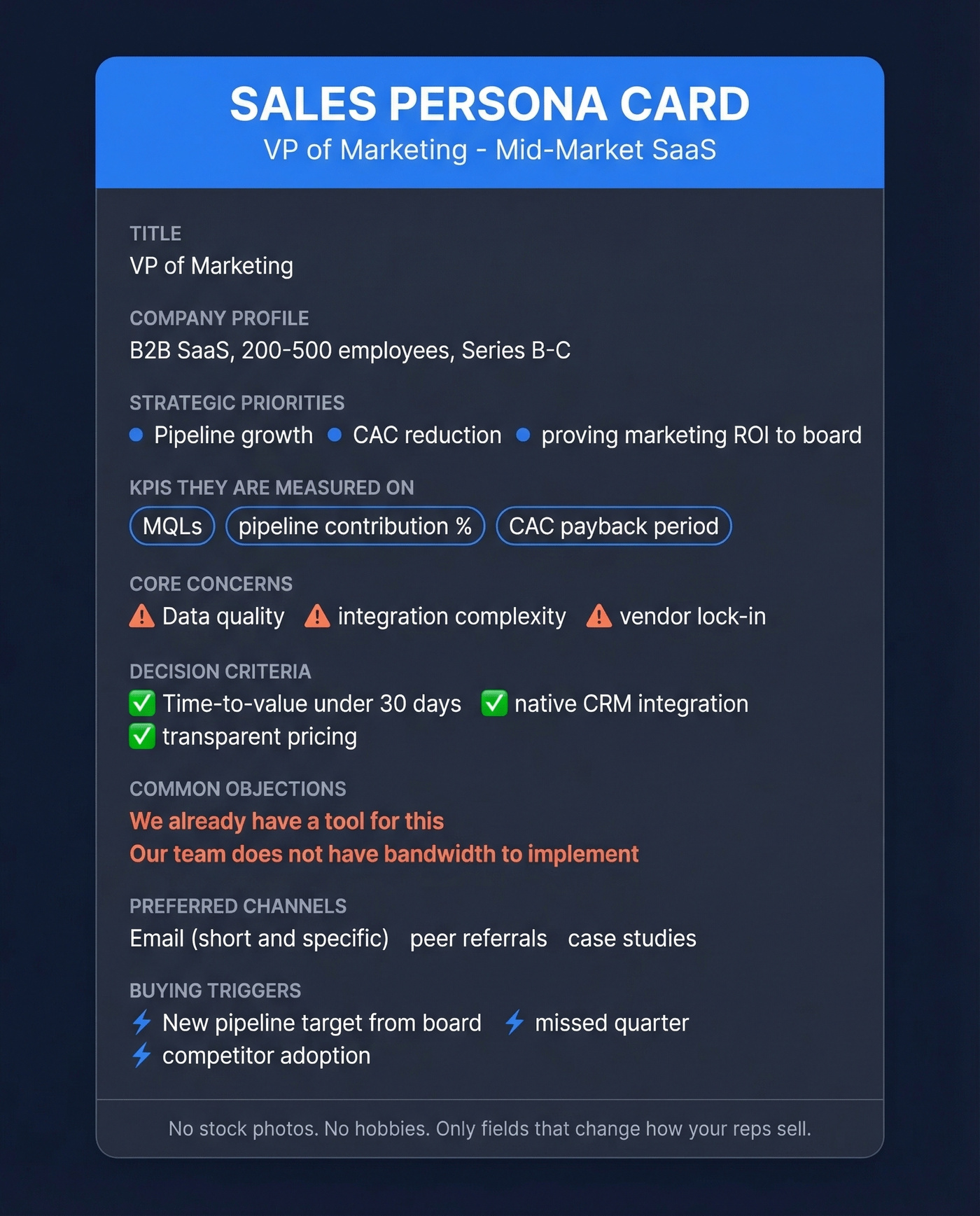
| Field | Example |
|---|---|
| Title | VP of Marketing |
| Company profile | B2B SaaS, 200-500 employees, Series B-C |
| Strategic priorities | Pipeline growth, CAC reduction, proving marketing ROI to board |
| KPIs | MQLs, pipeline contribution %, CAC payback period |
| Core concerns | Data quality, integration complexity, vendor lock-in |
| Decision criteria | Time-to-value under 30 days, native CRM integration, transparent pricing |
| Common objections | "We already have a tool for this," "Our team doesn't have bandwidth to implement" |
| Preferred channels | Email (short, specific), peer referrals, case studies |
| Buying triggers | New pipeline target from board, missed quarter, competitor adoption |
And a quick negative persona example: an individual contributor at a sub-20 person company with no budget authority, currently in a free trial of a competitor, and "just exploring options." Disqualify early. Your SDRs' time is worth more than a maybe.
Turn Your Persona Into Outbound Action
Every other persona guide stops at the template. You've got a beautiful document. Now what?
Your persona fields should map directly to outreach decisions. Job title becomes a search filter. Tech stack becomes a technographic filter. Growth signals become intent triggers. Objections become email copy angles. If your buyer persona document says "VP of Marketing at Series B SaaS companies using HubSpot," that's not a description - that's a search query.
Let's be honest about the scenario that kills pipeline: your SDR sends 500 cold emails based on a persona your marketing team built six months ago, the bounce rate is 34%, and half the titles are wrong. The persona wasn't the problem. The data was.
Prospeo bridges that gap. Its 30+ search filters map directly to persona attributes - job title, company size, industry, tech stack, buyer intent, headcount growth, funding stage - and the emails you export are 98% verified on a 7-day refresh cycle. The persona defines the filters. The platform applies them.

You've mapped the buying committee - champion, economic buyer, blocker. Now reach each one directly. Prospeo gives you 143M+ verified emails and 125M+ mobile numbers so your reps can run persona-specific sequences that actually connect.
Every role on the committee deserves a real phone number, not a guess.
Why Most Personas Fail
Seven mistakes we see repeatedly:
Built like B2C profiles. Demographics over decision criteria. If your persona includes "age 35-45, enjoys golf," you've built a dating profile, not a sales tool.
Created without talking to anyone. The Reddit community calls these "fairytale personas" - and they're right. They collect dust because they're fiction.
Never updated. A persona from six months ago reflects a market that no longer exists. Review annually at minimum, or when your product, pricing, or target market shifts.
Too many personas. Lead Forensics recommends no more than two or three active personas at a time. Nine personas means zero personas - one PM learned this the hard way when they couldn't point to a single decision their nine personas improved.
Marketing-only. If your sales team has never seen the persona, it doesn't exist for them. Share it in onboarding, pin it in Slack, reference it in pipeline reviews.
No negative persona. Without one, your SDRs waste cycles on prospects who'll never close.
Never operationalized. The persona exists, but it changes nothing about how you prospect, sequence, or qualify. A persona without verified contact data is a strategy document, not a pipeline tool.
Skip the 40-page playbook if your average deal size is under $15k. You need one sharp persona, a negative persona, and a data source that lets you act on both in under an hour.
Seller Archetypes: The Other Meaning
The second meaning of "sales persona" lives on the seller side. The Challenger Sale framework, based on CEB/Gartner research conducted in 2011 and repeated in 2020, identifies five seller profiles:
| Profile | Key trait | Why it matters |
|---|---|---|
| Challenger | Teaches, tailors, takes control | 54% of top performers fit this profile |
| Lone Wolf | Self-reliant, instinct-driven | Effective but hard to coach or scale |
| Hard Worker | High activity, coachable | Strong foundation, needs strategic direction |
| Problem Solver | Detail-oriented, reliable | Excels in complex, technical sales |
| Relationship Builder | Harmony-focused, generous | Only 7% of high performers - the least effective profile |
The headline stat: sales experience accounts for 53% of customer loyalty - more than brand, product, and price combined.
The Challenger framework is useful but overhyped. As RAIN Group's critique points out, the "Relationship Builder" label is misleadingly narrow. Real top sellers blend approaches - they challenge and build trust. The framework gives you a vocabulary for coaching conversations, but don't treat it as gospel. The best reps adapt their approach to the buyer's persona. That's the real skill.
FAQ
How many sales personas do I need?
Most B2B companies need three - one per key buying committee role. Start with one, validate it against closed-won deals, and add more only when data proves a new segment behaves differently enough to warrant separate messaging.
How often should I update my personas?
Review annually at minimum. Update immediately when you launch a new product, enter a new market, or notice your win rate dropping against a specific segment. Stale personas lead to stale outreach.
What's the fastest way to turn a persona into a prospect list?
Use a B2B data platform with filters that match your persona fields - job title, industry, company size, tech stack, intent signals. Prospeo lets you apply 30+ filters across 300M+ profiles and returns 98% verified emails so your outreach actually lands.
How do I build personas without customer data?
Start by interviewing your founding team about who they built the product for, then validate with five to ten discovery calls with prospects in your target segment. Even a rough persona based on real conversations beats a polished one based on assumptions. Refine as closed-won data comes in.