

Sales Pitch for a Notebook: Scripts That Sell in 2026
Someone picks up your notebook at a craft fair, flips two pages, sets it down, and says "I already have a bunch." You lost that sale because you didn't have a pitch ready - not because your product was bad.
A strong sales pitch for a notebook isn't about listing features. It's about having the right words for the right moment. Most pitch guides focus on SaaS demos and cold calls, and almost none give you word-for-word scripts for selling a physical notebook. These do.
The 6-Line Notebook Pitch Framework
Adapted from HubSpot's pitch structure, trimmed for a physical product you can hand someone in under 60 seconds:
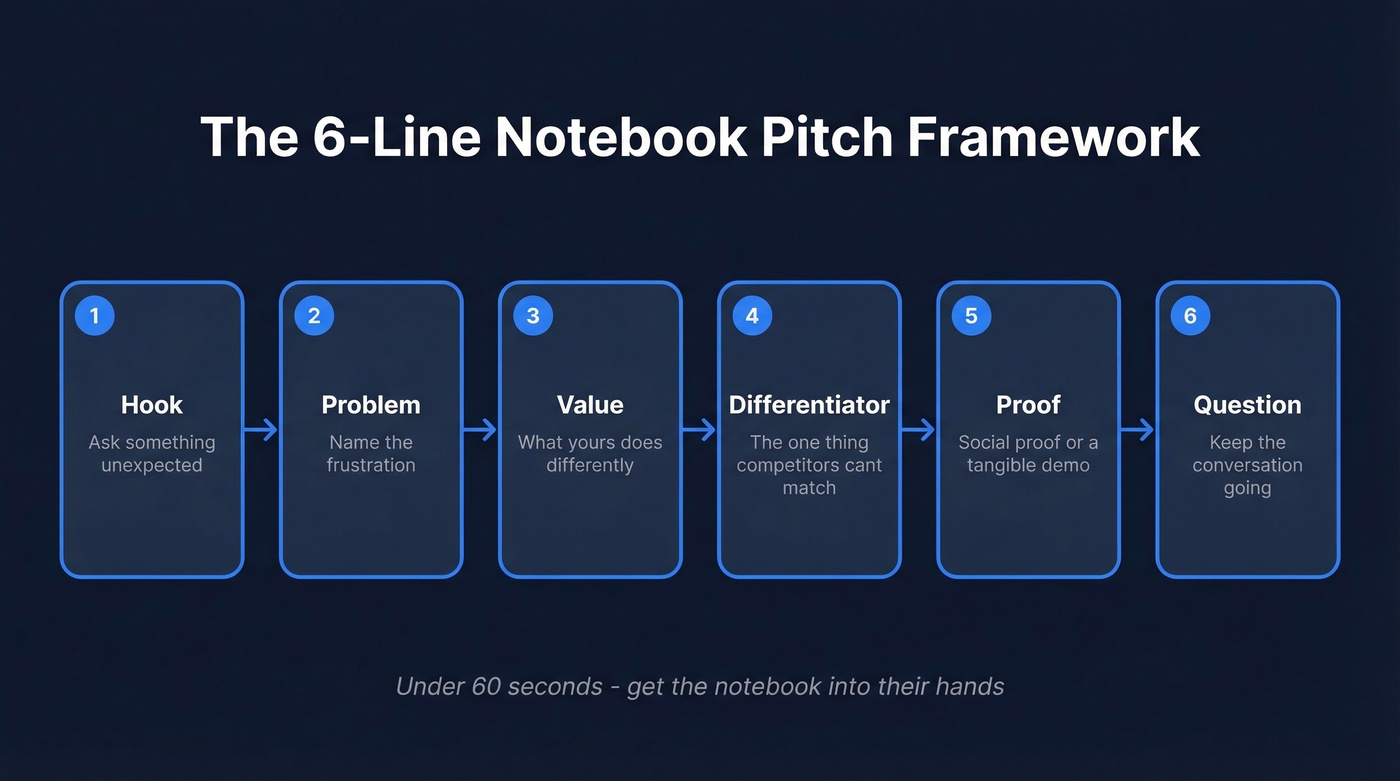
- Hook - Ask something unexpected. "When's the last time you wrote something by hand that you actually kept?"
- Problem - Name the frustration. "Most notebooks bleed through, fall apart, or feel like an afterthought."
- Value - What yours does differently. "100 GSM paper, lay-flat binding - built for fountain pens and heavy gel ink."
- Differentiator - The one thing competitors can't match. "Every interior page has guided prompts designed for [your niche]."
- Proof - Social proof or a tangible demo. "We've sold 2,000 on Etsy. Feel the paper."
- Question - Keep the conversation going. "What do you usually use a notebook for?"
Every script below follows this skeleton, compressed for the situation.
5 Copy-Ready Notebook Sales Scripts
10-Second Craft Fair Hook
"That one's 100 GSM - grab a pen from the cup and try it. It resists bleed-through with most pens and markers. What do you usually journal about?"
We've watched people at craft fairs decide in a few seconds whether to engage. Tactile beats verbal every time. Get the notebook into their hands and let the paper do the selling.
30-Second Corporate Gifting Pitch
"We make custom-branded notebooks for corporate gifts - your logo on the cover, your message on the first page. Boxed sets run $20-$40 depending on quantity. Clients like [name a past client or niche] use them for onboarding kits and holiday gifts. Want me to send you a sample box and a quote?"
Price-anchoring early removes the "is this expensive?" anxiety. Personalization is a growing trend in the $72.5B global notebook market - lead with that.
60-Second Retail Buyer Pitch
Retailers buy margin, sell-through, and reliability - not your origin story. Here's the script that respects their time:
"This is our [notebook name] - retails at $20, your wholesale cost is $10, so you're looking at a 50% margin. It's 100 GSM paper with lay-flat binding, which means customers who use fountain pens or heavy gel ink come back for refills. We ship in case packs of [24], MOQ is [one case], reorders ship in [5] business days. I've got a line sheet with all [six] SKUs - can I email it over today?"
Here's the thing: don't open with "I started making notebooks because I've always been passionate about journaling and wanted to create something meaningful..." The buyer stopped listening after "passionate." Lead with numbers, close with logistics.
Campus / Student Pitch
Skip the blockquote format here - students need this pitched fast, almost like a text message. The entire pitch: it's $8, lays flat so you can write in lecture without fighting the spine, dot grid works for notes and diagrams, and it's designed for people who burn through a notebook every semester without spending $25. That's it. Students don't care about your brand story. They care about price and function.
DTC Product Page / Video Script
People buy notebooks when they're sad, or craving a sense of control. The psychology is simple: the purchase is often about anticipating the person you'll become when you start writing. Your DTC copy should meet that emotion head-on:
"You know that feeling when you pick up a notebook with a cover so beautiful you have to own it? That's not impulse buying - that's anticipation. This notebook is 100 GSM, lay-flat, and designed for people who treat themselves to things that feel intentional. Treat yourself."

The hardest part of selling notebooks to stores isn't the pitch - it's reaching the right buyer. Prospeo's email finder gives you verified emails for purchasing managers and retail buyers with 98% accuracy, so your line sheet lands in a real inbox instead of a dead-end info@ address.
Stop guessing at buyer emails. Verify them for $0.01 each.
Differentiation Cheat Sheet
| Spec | What to Say |
|---|---|
| 100 GSM paper | "Ink won't bleed - works with fountain pens and markers" |
| Lay-flat binding | "Stays open on your desk, no hand wrestling" |
| Dot grid | "Flexible - notes, sketches, bullet journaling" |
| Niche interior pages | "Breathing exercises for anxiety journals, packing lists for travel - not just blank pages" |
| Cover design | "The cover is the top reason people pick it up" |
| QR code / scan-friendly pages | "Write by hand, digitize later - appeals to hybrid workers" |
| Bleed resistance | "Test any pen on it - we'll wait" |
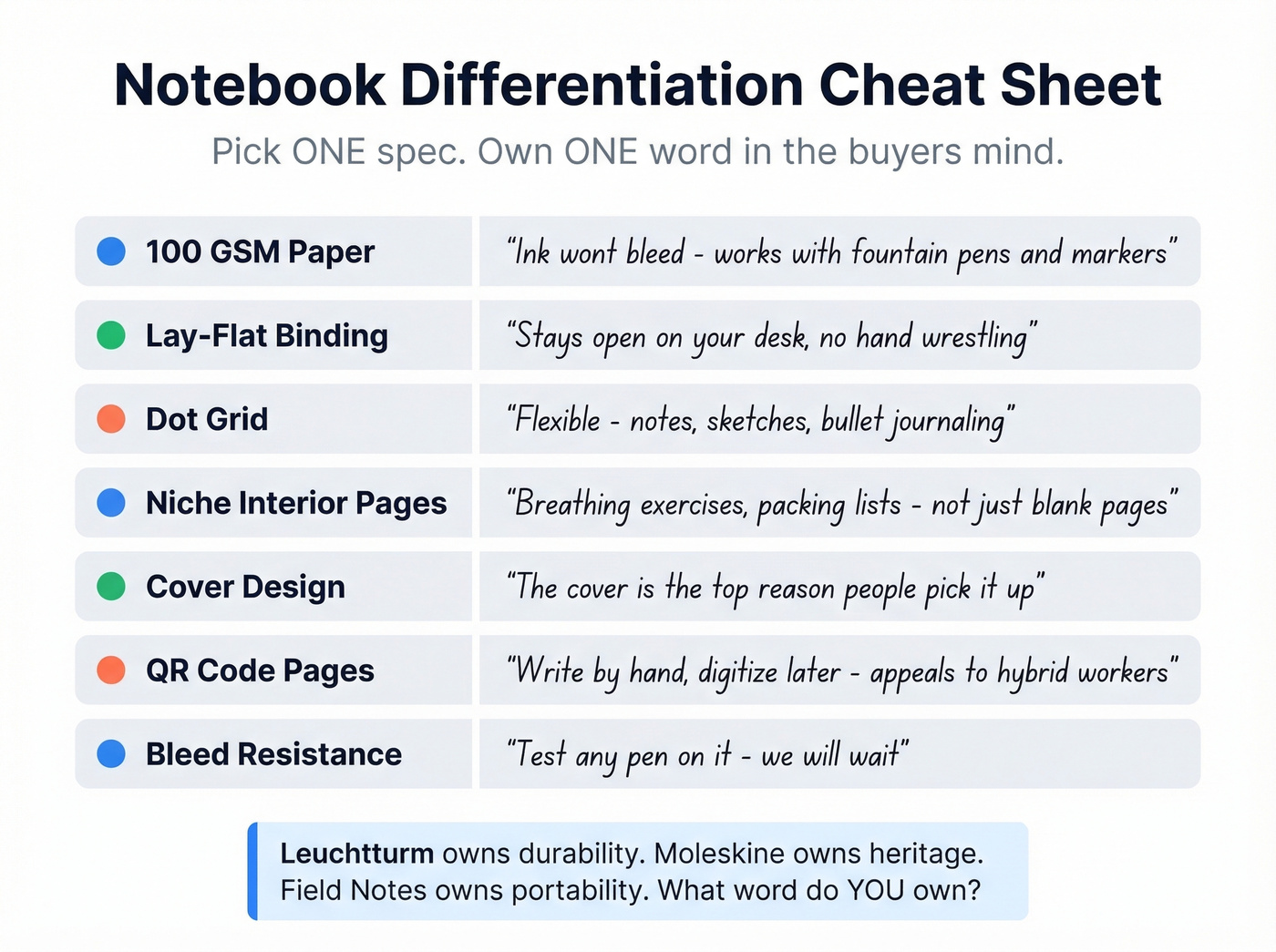
Most notebook sellers try to differentiate on twelve features at once. Pick one. The brands that win - Leuchtturm, Moleskine, Field Notes - each own a single word in the buyer's mind. Yours should too.
Pitching Notebooks to Stores
Retailers don't care about your creative journey. They care about three questions: will it sell, what's my margin, and can you deliver reliably?
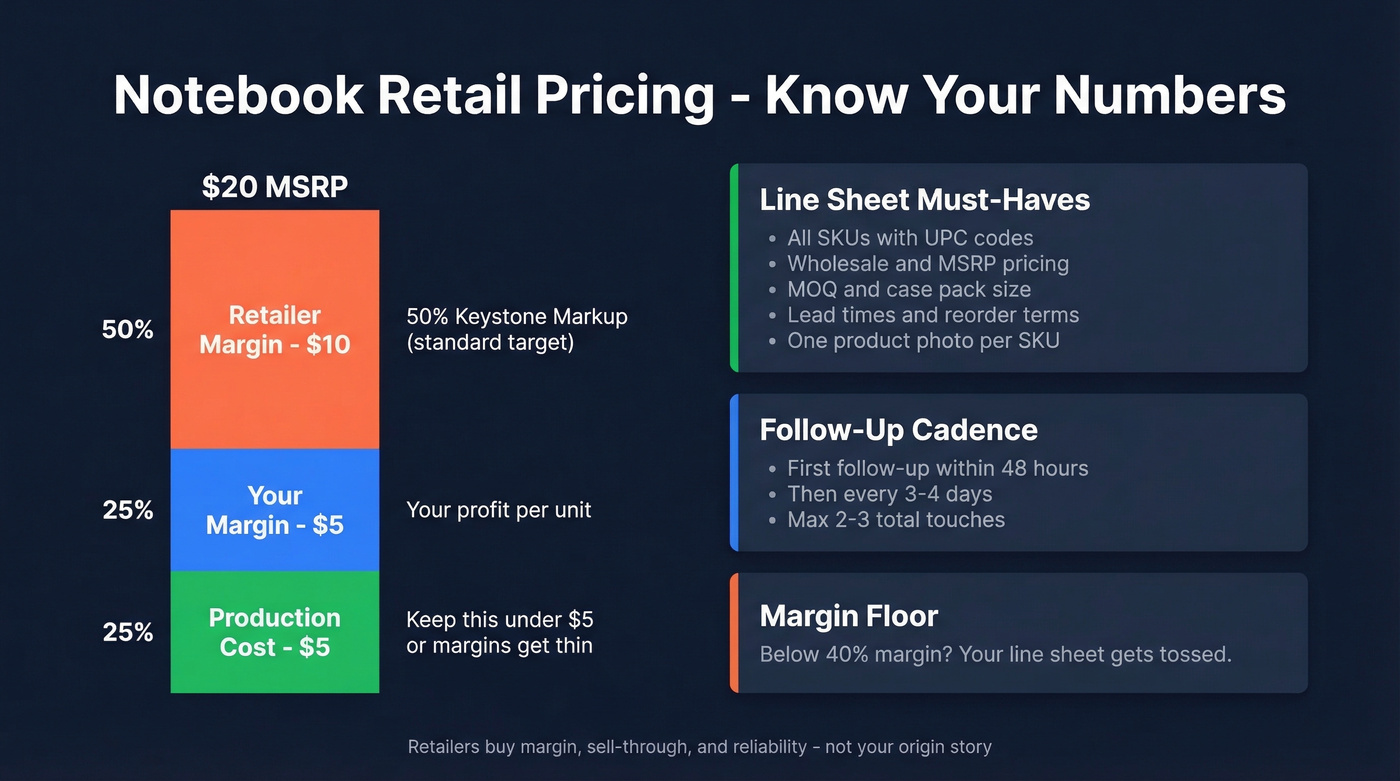
Your line sheet needs all SKUs with UPC codes, wholesale and MSRP pricing, minimum order quantity, case pack size, lead times, reorder terms, and at least one product photo per SKU. In our experience, the line sheet is where most notebook sellers lose the deal - not the pitch itself. Don't show up without one.
Retailers typically expect 30-50% margins; keystone (50%) is the standard target. A $20 retail notebook wholesales at $10. If your production cost is above $5 per unit, your margins get thin fast, so factor in case pack quantities that lower per-unit cost. Smartsheet's guide to pricing strategies breaks this down further if you want to model different scenarios.
Send your first follow-up within 48 hours of the initial pitch, then space follow-ups every 3-4 days, maxing out at 2-3 total. More than that and you're annoying, not persistent. If you need word-for-word sequences, use these sales follow-ups as a starting point.
The hardest part isn't the pitch - it's finding the buyer's email. Most independent retailers don't list their purchasing manager's contact info publicly. We use Prospeo's email finder for this: search by company and job title, get verified emails, and send your line sheet to an inbox that actually exists instead of a generic info@ address.
Objection Scripts
"I can get one cheaper."
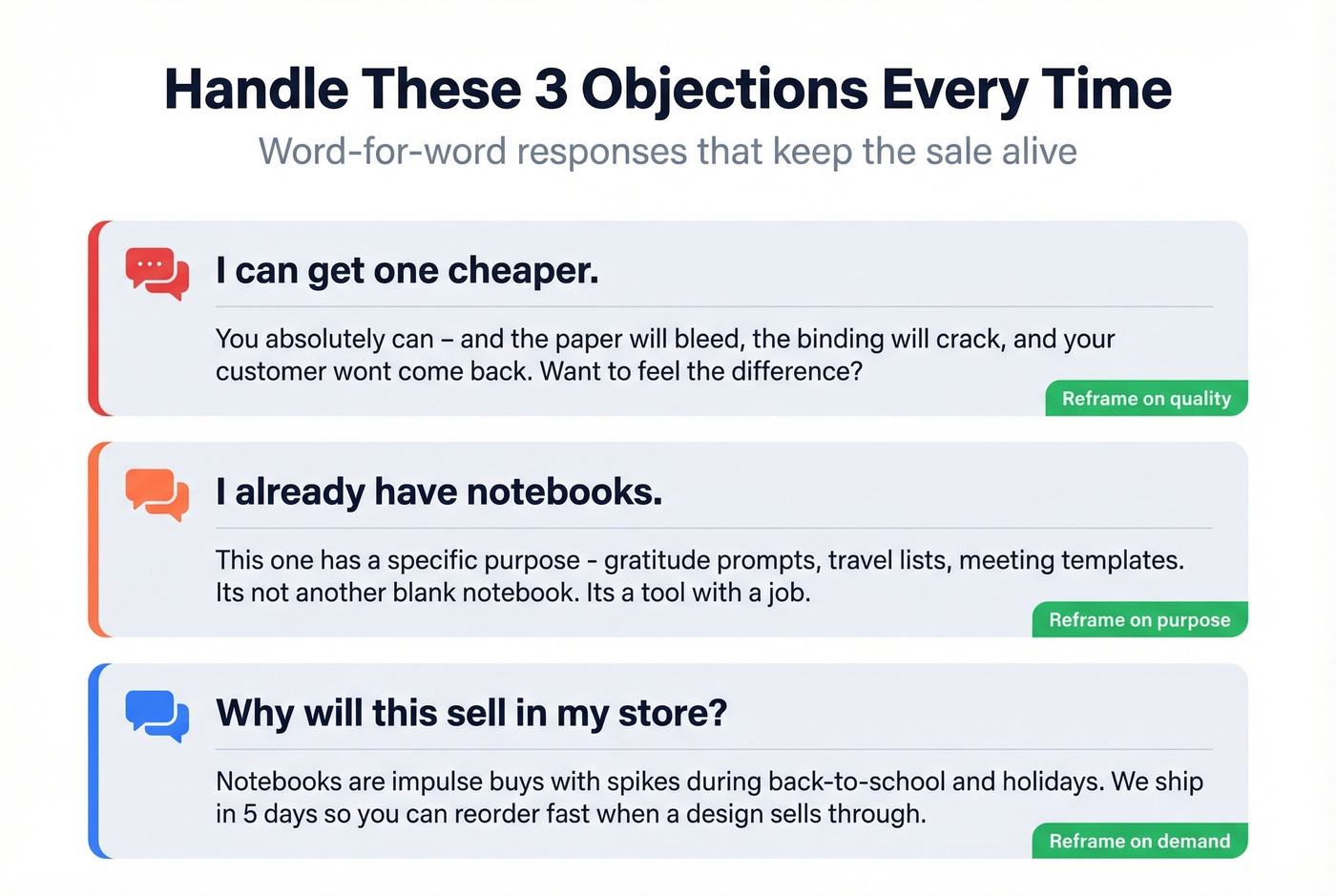
"You absolutely can - and the paper will bleed, the binding will crack in a month, and your customer won't come back. Our 100 GSM paper and lay-flat binding cost more to produce, but they're why people reorder. Want to feel the difference?"
"I already have notebooks."
Everyone does. A common theme on r/notebooks and r/bulletjournal is owning stacks of unused journals. That's exactly why this one has a specific purpose: gratitude prompts, travel packing lists, or meeting templates. It's not another blank notebook. It's a tool with a job.
"Why will this sell in my store?"
"Notebooks are often an impulse buy with spikes during back-to-school and holiday gifting. And because we ship in 5 days, you can reorder fast when a design sells through."
You've got the scripts, the line sheet, and the margins dialed in. Now scale your wholesale outreach. Prospeo's 30+ search filters let you build targeted lists of retail buyers by company size, industry, and job title - with verified contact data refreshed every 7 days.
Build a list of 500 store buyers in minutes, not weeks.
FAQ
How long should a notebook sales pitch be?
Under 60 seconds in person, under 200 words for email. Retail buyers give you roughly one minute - lead with margin and sell-through data, not your backstory. For pitch length benchmarks by format, Smartsheet breaks down 10-second through 2-minute structures.
How do I price notebooks for wholesale?
Wholesale at roughly 50% of MSRP - a $20 retail notebook wholesales at $10. If production costs exceed $5 per unit, explore case pack quantities that lower your per-unit cost before approaching retailers. Keystone pricing (50% margin) is what most buyers expect, and showing up with anything less than 40% margin will get your line sheet tossed.
How do I find store buyers to send my pitch to?
Visit stores in person and ask for the buyer's card - nothing beats a face-to-face first impression. For scaling beyond your local area, tools like Prospeo let you search for purchasing managers by company and get verified contact info so your line sheet reaches real inboxes instead of bouncing. If you're building a repeatable outreach system, start with these sales prospecting techniques and a simple ideal customer profile.