

Sales Procedures: How to Document, Enforce, and Measure a Process That Works
It's Monday morning. A new SDR starts, asks for the playbook, and gets a Slack message: "Just shadow Jordan for a week." Jordan's been there four months.
You can probably recite the stages in your sleep - prospecting, qualification, discovery, close. And yet you still can't onboard a rep in under a month without them shadowing someone. That's because you have a process sketch, not a set of sales procedures. 68% of sales reps don't follow a documented process - not because they're lazy, but because no one gave them an SOP worth following. The stages aren't the hard part. The enforceable procedures behind each stage are.
This article closes that gap: turning your CRM stage names into checklists, exit criteria, and governance rules that survive contact with real reps on real deals.
The Quick Version
- A sales process is the stages. Sales procedures are the documented, enforceable SOPs that make those stages repeatable.
- Start with three procedures: qualification criteria, presentation checklist, close/handoff protocol. Expand later.
- Every procedure needs stage-exit criteria - what must be true before a deal moves forward.
- Assign an owner and a six-month review cadence, or your SOPs die on day one.
- Build a data verification step into prospecting. Bad data compounds every downstream problem.
Procedures vs. Process vs. Methodology
These three terms get used interchangeably, and that's where teams get confused. They're different layers of the same system.
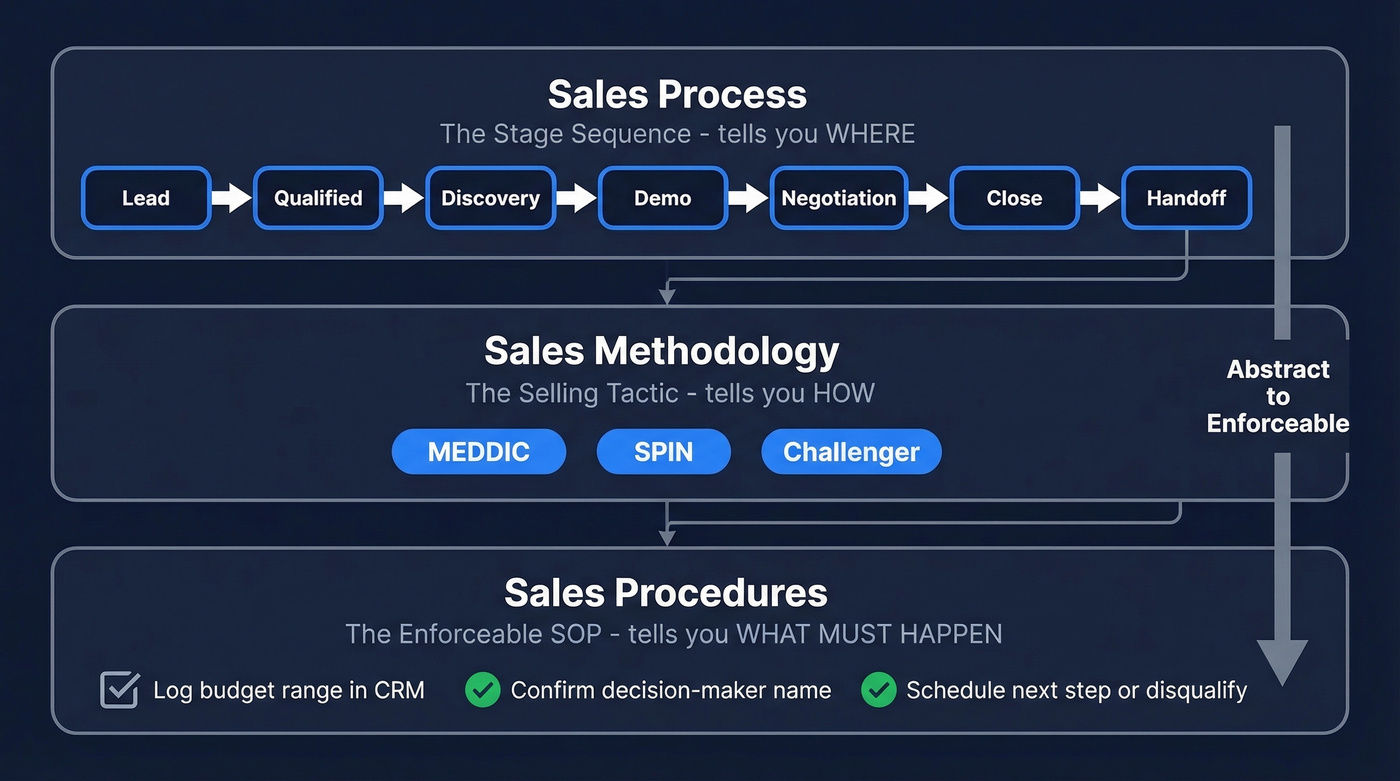
A sales process is a sequence - the stages a deal moves through from first touch to closed-won. It's the skeleton in your CRM: Prospecting → Qualification → Discovery → Presentation → Negotiation → Close → Handoff.
A sales methodology is the tactical framework reps use inside those stages. MEDDIC, SPIN, Challenger - these tell reps how to sell.
A sales procedure is the enforceable document that governs what happens at each stage. It's the SOP with checklists, exit criteria, required fields, and governance rules.
| Layer | What It Is | Example |
|---|---|---|
| Process | The stage sequence | Lead → Qualified → Demo → Close |
| Methodology | The selling tactic | MEDDIC qualification framework |
| Procedure | The enforceable SOP | "Before moving to Demo, rep must log budget range and decision-maker name" |
The process tells you where. The methodology tells you how. The procedure tells you what must happen or the deal doesn't advance. Most teams have a process sketched somewhere. Very few have SOPs that are documented, enforced, and reviewed - and that's the difference between a pipeline you can forecast and one that's fiction.
Why Formal SOPs Drive Revenue
The numbers aren't subtle. Companies with a formal, guided sales process are 33% more likely to be high performers. Organizations that define and enforce a standardized process see up to 28% more revenue than those running ad hoc. And yet 68% of reps still don't follow any structured approach.
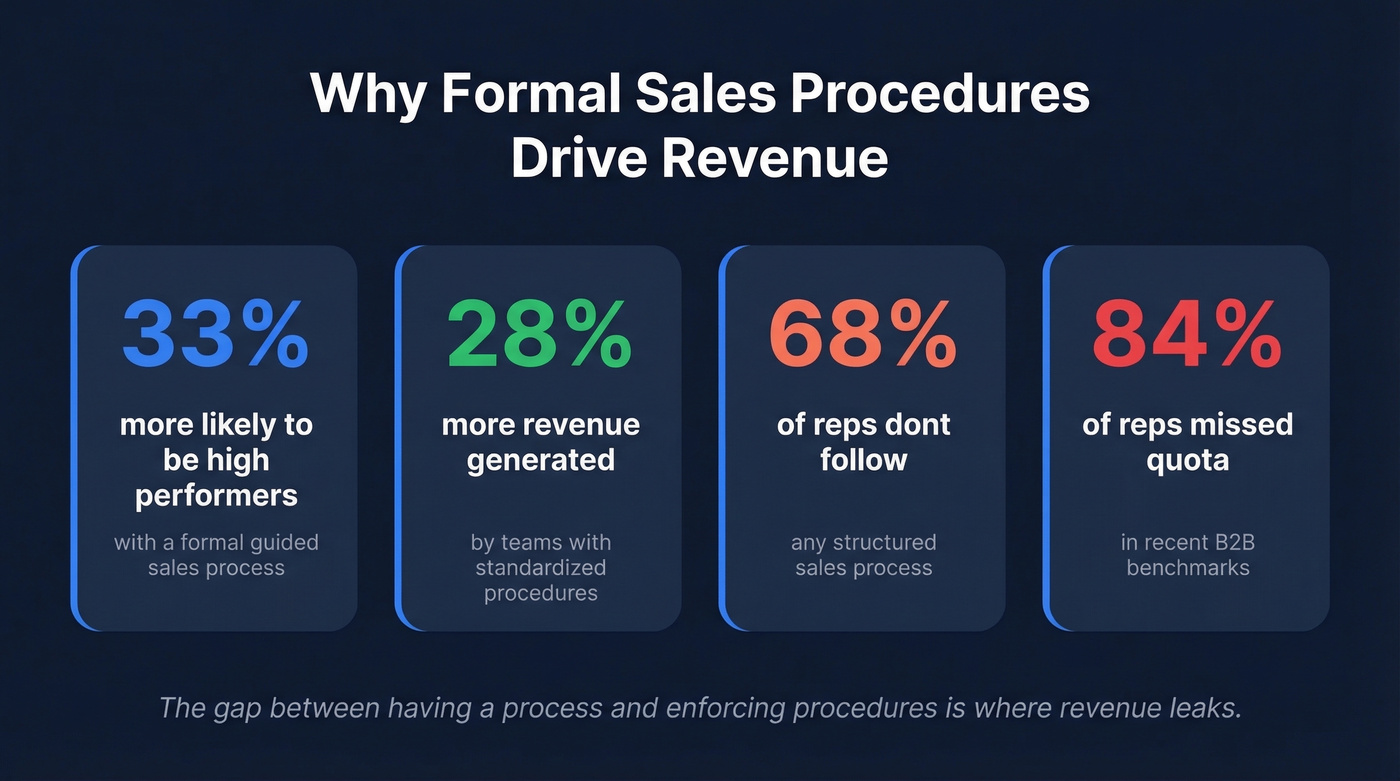
That gap is where revenue leaks. When reps freelance through deals, you get inconsistent qualification, unpredictable close rates, and forecasts that mean nothing. 84% of reps missed quota in recent benchmarks. Procedures won't fix all of that, but they close the execution gap between your best rep and your newest hire.
Automation without procedures just scales chaos faster.
Buyers use an average of 10 interaction channels. McKinsey estimates generative AI could unlock $0.8-$1.2 trillion in annual sales and marketing productivity. But none of that technology helps without a documented, repeatable process underneath it. Procedures are the foundation that makes data-driven selling possible - the consensus on r/sales is that teams investing in process documentation consistently outperform those chasing the latest tool.
The 7 Core Stages Every Procedure Must Cover
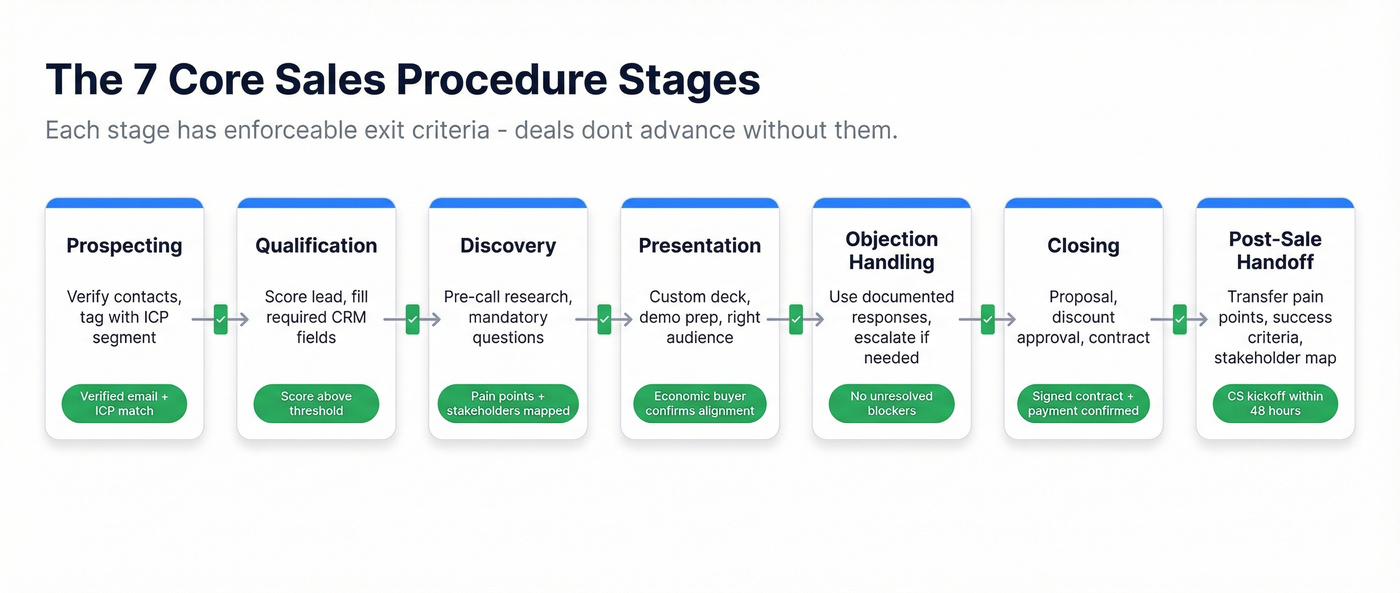
Every sales procedure maps to a stage. Here's what each stage needs - the activities, the exit criteria, and the guardrails that keep deals moving honestly through your pipeline.
Remember that new SDR from the intro? Let's call her Maya. She's going to walk through these stages with us.
Prospecting
Maya's first week. Instead of "just shadow Jordan," she opens the prospecting SOP and knows exactly what to do.
- Define target account criteria using ICP filters
- Verify every contact before loading into a sequence - job changes, role shifts, and invalid emails decay fast
- Tag contacts with correct segment and sequence identifiers
We've seen this play out firsthand: Snyk's 50-person AE team dropped their bounce rate from 35-40% to under 5% after building a verification step into their prospecting workflow, and AE-sourced pipeline jumped 180%. Prospeo's 98% email accuracy and 7-day data refresh cycle make it a natural fit for this verification layer.
Stage-exit criteria: Contact has verified email, confirmed title matches ICP, and is loaded into the sequencer with correct tags.
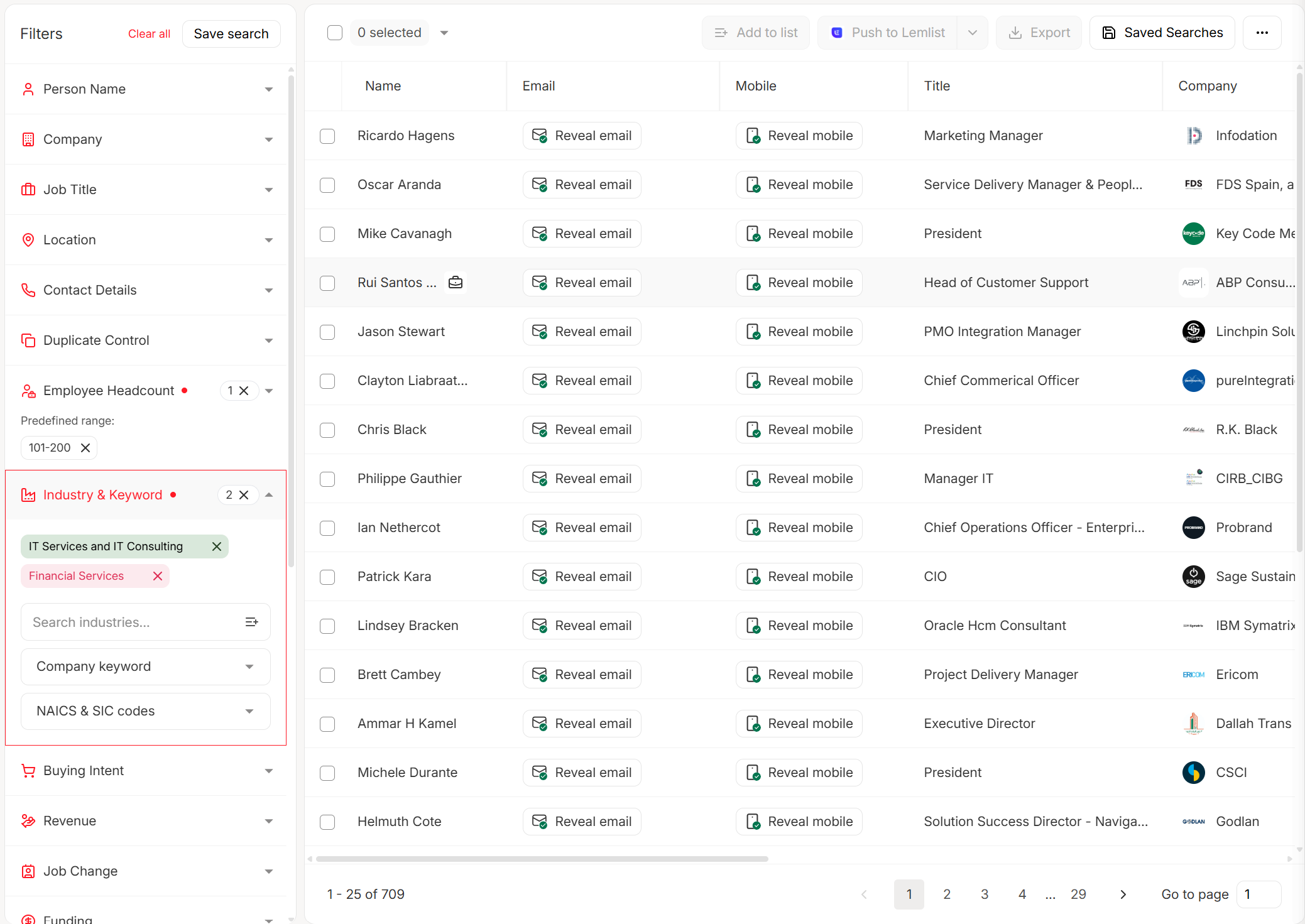

Your prospecting SOP is only as strong as the data feeding it. Snyk built verification into their procedures and dropped bounce rates from 35% to under 5%. Prospeo delivers 98% email accuracy on a 7-day refresh cycle - so every contact entering your pipeline is real.
Build your first procedure on data that doesn't decay.
Lead Qualification
This is the stage where 2-5% lead-to-customer conversion rates get decided. Maya's SOP tells her exactly which CRM fields to fill before a lead advances - no guessing, no inflated pipeline.
- Complete qualification framework fields (budget range, decision-maker, timeline, pain)
- Score lead against threshold criteria
- Schedule a confirmed next step or disqualify
Common mistake: Reps drag unqualified leads through the pipeline to pad their numbers. Your procedure should make this structurally impossible - if the fields aren't filled, the CRM won't let the deal advance.
Stage-exit criteria: Qualification fields completed in CRM. Lead scored above threshold. Next step scheduled.
Discovery & Needs Analysis
Discovery uncovers the real problem, not the surface-level pain the prospect mentioned on the first call.
- Complete pre-call research checklist (company news, tech stack, recent hires)
- Ask mandatory discovery questions from the SOP question bank
- Document findings in CRM within 24 hours of the call
Stage-exit criteria: Discovery notes logged with identified pain points, stakeholders mapped, and success criteria defined by the prospect.
Presentation & Value Demonstration
Most deals require 5-12 touchpoints before close. The presentation stage burns through several of those. Maya's procedure specifies deck customization requirements, demo environment prep, and who needs to be on the call - so she's not winging a demo for a VP with a generic slide deck.
Stage-exit criteria: Presentation delivered to economic buyer or champion. Prospect confirms alignment. Next step scheduled.
Objection Handling
Don't leave this to improvisation. Document the top 10-15 objections your team hears, the approved responses, and the escalation path for objections reps can't handle alone. This is the single fastest way to level up new hires - Maya doesn't need four months of tribal knowledge. She needs a document.
Stage-exit criteria: Objections addressed and documented. No unresolved blockers. Deal has an active next step.
Closing
Skip this section if your close rate is already above 35% and your discount approval process is airtight. For everyone else: the average B2B close rate sits at 29%, with win rates around 21%. Your closing procedure should cover proposal formatting, discount approval workflows (who can approve what percentage), contract routing, and signature collection. Up to 50% of sales go to the first vendor to respond - build response-time SLAs into this stage.
Stage-exit criteria: Signed contract. Payment terms confirmed. Deal marked closed-won with accurate revenue and close date.
Post-Sale Handoff
The handoff from sales to customer success is where deals go to die without a procedure. Document what information transfers (pain points, success criteria, stakeholder map, contract terms), who owns the handoff meeting, and the timeline for first check-in.
Stage-exit criteria: CS team has received full handoff document. Kickoff call scheduled within 48 hours. Rep's CRM record is complete.
Stage-Exit Criteria Template
Use this as a starting point. Copy it, adapt it to your stages, and paste it into your CRM's deal requirements. Smartsheet offers free SOP templates in Word, PDF, and Google Docs if you want a more polished format.
STAGE-EXIT CRITERIA CHECKLIST

Stage: [e.g., Qualification]

SOP Version: [e.g., 2.1]

Owner: [Name]

Last Reviewed: [Date]

☐ Required CRM fields completed: [list fields]
☐ Qualification score meets threshold: [minimum score]
☐ Next step confirmed with prospect: [date/type]
☐ Manager sign-off (if applicable): [name/date]
☐ Notes logged within 24 hours of last interaction

ESCALATION: If criteria cannot be met within [X days],
deal moves to [Stalled/Disqualified] and rep notifies manager.
Stage-exit criteria mean nothing if your reps are working stale contacts. Prospeo's 300M+ profiles refresh every 7 days - not the 6-week industry average - so your qualification and discovery procedures start with verified, current data at $0.01 per email.
Stop building SOPs on top of broken data.
How to Document Your Sales Procedures
A procedure that lives in someone's head isn't a procedure - it's tribal knowledge. Here's what a documented SOP actually includes.
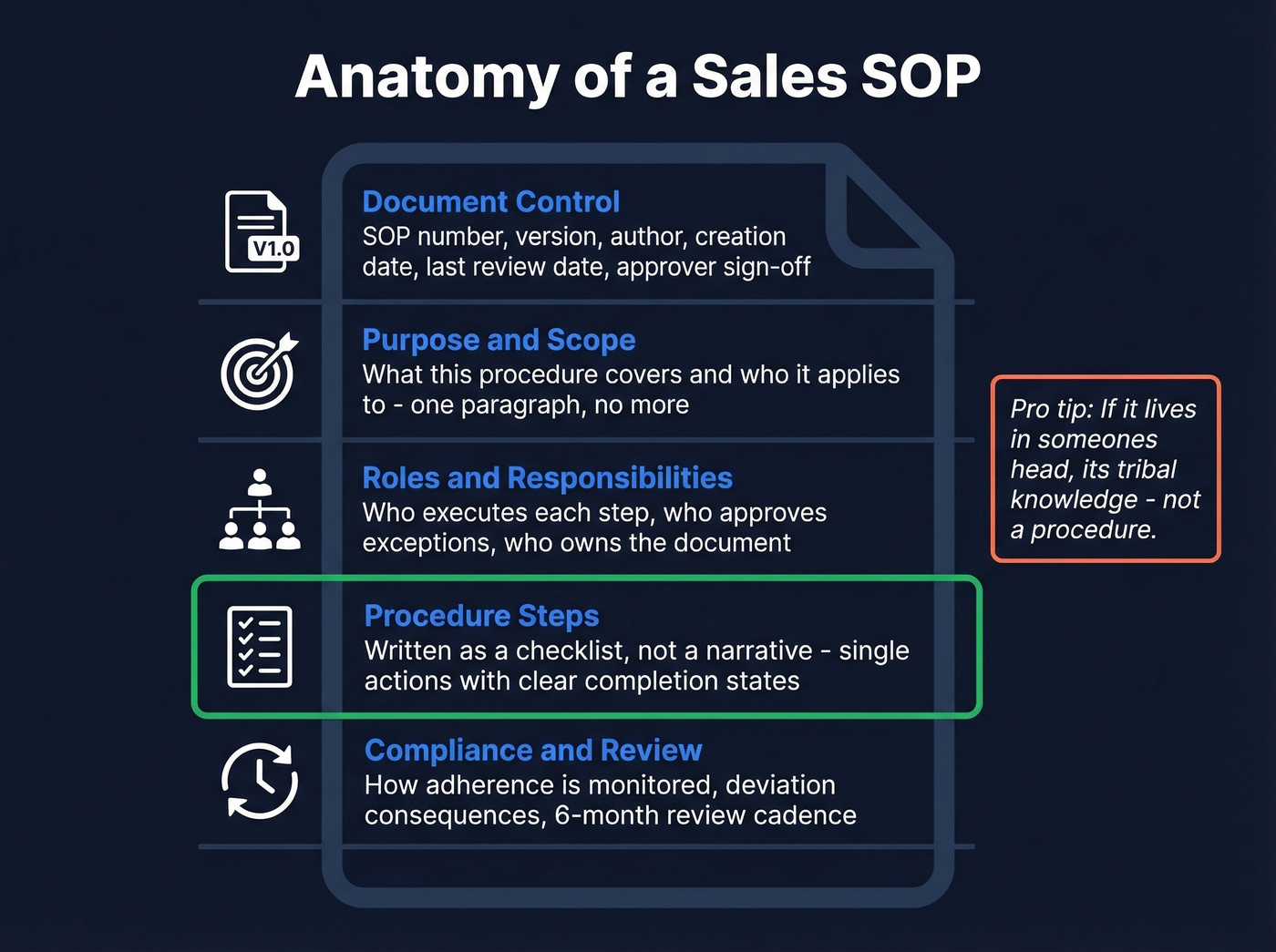
Document control - SOP number, version, author, creation date, last review date, and sign-off fields for approvers. This sounds bureaucratic until you're trying to figure out which version of the discount approval process is current.
Purpose and scope - one paragraph explaining what this procedure covers and who it applies to. "This procedure governs the qualification stage for all inbound leads handled by the SDR team." That's it.
Roles and responsibilities - who executes each step, who approves exceptions, who owns the document.
Procedure steps - written as a checklist, not a narrative essay. Checklists work because people are task-oriented; checking items off turns procedures into habits. Each step should be a single action with a clear completion state.
Compliance and review - how adherence is monitored, what happens when someone deviates, and when the procedure gets reviewed. Every procedure needs an owner and a review date. Prioritize the 20% of procedures that drive 80% of outcomes - you don't need to document every micro-step on day one.
Visual aids - flowcharts and stage diagrams aren't optional. A one-page flowchart communicates more than a ten-page document. Complex procedures need visual representation or they won't be followed.
Which Methodology to Embed
Your procedures need a methodology baked in - particularly at qualification and discovery.
| Framework | Best For | Sales Motion |
|---|---|---|
| BANT | Quick inbound triage | SMB / transactional |
| MEDDIC | Complex enterprise deals | Mid-market / enterprise |
| SPIN | Consultative discovery | Mid-market |
| Challenger | Insight-led selling | Enterprise |
| NEAT | Conversational qualification | Flexible |
| Sandler | Buyer-led, low-pressure | SMB / mid-market |
Pick one. Don't blend. We've seen teams try to run "MEDDIC-lite with Challenger elements" and end up with a framework nobody can remember, let alone follow. BANT works for high-velocity inbound where you need to sort fast. MEDDIC is the right call for enterprise deals with multiple stakeholders and long cycles. SPIN fits consultative motions where discovery is the differentiator.
What matters is that your team uses one consistently, not which one you pick.
Here's the thing: if your average deal size is under $15K, you probably don't need MEDDIC. BANT or NEAT will qualify leads faster with less friction. Save the heavyweight frameworks for deals that justify the overhead.
Enforcing Procedures That Stick
Writing procedures is the easy part. Getting reps to follow them is where most teams fail. The key distinction: you're not auditing for SOX compliance. You're building habits that drive revenue. Every enforcement mechanism should feel like a guardrail, not a cage.
Make your CRM enforce stage-exit criteria. Required fields, validation rules, and approval gates are the mechanism that turns a document into a living process. If your CRM doesn't enforce stage-exit criteria, your pipeline is fiction. Salesforce and HubSpot both support required fields per stage. Use them.
Train on the "why," not just the "what." Reps who understand that qualification procedures exist to protect their time - not to create busywork - are far more likely to comply. The biggest documentation mistake is not explaining the reasoning behind each step.
Monitor with dashboards, not micromanagement. Build dashboards that surface compliance gaps: deals missing required fields, stages skipped, deals sitting too long without activity. Tools like Scratchpad help with CRM hygiene by making it easier for reps to log data without leaving their workflow.
Use automation for nudges, not punishment. AI-powered alerts that remind a rep "this deal has been in Discovery for 14 days with no next step" are enforcement without friction. That's the sweet spot.
Celebrate compliance, not just closed deals. When a rep follows the procedure perfectly and loses a deal, that's still a win for the system. Recognize it. The alternative - rewarding cowboys who close despite ignoring every procedure - guarantees that nobody follows the SOP.
KPIs and Benchmarks
You can't improve what you don't measure. Here are the benchmarks your procedures should be calibrated against.
| KPI | Benchmark | Procedural Implication |
|---|---|---|
| Lead-to-customer conversion | 2-5% | Qualification procedures matter more than volume |
| Average close rate | 29% | Set realistic stage targets |
| Sales cycle length | 1-3 months | Build follow-up cadences into procedures |
| Touchpoints per deal | 5-12 | Document multi-touch sequences |
| Speed-to-lead | First responder wins 50% | Mandate response SLAs |
| Quota attainment | Only 16% hit quota | Procedures exist to close this gap |
| Interaction channels | 10 per buyer | Procedures must span digital + live touchpoints |
These aren't aspirational targets - they're baselines. If your lead-to-customer conversion is below 2%, your qualification procedure is broken. If your cycle length exceeds three months for deals that should close in one, your follow-up cadence needs work.
Track these monthly and tie them back to specific procedural steps. When close rates drop, don't tell reps to "sell harder" - look at which stage is leaking and fix the procedure.
5 Mistakes That Kill Sales Procedures
Too much detail. In our experience, the 40-page procedure doc is the most common failure mode. If a rep can't internalize the core steps in 15 minutes, you've over-engineered it. Map the forest, not every tree.
Seller-centric mapping. Your procedure stages should mirror the buyer's journey, not your internal org chart. "We send a proposal" isn't a stage - "Buyer evaluates solution fit" is. Flip the perspective.
No measurement plan. A procedure without KPIs attached is just a suggestion. Every stage needs a metric. Every metric needs a dashboard.
Copying another company's process. That SaaS unicorn's playbook was built for their market, their deal size, their team. Engage your reps in building procedures - they know where deals actually stall. Importing someone else's process without adaptation is a recipe for rejection.
No ownership or review cadence. Procedures written once and abandoned are worse than no procedures at all because they create false confidence. Assign an owner. Set a six-month review cycle. Version-control every change. A procedure is a living document or it's a dead one.
Tools That Support Sales Procedures
Your procedures need infrastructure. The tool stack matters less than whether your procedures actually reference these tools by name. "Log the call in Gong" is a procedure step. "Use a call recording tool" is a suggestion.
CRM - Salesforce, HubSpot, or Pipedrive. The CRM enforces stage gates, required fields, and approval workflows. Without it, procedures are unenforceable.
Prospecting data - Prospeo fits directly into the prospecting procedure as the verification layer, with 98% email accuracy, 125M+ verified mobiles, native Salesforce and HubSpot integrations, and pricing around $0.01 per email with a free tier to start. For enterprise teams already locked into a data contract, ZoomInfo covers similar ground at $15,000-$40,000+/year.
Enablement and adherence - Gong for call recording and methodology adherence tracking. Scratchpad for pipeline management and CRM hygiene without the friction of logging into Salesforce after every call.
FAQ
What's the difference between a sales process and a sales procedure?
A sales process is the sequence of stages a deal moves through. A sales procedure is the documented SOP with checklists, exit criteria, and governance rules that makes each stage enforceable and repeatable across your entire team.
How many procedures does a team need to start?
Three: qualification, presentation, and close/handoff. These cover the highest-leverage stages where deals most commonly stall or leak. Add prospecting and objection handling SOPs as your team matures past 5-10 reps.
How often should you update sales procedures?
Review every six months minimum. Assign a single owner per procedure, collect rep feedback quarterly, and version-control every change. Procedures that aren't reviewed become obstacles rather than accelerators.
How does a sales plan relate to sales procedures?
A sales plan sets strategic targets - revenue goals, territory assignments, activity quotas. Procedures are the tactical SOPs that execute that plan stage by stage. Without procedures, even the best plan breaks down at the rep level because there's no enforceable standard for how work gets done.
Sales procedures aren't documents you write once and file away. They're the operating system your team runs on - and like any OS, they need updates, monitoring, and an owner who actually cares. Start with three. Enforce them in your CRM. Review them in six months. That's the whole playbook.