

The Sales Process Guide That Actually Includes Numbers
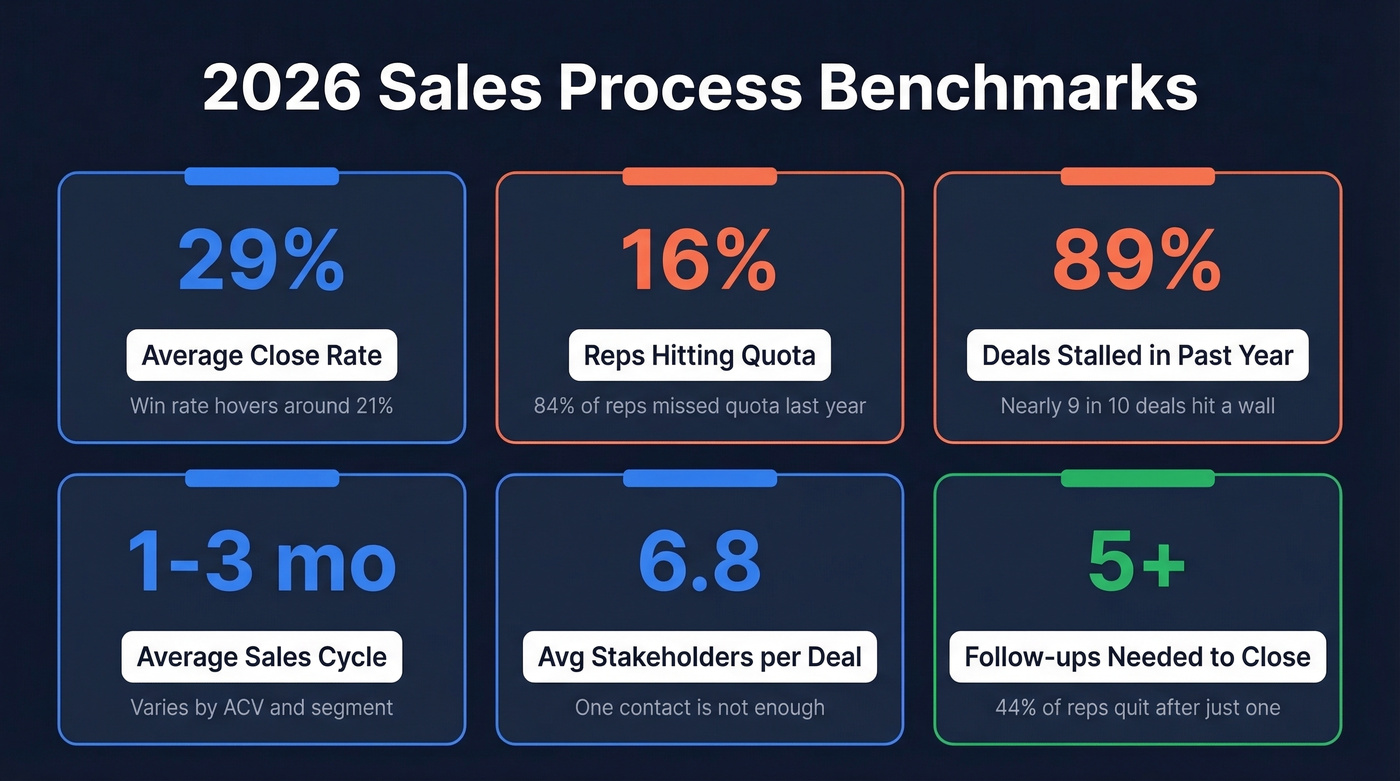
84% of reps missed quota last year. On r/growmybusiness, founders describe the fallout in blunt terms: "excessive follow-ups, lost leads, and back and forth - more effort for fewer conversions." That's not a skills problem. It's a sales process problem.
Organizations that define and enforce a structured selling process see up to 28% more revenue than those that don't. We've spent years watching teams try to outwork a broken process, and it never ends well. What follows is the version with actual benchmarks, stage exit criteria, and templates you can steal.
What Is a Sales Process?
The biggest confusion in sales ops is conflating process with methodology. They're different things, and you need both.
A sales process is the stages a deal moves through, the sequence, and the exit criteria - the "what" and "when." A methodology is the "how," the tactics and frameworks reps use inside each stage. The process is the tree; the methodology is the ornaments.
Here's the other distinction that trips people up: a sales process isn't a funnel, and it isn't a pipeline. The funnel is a marketing concept describing volume narrowing over time. The pipeline is the CRM view of active deals and their dollar values. The process is the operating system underneath both - the business logic that keeps everything moving predictably.
| Process | Methodology | |
|---|---|---|
| Defines | Stages, sequence, timing | Tactics, behaviors, frameworks |
| Answers | What happens when? | How do we execute? |
| Examples | 7-stage pipeline | SPIN, MEDDICC, Challenger, Sandler |
| Fails when | Reps don't know how to progress | Execution is inconsistent |
A process without a methodology gives reps a checklist with no playbook. A methodology without a process gives reps tactics with no structure. The teams that win embed both into their daily workflow - not a binder from a training session six weeks ago.
The 7 Sales Process Stages (With Exit Criteria)
Most guides list 5-7 stages. Few tell you what "done" looks like at each one. Here's the selling process broken down with real exit criteria so your team knows exactly when a deal is ready to advance.
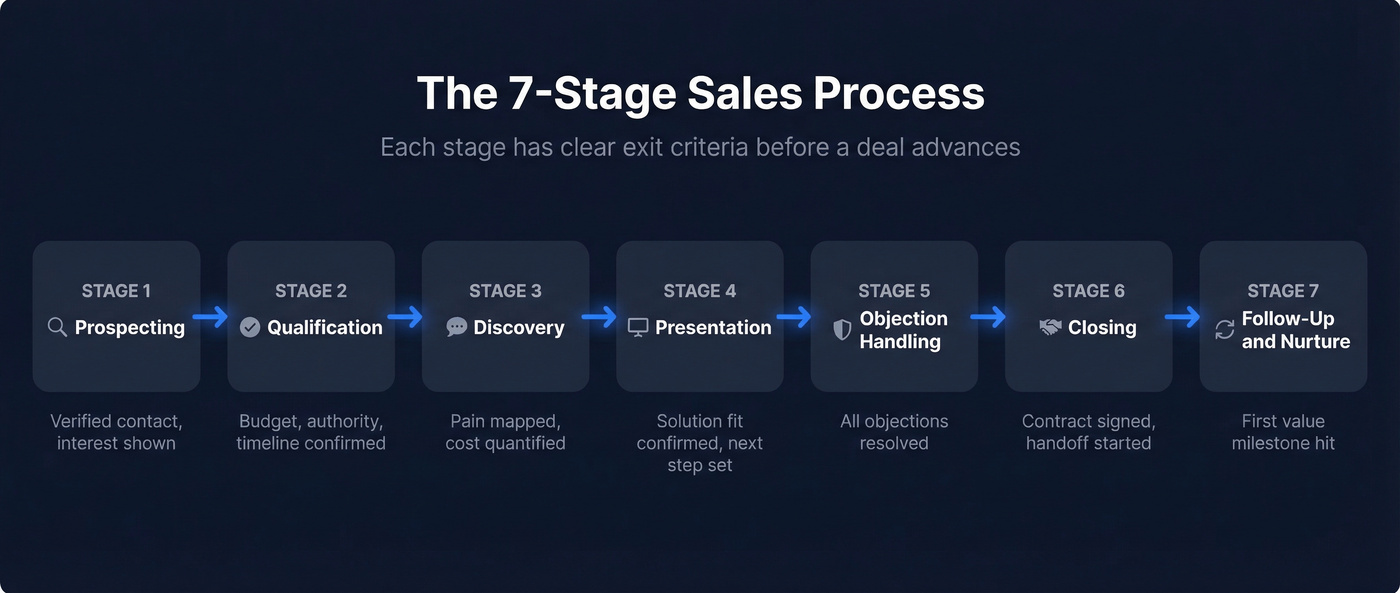
Prospecting
50% of sales time gets wasted on unproductive prospecting. That's not a rep problem - it's a data quality problem. If 30% of your emails bounce on the first sequence, you've already burned domain reputation and rep hours before a single conversation happens.
Prospecting means identifying and reaching out to potential buyers who fit your ideal customer profile. Build targeted prospect lists using firmographic and intent filters. Verify contact data before loading into sequences. Run multi-channel outreach across email, phone, and social.
Exit criteria:
- Prospect responds with interest or agrees to a meeting
- Contact data is verified - email deliverable, phone connected
The fix is upstream: start with verified data. Prospeo covers 300M+ professional profiles with 98% email accuracy on a 7-day refresh cycle, so reps aren't torching domain reputation on dead addresses. Free tier available, no contracts.

Qualification
An average of 6.8 stakeholders are involved in a typical B2B purchase. If you're only talking to one person, you're not qualified - you're hoping.
Qualification is determining whether a prospect has the need, budget, authority, and timeline to buy. Skip this stage and you'll waste months nurturing deals that were never real. Use BANT for simpler deals with fast decisions. Use MEDDICC for enterprise deals with multiple stakeholders and long cycles.
Exit criteria:
- Prospect meets minimum qualification criteria
- Decision-maker identified and engaged
- Budget range and decision timeline confirmed
Discovery
Here's a stat that should change how you run discovery calls: top closers talk 43% of the time versus 65% for average performers. Discovery is understanding the prospect's specific pain, current state, and desired outcome deeply enough to position your solution. This is where most reps talk themselves out of deals by running through a feature list nobody asked for.
Ask open-ended questions about current workflows and pain points. Map the prospect's decision process and evaluation criteria. Document the business impact of the problem in dollars whenever possible.
Exit criteria:
- Clear understanding of the problem and its cost to the business
- Prospect confirms your summary of their situation
The long-standing benchmark holds: [57% of the buying journey](https://www.linkedin.com/business/sales/blog/b2b-sales/this-popular-stat-is-wasting-your-time - the-57 - engagement-myth) is completed before a prospect talks to sales. They've already done their homework. Your job in discovery isn't to educate - it's to listen.
Presentation
Presentation is showing the prospect how your solution specifically addresses the problems uncovered in discovery. Not a feature tour. Not a generic deck.
Tailor the demo or proposal to the prospect's stated pain points, quantify the value in terms of ROI and time saved, and address their evaluation criteria directly. If you can restate their problem better than they can, the presentation sells itself - a point that came up repeatedly in an r/agency thread about what actually wins deals.
Exit criteria:
- Prospect confirms the solution addresses their core needs
- Next step agreed - proposal, trial, or stakeholder review
Objection Handling
44% of salespeople abandon a prospect after one rejection. Meanwhile, 80% of sales require five or more follow-ups. And 89% of buyers had a deal stall in the past year.
Most reps treat objections as rejection. They're actually buying signals.
Anticipate the top 3-5 objections for your product and market. Prepare evidence-based responses with case studies, ROI data, and competitive comparisons. Confirm the objection is resolved before advancing.
Exit criteria:
- All stated objections addressed
- Prospect agrees to next step - pricing discussion, contract review, or close
Closing
Your VP told the board you'll close 40% of pipeline. Your actual close rate is probably half that. The average B2B close rate is 29%, with win rates around 21%. Knowing the real number is step one.
Closing is securing the commitment - a signed contract, a purchase order, or a verbal yes with a defined timeline. Present final pricing and terms, address any remaining legal or procurement requirements, and set a clear decision deadline.
Exit criteria:
- Contract signed or verbal commitment with defined close date
- Handoff to onboarding/CS initiated
Follow-Up & Nurture
The most neglected stage is also the most profitable. Retaining current customers costs six to seven times less than acquiring new ones, yet most teams treat post-sale as someone else's problem.
Execute structured onboarding with clear milestones. Schedule regular check-ins at 30, 60, and 90 days. Identify expansion and referral opportunities early.
Exit criteria:
- Customer achieves first value milestone
- Renewal or expansion conversation scheduled
Post-sale isn't customer success's problem - it's a revenue stage. Treat it like one.
2026 Benchmarks Worth Tracking
Real numbers on the pipeline. These are the benchmarks your leadership team should measure against - and the ones most teams quietly ignore.
Overall Benchmarks
| Metric | Benchmark |
|---|---|
| Close rate | 29% |
| Win rate | ~21% |
| Avg cycle time | 1-3 months |
| Qualified lead CVR | 2.9% across 14 industries |
| Reps hitting quota | 16% |
| Deals stalled (past yr) | 89% |
Stage-to-Stage Conversions
| Stage Transition | Estimated Range |
|---|---|
| SQL to Demo | 40-60% |
| Demo to Proposal | 30-50% |
| Proposal to Close | 15-30% |
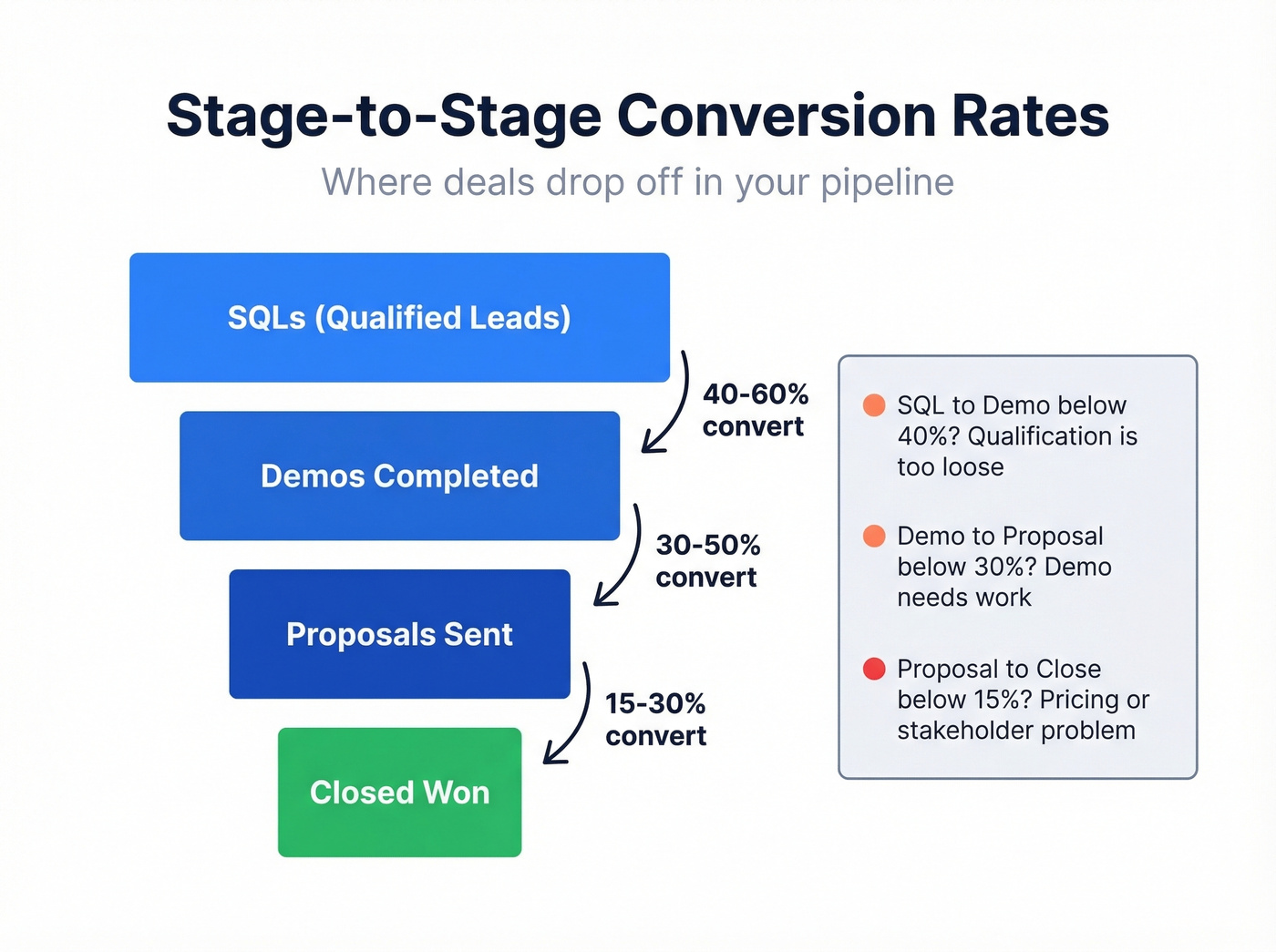
These ranges shift based on ACV, industry, and whether you're selling to SMB or enterprise. But they give you a diagnostic framework. If your SQL-to-demo conversion drops below 40%, your qualification criteria are too loose. If proposal-to-close drops below 15%, you've got a pricing or stakeholder problem.
The broader context matters too. Gartner projected 80% of B2B sales interactions would happen through digital channels by 2025 - and the data suggests they were right. Buyers now use about 10 interaction channels on average, up from 5 in 2016. 33% of B2B buyers prefer a seller-free buying experience, rising to 44% among millennial buyers.
Let's be honest: if you're closing deals under $10K, most of your buyers don't want to talk to a rep at all. A rigid seven-stage pipeline that assumes every deal gets a live demo is already outdated. Build self-serve paths into your sales procedure or watch conversion rates erode year over year.

Your sales process breaks at Stage 1 when 30% of emails bounce. Prospeo's 300M+ profiles with 98% email accuracy and 7-day data refresh mean reps spend time selling - not chasing dead addresses.
Stop burning domain reputation before the first conversation even starts.
Mistakes That Kill Deals
Five mistakes, ranked by how much revenue they silently burn.
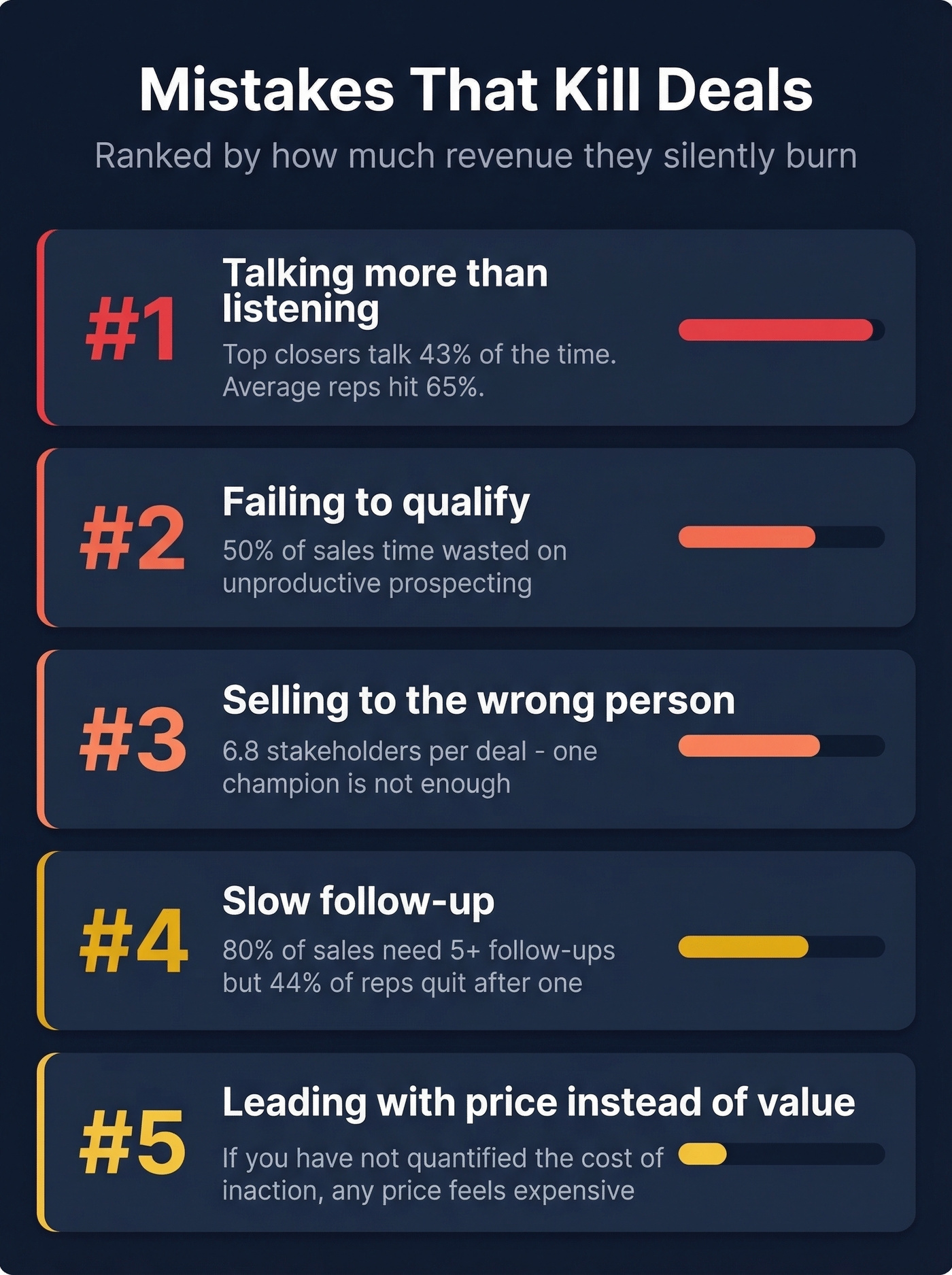
1. Talking more than listening. Gong's data is clear: top performers talk 43% of the time. Average performers hit 65%. If your reps are running through slides for 45 minutes on a "discovery" call, they're presenting - not discovering. Only 5% of B2B buyers say salespeople exceed their expectations. That number tells you everything.
2. Failing to qualify. Half of all sales time goes to unproductive prospecting and unqualified deals. If your reps can't articulate the prospect's budget range, decision timeline, and buying committee within two calls, the deal isn't qualified - it's a wish. And you can't demonstrate value if your emails never arrive. We've seen teams using verified contact data report bounce rates under 4%, compared to 30-40% with stale databases. Clean data is the prerequisite for every metric downstream.
3. Selling to the wrong person. With 6.8 average stakeholders in a B2B buying decision, talking only to your champion is a recipe for stalled deals. Map the buying committee early. If you can't get to the economic buyer by the proposal stage, you're building on sand.
4. Slow follow-up. 80% of sales need five or more follow-ups. 44% of reps give up after one. The math is simple. The first rep to respond after a trigger event has a massive advantage, and persistence isn't annoying - it's the job.
5. Leading with price instead of value. If you haven't quantified the cost of the prospect's problem, any price feels expensive. Lead with the dollar impact of inaction, not the dollar cost of your solution.
How to Build Your Sales Process
Six steps. No fluff. Each one builds on the last.
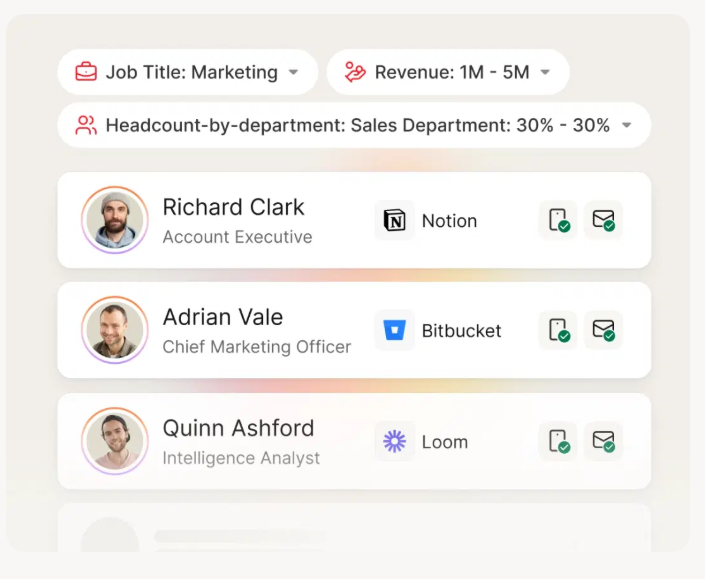
1. Define your ICP. Use the TAM/SAM/SOM framework to narrow from total addressable market to serviceable obtainable market. ZoomInfo's GTM worksheets offer a solid starting template with top-down, bottom-up, and value-theory calculation methods. Don't skip the persona layer - map the roles, buying behaviors, and evaluation criteria for each stakeholder type.
2. Map the buyer journey. 99% of B2B purchases are triggered by organizational change - a new hire, a funding round, a strategic pivot. Your selling process should align to these triggers, not to your internal stages. Work backward from how buyers actually buy, not how you wish they'd buy.
3. Set stage exit criteria. Every stage needs a clear definition of "done." Not "the rep feels good about it" - a specific, observable action. Did the prospect confirm budget? Did the economic buyer attend the demo? Did legal receive the contract? Without exit criteria, your pipeline is fiction.
4. Assign timeboxes. Qualification should take no more than 15 days. Proposal and proof of concept should resolve within 45 days. If a deal exceeds these windows without a documented reason, it's stalled - and stalled deals rarely close. Timeboxes force honest pipeline hygiene.
5. Choose a methodology. Match the methodology to your deal complexity. BANT works for simpler deals with fast decisions. MEDDICC is built for enterprise deals with multiple stakeholders and long cycles. SPIN fits consultative sales where the problem isn't obvious yet. Pick one. Train on it. Enforce it.
6. Track KPIs per stage. Don't just measure closed-won. Track stage-to-stage conversion rates, time-in-stage, and activity metrics at each step. If SQL-to-demo conversion drops, your qualification is broken. If demo-to-proposal drops, your presentations aren't landing. Stage-level metrics tell you where to intervene before it's too late.
Templates You Can Copy
B2B Template (4 Stages)
Based on Heflo's documented framework, this works well as a clean, timeboxed business selling process. Heflo also offers an editable process diagram you can download and customize.
- Lead Identification - Source and verify contacts matching ICP criteria
- Lead Qualification (15-day timebox) - Confirm need, value perception, budget, and decision-maker access
- Solution Proposal & POC (45-day timebox) - Present tailored solution, run proof of concept if needed
- Negotiation & Close - Finalize terms, get signatures, hand off to onboarding
Qualification questions to gate stage 2: Does the prospect have a clear need? Do they see value in solving it? Is budget allocated? Can you access the decision-maker?
Startup Template
From Zendesk's startup guide, five stages that work when you're still figuring things out: Prospecting, Qualifying, Quoting, Contracting, Won/Lost. For SaaS-specific stages, InAccord offers a downloadable template built from interviews with 100+ sales leaders.
If you're pre-revenue, use a spreadsheet. Seriously. A CRM adds value when you have enough volume to need pipeline visibility and forecasting. Before that, it's overhead. And when a prospect says they want more info, make a deliberate choice: do you email a one-pager, jump on a screenshare, or drive to their office? The answer depends on your ACV, not your preference.
Founder-Led Sales
Close's framework for founders who are still the primary seller:
- Sell time & information - You're consulting, not closing. Learn the market.
- Sell time + tools - Pair your expertise with early product. Validate willingness to pay.
- Sell the vision - The product is real. Now sell the outcome at scale.
The critical rule: don't hire a salesperson until you have a repeatable process. Don't hire a Head of Sales until you've onboarded 2+ profitable reps or hit $1M ARR. Sales by committee equals no accountability.
AI in the Selling Process
78% of organizations now use AI in at least one business function, up from 55% in 2023. Gartner projects that by 2027, 95% of seller research workflows will start with AI. Early adopters report 60% more demos booked, 81% shorter deal cycles, and email response rates improving by nearly 90%. Even discounting those figures by half, the directional signal is unmistakable.
Where AI fits across each stage:
- Prospecting: AI-powered data platforms surface intent signals and prioritize accounts showing buying behavior. Instead of reps manually building lists, AI identifies who's in-market right now.
- Discovery: Call transcription and analysis tools give managers real data on talk-to-listen ratios, objection patterns, and competitive mentions. No more guessing what happened on the call.
- Qualification: AI scoring models weight engagement signals, firmographic fit, and behavioral data to rank deals by likelihood to close. Reps focus on the top of the stack.
- Closing: Deal intelligence platforms flag risk signals - stalled engagement, missing stakeholders, timeline slippage - before the rep notices.
- Post-sale: AI-driven health scoring flags at-risk accounts before churn signals become obvious, giving CS teams a head start on retention.
Here's the thing: AI doesn't replace a broken sales process. It accelerates whatever you already have. If your qualification criteria are garbage, AI will help you qualify garbage faster. Fix the process first, then layer in automation.
A structured sales process only works when reps reach real buyers. Prospeo gives your team verified emails, 125M+ direct dials, and intent data across 15,000 topics - so every stage from prospecting to close runs on accurate data.
Build your pipeline on data that actually connects to decision-makers.
FAQ
What are the 7 steps of a sales process?
Prospecting, qualification, discovery, presentation, objection handling, closing, and follow-up/nurture. These seven stages form the backbone of most B2B selling motions, though the number can compress to 4-5 for lower-ACV deals or expand for complex enterprise cycles.
What's the difference between a process and a methodology?
A process defines the stages and sequence - the what and when. A methodology defines the tactics within those stages - the how. MEDDICC, SPIN, Challenger, and Sandler are methodologies. You need both working together; one without the other creates either a checklist with no playbook or tactics with no structure.
How long should a B2B sales cycle take?
The average B2B cycle runs 1-3 months, though high-value enterprise deals can exceed 5 months. If your cycle is lengthening, check qualification criteria and stakeholder mapping first - loose qualification and missing decision-makers are the top causes of timeline bloat.
How do I know if my selling process is broken?
Track stage-to-stage conversion rates. SQL-to-demo below 40% means qualification is too loose. Proposal-to-close below 15% signals a pricing, stakeholder, or value-articulation gap. Diagnose the specific stage that's leaking - overall win rate alone won't tell you where to intervene.
What tools help with the prospecting stage?
You need three categories: a CRM for pipeline visibility, an intent data platform to spot in-market accounts, and a contact data provider for verified emails and direct dials. We've found that teams pairing intent signals with verified contact data book significantly more meetings than those relying on manual list-building alone.