

The Best Sales Process Software for Every Team Size in 2026
96% of prospects research your company before they'll talk to a rep](https://blog.hubspot.com/sales/sales-statistics). By the time someone picks up the phone or replies to your sequence, they've already formed an opinion. Your sales process software isn't just a pipeline tracker - it's the infrastructure that determines whether you reach the right person, at the right time, with the right context.
And yet most teams pick their stack based on a demo and a discount. Deals closed within 50 days show a 47% win rate; after that, win rates crater to roughly 20% or lower. Speed matters. The tools you choose either accelerate that timeline or drag it out.
We've tested, implemented, and ripped out enough of these tools to know which ones actually move numbers. Here are eight worth your time - and three honorable mentions - ranked by what matters: data quality, usability, and whether the price tag makes sense for your team size.
Top Picks at a Glance
| Pick | Best For | Starting Price |
|---|---|---|
| Prospeo | Data accuracy + prospecting | Free (75 emails/mo) |
| HubSpot Sales Hub | All-in-one CRM for growth | Free; $20/seat/mo (Starter) |
| Pipedrive | Visual pipeline for SMBs | ~$18/user/mo |
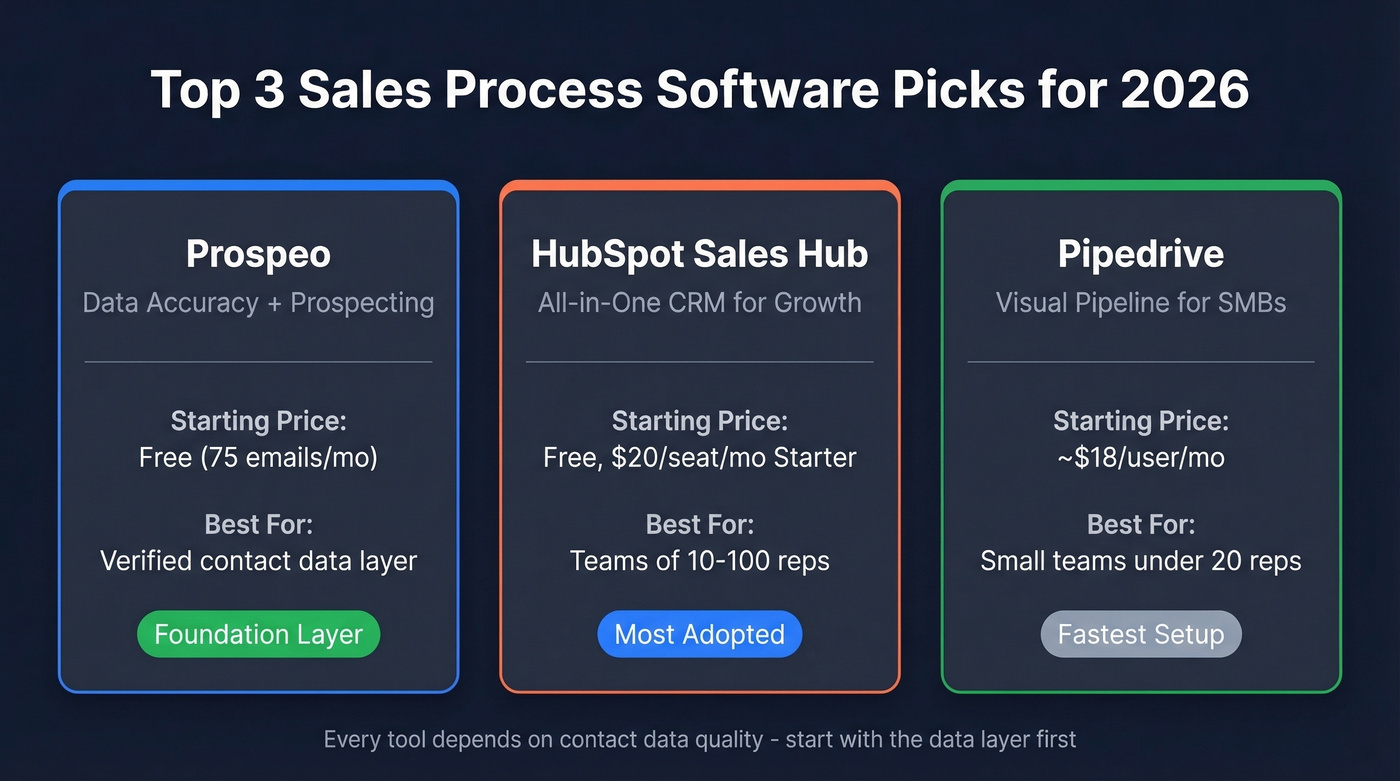
Every other tool on this list depends on contact data to function. Bad emails and dead phone numbers poison your pipeline before your CRM even touches it. That's why Prospeo sits at the top - it's the foundational layer that makes everything else work.
How Much Should You Budget?
Vendors are happy to take as much of your budget as you'll give them. Here's what you should actually spend:
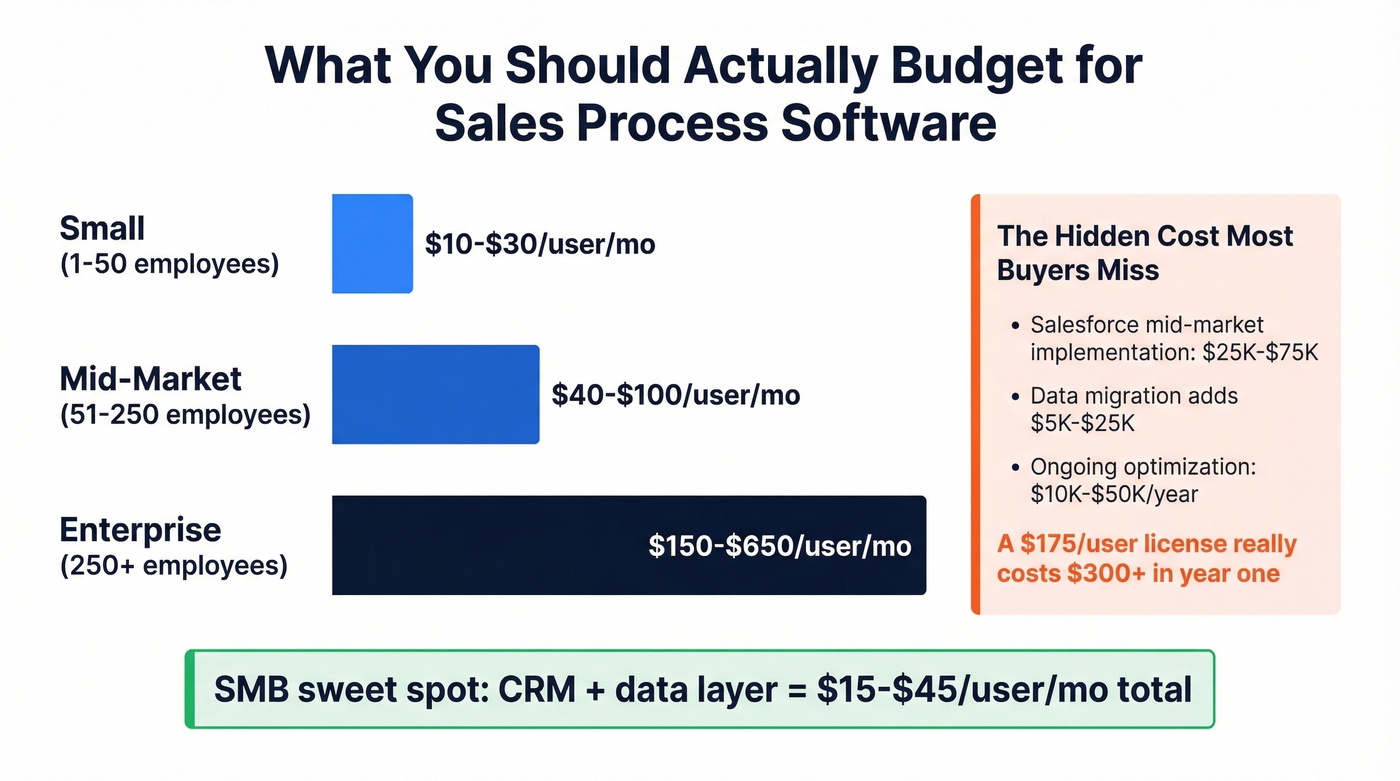
| Company Size | Employees | CRM Budget/User/Mo |
|---|---|---|
| Small | 1-50 | $10-$30 |
| Mid-market | 51-250 | $40-$100 |
| Enterprise | 250+ | $150-$650 |
Those numbers cover the CRM license only. What most buyers miss: budget 2-3x the license cost for year one on enterprise tools. Salesforce is the poster child - a mid-market implementation runs $25K-$75K, data migration adds $5K-$25K, and ongoing optimization tacks on another $10K-$50K per year. A $175/user/month license suddenly costs $300+ when you factor in the ecosystem around it.
For SMBs, the math is simpler. A CRM plus a data layer runs $15-$45/user/month total. That's a functional two-tool stack covering pipeline management and verified prospecting data.
How We Evaluated
We weighted six criteria, adapted from common evaluation frameworks across G2 and industry analysts:
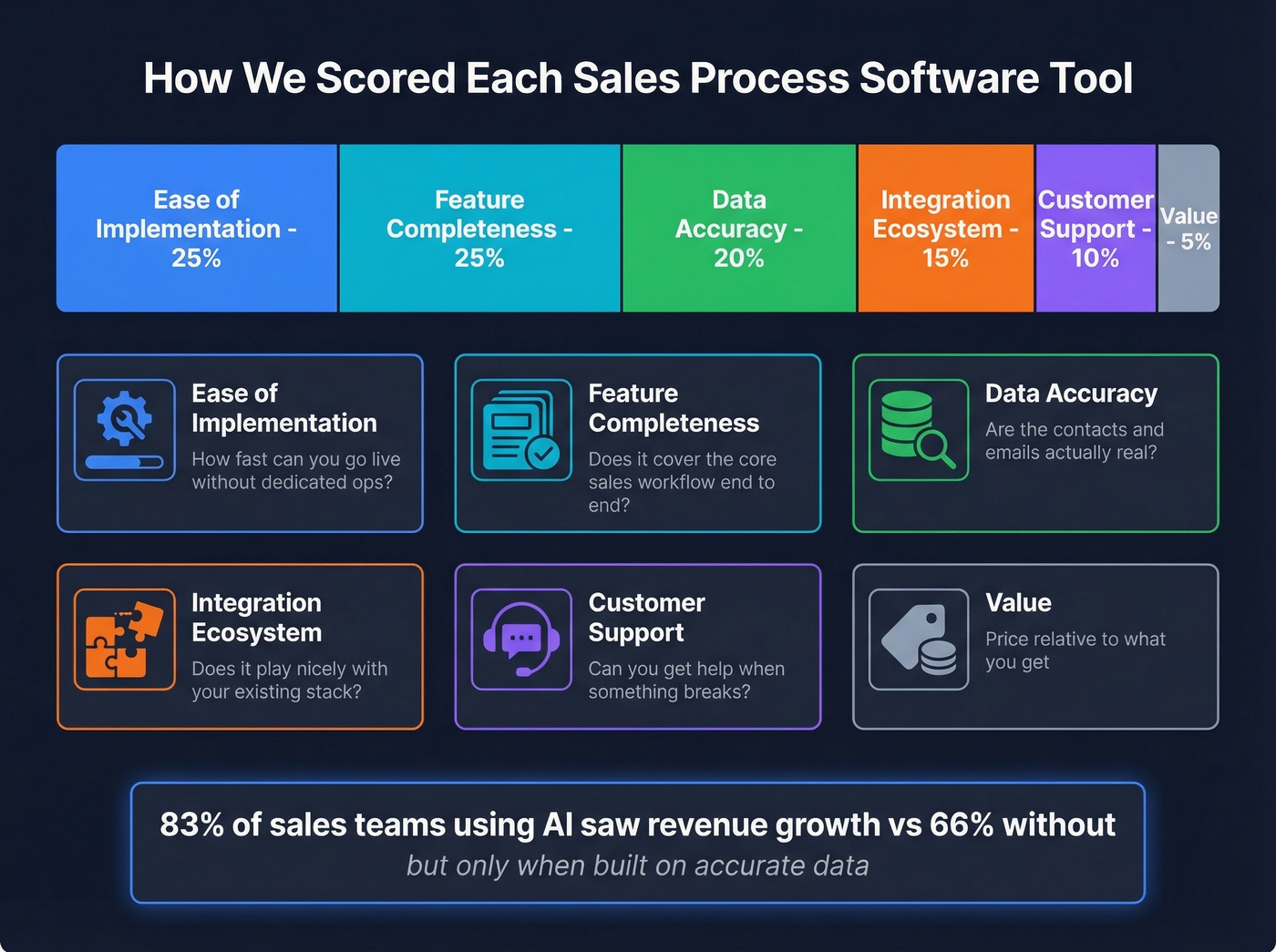
- Ease of implementation (25%) - How fast can a team go live without dedicated ops?
- Feature completeness (25%) - Does it cover the core sales workflow end-to-end?
- Data accuracy (20%) - Are the contacts, emails, and phone numbers actually real?
- Integration ecosystem (15%) - Does it play nicely with your existing stack?
- Customer support (10%) - Can you get help when something breaks?
- Value (5%) - Price relative to what you get.
One stat that shaped our thinking: 83% of sales teams using AI saw revenue growth, compared to 66% without. AI matters - but only when it's built on accurate data. G2's 2026 Best Sales Software Products list saw 60% turnover from 2025, with 30 new entrants replacing 20 returning products. The market is churning fast.
The 8 Best Tools for 2026
Prospeo - Best for Data Accuracy
Every CRM, every sequencer, every engagement tool on this list is only as good as the data feeding it.
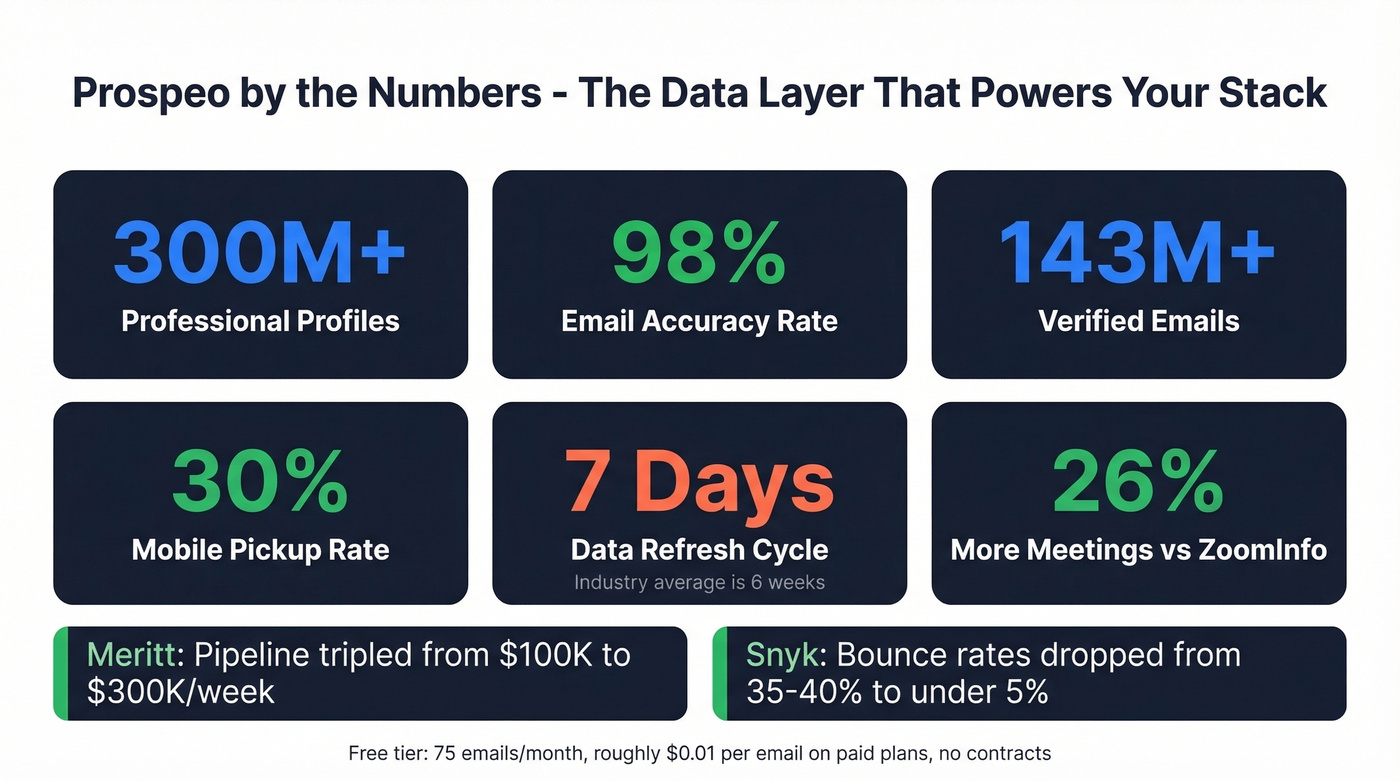
The database covers 300M+ professional profiles with 143M+ verified emails and 125M+ verified mobile numbers. Email accuracy runs at 98%, and mobile pickup rates hit 30%. But the real differentiator is the 7-day data refresh cycle - the industry average is six weeks, which means most providers are serving you contacts who've already changed jobs. In head-to-head comparisons, teams using Prospeo book 26% more meetings than ZoomInfo users and 35% more than Apollo users.

Search filters go deep: 30+ options including buyer intent powered by 15,000 Bombora topics, technographics, job changes, headcount growth, and funding signals. Pricing is credit-based at roughly $0.01 per email, with a free tier offering 75 emails per month. No contracts, no sales calls required.
The proof points speak for themselves. Meritt tripled pipeline from $100K to $300K per week. Snyk dropped bounce rates from 35-40% to under 5% and saw AE-sourced pipeline jump 180%. Integrations cover the essentials: Salesforce, HubSpot, Smartlead, Instantly, Lemlist, Clay, Zapier, and Make.
Use this if you need verified contact data that won't torch your domain reputation, and you want a self-serve platform without enterprise pricing.
Skip this if you need a standalone CRM - Prospeo is the data layer that powers your CRM, not a replacement. Pair it with Pipedrive or HubSpot.
HubSpot Sales Hub - Best All-in-One
HubSpot earns its spot through sheer usability. G2 sub-scores tell the story: Ease of Use 8.7, Ease of Setup 8.3, Quality of Support 8.6 - all higher than Salesforce - and HubSpot holds those scores across 13,565 Sales Hub reviews. It landed in G2's 2026 Top 5 Best Sales Software Products list, and for growing teams between 10 and 100 reps, it's the obvious default.
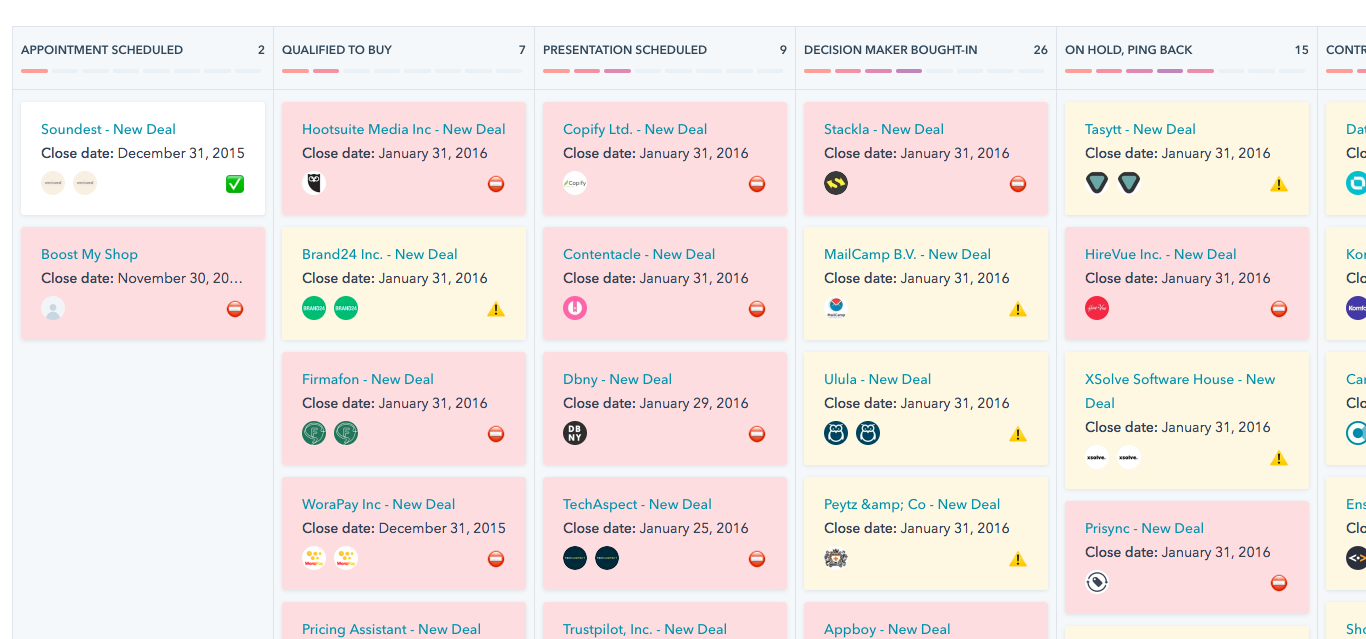
Pricing starts free, with Starter at $20/seat/month (annual billing) and Professional at $100/seat/month. Enterprise runs $150/seat/month. The catch? HubSpot gates the features that actually matter for sales teams - sequences, forecasting, custom reporting - behind the Professional tier. A top complaint theme on G2 is "missing or limited features," and that's because the Starter plan is really a glorified contact database. Budget for Professional from the start.
Use this if you want a CRM that your reps will actually adopt without a three-month training program.
Skip this if you need advanced sales features on a tight budget - the meaningful stuff lives at $100/seat/month, not $20.
G2 Rating: 4.4/5
Salesforce Sales Cloud - Enterprise Standard
Use this if you have 250+ employees, a dedicated RevOps team, and a six-figure implementation budget.
Skip this if you don't have an admin on staff. The learning curve is real and well-documented.
Official pricing runs from Free Suite ($0 for up to 2 users) through Starter Suite ($25), Pro Suite ($100), Enterprise ($175), Unlimited ($350), to Agentforce 1 Sales ($550/user/month). But the license is just the beginning.
| Cost Category | Mid-Market Range |
|---|---|
| Implementation | $25K-$75K |
| Data migration | $5K-$25K |
| Annual optimization | $10K-$50K/yr |
| Add-ons (engagement, AI) | $50-$75/user/mo |
G2 sub-scores confirm the tradeoff: Ease of Use 8.2, Setup 7.8, Support 8.1 - all below HubSpot. You're paying for depth, customization, and an ecosystem that can handle genuinely complex sales processes. If you need that, nothing else comes close. If you don't, you're hiring a full orchestra when you need a guitarist.
G2 Rating: 4.4/5
Pipedrive - Best Visual Pipeline for SMBs
Pipedrive is underrated. Pricing lands around $18-$95/user/month depending on tier, and there's a 14-day free trial with no credit card required. The drag-and-drop pipeline view is genuinely one of the best in the category for small teams who think visually about their deals.

We've seen teams of 3-5 reps get fully operational on Pipedrive in a single afternoon. Try doing that with Salesforce. The tradeoff is depth - if you need custom objects, complex workflows, or enterprise-grade forecasting, you'll outgrow it. But for teams under 20 reps running a straightforward process, it's the sweet spot.
Use this if you want a CRM that does one thing - visual pipeline management - better than tools costing 5x more.
Skip this if you need robust reporting or marketing automation. Lower tiers have limited analytics, and there's no built-in marketing suite.
Close - Best for Outbound-Heavy Teams
Close packs calling, email, and SMS into the CRM itself, which eliminates the "which tab am I in?" problem that plagues outbound teams juggling separate tools. Pricing starts at $9/seat/month (Solo, annual) and scales through Essentials ($35), Growth ($99), to Scale ($139/seat/month).
Here's the thing about Close: it's the most honest CRM about what outbound actually costs. But the add-on creep is real. Call Assistant runs $50/month per org plus $0.02/minute. Premium phone numbers cost $19/line/month. Call recording retention is just 30 days on lower tiers. Add-ons can increase your effective per-user cost by 40-75% above the base price. Budget for the real number, not the sticker price.
One constraint worth knowing: SMS availability is limited to the US, Canada, UK, and Australia.
Zoho CRM - Best Budget Option
Zoho gives you a free plan for 3 users and paid tiers from $14-$52/user/month. The feature set at each price point is genuinely impressive - workflow automation, AI predictions, and a broad integration ecosystem. Zia, Zoho's AI assistant, handles lead scoring, deal predictions, and anomaly detection.
The tradeoff is the UI, which feels a generation behind Pipedrive or HubSpot. If your team values aesthetics and intuitive design, Zoho will frustrate them. If they value functionality per dollar, it's hard to beat.
Freshsales - Best for Startups
Freshsales starts free for 3 users, with paid plans at $9/user/month and a generous 21-day trial. Capterra rates it 4.5/5 across 621 reviews, with 79% of reviewers coming from small businesses - that's the audience it's built for. The Freddy AI assistant handles lead scoring and next-best-action suggestions on paid plans out of the box.
One cost to watch: the AI add-on runs $100 per 1,000 sessions, which adds up fast if your team leans on it heavily.
Monday CRM - Best for Cross-Functional Teams
Monday's project management DNA is its superpower for sales teams that work closely with marketing, CS, or product. Free for up to 2 seats, then Basic ($9/seat), Standard ($12/seat), Pro ($19/seat), with Enterprise custom pricing. Annual billing saves 18%.
The CRM itself is simpler than HubSpot or Salesforce, but the ability to have your entire company working in one platform - sales pipelines next to project boards next to marketing calendars - is genuinely useful for teams under 50 where roles overlap and everyone shares workflows.
Honorable Mentions
Apollo.io covers prospecting and engagement in one platform, with a free tier and paid plans from $49+/user/month. It's the best hybrid option if you want a database and a sequencer without buying two tools.
Outreach is the enterprise engagement standard with pricing that typically starts around $100/user/month. Their Kaia AI assistant closes deals 11 days faster on average, with win rate lifts of up to 10 points on deals over $50K.
Nutshell starts at $13/user/month and earns a Capterra 4.4/5 across 618 reviews, with 71% of reviewers from small businesses. It's the simplest SMB CRM on this list - if you want something your team can learn in an hour, start here.

Every tool on this list depends on accurate contact data to function. Prospeo delivers 98% email accuracy, 125M+ verified mobiles, and a 7-day refresh cycle - so your CRM, sequencer, and engagement tools actually connect reps to real buyers instead of dead leads.
Fix the data layer and your entire sales process accelerates.
Full Pricing Comparison
| Tool | Starting Price | Mid-Tier | Enterprise | Free Tier? | Rating |
|---|---|---|---|---|---|
| Prospeo | ~$0.01/email | Credit-based | Custom | Yes (75/mo) | - |
| HubSpot | $20/seat/mo | $100/seat/mo | $150/seat/mo | Yes | 4.4/5 G2 |
| Salesforce | $25/user/mo | $175/user/mo | $350-$550/user/mo | Yes (2 users) | 4.4/5 G2 |
| Pipedrive | ~$18/user/mo | ~$65/user/mo | ~$95/user/mo | 14-day trial | - |
| Close | $9/seat/mo | $99/seat/mo | $139/seat/mo | No | - |
| Zoho CRM | $14/user/mo | $23/user/mo | $40-$52/user/mo | Yes (3 users) | - |
| Freshsales | $9/user/mo | $39/user/mo | $59/user/mo | Yes (3 users) | 4.5/5 Capterra |
| Monday CRM | $9/seat/mo | $19/seat/mo | Custom | Yes (2 seats) | - |
For context: ZoomInfo charges roughly $1 per lead. Prospeo runs at ~$0.01 per lead. That's a 90% cost reduction on the data layer alone - before you even factor in accuracy differences. Close users should note that add-ons can push effective costs 40-75% above the base prices shown here.
The Data Layer Nobody Talks About
Here's what every CRM comparison article ignores: 40% of CRM data goes stale within a month. Reps spend 5+ hours per week manually updating contact records. No amount of pipeline automation fixes a process built on wrong emails and dead phone numbers.

This is where most sales stacks quietly fail. You buy HubSpot or Salesforce, load it with contacts from a database that refreshes every six weeks, and wonder why bounce rates are climbing and connect rates are dropping. The CRM isn't the problem. The data is.
A 5-step verification process - including catch-all domain handling, spam-trap removal, and honeypot filtering - paired with a 7-day refresh cycle means you're not calling people who left the company last month. The results back this up across multiple teams: Snyk cut bounce rates from 35-40% to under 5% after switching data providers, Stack Optimize maintains 94%+ deliverability and sub-3% bounce rates across all their clients with zero domain flags, and GreyScout saw bounce rates drop from 38% to under 4% while pipeline jumped 140% and rep ramp time was cut from 8-10 weeks down to 4.
Let's be honest: you can spend $175/user/month on Salesforce and still have reps sending emails that bounce. Or you can spend $0.01 per email on verified data and make every tool in your stack perform better. The data layer isn't optional.
Teams using Prospeo book 26% more meetings than ZoomInfo users and 35% more than Apollo users. At $0.01 per email with no contracts, it's the highest-ROI addition to any sales process stack - from a two-tool SMB setup to a full enterprise motion.
Stop budgeting for tools that run on bad data.
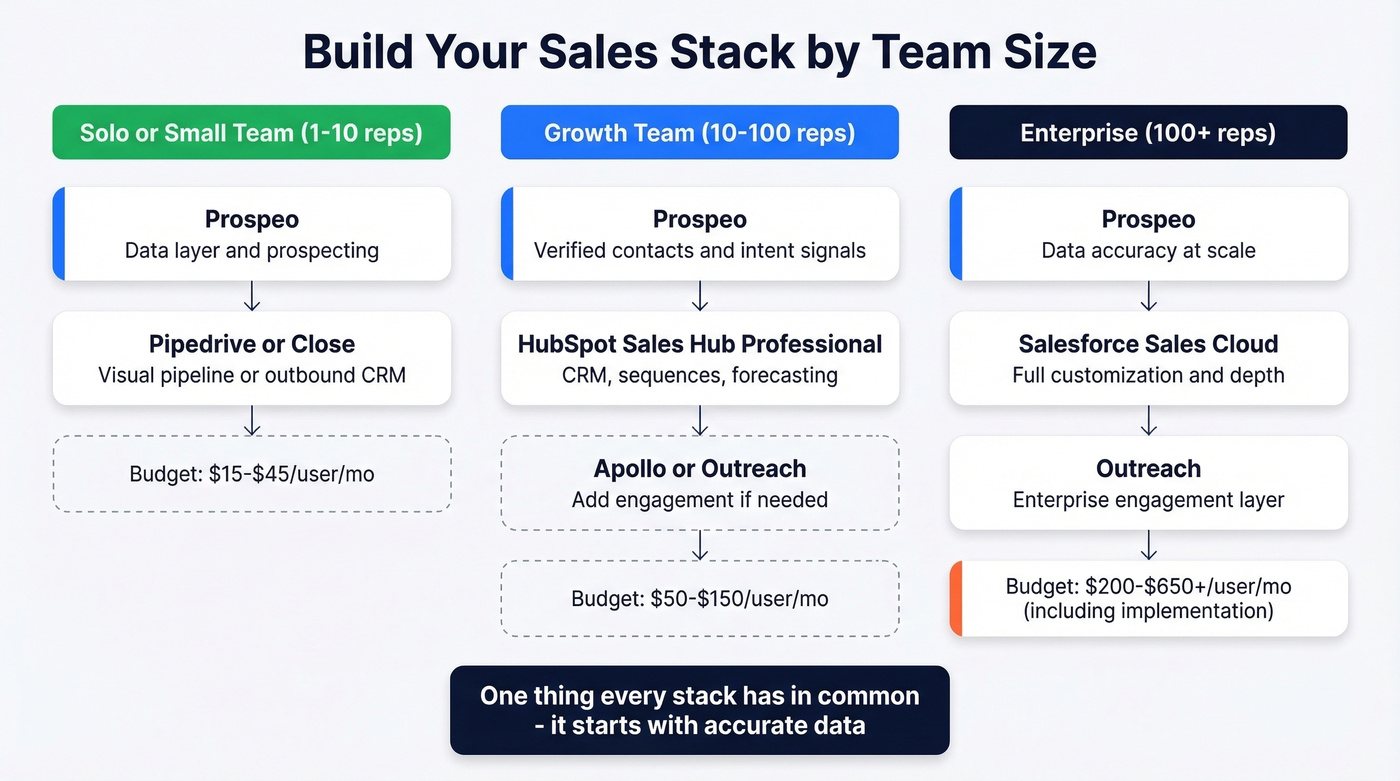
Build Your Stack by Team Size
You don't need 30 tools. You need 2-3 that actually talk to each other.
| Team Size | Stack | Monthly Budget |
|---|---|---|
| Solo / Small (1-10 reps) | Pipedrive + data layer | ~$30/user/mo |
| Growth (10-50 reps) | HubSpot Professional + data layer | ~$110/user/mo |
| Enterprise (50+ reps) | Salesforce + Outreach + data layer | $200+/user/mo + implementation |
Solo / Small Team (1-10 reps): Pipedrive plus a verified data layer. Budget ~$30/user/month total. Pipedrive handles your pipeline visually, verified contacts feed it clean data, and you can be operational by end of day.
Growth Team (10-50 reps): HubSpot Sales Hub Professional plus a data layer. Budget ~$110/user/month. HubSpot gives you sequences, forecasting, and reporting. A verified data layer ensures those sequences actually reach real inboxes. This is the stack where most Series A through C companies should land.
Enterprise (50+ reps): Salesforce + Outreach + a verified data layer. Budget $200+/user/month for licenses, plus $75K-$300K for Salesforce implementation. Salesforce handles complex pipeline and forecasting. Outreach runs multi-channel engagement. A fresh data layer keeps contact data accurate across both.
In our experience, if your average deal size is under $15K, you probably don't need Salesforce-level infrastructure. A growth stack at $110/user/month gets you 80% of the capability at 30% of the total cost. Save the enterprise spend for when deal complexity actually demands it.
Sales Process Software FAQ
What's the difference between a CRM and sales process software?
A CRM is one category within the broader sales process software space, which also includes engagement platforms like Outreach and Close, data providers, forecasting tools, and enablement platforms. Some vendors market their product as "sales program software," emphasizing structured playbooks and coaching workflows alongside pipeline management. Most teams start with a CRM and layer additional tools as their process matures.
How much does a small team spend?
Small teams typically spend $10-$30/user/month on a CRM plus $5-$15/user for a data layer. Total budget: $15-$45/user/month for a functional two-tool stack covering pipeline management and verified prospecting data.
Do I need Salesforce?
Only if you have 250+ employees, a dedicated RevOps team, and a six-figure implementation budget. For everyone else, HubSpot or Pipedrive paired with a strong data layer delivers 80% of the value at a fraction of the cost. We've seen too many mid-market teams buy Salesforce and spend the next year just trying to configure it.
What feature matters most?
Data accuracy. 83% of sales teams using AI saw revenue growth - but AI is only as good as the data feeding it. Prioritize tools that keep your contact data fresh and verified. Everything else - automation, forecasting, engagement sequences - builds on that foundation.
Can I start with free tools?
Yes. HubSpot, Salesforce, Zoho, Freshsales, and Monday all offer free tiers. Prospeo's free plan includes 75 verified emails per month. You'll hit feature limits quickly, but free plans work well for validating your process and proving ROI before committing budget. Start free, upgrade when the constraints start costing you deals.