

Sales Qualifying Questions That Actually Close Deals
Reps who ask more sales qualifying questions on discovery calls don't win more deals - they lose more. Gong's analysis of 326K sales calls found that lost deals averaged around 20 questions while won deals averaged 15-16. The problem isn't effort. It's precision.
Most qualifying question lists give you the words without teaching you what good answers sound like. A question is just a prompt. The skill is interpretation - knowing whether the answer you just heard is a green flag or a deal that'll stall in three weeks.
One documented framework rollout improved forecast accuracy from 62% to 89%. That's the gap between a pipeline you can trust and one that collapses every quarter-end.
The Data Behind Better Discovery Calls
The 519K-call analysis from Gong is one of the largest benchmarks we've got on discovery calls, and the findings are counterintuitive.
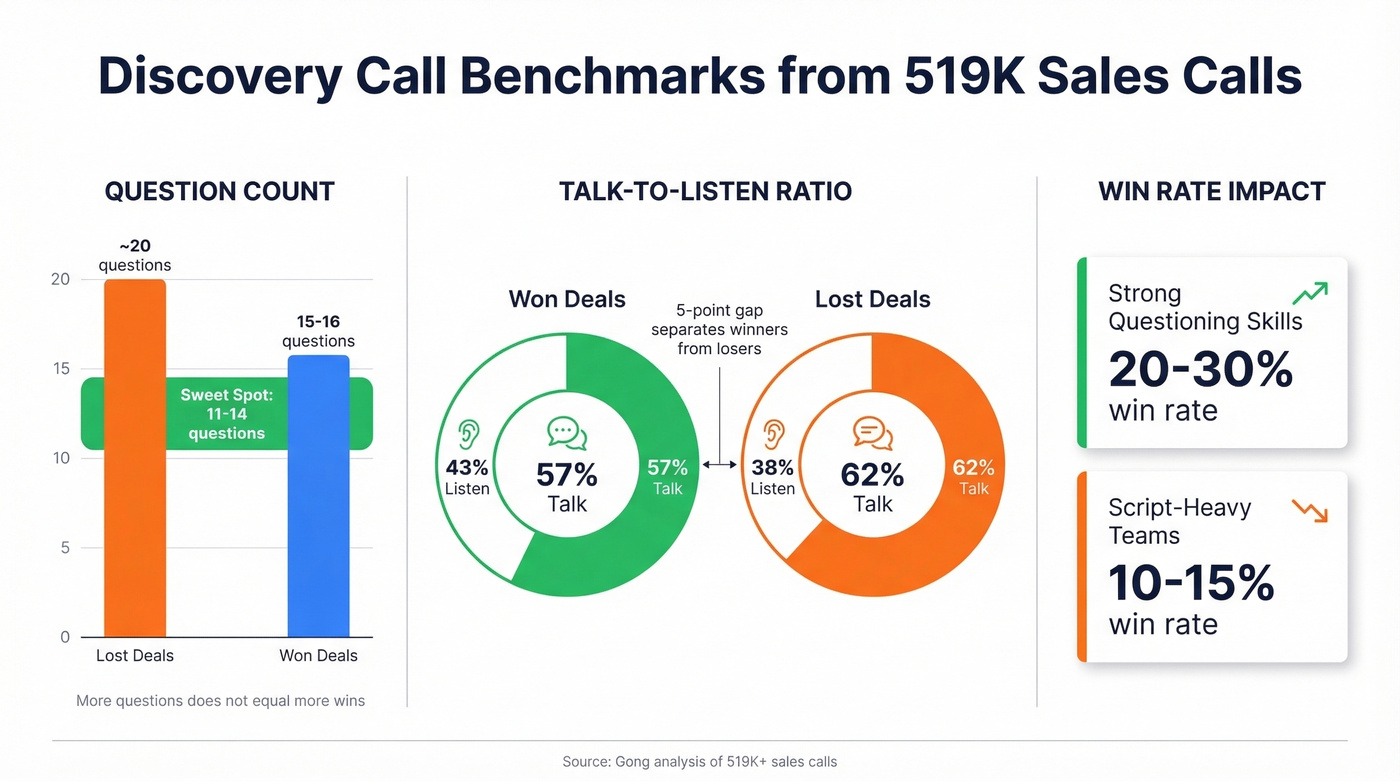
The optimal range is 11-14 targeted questions. Go beyond that and success rates drop back toward average. The issue isn't just quantity - it's sequencing. Top reps spread their questions evenly throughout the conversation. Average reps front-load them like a checklist, creating an interrogation dynamic that kills rapport before the prospect ever opens up.
Talk ratio tells a similar story. Won deals feature about 57% talk / 43% listen. Lost deals run at 62% talk / 38% listen. That five-point gap means winning reps shut up more and let the prospect reveal what matters. Teams with strong questioning skills report 20-30% win rates while script-heavy teams hover in the low teens.
The takeaway: ask fewer questions, space them out, and let the prospect fill the silence.
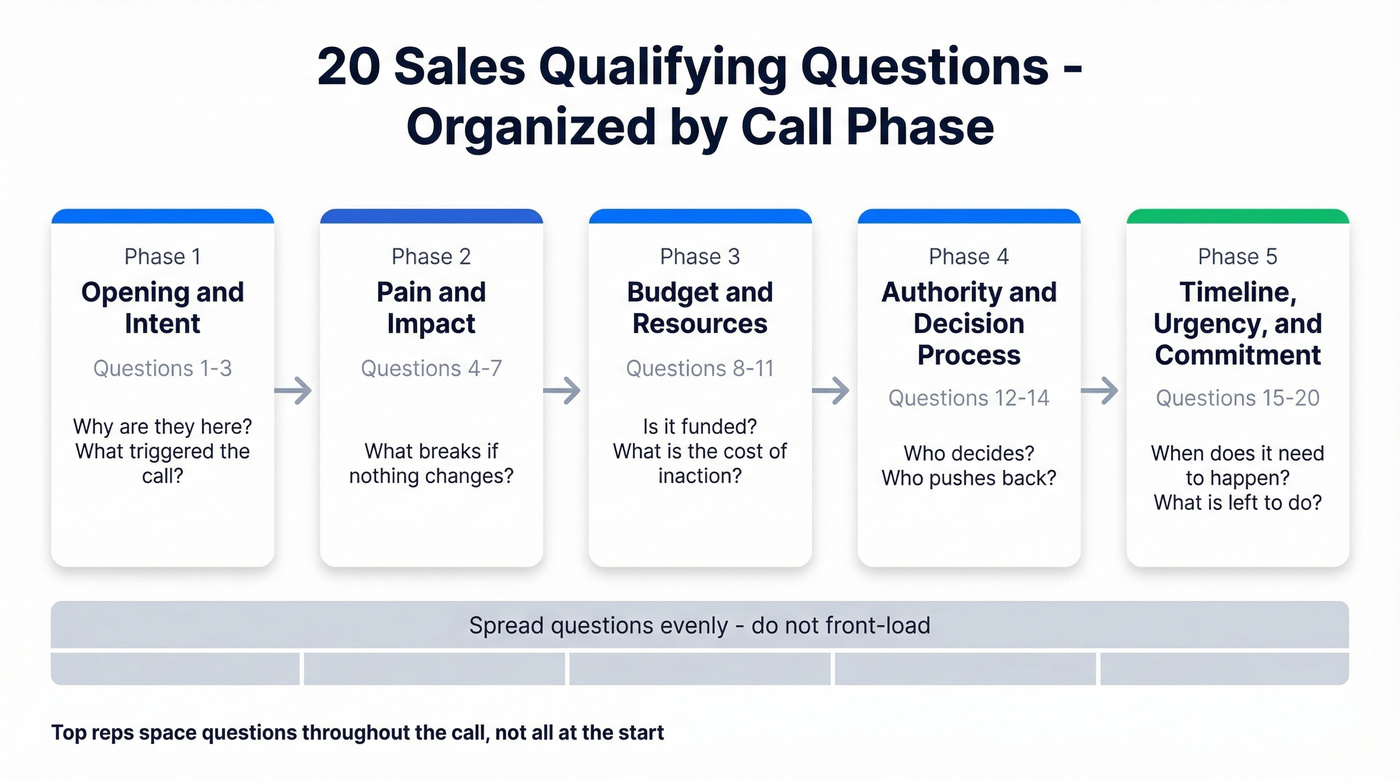
20 Best Questions by Call Phase
These aren't theoretical. They're pulled from what top reps share on r/sales and in discovery call teardowns, organized by where they belong in a conversation. Each one includes what a good answer sounds like and what should make you nervous.
Opening & Intent
1. "What's going on in your world that made you decide to talk to me?" The single best opener in sales. It's disarming, open-ended, and immediately reveals intent. Green flag: "We've been evaluating solutions since Q1 and narrowed to three vendors." Red flag: "My boss told me to take the call."
2. "Why hasn't this problem been fixed before today?" Surfaces prior attempts, internal politics, and urgency in one shot. If they've tried and failed, you'll learn what didn't work. If they haven't tried, you'll learn whether this is a real priority or a nice-to-have.
3. "Why did you agree to meet with me today?" More direct than #1, useful when the prospect was inbound. Green flag: they reference a specific trigger event. Red flag: "Just exploring options" with no timeline attached.
One caution on phrasing: "why" questions can trigger defensiveness. "What's driving this?" lands better than "Why are you looking at this now?" Watch the prospect's body language and adjust.
Pain & Impact
4. "What happens if nothing changes?" This separates discovery from small talk. If the prospect can't articulate consequences, the deal will stall. Green flag: quantified impact like "We're losing $40K/month in churn." Red flag: vague hand-waving with no numbers.
5. "If you didn't solve this in the next 6-12 months, what would the impact be?" Forces a time horizon onto the pain. Prospects who can project forward are further along in their buying process.
6. "How does this affect you personally?" People buy for personal reasons and justify with business logic. When someone says "I'm the one who gets the call at 2 AM when this breaks," you've found your champion's fuel. That kind of answer tells you more about deal momentum than any budget question ever will.
7. "What does success look like for you - specifically?" Anchors the conversation to outcomes, not features. Green flag: measurable criteria. Red flag: "We just want something better than what we have."
Budget & Resources
8. "Is this project funded?" Direct and efficient. Don't dance around money. Green flag: "Yes, it's in our Q3 budget." Red flag: "We don't really have a budget yet" - especially past initial discovery.
9. "What's the cost of doing nothing?" Reframes budget from "can we afford this?" to "can we afford not to?" Particularly effective with price-sensitive prospects because it shifts the anchor from your price to their pain.
10. "How are you navigating the process of choosing a solution?" Reveals whether there's a formal evaluation, a committee, competing vendors, or just one person Googling on a Friday afternoon. Each scenario requires a completely different sales motion.
11. "What would need to be true for this to be worth the investment?" Gets the prospect to define their own ROI threshold. Now you're building the business case together instead of pitching at them. This is one of the strongest qualifying questions for sales because it turns the prospect into a co-author of the deal.
Authority & Decision Process
12. "Who else needs to be involved before you can move forward?" The most important qualification question in complex deals. If the answer is "just me," verify it. If it's a list of names, you've just mapped the buying committee.
13. "What's your typical process for approving a purchase like this?" Surfaces procurement, legal review, board approval, and other steps that can add weeks or months. Green flag: they describe the process in detail. Red flag: "I'm not sure - I'll have to check."
14. "Who would push back on this internally, and why?" Proactively identifies detractors. A champion answers this honestly. A fan says "everyone's on board" - which is almost never true.
Here's the thing: a champion spends political capital. They share internal decks, map the org chart for you, bring detractors to the table, and get procurement involved early. A fan just nods along in your meetings and goes silent when it's time to push internally. Question #14 is your litmus test.
Before you run authority questions, make sure you're talking to the actual decision-maker. Prospeo's database covers 300M+ professional profiles with 30+ search filters - search by seniority, department, and job title - and returns 98%-accurate verified emails and direct mobile numbers. Spend your discovery call qualifying, not figuring out who to talk to.

Timeline & Urgency
15. "What's driving your timeline?" External deadlines - contract renewals, compliance dates, board meetings - are real urgency. Internal preferences like "we'd like to have this done by Q4" are soft. Know the difference.
16. "When does this need to be live, and what happens if it's not?" Adds consequences to the timeline question. Green flag: "Our current contract expires March 31 and there's a 60-day migration window." Red flag: no external deadline, no consequences for delay.
17. "What other priorities are competing for your team's time right now?" Even funded, urgent projects die when they're fifth on the priority list. This reveals where you actually sit in their stack rank.
Commitment & Next Steps
18. "Are there any reasons not to move forward together?" Proactive objection surfacing. Most reps wait for objections to appear. Top reps invite them. Green flag: specific, addressable concerns like "We need to confirm SSO integration." Red flag: silence or "let me think about it."
19. "What's the main reason you would hesitate to go ahead with this?" A softer version of #18 that works well when you sense unspoken concerns. The phrasing gives them permission to be honest.
20. "What needs to happen between now and a signed contract?" Maps every remaining step. If the prospect can't answer this, they haven't thought through their own buying process - which means you need to help them build one.
Which Qualification Framework Fits
Some teams add an ICP-fit check before running any framework, confirming the account matches your ideal customer profile before investing discovery time. Once you've cleared that gate, pick one of these and commit.
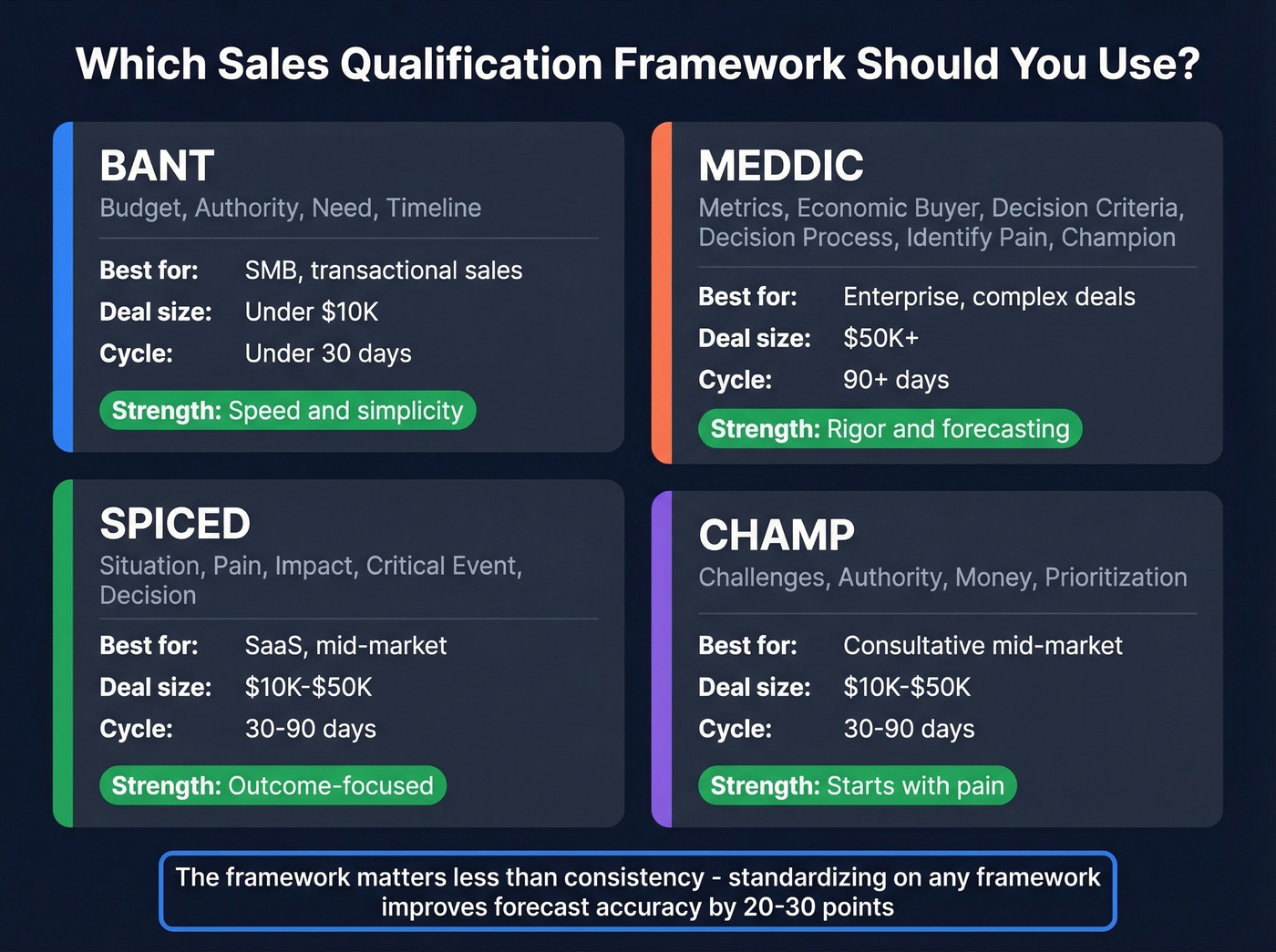
| Framework | Best For | Deal Size / Cycle | Key Strength |
|---|---|---|---|
| BANT | SMB / transactional | Under $10K / Under 30 days | Speed, simplicity |
| MEDDIC | Enterprise / complex | $50K+ / 90+ days | Rigor, forecasting |
| SPICED | SaaS / mid-market | $10K-$50K / 30-90 days | Outcome-focused |
| CHAMP | Consultative mid-market | $10K-$50K / 30-90 days | Starts with pain |
BANT works as a pre-filter for high-velocity motions. If you're closing deals in two calls, you don't need MEDDIC's depth - you need speed. MEDDIC (or MEDDPICC, which adds Paper Process and Competition) is built for enterprise deals where six-figure contracts require multi-stakeholder consensus over months. The tradeoff: MEDDIC slows deals if applied rigidly to smaller opportunities.
SPICED fits SaaS mid-market well because it's structured around the customer's situation and desired impact rather than the seller's checklist. CHAMP starts with challenges rather than budget, which works for consultative sales where the prospect doesn't know what they need yet.
Let's be honest: consistency matters more than which framework you choose. Teams that standardize on any framework see forecast accuracy improvements in the 20-30 point range. Teams that let reps freelance see pipeline fiction.
If your average deal closes under $15K, skip MEDDIC. You need BANT, a timer, and the discipline to disqualify in the first five minutes. Most teams over-engineer their qualification process for the deal size they're actually closing.

Every qualifying question you waste on the wrong contact is a question that never closes a deal. Prospeo's 300M+ profile database lets you filter by seniority, department, and title so you walk into discovery calls already talking to the decision-maker - with 98%-accurate emails and verified direct dials.
Qualify deals, not whether you're talking to the right person.
Enterprise vs SMB Qualification
The same core questions work in both contexts. The depth of answers you need - and the number of people you need them from - changes dramatically.
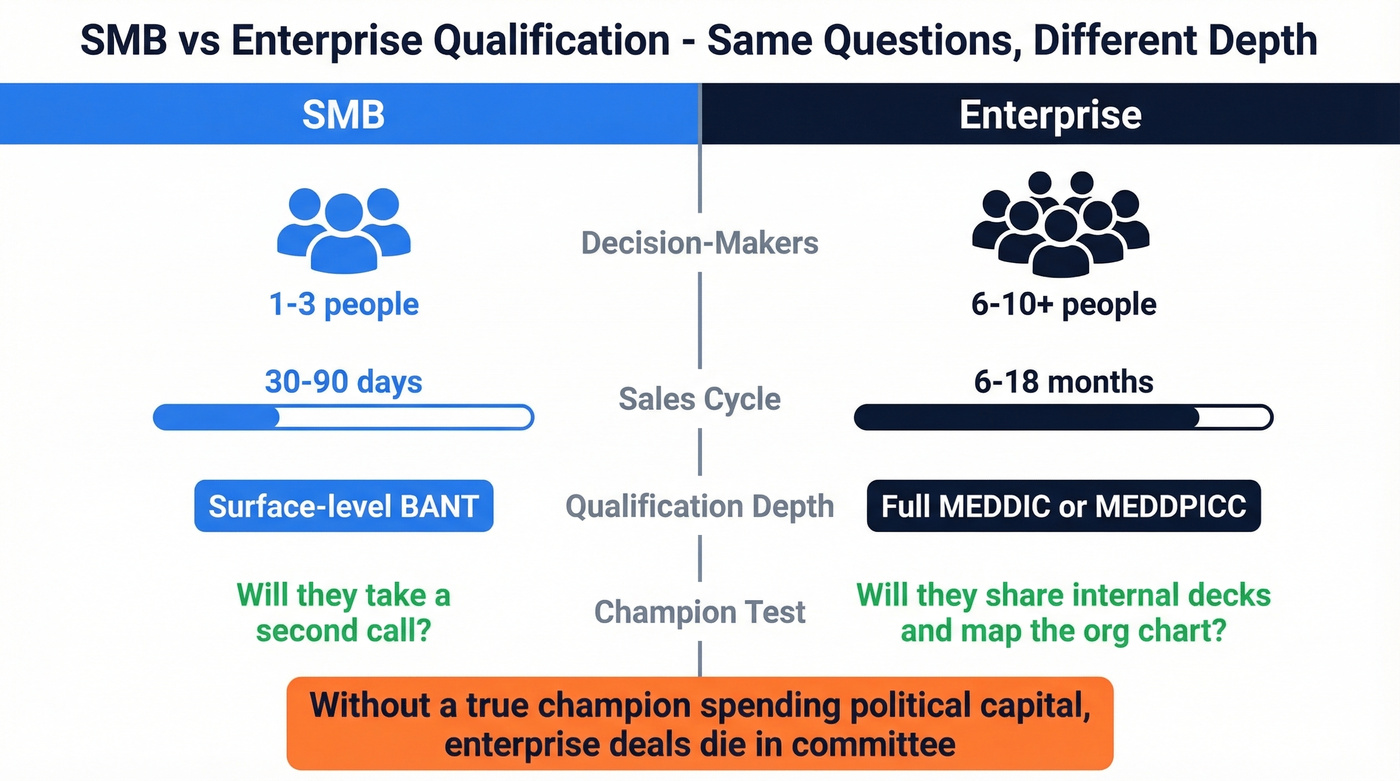
| Dimension | SMB | Enterprise |
|---|---|---|
| Decision-makers | 1-3 | 6-10+ |
| Sales cycle | 30-90 days | 6-18 months |
| Qualification depth | Surface-level BANT | Full MEDDIC/MEDDPICC |
| Champion test | Will they take a second call? | Will they share internal decks and map the org? |
In SMB, you're qualifying a single person's authority and budget in one call. In enterprise, you're qualifying an entire buying committee over multiple months. The champion vs fan distinction becomes make-or-break here - without a true champion spending political capital across a 6-10 person buying committee, your deal dies in committee.
Five Mistakes That Kill Deals
Interrogation mode. Front-loading all your questions in the first ten minutes turns discovery into a deposition. Top reps spread questions evenly throughout the call, spacing them between insights, stories, and genuine conversation.
The "send me a proposal" trap. One of the most-discussed pipeline killers on r/sales. When a prospect says "just send me a proposal," most reps comply. Don't. Proposals become floating documents that get shopped, ignored, or used to negotiate you down. The gating rule: no proposal goes out unless a review meeting is scheduled with the right stakeholders.
Confusing curiosity with buying intent. Interest isn't commitment. A prospect who asks great questions and seems engaged might just be researching for a future budget cycle or benchmarking your price against their current vendor. Qualify the timeline and budget, not just the enthusiasm.
Stage progression without proof. Moving a deal from "Discovery" to "Proposal" because you had a good call - without confirming budget, authority, and timeline - is pipeline fraud, even if it's unintentional. Every stage gate should require specific evidence.
Skipping disqualification. The best qualifiers aren't afraid to kill deals early. We've seen teams cut their pipeline by 40% and close more revenue in the same quarter just by disqualifying faster. Treating every lead as viable inflates your pipeline, wastes selling time, and destroys forecast accuracy.
How to Read the Answers
The question is only half the skill. Interpretation is the other half, and it's what separates reps who run great discovery from reps who just recite a script.
| Category | Green Flag | Red Flag |
|---|---|---|
| Budget | "It's in our Q3 budget at $X" | "We don't have a budget yet" |
| Authority | Names specific stakeholders + process | "I'll have to check" |
| Need | Quantified pain with timeline | Vague dissatisfaction, no urgency |
| Timeline | External deadline with consequences | "Sometime this year, maybe" |
| Champion | Shares internal docs, maps org | Says "everyone's on board" |
One pattern we see repeatedly: the prospect who checks every box - big budget, wants to sign next week, loves the product - and then becomes your worst customer. They had hidden expectations, unrealistic timelines, or were fleeing a previous vendor for reasons they didn't disclose.
The question "Why did you leave your last provider?" catches this. If the answer is all blame and no self-awareness, proceed carefully.
Green flags aren't just about having budget and authority. They're about answer quality. A prospect who says "We want to reduce costs" is less qualified than one who says "We need to improve reliability so our engineering team can focus on product instead of firefighting." The first is price-focused. The second is value-focused. You'll close both differently, and the second will be a better customer.
Question #12 asks 'who else needs to be involved?' - but top reps already know the answer. Prospeo maps entire buying committees with 30+ filters including department headcount, seniority, and job title. At $0.01 per verified email, mapping a 5-person committee costs less than a coffee.
Map the buying committee before your first discovery call.
FAQ
How many qualifying questions should I ask?
The 519K-call benchmark puts the sweet spot at 11-14 targeted questions per discovery call. Beyond that, success rates drop. Space them throughout the conversation and focus on open-ended business impact rather than yes/no confirmations.
What's the best sales qualification framework?
BANT works for transactional deals under $10K, MEDDIC for $50K+ enterprise cycles, and SPICED for SaaS mid-market. Standardized teams see forecast accuracy jump 20-30 points regardless of which framework they pick - consistency is the real variable.
What's the single best opener for a discovery call?
"What's going on in your world that made you decide to talk to me?" It's disarming, open-ended, and immediately surfaces intent and urgency. From there, layer in pain, budget, and authority questions based on what the prospect reveals.
How do I find the right decision-maker before qualifying?
Use a B2B database to search by job title, seniority, and department before you pick up the phone. Prospeo covers 300M+ profiles with 98% email accuracy and 125M+ verified mobile numbers, so your first call reaches the person who can actually say yes.