

The Sales Questionnaire Guide: Questions, Templates & Frameworks
Most "sales questionnaire" resources are just 50+ generic questions dumped into a blog post with no guidance on order, count, or framework. That's not a questionnaire - it's a word document. Analysis of 519,000+ B2B sales call recordings found the sweet spot is 11-14 targeted questions, not 70. Here's how to build one that actually moves deals forward.
What the Data Says About Question Count
Gong Labs studied those 519K+ recordings and the findings are blunt: discovery calls with 11-14 targeted questions consistently outperform calls with more or fewer. Go beyond 14 and success rates drop back to average. You're interrogating, not qualifying.
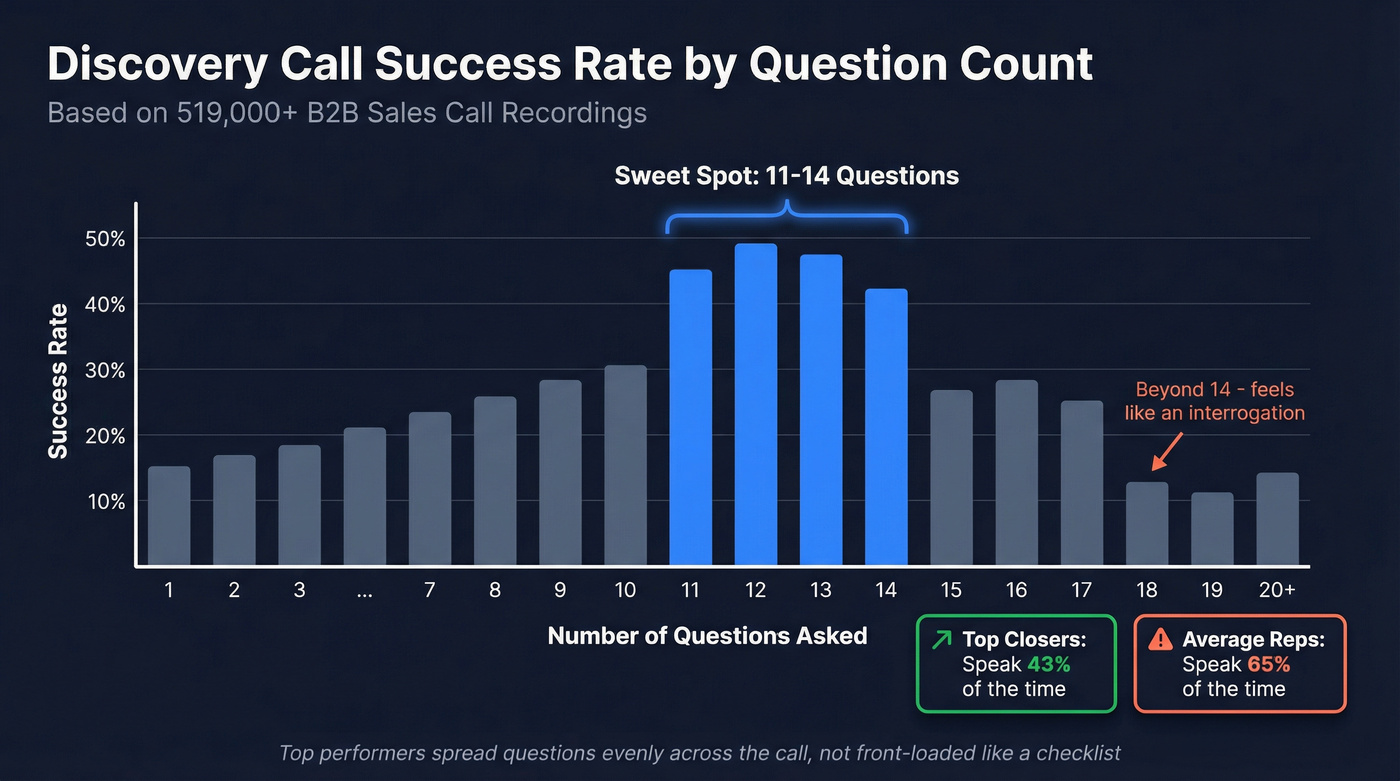
Distribution matters just as much as count. Top performers spread questions evenly across the conversation, while average reps front-load them like a checklist and run out of things to ask halfway through. The talk-to-listen ratio backs this up - top-closing reps speak 43% of the time versus 65% for average performers.
One small phrasing shift makes a surprising difference. Swapping "What's your biggest challenge?" for "Can you help me understand your biggest challenge?" produces longer, more detailed answers. That extra clause signals you want depth, not a one-liner.
Discovery Call Structure: Phase by Phase
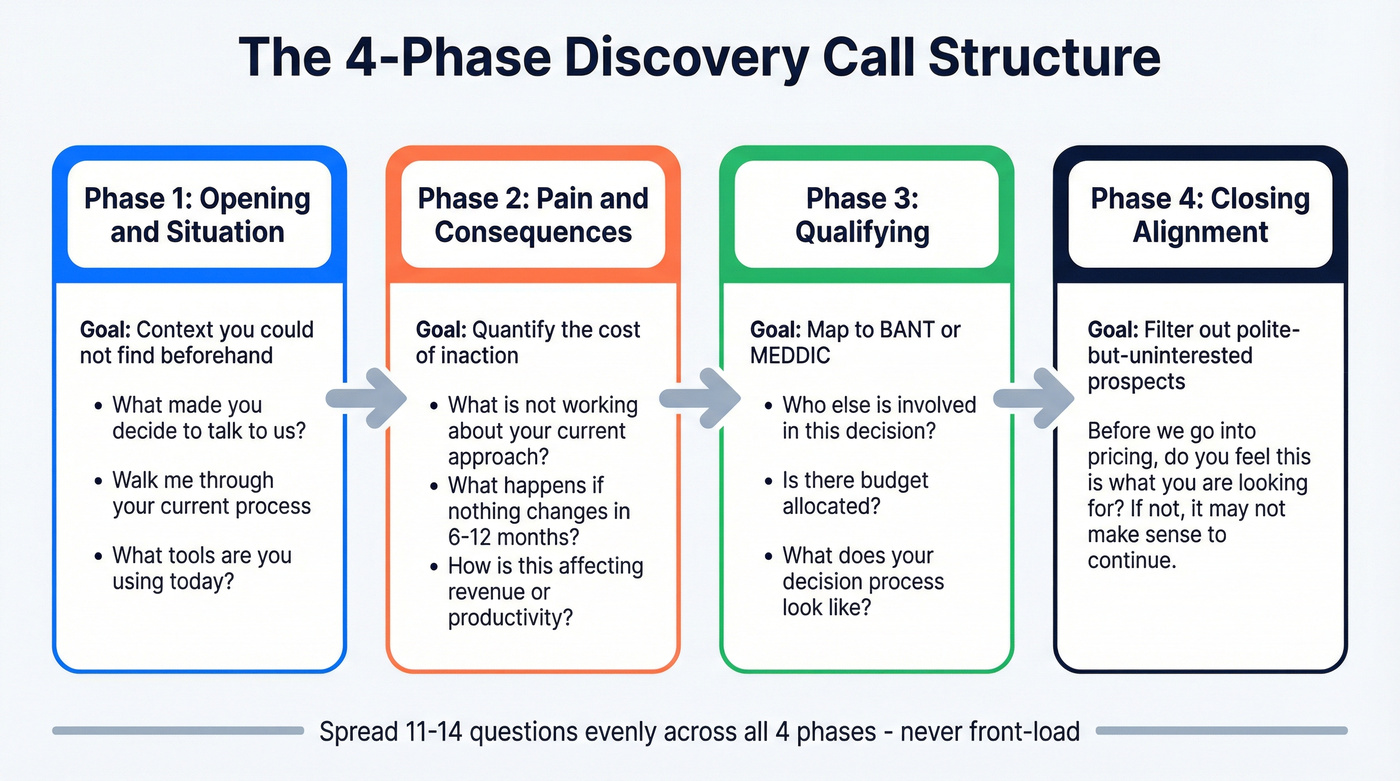
The best reps don't wing their question order. This four-phase structure mirrors how reps on r/sales actually organize their call flows - open, deepen, qualify, close. Reps who research 5+ situation elements before the call see 42% higher meeting-to-opportunity conversion, so do your homework.
Opening & Situation
The goal here is context you couldn't have found beforehand.
- "What's going on in your world that made you decide to talk to us?"
- "Walk me through how your team handles [process] today."
- "What tools are you currently using for this?"
Pain & Consequences
Now dig into why the status quo isn't working. Avoid stacking "why" questions - they trigger defensiveness. Lead with "what" and "how" instead.
The key is consequences: not just what's broken, but what happens if it stays broken. "Can you help me understand what's not working about your current approach?" opens the door. Follow with "What happens if nothing changes over the next 6-12 months?" and "How is this affecting [revenue / team productivity / your timeline]?" to quantify the cost of inaction. That second question is the one that makes prospects sit up, because most haven't actually calculated the cost of doing nothing.
Qualifying & Closing
This is where frameworks earn their keep. Map these questions directly to BANT or MEDDIC depending on deal complexity:
| Question | Maps To |
|---|---|
| "Who else should be involved in this decision?" | Authority / Champion |
| "Is there budget allocated, or do we need to build a case?" | Budget / Economic Buyer |
| "What does your decision process look like?" | Timeline / Decision Process |
Then close with alignment, not "any questions?" We've found this pre-close technique - popular on r/sales - is the single best filter for polite-but-uninterested prospects:
"Before we go into plans and pricing, based on everything you've seen, do you feel this is what you're looking for? If not, it may not make sense to go over pricing."
That line saves hours. It gives the prospect a graceful exit and saves you from chasing a dead deal for six weeks.
Map Questions to a Qualification Framework
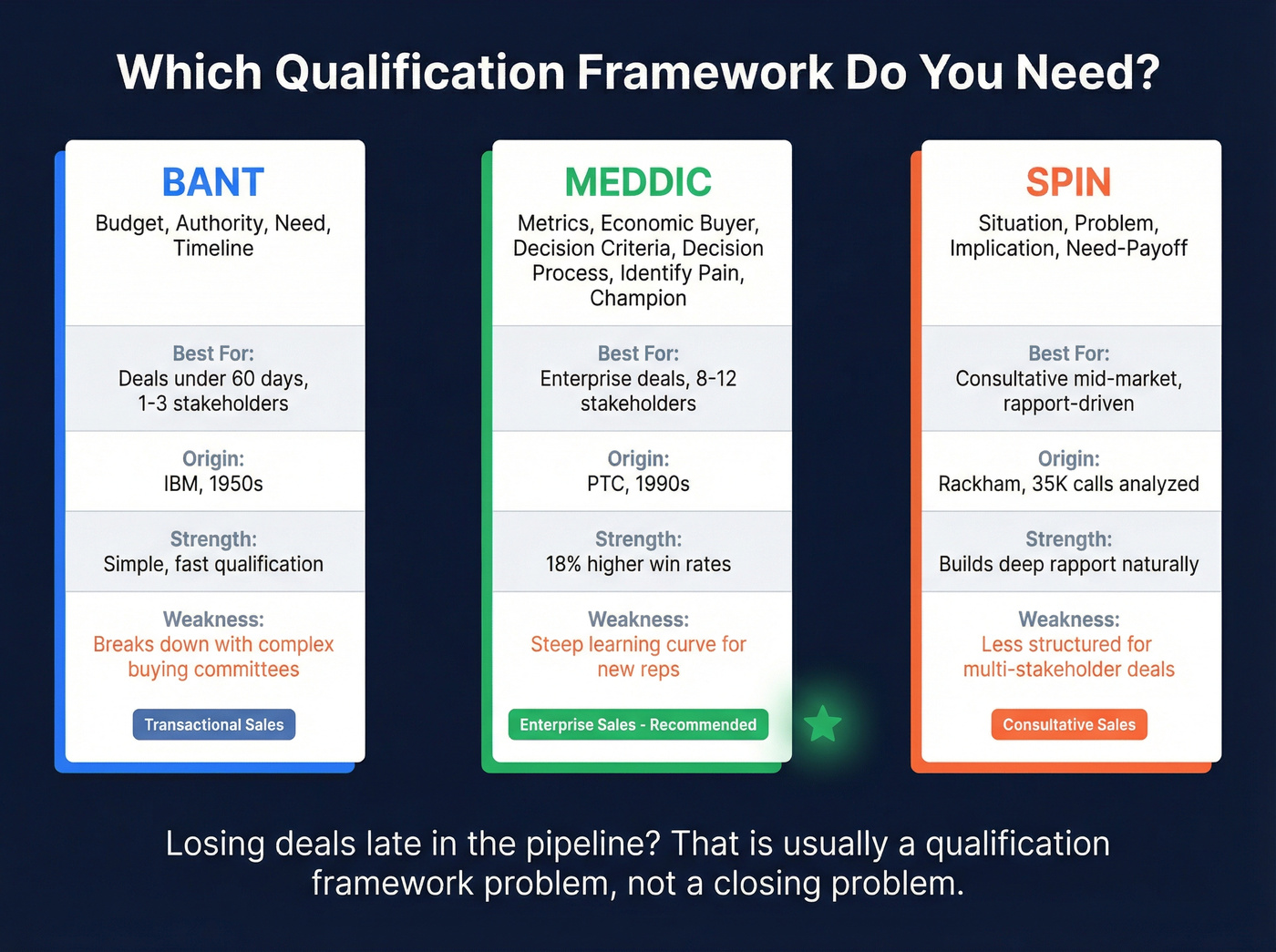
A sales questionnaire without a framework is just a list. Companies with a defined sales process are 33% more likely to be high performers, and buyers complete nearly 80% of their research before engaging sales. Your questions need to uncover what they've already decided, not educate them from scratch.
| Framework | Best For | Origin |
|---|---|---|
| BANT | Deals under 60 days, 1-3 stakeholders | IBM, 1950s |
| MEDDIC | Enterprise deals, 8-12 stakeholders | PTC, 1990s |
| SPIN | Consultative mid-market, rapport-driven deals | Rackham, 35K calls |
Here's the thing: BANT is fine for transactional sales. But if your average deal involves more than three stakeholders, MEDDIC is the move - teams using MEDDIC/MEDDPICC see 18% higher win rates. Most companies default to BANT because it's simpler, not because it's better. If you're losing deals late in the pipeline, that's usually a qualification framework problem, not a closing problem.

You just built a 11-14 question framework mapped to MEDDIC. Now make sure every question lands with the actual decision-maker. Prospeo's database covers 300M+ professionals with 98% email accuracy and 125M+ verified mobile numbers - so your discovery calls start with the right person, not a gatekeeper.
Stop qualifying leads you can't even reach. Get verified contact data first.
Pre-Sales Questionnaire Template
A pre-sales intake form captures context before the call so you don't waste the first 10 minutes on basics. Structure it in six sections:
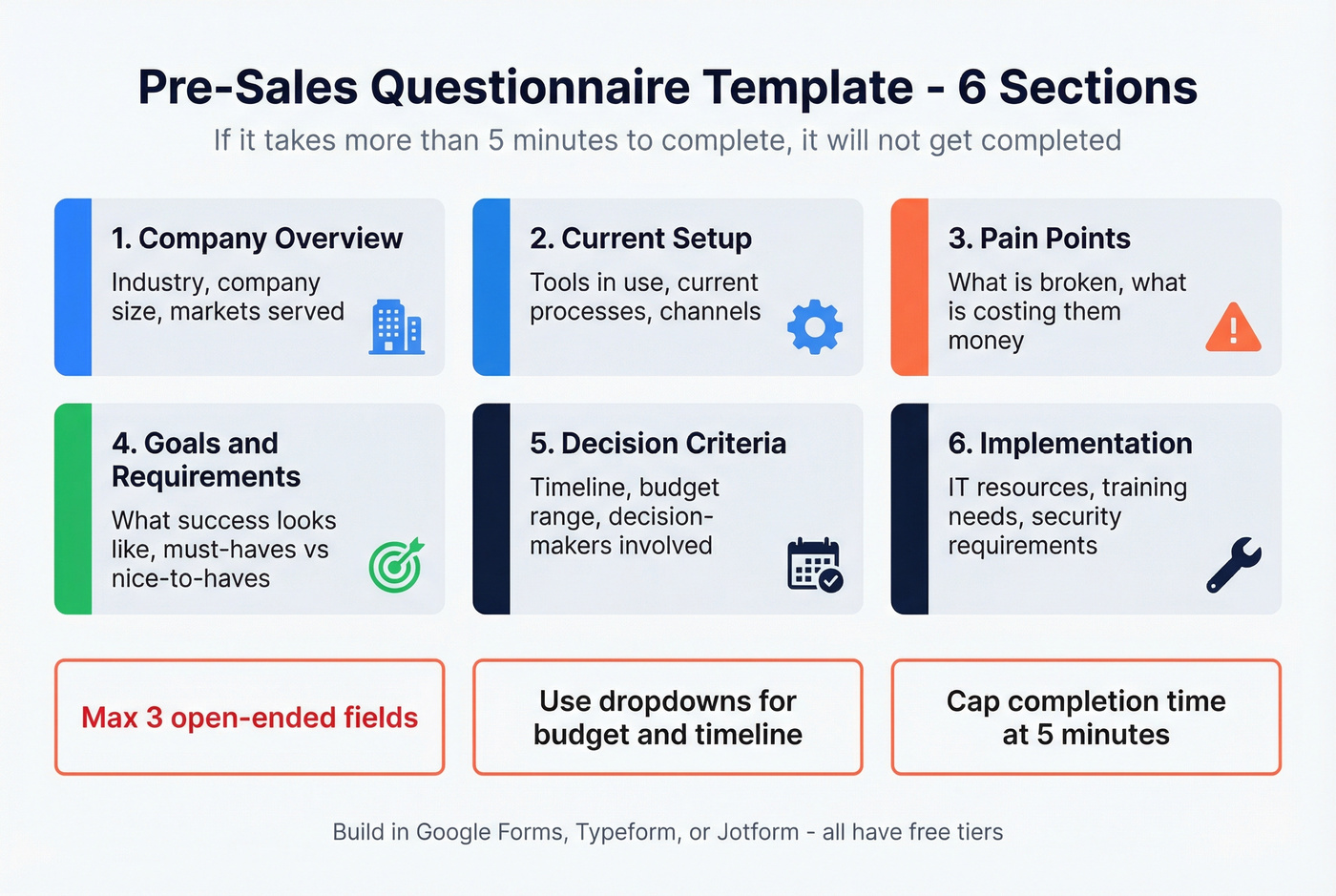
- Company Overview - industry, size, markets served
- Current Setup - tools, processes, channels in use
- Pain Points - what's broken, what's costing them money
- Goals & Requirements - what success looks like, must-haves
- Decision Criteria - timeline, budget range, decision-makers
- Implementation - IT resources, training, security needs
Build it in Google Forms, Typeform, or Jotform - all have free tiers. For enterprise requirements-gathering like ERP selection or multi-department intake, Jotform's pre-sales template with 5,547 clones offers a more detailed field structure. The design rule is simple: if it takes more than 5 minutes to complete, it won't get completed. Cap open-ended fields at 3 and use dropdowns for budget ranges and timelines.
Before you send that form, make sure it actually reaches the right person. A questionnaire that bounces is worse than no questionnaire at all - we've seen teams spend hours building the perfect intake form only to have 30%+ of sends hit dead addresses. Prospeo's email finder covers 143M+ verified emails at 98% accuracy, and the free tier gives you 75 verified lookups per month to validate your highest-priority prospects before every send.
A pre-sales questionnaire that bounces is worse than none at all. Teams using unverified data see 30%+ of sends hit dead addresses - killing response rates before discovery even starts. Prospeo verifies emails on a 7-day refresh cycle (industry average: 6 weeks) so your intake forms reach real inboxes at $0.01 per email.
75 free verified email lookups per month. No contracts, no sales calls.
5 Mistakes That Kill Your Questionnaire
Leading questions. "Don't you agree your current process is inefficient?" tells the prospect what to say. Rewrite it: "How would you describe your current process?"
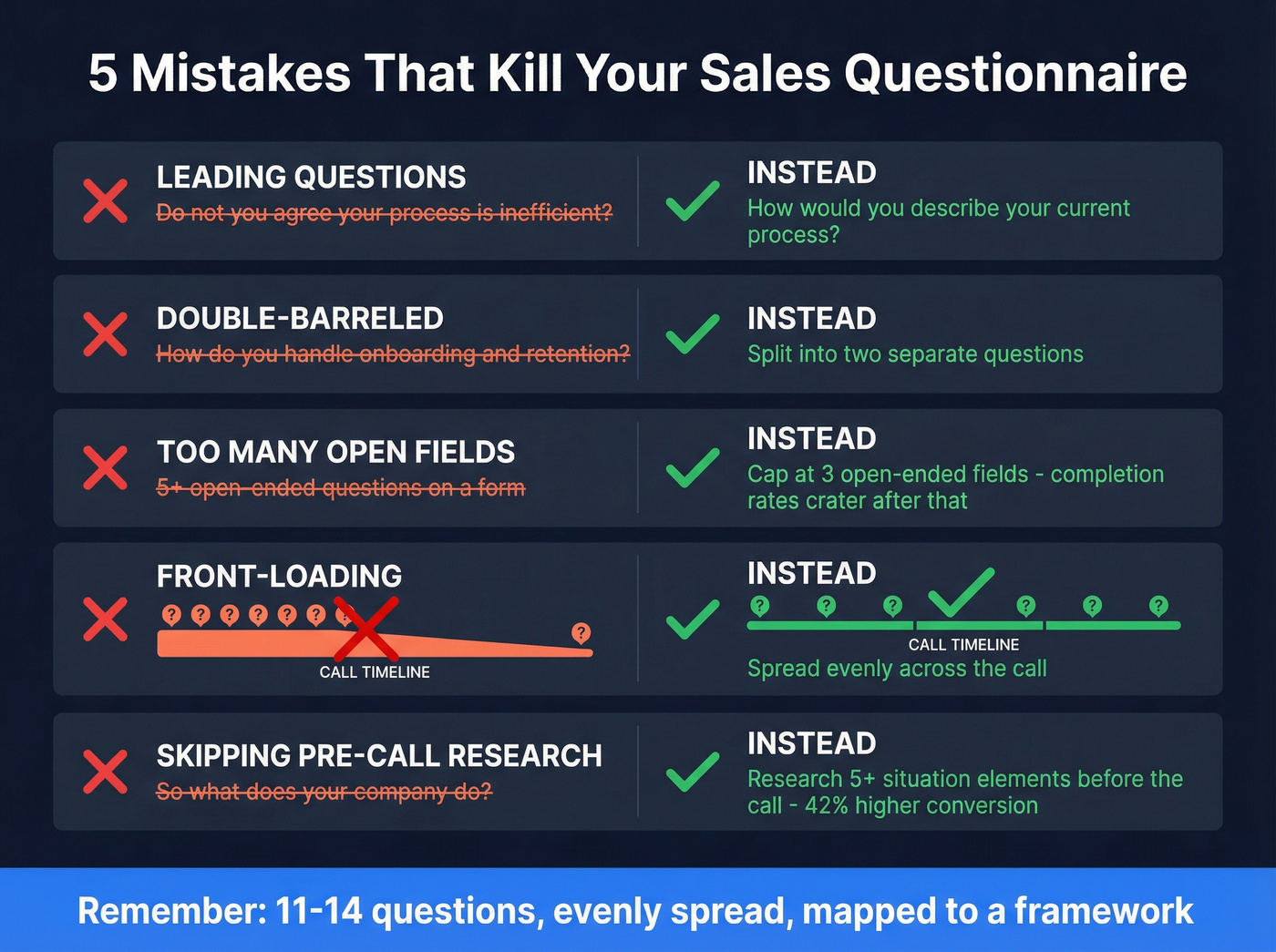
Double-barreled questions. "How do you handle onboarding and retention?" is two questions crammed into one. Split them.
Too many open-ended fields. For written forms, cap at 3 open-ended questions. Beyond that, completion rates crater. We've tested this across client intake forms and the drop-off after the third open field is dramatic.
Front-loading all questions. The call data is unambiguous - spreading questions evenly outperforms the checklist approach every time. If your discovery calls feel like interrogations for the first 10 minutes and then awkward silence, this is why. (If you want a deeper bank of prompts, see our discovery questions guide.)
Skipping pre-call research. If you're asking "So what does your company do?" on the call, you've already lost credibility. Research their company news, the contact's role, and their tech stack beforehand. It correlates with that 42% higher conversion rate we mentioned earlier. (A simple way to standardize this is an Ideal Customer Profile checklist.)
Sales Assessment Questionnaire (SPQ Gold)
Skip this section if you're building a discovery questionnaire - this is for hiring managers.
If you searched "sales questionnaire" looking for a hiring assessment, you're after SPQ*GOLD/FSA. It's a call reluctance diagnostic that measures whether a salesperson will actually prospect. The assessment has been validated across 1,000,000+ administrations globally and identifies up to 16 types of call reluctance, with 12 commonly referenced types like Doomsayer, Over-Preparer, and Stage Fright. Pricing is volume-based and sold per assessment.
FAQ
How many questions should a sales discovery call include?
Analysis of 519,000+ B2B calls found 11-14 targeted questions is optimal. Beyond 14, success rates drop back to average. Spread them evenly across the call rather than front-loading - top closers speak only 43% of the time.
What's the difference between a sales questionnaire and a discovery script?
A questionnaire is structured questions mapped to a framework like BANT or MEDDIC. A script wraps transitions, objection handling, and talk tracks around those questions. Most teams need both - the questionnaire as the skeleton, the script as the muscle.
How do I make sure my pre-sales questionnaire reaches the right person?
Verify the contact's email before sending. Teams like Snyk cut bounce rates from 35-40% to under 5% by switching to verified contact data, which means more forms land in the right inbox on the first attempt.