

How to Build Sales Rep Incentive Programs That Actually Drive Revenue
It's Q3. Your team is sitting at 62% of annual quota. Your VP just pinged you: "We need an incentive program by Friday." You've got a spreadsheet, a vague idea about SPIFs, and zero confidence that whatever you throw together won't get gamed, ignored, or create a tax nightmare in January.
Sales rep incentive programs don't have to be this stressful. Let's fix that.
What You Need (Quick Version)
- Start with tiered commissions + one quarterly SPIF. A three-tier accelerator structure gives reps a clear reason to push past quota. Add a single SPIF targeting the behavior you need most right now.
- Layer in activity-based incentives. A peer-reviewed study across 305 sales territories found ABIs produce 6-9% sales gains. That's not vendor marketing - that's a three-year field intervention.
- Budget $100-$500/person for non-cash rewards. 62% of incentive programs land in this range. You don't need a massive budget to move the needle.
What Are Sales Incentive Programs?
A sales rep incentive program is any structured reward system - beyond base salary and standard commission - designed to motivate specific sales behaviors or outcomes. Cash bonuses, travel, recognition, SPIFs, accelerators, creative perks. The common thread is tying a reward to a measurable action or result.
Here's what's shifted recently. Companies aren't pulling back on incentives; they're doubling down. Per the most recent IRF survey data, program discontinuation rates in North America dropped from 44% in 2021 to just 15%. Europe saw an even sharper decline, from 66% to 19%. The programs that survived the post-COVID budget squeeze proved ROI, and now leadership is investing more, not less.
The question isn't whether you should have a sales compensation plan with incentives. It's whether the one you're building will actually change behavior or just add noise.
Types of Incentive Structures
Activity-Based vs. Outcome-Based
Activity-based incentives reward inputs - calls made, demos booked, proposals sent. Outcome-based incentives reward results - revenue closed, deals won, renewals signed.
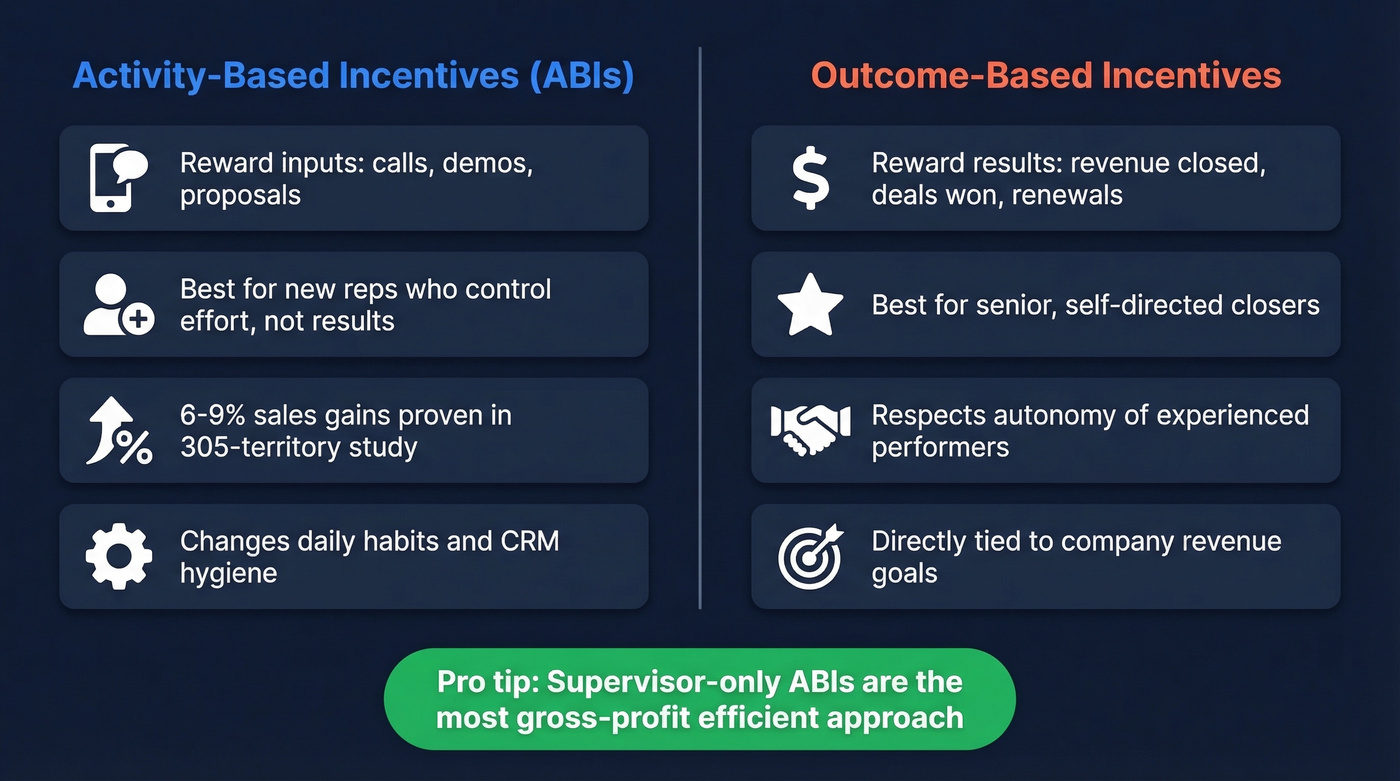
The instinct is to skip straight to outcome-based. Revenue is what matters, right? But a large-scale study published in the Journal of Marketing Research tells a different story. Across 305 territories over three years, adding modest ABI pay generated 6-9% sales gains relative to an output-only baseline. Even more interesting: when supervisors alone received ABIs, the performance lift was more gross-profit efficient because supervisors with activity incentives exerted stronger behavior control downward, driving rep performance without paying double.
Use activity-based incentives when you need to change daily habits - more prospecting calls, better CRM hygiene, faster follow-up. They're especially powerful for new reps who can't control outcomes yet but can control effort. Skip them when your team is senior, self-directed, and already executing the right activities. For experienced closers, outcome-based plans feel more respectful of their autonomy.
Individual vs. Team-Based
Individual incentives work best for transactional, high-volume sales where one rep owns the full cycle. Team-based incentives make sense for complex enterprise deals where an AE, SE, SDR, and CSM all touch the account.
The trap with team incentives is free-riding. If the payout is split evenly regardless of contribution, your top performers will resent it within one quarter. Weight team incentives by role contribution or use hybrid models - individual commissions plus a team bonus pool triggered by collective targets.
Tiered Commissions and Accelerators
A flat commission rate gives reps no reason to push past quota attainment. Tiered accelerators create that reason - and when paired with stretch goals in sales, they turn good quarters into record-breaking ones.
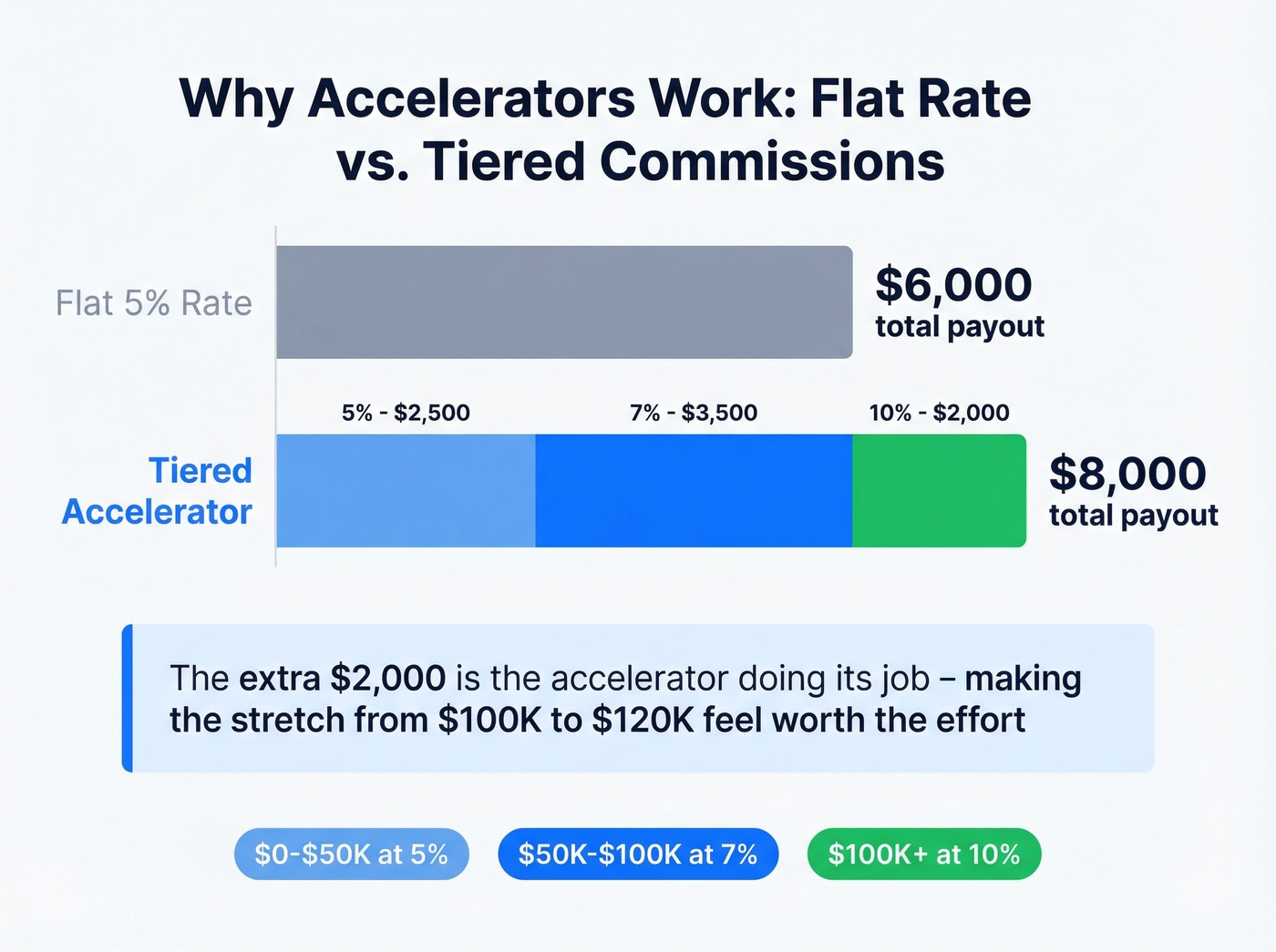
| Revenue Tier | Rate | Payout on $120K |
|---|---|---|
| $0-$50K | 5% | $2,500 |
| $50K-$100K | 7% | $3,500 |
| $100K+ | 10% | $2,000 |
| Total | $8,000 |
A rep who closes $120K earns $8,000 instead of the $6,000 they'd get at a flat 5%. That extra $2,000 is the accelerator doing its job - making the stretch from $100K to $120K feel worth the effort.
Incentive Ideas That Work
Monetary Incentives
SPIFs are the workhorse. Short-term, targeted, easy to communicate. $25-$100 per qualifying activity is a common range for behavior-based SPIFs, and bigger payouts work when you're tying them to high-value actions. Keep them short - one to four weeks - and focused on one behavior. A SPIF that rewards five different things rewards nothing.
Accelerators layer on top of base commission structures. Once a rep hits 100% of quota, the rate jumps. 1.5x or 2x is common. This is what separates good quarters from great ones.
Profit sharing and stock options work for retention, not short-term motivation. They're the long game - keeping your best reps from jumping to the competitor offering $20K more in base.
Non-Monetary Incentives
Incentive travel runs $5,100 per person on average, and it's one of the most effective reward types for top performers. Presidents' Club trips aren't just perks - they're status symbols. The rep who qualifies gets bragging rights for the year.
PTO days, professional development budgets, and public recognition cost less than cash but often outperform it for mid-tier performers who aren't purely coin-operated.
Gift cards account for 43% of all non-cash incentives in North America, and that's lazy. They're taxable, impersonal, and forgettable. A $500 gift card disappears into someone's Amazon cart. A $500 experience - a cooking class, concert tickets, a spa day - gets talked about. For your top performers especially, status and experiences outperform cash equivalents.
Zero-Budget Ideas
No budget doesn't mean no program. One of the best incentive mechanics we've come across was in a Reddit thread where a manager ran a poker-card system. Reps earned cards weekly for hitting metrics - most calls, highest close rate, most contacts added. At the end of the month, the best poker hand won.
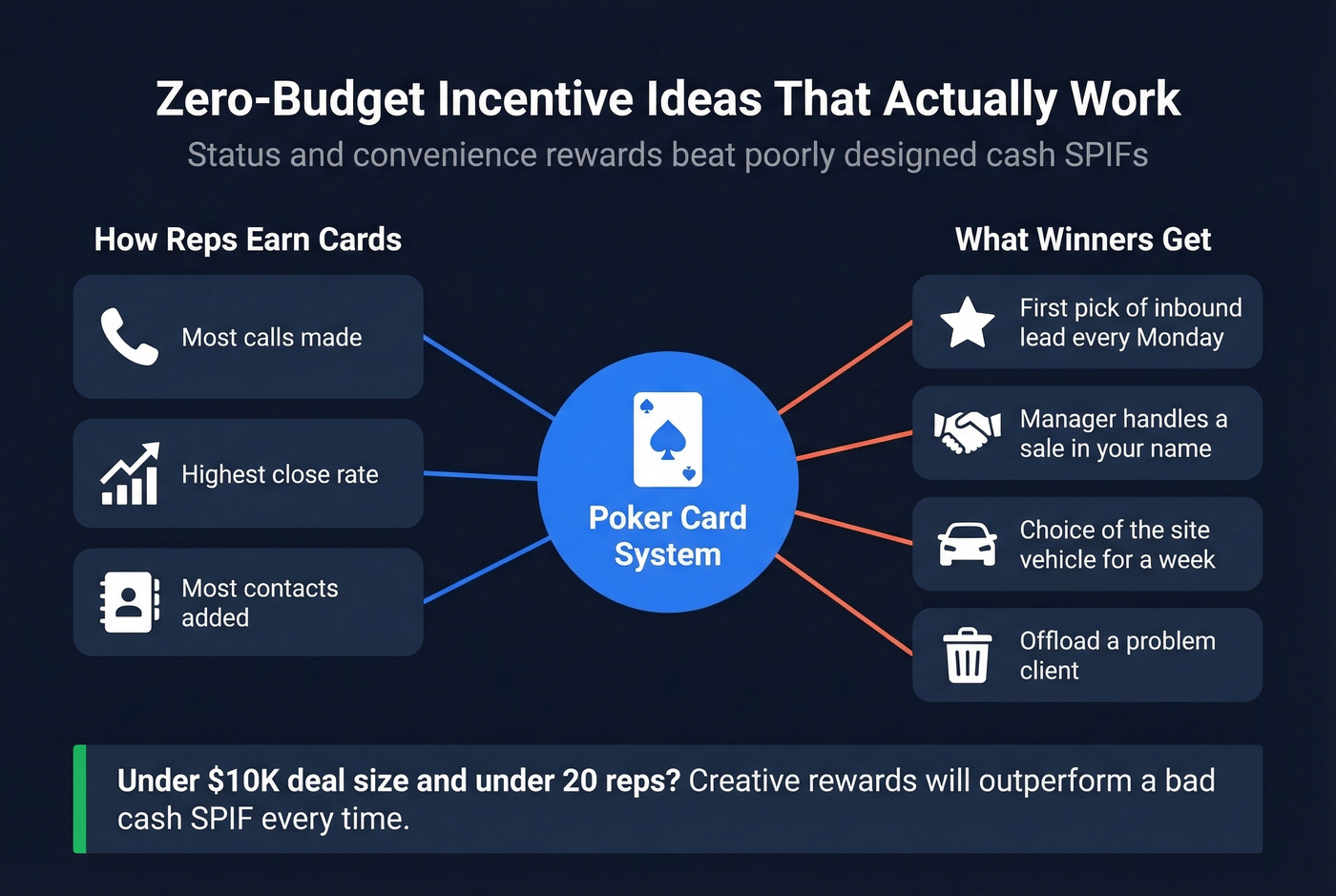
The rewards cost nothing: first pick of an inbound lead every Monday, the sales manager handles a sale in your name, choice of the site vehicle for a week, or offloading a problem client. These are status and convenience rewards, and they worked because they addressed things reps actually cared about - autonomy, recognition, and relief from friction.
Here's the thing: if your average deal size is under $10K and your team is under 20 reps, a well-designed zero-budget program with creative rewards will outperform a poorly designed cash SPIF every single time. Most incentive programs fail because of bad design, not insufficient budget.
Design Your Plan Step-by-Step
Set Goals and Pick Metrics
If a rep can't figure out their commission with a calculator in under two minutes, the plan is broken. Complexity kills motivation. We've seen teams build 10-page comp plan documents with matrix scoring across six dimensions. Nobody reads them. Nobody trusts them.
Pick two to three metrics. Revenue closed is almost always one. The second might be pipeline generated, meetings booked, or net retention - whatever behavior you need most right now. The third is optional and should only exist if it's genuinely independent of the first two. Goal-based sales incentives tied to clear, measurable targets beat vague "do more" directives every time. One-page plans beat 10-page documents every time.
Define OTE, Pay Mix, and Tiers
On-target earnings is the total variable compensation a rep earns at 100% quota attainment. A common mid-market SaaS example: $70K base + $70K variable = $140K OTE.
Pay mix depends on how much control reps have over outcomes. A 50/50 split is standard for full-cycle AEs. A 60/40 split works better for roles with longer sales cycles or heavy account management components where reps can't control timing as tightly. Layer in the tiered commission structure from earlier - first tier covers 0-80% of quota at the base rate, second tier covers 80-100%, and the accelerator kicks in above 100%.
Clawbacks, Caps, and Payouts
Clawbacks make sense when churn is a problem. If a customer cancels within 90 days, clawing back the commission aligns the rep's incentive with the company's. Beyond 90 days, the churn is usually a product or CS problem, not a sales problem. Don't punish reps for things they can't control.
Caps kill motivation. If your best rep is about to blow past 200% of quota and you cap their commission, you've just told them to stop selling. Or worse, to sandbag deals into next quarter. Remove caps and let your top performers run.
Payout frequency matters more than most leaders think. Monthly payouts keep reps engaged and reinforce the connection between effort and reward. Quarterly payouts work for larger deals with longer cycles but create a motivation gap in the middle months.
Communicate and Launch
Picture this: your top rep just told you she's leaving because she doesn't trust the commission calculations. She's been underpaid twice in six months due to spreadsheet errors, and nobody caught it until she flagged it herself.
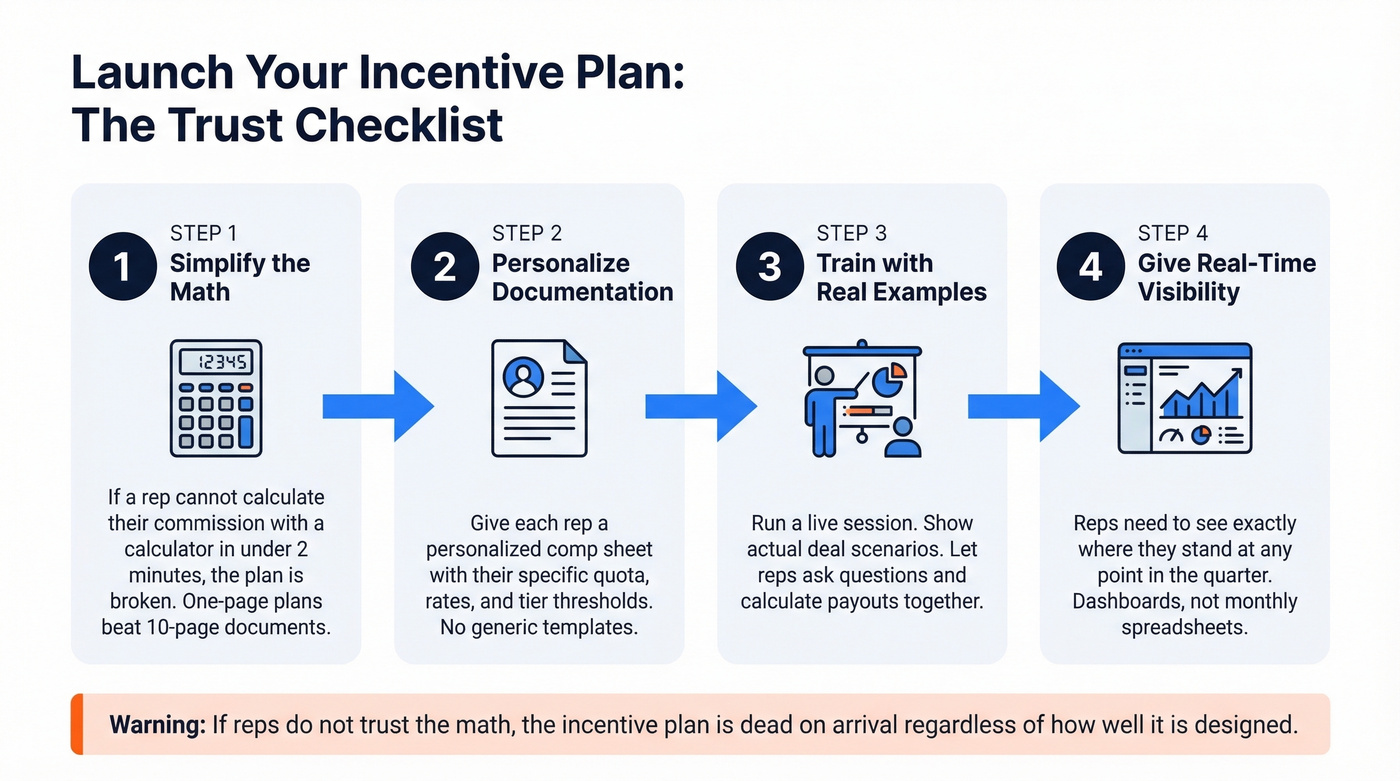
This happens constantly. A recurring theme on r/sales backs it up - reps don't hate incentive programs, they hate opaque ones where they can't verify their own numbers. The launch isn't just announcing the plan. It's building trust in the system through personalized documentation, a training session with real examples, and real-time visibility into progress so reps can see exactly where they stand at any point in the quarter.
If reps don't trust the math, the incentive plan is dead on arrival regardless of how well it's designed.

Your SPIF rewards reps for more outbound calls - but bad data turns those calls into dead ends. Prospeo gives your team 300M+ verified contacts with 98% email accuracy and a 30% mobile pickup rate, so every incentivized activity actually connects to a real buyer.
Don't pay reps to dial wrong numbers. Give them data that connects.
Budgeting Your Program
The IRF's industry benchmarks give us solid numbers. North American companies spend an average of $921 per person per year on non-cash rewards, down from $1,090 the prior year. But that average masks a wide range - 62% of programs spend between $100 and $500 per person.
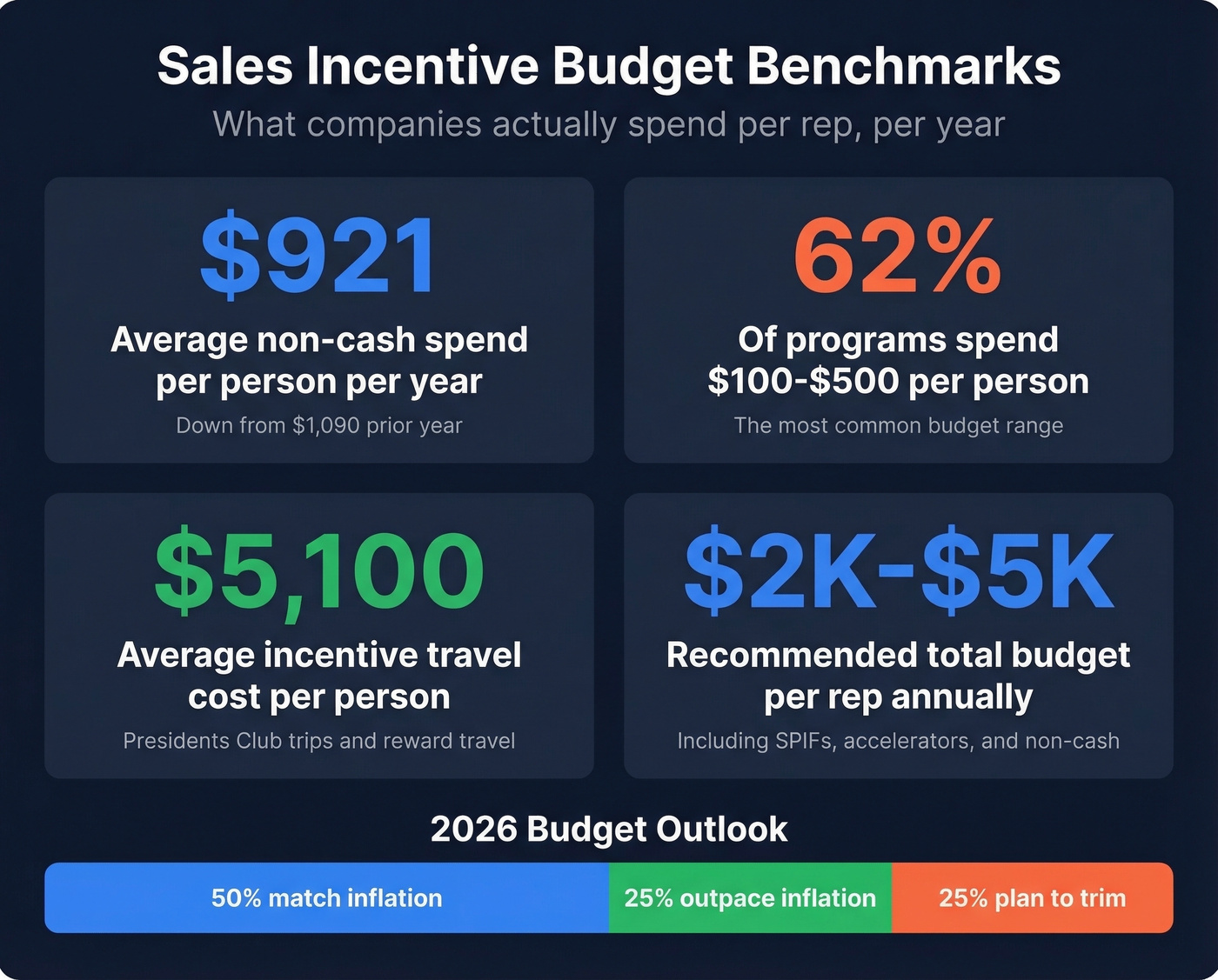
| Category | Benchmark |
|---|---|
| Non-cash average | $921/person/year |
| Most common range | $100-$500/person |
| Incentive travel | $5,100/person |
| Merchandise (per instance) | ~$276 |
For a practical starting point, budget $2K-$5K per rep annually when you include SPIFs, accelerator payouts above base commission, and non-cash rewards.
The IRF's 2026 outlook projects that 50% of program owners expect budgets to match inflation, 25% expect to outpace it, and 25% plan to trim per-person spending. The most common cost-cutting levers are reducing gifting, choosing less expensive destinations for travel, and shortening trips. The best reward programs don't require unlimited budgets - they require smart allocation.
How Reps Game Incentive Plans
Most organizations run structured incentive programs. Most are poorly designed, and poorly designed plans actively encourage gaming. Here's the taxonomy of gaming behaviors you need to watch for:
| Behavior | Example | Countermeasure |
|---|---|---|
| Sandbagging | Hold Oct-Dec orders, submit in Jan to spike Q1 | Rolling quotas, deal-stage audits |
| Partners in profit | Colluding with buyers on timing/terms | Approval workflows for unusual terms |
| Squandering sales | Excessive discounting to close fast | Margin floors, discount approval tiers |
| Lost in segmentation | Exploiting territory/segment boundaries | Clear rules, territory audits |
| Carrot and stick | Pressuring customers to buy before period end | Customer satisfaction surveys |
| Misleading customers | Overselling features to close | Post-sale NPS, clawbacks on churn |
| Falsifying data | Fake pipeline entries, inflated activities | CRM audit trails, spot checks |
| Faux customers | Creating fictitious accounts | Verification workflows, payment confirmation |
Sandbagging is the most common. A rep closes a deal in November but holds the paperwork until January. They miss Q4 quota (which they were going to miss anyway) but start Q1 with a massive head start, triggering accelerators early. The fix is rolling quotas or real-time deal-stage monitoring that flags stalled contracts.
Three countermeasures work consistently: data monitoring and regular audits, plan revisions that close loopholes as you discover them, and ongoing education so reps understand the spirit of the plan, not just the letter.
Tax and Legal Compliance
You need a tax section in your incentive plan document. Period. The number of companies that launch SPIFs and travel rewards without consulting payroll is alarming.
Everything is taxable. All incentive prizes and awards earned for performance are taxable as compensation - cash, merchandise, or travel. This is per Treas. Reg. SS 1.74-1. There's no exception for small gifts.
Employees vs. contractors. For employees, the fair market value of any award goes on their W-2 and is subject to withholding. For independent contractors and channel partners, report FMV on a 1099-MISC if the aggregate hits $600 or more in a calendar year.
Gift cards are never de minimis. This trips up more companies than anything else. Under IRC SS 132(a)(4), cash and cash equivalents - including gift cards - are always taxable wages. Items exceeding $100 can't be treated as de minimis under any circumstance. That $50 Starbucks card you gave the team? Technically taxable.
Achievement award exclusion. A narrow exclusion exists for tangible personal property awards given for length of service or safety - capped at $1,600/year, with a five-year minimum. This almost never applies to sales incentives.
Overtime impact. Non-discretionary bonuses affect the regular rate of pay under the FLSA. For non-exempt employees, incentive payouts can increase overtime calculations. If you have inside sales reps classified as non-exempt, your payroll team needs to account for this.
Measuring Program ROI
The gold standard is an experimental design - run the program for a treatment group and compare results against a control group. When that's not feasible (and in our experience it usually isn't, because sales leaders don't want to leave money on the table), the IRF recommends post-hoc measurement using historical data to create pseudo control groups.
Analytics-based sales incentives take this further by using performance data to continuously tune payout thresholds, identify which behaviors actually correlate with revenue, and surface reps who are underperforming relative to their territory potential.
Two real cases illustrate what's possible. An office equipment manufacturer invested $3.5M in a dealer incentive program and generated $7.44M in incremental profit - a 112.5% ROI. A hand tools manufacturer ran a points program across 126 distributors and saw a 7.5% net sales gain versus projected baseline. That same program improved accounts receivable from 59 days to 32 days, inventory turnover from 89 days to 70 days, and generated an estimated $328K/month in additional cash flow. Incentive programs can reshape operational behavior, not just top-line numbers.
One variable that distorts ROI measurement: data quality. If 30% of prospect emails bounce, activity-based metrics are artificially deflated, making the program look like it failed when the data was the real problem. Verify your contact data before blaming the incentive plan.
Tools to Run Your Program
| Tool | Best For | Starting Price | Why It Wins |
|---|---|---|---|
| QuotaPath | SMBs under 50 reps | $25/user/mo | Real-time rep visibility |
| Spiff (Salesforce) | Salesforce-only shops | Custom (~$30-$60/user/mo) | Native SFDC integration |
| CaptivateIQ | Complex multi-product plans | Custom (~$40-$100/user/mo) | Unmatched plan modeling |
| Xactly | 500+ rep global orgs | Custom (~$50-$150/user/mo) | Multi-geo compliance |
| Sales Cookie | Bootstrapped teams | $30/payee/mo | Simplest setup |
| Varicent | CFO-driven scenario planning | Custom (~$50-$150/user/mo) | Advanced analytics |
| Everstage | Mid-market sweet spot | Custom (~$30-$50/user/mo) | G2 4.9/5 |
QuotaPath - The Transparency Play
The killer feature isn't the commission engine - it's that reps can see exactly what they've earned, what's pending, and what they'd earn if they close the deals in their pipeline. That transparency alone solves the "I don't trust the math" problem that kills incentive programs. Starts at $25/user/month. For teams that don't need enterprise-grade plan modeling, this is the obvious pick.
Spiff - Worth It If You're All-In on Salesforce
Salesforce acquired Spiff, so the integration is native - commission data lives right inside the CRM your reps already use. G2 users rate it 4.7/5. The tradeoff is real though: you're locked into the Salesforce ecosystem. If you ever migrate CRMs, your commission tool migrates too, whether you want it to or not. Mid-market teams often land around $30-$60/user/month.
CaptivateIQ - For Genuinely Complex Plans
Built for the RevOps team modeling 15 different plan variations before the board meeting. Multi-product, multi-role, split deals, accelerators with cliffs - CaptivateIQ handles it all. Their 2026 State of ICM report is worth reading even if you don't buy the tool. Pricing commonly runs $40-$100/user/month. If you're a 10-person team with a simple plan, you're paying for horsepower you'll never use.
The Rest of the Field
Xactly and Varicent are enterprise tools for enterprise problems - 500+ reps across multiple continents, complex compliance requirements, CFO-level scenario planning. Budget custom enterprise pricing plus significant implementation costs. Everyone under that threshold should look elsewhere. Sales Cookie ($30/payee/month) is QuotaPath's more bare-bones cousin - simple setup, small teams, gets the job done. Everstage carries a G2 rating of 4.9/5 and is worth a look when CaptivateIQ feels too heavy and QuotaPath feels too light.
The Tool Nobody Thinks About
Every tool above assumes your reps are working from clean data. That assumption is wrong more often than anyone admits. If your incentive program rewards activity metrics and 30% of your contact data is bad, you've built a system that punishes effort. Prospeo's 98% email accuracy, 125M+ verified mobile numbers, and 7-day data refresh cycle eliminate that variable - pricing starts free with paid plans at roughly $0.01 per email, making it the cheapest investment that makes every other investment work harder.

Activity-based incentives drive 6-9% more sales - but only when reps spend time selling, not list-building. Prospeo's 30+ search filters and Chrome extension cut list-building from hours to minutes, so your team hits SPIF targets instead of wrestling with bad data.
Turn every incentivized hour into pipeline, not data cleanup.
FAQ
What's the difference between a SPIF and a commission?
A commission is the ongoing percentage a rep earns on every deal as part of their standard comp plan. A SPIF is a short-term bonus - typically one to four weeks - layered on top to accelerate a specific behavior. SPIFs target one metric like demos booked, while commissions apply to all closed revenue.
How much should I budget per rep for incentives?
Budget $2K-$5K per rep annually, including SPIFs, accelerator payouts, and non-cash rewards. The industry average for non-cash rewards alone is $921/person/year. Smart structure matters more than raw spend - 62% of programs operate on just $100-$500 per person.
Are gift cards taxable as sales incentives?
Yes, always. Gift cards are cash equivalents under IRS rules (IRC SS 132(a)(4)) and can never qualify as de minimis fringe benefits. Report the full fair market value as wages on the employee's W-2, regardless of the amount.
Do activity-based incentives actually work?
A peer-reviewed field study across 305 territories over three years found ABIs produce 6-9% sales gains relative to output-only baselines. Targeting ABIs at supervisors alone was even more gross-profit efficient, making them a strong option for budget-conscious teams.
How can I keep contact data from undermining my incentive program?
Use a verified data provider with high accuracy rates - bounced emails and disconnected numbers deflate activity metrics and make well-designed programs look broken. Tools like Prospeo deliver 98% email accuracy and refresh records every 7 days, compared to the 4-6 week cycles common among larger providers.